Deep-sea communication with neutrinos

Communicating with nuclear-powered submarines – which can remain underwater essentially indefinitely – is a major challenge because seawater is opaque to most of the electromagnetic spectrum. Neutrinos have previously been proposed as a solution to this problem, because these subatomic particles can pass easily through all matter, but it was thought to be impossible to generate beams of sufficient intensity. However, a physicist in the US has now calculated that the extremely intense beams of a neutrino factory would do the job.

Nuclear-powered submarines can remain submerged for months at a time and only need to resurface to replenish food stocks or carry out maintenance. However, submarines’ movements are restricted by the need to receive messages to direct their actions. Seawater is transparent only in part of the visible portion of the electromagnetic spectrum (blue and green wavelengths) and at frequencies below about 100 Hz. Using lasers in the visible is not practical and low-frequency radio transmissions result in extremely low data rates – around one bit per minute. As a result, nuclear submarines currently communicate by floating a wire antenna close to the surface of the ocean. While this supports data rates of about 50 bits per second, it restricts the depth and speed of operation of a vessel.

Sent through the Earth

Patrick Huber of Virginia Tech believes that these problems can be overcome by instead using neutrinos. Because neutrinos interact extremely weakly with other matter, a beam of such particles can be sent through the Earth with very little loss of intensity. So a submarine could in principle pick up information encoded in a neutrino beam sent from anywhere else on the planet by detecting the neutrinos that approach it from below.

Unfortunately, neutrinos interact very weakly with matter and, therefore, generating a measurable signal requires an extremely intense beam. There are currently a number of experiments around the world that involve the transmission and detection of neutrino beams in order to measure how neutrinos “oscillate” as they travel through space, an important area of study in fundamental physics. But such facilities would be unsuited for carrying out long-range communications. For example, a beam sent from Fermilab outside Chicago to a mine around 700 km away in Minnesota results on average in just one neutrino being registered in the detector every 12 hours. As Huber points out, this rate would need to improve by a factor of about one million if neutrinos were to be used to send messages.

Huber, however, has worked out that a new kind of neutrino source that physicists hope to build within the next decade – a neutrino factory – would provide sufficient intensities. A neutrino factory would work by slamming high-energy protons into a target made of liquid mercury, with the collisions producing pions, which decay into muons, which in turn decay into muon neutrinos.

Detecting Cerenkov radiation

Huber calculates that data encoded in beams of such neutrinos could be picked up by detectors wrapped around the hull of a submarine at rates of between 1 and 100 bits per second. These detectors would either pick up the muons produced when muon neutrinos interact with the water or, more indirectly, measure the Cerenkov radiation generated by the passage of such muons through the water. Data would be encoded by chopping time up into many different slots and then sending a pulse of neutrinos within a particular slot, so that one second divided up into 16,000 slots, for example, would be equivalent to transmitting one letter out of a 16,000 letter alphabet or 14 bits (214).

A neutrino factory would not come cheap – it would cost several billion dollars. And adapting it for telecommunications might, says Huber, roughly double this price; the extra expense required to make the device rotatable so that it could point to wherever a submarine is located. But Huber believes that this price should be seen in the context of the money already spent on nuclear submarines by the US, with the 14 Trident vessels, including missiles, costing some $150bn. “There are many things I would not have thought a government would spend very large amounts of money on,” he adds. “So I would not expect anyone to actually build such a system. But I would not be surprised if someone wanted to do more research on it.”

The work is described on the arXiv preprint server.

Propelling bacteria ease liquid flow

The combined action of swimming bacteria can reduce the viscosity of a liquid by up to a factor of seven, according to a pair of researchers in the US. This surprising discovery could lead to new microfluidic applications such as extremely well controlled and efficient mixing devices.

Bioscientists and physicists alike are interested in how tiny biological entities such as bacteria and sperm cells can propel themselves. Observations and models have revealed that a variety of non-trivial mechanics may lie at the heart of these propulsion systems. One interesting feature, hinted at by models, is that the viscosity of a liquid – that is, its resistance to flow – could be significantly reduced by the presence of swimming bacteria.

Now, Andrey Sokolov and Igor Aranson of Argonne National Laboratory in the US have tested this theory and confirmed it to be the case – to a much larger extent than anyone had predicted. The researchers carried out two complementary experiments using Bacillus subtilis, the rod-shaped bacteria chosen for its swimming ability. In both cases, the bacteria – which are approximately 5 µm long and 0.7 µm in diameter – were suspended in a nutrient-rich medium to a concentration of approximately 2 ×  1010 cm-3.

Oxygen feed

The researchers found that they could control the mobility of Bacillus subtilis by varying the amount of available oxygen dissolved in the fluid. Therefore, the swimming speed of bacteria was controlled by steadily replacing the air in the experimental chambers with nitrogen, and tracking the bacteria using fluorescent markers. After approximately two minutes, the bacteria had reached a complete standstill.

In the first experiment, the researchers triggered a miniature vortex using a magnetically controlled probe. They then inferred the viscosity of each suspension from the time it took each vortex to decay. In the second experiment, they calculated the viscosities more directly by measuring the torque generated by a rotating magnetic microparticle also suspended in the fluid.

In both experiments, the viscosity of the bacterial solution was reduced by up to a factor of seven, so long as there was sufficient oxygen to keep the bacteria moving.

Organic industry

While the researchers do not offer a full physical description of why the viscosity varies in this way, they attribute the reducing viscosity to the conversion of oxygen and nutrients into mechanical energy. “The bacteria are effectively absorbing energy and injecting it directly into the liquid,” explained Aranson. The researcher told physicsworld.com that he can imagine this mechanism finding a role in industry, for example to enhance mixing processes in microscopic systems.

Roberto Di Leonardo, a microfluidics researcher at Rome University, can also see the potential of this research for industry. “Bacterial suspensions could play a more interesting role as advanced, ‘active’ lubricants for micro-machines,” he says. Di Leonardo notes, however, that the “contamination” with organic microfluid could be problematic in some applications.

One of the new directions that Aranson hopes to pursue is the development of a bacterial micromotor that is self-starting. “These micromotors are asymmetric with 200–400 µm miniature gears immersed into the suspensions of swimming bacteria and energized due to collisions with bacteria,” he says.

This research has been published in Physical Review Letters.

Optics pioneers scoop Nobel prize


Three physicists from China, the US and Canada have picked up this year’s Nobel Prize for Physics. The SEK10m prize has been shared between Charles Kao from the Chinese University of Hong Kong and Willard Boyle and George Smith, both from Bell Laboratories, US.

Kao has won half the prize for his work on the transmission of light in optical fibres, which has allowed a revolution in telecommunications. In a statement, the Royal Swedish Academy of Sciences said that “Today, optical fibres make up the circulatory system that nourishes our communication society. These low-loss glass fibers facilitate global broadband communication such as the Internet.”

Boyle and Smith each receive a quarter of the prize for inventing the charge-coupled device (CCD) – an imaging semiconductor circuit that forms the basis of every digital camera. “Digital photography has become an irreplaceable tool in many fields of research,” stated the Academy. “The CCD has provided new possibilities to visualize the previously unseen.”

Telecommunication revolution

Charles Kao was born on 4 November 1933 in Shanghai, China and studied electrical engineering at Woolwich Polytechnic (now the University of Greenwich). After receiving his PhD in electrical engineering from University College London in 1965, he moved to Standard Telecommunication Laboratories (STL) based in Harlow, UK, where he later served as director of engineering. It was here that he did his groundbreaking research into fibre optics.

When Kao joined STL he began working with Antoni Karbowiak who was seeing if optical waveguides could be used for communication. Karbowiak was trying to build such wave guides from sequences of lenses or tubes filled with gas, but without success. In 1964 when Karbowiak moved from STL to the University of New South Wales, Sydney, Australia, and Kao took over the research group.

Kao was familiar with working with dielectric waveguides – flexible plastic rods that could guide microwaves – and became interested in the work of Elias Snitzer from the American Optical Company, who had showed that dielectric waveguide theory could be also applied to optical fibres for communication.

However, because of their high attenuation, optical fibres were useless for communication. Kao, together with a colleague George Hockham, found that impurities in the fibre were absorbing and scattering light, which led to signal losses. Kao proposed that having optical fibres with high purity glass could be a good candidate for optical communication and calculated that attenuations of a couple of decibels per kilometre (dB/km) could be possible.

Kao is one of the optics heroes, a real pioneer Peter Knight, Imperial College London

Kao immediately saw the potential of optical fibres and published a paper in the Proceedings of the Institute of Electrical Engineers (113, 1151), in which they wrote that “A fibre of glassy material in a cladded structure represents a practical optical waveguide worth important potential as a new form of communication medium.” Optical fibres can keep light in the core of a fibre for kilometres by exploiting the principle of total internal reflection.

However, optical fibres would only be any good in practice for telecommunications if a signal could travel several kilometres without the signal needing to be boosted by ”repeaters”. A few years later, Kao showed that fused silica (SiO2) had the required purity and could be easily manufactured. By 1970 research led by John MacChesney at Bell labs demonstrated that fibres with an attenuation of 1 dB/km could be achieved.

“Kao is one of the optics heroes, a real pioneer,” Peter Knight from Imperial College London told physicsworld.com. “His research has changed the modern world and what is more astonishing is that Kao immediately saw the application of his work.”

After leaving STL, Kao became research director at the US manufacturing firm ITT cooperation and chief executive of Transtech – a company that produces materials for the telecommunications industry. He also served as vice-chancellor of the Chinese University of Hong Kong from 1987 to 1996. Kao is now a British and US citizen.

The electronic eye

The other half of the 2009 Nobel Prize for Physics is shared between Willard Boyle and George Smith for inventing the CCD camera. Boyle and Smith were both working at Bell Laboratories in New Jersey when they made their discovery in 1969 – Boyle was director of device development at the lab and was Smith’s boss who was a department head.

A CCD camera contains millions of light-sensitive cells that are arranged in a rows and columns to form a matrix. When light then shines on this matrix it is converted via the photoelectric effect into an electron, which is stored in a capacitor. The amount of stored charge in each cell is then proportional to the intensity of light.

The charges are then transported to the edge of the CCD matrix to be read out. The image can then be reconstructed from the contents of each pixel. The CCD revolutionized photography as it allowed light to be captured electronically instead of on film.

Apart from forming the basics of most digital cameras, CCDs are also widely used in astronomy. The Hubble Space Telescope has several CCD cameras on board, including in the Wide field Planetary Camera, which was recently upgraded.

“CCDs are the backbone of modern astronomy,” says Andrew Fabian, president of the Royal Astronomical Society. “They let professional and even amateur astronomers see objects throughout the Universe with a sensitivity to light that would have been unthinkable even three decades ago.”

CCDs are the backbone of modern astronomy Andrew Fabian, president of the Royal Astronomical Society

Boyle was born in Amherst, Nova Scotia, on 19 August 1924. He served in the Royal Canadian Navy in the Second World War and then attended McGill University, receiving a PhD in physics in 1950. Boyle retired in 1979 and is a Canadian and US citizen.

Smith was born in New York on 10 May 1930. He obtained his PhD in physics from the University of Chicago in 1959 after which he joined Bell Labs as a research scientist. He retired in 1986.

Knight says that while fundamental physics is behind each development, the clear applications set them apart. “I think it is excellent that the Nobel Foundation has chosen these areas of physics where they have obviously changed the world,” says Knight. “Sometimes physics needs to jump up and down and say that it is capable of doing this.”

Earth’s ‘hum’ reveals hidden depths

Researchers in Japan and France have discovered a new way of looking inside the Earth that will no longer be hampered by “tectonic blind spots”. Exploiting a curious phenomenon known as the Earth’s “hum”, the technique could give geophysicists the most extensive picture yet of the upper mantle – the zone in which earthquakes originate.

Earth journeys

In Jules Verne’s science-fiction classic of 1864, an intrepid professor embarks on a curiosity-driven Journey to the Centre of the Earth. While this type of exploration has remained firmly in the realms of fiction, scientists have since found an indirect means of “seeing” beneath the Earth’s surface. Studying how earthquake-driven shock waves travel through the planet has provided geophysicists with a basic picture of the Earth’s interior.

The limitation with this method of imaging, however, is that it is restricted to the zones where earthquakes occur, the vast majority of which are concentrated along plate boundaries. What is more, the technique can only be deployed when seismic activity is occurring – earthquakes are notoriously difficult to predict and they can strike in zones that have been seismically quiet for very long periods.

Now, Kiwamu Nishida at the University of Tokyo and his colleagues have realized an alternative way to image the Earth that is not reliant on the presence of earthquakes. The geophysicists instead track surface waves generated through the interaction of the Earth’s atmosphere and surface – a phenomenon known as the Earth’s seismic “hum”.

Mother Nature calls

Strange as it may seem, the Earth’s atmosphere continuously rings out in a chorus of frequencies just below the reach of the human ear. This phenomenon is expressed at the Earth’s surface as “infrasonic” waves – that is, waves with frequencies ranging 0.01–10 Hz – that are known to exist from acoustic recordings around the globe.

Until now, however, researchers have been unable to link variations in the Earth’s hum with features in the mantle. This is largely because of the complicated processes involved the hum’s generation and the presence of various other sources of ambient seismic noise.

Nishida and his team get around this problem by studying records of the Earth’s ambient noise over a long time period – between 1986 and 2003. In this way, they were able to disentangle the hum from the different sources of ambient noise and observe how it varied over periods of 100–400 s. They could then link fluctuations and geographical variation in the hum with the physical and chemical composition of the mantle.

Mapping the mantle

The geophysicists measured the speed of sound in the mantle to depths of 340 km beneath Asia, North and South America and Australia. By combining a large set of data in a form of tomography, they were able to build up velocity maps of the mantle beneath these continental land masses. “Using seismic hum, estimation of Earth’s structure is not limited by spatial distribution of earthquakes,” Kiwamu told physicsworld.com.

Sebastian Rost, a geophysicist at the University of Leeds in the UK, is impressed by the new development and sees a lot of potential. “Understanding the structure of the upper mantle is important to better understand plate tectonics, especially the way subducted plates are recycled at subduction zones and new crust is generated at mid oceanic ridges.”

Rost is slightly concerned, however, that the researches require a seven year timescale in order for the technique to work. “Seismic data are lost every day due to archive being closed to save money or decaying magnetic tapes or data not available for research in the first place.”

This research appears in the latest edition of Science.

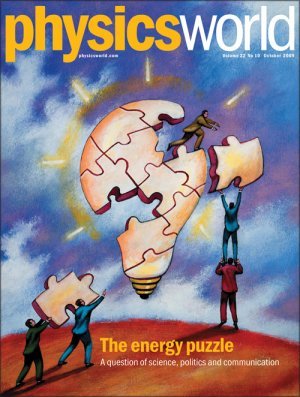
The energy puzzle: yours for free

PWOct09cover-iop.jpg
<a href="http://physicsworld.com/cws/download/oct2009

“>The energy puzzle: download yours for free

By Matin Durrani

The new-look physicsworld.com has now been live for a couple of weeks. The relaunch went pretty smoothly from a technical point of view and we’ve snared most of the inevitable glitches, of which there were thankfully few.

Apart from a fresh new look, we’ve now got a multimedia channel, which kicked off with an exclusive video interview with the CERN director-general Rolf-Dieter Heuer. Watch out for more videos like that and keep an eye out for our webinar series, which we’ll be expanding too in the coming months.

One question we have been asked is: where is Physics World magazine? The short answer is that you can find it by following this link.

However, user testing that we carried out before relaunching the site told us that most people didn’t actually go to the website to find magazine content on a month-by-month basis. That’s hardly surprising: a website that’s updated daily is very different in tone and feel from a monthly magazine

So what we’ve done is change the focus of physicsworld.com away from being the website of a monthly magazine and, instead, onto breaking news, multimedia content, and our regularly updated blog.

All of which explains why physicsworld.com is no longer dominated — as it used to be — by a large photo of the cover of the latest issue.

But don’t worry if you love the magazine as much we do. Selected articles from each issue of Physics World magazine continue to appear in our in-depth section, which you can, by the way, cleverly filter according to different fields of interest, should you so wish.

And don’t forget that if you’re a member of the Institute of Physics, you can get free access to a full digital version of the latest issue as well as to a searchable archive of the first 20 years of the magazine. Check out the latest issue by following this link

As an added bonus just for this month, you can, whether you’re a member of the Institute of Physics or not, download a free PDF of the October issue of Physics World by following this link.

The focus of the issue is energy and climate change, with some great articles by the likes of the physicist and former BP chief executive Lord Browne, who argues that the biggest barriers to a low-carbon economy are not scientific or technological but political. Other articles look at progress in climate modelling, the materials-science challenges standing between us and clean, long-lasting energy, as well as how in the future we could all be connected to a hydrogen SuperGrid.

Download the free October issue here.

What to expect when your spouse wins the Nobel prize

By Michael Banks

With only one day left until the Nobel Prize for Physics is announced everyone, of course, will have their eyes on the eventual winners.

Yet what about the winner’s family and in particular their spouse: how will winning the prize affect their daily lives?

Anita Laughlin, the wife of the Nobel-prize-winning physicist Robert Laughlin from Stanford University who shared the 1998 Nobel Prize for the discovery of the fractional quantum-Hall effect, has written a behind-the-scenes account of what winning the prize can do to a family.

In Reindeer with King Gustav, Anita Laughlin describes the months after her husband won the prize and the mad rush to sort everything out for the big day in Stockholm.

I haven’t read the book yet, but if it is anything like the video posted on Anita Laughlin’s website to promote it then the account will make for an hilarious read.

“Dad, some guy is calling from Sweden,” is how the video starts, when the youngest son in the Laughlin household answers the phone at 02:30 on 13 October 1998.

Then in true Laurel and Hardy style, with Henry Mancini’s Shades of Sennett playing, the Laughlins rush around their bedroom already dressed in their evening attire  to pack (or at least Anita Laughlin seems to be doing most of the packing, with Robert sitting on the bed holding a bottle of bubbly).

If you believe the video then the Laughlins seem to have got some sleep that evening, I just wonder how many physicists will instead be sat patiently by the phone tonight.

Developing-world research hub unveils new director

Fernando Quevedo of Cambridge University in the UK has been appointed as the new director of the Abdus Salam International Centre for Theoretical Physics (ICTP) in Trieste, Italy. He replaces Katepalli Sreenivasan, the India-born physicist who has led the institute since 2003.

Founded in 1964, the ICTP was the inspiration of the Pakistani Nobel-prize-winning theorist Abdus Salam who wanted to establish an international research centre where young scientists from the developing world could gather to encourage their intellectual development.

More than 5000 researchers from over 100 countries now visit the ICTP each year. Although its focus is still on physics and mathematics, the centre has expanded its activities to cover more areas of the physical sciences including Earth systems and multidisciplinary research. The ICTP is jointly funded by the Italian government, UNESCO and the International Atomic Energy Agency.

Nobel supervision

Born in Costa Rica in 1956, Quevedo is a theoretical physicist best known for his work on superstring theory for which he was awarded the ICTP’s annual research prize in 1998. After studying in Guatemala, Quevedo went on to complete his PhD at the University of Texas in 1986 under the supervision of Nobel Laureate Steven Weinberg.

In 1998, following in the footsteps of Salam himself, Quevedo joined the Department of Applied Mathematics and Theoretical Physics at the University of Cambridge, where he is currently professor of theoretical physics. “I am deeply honoured to have been selected for this highly prestigious position at an institution that is very close to my heart,” says Quededo. He added that Salam has always been a role model.

Quevedo will officially begin his new role on 5 November and he told physicsworld.com that he plans to focus on “quality over quantity”. He said that he has no short-term plans to further expand the variety of research carried out at ICTP but would like to “maintain the excellent standard” already in place.

People must start talking

Quevedo also wants to strengthen existing links with other international research centres and to encourage more collaboration between developing nations. “The developing world has changed a lot in the past 40 years. Some of the larger countries like Mexico, Brazil, China and India are now offering a significant contribution to international science. But there are smaller countries, particularly in South America and Africa that people still don’t like to talk about.”

Quevedo believes that countries like Mexico and Brazil have a responsibility to work with their less developed neighbours to stimulate scientific development. He revealed that he will focus on trying to improve the internet connectivity in these less developed nations, which he cites as a key tool in the development of research capacity.

Herschel opens its eye on the universe

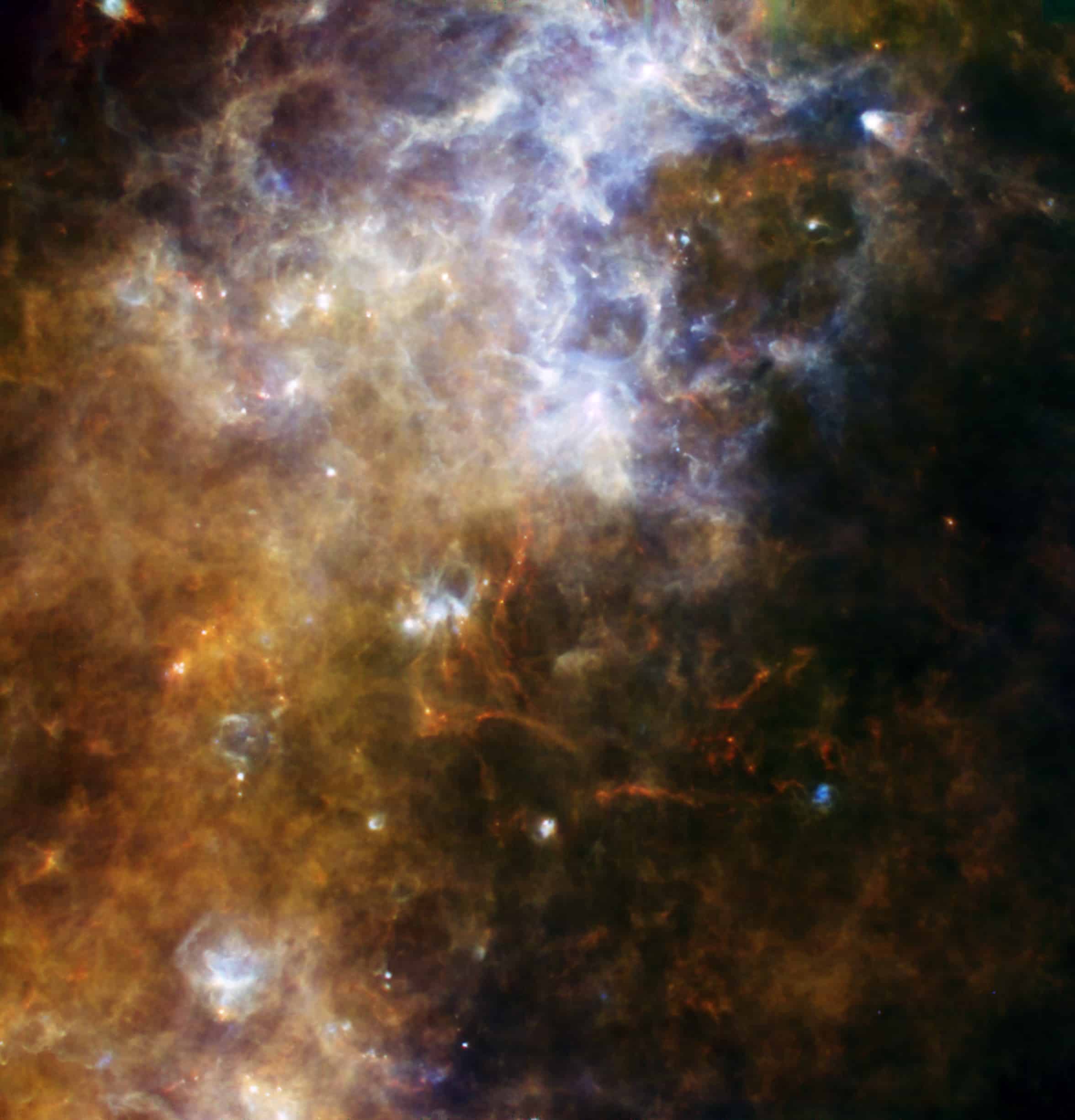
G299_SPIRE_PACS_Crop.jpg
Space chill (credit: ESA/PACS/SPIRE)

By Michael Banks

The European Space Agency (ESA) has released the first images taken by its Herschel space telescope during a calibration run last month.

The awe-inspiring images show cold gas clouds lying near the Milky Way — thousands of light-years from Earth. Five infrared wavelengths have been colour-coded in the image to differentiate very cold material (shown in red) from the surrounding, slightly warmer stuff in blue.

Herschel — named after the German-born astronomer who in 1781 discovered Uranus — is a far-infrared and submillimetre telescope that will study star formation in our galaxy and galaxy formation across the universe.

Herschel was launched in April together with ESA’s Planck mission — a microwave observatory that will study the geometry and contents of the universe by finely measuring the comic microwave background (CMB) radiation, which is a remnant of the Big Bang.

The both occupy a place in space called the Lagrange point L2 — where a probe can usefully hover, little disturbed by stray signals from home and without having to use much fuel to keep it in position.

Herschel will investigate light with wavelengths of 55-670 μm and the satellite will look back to the early universe to see galaxy formations that are invisible to the likes of the Hubble Space Telescope because of gas and dust.

Larger areas of the Milky Way will now be surveyed by Herschel so look out for more cool images soon.

Ig Nobel prize for physics falls flat on its face

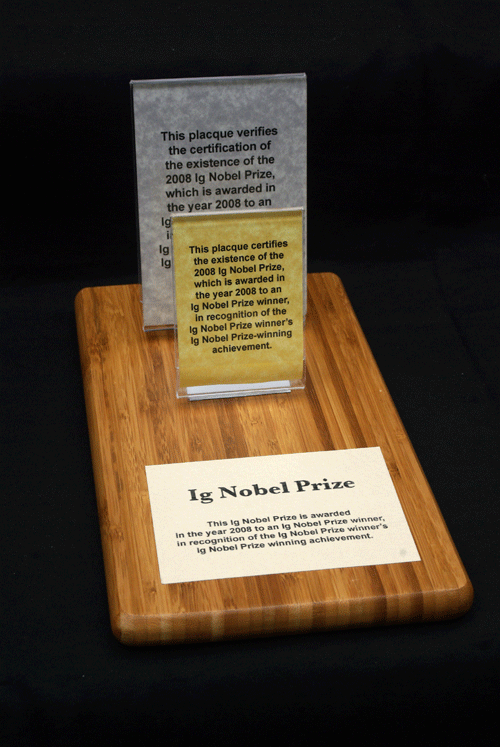
2008IgNobelPrize1-500w.gif
The 2008 Ig Nobel award

By Michael Banks

Maybe physicists are not doing enough research that “first makes people laugh, then think”.

Last night was the annual bash at Harvard University for the Ig Nobel awards, which are given by the humour magazine The Annals of Improbable Research and celebrates research that “cannot, or should not, be repeated”.

Each year the awards have an overall theme. Last year it was redundancy, and in 2007 it was, bizarrely, chickens which involved keynote speaker Doug Zonker repeating the word “chicken” for two minutes.

This year’s theme was risk and mathematician Benoît Mandelbrot gave a keynote address. But fitting in with the eccentricity of the event, every winner of an award had only 60 seconds to give a speech before an eight-year-old girl went up to that stage saying she was ‘bored’.

This year’s ‘physics’ prize went to three anthropologists: Katherine Whitcome from the University of Cincinnati, Daniel Lieberman from Harvard University and Liza Shapiro from the University of Texas won the award for determining why pregnant women do not tip over.

The work, published in Nature, found a difference in the spines of women and men, which allowed a pregnant woman to lean backward and counterbalance the weight of the developing fetus.

I didn’t find the work particularly hilarious and probably represents rather bona fide research.

The chemistry prize lived up more to the suggestion of making you laugh then think. This year’s prize went to Javier Morales, Miguel Apátiga, and Victor M. Castaño at the Universidad Nacional Autónoma de México, for creating diamond films from tequila.

Other 2009 winners include Gideon Gono, governor of Zimbabwe’s Reserve Bank, who won the prize for mathematics for “giving people a simple, everyday way to cope with a wide range of numbers”. Gono ordered bank notes in Zimbabwe to be printed with denominations ranging from one cent to one hundred trillion dollars.

Catherine Douglas and Peter Rowlinson from Newcastle University’s school of agriculture were awarded the veterinary medicine prize for discovering that giving cows names increases their milk yield compared to unnamed cows.

The last few years have seen rather dubious awards given for physics. Last year was for understanding why knots form spontaneously in lengths of “agitated” string, while in 2007 the prize was won for the “physics of wrinkling” — providing insight into why drapes hang a certain way.

It was much better when the prize for physics was given for such things as levitating frogs, calculating that beer froth decays exponentially and finding the best way to dunk a biscuit in a cup of tea.

‘Supermicroscope’ shrunk down to lab-size

Physicists in the UK and Germany have created a powerful yet highly compact X-ray source, which they claim could come to replace some of the world’s major research facilities.

X-ray beams have become a valuable tool for scientists because they can “see” deep inside matter, illuminating its internal structure at the atomic scale. Indeed, the technique is now applied across a wide range of science, from revealing the structure of viruses to tracking chemical reactions as they happen.

As scientists have begun to realize the full potential of X-rays, they have come to require much more advanced X-ray sources than those available at their academic institutions. This has led to the formation of a number of specialist facilities that provide the international research community with a centralized source of high-quality X-rays.

Shake it like a synchrotron

These centres, like ESRF in France and Diamond Light Source in the UK, generate X-rays as a form of “synchrotron” radiation. In the standard process, high-energy beams of charged particles are accelerated using electric and magnetic fields around loops that can be hundreds of metres in size. As the particles veer around the circle, they constantly shed energy in the form of X-rays tangential to the beamline.

In most modern synchrotrons, the particles are also passed through a periodic magnetic structure, known as an undulator, which forces the electrons to “wiggle” and emit X-rays each they change direction.

While these synchrotron facilities have proved very popular and provide researchers with an opportunity to mix with their international peers, they are not without their critics. Some feel that the high set-up and running costs are unnecessary, and it is notoriously difficult to provide all research applicants with sufficient time on the beam line. Moreover, the large size of the accelerators and the air-miles accumulated by all the international visits means that these facilities have a number of sustainability issues.

Determined to overcome these problems, Stefan Karsch of the Max Planck Institute for Quantum Optics and his colleagues have realized an alternative method for generating X-rays. They have developed a technique that has gained recognition in the last few years known as “laser wakefield acceleration”.

Ride the wave

The physicists begin by firing a 37 fs laser pulse at a cell of hydrogen atoms, energizing the electrons and causing some of them to try to break free. However, the positive attraction of the nucleus acts to cling onto the electrons and they end up oscillating back-and-forth about the nucleus – resulting in a form of plasma wave in the cell. Some of the other electrons then “ride” down this wave at relativistic speeds, generating X-rays as they change direction.

Laser wakefield acceleration has been demonstrated previously but never before to generate soft X-rays – that is, electromagnetic radiation that can resolve the structure of matter on the atomic scale. One of the important developments in this latest research was to introduce a miniature version of the undulator present in synchrotrons. The combination of a 1.5 cm accelerator and a 30 cm magnetic undulator enabled the physicists to accelerate electrons up to energies of 210 MeV.

The energy of these electrons is comparable with those in synchrotron facilities, producing X-rays with the same brilliance, but the generator is 10,000 times more compact. “In the long run we aim to replace large, costly synchrotron and linear accelerator facilities with something small and affordable, namely a high-power laser-driven plasma accelerator of cm-size,” Karsch told physicsworld.com.

The researchers now intend to develop their technique to generate X-rays with an even higher brilliance than those in synchrotrons. “Through an ongoing laser upgrade, we first aim at increasing the electron energy to 1–1.5 GeV to reach keV photon energies, which could serve as a first ultrashort X-ray source for application experiments on solids,” he said.

Copyright © 2026 by IOP Publishing Ltd and individual contributors