Jockeying for position

spike.jpeg
Peak time

By Michael Banks

When submitting an article to the arXiv preprint server you might not think it matters when in the day you do it.

But according to new analysis by the server’s founder Paul Ginsparg and Asif-ul Haque from Cornell University, it does, and it could affect how many citations the paper will receive.

They looked at arXiv paper submissions between 2002 and 2004 in three categories: astrophysics (astro-ph), high energy physics – theory (hep-th) and high energy physics – phenomenology (hep-ph).

They found that papers appearing at the top of the list each day generated more citations than papers lower down.

Researchers can submit articles to arXiv at any time of the day. However, there is a cut-off point at 4pm eastern time (EST) for papers to appear on the server on the same day, which are then published at 8pm.

Articles submitted just after 4pm EST will be published the next day. The first paper to be submitted in a certain category after this cut-off time will then be top of the following day’s list.

Interestingly enough, Haque and Ginsparg see a spike in submissions to the server just after 4pm EST (see above chart for submissions to hep-ph) as physicists jostle for top position on the next day.

Physicists’ instincts for trying to land top spot are now backed up by evidence.

Haque and Ginsparg find that papers appearing in the number one position in the astrophysics category, overall, received a median number of citations 83% higher than other papers on that day.

Articles in hep-ph taking the top four places received a median number of citations 100% higher than those published in positions 5-15. For articles in hep-th it was 50% higher.

They also found that the position of the article on arXiv also affected how many full text downloads it had.

Articles taking the daily number one spot in astro-ph, hep-th and hep-ph received a median number of downloads 82%, 61% and 58% higher than that for lower positioned articles, respectively.

This means that it is good news if you are a researcher in the US itching to get the number one spot.

However, researchers in the UK would have to wait until midnight to get a chance of being top, while researchers in Japan would have to get into the office bright and early just after 8am to secure top spot.

So when you submit your next paper to the arXiv remember to keep an eye on the time.

Have your say on the future of Earth science

earth science.jpg

By James Dacey

What is the most important research question in Earth system research that needs answering in the next decade? Why?

These two questions have been posed by the International Council for Science (ICSU) in cooperation with the International Social Science Council in a new online survey.

Responses are being encouraged from scientists but the “Earth System Visioning” project is billed as an open, moderated process where absolutely anyone can chip in. What’s more you can suggest as many questions as you like just as long as you don’t repeat previous suggestions.

If you’re interested in posting a question you’ll have to get in before midnight on August 15th. You can also comment on the questions posed by others and this feedback will be analysed at a workshop in September, which will feed into a draft research strategy. A second meeting will take place in May 2010 to take on board feedback and then a finalized research strategy will be presented later that year.

So who are the ICSU and what do they hope to achieve with this document?

Well, unless you’ve been trapped in a time warp, it’s pretty obvious by now that environmental research programmes – and those related to climate change in particular – tend to be formed at a confluence between natural science, politics, and economics.

Amongst the ICSU’s funders are UNESCO and the US National Science Foundation and a lot of the science that went into the latest report of the Intergovernmental Panel on Climate Change (2007) came ICSU-funded programmes.

The idea with their latest web consultation process is to help shape the environmental research agenda for the next 10 years, whilst encouraging the social sciences to play a more active role.

Is it a good idea?

Well, I saw the Age of Stupid yesterday – a new film about the imminent and severe threat of climate change – and if its gloomy forecasts are right then I really hope this ICSU survey is well thought out.

Walk this way

walking.jpg
Like this

By Hamish Johnston

I am one of the lucky few in the western world who can walk to work. It’s a five-mile (8 km) round trip and I have been doing it most days for over a decade.

Sadly, I’m getting to that age where I can feel the effects of all that walking — an occasional sharp pain in my left foot that has thus far defied a medical explanation.

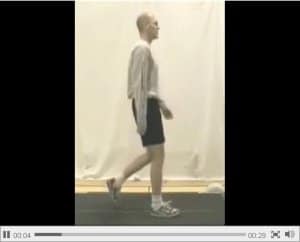
So I was very interested to read this piece on the Guardian website about the role of arm swinging in walking.

According to researchers in the Netherlands, swinging arms exert a succession of alternating torques on the body, which counteract the torques created by the swinging of the legs.

In a normal gait you swing your right arm forward as your left leg swings backwards and vice versa. However, if you walk with your hands behind your back, you use 12% more energy — and if you swing your right arm and right leg in the same direction etc, you use an astonishing 26% more energy.

I had a quick try at all these gaits and I have convinced myself that I can feel the effect of the unbalanced torques.

If you are a bit more self-conscious, you can watch a video of all three gaits on the Guardian website.

It’s amazing how “natural” the walker looks when he uses the normal swing — whereas when arms and legs move in the same direction it looks like something out of a Monty Python sketch.

Three-in-one oven could ease energy needs in developing world

A combined combustion oven and refrigerator that can also harness electricity from its vibrations is now undergoing field trials in the UK and Nepal. The versatile appliance has been developed over the past two years through a UK research collaboration led by the University of Nottingham. With its cheap production costs and variety of functions, the new generator could become an affordable and sustainable energy technology for communities in the developing world, say the project leaders.

Underpinning the electricity generator is a two-step energy conversion from heat to sound to electricity, which takes place inside a gas-filled pipe. A fire at one end of the pipe creates a temperature gradient, which triggers acoustic waves as gas moves from hot to cold regions — much like a singing kettle as the water reaches boiling point. These sound waves can then be harnessed by a linear alternator, which converts mechanical energy into electrical electricity in the reverse process to an electric motor.

What’s more, some of the pipe’s vibrations can also be passed into another thermoacoustic engine, which works in reverse to generate a cooling effect. Finally, the heat from the burning wood or other available biomass can also be used for cooking. The real innovation is that these three functions can be run simultaneously to provide the users with a combined stove, refrigerator and electricity generator.

Three-in-one

The SCORE (Stove for Cooking, Refrigeration and Electricity supply) project was launched two years ago with the aim of developing an affordable, versatile domestic appliance to address the energy needs of rural communities in Africa and Asia, where access to power is extremely limited. One advantage of the new generator is its efficiency, which is higher than that in thermocouples — another device that converts heat into electrical energy. “The best [thermocouples] I have seen are less than 5–7% efficient. Compare this with 15–20% for a thermoacoustic engine,” said project director Paul Riley.

Technical development of the appliance has been split between different institutions in the UK. Researchers at the University of Nottingham have been working to maximize the efficiency of the linear accelerator. “The current design is very exciting for me as it solves many of the problems we had with using loudspeakers as alternators,” said Chitta Saha, a member of the Nottingham team.

Researchers at City University London have been developing the stove design and working with the University of Manchester to hone the thermoacoustic engine. In addition, researchers at Queen Mary University of London are working on the heat transfer aspects of the device.

Putting it into action

Paul Riley told physicsworld.com that his team has already generated 8 W of electrical power by using a propane burner instead of biomass. “We have built the stove top unit using local materials and tested it in Nepal. The results look very encouraging — the science is progressing well and we have developed mathematical models that are being tested,” he said.

The SCORE team are aiming to create a generator weighing between 10 and 20 kg, at a cost of £20 per household, based on the production of a million units. The target is to generate an hour’s use per kilogram of fuel — which could be wood, dung or any other locally available biomass material. SCORE are now looking for sponsorship to fund further testing and Riley believes that the Indian sub-continent (particularly Nepal), sub-Saharan Africa and South America are regions that could benefit particularly from the new innovation.

Riley also told physicsworld.com that his team will also begin to explore other applications once they have proven the technology. “Examples could include waste heat recovery, CHP for domestic boilers and low-cost solar power,” he said.

Film review: The Time Machine

atlas scaffolding.jpg
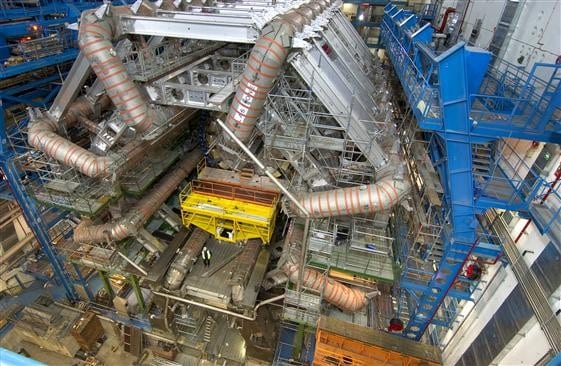
Scaffolding on the LHC’s ATLAS detector during construction. Credit: CERN

It may seem odd to think of CERN’s Large Hadron Collider (LHC) as a “time machine”. After all, in its usual science-fiction sense, the phrase refers to a telephone-booth-sized device you climb into before zooming off to explore the future, like the hero of H G Wells’ novel. Yet as filmmaker Yariv Friedman points out in The Time Machine, the LHC should allow physicists to study what happened in the instant after the Big Bang — thereby transporting them, in some sense, through 13.7 billion years of cosmic history.

Friedman’s documentary on this real-life time machine follows a multilingual team of scientists through the final stages of the collider’s construction, where footage taken inside the ATLAS detector offers ample proof of its complexity. Here, even the scaffolding looks complicated, like a giant adventure playground crawling with hard-hatted engineers and physicists. Interviews with scientists offer glimpses of the non-technical challenges; one team leader describes his task as “management by coffee…you have to drink a lot of coffee with a lot of different people to get to the end product”.

The most telling comments, however, come in the run-up to the collider’s gala opening in September 2008. ATLAS’ technical coordinator declares that the LHC will work because “behind every nut or bolt is someone who cares”, while another scientist confesses that he cried when he saw the first particle traces. After this initial success, the shutdown nine days later, “felt like a kick in the teeth,” admits project manager Lyn Evans. Like the project it chronicles, The Time Machine doesn’t quite get off the ground within its hourlong running time, but there’s some great material in this near-miss.

Big bucks for physicists

physics salaries.jpg
How salaries stack up. Credit: PayScale

By Margaret Harris

Here’s a rare bit of economic good news: people with physics degrees earn more, on average, than their fellow graduates in all but a handful of disciplines.

According to this study by the US website PayScale, physicists are the sixth-highest-earning group of graduates, with a median salary of $98,800 (just under £60k) after at least 10 years in the workforce. Indeed, physics was one of only three non-engineering majors to crack the top ten, along with computer science and economics. Starting salaries for physicists aren’t bad either: $51,100, or a respectable 14th on the same list of 75 different subjects.

In addition to looking at degree subject, the study also ranked 320 US colleges and universities according to their graduates’ salaries. Readers familiar with the US educational system will find some fascinating results in the list for example, graduates of Loma Linda University, a religious college in southern California, have the highest median starting salary, while Dartmouth College grads earn the most at mid-career.

(more…)

Nanoscale light source can change its colour

An international collaboration claims to have made the first tunable nanoscale light source that is driven by free electrons. Light is created by directing a beam of electrons through a tiny aperture that has been drilled into a stack of alternating gold and silicon-dioxide layers. Interaction between the electron beam and the alternating layers generates visible and infrared light emission.

The device resembles a free-electron laser in which a beam of electrons passes through an alternating magnetic field — causing the electrons to “wiggle” and emit light.

The invention could lead to an on-chip light source for nanophotonic circuits, according to the partnership, which involves researchers at the University of Southampton, UK, National Taiwan University and theorists at CSIC in Madrid, Spain.

Lab-on-a-chip potential?

Tunability would provide a range of opportunities, such as spectroscopic lab-on-a-chip devices for medical diagnostics Kevin MacDonald, University of Southampton

“Nanoscale devices require nanoscale light sources, and tunability would provide a range of opportunities, such as spectroscopic lab-on-a-chip devices for medical diagnostics,” said Southampton’s Kevin MacDonald.

Next-generation displays could also benefit from a tunable light source, according to MacDonald. Switching to this type of device could eliminate the need for separate pixels that deliver different colours of light such as red, green and blue.

The team fabricated their “lightwells” by depositing alternating 200 nm thick gold and silicon-dioxide layers onto a silicon substrate, before a focused ion beam milled a 700 nm diameter hole in the metal-dielectric stack.

Oscillating dipoles

Researchers at Southampton then used an electron microscope to fire a beam into the device. In principle, the beam could instead be supplied by an integrated free-electron emitter — a technology that has already been developed for microelectronic and flat-panel display applications.

As electrons pass through the aperture they create a dipole, due to the presence of “image charges” in the gold layers. This dipole oscillates, producing light emission, thanks to the alternating dielectric environment encountered by the electron as it passes through the well.

By adjusting the energy of the beam from 20–40 keV, the emission is tuned from the red to the near infrared. “However, with adjustments in structural periodicity we anticipate that lightwells could operate anywhere from the ultraviolet range to the terahertz domain,” MacDonald told physicsworld.com.

Twin peaks

Two broad emission peaks were produced by the structure: one that shifted from 830–750 nm and the other 910–800 nm as the electron energy increased. The number of emission peaks depends on the physical dimensions of the device.

The emission lines are broader than 150 nm, which may be too wide for some applications. However, it should be possible to produce narrower emission lines by simply extending the length of the well.

The efficiency of the light generation process is very low, with just 2–4 photons produced for every 100,000 electrons injected. Substantial improvements are possible, however, by optimizing the lightwell geometry, material composition and pumping regime.

A fuller understanding of the emission process requires the inclusion of the more complicated interaction between the electron and the dielectric silicon-dioxide layers. Relativistic corrections also need to be included in the calculations, along with the light-guiding properties of the silicon-dioxide layers, and the interaction of metal-dielectric interfaces with surface plasmons — which are collective oscillations of electrons.

Barriers to commercialization?

Nikolay Ledentsov, chief executive of the laser manufacturer VI Systems, thinks that the development of the lightwell is an interesting piece of fundamental research. However, he says that because this emitter is a plasmonic structure, it will be hampered by losses that could prevent deployment in commercial applications. Realizing single-wavelength emission is another obstacle, alongside higher efficiencies for every part of the system.

The work can be accessed on the arXiv server. It is currently under review for journal publication.

Google Earth: a speed camera for ships?

google.jpg
Caught speeding on camera?

By Hamish Johnston

The renowned Victorian physicist Lord Kelvin spent a good deal of his life at sea and had a great interest in all things maritime. So it’s not surprising that the wedge-like pattern that follows in the wake of a slow moving ship is named in his honour.

Kelvin worked out that the pattern arises because of the interference of two distinct types of waves that are created when an object moves through the water. One type of wave diverges away from the ship, while the other follows the ship.

These two waves sum to create a distinctive wedge-shape wake, outside of which there are no significant waves created by the ship.

Apparently, these “Kelvin wedges” can be easily seen in Google Earth images and two physicists in Brazil claim that the images can be analysed to give velocity of the ship.

The paper is very brief and I’m no wave expert — but it seems to me that the trick is to spot evanescent waves, which do manage to propagate a little way beyond the Kelvin wedge before petering out.

The wavelength and direction of these waves can be extracted from the satellite image and a simple equation can be used to give the speed of the ship.

The team tested their theory on an image of a ferry boat that is known to cruise at 33 km/h — and clocked it at 31 km/h.

You can read a preprint of their paper here.

The paper is less than three pages long so I’m guessing that their analysis is highly-simplified (the aim of the paper is to encourage students to analyse boats operating near to their school). I would have guessed, for example that the shape of the boat would have some effect on the wake?

Dark energy and the balance of blogging

wmap.jpg
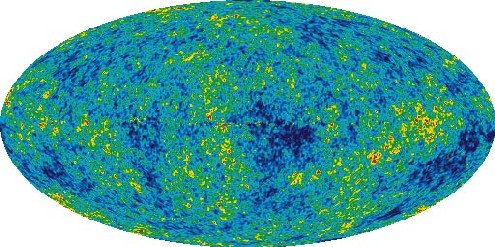
Credit: NASA/WMAP Science Team

By James Dacey

In my view, the real beauty of blogging is that it allows for a more free-flowing form of journalism in which the reporter brings him / her self into the story. If done well, a good blogger should be able to convey not only the news but also their experience of the news as it is happening.

Academic presentations are a favourite subject of science bloggers but what happens if one of the “protagonists” feels that the blogger has not quite grasped all the subtleties of their argument? Should the blogger go back and add more layers to their post or does this defeat the whole point of blogging – removing the personal touch and converting it into a more polished article all in one editorial concession?

Last Tuesday I went to Imperial College, London to watch a highly entertaining public debate on the small topic of “The Fate of the Universe”. On the train journey home my head was still spinning with some of the huge ideas so I decided to rattle off a blog about the event and my experience of attending of it.

Since publishing this blog I have been contacted by one of the speakers Subir Sarkar of Oxford University who enjoyed reading the blog BUT felt that it didn’t quite portray the full depth of his argument. Therefore, to keep in the spirit of blogging whilst doing full justice to Sarkar’s debate-winning presentation, we have agreed that the best solution is to publish these clarifications as a new blog post. And here it is:

Dear James,

I hope you don’t mind my pointing this out (it is your blog!) but the technical points you report are slightly different from what I actually said in two important respects.

Firstly, the large cosmological constant (aka vacuum energy) is predicted not by quantum mechanics but by quantum field theory (the union of qm and special relativity) when coupled to gravity as described by Einstein’s general relativity. Clearly something must give – either Einstein’s theory must be modified and/or there must be a mechanism that cancels the huge vacuum energy. No one has been able to figure out how … but Nature must know the trick otherwise we would not be here talking about it! Until we figure it out we ought to be wary of naively invoking (a relatively tiny) vacuum energy to explain cosmological observations.

Secondly, the observations may well be right but the inference of a cosmological constant (in terms of the present – probably oversimplified – cosmological model) may be wrong. No one has actually seen acceleration – this is inferred from the observation that distant supernovae are slightly fainter than would be expected for a decelerating universe. But this inference is based on the assumption of homogeneity – what if we are in a void that is expanding faster than the average rate so that distant supernovae are in a slower Hubble flow relative to the local ones and this creates the illusion of acceleration?

Also the 10122 number was quoted by Andrew, while I said 1060 since this is the expectation from the Standard Model of particle physics – our most successful quantum field theory – which has been verified to work very well up to energies of ~103 GeV. If QFT holds all the way up to the Planck scale of 1019 GeV then we would get the extra (1016)4 ~ 1064 factor (of course all these numbers are so huge that it does not really matter). My point was that Nature must have somehow solved this problem, otherwise the universe would have never got bigger than a mm (before becoming vacuum energy dominated). Interestingly enough, Wolfgang Pauli had apparently estimated that the universe “could not even reach to the moon” from a similar argument by taking the ‘cut-off energy’ to be the electron mass – this calculation was reproduced recently by Prof Norbert Straumann of Zurich. So Pauli concluded that vacuum energy does not gravitate (“as is evident from experience”) – but he did not explain why!

I am glad you liked Rachel Thomas’s article in Plus Magazine – I thought she did a great job of communicating the essential puzzles about the cosmological constant problem.

Best – Subir

Beetle has polarizing twist in its shell

A structure much like a liquid crystal allows the shell of a scarab beetle to circularly polarize light, scientists in the US have discovered.

Mohan Srinivasarao of the Georgia Institute of Technology and colleagues have used microscopy techniques to show that the iridescent green scarab beetle (Plusiotis gloriosa), has a shell that contains a helical structure, rather like a “cholesteric” liquid crystal.

“This study is important because it highlights how animals produce very complex nanostructures by self-assembly,” Srinivasarao told physicsworld.com. “The resulting structures are optically active and produce brilliant metallic green structures, [and] the optical activity results in reflected light being circularly polarized.”

Ripe for bio-mimicry?

There are many examples of insect shells, fish scales, bird feathers and other objects in the animal kingdom that have unusual optical properties. Sometimes researchers find the properties surpass those in manmade materials, in which case they can try to copy the animal’s design. In 2007, researchers discovered that a tropical beetle’s oddly bright white shell was the result of an “aperiodic” shell structure, and said it could lead to a new type of super-white, synthetic material.

Using reflected-light microscopy, Srinivasarao’s group could see how the shell of Plusiotis gloriosa changes colour at different angles, producing the iridescent colours visible to the human eye. However, using laser-scanning confocal microscopy for higher magnifications, the group could discern a helical structure. This structure resembled a cholesteric liquid crystal, which circularly polarizes light as a result of defects that twist its ordered layers of molecules with respect to one another.

Srinivasarao thinks the scarab beetle’s shell could, like other animals, be mimicked for manmade applications. “One could envision making very shiny metallic colours by taking a cholesteric fluid and varying the conditions at which the surface defects appear,” he says.

Unknown use

Biophysicists are just beginning to realize that animals can make use of circularly polarized light. Last year, researchers in Germany and Australia suggested that the “mantis shrimp” uses circular polarization for enhanced communication. However, it is not yet clear whether this scarab beetle employs the optical effect for the same purpose.

“The purpose of the shell is still under some debate,” says Srinivasarao. “Mainly it is supposed to be for mating purposes, [but] the full range of purpose is not yet known…currently there is no evidence that Plusiotis gloriosa can actually distinguish circularly polarized lights of different handedness.”

Srinivasarao adds that he and his colleagues are now investigating why the beetle evolved the polarizing property.

This research appears in the latest edition of Science.

Copyright © 2026 by IOP Publishing Ltd and individual contributors