Higgs boson spotted

higgs sm.jpg
Catching up on the latest physics

By Michael Banks

Sorry, not at CERN’s Large Hadron Collider near Geneva or Fermilab’s Tevatron in Batavia, Illinois, but at our office here in Bristol.

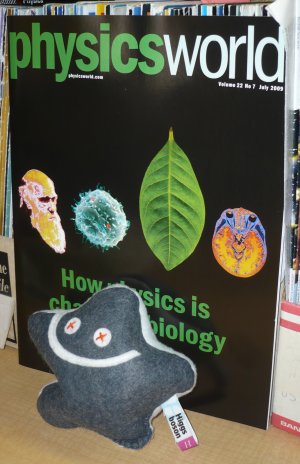
This morning, Physics World’s postbag contained our very own Higgs boson plush toy sent from Julie Peasley at Particle Zoo.

Particle Zoo, based in Los Angeles, makes plush toys of all your favourite particles including the neutron, electron as well as particles that have not yet been discovered such as the graviton.

Recently, Particle Zoo even branched out from just making particles to produce a plush toy of the cosmic microwave background and higher-dimensional “branes”.

Physics World can confirm that the mass of the Higgs is surprisingly large and that it is currently taking pride of place in the office next to the latest issue of the magazine.

‘Nanopillars’ make good photovoltaics

A new type of solar-cell module based on arrays of tiny pillars has been made by researchers in the US. According to its inventors, the module is flexible, efficient and can be made using industrial processing techniques — which means that it could offer a low-cost route to efficient and robust solar panels.

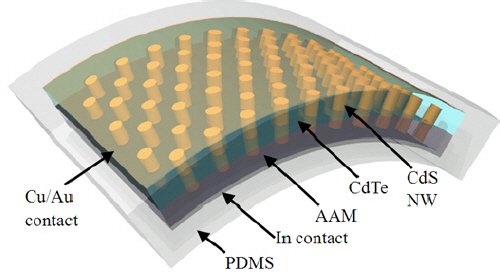
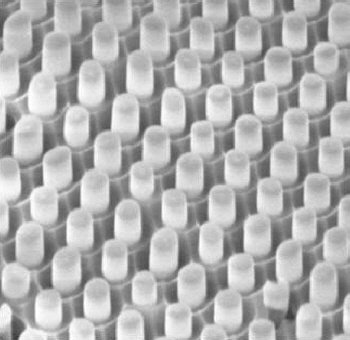
Ali Javey and colleagues at the University of California at Berkeley grew regular arrays of cadmium sulphide (CdS) pillars on anodized aluminium-foil membranes. The pillars are identical cylinders, which are each a single crystal about 200 nm in diameter and about 500 nm tall.

To make the pillars, the team deposited a thin layer of gold seeds in the highly regular pores that form in the aluminium foil after anodization. These seeds encourage the growth of the nanopillars when exposed to a vapour-liquid-solid (VLS) process — a technique that produces ordered structures with an orientation that can be controlled.

CdS is a semiconductor and the nanopillars function as photoelectrodes, which convert light into electrical current. Previous studies have shown that such structures have a higher efficiency than flat surfaces because more photons are absorbed at greater depths in the photoelectrode.

The team then fabricated solar cells from the nanopillar arrays and achieved a conversion efficiency of about 6%. This is higher than many other thin and flexible devices, including those based on nanostructured materials. Another advantage compared with bulk solar modules is the small amount of active semiconductor used in the device, which makes them more cost-effective, says Javey.

The technique also shows commercial promise because it could be compatible with “roll-to-roll processing”, which is used to make electronic devices.

“The nanopillars we produced could be used to develop a robust technology for low-cost and lightweight photovoltaics with respectable efficiencies,” he says. “Our work could have important implications for the large-scale integration of solar modules for a wide range of applications. There are still a lot of challenges ahead of us, but the work shows the potential of our technique.”

The team, which includes researchers from the Lawrence Berkeley National Lab, now plans to further enhance light-conversion efficiencies in the devices. The first thing that they will do is optimize and/or replace the top contact material, which is currently causing a 50% loss in the optical transmission. “We will also explore other materials systems by using our device structure and fabrication approach and try to make the technology more viable for large-scale integration,” added Javey.

In particular, the researchers will try to replace the cadmium-based materials used in their devices, because the metal is highly toxic.

The work was reported in Nature Materials.

Apollo conspiracy theories still going strong

buzz.jpg
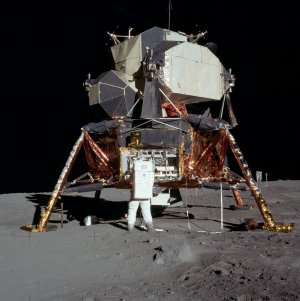
Apollo 11 photograph: too good to be true? (NASA).

By Hamish Johnston

Today is the 40th anniversary of Neil Armstrong’s stroll on the Moon so it’s not surprising that conspiracy theorists are one again arguing that the Apollo programme was a hoax.

This morning Marcus Allen, UK publisher of Nexus Magazine — which specializes in conspiracy theories — was interviewed on BBC radio.

He thinks the Apollo landings were hoaxes, partly because of the “high-quality” of the photos taken by crews on the moon. In particular, he claimed that it would be impossible to take such nice photos under the extreme conditions on the Moon — and even if you could, the film would be fogged by the ambient radiation experienced by the mission.

Martin Ward, Head of physics at Durham University, was on hand to debunk the debunker. He explained that the extreme temperatures are a red herring because the lack of atmosphere on the Moon means that the camera and film would take a long time to heat up or cool down once outside the lunar module. As for the effects of radiation, Ward pointed out that lots of other photos have since been taken in space and have not been fogged.

You can listen to their exchange here.

Although I have no doubt that the Apollo missions were real — it’s interesting to ask the following question:

“Would it have been much easier (and much cheaper) to fake the Apollo programme and cover it up for 40 years, than to actually put people on the Moon?”

If you apply Occam’s razor to this question, you may find yourself siding with Marcus Allen…which is what makes the the Apollo missions all the more amazing!

Migrating giants enrich asteroid belt

The Solar System underwent a violent shake-up during its teenage years slinging millions of dark primitive rocks and ice from beyond Neptune into the main asteroid belt, which lies between Mars and Jupiter. This idea contrasts with the standard picture of Solar System formation, which assumes that the entire contents of this belt originate from the same part of the Solar System. It could also yield valuable insights into how the Earth was born from a cloud of interstellar dust nearly 5 billion years ago.

The main asteroid belt in the Solar System is a narrow disc of small objects lying between the orbits of Mars and Jupiter. Images from spectroscopy along with samples gathered from rare collisions with the Earth reveal a wide variety of material from primitive ice-rock mixtures through to igneous rocks. The standard interpretation is that this diversity is a good indicator of what conditions were like in the early solar system before the planets were formed.

A violent youth

In the widely accepted view of how the Solar System evolved, the planets formed in the same orbits they occupy today, by gravitational collapse of a giant molecular cloud some 4.6 billion years ago. In this interpretation, the material in the asteroid belt has also remained in its current location throughout the history of the solar system. Meteorites are studied by geologists to get an idea of what the planet was composed of at the beginning of Earth history.

Now, Harold Levison at the NASA Lunar Science Institute and his colleagues offer a different view of the early Solar System through a simulation they have been developing since 2005. The “Nice model” has all the giant planets forming within a compact configuration between 5 and 15 AU from the Sun — 1 AU is the distance between the Earth and the Sun. Then, after roughly 600 million years, the orbits of these planets started to become unstable, resulting in Uranus and Neptune being scattered outwards into proto-planetary material, which stretches to 30 AU from the Sun.

In astronomical terms this process occurs very rapidly taking just 10,000 years for these planets to migrate to their present orbits. As a result, the arrival of these planets sends material flying in all directions including back towards the inner Solar System. A significant number of these asteroids are then captured in orbits between Mars and Jupiter, or as Trojan asteroids — sharing an orbit with Jupiter. “This is a violent process. I like to use the analogy of a bowling ball colliding with a set of pins,” explained Levison.

Levison and his team estimate that 10–20% of the material in the main asteroid belt could have arrived by this process. He told physicsworld.com that his team intend to develop their research by refining the initial conditions that existed in the proto-planetary disc. “The Nice model is undoubtedly controversial, but there are no other alternative numerical models that can explain how the solar system evolved into its current configuration,” he said.

This research was published in the latest issue of Nature.

NASA unveils aerial views of Apollo landing sites

The highest-ever resolution aerial views of the Apollo landing sites will be made publicly available by NASA today. The photos have been returned by NASA’s Lunar Reconnaissance Orbiter (LRO), launched in June to produce maps of the Moon’s surface with the highest resolution yet. The agency will release the images at noon Eastern Daylight Time and they will also be holding a teleconference at 2.00 p.m. to discuss future plans for the LRO mission.

NASA’s Lunar Reconnaissance Orbiter was launched on 19 June with the mission of gathering a variety of data on the lunar environment. It will have seven on-board instruments, including a camera that will map the Moon with a resolution of about 50 cm. NASA hope this will help them in preparing for a new generation of longer-duration manned expeditions to the moon.

LRO will spend at least a year in a low polar orbit approximately 50 km above the lunar surface, while its seven instruments find safe landing sites. Its objectives include the location of potential resources, characterization of the radiation environment, and the testing of new technology.

“Accomplishing these significant milestones moves us closer to our goals of preparing for safe human return to the moon, mapping the moon in unprecedented detail, and searching for resources,” said LRO Project Scientist Richard Vondrak of NASA’s Goddard Space Flight Center in Maryland.

Could Fermi detect dark matter within a year?

The Fermi Gamma-ray Space Telescope could detect the telltale signs of dark-matter annihilation in as little as a year, if calculations by UK and US astrophysicists prove correct.

The calculations, which are the first to take into account the relative velocities of dark-matter particles, suggest that dark-matter annihilation is many times more prevalent than has been predicted before. If this is true, the annihilations could be producing enough gamma rays to expose several clumps or “subhaloes” of dark matter in Fermi’s first year of data collection alone.

Michael Kuhlen, lead author of the research and an astrophysicist at the Institute for Advanced Study in Princeton, US, says such a detection by Fermi would be “an amazing confirmation” of the standard paradigm of structure formation in “cold” dark-matter theories. “First of all, it would show that dark matter is cold, and that it forms small clumps that populate the Milky Way,” he says. “Second of all, it would show that it is a fundamental particle, which is still not really

Confirming theory

Cold dark matter has become the most accepted explanation as to why the universe appears to have at least 80% more gravitating mass than is directly visible to telescopes. According to theory, cold dark matter is not luminous and interacts only via gravity, and exists in vast haloes around the centres of galaxies. These haloes are full of lumpy substructures called subhaloes, which would be the most likely places for dark-matter particles to collide with one another and annihilate.

Past simulations of dark matter for a galaxy like our own Milky Way have always predicted annihilations to be so rare that telescopes would barely be able to detect the resultant gamma-rays and other particles above the universe’s background. Last year, however, the European satellite PAMELA and the international balloon-borne experiment ATIC recorded excesses of positrons and electrons respectively, hinting at dark-matter annihilation.

Kuhlen, together with Piero Madau at the University of California in Santa Cruz, US, and Joseph Silk at the University of Oxford, UK, decided to see whether these observations could be explained if dark-matter annihilation rates were boosted by an effect known as the Sommerfield enhancement. In this effect, a long range force — which would manifest as either a conventional weak-force boson or a new force carrier — increases the rate of annihilations when the dark-matter particles are moving slowly. Kuhlen’s group applied several different models of Sommerfield enhancement to a simulation of the Milky Way that contained more than a billion particles to see how the gamma-ray flux would be affected.

Seeing subhaloes

For the greatest enhancement, the researchers found that more than 400 subhaloes would be detectable to the Fermi space telescope — which was launched in June 2008 — after one year, and after ten years the figure would rise to over 900. But even for the most conservative model, the researchers found that after a year five subhaloes would be visible.

The news is likely to excite astrophysicists, many of whom have spent decades searching for dark matter’s smoking gun.

“The indirect search for dark matter through its signature in gamma rays is one of the central topics in the Fermi science programme,” says Ronaldo Bellazzini, a physicist at the University of Pisa, Italy, and principal investigator of Fermi’s Italian team. Bellazzini explains that Fermi could detect gamma rays from annihilation even without effects such as the Sommerfield enhancement, but that the latter will improve the chances. “We have already started a search for a dark-matter signal in candidate subhaloes,” he says, adding: “No dark-matter [signal] has been found in the three months of data. This is not yet in contradiction with the most conservative predictions of this paper.”

This research appears in the latest edition of Science.

Physicists spy on skink swimming through sand

If you own a pet lizard, it could be a sandfish — a mild-mannered skink native to North Africa and the Middle East. The creature is so-called because it appears to “swim” under the sand — an ability that has fascinated biophysicists interested in animal propulsion. But because sand is opaque, the question is: does the sandfish really swim like a fish, or does it use its legs?

To find out, Daniel Goldman and colleagues at the Georgia Institute of Technology in the US allowed a sandfish to scurry (using its legs) into a container filled with deep sand. When the skink reached the sand it immediately burrowed into the material — where its motion was recorded by illuminating the sand with X-rays and capturing the images with a high-speed camera.

The experiment revealed an undulating motion that, Goldman says, is intermediate to how a snake moves across a solid surface and how a fish swims through water. A sandfish, in other words, seems a pretty accurate name.

Completely legless

The team was particularly interested to see if the sandfish uses its limbs to push its way through the sand, so markers were glued onto its legs. These revealed that the sandfish keeps its legs tucked against its body while swimming.

Goldman told physicsworld.com that this legless propulsion came as a bit of a surprise because a previous study (by others) using magnetic resonance imaging to follow a sandfish suggested that the skink was using its legs.

To gain a better understanding of the sandfish’s propulsion strategy, the team measured the thrust and drag forces on a skink-sized stainless-steel rod as it was pushed through sand. These data were used to predict the “wave efficiency” of the skink’s motion — the ratio of its velocity through the sand to the velocity of the wave that travels down its body.

Frictional fluid

By comparing their model and observations, the team was able to conclude that the sandfish was swimming through a “frictional fluid”. Drag arises in such a fluid because of friction between the skink’s body and sand grains, and between the sand grains themselves. It differs from water and other familiar viscous fluids because the drag forces are independent of velocity — whereas in viscous fluids the drag is proportional to velocity.

The team repeated its experiment several times using sands with different solid-to-air ratios. They found that the skink did not modify its swimming technique, even though the drag force in the densest sand was double that in the least dense sand.

Goldman said that the team’s next goal is to work out whether the sandfish expends more energy while swimming in denser sand.

This research appears in the latest edition of Science.

More delays at the LHC

By Hamish Johnston

There have been several small slippages lately in the restart date for the LHC.

We haven’t been reporting them because they tend to be on the order of a week or so, which isn’t much in the overall scheme of things.

But they do seem to be adding up.

Peter Woit has been documenting them on his blog and you read about the latest here.

Flexible fabric that ‘takes pictures’

It may sound like something from a highly stylized science-fiction film but imagine a soldier who could detect threats by seeing in all directions at once. A group of researchers at the Massachusetts Institute of Technology (MIT) have taken the first step to turning this futuristic vision into reality with a new imaging technique that involves light-detecting fibres that could be woven into a flexible web or even a soldier’s uniform.

The individual fibres created by the MIT team consist of two separate sheets of semiconducting glasses — just 100 nm thick — folded up like a Swiss roll. Electrodes are worked into the fibres and the resulting cylinder, which is 35 cm long, is covered in an insulating cladding. The fibres can detect light because photons interacting with a semiconductor material can ionize the component atoms, thus triggering a current in the presence of a potential difference.

Picking the colour

Long-wavelength photons arriving at the fibre with relatively low energy can only trigger a significant current in the outer semiconductor. Shorter-wavelength photons, in contrast, have higher energies and so can trigger currents in both the inner and outer semiconductors. So by comparing the relative currents in the two semiconductors, the researchers can determine the colour of the incoming light.

The biggest challenge when manufacturing these fibres was integrating the electrodes: “We needed to choose a metal that had very different electronic properties but similar thermal properties to the semiconductor,” says Fabien Sorin, one of the MIT researchers. Tin was chosen because it is highly malleable, which means that it can be deformed plastically without fracturing.

Sorin and his team merged the separate layers by carefully heating them in a furnace and then drawing them into fibres that retain the original orientation of the various layers. “The trick was to encapsulate the metal within the semiconductor, rather than melting the different layers into one,” says Sorin. The researchers then combined a series of fibres into a 32 × 32 mesh.

Smiles all round

To demonstrate the imaging capability of their material, the researchers placed it in front of a “smiley face” with a diameter of 800 µm painted in chrome on a glass substrate. This generated a distinct pattern on the fabric mesh that was then fed into a computer. An algorithm then assimilated the data to create an image of the object on the computer screen. The face’s features were successfully resolved with colour differentiation determined to a resolution of 5 nm.

Changhui Yang, an electrical engineer at the California Institute of Technology, is impressed by the research. “Imagine a soldier wearing a uniform made with this technology. The uniform will be able to alert the solider if an enemy tags them with a laser beam,” he says.

This research was published in Nano Letters.

Watch Richard Feynman's lectures for free

tuva.jpg
Gates and Feynman

By Hamish Johnston

In case you haven’t heard, Bill Gates has bought the rights to seven lectures by the late Richard Feynman, which were filmed by the BBC in 1964 — a year before Feynman shared the Nobel Prize in Physics.

You can watch them for free here — all you need to do is download and install a bit of software from Microsoft (which took me a minute or two).

tuva 2.jpg
The first lecture (it gets better).

Feynman had a reputation as an entertaining speaker, who could convey complex physical concepts to the general public.

The Messenger Series of lectures is also available as a book entitled The Character of Physical Law

Copyright © 2026 by IOP Publishing Ltd and individual contributors