T-shaped probe exposes protein elasticity

Researchers in the US have used a modified atomic force microscope to find the flexible regions of a protein. The motions of proteins can play important roles in their biological function and therefore understanding which parts of the molecule can easily bend — and how this suppleness is affected by the presence of other molecules — could help in the development of new drugs.

Proteins are chains of amino acids that are involved in just about every biological process. They are essentially nanoscale mechanical devices with flexible moving parts, as well as more rigid components. According to Ozgur Sahin, who led the study at Harvard University’s Rowland Institute: “If one can identify flexible parts of proteins, one can design small molecules (drugs) to bind and alter their flexibility.”

Sahin and team have used their modified AFM to study the flexibility of bacteriorhodopsin — a protein used by some micro-organisms to convert light into electricity. The molecule is a distant relative of rhodopsin, which performs the role of detecting light in human eyes.

Tiny forces

The AFM itself works by measuring how the force between the sample and a tiny “tip” on a cantilever changes as the tip is moved over the surface of the sample. This allows the AFM to record images with extremely high spatial resolution on the nanometre scale.
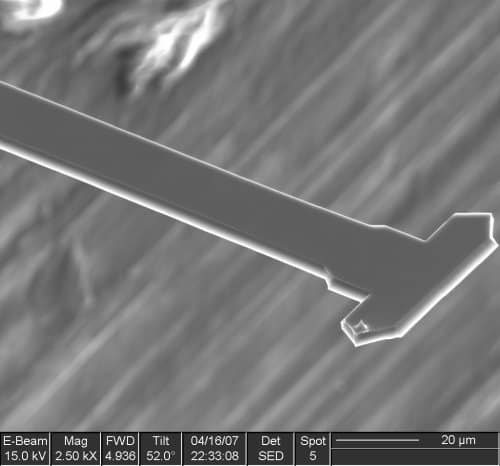
The flexibility of a material can be measured by pushing the AFM cantilever against a sample — and measuring the deformation of the sample as a function of the applied force (the elastic modulus). However, this method has its drawbacks when used on tiny and fragile proteins. “If the cantilever is soft, the forces can be determined accurately, but the sample will not be deformed — rather, the cantilever will bend ” explains Sahin. Conversely, if the cantilever is stiff, the sample will be deformed, but it will be difficult to measure the forces.

The team addressed the challenge by designing a T-shaped cantilever that can both twist and bend. The tip is located at one end of the crossbeam and sensitive measurements of the forces are made from the twisting motion of the cantilever and deformation is determined from its bending.

The AFM was operating in vibrating mode, which means that the tip was oscillating rather than stationary. Successful measurements result from careful adjustments to resonant frequencies and spring constants of the bending and torsional modes of oscillation.

Flexible “switches”

Before being placed in the AFM, bacteriorhodopsin molecules were embedded in micrometer-sized cell membranes. The membranes were placed on a flat surface and the AFM was used to measure their elastic moduli. The measurements revealed that the region that contains the protein’s “electrical switch is about three times more flexible than the the rest of the structure.

Armed with the T-shaped cantilever, the team could perform a single force measurement in just 120 μs. By comparison, a standard AFM would take 1 s to perform the same measurement, and consequently several hours to generate an image.

The T-shaped probe also leads to superior spatial resolution. The best images from a conventional tip have tens of nanometres of spatial resolution in liquid, and cannot visualizing single molecules — whereas Sahin’s tool has a typical resolution of one nanometre.

Easy to manufacture

Sahin also says that the cantilevers are “relatively easy to manufacture,” — the team’s probes are made by an AFM cantilever manufacturer that carries out bespoke batch production. The experiments were done on a commercial AFM.

A protein’s mechanical properties can also be determined by inelastic neutron scattering (INS). However, neutron sources are only available in national facilities, and protein replicas with certain hydrogen atoms replaced with deuterium are needed.

Despite these drawbacks, INS has been used to study bacteriorhodopsin. “There is an agreement in the numbers, but that does not necessarily build additional confidence into our method,” says Sahin. INS quantifies thermally actuated atomic fluctuations, while Sahin’s team has determined the collective response of atoms to external forces, and he says that the correlation between these two techniques is unknown.

Future targets

The next goal for Sahin’s team is to measure protein dynamics. “High-speed measurements can, in principle, show changes in protein that occur at the microsecond to millisecond timetable.” Tracking of single molecule dynamics might even be possible, because enzymes form and break chemical bonds on this timescale.

The research is published in the journal Nature Nanotechnology.
Dodging wet paint at J-PARC

DSCN1570.jpg
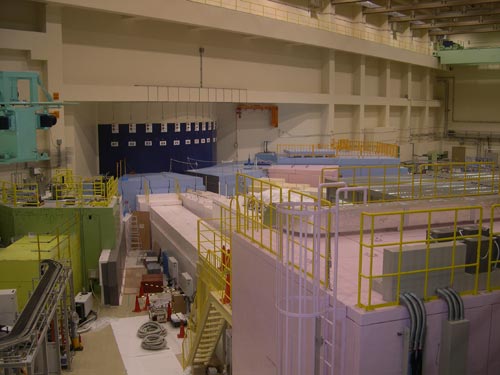
The target station at the Material Life-Science Facility

By Michael Banks

The paint has yet to dry here at the J-PARC experimental complex in Tokai, Japan.

Today I visited the Material Life-Science Facility (MLF), which produces neutrons and muons that are used in a variety of experiments in materials science to biology.

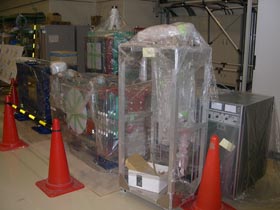
DSCN1602.jpg
under wraps…for now

At J-PARC, a 3 GeV synchrotron feeds the MLF with a intense beam of protons that are then smashed into a 20 tonne mercury target to produce neutrons.

Theses neutrons are then cooled using a water moderator before being sent to a maximum of 23 experimental stations.

If you like your research equipment brand new, then you have come to the right place. I could not find a single piece of kit that looked used. Even the box containing spanners looked like it had just been opened that morning.

So far 15 instruments at the MLF have been funded by the Japanese government and eight have already been built at a total cost of around $70m.

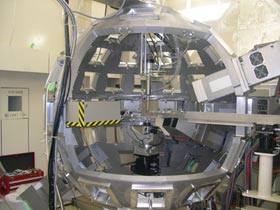
DSCN1577.jpg
A crystal diffrotometer – the ‘cage’ – for biological samples

The MLF has been operational since May 2008 when it produced its first neutron beam. At the moment, however, the beam has a power of 18 kW, which when fully operational is expected to reach 1 MW (the ISIS neutron source in Oxfordshire, for example, operates at 160 kW).

According to Masatoshi Arai, deputy director of the MLF, training the beam to full power will take around five years to complete.

The MLF has already had its first users. From the 100 proposals submitted last September for beamtime, 10% were from scientists based abroad, 10% from industry and the rest from scientists in Japan.

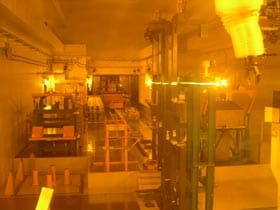
DSCN1623.jpg
Inside the target chamber

Interestingly, Aria told me that the Japanese government would only fund the MLF if it gave 25% of its beamtime to industry users – a decision that was reached at a meeting in 2000 that lasted until 5am in the morning after a full night of negotiations.

It was not only a great opportunity to walk around the facility and squeeze into all the sample rooms, but I also had the chance to see inside the mercury target chamber.

Once a high-powered beam has been used at the facility, access to the target chamber is strictly off limits due to the increase in radiation levels. Indeed, 1m deep perspex ‘windows’ are used to look into the target chamber.

Aria has spent the last nine years fully focused on getting the facility finished and is now looking forward to returning to his research into superconductivity.

Yet he isn’t quite finished thinking about the next steps for the MLF. “It is early days, but we already have plans for a second target station and then even more experiments,” says Aria.

Blogs, big physics and breaking news

wcsjlogo.jpg
Last week science journalists flocked to London from all corners of the globe

By Matin Durrani

My colleague James Dacey has already blogged twice (here and here about last week’s World
Conference of Science Journalists in London, but I thought I’d give my take on the meeting.

I chaired a session entitled “Blogs, big physics and breaking news”, which examined the challenges that physics bloggers pose to journalists and looked at the merits and downsides of such blogs.

The session was inspired in part by the incident a couple of years ago, when Tommaso Dorigo — a member of the 600-strong CDF collaboration at Fermilab — discussed on his blog A Quantum Diaries Survivor possible sightings of the Higgs boson in the decay of a Z-boson to a pair of tau leptons.

Although Dorigo — and other bloggers who discussed the data at the time — emphasized the uncertainty inherent in their results, his blog entry was picked up by journalists, who reported the story around the world. (Physics World gave a full account shortly afterwards of what happenned, which you can read here ).

That all seems fine on the surface — journalists dug out a story on particle physics that might otherwise have not seen the light of day.

Even better for journalists was the fact that Fermilab was not exactly chuffed that the discussion was out in the open — new results in particle physics are usually only made public after being “blessed” by the collaboration and published in a scientific paper.

But Dorigo was unhappy at the way his analysis was reported, which he claimed did not underline the uncertainty in the data. What’s more, it raises the question of the whole point of science journalism: if someone is really interested in Dorigo’s analysis, why bother with possibly inaccurate science stories in the media? Why not go straight to the blogosphere instead for the “real” story?

Admirably, Dorigo agreed to speak in London, braving an audience of about 100 of the world’s science journalists in the Edwardian-style Methodist Central Hall. On the stage alongside him were former Physics World features editor (and particle physicist) Matthew Chalmers, and CERN communication chief (and particle physicist) James Gillies

What followed was an entertaining debate, which saw this issue — and others — aired in a friendly and open manner.

(more…)

Accelerator complex officially opens

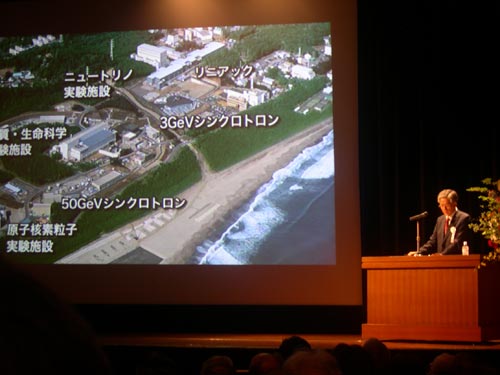
DSCN1553.jpg
Shoji Nagamiya, director of J-PARC, outlines the accelerator complex

By Michael Banks

Imagine having a world-leading neutron and muon source, a particle accelerator capable of boosting protons to 50 GeV, and a neutrino facility all on one site.

Well, you don’t have to any longer, as this is exactly what the $1.5bn J-PARC accelerator complex in Tokai, 100 km north of Tokyo, has to offer.

Today, physicists from around the world, myself included, met in Tokyo to celebrate the opening of the J-PARC accelerator complex after 12 years of construction.

The main aspects of J-PARC revolve around its 3 and 50 GeV synchrotrons. The 3 GeV synchrotron ramps up a beam of protons to smash them into a mercury target producing copious amounts of neutrons and muons that are then used in a range of experiments in biology to condensed-matter physics.

Meanwhile, the 50 GeV synchrotron, which is currently only operating at 30 GeV, accelerates protons before smashing them into a graphite target to produce kaons and neutrinos.

The inauguration held at the Kudan Kaikan centre in central Tokyo was attended by around 1000 scientists.

First to speak was Shoji Nagamiya, director of J-PARC, who has been with the project since its inception in 1999.

Unfortunately, during my few days in Tokyo I haven’t yet picked up the language, so I didn’t understand most of his or the other talks as they were given in Japanese.

After Nagamiya came a roster of dignitaries to the stage to offer their congratulations for the completion of J-PARC. These included the Japanese science minister, Ryu Shionoya, as well as Akito Arima, the former Japanese education minister and Masaru Hashimoto, governor of the Ibaraki prefecture, where J-PARC is based.

Next up was Makoto Kobayashi from the KEK lab, who shared the 2008 Nobel Prize with Yoichiro Nambu from the University of Chicago and Toshihide Maskawa from Kyoto University. Kobayashi gave a brief lecture about the new science that J-PARC hopes to unveil.

DSCN1564.jpg
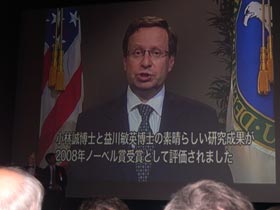
Steve Koonin gives a recorded message of congratulations

Steve Koonin, under secretary for science at the US Department of Energy also give a brief recorded message (in English) of congratulations saying that J-PARC represented “another great venture in Japanese science”.

After the talks had finished, scientists from other countries who helped to build J-PARC were named and invited to the stage.

Then Nagamiya flashed a slide up saying that any foreigner in attendance should come to the stage.

I couldn’t really hide away and was duly encouraged to go on the stage along with some other members from the audience.

I felt somewhat embarrassed to be applauded by over 500 Japanese scientists, but it was a nice touch to the event.

However, it was not all about talks and being red-faced on stage and after the talks a lavish banquet was put on with sushi and sashimi.

After the inauguration I caught up with Nagamiya, who said it was not always easy to build such a big lab that was a partnership between the KEK lab and the Japan Atomic Energy Agency. “Now I feel confident about the project,” says Nagamiya, “but when I started I was less confident. What is especially pleasing is that the world is leaning towards new neutron and neutrino facilities, so we are setting the trends.”

Lasers look inside human bones

Scientists in the UK are set to carry out hospital tests on a new laser technique that could ultimately lead to rapid and reliable detection of bone disorders such as brittle bone disease. The method includes a novel version of Raman spectroscopy — routinely used by physicists and chemists — and could give medics the most detailed characterization yet of bones inside the human body. That is according to the researchers based at the Central Laser Facility in the UK.

The strength of bones comes from two main components: the mineral content, such as calcium and crystalline mineral salts; and a protein-based substance known as collagen. There are various medical conditions linked with these substances including “brittle bone disease” where defective bones result from a deficiency of “type I” collagen.

To detect these diseases and to monitor a patient’s response to treatment, doctors require non-invasive ways of seeing inside bones in the body. At present the two favoured approaches are X-ray spectroscopy and ultrasound but both of these techniques struggle to see the collagen. As a result many cases of bone disease can go undetected.

Elusive proteins

In recent years, a different approach has been suggested that could detect both mineral content and collagen. Raman spectroscopy relies on the fact that light is scattered inelastically as it interacts with matter. In the classic experimental set-up, a laser is shone on a sample, which then scatters the photons at a slightly lower frequency. Measuring this change in colour of photons can determine the identity of the chemical under study.

Already, medical physicists have successfully applied Raman spectroscopy to tissues extracted from the body, but a problem arises when you attempt to observe bones that are still in vivo. Raman signals from surface layers tend to dominate those signals from under the skin of a patient, which are weakened significantly as they scatter sideways. These bone signals are then drowned out even further by the strong fluorescence in the melanin content of skin.

To overcome this problem, Pavel Matousek at the Central Laser Facility and his colleagues have bedecked Raman spectroscopy with an innovative new geometry. These scientists have reduced the dominance of the skins’ signal by creating a distance between the illumination and collection points of the Raman process. They also employ a ringed detector to ensure that all signals are captured effectively.

Souped-up spectroscopy

This technique, known as Spatially Offset Raman Spectroscopy (SORS), has already been used by an independent group in the US to determine the ratio of phosphate to carbonate — a potential indicator of osteoporosis — in a chicken’s shin bone. Matousek and his team now plan to take the next step by testing out SORS on human subjects at the Royal National Orthopaedic Hospital (RNOH) in Middlesex, UK.

Michael Morris, a spectroscopy researcher at the University of Michigan is optimistic about the new development. “Matousek is well-known for his excellent pioneering work in developing spatially offset Raman spectroscopy.” However, Morris also anticipates one of the main challenges ahead. “Confirmation by independent investigators is needed before any new finding can be accepted by clinicians.”

Matousek and his team will initially use their technique to test for brittle bone disease but they hope this will lead on to the investigation of other bone conditions such as osteoporosis, which presently goes undetected in three to four out of ten cases. “This project has the potential to provide a means of detection and confirmation of some of the rare bone disorders that are still difficult to diagnose,” said Richard Keen, a consultant rheumatologist at RNOH.

This work was published in Analyst.

Visiting Asia's oldest observatory

DSCN1476.jpg
The Cheomseongdae observatory

By Michael Banks

Being the International Year of Astronomy, what better time than to go and see Asia’s oldest surviving observatory.

The Cheomseongdae (star-gazing tower) observatory in Gyeongyu, South Korea, dates back to the seventh century and was built during the reign of Queen Seondoek of Silla.

The Silla dynasty began in 57 BC and reigned for almost 1000 years. It was one of the three kingdoms that ruled in Korea, but by 660 AD it had occupied the other two kingdoms – Baekje and Goguryeo — to rule most of the Korean peninsula.

The observatory is around 9m high and is built by 356 stones representing each day in the year. Seemingly everything about the construction of the observatory has some meaning. The observatory has 27 layers of stones as it is thought that Queen Seondoek was Silla’s 27th ruler. Then, above and below the opening is 12 layers of stone for every month in the year.

The Queen’s astronomer would climb to the top of the observatory every day to take a view the sky. Using a ladder, he would clamber through the opening in the observatory and then climb to the top. There he would give information to the Queen about weather patterns and the timings of any solar eclipse.

A shining light in Korean science

DSCN1436.jpg
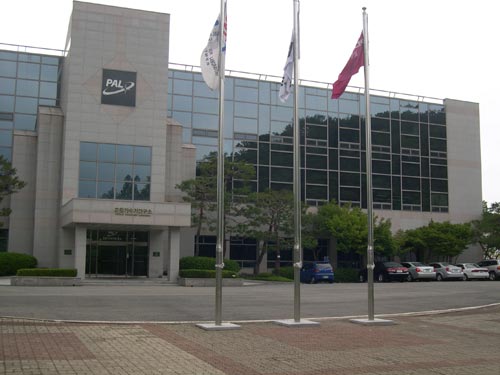
The Pohang Accelerator Laboratory

By Michael Banks

The number of synchrotrons in the world seems to be increasing with every month that passes by. Indeed, only a few months ago the Shanghai Synchrotron Radiation Facility China started experiments, closely followed by the PETRA III light source in Hamburg, Germany – adding to the 50 or so light sources operational worldwide.

Synchrotrons are used by researchers for a range of experiments in everything from condensed-matter physics to biomedicine by providing radiation from the infra-red to hard X-rays that can be used to solve protein structures and study quantum dots.

I visited South Korea’s only synchrotron, the $270m Pohang Accelerator Laboratory (PAL), which is on the Pohang Univeristy of Science and Technology (POSTECH) campus located in the South East of the country.

Opened in 1995, PAL is a 2.5 GeV light source that can house up to 27 beamlines around its 200m circumference.

DSCN1427.jpg
A public-private initiative. On the left is POSTECH’s first president, Hogil Kim, and on the right is the former chairman of POSCO, Tae-Joon Park.

Interestingly, I learned that PAL was built with both public and private funding. A local company, POSCO, which is now the world’s second largest steel manufacturer, funded the synchrotron with $190m, with the remainder coming from the Korean government.

PAL is open to scientists from other countries, but most of the experiments are carried out by scientists in Korea. Research carried out at the synchrotron now leads to over 8000 published papers every year with around 60% of them in international journals.

Researchers at POSTECH, which operates and owns PAL, are now hoping to upgrade the synchrotron to increase the number of beamlines as well as increasing its energy to 3 GeV. If the Korean government funds the upgrade it will begin construction late next year

South Korea also has other ambitious plans for an X-ray free electron laser facility — so-called fourth generation light source — that is only just in the proposal phase. If it is built then it would be situated next to PAL on the POSTECH campus making Pohang a leading centre for research in East Asia.

Happy 50th, Oxford Instruments

castle.jpg
Highclere: they don’t build them like they used too

By Hamish Johnston

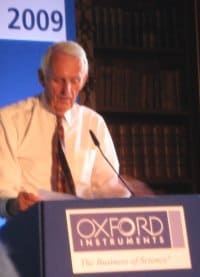
If you ask a British physicist to name a successful university spin-out, chances are they will say Oxford Instruments.

The company was founded 50 years ago by Martin and Audrey Wood — and has become a “household name” in physics labs throughout the world.

Yesterday I was invited to a series of lectures in celebration of the firm’s golden anniversary at the magnificent (and I don’t use that word lightly) Highclere Castle near Newbury.

Highclere is home to the Earl of Carnarvon, whose great-grandfather — along with Howard Carter — discovered the tomb of Tutankhamen. Under the house is a small museum dedicated to King Tut, and we were given a personal tour of the collection by the present Earl. Upstairs in the grand rooms one can also admire several family portraits by Joshua Reynolds.

But enough about Highclere…I was there to learn how a firm founded around a kitchen table in 1959 — and used a garden shed as its first manufacturing facility — has grown to employ over 1500 people in 25 offices worldwide.

wood opic.jpg
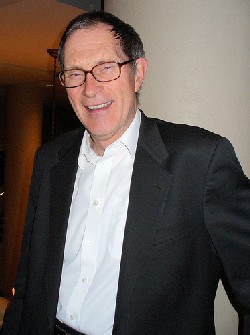
Sir Martin Wood

As its name suggests, the firm had its origins at Oxford University’s physics department, where Martin Wood’s day job involved designing and building lab equipment — including high-field magnets, which the Woods realized that they could make and sell.

According to Audrey Wood, who is also the firm’s historian, the early success of the company can be traced back to the 4th of November, 1961 and a decision made on a New York subway train. The Woods were in town for a physics conference and became convinced that they should wind magnets using superconducting wire.

Although superconducting magnets are more expensive than their copper counterparts, they can deliver extremely high magnetic fields without the need for large and very expensive power supplies.

At the time there were only about 10 facilities worldwide that had the need for — and could afford running — Oxford’s high-field magnets. By switching to superconducting magnets, the Woods figured this would rise to 10,000 potential users.

They were right…and soon the magnets were so popular that the users were struggling to buy enough liquid helium to cool them. This led to another crucial decision by the Woods — to buy a helium liquefier in order to supply its customers. This signalled the beginning of a cryogenics business group that became famous for its commercial dilution refrigerators — which can cool samples to below 2 mK.

But the biggest boost to the company’s fortunes came in the 1980s with the development of magnetic resonance imaging (MRI) systems for medical use. In order to keep pace with the demand for MRI magnets, the company was floated on the London stock exchange in 1983.

Martin Wood was knighted in 1986 for his services to science. At Highclere he described how being treated shabbily at his first job — making farm machinery at the the age of 15 — left him wanting to start a company that would thrive by treating its employees with respect. He certainly seems to have done that.

Science fiction on science journalism

ryman.jpg
He loves a good metaphor

By James Dacey

Science reporting should make more use of metaphors in order to explain difficult technical concepts. That is the opinion of Geoff Ryman, an award-winning science fiction writer, voiced at the World Conference of Science Journalists in London yesterday.

Ryman, who is also a lecturer at the University of Manchester, subscribes to the “mundane” school of sci-fi – rejecting “sexy” ideas like flying saucers and tentacled aliens in favour of more down-to-Earth, preferably “human” concepts. In 2006 he won the Arthur C. Clarke award for Air, a novel based on the idea of a successor to the internet which connects people’s brains via an invisible substance… known as Air.

Ryman’s line of argument – and it’s a well-trodden one – is that the general public only tend to engage in science and technology writing when it is presented to them in everyday concepts. “The best science writing tells a human story,” he said and, as a science fiction writer, he places himself amongst the “lay readers” drawing inspiration from ideas that touch him on an emotional rather than an abstract level.

According to the author, science journalism need not be any different from his approach, other than the fact that it’s obviously “limited” by scientific truths.

Sitting there yesterday, I thought Ryman did make some good points and he certainly delivered them in an eloquent way. But it also seems to me that he holds a very narrow view of science and scientists, painting them as abstract entities, disconnected from the rest of everyday life. This is simply not true.

I reckon that the distinction between good science and good fiction is a lot muddier than this because clear communication is absolutely integral to both. Many of the great scientific ideas have been presented with a devastating clarity through striking metaphors. Take Darwin’s Tree of Life, take String Theory, take the Big Bang… and I’m sure there’s plenty more. Anyway, the survival of these ideas has – in my opinion – been aided by their ability to reduce the complexity of nature into simpler, everyday concepts… just like a work of great fiction.

Let me know what you think…

Canada and Japan threaten global climate deal, warns prominent policy-maker

king.jpg
Countdown to Copenhagen

By James Dacey

Canada and Japan pose a serious threat to achieving a planet-saving deal in Copenhagen this December, warned Sir David King, former Chief Science Advisor to the UK government, speaking yesterday at the World Conference of Science Journalists that is taking place in London this week.

He was, of course, referring to the UN Climate Change Conference, which is set to thrash out a successor to the Kyoto protocol when it reaches the end of its first stage in 2012.

The latest report of the Intergovernmental Panel on Climate Change (IPCC concluded that global greenhouse-gas emissions will need to be cut by 80% of 1990 levels by 2050 if we are to ensure that global temperatures do not rise more than 2 degrees by the end of the century.

Over the course of two weeks in the Danish capital, officials from 192 nations will gather to address four main objectives:

1) Legally-binding targets – on carbon emissions;
2) Clarity on how developing countries should be expected to act;
3) Financing – how we going to cover the economic cost of maintaining acceptable living standards in low carbon societies; and
4) Governance structure – how the international community will work together to take the deal forward.

Yesterday in the UK capital, Sir David King urged the developed nations to “show their cards” now so we they can begin to formulate mitigation and adaptation plans in the lead up to December. “The debate has moved on – it is no longer a question of whether man-made climate change is happening but what to do about it”.

The former professor of physical chemistry at Cambridge University then went on to warn of a worrying shift in the positions of the Japanese and Canadian governments. King accused these nations of waning interest in tackling climate change, and attributed this to the recent scrapping of the role of chief scientist in both nations.

But when asked about the viability of mitigating climate change through large-scale geoengineering projects, King played his own cards surprisingly close to his chest:
“I am yet to be convinced that any of the existing options would be worth investing in, but I would like to see more research in this area.”

However, when pressed for his course of action in the event of an unsatisfactory result in Copenhagen, King did reveal a couple of back-up plans:

Plan B look for legal avenues that could stall the protocol from being implenented
Plan C lobby for a strong bilateral agreement between China and the US that could have the international clout to bring about a revision of the agreement.

“Obviously, I am a bit reluctant to discuss these options because it will appear that I am losing faith in plan A – which is by far the most desirable option,” he said.

Copyright © 2026 by IOP Publishing Ltd and individual contributors