Estonia is the first Baltic state to become a full member of the CERN particle-physics lab near Geneva. The country, which has a population of 1.3 million, formally became the 24th CERN member state on 30 August. Estonia is now expected to pay around €1.5m each year in membership fees.
Celebrating its 70th anniversary this year, CERN’s member countries, which include France, Germany and the UK, pay costs towards CERN’s programmes and sit on the lab’s governing council. Full membership also allows a country’s nationals to become CERN staff and for its firms to bid for CERN contracts. The lab also has 10 “associate member” and four countries or organizations with “observer” status, such as the US.
Accelerating collaborations
A first cooperation agreement between Estonia and CERN was signed in 1996, which was followed by a second agreement in 2010 with the country paying about €300,000 each year to the lab. Estonia formally applied for CERN membership in 2018 and on 1 February 2021 the country became an associate member state “in the pre-stage” to fully joining CERN.
Physicists in Estonia are already part of the CMS collaboration at the lab’s Large Hadron Collider (LHC) and they participate in data analysis and the Worldwide LHC Computing Grid (WLCG), in which a “tier 2” centre is located in Tallinn. Scientists from Estonia also contribute to other CERN experiments including CLOUD, COMPASS, NA66 and TOTEM, as well as work on future collider designs.
Estonia’s president, Alar Karis, who trained as a bioscientist, says he is “delighted” with the country’s full membership. “CERN accelerates more than tiny particles, it also accelerates international scientific collaboration and our economies,” Karis adds. “We have seen this potential during our time as associate member state and we are keen to begin our full contribution.”
CERN director general Fabiola Gianotti says she is “very pleased to welcome Estonia” as a full member. “I am sure the country and its scientific community will benefit from increased opportunities in fundamental research, technology development, and education and training.”
Any artist who paints is intuitively an expert in empirical fluid mechanics, manipulating liquid and pigment for aesthetic effect. The paint is usually brushed onto a surface material, although it can also be splattered onto a horizontal canvas in a technique made famous by Jackson Pollock or even layered on with a palette knife, as in the works of Paul Cezanne or Henri Matisse. But however the paint is delivered, once it dries, the result is always a fixed, static image.
Japanese artist Akiko Nakayama is different. Based in Tokyo, she makes the dynamic real-time flow of paint, ink and other liquids the centre of her work. Using a variety of colours, she encourages the fluids to move and mix, creating gorgeous, intricate patterns that transmute into unexpected forms and shades.
What also sets Nakayama apart is that she doesn’t work in private. Instead, she performs public “Alive painting” sessions, projecting her creations onto large surfaces, to the accompaniment of music. Audiences see the walls of the venue covered with coloured shapes that arise from natural processes modified by her intervention. The forms look abstract, but in their mutations often resemble living creatures in motion.
Inspired by ink
Born in 1988, Nakayama was trained in conventional techniques of Eastern and Western painting, earning degrees in fine art from Tokyo Zokei University in 2012 and 2014. Her interest in dynamic art goes back to a childhood calligraphy class, where she found herself enthralled by the beauty of the ink flowing in the water while washing her brush.
“It was more beautiful than the characters [I had written],” she recalls, finding herself “fascinated by the freedom of the ink”. Later, while learning to draw, she always preferred to capture a “moment of time” in her sketches. Eventually, Nakayama taught herself how to make patterns from moving fluids, motivated by Johann Wolfgang von Goethe’s treatise Theory of Colours (1810).
Best known as a writer, Goethe also took a keen interest in science and his book critiques Isaac Newton’s work on the physical properties of light. Goethe instead offered his own more subjective insights into his experiments with colour and the beauty they produce. Despite its flaws as a physical theory of light, reading the book encouraged Nakayama to develop methods to pour and agitate various paints in Petri dishes, and to project the results in real time using a camera designed for close-up viewing.
Wonderful stuff Appearing at the Dao Xuan Festival in Hanoi, Vietnam, in 2019, Akiko Nakayama is shown here creating a “dendritic” painting by applying colourful droplets of acrylic ink mixed with alcohol onto a flat surface coated with a layer of acrylic paint. Audience members watch as beautiful fractal structures appear in front of their eyes. (Courtesy: Akiko Nakayama)
She started learning about liquids, reading research papers and even began examining the behaviour of water droplets under strobe lights. Nakayama also looked into studies of zero gravity on liquids by JAXA, the Japanese space agency. After finding a 10 ml sample of ferrofluid – a nanoscale ferromagnetic colloidal liquid – in a student science kit, she started using the material in her presentations, manipulating it with a small, permanent magnet.
Nakayama’s art has an unexpected link with space science because ferrofluids were invented in 1963 by NASA engineer Steve Papell, who sought a way to pump liquid rocket fuel in microgravity environments. By putting tiny iron oxide particles into the fuel, he found that the liquid could be drawn into the rocket engine by an electromagnet. Ferrofluids were never used by NASA, but they have many applications in industry, medicine and consumer products.
Secret science of painting
Having presented dozens of live performances, exhibitions and commissioned works in Japan and internationally over the last decade, other scientific connections have emerged for Nakayama. She has, for example, mixed acrylic ink with alcohol, dropping the fluid onto a thin layer of acrylic paint to create wonderfully intricate branched, tree-like dendritic forms.
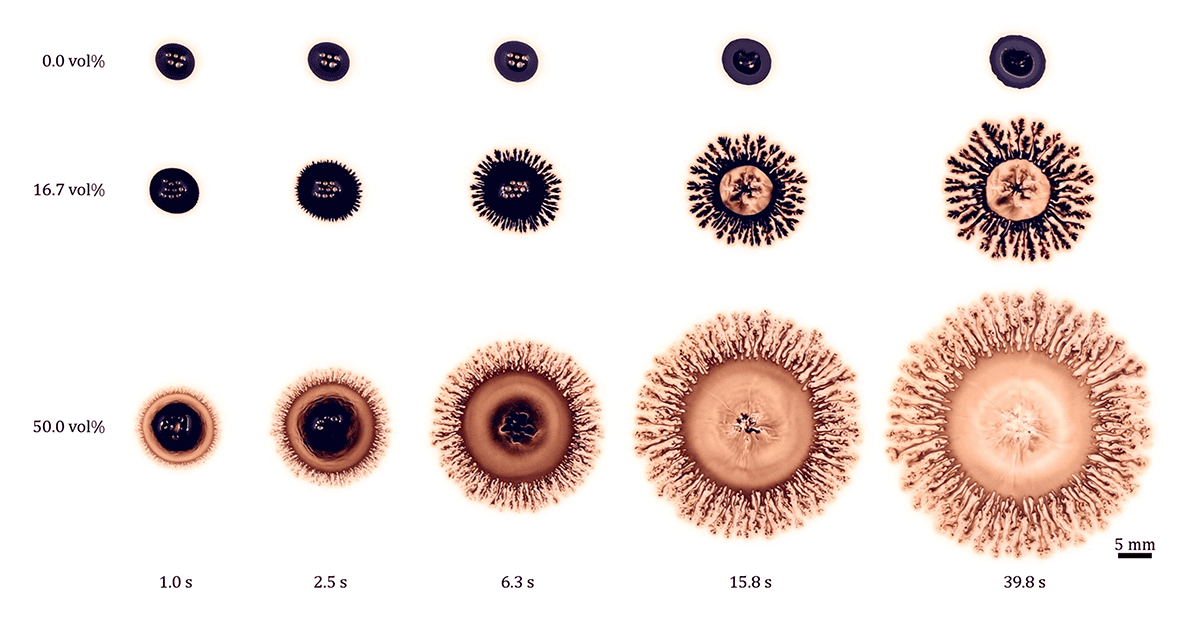
In 2023 her painting caught the attention of materials scientists San To Chan and Eliot Fried at the Okinawa Institute of Science and Technology in Japan. They ended up working with Nakayama to analyse dendritic spreading in terms of the interplay of the different viscosities and surface tensions of the fluids (figure 1).
When pure ink is dropped onto an acrylic resin substrate 400 microns thick, it remains fairly static over time (top). But if isopropanol (IPA) is mixed into the ink, the combined droplet spreads out to yield intricate, tree-like dendritic patterns. Shown here are drops with IPA at two different volume concentrations: 16.7% (middle) and 50% (bottom).
Chan and Fried published their findings, concluding that the structures have a fractal dimension of 1.68, which is characteristic of “diffusion-limited aggregation” – a process that involves particles clustering together as they diffuse through a medium (PNAS Nexus3 59).
The two researchers also investigated the liquid parameters so that an experimentalist or artist could tune the arrangement to vary the dendritic results. Nakayama calls this result a “map” that allows her to purposefully create varied artistic patterns rather than “going on an adventure blindly”. Chan and Fried have even drawn up a list of practical instructions so that anyone inclined can make their own dendritic paintings at home.
Another researcher who has also delved into the connection between fluid dynamics and art is Roberto Zenit, a mechanical engineer at Brown University in the US. Zenit has shown that Jackson Pollock created his famous abstract compositions by carefully controlling the motion of viscous filaments (Phys. Rev. Fluids4 110507). Pollock also avoided hydrodynamic instabilities that would have otherwise made the paint break up before it hit the canvas (PLOS One14 e0223706).
Deeper meanings
Although Nakayama likes to explore the science behind her artworks, she has not lost sight of the deeper meanings in art. She told me, for example, that the bubbles that sometimes arise as she creates liquid shapes have a connection with the so-called “Vanitas” tradition in art that emerged in western Europe in the 16th and 17th centuries.
Derived from the Latin word for “vanity”, this kind of art was not about having an over-inflated belief in oneself as the word might suggest. Instead, these still-life paintings, largely by Dutch artists, would often have symbols and images that indicate the transience and fragility of life, such as snuffed-out candles with wisps of smoke, or fragile soap bubbles blown from a pipe.
Dramatic effect A close-up of one of the bubbles in Nakayama’s live paintings created at the Mutek festival in Tokyo in December 2020, with the artist on the right and musical accompanists on the left. (Courtesy: Haruka Akagi)
The real bubbles in Nakayama’s artworks always stay spherical thanks to their strong surface tension, thereby displaying – in her mind – a human-like mixture of strength and vulnerability. It’s not quite the same as the fragility of the Vanitas paintings, but for Nakayama – who acknowledges that she’s not a scientist – her works are all about creating “a visual conversation between an artist and science”.
Asked about her future directions in art, however, Nakayama’s response makes immediate sense to any scientist. “Finding universal forms of natural phenomena in paintings is a joy and discovery for me,” she says. “I would be happy to continue to learn about the physics and science that make up this world, and to use visual expression to say ‘the world is beautiful’.”
A quarter of a century after it was first posed, a fundamental question about the nature of quantum entanglement finally has an answer – and that answer is “no”. In a groundbreaking study, Julio I de Vicente from the Universidad Carlos III de Madrid, Spain showed that so-called maximally entangled mixed states for a fixed spectrum do not always exist, challenging long-standing assumptions in quantum information theory in a way that has broad implications for quantum technologies.
Since the turn of the millennium, the Institute for Quantum Optics and Quantum Information (IQOQI) in Vienna, Austria, has maintained a conspicuous list of open problems in the quantum world. Number 5 on this list asks: “Is it true that for arbitrary entanglement monotones one gets the same maximally entangled states among all density operators of two qubits with the same spectrum?” In simpler terms, this question is essentially asking whether a quantum system can maintain its maximally entangled state in a realistic scenario, where noise is present.
This question particularly suited de Vicente, who has long been fascinated by foundational issues in quantum theory and is drawn to solving well-defined mathematical problems. Previous research had suggested that such a maximally entangled mixed state might exist for systems of two qubits (quantum bits), thereby maximizing multiple entanglement measures. In a study published in Physical Review Letters, however, de Vicente concludes otherwise, demonstrating that for certain rank-2 mixed states, no state can universally maximize all entanglement measures across all states with the same spectrum.
“I had tried other approaches to this problem that turned out not to work,” de Vicente tells Physics World. “However, once I came up with this idea, it was very quick to see that this gave the solution. I can say that I felt very excited seeing that such a relatively simple argument could be used to answer this question.”
Importance of entanglement
Mathematics aside, what does this result mean for real-world applications and for physics? Well, entanglement is a unique quantum phenomenon with no classical counterpart, and it is essential for various quantum technologies. Since our present experimental reach is limited to a restricted set of quantum operations, entanglement is also a resource, and a maximally entangled state (meaning one that maximizes all measures of entanglement) is an especially valuable resource.
One example of a maximally entangled state is a Bell state, which is one of four possible states for a system of two qubits that are each in a superposition of 0 and 1. Bell states are pure states, meaning that they can, in principle, be known with complete precision. This doesn’t necessarily mean they have definite values for properties like energy and momentum, but it distinguishes them from a statistical mixture of different pure states.
Maximally entangled mixed states
The concept of maximally entangled mixed states (MEMS) is a departure from the traditional view of entanglement, which has been primarily associated with pure states. Conceptually, when we talk about a pure state, we imagine a scenario where a device consistently produces the same quantum state through a specific preparation process. However, practical scenarios often involve mixed states due to noise and other factors.
In effect, MEMS are a bridge between theoretical models and practical applications, offering robust entanglement even in less-than-ideal conditions. This makes them particularly valuable for technologies like quantum encryption and quantum computing, where maintaining entanglement is crucial for performance.
What next?
de Vicente’s result relies on an entanglement measure that is constructed ad hoc and has no clear operational meaning. A more relevant version of this result for applications, he says, would be to “identify specific quantum information protocols where the optimal state for a given level of noise is indeed different”.
While de Vicente’s finding addresses an existing question, it also introduces several new ones, such as the conditions needed to simultaneously optimize various entanglement measures within a system. It also raises the possibility of investigating whether de Vicente’s theorems hold under other notions of “the same level of noise”, particularly if these arise in well-defined practical contexts.
The implications of this research extend beyond theoretical physics. By enabling better control and manipulation of quantum states, MEMS could revolutionize how we approach problems in quantum mechanics, from computing to material science. Now that we understand their limitations better, researchers are poised to explore their potential applications, including their role in developing quantum technologies that are robust, scalable, and practical.
Incandescent light bulbs and other thermal radiation sources can produce coherent, polarized and directed emissions with the help of a structured thin film known as a metasurface. Created by Andrea Alù and colleagues at the City University of New York (CUNY), US, the new metasurface uses a periodic structure with tailored local perturbations to transform ordinary thermal emissions into something more like a laser beam – an achievement heralded as “just the beginning” for thermal radiation control.
Scientists have previously shown that metasurfaces can perform tasks such as wavefront shaping, beam steering, focusing and vortex beam generation that normally require bulky traditional optics. However, these metasurfaces only work with the highly coherent light typically emitted by lasers. “There is a lot of hype around compactifying optical devices using metasurfaces,” says Alù, the founding director of CUNY’s Photonics Initiative. “But people tend to forget that we still need a bulky laser that is exciting them.”
Unlike lasers, most light sources – including LEDs as well as incandescent bulbs and the Sun – produce light that is highly incoherent and unpolarized, with spectra and propagation directions that are hard to control. While it is possible to make thermal emissions coherent, doing so requires special silicon carbide materials, and the emitted light has several shortcomings. Notably, a device designed to emit light to the right will also emit it to the left – a fundamental symmetry known as reciprocity.
Some researchers have argued that reciprocity fundamentally limits how asymmetric the wavefront emitted from such structures can be. However, in 2021 members of Alù’s group showed theoretically that a metasurface could produce coherent thermal emission for any polarization, travelling in any direction, without relying on special materials. “We found that the reciprocity constraint could be overcome with a sufficiently complicated geometry,” Alù says.
Smart workarounds
The team’s design incorporated two basic elements. The first is a periodic array that interacts with the light in a highly non-local way, creating a long-range coupling that forces the random oscillations of thermal emission to become coherent across long time scales and distances. The second element is a set of tailored local perturbations to this periodic structure that make it possible to break the symmetry in emission direction.
The only problem was that this structure proved devilishly difficult to construct, as it would have required aligning two independent nanostructured arrays within a 10 nm tolerance. In the latest work, which is described in Nature Nanotechnology, Alù and colleagues found a way around this by backing one structured film with a thin layer of gold. This metallic backing effectively creates an image of the structure, which breaks the vertical symmetry as needed to realize the effect. “We were surprised this worked,” Alù says.
The final structure was made from silicon and structured as an array of rectangular pillars (for the non-local interactions) interspersed with elliptical pillars (for the asymmetric emission). Using this structure, the team demonstrated coherent directed emission for six different polarizations, at frequencies of their choice. They also used it to send circularly polarized light in arbitrary directions, and to split thermal emissions into orthogonally polarized components travelling in different directions. While this so-called photonic Rashba effect has been demonstrated before in circularly polarized light, the new thermal metasurface produces the same effect for arbitrary polarizations – something not previously thought possible.
According to Alù, the new metasurface offers “interesting opportunities” for lighting, imaging, and thermal emission management and control, as well as thermal camouflaging. George Alexandropoulos, who studies metasurfaces for informatics and telecommunication at the National and Kapodistrian University of Athens, Greece but was not involved in the work, agrees. “Metasurfaces controlling thermal radiation could direct thermal emission to energy-harvesting wireless devices,” he says.
Riccardo Sapienza, a physicist at Imperial College London, UK, who also studies metamaterials and was also not involved in this research, agrees that communication could benefit and suggests that infrared sensing could, too. “This is a very exciting result which brings closer the dream of complete control of thermal radiation,” he says. “I am sure this is just the beginning.”
If you have ever been on the receiving end of a paper cut, you will know how painful they can be.
Kaare Jensen from the Technical University of Denmark (DTU), however, has found intrigue in this bloody occurrence. “I’m always surprised that thin blades, like lens or filter paper, don’t cut well, which is unexpected because we usually consider thin blades to be efficient,” Jensen told Physics World.
To find out why paper is so successful at cutting skin, Jensen and fellow DTU colleagues carried out over 50 experiments with a range of paper thicknesses to make incisions into a piece of gelatine at various angles.
Through these experiments and modelling, they discovered that paper cuts are a competition between slicing and “buckling”. Thin paper with a thickness of about 30 microns, or 0.03 mm, doesn’t cut so well because it buckles – a mechanical instability that happens when a slender object like paper is compressed. Once this occurs, the paper can no longer transfer force to the tissue, so is unable to cut.
Thick paper, with a thickness greater than around 200 microns, is also ineffective at making an incision. This is because it distributes the load over a greater area, resulting in only small indentations.
The team found, however, a paper cut “sweet spot” at around 65 microns and when the incision was made at an angle of about 20 degrees from the surface. This paper thickness just happens to be close to that of the paper used in print magazines, which goes some way to explain why it annoyingly happens so often.
Using the results from the work, the researchers created a 3D-printed scalpel that uses scrap paper for the cutting edge. Using this so-called “papermachete” they were able to slice through apple, banana peel, cucumber and even chicken.
Jensen notes that the findings are interesting for two reasons. “First, it’s a new case of soft-on-soft interactions where the deformation of two objects intertwines in a non-trivial way,” he says. “Traditional metal knives are much stiffer than biological tissues, while paper is still stiffer than skin but around 100 times weaker than steel.”
The second is that it is a “great way” to teach students about forces given that the experiments are straightforward to do in the classroom. “Studying the physics of paper cuts has revealed a surprising potential use for paper in the digital age: not as a means of information dissemination and storage, but rather as a tool of destruction,” the researchers write.
This article has been updated to correct a misinterpretation of this null result.
Things can go a bit off-topic at Physics World and recent news about dark matter got us talking about the beauty of the Black Hills of South Dakota. This region of forest and rugged topography is smack dab in the middle of the Great Plains of North America and is most famous for the giant sculpture of four US presidents at Mount Rushmore.
A colleague from Kansas fondly recalled a family holiday in the Black Hills – and as an avid skier, I was pleased to learn that the region is home to the highest ski lift between the Alps and the Rockies.
The Black Hills also have a special place in the hearts of physicists – especially those who are interested in dark matter and neutrinos. The region is home to the Sanford Underground Research Facility, which is located 1300 m below the hills in a former gold mine. It was there that Ray Davis and colleagues first detected neutrinos from the Sun, for which Davis shared the 2002 Nobel Prize for Physics.
Today, the huge facility is home to nearly 30 experiments that benefit from the mine’s low background radiation. One of the biggest experiments is LUX–ZEPLIN, which is searching for dark-matter particles.
Hypothetical substance
Dark matter is a hypothetical substance that is invoked to explain the dynamics of galaxies, the large-scale structure of the cosmos, and more. While dark matter is believed to account for 85% of mass in the universe, physicists have little understanding of what it is – or indeed if it actually exists.
So far, the best that experiments like LUX–ZEPLIN have done is to tell physicists what dark matter isn’t. Now, the latest result from LUX–ZEPLIN places the best-ever limits on the nature of dark-matter particles called WIMPs.
The measurement involved watching several tonnes of liquid xenon for 280 days, looking for flashes of light that would be created when a WIMP collides with a xenon nuclei. However no evidence was seen for collisions with WIMPs heavier than 9 GeV/c2 – which is about 10 times the mass of the proton.
The team says that the result is “nearly five times better” than previous WIMP searches. “These are new world-leading constraints by a sizable margin on dark matter and WIMPs,” explains Chamkaur Ghag, who speaks for the LUX–ZEPLIN team and is based at University College London.
Digging for treasure
“If you think of the search for dark matter like looking for buried treasure, we’ve dug almost five times deeper than anyone else has in the past,” says Scott Kravitz of the University of Texas at Austin who is the deputy physics coordinator for the experiment.
This will not be the last that we hear from LUX–ZEPLIN, which will collect a total of 1000 days of data before it switches off in 2028. And it’s not only dark matter that the experiment is looking for. Because it is in a low background environment, LUX–ZEPLIN is also being used to search for other rare or hypothetical events such as the radioactive decay of xenon, neutrinoless double beta decay and neutrinos from the beta decay of boron nuclei in the Sun.
LUX–ZEPLIN is not the only experiment at Sanford that is looking for neutrinos. The Deep Underground Neutrino Experiment (DUNE) is currently under construction at the lab and is expected to be completed in 2028. DUNE will detect neutrinos in four huge tanks that will each be filled with 17,000 tonnes of liquid argon. Some neutrinos will be beamed from 1300 km away at Fermilab near Chicago and together the facilities will comprise the Long-Baseline Neutrino Facility.
One aim of the facility is to study the flavour oscillation of neutrinos as they travel over long distances. This could help explain why there is much more matter than antimatter in the universe. By detecting neutrinos from exploding stars, DUNE could also shed light on the nuclear processes that occur during supernovae. And, it might even detect the radioactive decay of the proton, a hypothetical process that could point to physics beyond the Standard Model.
Enhancing the dose Dose distributions for a pancreatic ductal carcinoma case and a pancreatic adenocarcinoma case, for GNP-enhanced 2.5 MV plans (left) and 6 MV beams without GNPs (right). (Courtesy: Phys. Med. Biol. 10.1088/1361-6560/ad68be)
The primary goal of radiotherapy is to effectively destroy the tumour while minimizing side effects to nearby normal tissues. Focusing on the challenging case of pancreatic cancer, a research team headed up at Toronto Metropolitan University in Canada has demonstrated that gold nanoparticles (GNPs) show potential to optimize this fine balance between tumour control probability (TCP) and normal tissue complication probability (NTCP).
GNPs are under scrutiny as candidates for improving the effectiveness of radiation therapy by enhancing dose deposition within the tumour. The dose enhancement observed when irradiating GNP-infused tumour tissue is mainly due to the Auger effect, in which secondary electrons generated within the nanoparticles can damage cancer cells.
“Nanoparticles like GNPs could be delivered to the tumour using targeting agents such as [the cancer drug] cetuximab, which can specifically bind to the epidermal growth factor receptor expressed on pancreatic cancer cells, ensuring a high concentration of GNPs in the tumour site,” says first author Navid Khaledi, now at CancerCare Manitoba.
This increased localized energy deposition should improve tumour control; but it’s also crucial to consider possible toxicity to normal tissues due to the presence of GNPs. To investigate this further, Khaledi and colleagues simulated treatment plans for five pancreatic cancer cases, using CT images from the Cancer Imaging Archive database.
Plan comparison
For each case, the team compared plans generated using a 2.5 MV photon beam in the presence of GNPs with conventional 6 MV plans. “We chose a 2.5 MV beam due to the enhanced photoelectric effect at this energy, which increases the interaction probability between the beam and the GNPs,” Khaledi explains.
The researchers created the treatment plans using the MATLAB-based planning program matRad. They first determined the dose enhancement conferred by 50-nm diameter GNPs by calculating the relative biological effectiveness (RBE, the ratio of dose without to dose with GNPs for equal biological effects) using custom MATLAB codes. The average RBE for the 2.5 MV beam, using α and β radiosensitivity values for pancreatic tumour, was 1.19. They then applied RBE values to each tumour voxel to calculate dose distributions and TCP and NTCP values.
The team considered four treatment scenarios, based on a prescribed dose of 40 Gy in five fractions: 2.5 MV plus GNPs, designed to increase TCP (using the prescribed dose, but delivering an RBE-weighted dose of 40 Gy x 1.19); 2.5 MV plus GNPs, designed to reduce NTCP (lowering the prescribed dose to deliver an RBE-weighted dose of 40 Gy); 6 MV using the prescribed dose; and 6 MV with the prescribed dose increased to 47.6 Gy (40 Gy x 1.19).
The analysis showed that the presence of GNPs significantly increased TCP values, from around 59% for the standard 6 MV plans to 93.5% for the 2.5 MV plus GNPs (increased TCP) plans. Importantly, the GNPs helped to maintain low NTCP values of below 1%, minimizing the risk of complications in normal tissues. Using a conventional 6 MV beam with an increased dose also resulted in high TCP values, but at the cost of raising NTCP to 27.8% in some cases.
Minimizing risks
The team next assessed the dose to the duodenum, the main dose-limiting organ for pancreatic radiotherapy. The mean dose to the duodenum was highest for the increased-dose 6 MV photon beam, and lowest for the 2.5 MV plus GNPs plans. Similarly, D2%, the maximum dose received by 2% of the volume, was highest with the increased-dose 6 MV beam, and lowest with 2.5 MV plus GNPs.
It’s equally important to consider dose to the liver and kidney, as these organs may also uptake GNPs. The analysis revealed relatively low doses to the liver and left kidney for all treatment options, with mean dose and D2% generally below clinically significant thresholds. The highest mean doses to the liver and left kidney for 2.5 MV plus GNPs were 3.3 and 7.7 Gy, respectively, compared with 2.3 and 8 Gy for standard 6 MV photons.
The researchers conclude that the use of GNPs in radiation therapy has potential to significantly improve treatment outcomes and benefit cancer patients. Khaledi notes, however, that although GNPs have shown promise in preclinical studies and animal models, they have not yet been tested for radiotherapy enhancement in human subjects.
Next, the team plans to investigate new linac targets that could potentially enable therapeutic applications. “One limitation of the current 2.5 MV beam is its low dose rate (60 MU/min) on TrueBeam linacs, primarily due to the copper target’s heat tolerance,” Khaledi tells Physics World. “Increasing the dose rate could make the beam clinically useful, but it risks melting the copper target. Future work will evaluate the beam spectrum for different target designs and materials.”
On 15 August 1977 the Big Ear radio telescope in the US was scanning the skies in a search for signs of intelligent extraterrestrial life. Suddenly, it detected a strong, narrow bandwidth signal that lasted a little longer than one minute – as expected if Big Ear’s field of vision swept across a steady source of radio waves. That source, however, had vanished 24 hours later when the Ohio-based telescope looked at the same patch of sky.
This was the sort of technosignature that searches for extraterrestrial intelligence (SETI) were seeking. Indeed, one scientist wrote the word “Wow!” next to the signal on a paper print-out of the Big Ear data.
Ever since, the origins of the Wow! signal have been debated – and now, a trio of scientists have an astrophysical explanation that does not involve intelligent extraterrestrials. One of them, Abel Méndez, is our guest in this episode of the Physics World Weekly podcast.
Méndez is an astrobiologist at the University of Puerto Rico at Arecibo and he explains how observations made at the Arecibo Telescope have contributed to the trio’s research.
Abel Méndez, Kevin Ortiz Ceballos and Jorge I Zuluaga describe their research in a preprint on arXiv.
An antihyperhydrogen-4 nucleus – the heaviest antinucleus ever produced – has been observed in heavy ion collisions by the STAR Collaboration at Brookhaven National Laboratory in the US. The antihypernucleus contains a strange quark, making it a heavier cousin of antihydrogen-4. Physicists hope that studying such antimatter particles could shed light on why there is much more matter than antimatter in the visible universe – however in this case, nothing new beyond the Standard Model of particle physics was observed.
In the first millionth of a second after the Big Bang, the universe is thought to have been too hot for quarks to have been bound into hadrons. Instead it comprised a strongly interacting fluid called a quark–gluon plasma. As the universe expanded and cooled, bound baryons and mesons were created.
The Standard Model forbids the creation of matter without the simultaneous creation of antimatter, and yet the universe appears to be made entirely of matter. While antimatter is created by nuclear processes – both naturally and in experiments – it is swiftly annihilated on contact with matter.
The Standard Model also says that matter and antimatter should be identical after charge, parity and time are reversed. Therefore, finding even tiny asymmetries in how matter and antimatter behave could provide important information about physics beyond the Standard Model.
Colliding heavy ions
One way forward is to create quark–gluon plasma in the laboratory and study particle–antiparticle creation. Quark–gluon plasma is made by smashing together heavy ions such as lead or gold. A variety of exotic particles and antiparticles emerge from these collisions. Many of them decay almost immediately, but their decay products can be detected and compared with theoretical predictions.
Quark–gluon plasma can include hypernuclei, which are nuclei containing one or more hyperons. Hyperons are baryons containing one or more strange quarks, making hyperons the heavier cousins of protons and neutrons. These hypernuclei are thought to have been present in the high-energy conditions of the early universe, so physicists are keen to see if they exhibit any matter/antimatter asymmetries.
In 2010, the STAR collaboration unveiled the first evidence of an antihypernucleus, which was created by smashing gold nuclei together at 200 GeV. This was the antihypertriton, which is the antimatter version of an exotic counterpart to tritium in which one of the down quarks in one of the neutrons is replaced by a strange quark.
Now, STAR physicists have created a heavier antihypernucleus. They recorded over 6 billion collisions using pairs of uranium, ruthenium, zirconium and gold ions moving at more than 99.9% of the speed of light. In the resulting quark–gluon plasma, the researchers found evidence of antihyperhydrogen-4 (antihypertriton with an extra antineutron). Antihyperhydrogen-4 decays almost immediately by the emission of a pion, producing antihelium-4. This was detected by the researchers in 2011. The researchers therefore knew what to look for among the debris of their collisions.
Sifting through the collisions
Sifting through the collision data, the researchers found 22 events that appeared to be antihyperhydrogen-4 decays. After subtracting the expected background, they were left with approximately 16 events, which was statistically significant enough to claim that they had observed antihyperhydrogen-4.
The researchers also observed evidence of the decays of hyperhydrogen-4, antihypertriton and hypertriton. In all cases, the results were consistent with the predictions of charge–parity–time (CPT) symmetry. This is a central tenet of modern physics that says that if the charge and internal quantum numbers of a particle are reversed, the spatial co-ordinates are reversed and the direction of time is reversed, the outcome of an experiment will be identical.
STAR member Hao Qiu of the Institute of Modern Physics at the Chinese Academy of Sciences says that, in his view, the most important feature of the work is the observation of the hyperhydrogen-4. “In terms of the CPT test, it’s just that we’re able to do it…The uncertainty is not very small compared with some other tests.”
Qiu says that he, personally, hopes the latest research may provide some insight into violation of charge–parity symmetry (i.e. without flipping the direction of time). This has already been shown to occur in some systems. “Ultimately, though, we’re experimentalists – we look at all approaches as hard as we can,” he says; “but if we see CPT symmetry breaking we have to throw out an awful lot of current physics.”
“I really do think it’s an incredibly impressive bit of experimental science,” says theoretical nuclear physicist Thomas Cohen of University of Maryland, College Park; “The idea that they make thousands of particles each collision, find one of these in only a tiny fraction of these events, and yet they’re able to identify this in all this really complicated background – truly amazing!”
He notes, however, that “this is not the place to look for CPT violation…Making precision measurements on the positron mass versus the electron mass or that of the proton versus the antiproton is a much more promising direction simply because we have so many more of them that we can actually do precision measurements.”
A thermochemical reactor powered entirely by electricity has been unveiled by Jonathan Fan and colleagues at Stanford University. The experimental reactor was used to convert carbon dioxide into carbon monoxide with close to 90% efficiency. This makes it a promising development in the campaign to reduce carbon dioxide emissions from industrial processes that usually rely on fossil fuels.
Industrial processes account for a huge proportion of carbon emissions worldwide – accounting for roughly a third of carbon emissions in the US, for example. In part, this is because many industrial processes require huge amounts of heat, which can only be delivered by burning fossil fuels. To address this problem, a growing number of studies are exploring how combustion could be replaced with electrical sources of heat.
“There are a number of ways to use electricity to generate heat, such as through microwaves or plasma,” Fan explains. “In our research, we focus on induction heating, owing to its potential for supporting volumetric heating at high power levels, its ability to scale to large power levels and reactor volumes, and its strong safety record.”
Induction heating uses alternating magnetic fields to induce electric currents in a conductive material, generating heat via the electrical resistance of the material. It is used in a wide range of applications from domestic cooking to melting scrap metal. However, it has been difficult to use induction heating for complex industrial applications.
In its study, Fan’s team focused on using inductive heating in thermochemical reactors, where gases are transformed into valuable products through reactions with catalysts.
Onerous requirements
The heating requirements for these reactors are especially onerous, as Fan explains. “They need to produce heat in a 3D space; they need to feature exceptionally high heat transfer rates from the heat-absorbing material to the catalyst; and the energy efficiency of the process needs to be nearly 100%.”
To satisfy these requirements, the Stanford researchers created a new design for internal reactor structures called baffles. Conventional baffles are used to enhance heat transfer and mixing within a reactor, improving its reaction rates and yields.
In their design, Fan’s team re-reimagined these structures as integral components of the heating process itself. Their new baffles comprised a 3D lattice made from a conductive ceramic, which can be heated via magnetic induction at megahertz frequencies.
“The lattice structure can be modelled as a medium whose electrical conductivity depends on both the material composition of the ceramic and the geometry of the lattice,” Fan explains. “Therefore, it can be conceptualized as a metamaterial, whose physical properties can be tailored via their geometric structuring.”
Encouraging heat transfer
This innovative design addressed three key requirements of a thermochemical reactor. First, by occupying the entire reactor volume, it ensures uniform 3D heating. Second, the metamaterial’s large surface area encourages heat transfer between the lattice and the catalyst. Finally, the combination of the high induction frequency and low electrical conductivity in the lattice delivers high energy efficiency.
To demonstrate these advantages, Fan says, “we tailored the metamaterial reactor for the ‘reverse water gas shift’ reaction, which converts carbon dioxide into carbon monoxide – a useful chemical for the synthesis of sustainable fuels”.
To boost the efficiency of the conversion, the team used a carbonate-based catalyst to minimize unwanted side reactions. A silicon carbide foam lattice baffle and a novel megahertz-frequency power amplifier were also used.
As Fan explains, initial experiments with the reactor yielded very promising results. “These demonstrations indicate that our reactor operates with electricity to internal heat conversion efficiencies of nearly 90%,” he says.
The team hopes that its design offers a promising step towards electrically powered thermochemical reactors that are suited for a wide range of useful chemical processes.
“Our concept could not only decarbonize the powering of chemical reactors but also make them smaller and simpler,” Fan says. “We have also found that as our reactor concept is scaled up, its energy efficiency increases. These implications are important, as economics and ease of implementation will dictate how quickly decarbonized reactor technologies could translate to real-world practice.”