Ig Nobel stars roll into town

sword.jpg
Cutting edge science

Ever levitated a frog?
No.
How about, organized an athletics contest between the fleas of a dog and the fleas of a cat?
Thought not.
Ever observed homosexual ducks commit necrophilia?
Ok, I think I need to explain…

These scientific “feats” were amongst the wacky studies presented last night on the latest stop of the Ig Nobel awards tour, in Bristol.

I went along to see if the show lives up to its claim to “first make people laugh, and then make them think”.

Jovial compere Marc Abrahams opened the proceedings telling each speaker they had “5 minutes and NOT A SECOND MORE!”

In the physics category, Sir Michael Berry of Bristol University described how he won the prize in 2000 for explaining how frogs can be levitated with magnets. “Of Flying Frogs and Levitrons” was published in the European Journal of Physics.

Surely the weirdest talk was from 2003 winner for biology Kees Moeliker who talked about homosexual ducks committing necrophilia. So the story goes… he had been sitting in his office when he heard the loud bang of a duck crashing into his window. Rushing out to see if it was ok he was shocked to witness the duck – dead, with a second, live duck, forcing itself upon the corpse. Later observations revealed both ducks to be male and the study was published in the Annual of the Natural History Museum Rotterdam.

A slightly tamer ornithological study addressed the question of “why woodpeckers don’t get headaches?” Apparently it’s because of a millisecond delay between the bird’s beak hitting the tree and its head moving forwards. I caught up with study’s presenter Julian Vincent and his wife after the show. She said he’s “always been full of ideas”.

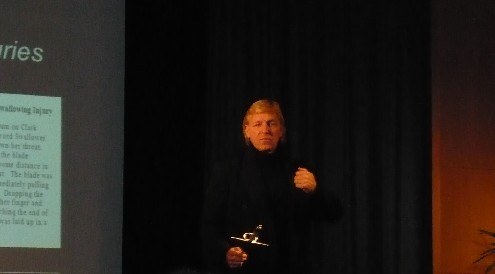
My favourite act was Dan Meyer – a sword swallower from Tennessee. He eloquently talked us through his 2007 prize-winning paper “Sword Swallowing and Its Side Effects,” before ramming a 17 inch blade down his throat.

A scared looking young girl near the front asked the question everyone was thinking “does it hurt?” To which he replied “a little”

So did the evening make me laugh and then think afterwards?
Well, putting the ancient art of sword-swallowing to one side – I have to say that I found the whole thing a little bit “zany” for my taste.

Having said that, when I looked around the conference room, people were certainly laughing and there was plenty of scientific interest in the after show Q&A session. So perhaps it’s just me becoming an old fuddy-duddy before my time…

US pays price for $500m budget blunder

A $500m accounting error led to the Bush administration scrapping a carbon–capture and storage demonstration plant last year according to a report by the US House of Representatives committee of science and technology. The project was scrapped because costs appeared to have ballooned from $1bn to $1.8bn when in fact it had only risen to $1.3bn.

The report concludes that the Bush administration’s abrupt pull-out “severely” damaged the country’s reputation as an international science partner and “left the country with no coherent strategy for carbon–capture”.

First announced by President George W Bush back in 2003 FutureGen was designed as a coal-fired power plant that would not emit any carbon dioxide by capturing and storing it underground in a technique known as carbon capture and sequestration (CCS). To be built in 2013, the plant was to have been constructed by the FutureGen Alliance — a public–private partnership set up to design, build and operate the plant.

Huge cost overrun?

However, in the 2008 financial year budget, the Department of Energy (DOE), led by Samuel Bodman, cancelled a $1.1bn grant for the project because of the apparent huge cost overrun. “Unfortunately, the Bush Energy Department withdrew their support for FutureGen before the Alliance could complete a new cost estimate in June 2008,” Lawrence Pacheco, a spokesperson for the company told physicsworld.com. However, that figure now seems to be wrong. The report by the House, says that Bodman made an “inexcusable error for the head of a federal agency”. The cause for the mistake was that the initial $1bn estimate was made using constant 2004 dollars, but for the cost estimate last year the DOE factored in inflation through until 2017, which led to the cost ballooning to $1.8bn.

An audit carried out by the US Government Accountability Office in February concluded that the cost of the FutureGen project had actually increased by only 39% to $1.3bn in constant 2005 dollars — $500m less than the DOE calculated.

‘Shovel ready’ projects

Following from President Obama’s $787bn stimulus package announced last month, the DOE gained an extra $1.6bn in funding beyond its 2009 budget of $4.0bn. Some of this may be spent on “shovel ready” projects, which could include FutureGen. “The Alliance will make the case that it is shovel ready,” says Pacheco, “[FutureGen is] the furthest along of any similar project and can deliver much needed CCS technology to the world.”

The FutureGen Alliance now plans to meet with energy secretary Steven Chu to kick-start the project. The Nobel–prize winning physicist has already stated his support of CCS demonstration plants.

Molecular junctions make a switch

Physicists in the US have shown how the electrical current flowing through certain molecular junctions can be switched on and off on by simply stretching or compressing the molecules. The discovery could be exploited to make switches in future molecular devices, and could also help in the understanding of resistance at the nanoscale.

In normal electronic devices, resistance is a well-understood property. When an electric field is applied across a metal, charge–carrying electrons begin to drift but bump into ions and impurities, which slow their motion. At nanometre distances, however, things are not so simple: electrons are able to “tunnel” across small insulating barriers with a finite probability. This means that the electrons can overcome obstacles without losing energy, and therefore without electrical resistance.

Tunnelling is an important consideration in designing nanoscale devices, but measuring its effect is not easy. In 2007, a team led by Latha Venkataraman at Columbia University in New York and Jeffrey Neaton of Lawrence Berkeley National Laboratory (LBNL) in California, managed to measure the conductance of amine-based molecules that were in contact with gold and successfully compare with theory. They touched the gold tip of a scanning tunnelling microscope (STM) onto a gold surface containing amine molecules and then retracted it, so that the tip linked to the surface only by a single, fragile molecular strand. When this strand broke other molecules hopped in to fill the gap, and from this the researchers could calculate the sudden jump in conductance.

Molecular bridge

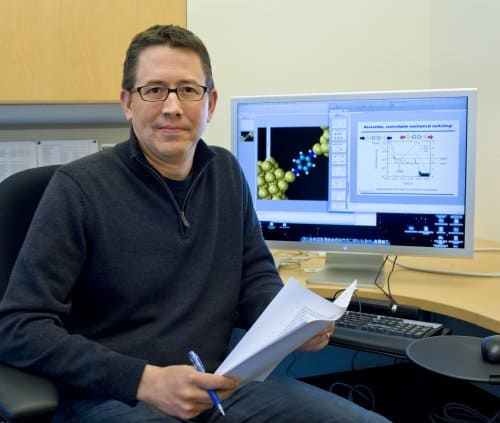
Now, the researchers at Columbia’s NSF Center for Electron Transport in Molecular Nanostructures, and LBNL’s Molecular Foundry have gone a step further and looked at different conductance states in the molecular strand bridging a STM to a gold surface. Rather than use amines they have used bipyridine, a molecule with twin benzene-like rings that contain nitrogen. They found that bipyridine has two resistance states: when it is bonded to the STM at an angle the resistance is low and the junction is “on”; when it is bonded vertically the resistance is high and the junction is “off”. In fact, the researchers found that they could switch the junction between the on and off resistance states simply by pushing and pulling the STM tip (Nature Nanotechnology doi:10.1038/nnano.2009.10).

Venkataraman, Neaton, and colleagues believe the different resistance states result from electron tunnelling through the conductive “pi” orbitals of the bipyridine molecule. The different orientations of the molecule change the amount of overlap between the quantum wavefunctions of the pi orbitals and the incident electrons from the gold electrodes. When bipyridine is at an angle the overlap is greater, which increases the chance of tunnelling and therefore decreases the resistance.

A better theory

“One outcome of this study is an improved ‘first principles’ theoretical approach, free of empirical parameters, for conductance in certain classes of nanoscale molecular junctions,” Neaton told physicsworld.com. “Working with experiments, we will continue to develop and extend the range of our theories to junctions and phenomena involving more complex molecules.”

Neaton explains that his team are particularly interested in looking at certain asymmetric molecules with the ability to separate charge, which are used in some organic photovoltaic materials. “Extended studies of such molecular junctions may shed further light on how we might enhance the efficiency of charge separation and transport — and thereby light harvesting — in organic and hybrid organic–inorganic nanomaterials,” he adds.

Sour grapes in the Big Apple

nycsteam.jpg
Letting off steam in NYC

What do the president of the Czech Republic and the last living man to walk on the moon have in common?

Answer: they both have a thing about climate change “alarmists”

Both angry men are giving speeches at what’s being billed as the world’s largest ever meeting of climate change sceptics, in New York City.

Organised by the Heartland Institute – a US public policy think tank dedicated to free market solutions – the conference will centre around the question: “Global Warming: Was it Ever Really a Crisis?”

One of the pre-event adverts led with the statement:

Tens of thousands of scientists now say the media and environmental advocacy groups have it all wrong, that global warming is not a crisis. They point to a cooling trend in global temperatures since 2000, past warming and cooling cycles that were not man-made, and new evidence that carbon dioxide is not a very powerful greenhouse gas.

You can also watch a couple of the Institute’s short promos here.

Amongst the keynote speakers is Vaclav Klaus, President of the Czech Republic which currently holds the rotating presidency of the European Union.

Klaus, who has an academic background in economics, is giving a talk this morning (Tuesday) entitled “We Should Not Make Big Changes over Climate Change”.

Other notable presenters include: Jack Schmitt, the last living astronaut to walk on the moon; Roy Spencer, the principal research scientist on NASA’s Aqua satellite; and Richard Lindzen of Massachusetts Institute of Technology, one of the world’s leading experts in dynamic meteorology.

Meanwhile, over in Copenhagen this week more than 2000 climate scientists will be discussing their latest research ahead of the UN Conference on Climate Change that will take place in the city in December.

I’m guessing the outlook at that event will be rather different.

Double graphene coat is slippery stuff

Coating an object with just one or two layers of carbon atoms gives it an extremely slippery yet tough surface, according to physicists in Germany and North America.

What’s more, the friction on a single layer of carbon atoms — known as graphene — is greater than on a double layer, which the researchers say is due to differences in how vibrating carbon atoms interact with surrounding electrons.

The results suggest that such coatings could reduce frictional wear and tear in tiny machines.

The new findings were made by a team led by Roland Bennewitz, who splits his time between McGill University in Montreal and the Leibniz Institute for New Materials in Saarbruecken, Germany. Researchers at McGill, the Lawrence Berkeley National Laboratory, University of Erlangen–Nuremberg and Max Planck Insititute in Berlin were also involved (Phys. Rev. Lett. 102 086102).

Graphene terraces

The team began by carefully heating a single crystal of silicon carbide (SiC), which causes carbon atoms to migrate to the surface of the material. This leads to flat “terraces” on the surface — with each terrace comprising exactly one, two or zero atomic layers of carbon.

The researchers then put the silicon carbide in an ultrahigh-vacuum chamber before studying its surface properties using an atomic–force microscope (AFM). The team measured the friction on the surface simply by dragging the nanometre-sized tip of the AFM along the surface. Friction was measured on bare silicon carbide as well as in the presence of single and bi–layers of graphene.

Bennewitz’s team discovered that both single and bi–layers of graphene are much more slippery than bare silicon carbide. For example, when the AFM tip was pushed down onto the surface with a normal force of 100 nN, the frictional force on single and bi–layer graphene was found to be about 0.6 and 0.2 nN respectively. The friction force on bare silicon carbide, in contrast, was 8 nN.

Surprisingly slippery

Bennewitz told physicsworld.com that the team was “surprised” to find that a bi–layer of graphene is significantly more slippery than a single layer over a wide range of normal forces. They believe this is related to how quantized vibrations of the carbon atoms (called phonons) interacted with the electrons in the graphene — a process that is thought to dissipate some of the heat generated by the sliding tip.

To confirm this the team used a standard technique called angle-resolved photo-emission spectroscopy (ARPES), which revealed that electron-phonon coupling is much stronger in the single layer of graphene than in the bi–layer. Bennewitz likens the effect of the coupling to dragging the tip through sand — with the greater the coupling, the thicker the sand.

The researchers also studied friction in thicker multiple–layer coatings, and found these slightly less slippery than a bi–layer. This could be because the tip is able to dig into a multilayer and become stuck — something that was not seen with the bi-layers.

Hard-wearing as well

The team ended their experiment by trying to damage the graphene coatings using the diamond–coated AFM tip. They were unsuccessful, suggesting that the graphene coatings are hard-wearing as well as slippery.

The team’s results could be good news for researchers that are trying to build micro and nanometre-sized machines using silicon carbide instead of silicon — which is the conventional material for such devices.

These include Roya Maboudian at the University of California Berkeley, who described the discovery as “technologically exciting” and suggested that suggests potential opportunities for improving the reliability of nano and micro machines.

A great day for science in the US

obama.jpg
Signing the memorandum

By Hamish Johnston

Yesterday was a great day for scientists in the US.

Barack Obama issued a Presidential Memorandum on Scientific Integrity to US government agencies. The following excerpt says it all…

“The public must be able to trust the science and scientific process informing public policy decisions. Political officials should not suppress or alter scientific or technological findings and conclusions. If scientific and technological information is developed and used by the Federal Government, it should ordinarily be made available to the public. To the extent permitted by law, there should be transparency in the preparation, identification, and use of scientific and technological information in policymaking. The selection of scientists and technology professionals for positions in the executive branch should be based on their scientific and technological knowledge, credentials, experience, and integrity.

While these are noble words (you can read the rest of them here government can never be done by peer review. It remains to be seen how Obama can follow the advice of climate scientists, while dealing with many American’s desire to own a large air-conditioned house in the suburbs with two or more vehicles in the driveway.

Lasers take a measure of halo nucleus

Physicists in Europe and North America have measured the radius of an unusual beryllium isotope containing a single neutron a long way from the rest of the nuclear core. Although the radii of other such “halo” isotopes have been determined before, this is the first time that the measurement has been made on a nucleus with just a single halo neutron. The researchers found that the halo neutron in beryllium–11 is, on average, about 7 fm (7 x 10-15 m ) from the nuclear core, which itself has a radius of about 2.5 fm.

First discovered in 1985, halo nuclei have a conventional nuclear core plus one or more halo neutrons that spend much of their time a relatively long distance away. The lithium–11 halo nucleus, for example, has about the same diameter as the much more massive uranium nucleus. The reason such nuclei are so large is that the energy that binds halo neutrons to the core is only 100 keV — roughly a tenth of the energy tying neutrons in a conventional nucleus.

But measuring the size of halo nuclei has proven tricky because the nuclei are very short lived — and because they have no electrical charge, the halo neutrons do not interact readily with experimental probes.

Blur of positive charge

The best measurements have involved studying the tiny “volume” shift — of about one part in a billion — of the energy levels of the electrons that are bound to a halo nucleus in an atom or ion. This shift occurs because the halo neutron and the core orbit each other and their relative motion makes the core appear as a blur of positive charge to the electrons. This, for example, means that the electron energy levels of a beryllium atom containing the halo nucleus beryllium–11 are shifted slightly compared to atoms containing the more conventional nuclei beryllium–7, beryllium–9 or beryllium–10.

The volume shift can then be used to calculate the radius of the blur of positive charge, which can then be used to calculate the average separation between the halo and core.

While physicists have already managed to measure this shift in helium and lithium halo isotopes, experiments on beryllium–11 nuclei are further complicated because beryllium has four electrons.

It turns out that electron energy levels are also affected by “mass shifts” that are caused, in part, by interactions between the nucleus and the correlated motion of the electrons. These mass shifts are about 1000 times larger than the volume shift and become increasingly difficult to calculate as the number of electrons increases. The problem is simplified somewhat by studying Be+ ions, which only has three electrons.

Measurements and calculations

The new study was carried out at the ISOLDE facility at CERN by Wilfried Nörtershäuser at the University of Mainz and colleagues in Germany, Canada and Switzerland (Phys. Rev. Lett. 102 062503).

The experiment involved producing four different isotopes of beryllium (with 7, 9 10 and 11 nucleons) by firing a 1.4 GeV proton beam into a uranium-carbide target. This created beryllium atoms, which were then ionized using a laser and accelerated to 50 kV. Transitions in electron energy levels were induced by firing two ultraviolet laser beams at the ions. One beam was fired straight at the oncoming ions, while the other was fired in the opposite direction from behind the ions to cancel out the experimental uncertainty in the kinetic energy of the ions.

Some of the laser light is absorbed by the beryllium’s electrons, which jump to a higher energy level. As the electrons fall back down, they emit light at the same wavelength as the laser through the process of “resonance fluorescence”. However, the wavelength of the light absorbed and then emitted by the halo isotope beryllium–11 differs very slightly from the light emitted from conventional beryllium isotopes — the difference being due to the isotope shift, which is the sum of the mass and volume shifts.

The team determined this tiny shift by using a device called a frequency comb, which is capable of making a very accurate measurement of the laser’s wavelength. By comparing the resonant wavelengths of beryllium–11 with the other beryllium isotopes — and then correcting for the mass shift — the team worked out the volume shift. This allowed them to conclude that the halo neutron is about 7 fm from the nuclear core. The core itself has a radius of about 2.5 fm.

Improving mathematical models

“The halo neutron is thus much farther from the other nucleons than would be permissible according to the effective range of strong nuclear forces in the classical model”, explained Nörtershäuser. “The result can now be used by nuclear physicists to improve their mathematical models of nuclei”, he said

Jim Al-Khalili at the University of Surrey in the UK told physicsworld.com, “These measurements tell us quite clearly that the core of the halo nucleus beryllium–11 (namely, beryllium–10) is more tightly packed together than a much lighter nucleus like beryllium–7.” He added. “We learn a lot about the core within the halo with this work, and indirectly we can test our theoretical models of how the halo particles interact with the core”.

Sociologists are too sceptical of science…

sociology 2.jpg
Science studies – blending traditional disciplines

By James Dacey

I’m a big fan of The Guardian’s Digested Read in which John Crace reviews new books by condensing them into short narratives. They’re always informative and often satirical. So borrowing his style, I’ve reviewed a new paper by the eminent sociologist Harry Collins, which looks at the changing face of “science studies” since its birth in the post war years. Hope you enjoy…

Back in the Fifties, social scientists were confident in science; in part because of the success of physicists during Second World War. My predecessors developed the naïve view that science works under democratic ideals with scientists interested in nothing but scientific truths. Socio-political realities — like the ongoing debate surrounding Eddington’s ‘clear-cut’ proof of Relativity — were simply ignored.

So hooray for the swinging Sixties! Everything from sex to ideology started to loosen up and even academics wanted in on the action. Sociologists finally realized that even science is underpinned by people power — despite what that stuffy Merton chap had said before.

Sadly though, the party was short-lived as by the late sixties / early seventies, a new scepticism was taking its grip. Terribly inconvenient eco groups were pointing out environmental damage, and after all the post war hype, society was disappointed with science and all its groupies.

At this time, a new way of thinking was sweeping through the humanities. We called it postmodernism and it passionately rejected the ontological hierarchies of modernism. Extremists proposed that all forms of knowledge are shaped equally by faith and politics. Science — previously hailed as the ultimate form of knowledge — became an obvious target and during the Seventies and Eighties we launched a series of attacks.

(more…)

Top result for Tevatron

The CDF experiment

An important missing piece of the Standard Model of particle physics has been discovered by researchers at Fermilab in the US, home to the world’s most powerful operational particle collider, the Tevatron. On Wednesday the CDF and D0 experiments independently reported unambiguous evidence that top quarks, the heaviest of the six known quark flavours, can be produced individually rather than in pairs as had been observed until now (arXiv 0903.0885v1 and arXiv 0903.0850v1 both submitted to Phys. Rev. Lett.).

Because singly produced top quarks decay into final states that mimic the signature expected for the Standard Model Higgs boson — the biggest missing chunk of the 35-year-old theory — the results bode well for the Higgs search currently gathering pace at the Tevatron while CERN’s more powerful Large Hadron Collider (LHC) is being repaired. “We would not be able to claim evidence for a low-mass Higgs if we did not first observe single top quark production,” says D0 co-spokesperson Darien Wood.

No fourth generation

The top quark was discovered by CDF and D0 in 1995, completing the “three generation” structure of the Standard Model in which the up and down quarks that make up ordinary nuclear matter (with electrical charges of +2/3 and -1/3, respectively) have heavier copies: charm and strange, top and bottom. The same mysterious hierarchy exists for leptons, the lightest generation comprising the electron and the electron neutrino.

We would not be able to claim evidence for a low-mass Higgs if we did not first observe single top quark production

Darien Wood, D0 co-spokesperson

In the discovery of the top quark and subsequent measurements of its properties, the particle (weighing 180 times more than the proton) was produced in pairs along with its antimatter partner — a process that only involves the strong nuclear force. But the Standard Model predicts that tops are also produced singly via the electroweak force, for example when a proton–antiproton collision produces an excited W boson that decays into a top and a bottom quark.

While the process is rarer than pair-produced tops and mired in similar-looking background events, the rate at which single tops are produced gives a direct measurement of V_tb — one of the elements in the 3×3 Cabibbo–Kobayashi–Maskawa “mixing” matrix, which describes how quarks transform into different flavours via the weak force. Having now measured the cross section for single-top production and shown that V_tb is closer to one than to zero, the Fermilab results strongly disfavour the existence of a fourth generation of quarks.

Healthy competition

Paul de Jong, who works on the LHC’s ATLAS experiment, describes the Fermilab results as a tour de force, requiring sophisticated analysis techniques that potentially will lead to an earlier observation of the Higgs. “At the LHC we will collect a significantly larger sample of single top quarks,” he adds, “but we can only congratulate D0 and CDF for this fine piece of work.”

We can only congratulate D0 and CDF for this fine piece of work. 

Paul de Jong, member of the ATLAS experiment at the LHC

Although CDF and D0 first reported evidence for single-top production in 2007, in the past 18 months the experiments have doubled the number of proton–antiproton collisions recorded. The extra data have allowed each collaboration to achieve — based on rather different analysis techniques and with CDF using 40% more events than D0 — a statistical significance of over five standard deviations.

The CDF and D0 preprints were posted just hours apart, yet both claim first observation of single top production. “There is a constructive rivalry that improves both experiments,” says CDF member Mark Lancaster of University College London. “We happily combine our results for the Higgs searches.”

New Higgs limits based on the latest Tevatron data are expected to be presented in the coming months, potentially excluding larger regions of the Higgs mass range than the 170 GeV already excluded by Fermilab last year.

Kepler mission set for blast-off

A mission to search for planets beyond our solar system that could harbour life is set to blast off from Cape Canaveral, Florida, later today at no earlier than 22:48 local time.

The three-year Kepler mission will seek to probe 100,000 stars for Earth-sized objects. Costing $590m, the NASA craft will aim to determine what fraction of stars have an Earth-like planet around them and guide future missions in locating Earth-like twins that can be scrutinized for any signs of life.

If the launch succeeds, the craft will enter into a “trailing orbit” that will fall behind Earth by roughly 18 million km each year. From there it will stare at the same part of the sky in hopes of catching any star that “blinks” as a planet passes in front.

Largest space camera

The Kepler spacecraft has the largest camera to ever be put into space. Its CCD array has more than 94 million pixels that will monitor 105 square degrees of sky (about the size of your hand held at arm’s length).

Speaking before the launch, James Fanson, project manager of Kepler at NASA’s Jet Propulsion Laboratory (JPL) in California, said that Kepler would be “a major step in our quest to understand if we are alone in the universe.” If our type of planet is common, then Kepler might see hundreds of Earth-size transits, but it could also see none at all if terrestrial planets are rare.

Over 330 extrasolar planets are currently known, but most are “gas giants”. These planets have been the easiest to detect with traditional “radial velocity” techniques, which measure the wobble their gravity induces in the star. Kepler will use a different technique, which involves looking for changes in the brightness of a star as a planet crosses in front.

No atmospheric blurring

In the last few years small, dedicated ground-based telescopes have detected more than 50 transiting planets, with radii between 5 and 20 times that of Earth. The big advantages of Kepler over such instruments are that it will not be limited by atmospheric blurring and it will not suffer from daily temperature fluctuations in equipment. It will therefore be able to measure changes of as little as 10 parts per million in the brightness of stars.

Principal investigator William Borucki of NASA Ames Research Center in California compares this to seeing a tiny flea crossing a distant headlight. “What’s exciting about Kepler is that it will detect far smaller planets than we are currently able to do from the ground,” says Coel Hellier of Keele University in the UK, who is a member of the world’s largest ground-based transiting survey called SuperWASP.

Far from easy

Seeing small changes in a star’s brightness caused by a passing planet is far from easy. If someone on another planet were looking at our Sun, they would need to detect a drop of 84 parts per million in brightness to notice our planet. Even if they had this capability, they would have to wait patiently to catch the 13-hour transit that only happens once every year.

Moreover, there is only a 0.5% probability that the geometry is right for seeing an Earth transit — in other words, these outside observers must be viewing the Sun along its orbital plane.

To deal with these low odds, the Kepler mission has selected a large sample: 100,000 stars that are between 150 and 2500 light-years away from Earth in the direction of the Cygnus constellation. If every one of these stars had an Earth-sized planet, Kepler would observe at most 500 of them.

Following act

The planets of greatest interest will be those in the so-called habitable zone, where the planet has temperatures favourable for liquid water — a presumed necessity for life. To tell whether a transiting planet is orbiting in this region, astronomers will observe at least three or four transits from which they will be able to verify the planet’s period.

By including a separate estimate of the host star’s mass, they can then calculate the orbital radius using the laws of motion derived by the namesake of the mission, the astronomer Johannes Kepler in 1609.

Kepler will not be the first transit survey from space. The largest current mission is CoRoT, led by the French Space Agency (CNES) with contributions from the European Space Agency (ESA) and other nations.

Smallest exoplanet so far

Launched in 2007, CoRoT has so far detected seven transits and researchers recently announced the confirmation of the smallest extrasolar planet found so far. It is presumed to be rocky, having 1.8 times the radius and 11 times the mass of Earth.

CoRoT’s recent findings bode well for Kepler, which can detect planets over a 10 times larger range of orbital periods than CoRoT. “Kepler has a very good chance of seeing the first Earth-sized planet,” says Malcolm Fridlund, ESA’s CoRoT project scientist.

But, like all transit detections, Kepler’s observations will need to be confirmed by the radial velocity method with ground-based telescopes, such as Keck in Hawaii and the William Herschel Telescope on the Canary Islands that measure the mass of a transiting object.

Transit mimicry

Lots of things can mimic a transit. Some stars like our Sun, for example, can have spots that alter the brightness as they rotate around the surface, while many others have faint companion stars than can appear like a planet when they pass in front.

“The important thing about Kepler is that it will tell us the relative number of small, medium and large mass planets,” says Wesley Traub, chief scientist for JPL’s Exoplanet Exploration Program.

Kepler was originally planned to launch yesterday. However, NASA engineers have spent an extra day testing common hardware on the Delta II rocket, which will take the spacecraft into orbit, with that used for the Taurus XL rocket that crashed last month while taking NASA’s Orbiting Carbon Observatory into space.

Kepler will help support potential missions in the coming decade such as NASA’s Terrestrial Planet Finder and ESA’s Darwin mission that both have their sights on directly imaging an Earth-like planet around a nearby star. “How deep will we have to look? The nearest 100 stars? The nearest 1000 stars? Kepler will help us decide by giving the frequency of Earths in our galaxy,” Fanson says.


Copyright © 2026 by IOP Publishing Ltd and individual contributors