Supernovae recorded in the Antarctic ice

In the spring of 1006, stargazers around the globe enjoyed what is thought to be the brightest supernova in recorded history, as observed from earth. Just 48 years later the drama in the heavens resumed as the Crab Nebula was born from the explosive death of another star slightly closer to home. Our knowledge of these events is based on the accounts of Chinese and Arab astronomers along with modern day observations of the supernovae remnants.

Now, a team of scientists based in Japan has discovered that a trace of these explosions has been locked away here on Earth — in the ices of Antarctica.

Yuko Motizuki at the RIKEN Nishina Center for Accelerator-based Science in Wako and her colleagues analysed an Antarctic ice core and identified spikes in the concentration of nitrate ions (NO3–) corresponding to the supernovae of the 11th Century (arXiv 0902.3446).

When intense gamma ray bursts from supernovae in our galaxy interact with Earth’s atmosphere they cause an increase in the production of nitrate ions in the stratosphere. Thanks to atmospheric circulation, some of these ions make it into the Antarctic ice.

Electric swingers

Ice cores are known to be a rich source of information regarding past climates but using them to learn about astronomical phenomena has not moved beyond academic discussions until now.

Motizuki and his colleagues knew that nitrogen oxide transported through the troposphere and lower latitudes tends to precipitate in the coastal region. Therefore, to avoid a distortion in the record, the researchers studied a portion of an Antarctic ice core drilled inland in 2001 at the Fuji dome — the second highest summit of the Antarctic ice sheet.

Another potential source of distortion are the high energy protons originating from so-called “solar proton events” (SPEs). To mitigate against this effect, the researchers calculated the periodicity of these events before choosing which period to analyse. Fortunately, the period of interesting supernova activity in the 11th century coincided with a particularly quiet time for SPEs.

One final measure was to confirm that the spikes were not accompanied by any sudden changes in the water — heavy water (deuterium) ratio, which could indicate sudden violent climate changes.

Closer to home

The depth-to-age relationship of ice was determined by using past volcanic eruption signals as absolute time markers. The section of ice core under analysis — covering a 200 year period — was sandwiched between layers with high sulphate concentrations. These correspond to known volcanic eruptions like El Chichon, Mexico in AD1260.

As well as the spikes, the researchers found a modulation in the background trend of nitrogen oxide levels with a period of 10 years. They suggest that this could represent the solar cycle. Interestingly this periodicity varies from previous nitrogen oxide ice core profiles and theoretical models which report that solar variations occur on an 11-year cycle.

“Our current understanding of solar cycles is totally observation driven. This research significantly increases our understanding of the cycle by going into remote pasts when other solar indices were not available,” said Mausumi Dikpati, a solar magnetic field researcher at the National Center for Atmospheric Research in Colorado.

“I was interested because it is an orthogonal approach to looking at a ‘classical’ astronomical problem,” said Ian Smail a computational cosmologist at Durham University in the UK.

Yuko Motizuki declined to comment as the paper has now been passed to a journal for publication.
Victory in Idaho!

By Hamish Johnston

It looks the the University of Idaho is not going to close its physics department after all — according to an article in the university’s student paper.

Instead of vanishing the department looks set to boost the number of undergraduate students from 28 this year to 100 in a few years time — said Wei Jiang Yeh, chair of the physics department.

You may recall that the university had placed physics on a list of departments that could be axed.

Common sense has prevailed.

NASA missions: late and expensive

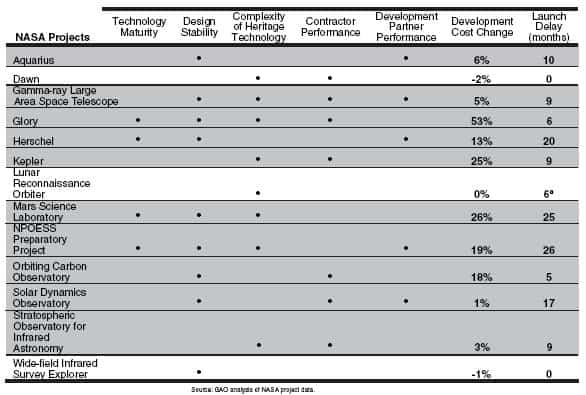
Most large NASA missions have an average delay of almost a year and are launched over budget, according to a new report by official US spending watchdogs.

The Governmental Accountability Office (GAO) found that of 13 missions for which NASA provided figures, a total of 10 were delayed by, on average, 11 months and cost 13% above the original estimates. Two projects came in on schedule and under budget and one was delayed but stayed on budget.

Glorious overspend

The mission with the biggest overspend is NASA’s $347m Glory satellite, which is designed to look at aerosol and carbon levels in the atmosphere. First conceived in 2003, it will cost 53% more than originally planned and has been delayed from its June launch because of the loss of the $273m Orbiting Carbon Observatory (OCO), which crashed in the Pacific Ocean shortly after take-off last month.

Also hit hard has been the Mars Science Laboratory, which was recently delayed by two years and is now estimated to cost $2.3bn, up by $700m from its initial estimate of $1.6bn.

Of the 13 projects, the only two that come in on schedule and under budget are the $300m Wide-field Infrared Survey Explorer (WISE) and the Dawn spacecraft. WISE is set to launch in November to perform an “all-sky” survey in the 3–25 µm wavelength range and was 1% less than planned, while the $465m Dawn spacecraft was launched in 2007 — 2% below initial estimates — to visit the dwarf planet Ceres and a large asteroid.

Some missions omitted

NASA did not give the GAO data on five missions including the James Webb Space Telescope, the Hubble Space Telescope’s successor, which is expected to launch in 2013, as well as the Ares crew launch vehicle and the Orion exploration capsule, which are expected to take astronauts to the Moon.

The GAO does not make recommendations on what should be done to reverse the current trend.

A table summarizing the GAO’s findings is shown below.

CERN hold-up hurts graduate students

When staff at CERN threaded the first protons around the Large Hadron Collider (LHC) on 10 September last year, the world watched in awe at the prospect of particles being collided at unprecedented energies. But then progress stalled dramatically on 19 September when a poor connection between two superconducting magnet cables disintegrated while carrying a test current of 8.7 kA. The incident, which produced an electrical arc that breached the collider’s liquid-helium cooling system, has meant that 53 magnets have had to be repaired at a cost of about €20m.

Last month CERN announced that protons will re-enter the 27 km ring in late September — six months later than estimated immediately after the incident and two years later than advertised between 2003 and 2006. To avoid another major mishap, by September CERN will have in place a network of cables able to detect nano-ohm rises in resistance in the LHC’s superconducting cables, plus extra helium-relief valves to reduce collateral damage in the unlikely event of a similar fault.

Low-energy collisions are now planned for late October, building up to 10 TeV before the end of the year. To make up for lost time, CERN will then run the LHC straight through next winter and on into autumn 2010 — incurring an extra €8m in electricity costs (40% of the LHC’s annual bill) but putting the lab pretty much where it would have been had the LHC not broken down. By mid-2010 the LHC should have enough data to rival the Tevatron proton–antiproton collider at Fermilab in the US, which has an energy of about 2 TeV and threatens to steal some of the LHC’s thunder.

Decision time

There are a couple of guys here who are really gutted Dave Newbold, Bristol University

Among those hardest hit by the delays are final-year graduate students who were expecting to publish some of the first LHC data in their theses. “There are a couple of guys here who are really gutted,” says Dave Newbold of Bristol University in the UK.

One student in his group is James Jackson, who works on the Compact Muon Solenoid (CMS) detector — one of the four main experiments at the LHC. “It was massively exciting when it was going well, but then a major disappointment,” says Jackson, adding that he was fortunate to have also worked on high-performance computing and undertaken theoretical work during his PhD.

It breaks my heart that I’ll have spent four years doing a PhD with no data Catherine Wright, University of Glasgow

The UK currently has about 40 experimental particle physicists in the final year of their PhD who work on the LHC and are therefore potentially affected. They include Catherine Wright from the University of Glasgow, who works on the ATLAS experiment and turned up for a six-month stint at CERN just days before the September accident. “It breaks my heart that I’ll have spent four years doing a PhD with no data,” she says, admitting that the lure of analysing LHC data might be enough to make her stay to do postdoc research.

Radical measures

Most students can beef up other aspects of their research to compensate, for instance by improving their analysis routines and running them over simulated LHC data. As CMS spokesperson Jim Virdee points out, “several hundred students have, over the past 15 years, done their theses on CMS”. But other students, particularly those in the US where PhDs last six or seven years, face stricter data requirements that have forced them to take more radical decisions.

There is not an immediate threat of running out of funding, just the threat of being a graduate student for a decade Katy Grimm, Stony Brook University

Katy Grimm of Stony Brook University in New York, who started out on ATLAS and is currently in her fifth year, has decided to do the second half of her thesis on data from the Tevatron’s D0 experiment. “Luckily, there is not an immediate threat of running out of funding, just the threat of being a graduate student for a decade,” she says, estimating that some 10–15 students are switching from the LHC to the Tevatron.

That may turn out to be a shrewd move. The Tevatron is working like a dream and many physicists there think they have a good chance of sighting the Higgs boson in the next two years. “We have a lot of data at the Tevatron, many interesting thesis topics, and good opportunities to contribute to and learn from running experiments,” says co-spokesperson of the D0 collaboration Darien Wood.

Waiting game

But the excitement of searching for new heavy “vector bosons” that may show up early in LHC data has led Stony Brook student Regina Caputo to hang on for a year or two. Fellow ATLAS student Andree Robichaud-Veronneau, currently in her third year at the University of Geneva, is also sticking around, although she has put on hold an analysis looking for supersymmetric particles in favour of something possible with less data, involving the already known J/ψ particle.

An upside of the delay is that physicists will be in a better position to understand the LHC collision data when they start pouring in. Numerous “splash” events obtained during the September start-up, when protons struck graphite collimators and sprayed millions of muons into the detectors, have enabled their subdetectors to be sychronized, which is vital to distinguish between particles produced in successive collisions. Hundreds of millions of cosmic rays recorded so far have allowed the giant experiments to be aligned and calibrated with great precision, which has also provided some data for students.

While the LHC is a long way from its peak design performance, running through next winter should amass almost the same volume of data had it not broken down (assuming it was operated at 10 TeV then). Full-energy collisions at 14 TeV, which will roughly double the machine’s “physics reach”, will not be attempted until mid-2011. Then it will take a couple of years to crank up the proton collision rate before the machine is upgraded.

Jordan Nash of Imperial College London believes that PhD students wishing to remain in physics should not be too downcast. “I don’t belittle the predicament of graduate students,” he says, “but the LHC will run for 10–15 years and soon those students will have the opportunity to do some excellent physics.”

The measurement problem in physics

By Hamish Johnston

This morning on BBC Radio 4, the mathematician Roger Penrose, physicist Basil Hiley, and philosopher Simon Saunders had a lively discussion about the “measurement problem in physics” with broadcaster Melvyn Bragg.

You can listen to it here

I got to thinking that the growing interest in building quantum computers and other information systems has put a practical spin on the measurement problem.

The “problem” the open question of how (or even if) a measurement transforms an entity such as an electron from being a ghostly combination of quantum states to being very definitely in just one state.

Many physicists believe that the clever manipulation of such ghostly combinations could be done in quantum computers, allowing such machines to outperform conventional computers on some tasks.

Such quantum computers would rely on making the right measurements — and avoiding the wrong measurements — so what had been mostly a philosophical/mathematical debate about measurement has a growing technological relevance.

Higgs seen on canvas

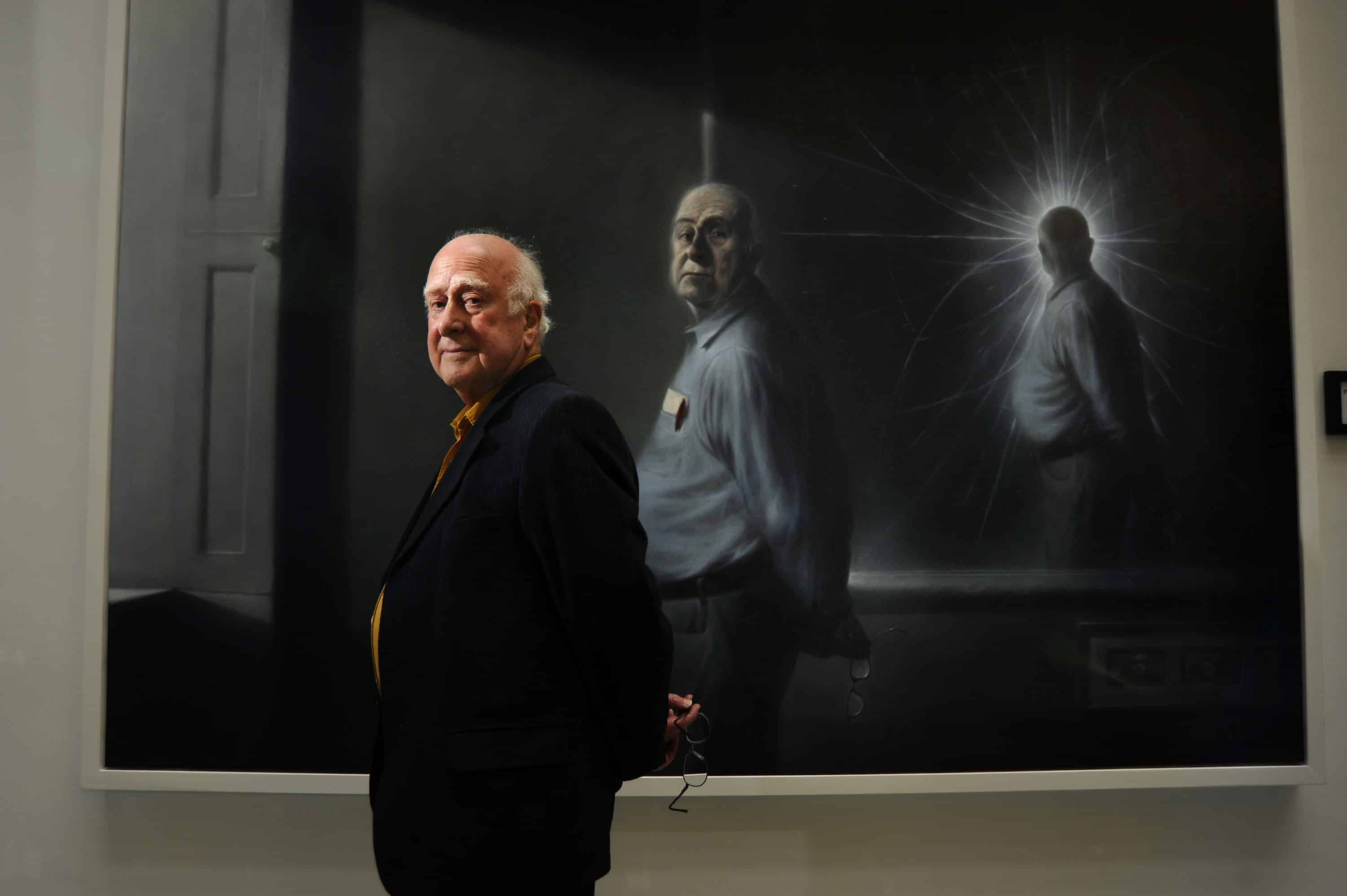
higgs potrait.jpg
Peter Higgs with his portrait (credit: Callum Bennetts/Maverick Photo Agency)

By Michael Banks

As the old cliché goes, a picture is worth a thousand words. For Peter Higgs, a sighting of the Higgs boson, the sub-atomic particle he predicted over 40 years ago that is thought to give particles their intrinsic masses, would be worth more than a few words of congratulations – possibly a Nobel Prize.

But until the Large Hadron Collider starts up again later this year — or the Tevatron fails to spot the Higgs first — he will just have to make do with the picture.

A portrait of the 79-year-old physicist was unveiled on Tuesday at the University of Edinburgh showing a younger, slightly more rounded Higgs looking at the remnants of a particle collision.

The oil-painting, commissioned by the University of Edinburgh and painted by Scottish based artist Ken Currie, shows Higgs holding a pair of glasses and looking both towards the unseen artist and – as seen in the mirror behind – to the debris of colliding particles.

Speaking at the launch of the portrait at the university, Higgs said he was quite relieved the artist didn’t make him hold difficult poses for the portrait.

“It is a great surprise to me that the university wanted to paint my portrait,” Higgs said. “I would not have predicted it 30 years ago.” Indeed, he was rather busy predicting other things.

Power source from human vibrations

Tiny sensors with the ability to roam can be a great aid to doctors, returning information from some hard-to-reach locations inside the body. A problem arises, however, in powering these devices. Standard fuel cells are too large and it is very difficult to “replace the batteries” once a sensor is inside the body. Researchers in Italy are proposing a solution in which mobile electronic devices “harvest” the energy of natural vibrations inside the human body.

“Over next 5 to 10 years we will be faced with a huge number of microscale mechanisms. A big question is: how do we power them?” said Luca Gammaitoni, one of the researchers at the University of Perugia.

Gammaitoni and his colleagues have the idea to create sensors from piezoelectric materials, which generate tiny electric currents when flexed by ambient vibrations. Although the principle of converting ambient noise into useful energy is not a new idea, the researchers present a technique for “broadband” harvesting of a wide range of vibrations.

Electric swingers

To demonstrate the concept the physicists took a piezoelectric beam and subjected it to both linear and nonlinear oscillations. Reporting their findings in Phys. Rev. Lett., they claim that the nonlinear oscillators yielded 4–6 times more energy than the linear ones.

Existing methods for energy harvesting have focused on harvesting vibrations at specific resonant frequencies. However, according to Gammaitoni and his colleagues, this approach is not suitable for devices inside the human body where the majority of ambient vibrations are distributed over a wide spectrum of frequencies. So the physicists designed an experiment to determine, as a general principle, whether nonlinear oscillators allow a larger energy harvest than linear oscillators.

Included in the experimental set-up was a steel pendulum mass, the swing of which was controlled by magnets on either side of the pendulum tip. Attached to the pendulum mass was a beam of piezoelectric material that was clamped at the base and so flexed every time the pendulum swung. By varying the distance between the magnets and the steel mass, the researchers were able to facilitate both linear and nonlinear oscillations.

Scaling down

“This is a neat new approach to harvesting energy from nonlinear vibrations. However, scaling this principle down to make useful biomedical devices will be a challenge because power output scales with internal deflection — if the pendulum hasn’t got room to move very far it can’t produce much power,” said Eric Yeatman, an electronic engineering researcher at Imperial College, London.

The patent for this new technique is held by Wisepower, a spin-off company set up by Gramaitoni and his colleagues in Perugia. Wisepower will now turn its attention to the practical challenges of converting this principle into working devices, Gammaitoni told physicsworld.com.

“We are looking to develop a prototype that could pave the way for microscale applications. One of our big problems at the moment is getting the funding — Italy at this time is not a great place for development. Right now we are open to investors from across the world,” said Gammaitoni.

Well or ill defined?

dictionary.jpg

By Michael Banks

“Science is the pursuit of knowledge and understanding of the natural and social world following a systematic methodology based on evidence.”

That is the definition of ‘science’ according to Britain’s Science Council, an organisation representing over 30 learned and professional bodies in the UK ranging from the Royal Astronomical Society to the Association of Clinical Biochemistry.

Apparently the council has spent a whole year deciding on this new meaning to provide a distinction between genuine science and psuedoscience.

So let us look at the alternatives. According to my Chambers dictionary, ‘science’ means the “knowledge ascertained by observation and experiment, critically tested, systematised and brought under general principles, esp in relation to the physical world.”

One notices in the council’s definition that science is the ‘pursuit’ of knowledge rather than that ‘ascertained’, as well as the inclusion of the ‘social’ world.

So Physics World readers, what do you think of the definition? Can you do any better? But please don’t take one year to decide!

Still a planet in Illinois

By Hamish Johnston

The US is famous for its quirky local laws and the state of Illinois is no exception. In the town of Zion, it is apparently Illegal for anyone to give lighted cigars to dogs, cats, and other domesticated animals.

Now lawmakers in that state have turned their attentions to the status of Pluto, which was discovered in 1930 by Illinoisian Clyde Tombaugh — but then downgraded to “dwarf planet” status by the International Astronomical Union in 2006.

So the next time you’re in the Land of Lincoln, don’t refer to the ninth planet as a dwarf or you could be singing the blues in the Joliet Correctional Center for running afoul of the following…

“RESOLVED, BY THE SENATE OF THE NINETY-SIXTH GENERAL ASSEMBLY OF THE STATE OF ILLINOIS, that as Pluto passes overhead through Illinois’ night skies, that it be reestablished with full planetary status, and that March 13, 2009 be declared “Pluto Day” in the State of Illinois in honor of the date its discovery was announced in 1930.

You can read the entire resolution here

I think the Senate’s next task should be to declare a better name for its citizens than Illinoisians — something along the lines of “Buckeyes” or “Hoosiers”.

Nanotubes wreak havoc with heat

Physicists in the US have discovered that electrons flowing in carbon nanotube-based circuits dissipate energy in very different ways from electrons flowing through devices made from conventional semiconductors such as silicon. The findings reveal processes of heat conduction that were never previously thought important and could influence the types of materials chosen for the next generation of electronic devices in order to prevent them from overheating.

In conventional semiconductor devices, different layers of material are always joined by chemical bonds. This provides continuity for heat flowing through such devices, making them relatively easy to cool. Many researchers believe that future generations of electronic devices could be made from carbon nanotubes — tubes with walls just one atom thick — which could enable much smaller feature sizes and hence much better computing performance. However, nanotubes do not bond chemically to adjoining structures, which suggested that it should be very difficult to remove heat from such devices.

Bonding not needed

But now Phaedon Avouris and colleagues at the IBM Thomas J Watson Research Center in New York and researchers at Duke University in North Carolina have found that electrons in nanotubes can dissipate energy straight to an adjacent substrate even though it is not chemically bonded.

The team has also found that current-carrying electrons in nanotube devices do not undergo the normal process of “thermalization”, in which a material’s thermal vibrations reach statistical equilibrium (Nature Nanotechnology doi:10.1038/nnano.2009.22).

Avouris and team studied a carbon nanotube on a silicon-dioxide substrate, an arrangement that acts like the active channel of a field-effect transistor. They have used a variety of techniques including Raman scattering, in which the energy of scattered light reveals the different temperatures or “modes” of vibration of the nanotube lattice.

Normally when a current passes through a semiconductor the electrons bump into nearby atoms, which begin to vibrate in a certain mode. This mode then gradually transfers its energy to atoms at lower temperature modes until, at thermalization, all atoms are vibrating in statistical equilibrium.

The researchers have shown that, in nanotubes, thermalization does not take place; the atoms continue to vibrate in the same mode and statistical equilibrium is never reached.

Just as surprising, however, is that the lack of chemical bonding to the substrate does not inhibit heat conduction. The team has shown that when the electrons collide with atoms in the silicon dioxide, which is a polar material, the subsequent shift in position of the atoms generates an electric field that extends beyond the substrate and into the nanotube. When the nanotube’s electrons interact with this field they are able to dissipate energy straight to the substrate.

Overlooked effect

Scientists were aware of this process of remote heat conduction before, but had never considered it important because they had focused on 2D and 3D materials in which the effect is much weaker. But Avouris told physicsworld.com that the other unusual mechanism — the absence of thermalization — could exist in other materials, and that it may have been overlooked because researchers have not had the right observational tools.

“Understanding this dissipation mechanism in detail is important, especially if nanotubes are someday employed in electronic circuits,” says Adrian Bachtold, a nanoelectronics researcher at the Autonomous University of Barcelona. “Indeed, a better understanding is the first step to be able to engineer the dissipation pathway. For instance, it may be possible to find tricks to enhance the current in the ‘on’ state of the transistor, [which would be] good for rapid circuits.”

The US team is now investigating similar effects in graphene, a one-dimensional “chickenwire” lattice of carbon atoms rather like an unrolled nanotube. Avouris says his team knows that the same mechanisms occur in graphene, but expects some “curious effects” due the material’s larger footprint on the substrate.

Copyright © 2026 by IOP Publishing Ltd and individual contributors