Fight the 'galaxy wars'…

zoo.jpg
Courtesy: NASA/Space Telescope Science Institute

By Hamish Johnston

Are you bored and sitting in front of a computer — then why not spare a few minutes for astronomers in need?

The people that brought you the Galaxy Zoo online project — which uses members of the public to help astronomers classify galaxies — have launched a new project called Galaxy Zoo 2.

The original Zoo began 18 months ago by astronomers who realized that they had discovered far more galaxies than they knew what to do with. So they asked the public to decide whether a galaxy is spiral or elliptical and which way it is rotating. So far, more than 150,000 “armchair astronomers” have make 80 million classifications of 1 million different objects, say the Zoo’s keepers.

Scientific results include the discovery of over 3000 merging galaxies, some of which are being investigated further by astronomers.

Now Galaxy Zoo 2 is asking folks to “delve deeper into 250,000 of the brightest and best to search for the strange and unusual”. This is done, for example, by pitting objects against each other in “galaxy wars” to decide which one is more “spirally”.

You can read all about the original Zoo in this article in Physics World written by two of its founders.

Interview with Federico Capasso

qcl.jpg
Federico Capasso

By Hamish Johnston

“Advances in quantum-mechanically designed materials have led to fundamentally new high-power semiconductor lasers that are suitable for a broad range of applications,” is how Federico Capasso and colleagues began a June 1999 article in Physics World about the quantum cascade laser.

Ten years later, Capasso — a co-inventor of the QCL — tells Marie Freebody at optics.org about the challenges of commercializing the technology.

You can read the full interview with the Harvard University physicist here .

Laser captures photosynthesis in action

Scientists could be closer to understanding how photosynthetic molecules transport energy with such high efficiency thanks to a new optical experiment developed by researchers in the Ireland and the UK. The technique could also help researchers develop more efficient solar cells, say the researchers (Phys. Rev. Lett. 102 057402).

Perhaps the most important chemical reaction on Earth, photosynthesis allows plants to harness the Sun’s energy by converting carbon dioxide and water into carbohydrates. Gaining a better understanding of this efficient process is important to biologists and could point towards better technologies for harvesting solar energy.

“Photosynthesis is a good example of where nature transports energy efficiently from one place in a molecule to another. It’s this transfer process that we have been studying,” said Ian Mercer of University College Dublin, the lead author of this new study. “We know that electrons are the mediators of energy transport in molecules. What we don’t know is the design rules for how these electrons hand the energy on to each other.”

To study these rules, researchers had used various laser-based techniques to attempt to understand the complex interactions between electrons in molecules. Many are based on the principle of four-wave mixing, whereby three different laser beams interact with a sample to create a fourth beam. Common problems with these methods include degrading the sample by over-exposing it to laser light and the need for intensive computer processing.

We estimate that ARC is up to 1015 times faster than previous four-wave mixing approaches Ian Mercer, University College Dublin

The new method is called angle-resolved coherent (ARC) wave mixing and Mercer said “We estimate that ARC is up to 1015 times faster than previous four-wave mixing approaches for revealing coupled electrons”. “Our results are instantaneous snap-shots of energy being transported between electrons that give you a significant amount of information in parallel. No computer processing is required to form a map or to distinguish electron coupling mechanisms for isolated features” (Phys. Rev. Lett. 102 057402.)

A pulse of many colours

The starting point in the team’s ARC system is a femtosecond laser emitting millijoule pulse energies at kilohertz repetition rates. The emission is fed into a 1 m long hollow fibre filled with an inert gas which creates a very stable beam and pulses with a broad coherent bandwidth.

“The fibre takes a 30 fs pulse with a bandwidth of about 30 nm at 800 nm and spreads that out to cover 650–900 nm,” said Mercer. “What’s crucial is that these colours are all coherently related to each other, which allows us to probe a broad range of energy levels in the sample”. The fibre development was led by John Tisch and Jon Marangos at Imperial College London and the technology was subsequently used with the Rutherford Appleton Laboratory’s Astra laser.

The pulses then pass through a diffraction grating placed at the object point of a telescope (with the sample being at the image point), which generates four beams. Mercer and colleagues block one of the beams and mix the remaining three at the image point.

Instant picture

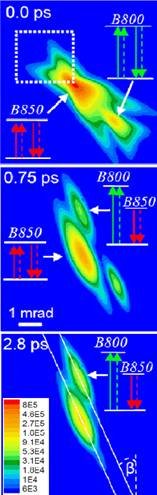
“This generates new light out of the sample at specific angles governed by conservation of momentum,” explained Mercer. “By putting a CCD camera at the right place, all of the angles go to different places on the camera. You get one instant picture, or map, that captures all of the different angles of light emission at the same time.”

The specific features present on the map allow the team to understand how the electrons in the molecule are interacting. “We spread out the map in a diagonal direction by dispersing the emission and then look at deviations from the diagonal,” commented Mercer. “For example, horizontal deviation of a feature from the diagonal tells you that electrons are strongly coupled with each other.”

In a proof-of-principle experiment, the researchers successfully probed a common photosynthetic protein called LH2. They are also now studying a polymer-based photovoltaic to see how the electrons inside the system are coupled. “Our technique is instantaneous,” concluded Mercer. “This opens up the opportunity to look at small volumes of high-value samples and to get your answer out in one laser pulse.”

Mercer said he is interested in hearing from anyone who would like to exploit the ARC technique to study energy transport in other systems.


Fun science at the exhibit hall

rubegoldberg.jpg
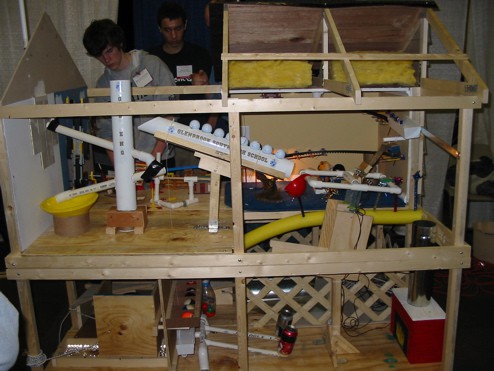
An “energy-saving” Rube Goldberg house.

By Margaret Harris

For the past two days the conference exhibit hall has been full of both regular conference-goers and also parents and children attending “Family Science Days”. I wasn’t able to catch the full show at the “Physics Van” yesterday, and I’m not even sure what the giant inflatable shark near the hall entrance was supposed to do, but I did happen to pitch up at this energy-saving house just in time to watch it in action.

The house was built by members of the Glenbrook South High School science club, and it’s designed to show people just how “easy” it is to switch from incandescent bulbs to LED lights — by making the switch in the most complicated way possible. I grew up calling such things Rube Goldberg machines, but I’m told that the British term is “Heath Robinson contraptions”. Great minds think alike, or something.

Whatever the name, the result was impressive: there were trains running down slopes, propellers spinning into things, bowling balls lumbering along tracks and fizzy-drink cans catapulting through the air — and yes, the LED light came on at the end of it. Club leader Dan Uhler and team members Max Frotheringham and Liam Ennis talked me through its operation afterwards, and Uhler told me they’d been generating ideas for the house since Christmas. All in all, it was a fine demonstration of physics in action — and although everyone on the team told me they want to study engineering, I guess there’s still time for them to change their minds.

Mobile phones and metamaterials

By Hamish Johnston

When it comes to putting the latest technologies to work, you can’t beat the mobile-phone industry. Just think of all the R&D that went into evolving those “bricks” of just twenty years ago into the sleek little cellphone in your pocket today.

It is strange therefore that the industry seems to have shunned electromagnetic metamaterials — which many physicists (and admittedly physicsworld.com) claim could boost cellphone performance.

Metamaterials are arrays of tiny components — each of which is designed to have a specific response to microwaves. By carefully selecting and arranging the components, a metamaterial antenna could be made much smaller than a conventional antenna — but offer similar performance.

In a paper posted on the arXiv preprint server, Nokia’s Pekka Ikonen gives five reasons why metamaterials have not been embraced — ranging from practical engineering and cost challenges to shortcomings in how developers “market” their new antennas to handset designers.

Ikonen also suggests a few ways forward, notably creating performance benchmarks for comparing metamaterial-based antennas to more conventional devices.

He also points out that those designing handsets seem to have forgotten that there is a long tradition of using metamaterials elsewhere in microwave engineering.

A prediction from string theory?

stringtherry.jpg
Image from Barbara Jacak’s talk. Credit: icanhazcheezburger.com

By Margaret Harris

Skeptics find much to complain about in string theory, but perhaps their most stinging criticism has been its inability to be falsified by experiment. A few years ago, one string theorist even told me that a particle accelerator big enough to “see” a string would be so large that its opposite ends would be causally disconnected. So this is not a problem we’ll be solving any time soon.

Yet even if we’ll never see a string in the lab, it turns out that string theory does make a few predictions about how matter should behave at the quantum level — and now physicists from the apparently unrelated disciplines of heavy-ion collisions and cold fermions are coming tantalizingly close to testing them.

(more…)

On the origin of freebies

freebies2.jpg
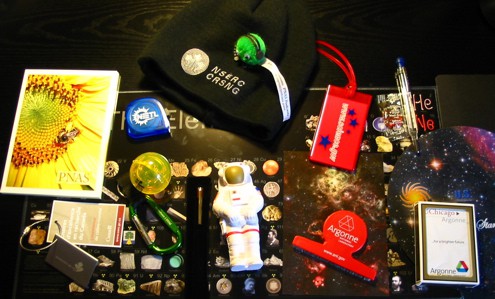
Cool stuff from the AAAS exhibit hall.

By Margaret Harris

Human beings may have originated in Africa, but the best freebies on offer in the AAAS exhibit hall have a distinctly colder origin: Canada. Not only does the silver luggage tag (bottom left) from the Canadian Natural Sciences and Engineering Research Council look classy, their knit cap really scores on the usefulness front — it’s a bit chilly in Chicago this week! And as for the maple sugar candies…well, I’m planning to bring this one back for physicsworld.com editor (and native Canadian) Hamish Johnston, but there’s a chance it might get lost in transit.

The prize for most frustrating freebie, on the other hand, goes to the yellow rubber ball from ITER. It’s got a mechanism inside — probably piezoelectrical — that theoretically ought to make it light up when you bounce it. However, it only seems to work when I don’t want it to — like in a seminar when they’ve just dimmed the lights.

I’m sure there’s an experimental fusion metaphor in there somewhere, but at the moment I’m more worried about getting it past airport security. If they had to confiscate my contact solution because the bottle was 18 mL too big, who knows what they’ll make of a mysteriously flashing yellow ball with “fusion” written all over it?

T-shaped scientists

By Margaret Harris

Are you a T-shaped scientist? No? What about I-shaped? Or pi-shaped?

According to Rita Colwell of the US National Research Council, a T-shaped scientist is one with a broad, shallow background in a lot of scientific topics (the top of the T), plus deep expertise in a single area (the base). This, she argues, is the kind of scientist that many technical and managerial jobs require, but that traditional science postgraduate courses usually fail to produce.

Colwell’s solution is a relatively recent innovation in science education: the professional science master’s (PSM) degree. She described the PSM as a two-year programme that gives students some research experience beyond undergraduate level whilst also providing training in topics like leadership, dealing with government regulations and patent applications, and communication. There are now 135 such programmes in place at more than 60 US universities, said Elizabeth Friedman of the National Professional Science Master’s Assosciation, and that number is growing every year.

Unlike their counterparts in fields like business and public health, master’s degrees in science have often been seen as “consolation prizes” for students who can’t hack a PhD. But in many cases, Friedman said, graduates with only a bachelor’s degree lack the technical knowledge needed to lead a team of scientists in industry. And not everyone wants to spend five or even two years as an apprentice academic — effectively the situation for students doing PhDs or research masters degrees. So in principle, the PSM sounds like a nice middle route, and Friedman said it’s already proving extremely popular with students in biotech fields.

Yet there are drawbacks as well. Colwell noted in passing that universities love the programme because it’s a real “cash cow” for them; PSM students or their industry sponsors pay stiff tuition fees, and some universities rely heavily on cheaper adjunct professors to supply the non-academic part of students’ training (a practice Colwell deplored as short-sighted).

I asked Colwell whether PSM students have any problems fitting in with their home departments, curious as to whether their fee-paying status and industry focus would set them apart. Colwell said that she’d seen no evidence for such divisions within her field of public health, but I’m not sure that would be the case for physics.

Perhaps physicists are more U-shaped…

A mole of Earths

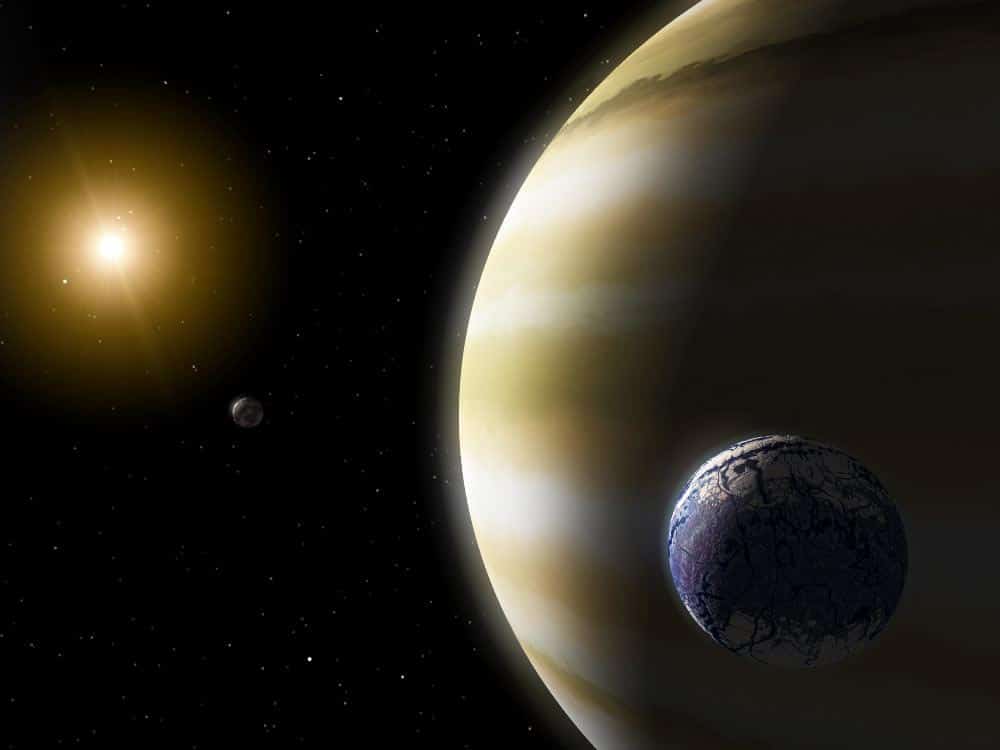
extrasolar.jpg
Artist’s impression of extrasolar planets. Credit: NASA

By Margaret Harris

Alan Boss is the kind of astronomer who sees the glass as not only full, but overflowing. Boss, of the Carnegie Institution for Science in Washington, US, told an AAAS audience that there could be up to 10^22^ Earthlike planets in the universe. Moreover, he argued that finding life on them is almost as inevitable as finding slime mould in a packed refrigerator left unplugged for two months. Maybe these extrasolar Earths don’t harbour life with two legs and a face, Boss said, but they should certainly be teeming with microbes and other simple organisms.

Avogadro’s number, 6.02 x 10^23^, is best known as the number of atoms in a mole, but in a fuzzier sense, it’s also a gold standard for mind-bogglingly large numbers. So 10^22^ Earthlike planets is really up there — and, as Boss noted, among astronomers an extra order of magnitude is nothing.

Perhaps I’m suffering from imagination failure, but a mole of Earths is hard for me to to get my head round. Judging from the mob of journalists who surrounded Boss after his talk, I wasn’t alone, and unfortunately someone from the New York Times led him away before I could do more than say hello.

However, if you’re interested in hearing more about Boss’ “crowded universe” hypothesis, fear not: he’s written a feature for next month’s print edition of Physics World on the same subject. In it, he talks about the search for extrasolar planets, and how new space telescopes will provide data to distinguish between a universe that is half full, half empty, or maybe even overflowing. So if you find the idea of 10^22^ extrasolar Earths intriguing, you know where to look.

Science that's hard to swallow

swordswallower.jpg
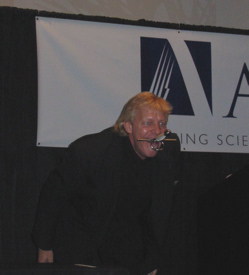
Dan Meyer won an Ig Nobel prize for publishing a paper on the side effects of sword swallowing.

By Margaret Harris

It’s not all doom and climate-change gloom here in conferenceland, however. Many readers will already be familiar with the Ig Nobel prizes, which are given annually in honour of science that makes you laugh, and then makes you think. But it’s not every day that you get to see a proud Ig Nobelist in the flesh — and it’s even rarer to watch one of them swallow 12 inches of solid steel, as Dan Meyer is doing in this photo (he swallowed an even bigger blade — 24 inches, long enough to reach the base of his stomach — at the press party later that night).

Meyer is president of the Sword Swallowers Association International, and he won the Ig Nobel for medicine in 2007 for co-authoring a paper in the British Medical Journal on “Swordswallowing and Its Side Effects”. These side effects include – unsurprisingly – both sore throats and, erm, death. Fortunately, nothing so drastic occurred tonight, and if Meyer did get a sore throat afterwards, I’m sure plenty of people would have bought him a drink to help soothe it.

Copyright © 2026 by IOP Publishing Ltd and individual contributors