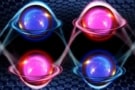
A new type of switch sends electrons propagating in opposite directions along the same paths – without ever colliding with each other. The switch works by controlling the presence of so-called topological kink states in a material known as Bernal bilayer graphene, and its developers at Penn State University in the US say that it could lead to better ways of transmitting quantum information.
Bernal bilayer graphene consists of two atomically-thin sheets of carbon stacked on top of each other and shifted slightly. This arrangement gives rise to several unusual electronic behaviours. One such behaviour, known as the quantum valley Hall effect, gets its name from the dips or “valleys” that appear in graphs of an electron’s energy relative to its momentum. Because graphene’s conduction and valence bands meet at discrete points (known as Dirac points), it has two such valleys. In the quantum valley Hall effect, the electrons in these different valleys flow in opposite directions. Hence, by manipulating the population of the valleys, researchers can alter the flow of electrons through the material.
This process of controlling the flow of electrons via their valley degree of freedom is termed “valleytronics” by analogy with spintronics, which uses the internal degree of freedom of electron spin to store and manipulate bits of information. For valleytronics to be effective, however, the materials the electrons flow through need to be of very high quality. This is because any atomic defects can produce intervalley backscattering, which causes electrons travelling in opposite directions to collide with each other.
A graphite/hBN global gate
Researchers led by Penn State physicist Jun Zhu have now succeeded in producing a device that is pristine enough to support such behaviour. They did this by incorporating a stack made from graphite and a two-dimensional material called hexagonal boron nitride (hBN) into their design. This stack, which acts as a global “gate” that allows electrons to flow through the device, is free of impurities, and team member Ke Huang explains that it was key to the team’s technical advance.
The principle behind the improvement is that while graphite is an excellent electrical conductor, hBN is an insulator. By combining the two materials, Zhu, Huang and colleagues created a structure known as a topological insulator – a material that conducts electricity very well along its edges or surfaces while acting as an insulator in its bulk. Within the edge states of such a topological insulator, electrons can only travel along one pathway. This means that, unlike in a normal conductor, they do not experience backscatter. This remarkable behaviour allows topological insulators to carry electrical current with near-zero dissipation.
In the present work, which is described in Science, the researchers confined electrons to special, topologically protected electrically conducting pathways known as kink states that formed by electrically gating the stack. By controlling the presence or absence of these states, they showed that they could regulate the flow of electrons in the system.
A quantized resistance value
“The amazing thing about our devices is that we can make electrons moving in opposite directions not collide with one another even though they share the same pathways,” Huang says. “This corresponds to the observation of a quantized resistance value, which is key to the potential application of the kink states as quantum wires to transmit quantum information.”
Importantly, this quantization of the kink states persists even when the researchers increased the temperature of the system from near absolute zero to 50 K. Zhu describes this as surprising because quantum states are fragile, and often only exist at temperatures of a few Kelvin. Operation at elevated temperatures will, of course, be important for real-world applications, she adds.
The new switch is the latest addition to a group of kink state-based quantum electronic devices the team has already built. These include valves, waveguides and beamsplitters. While the researchers admit that they have a long way to go before they can assemble these components into a fully functioning quantum interconnect system, they say their current set-up is potentially scalable and can already be programmed to direct current flow. They are now planning to study how electrons behave like coherent waves when travelling along the kink state pathways. “Maintaining quantum coherence is a key requirement for any quantum interconnect,” Zhu tells Physics World.
Fuelled by science Gas lamps at the Louvre in modern-day Paris, which in 1801 became the first city in the world to use gas for lighting purposes. (Courtesy: iStock/Charlotte167)
The first person to use gas for illumination was a French engineer by the name of Philippe Lebon. In 1801 his revolutionary system of methane pipes and jets lit up the Hôtel de Seignelay so brilliantly that ordinary Parisians paid three francs apiece just to marvel at it. Overnight guests may have been less enthusiastic. Although methane itself is colourless and odourless, Lebon’s process for extracting it left the gas heavily contaminated with hydrogen sulphide, which – as Mark Miodownik cheerfully reminds us in his latest book – is a chemical that “smells of farts”.
The often odorous and frequently dangerous world of gases is a fascinating subject for a popular-science book. It’s also a logical one for Miodownik, a materials researcher at University College London, UK, whose previous books were about solids and liquids. The first, Stuff Matters, was a huge critical and commercial success, winning the 2014 Royal Society Winton Prize for science books (and Physics World’s own Book of the Year award) on its way to becoming a New York Times bestseller. The second, Liquid, drew more muted praise, with some critics objecting to a narrative gimmick that shoehorned liquid-related facts into the story of a hypothetical transatlantic flight.
Miodownik writes about the science of substances such as breath, fragrance and wind as well as methane, hydrogen and other gases with precise chemical formulations
Miodownik’s third book It’s a Gas avoids this artificial structure and is all the better for it. It also adopts a very loose definition of “gas”, which leaves Miodownik free to write about the science of substances such as breath, fragrance and wind as well as methane, hydrogen and other gases with precise chemical formulations. The result is a lively, free-associating mixture of personal, scientific and historical anecdotes very reminiscent of Stuff Matters, though inevitably one that feels less exceptional than it did the first time around.
The chapter on breath shows how this mixture works. It begins with a story about the young Miodownik watching a brass band march past. Next, we get an explanation of how air travels through brass instruments. By the end of the chapter, Miodownik has moved on, via Air Jordan sneakers and much else, to pneumatic bicycle tyres and their surprising impact on English genetic diversity.
Though the connection might seem fanciful at first, it seems that after John Dunlop patented his air-filled rubber bicycle tyre in 1888, many people (especially women) were suddenly able to traverse bumpy roads cheaply, comfortably and without assistance. As their horizons expanded, their inclination to marry someone from the same parish plummeted: between 1887 and the early years of the 20th century, marriages of this nature dropped from 77% to 41% of the total.
Miodownik is not the first to make the link between bicycle tyres and longer-distance courtships. (He credits the geneticist Steve Jones for the insight, building on work by the 20th-century geographer P J Parry.) However, his decision to include the tale is a deft one, as it illustrates just how important gases and their associated technologies have been to human history.
Anaesthetics are another good example. Though medical professionals were scandalously slow to accept nitrous oxide, ether and chloroform, these beneficial gases eventually revolutionized surgery, saving millions of patients from the agony of their predecessors. Interestingly, criminals proved far less hide-bound than doctors, swiftly adopting chloroform as a way of subduing victims – though the ever-responsible Miodownik notes that this tactic seldom works as quickly as it does in the movies, and errors in dosage can be fatal.
Not every gas-related invention had such far-reaching effects. Inflatable mattresses never really caught on; as Miodownik observes, “beds were for sleeping and sex, and neither was enhanced by being unexpectedly launched into the air every time your partner made a move”.
The history of balloons is similarly chequered. Around the same time as Lebon was filling the Hôtel de Seignelay with aromas, an early balloonist, Sophie Blanchard, was appointed Napoleon’s “aeronaut of the official festivals”. Though Blanchard went on to hold a similar post under the restored King Louis XVIII, Miodownik notes that her favourite party trick – launching fireworks from a balloon filled with highly flammable and escape-prone hydrogen – eventually caught up with her. In 1819, aged just 41, her firework-festooned craft crashed into the roof of a house and Blanchard fell to her death.
Miodownik brings a pleasingly childlike wonder to his tales of gaseous derring-do
The lessons of this calamity were not learned. More than a century later, 35 passengers and crew on the hydrogen-filled Hindenburg airship (which included a smoking area among its many luxuries) met a similarly fiery end.
Occasional tragedies aside, Miodownik brings a pleasingly childlike wonder to his tales of gaseous derring-do. He often opens chapters with stories from his actual childhood, and while a few of these (like the brass band) are merely cute, others are genuinely jaw-dropping. Some readers may recall that Miodownik began Stuff Matters by describing the time he got stabbed on the London Underground; while there is nothing quite so dramatic in It’s a Gas (and no spoilers in this review), he clearly had an eventful youth.
At times, it becomes almost a game to guess which gas these opening anecdotes will lead to. Though some readers may find the connections a little tenuous, Miodownik is a good enough writer to make his leaps of logic seem effortless even when they are noticeable. The result is a book as delightfully light as its subject matter, and a worthy conclusion to Miodownik’s informal phases-of-matter trilogy – although if he wants to write about plasmas next, I certainly won’t stop him.
As the world becomes more connected by global communications networks, the field of free-space optical communications has grown as an alternative to traditional data transmission via RF frequencies. While optical communications setups deliver scalability and security advantages along with a smaller infrastructure footprint, they also bring distinct challenges, including attenuation, interference, and beam divergence.
During this presentation, Liquid Instruments will give an overview of the FPGA-based Moku platform, a reconfigurable suite of test and measurement instruments that provide a flexible and efficient approach to optical communications development. You’ll learn how to use the Moku Lock-in Amplifier and Time & Frequency Analyzer for both coherent and direct detection of optical signals, as well as how to frequency-stabilize lasers with the Laser Lock Box.
You’ll also see how to deploy these instruments simultaneously in Multi-instrument Mode for maximum versatility, plus digital and analog modulation methods such as phase-shift keying (PSK) and pulse-position modulation (PPM) covered in a live demo.
Jason Ball is an engineer at Liquid Instruments, where he focuses on applications in quantum physics, particularly quantum optics, sensing, and computing. He holds a PhD in physics from the Okinawa Institute of Science and Technology and has a comprehensive background in both research and industry, with hands-on experience in quantum computing, spin resonance, microwave/RF experimental techniques, and low-temperature systems.
Most scientific learning is focused on gaining knowledge, both to understand fundamental concepts and to master the intricacies of experimental tools and techniques. But even the most qualified scientists and engineers need other skills to build a successful career, whether they choose to continue in academia, pursue different pathways in the industrial sector, or exploit their technical prowess to create a new commercial enterprise.
“Scientists and engineers can really benefit from devoting just a small amount of time, in the broad scope of their overall professional development, to understanding and implementing some of the ideas from management science,” says Peter Hirst, who originally trained as a physicist at the University of St Andrews in the UK and now leads the executive education programme at MIT’s Sloan School of Management. “Whether you’re running a lab with just a few post-docs, or you have a leadership role in a large organization, a few simple tools can help to drive innovation and creativity while also making your team more effective and efficient.”
MIT Sloan Executive Education, part of the management school, the business school of the Massachusetts Institute of Technology in Cambridge, US, offers more than 100 short courses and programmes covering all aspects of business innovation, personal skills development, and organizational management, many of which can be accessed in different online formats. Delivered by expert faculty who can share their experiences and insights from their own research work, they are designed to introduce frameworks and tools that enable participants to apply key concepts from management science to real-world situations.
Research groups are really a type of enterprise, with people working together to produce clearly defined outputs
Peter Hirst, MIT Sloan School of Management
One obvious example is the process of transforming a novel lab-based technology into a compelling commercial proposition. “Lots of scientists develop intellectual property during their research work, but may not be aware of the opportunities for commercialization,” says Hirst. “Even here at MIT, which is known for its culture of innovation, many researchers don’t realize that educational support is available to help them to understand what’s needed to transfer a new technology into a viable product, or even to become more aware of what might be possible.”
For academic researchers who want to remain focused on the science, Hirst believes that management tools originally developed in the business sector can offer valuable support to help build more effective teams and nurture the talents of diverse individuals. “Research groups are really a type of enterprise, with people working together to produce clearly defined outputs,” he says. “When I was working as a scientist, I really didn’t really think about the human system that was doing that work, but that’s a really important dimension that can contribute to the success or failure of the whole enterprise.”
Modern science also depends on forging successful collaborations between research groups, or between academia and industry, while researchers are under mounting pressure to demonstrate the impact of their work – whether for scientific progress or commercial benefit. “Even if you’re working in academia, it’s really important to understand the contribution that your work is making to the whole value chain,” Hirst comments. “It provides context that helps to guide the work, but it’s also vital for sustainably securing the resources that are needed to pursue the science.”
The training offered by MIT Sloan takes different formats, including short courses and longer programmes that take a deeper dive into key topics. In each case, however, the faculty designs tasks, simulations and projects that allow participants to gain a deeper understanding of key concepts and how they might be exploited in their own workplace. “People believe by seeing, but they learn by doing,” says Hirst. “Our guiding philosophy is that the learning is always more effective if it can be done in the context of real work, real problems, and real challenges.”
Real-world learning MIT Sloan integrates tasks, simulation and projects into their courses to enable participants to understand how different tools and frameworks might be exploited in their own workplace. (Shutterstock/fizkes)
Many of the courses are taught on the MIT campus, offering the opportunity for delegates to discuss key ideas, work together on training tasks, and network with people who have different backgrounds and experience. For those unable to attend in person, the same ethos extends to the two types of online training available through the executive education programme. One stream, developed in response to the Covid pandemic, offers live tutoring through the Zoom platform, while the other provides access to pre-recorded digital programmes that participants complete within a set time window. Some of these self-paced courses adopt a sprint format inspired by the concepts of agile product development, enabling participants to break down a complex challenge or opportunity into a series of smaller questions that can be tackled to reach a more effective solution.
“It’s not just sitting and watching, people really have the opportunity to work with the material and apply what they are learning,” explains Hirst. “In each case we have worked hard with the faculty to figure out how to achieve the same outcomes through a different type of experience, and it’s been great to see how compelling that can be.”
Evidence that the approach is working can be found in the retention rate for the self-paced courses, with more than 90% of participants completing all the modules and assignments. The Zoom-based programmes also remain popular amid the more general post-pandemic return to in-person training, providing greater flexibility for learners in different parts of the world. “We have tried to find the sweet spot between effectiveness and accessibility, and many people who can’t come to campus have told us they find these courses valuable and impactful,” says Hirst. “We have put the choice in the hands of the learners.”
Plenty of scientists and engineers have already taken the opportunity to develop their management capabilities through the courses offered by MIT Sloan, particularly those that have been thrown into leadership positions within a rapidly growing organization. “Perhaps because we’re at MIT, we are already seeing scientists and engineers who recognize the value of engaging with ideas and tools that some people might dismiss as corporate nonsense,” says Hirst. “Generally speaking, they have really great experiences and discover new approaches that they can use in their labs and businesses to improve their own work and that of their teams and organizations.”
For those who may not yet be ready to make the leap into developing their personal management style, Hirst advocates courses that analyse the dynamics of an organization – whether it’s a start-up company, a manufacturing business or a research collaboration. The central idea here is to apply concepts from systems engineering to organizations, and how work gets done by a human system, to improve overall productivity and performance.
One case study that Hirst cites from the biomedical sector is the Broad Institute, a research organization with links to MIT and Harvard that has developed a platform for generating human genomic information. “Originally they were taking months to extract the genomic data from a sample, but they have reduced that to a week by implementing some fairly simple ideas to manage their operational processes,” he says. “It’s a great example of a scientific organization that has used systems-based thinking to transform their business.”
Others may benefit from courses that focus on technology development and product strategy, or an entrepreneurship development programme that immerses participants in the process of creating a successful business from a novel idea or technology. “That programme can be transformational for many people,” Hirst observes. “Most people who come into it with a background in science and engineering are focused on demonstrating the technical superiority of their solution, but one of the big lessons is the importance of understanding the needs of the customer and the value they would derive from implementing the technology.”
For those who are keen to develop their skills in one particular area, MIT Sloan also offers a series of Executive Certificates that enable learners to choose four complementary courses focusing on topics such as strategy and innovation, or technology and operations. Once all four courses in the track have been completed – which can be achieved in just a few weeks as well as over several months or years – participants are awarded an Executive Certificate to demonstrate the commitment they have made to their own personal development.
More information can be found in a digital brochure that provides details all of the courses available through MIT Sloan, while the website for the executive education programme provides an easy way to search for relevant courses and programmes. Hirst also recommends reading the feedback and reviews from previous participants, which appear alongside each course description on the website. “Prospective learners find it really useful to see how people in similar situations, or with similar needs, have described their experience.”
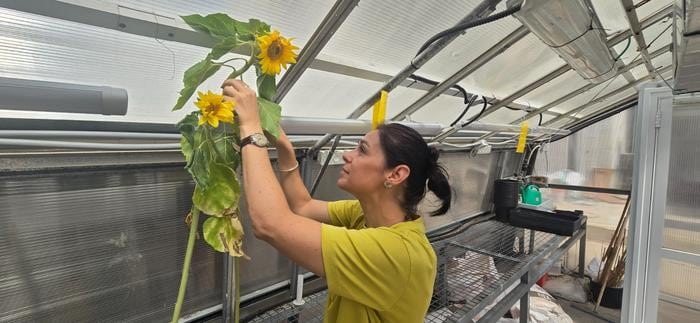
Dancing in the sunlight: Yasmine Meroz inspects a sunflower plant. (Courtesy: Tel Aviv University)
Sunflowers in a field can co-ordinate the circular motions of their growing stems to minimize the amount of shade each plant experiences – a study done in the US and Israel has revealed. By doing a combination of experiments and simulations, a team led by Yasmine Meroz at Tel Aviv University discovered that seemingly random movements within groups of plants can lead to self-organizing patterns that optimize growing conditions.
Unlike animals, plant motion is usually related to growth – which is an irreversible process that defines a plant’s morphology. One movement frequently observed in plants is called circumnutation, which describes repeating, circular motions at the tips of growing plant stems.
“Charles Darwin and his son, Francis, already identified circumnutations in their book, The Power of Movement in Plants, in 1880,” Meroz explains. “While they documented these movements in a number of species, it was not clear whether these have a function. It is only in recent years that some research has started to identify possible roles of circumnutations, such as the ability of roots to circumvent obstacles.”
Understanding self-organization
Circumnutation was not the initial focus of the team’s study. Instead, they sought a deeper understanding of self-organization. This is a process whereby a system that start outs in a disorderly state can gain order through local interactions between its individual components.
In nature, self-organization has been widely studied in groups of animals, including fish, birds, and insects. The coordinated movements of many individuals help animals source food, evade predators, and conserve energy.
But in 2017 a fascinating example of self-organization in plants was discovered by a team of researchers in Argentina. While observing a field of sunflowers growing in dense rows, the team found that the plants’ stems self-organized into zigzag patterns as they grew. This arrangement minimized the shade the sunflowers cast on one another, ensuring each plant received the maximum possible amount of sunlight.
Meroz’s team has now studied this phenomenon in a controlled laboratory environment. “Unlike previous work, we tracked the movement of sunflower crowns during the whole experiment,” Meroz describes. “This is when we found that sunflowers move a lot via circumnutations, and we asked ourselves whether these movements might play a role in the self-organization process.”
To inform the analysis, Meroz’s team considered two key ingredients of self-organization. The first involved local interactions between individual plants – in this case, their ability to adapt their growth to avoid shading each other.
The second ingredient were the random, noisy motions that allow self-organized systems to explore a variety of possible states. This randomness enables plants to adapt to short-term environmental changes while maintaining stability in their growth patterns.
Tweaking noise
For their sunflowers, the researchers predicted that these random motions could be provided by the circumnutations first described by Charles and Francis Darwin. To investigate this idea, they ran simulations of groups of sunflowers based closely on the movements they had observed in the lab. In these simulations, they tweaked the amount of noise generated by circumnutation with a level of control that is not yet possible in real-world experiments.
“By comparing what we saw in the group experiments with our simulation data, we figured out the best balance of these factors,” explains Meroz’s colleague, Orit Peleg at the University of Colorado Boulder. “We also confirmed that real plants balance these factors in a way that leads to near-optimal minimization of shading.”
As expected, the results confirmed that the random movements of individual sunflowers play a vital role in minimizing the amount of shading experienced by each plant.
Peleg believes that their discovery has fascinating implications for our understanding of how plants behave. “It’s a bit surprising because we don’t usually think of random movement as having a purpose,” she says. “Yet, it’s vital for minimizing shading. This finding prompts us to view plants as active matter, with unique constraints imposed by their anchoring and growth-movement coupling.”
If you want to make a clock, all you need is an oscillation – preferably one that is stable in frequency and precisely determined. Many systems will fit the bill, from the Earth’s rotation to pendulums and crystal oscillators. But if you want the world’s most precise clock, you’ll need to go to the US state of Colorado, where researchers from JILA and the University of Colorado, Boulder have measured the frequency of an optical lattice clock (OLC) with a record-low systematic uncertainty of 8.1 × 10⁻¹⁹ – equivalent to a fraction of a second throughout the age of the universe.
OLCs are atomic clocks that mark the passage of time using an electron that oscillates between two energy levels (the ground state 1S0 and clock state 3P0) in an atom such as strontium. The high frequency and narrow linewidth of this atomic transition makes these clocks orders of magnitude more precise than the atomic clocks used to redefine the second in 1968, which were based on a microwave transition in caesium atoms.
The high precision of OLCs gives them the potential to unlock technologies that can be used to sense quantities such as distances, the Earth’s gravitational field and even atomic properties such as the fine structure constant at extremely small scales. To achieve this precision, however, they must be isolated from external effects that can cause them to “tick” irregularly. This is why the atoms in an OLC are trapped in a lattice formed by laser beams and confined within a vacuum chamber.
An OLC that is isolated entirely from its environment would oscillate at the constant, natural frequency of the atomic transition, with an uncertainty of 0 Hz/Hz. In other words, its frequency would not change. However, in the real world, temperature, magnetic and electric fields, and even the collisional motion of the atoms in the lattice all influence the clock’s oscillations. These parameters therefore need to be very well controlled for the clock to operate at maximum precision.
Controlling blackbody radiation
According to Alexander Aeppli, a PhD student at JILA who was involved in setting the new record, the most detrimental environmental effect on their OLC is blackbody radiation (BBR). All thermal objects – light bulbs, human bodies, the vacuum chamber the atoms are trapped in – emit such radiation, and the electric field of this radiation couples to the atom’s energy levels. This causes a systematic shift that translates to an uncertainty in the clock’s frequency.
To minimize the effects of BBR, Aeppli and colleagues enclosed their entire system, including the vacuum chamber and optics for creating the clock, within a temperature-controlled box equipped with numerous temperature sensors. By running temperature-stabilized liquid around different parts of their experimental apparatus, they stabilized the air temperature and controlled the vacuum system temperature.
This didn’t completely solve the problem, though. BBR shift is the sum of a static component that scales with the fourth power of temperature and a dynamic component that scales with higher powers. Even after limiting the lab’s temperature fluctuations to a few millikelvin per day, the team still needed to carry out a systematic evaluation of the shift due to the dynamic component.
For this, the JILA-Boulder researchers turned to a 2013 study in which physicists in the US and Russia found a correlation between the uncertainty of the BBR shift and the lifetime of an electron occupying a higher-energy state (3D1) in strontium atoms. By measuring the lifetime of this 3D1 state, the team was able to calculate an uncertainty of 7.3 × 10⁻¹⁹ in the BBR shift.
To fully understand the atoms’ response to BBR, Aeppli explains that they also needed to measure the strength of transitions from the clock states. “The dominant transition that is perturbed by BBR radiation is at a relatively long wavelength,” he says. “This wavelength is longer than the spacing between the atoms, meaning that atoms can behave collectively, modifying the physics of this interaction. It took us quite some time to characterize this effect and involved almost a year of measurements to reduce its uncertainty.”
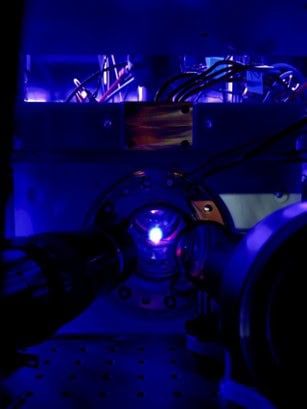
Minimizing uncertainty: Several layers of systematics need to be tackled individually to isolate the optical lattice clock from external influences. (Courtesy: Kyungtae Kim, JILA)
Other environmental effects
BBR wasn’t the only environmental effect that needed systematic study. The in-vacuum mirrors used to create the lattice tend to accumulate electric charges, and the resulting stray electric fields produce a systematic DC Stark shift that changes the clock transition frequency. By shielding the mirrors with a copper structure, the researchers reduced these DC Stark shifts to below the 1 × 10⁻¹⁹ uncertainty level.
OLCs are also sensitive to magnetic fields. This is due to the Zeeman effect, which shifts the energy levels of an atom by different amounts in the presence of such fields. The researchers chose the least magnetically sensitive sub-states to operate their clock, but that still leaves a weaker second-order Zeeman shift for them to calibrate. In the latest work, they reached an uncertainty in this second-order Zeeman shift of 0.1 × 10⁻¹⁸, which is a factor of two smaller than previous measurements.
Even the lattice beams themselves cause an unwanted shift in the atoms’ transition frequency. This is known as the light or AC Stark shift, and it is due to the power of the laser beam. The researchers minimized this shift by ramping down the beam power just before starting the clock, but even at such low trapping powers, atoms in the different lattice sites can still interact, and atoms at the same site can collide. These events lead to a tunnelling and a density shift, respectively. While both are rather weak, the team nevertheless investigated their effect on the clock’s uncertainty and constrained them to below the 10−19 level.
How low can you go?
In early 2013, JILA scientists reported a then-record-low systematic uncertainty in their strontium OLC of 6.4 × 10⁻¹⁸. A year later, they managed to reduce this uncertainty by a factor of three, to 2.1 × 10⁻¹⁸. Ten years on, however, progress seems to have slowed: the latest uncertainty record improves on this value by a mere factor of two. Is there an intrinsic lower bound?
“The largest source of systematic uncertainty continues to be the BBR shift since it goes as temperature to the fourth power,” Aeppli says. “Even a small reduction in temperature can significantly reduce the shift uncertainty.”
To go below the 1 × 10⁻¹⁹ level, he explains that it would be advantageous to cool the system to cryogenic temperatures. Indeed, many OLC research groups are using this approach for their next-generation systems. Ultimately, though, while progress on optical clocks might not be quite as fast as it was 20 years ago, Aeppli says there is no obvious “floor”, no fundamental limit to the systematic uncertainty of optical lattice clocks. “There are plenty of clever people working on pushing uncertainty as low as possible,” he says.
A child prodigy born in a humble village in British India on 29 January 1926, Abdus Salam became one of the world’s greatest theorists who tackled some of the most fundamental questions in physics. He shared the 1979 Nobel Prize for Physics with Sheldon Glashow and Steven Weinberg for unifying the weak and electromagnetic interactions. In doing so, Salam became the first Muslim scholar to win a science-related Nobel prize – and is so far the only Pakistani to achieve that feat.
After moving to the UK in 1946 just before the partition of India, Salam gained a double-first in mathematics and physics from the University of Cambridge and later did a PhD there in quantum electrodynamics. Following a couple of years back home in Pakistan, Salam returned to Cambridge, before spending the bulk of his career at Imperial College, London. He died aged 70 on 21 November 1996, his later life cruelly ravaged by a neurodegenerative disease.
Yet to many people, Salam’s life and contributions to science are not so well known despite his founding of the International Centre for Theoretical Physics (ICTP) in Trieste, Italy, exactly 60 years ago. Upon joining Imperial, he also became the first academic from Asia to hold a full professorship at a UK university. Keen to put Salam in the spotlight ahead of the centenary of Salam’s birth are Claudia de Rham, a theoretical physicist at Imperial, and quantum-optics researcher Ian Walmsley, who is currently provost of the college.
How would you summarize Abdus Salam’s contributions to science?
CdR: Salam was one of the founders of modern physics. He pioneered the study of symmetries and unification, which helped contribute to the formulation of the Standard Model of particle physics. In 1967 he incorporated the Higgs mechanism – co-discovered by his Imperial colleague Tom Kibble – into electroweak theory, which unifies the electromagnetic and weak forces. It changed the way we see the world by underlining the importance of symmetry and by showing how some forces – which may appear different – are actually linked.
This breakthrough led him to win the 1979 Nobel Prize for Physics with Steven Weinberg and Sheldon Glashow, making him the first – in fact, so far, the only – Nobel laureate from Pakistan. Salam was also the first person from the Islamic world to win a Nobel prize in science and the most recent person from Imperial College to do so, which makes us very proud of him.
How did his connection to Imperial College come about?
CdR: After studying at Cambridge, he went back to Pakistan but realized that the scientific, opportunities there were limited. So he returned to Cambridge for a while, before being appointed a professor of applied mathematics at Imperial in 1957. That made him the first Asian academic to hold a professorship at any UK university. He then moved to the physics department at Imperial and stayed at the college for almost 40 years – for the rest of his life.
Read all about it Imperial College’s main library was renamed in honour of Abdus Salam in 2023, with visitors greeted by a large new tribute to him. (Courtesy: Imperial College London)
For Salam, Imperial was his scientific home. He founded the theoretical physics group here, doing the work on quantum electromagnetics and quantum field theory that led to his Nobel prize. But he also did foundational work on renormalization, grand unification, supersymmetry and so on, making Imperial one of the world’s leading centres for fundamental physics research. Many of his students, like Michael Duff and Ray Rivers, also had an incredible impact in physics, paving the way for how we do quantum field theory today.
What was Salam like as a person?
IW: I had the privilege of meeting Salam when I was an undergraduate here in Imperial’s physics department in 1977. In the initial gathering of new students, he gave a short talk on his work and that of the theoretical physics group and the wider department. I didn’t understand much of what he said, but Salam’s presence was really important for motivating young people to think about – and take on – the hard problems and to get a sense of the kind of problems he was tackling. His enthusiasm was really fantastic for a young student like myself.
When he won the Nobel prize in 1979, I was by then a second-year student and there were a lot of big celebrations and parties in the department. There were a number of other luminaries at Imperial like Kibble, who’d made lots of important contributions. In fact, I think Salam’s group was probably the leading theoretical particle group in the UK and among the best in the world. He set it up and it was fantastic for the department to have someone of his calibre: it was a real boost.
How would you describe Salam’s approach to science?
CdR: Salam thought about science on many different levels. There wasn’t just the unification within science itself, but he saw science as a unifying force. As he showed when he set up the theoretical physics group at Imperial and, later, the ICTP in Trieste, he saw science as something that could bring people from all over the world together.
We’re used to that kind of approach today. But at the time, driving collaboration across the world was revolutionary. Salam wasn’t just an incredible scientist, but an incredible human being. He was eager to champion diversity – recognizing that it’s the best thing not just for science but for humanity too. Salam was ahead of his time in realizing the unifying power of science and being able to foster it throughout the world.
What impact has the ICTP had over the last 60 years?
CdR: The goal of the ICTP has been to combat the isolation and lack of resources that people in some parts of the world, especially the global south, were facing. It’s had a huge impact over the last 60 years and has now grown into a network of five institutions spread over four continents, all of which are devoted to advancing international collaboration and scientific expertise to the non-western world. It hosts around 6000 scientists every year, about 50% of whom are from the global south.
How well known do you think Salam is around the world?
IW: Is he well known in the physics community globally? Absolutely. I also think he is well regarded and known across the Muslim community. But is he well known to the general public as one of the UK’s greatest adopted scientists? Probably not. And I think that’s a shame because his skills as a pedagogue and his concern for people as a whole – and for science as a motivating force – are really important messages and things he really championed.
What activities has Imperial got planned for the centenary of Salam’s birth?
Celebrating success Paying tribute to Abdus Salam on his 98th birthday on 29 January 2024 at Imperial College were (from left to right) college president Hugh Brady, theorist Claudia de Rham, ICTP director Atish Dabholkar, TV’s Brian Cox and Imperial provost Ian Walmsley. (Courtesy: Imperial College London)
We also held an exhibition here on campus about many aspects of Salam’s life for school children all around London to come and visit. It’s now moved to a permanent virtual home online. And we held an essay contest for school children from Pakistan to see how Salam has inspired them, selecting a few to go online. We also had a special documentary about Salam filmed called “A unifying force”.
What impact do you think those events have had?
IW: It was really great to name a building after him, especially as it’s the library where students congregate all the time. There’s a giant display on the wall outside that describes him and has a great picture of Salam. You can see it even without entering the library, which is great because you often have families taking their children and showing them the picture and reading the narrative. It’ll spread his fame a bit more, which is really important and really lovely.
CdR: One thing that was clear in the build-up to the event in January was just how much his life story resonates with people at absolutely every level. No matter your background or whether you’re a scientist or not, I think Salam’s life awakens the scientist in all of us – he connects with people. But as the centenary of his birth draws closer, we want to build on those initiatives. Fundamental, curiosity-driven research is a way to make connections with the global south so we’re very much looking forward to an even bigger celebration for his 100th birthday in 2026.
A full version of this interview can be heard on the 8 August 2024 episode of the Physics World Weekly podcast.
Abdus Salam: driven to success
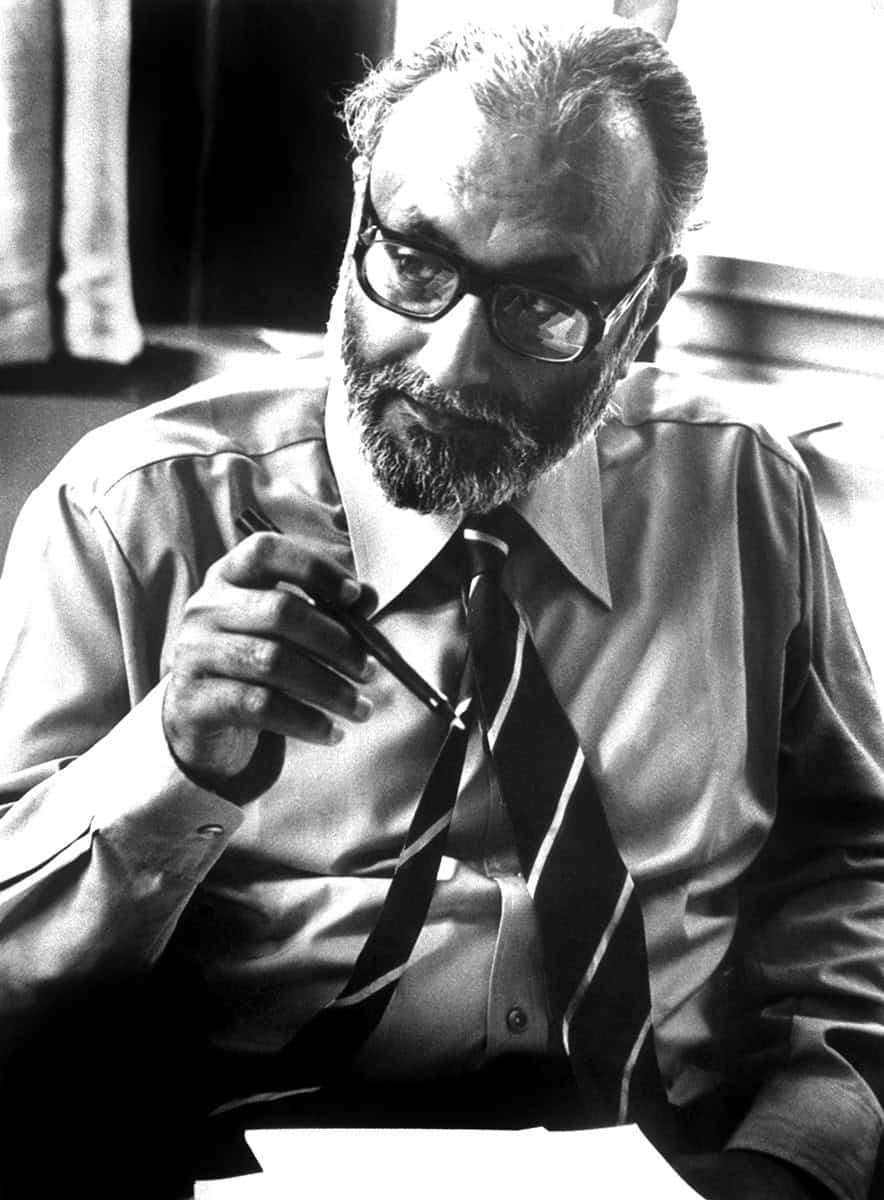
Genius in action A portrait of Abdus Salam taken in 1979, the year in which he shared the Nobel Prize for Physics with Sheldon Glashow and Steven Weinberg. (Courtesy: Giovanni Montenero, ICTP Photo Archives)
Abdus Salam, like all geniuses, was not a straightforward character. That much is made clear in the 2018 documentary movie Salam: the First ****** Nobel Laureate directed by Anand Kamalakar and produced by Zakir Thaver and Omar Vandal. Containing interviews with Salam’s friends, family members and former colleagues, Salam is variously described as being “charismatic”, “humane”, “difficult”, “impatient”, “sensitive”, “gorgeous”, “bright”, “dismissive” and “charming”.
Despite him being the first Nobel-prize winner from Pakistan, the film also wonders why he is relatively poorly known and unrecognized in his homeland. The movie argues that this was down to his religious beliefs. Most Pakistanis are Sunnis but Salam was an Ahmadi, part of a minor Islamic movement. Opposition in Pakistan to the Ahmadis even led to its parliament declaring them non-Muslims in 1974, forbidden from professing their creed in public or even worshipping in their own mosques.
Those edicts, which led to Salam’s religious beliefs being re-awakened, also saw him effectively being ignored by Pakistan (hence the title of the movie). However, Salam was throughout his life keen to support scientists from less wealthy nations, such as his own, which is why he founded the International Centre for Theoretical Physics (ICTP) in Trieste in 1964.
Celebrating its 60th anniversary this year, the ICTP now has 45 permanent research staff and brings together more than 6000 leading and early-career scientists from over 150 nations to attend workshops, conferences and scientific meetings. It also has international outposts in Brazil, China, Mexico and Rwanda, as well as eight “affiliated centres” – institutes or university departments with which the ICTP has formal collaborations.
A new method for 3D printing, described in Science, makes inroads into hydrogel-based adhesives for use in medicine.
3D printers, which deposit individual layers of a variety of materials, enable researchers to create complex shapes and structures. Medical applications often require strong and stretchable biomaterials that also stick to moving tissues, such as the beating human heart or tough cartilage covering the surfaces of bones at a joint.
Many researchers are pursuing 3D printed tissues, organs and implants created using biomaterials called hydrogels, which are made from networks of crosslinked polymer chains. While significant progress has been made in the field of fabricated hydrogels, traditional 3D printed hydrogels may break when stretched or crack under pressure. Others are too stiff to sculpt around deformable tissues.
Researchers at the University of Colorado Boulder, in collaboration with the University of Pennsylvania and the National Institutes of Standards and Technology (NIST), realized that they could incorporate intertwined chains of molecules to make 3D printed hydrogels stronger and more elastic – and possibly even allow them to stick to wet tissue. The method, known as CLEAR, sets an object’s shape using spatial light illumination (photopolymerization) while a complementary redox reaction (dark polymerization) gradually yields a high concentration of entangled polymer chains.
To their knowledge, the researchers say, this is the first time that light and dark polymerization have been combined simultaneously to enhance the properties of biomaterials fabricated using digital light processing methods. No special equipment is needed – CLEAR relies on conventional fabrication methods, with some tweaks in processing.
“This was developed by a graduate student in my group, Abhishek Dhand, and research associate Matt Davidson, who were looking at the literature on entangled polymer networks. In most of these cases, the entangled networks that form hydrogels with high levels of certain material properties…are made with very slow reactions,” explains Jason Burdick from CU-Boulder’s BioFrontiers Institute. “This is not compatible with [digital light processing], where each layer is reacted through short periods of light. The combination of the traditional [digital light processing] with light and the slow redox dark polymerization overcomes this.”
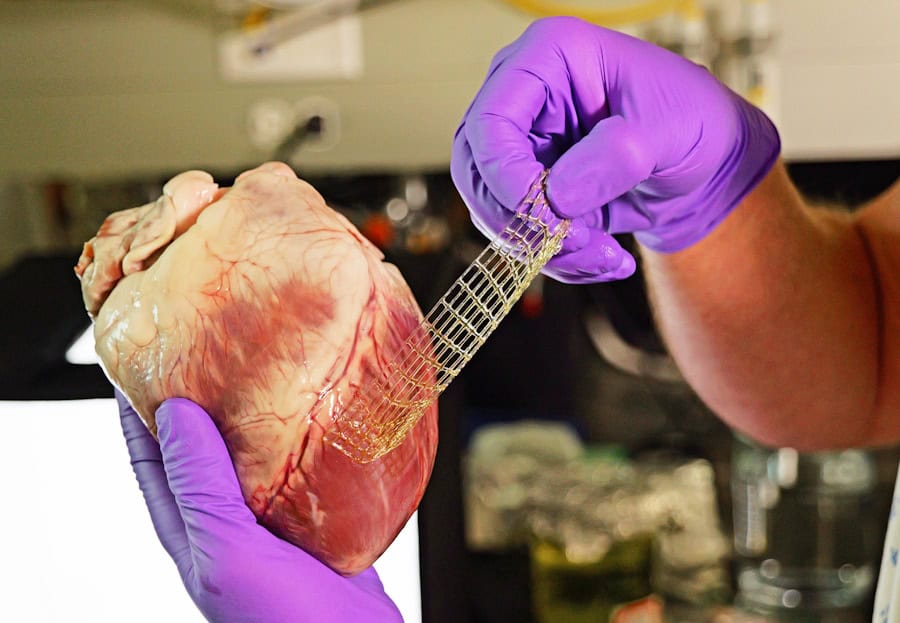
Medical applications Laboratory tests showed how the 3D printed material moulds and sticks to organs such as this porcine heart. (Courtesy: Casey Cass/CU Boulder)
Experiments confirmed that hydrogels produced with CLEAR were fourfold to sevenfold tougher than hydrogels produced with conventional digital light processing methods for 3D printing. The CLEAR-fabricated hydrogels also conformed and stuck to animal tissues and organs.
“We illustrated in the paper the application of hydrogels printed with CLEAR as tissue adhesives, as others had previously defined material toughness as an important material property in adhesives. Through CLEAR, we can then process these adhesives into any structures, such as porous lattices or introduce spatial adhesion that may be of interest for biomedical applications,” Burdick says. “What is also interesting is that CLEAR can be used with other types of materials, such as elastomers, and we believe that it can be used across broad manufacturing methods.”
CLEAR could also have environmentally friendly implications for manufacturing and research, the researchers suggest, by eliminating the need for additional light or heat energy to harden parts. The researchers have filed for a provisional patent and will be conducting additional studies to better understand how tissues react to the printed hydrogels.
“Our work so far was mainly proof-of-concept of the method and showing a range of applications,” says Burdick. “The next step is to identify those applications where CLEAR can make an impact and then further explore those topics, whether this is specific to biomedicine or more broadly beyond this.”
Drowsiness plays a major role in traffic crashes, injuries and deaths, and is considered the most critical hazard in construction and mining. A wearable device that can monitor fatigue could help protect drivers, pilots and machine operators from the life-threatening dangers of fatigue.
With this aim, researchers at UC Berkeley are developing techniques to detect signs of drowsiness in the brain, using a pair of prototype earbuds to perform electroencephalography (EEG) and other physiological measurements. Describing the device in Nature Communications, the team reports successful tests on volunteers.
“Wireless earbuds are something we already wear all the time,” says senior author Rikky Muller in a press statement. “That’s what makes ear EEG such a compelling approach to wearables. It doesn’t require anything extra. I was inspired when I bought my first pair of Apple’s AirPods in 2017. I immediately thought, ‘What an amazing platform for neural recording’.”
Improved design
EEG uses multiple electrodes placed on the scalp to non-invasively monitor the brain’s electrical activity – such as the alpha waves that increase when a person is relaxed or sleepy. Researchers have also demonstrated that multi-channel EEG signals can be recorded from inside the ear canal, using in-ear sensors and electrodes.
Existing in-ear devices, however, mostly use wet electrodes (which necessitate skin-preparation and hydrogel on the electrodes), contain bulky electronics and require customized earpieces for each user. Instead, Muller and colleagues aimed to create an in-ear EEG with long-lifespan dry electrodes, wireless electronics and a generic earpiece design.
Generic design Schematic of the ear EEG (left) and the earpiece being worn by a user (right). (Courtesy: Ryan Kaveh/UC Berkeley)
The researchers developed a fabrication process based on 3D printing of a polymer earpiece body and electrodes. They then plated the electrodes with copper, nickel and gold, creating electrodes that remain stable over months of use. To ensure comfort for all users, they designed small, medium and large earpieces (with slightly different electrode sizes to maximize electrode surface area).
The final medium-sized earpiece contains four 60 mm2 in-ear electrodes, which apply outward pressure to lower the electrode–skin impedance and improve mechanical stability, plus two 3 cm2 out-ear electrodes. Signals from the earpiece are read out and transmitted to a base station by a low-power wireless neural recording platform (the WANDmini) affixed to a headband.
Drowsiness study
To assess the earbuds’ performance, the team recorded 35 h of electrophysiological data from nine volunteers. Subjects wore two earpieces and did not prepare their skin beforehand or apply hydrogel to the electrodes. As well as EEG, the device measured signals such as heart beats (using electrocardiography) and eye movements (via electrooculography), collectively known as ExG.
To induce drowsiness, subjects played a repetitive reaction time game for 40–50 min. During this task, they rated their drowsiness every 5 min on the Karolinska Sleepiness Scale (KSS). The measured ExG data, reaction times and KSS ratings were used to generate labels for classifier models. Data were labelled as “drowsy” if the user reported a KSS score of 5 or higher and their reaction time had more than doubled since the first 5 min.
To create the alert/drowsy classifier, the researchers extracted relevant temporal and spectral features in standard EEG frequency bands (delta, theta, alpha, beta and gamma). They used these data to train three low-complexity machine learning models: logistic regression, support vector machines (SVM) and random forest. They note that spectral features associated with eye movement, relaxation and drowsiness were the most important for model training.
All three classifier models achieved high accuracy, with comparable performance to state-of-the-art wet electrode systems. The best-performing model (utilizing a SVM classifier) achieved an average accuracy of 93.2% when evaluating users it had seen before and 93.3% with never-before-seen users. The logistic regression model, meanwhile, is more computationally efficient and requires significantly less memory.
The researchers conclude that the results show promise for developing next-generation wearables that can monitor brain activity in work environments and everyday scenarios. Next, they will integrate the classifiers on-chip to enable real-time brain-state classification. They also intend to miniaturize the hardware to eliminate the need for the WANDmini.
“We plan to incorporate all of the electronics into the earbud itself,” Muller tells Physics World. “We are working on earpiece integration, and new applications, including the use of earbuds during sleep.”
This episode of the Physics World Weekly podcast explores how physics can be used as a force for good – helping society address important challenges such as climate change, sustainable development, and improving health.
Our guest is the Swiss physicist Christophe Rossel, who is a former president of the European Physical Society (EPS) and an emeritus scientist at IBM Research in Zurich.
Rossel is a co-editor and co-author of the book EPS Grand Challenges, which looks at how science and physics can help drive positive change in society and raise standards of living worldwide as we approach the middle of the century. The huge tome weighs in at 829 pages, was written by 115 physicists and honed by 13 co-editors.
Rossel talks to Physics World’s Matin Durrani about the intersection of science and society and what physicists can do to make the world a better place.