Galileo's inconvenient truth

Al Gore.jpg
Al Gore

By Margaret Harris

As we were waiting for tonight’s keynote address by former US vice president and Nobel laureate Al Gore, the man next to me commented that the International Year of Astronomy hasn’t received nearly as much press attention as the 150th anniversary of Charles Darwin’s publication of Origin of Species. Perhaps people can only absorb one celebration at a time, he suggested, and Darwin pipped Galileo to the post.

If it’s true that the public has a limited appetite for scientific anniversaries, then Gore’s speech must have left its audience very full indeed. The beginning of the talk incorporated not only Darwin and Galileo — whose evidence for a heliocentric universe Gore called “the original inconvenient truth” in reference to his 2006 film — but also Sir John Tyndall, who discovered 150 years ago that carbon dioxide in the atmosphere absorbs radiation from the sun.

The remainder of Gore’s address was essentially a statistics-rich tour of climate change and its potentially catastrophic effects on human life. Having seen it, I can understand how “An Inconvenient Truth” struck such a chord with viewers. As a politician, Gore was often lampooned for being humourless and wooden, but his calm, deadpan manner suits his subject matter perfectly: the facts are so striking that they speak for themselves, with no need for histrionics or overt emotion.

Gore now calls himself a “recovering politician” — he’s on Step 9 of the programme, he joked — and he claimed he didn’t want to make a political speech tonight. Yet one of the most optimistic things he had to say was also among the most political. After calling the search for green energy the greatest scientific challenge of our age, he claimed that we nonetheless have everything we need to solve it “except possibly political will — and the United States has just demonstrated that political will is a renewable resource.” If the situation is as dire as Gore’s data indicate, let’s hope he’s right.

Harder than diamond?

For millennia diamonds have been well established as the hardest material in nature. Then, two years ago, a composite material containing the mineral wurtzite BN was shown to have the same resistance to indentation as diamond.

Now, theoretical work by researchers in China and the US suggests that pure wurtzite BN is significantly harder than diamond. They also predict that Lonsdaleite — with a structure closely related to wurtzite — could be transformed under pressure to become 58% harder than diamond, a new world record (PRL:102.05503).

Hong Sun of Shanghai University and his colleagues report that the very act of indenting wurtzite-BN can force it to undergo a phase transformation into a new crystalline structure with super strength.

A new phase

A material’s hardness is usually taken as a measure of its resistance to external forces. The classic field test is to determine relative “indentation hardness” by crunching together two materials; the harder does the indenting and the weaker gets indented. The fact that diamond has always won these battles is related to its strong, stable carbon lattice, which most commonly takes the form of an octahedron.

Two years ago diamond finally met its match when a small quantity of composite containing the little known wurtzite BN (w-BN) was shown to have the same level of indentation hardness as diamond. Because all other minerals in the composite were known to be significantly weaker than diamond, it led researchers to believe that w-BN may be may possess hardness superior to diamond.

Sun and colleagues focussed on w-BN’s hexagonal crystalline structure, and its stress response to indentation loading. This paid off when their calculations showed w-BN to undergo a structural phase transition when subject to high pressures. The crystal volume remained unchanged but a “bond flip” led to a much increased resistance to indentation.

Armed with this theoretical explanation, the researchers then extended their theory to the related mineral Lonsdaleite. They predict that this naturally-occurring material can be compressed into an even stronger crystalline lattice that 58% more resistant to indentation than diamond.

A machinist’s best friend?

Given the usefulness of diamonds for industrial cutting but their high prices, a lot of practical and theoretical research has gone into finding materials that are as hard and thermally stable as diamond. Lonsdaleite certainly has the strength, according to this new research, but the main problem is its scarcity in nature. “Lonsdaleite and w-BN exist in these metastable structures but they need to overcome the very high potential barriers to transform,” said Sun.

“The kind of heat and pressures needed to produce Lonsdaleite requires the kind energies associated with meteorite collisions,” said Phil Bland, a rock mechanics researcher at Imperial College. Indeed until now naturally-occurring Lonsdaelite has only been found at impact craters like Tunguska in Russia and the Ries crater in southern Germany.

Given this drawback, Sun told physicsworld.com that his team intends to look for ways to produce Lonsdaleite and related materials by artificial processes. “With the fast development of nano science, one might be able to design and synthesize any new kind of artificial materials in the future. The possibility is unlimited,” he said.

'Promiscuous networking'

By Margaret Harris

I’d thought that the economic crisis might be the elephant in the conference room here at AAAS, but it turns out I was only half right: it’s an elephant-sized issue, true enough, but presenters aren’t avoiding it.

Jose Manuel Silva Rodriguez, the director-general of the European Commission for Research, seemed optimistic about prospects for science research in a recession despite looming budget cuts in EU member countries. Most of their projects, he said, are funded well in advance, and should be safe through 2012. But one speaker at a career forum for women and minorities was less sure: she claimed that 50% of jobs in her subject — field biology — were canceled this year in the teeth of previous funding promises.

Brooke Allen of trading group Maple Security took a middle route. He’d changed the title of his seminar from “Finding Hidden Values in the Job Market” to the more downbeat “Finding Work and Finding Jobs in Hard Times,” but he also maintained that recessions were the best time to find work, because “greedy people who won’t work except for lots of compensation drop out of the market”.

There’s just one catch: “work” and “jobs” are not synonymous, so there may be plenty of work to be done, but not enough paid jobs available for people to do them. His advice for securing a paid job boiled down to an exhortation to do more networking — not in itself a terribly original suggestion, but Allen did have an interesting way of illustrating this old cliché.

He’s an advocate of what he calls “promiscuous networking,” which means that he views literally everyone he’s ever met (2500 people and counting) as part of his network. To illustrate how this works, he got everyone in his audience to list three things they wanted, three things they could offer, and then mill about the room comparing notes and exchanging email addresses.

I decided to offer help with reviewing books, living in the UK, and finding good places to go hiking, while asking for help on articles about careers, finding funny physicists to write Lateral Thoughts columns, and improving my Spanish. At the end of the session, I had collected names of four people who wanted my help, and four who thought they might be able to help me. Not bad.

So does this promiscuous networking thing work? The jury’s still out for me, but for those of you seeking jobs in this difficult climate, it could be worth a try.

Nano-imprinting breaks the mould

A new nanoimprinting technique that could come in useful for making high-density data storage and processing devices has been invented by mechanical engineers at Yale University in the US. The technique, which employs moulds made from amorphous metal rather than conventional silicon, can produce features as small as 13 nm — compared to the 45 nm features used in today’s computer chips. These can then be used to imprint onto polymers and other materials.

“We can now manipulate metallic glasses on extremely small scales, which were inaccessible in the past,” said team member Golden Kumar. “These glasses could be ideal materials for small-scale applications due to their superior mechanical and homogenous properties.”

Nanomoulding metallic glasses will have an important impact on nanoimprint lithography, which is regarded as the next-generation tool for nanoscale pattering, adds Kumar. Current nanoimprint technology relies on silicon-based moulds that are expensive to make and are not very durable. Nanoscale patterning such moulds also requires expensive and low-throughput electron-beam lithography.

Flow like plastics

The Yale researchers made their metallic glass templates by simple embossing techniques thanks to the fact that newly developed metallic glasses flow like plastics at moderately high temperatures. The metallic glass casts are stronger than silicon-based ones, can be massively replicated and are also reusable because features can be erased and the mould re-sculpted (Nature 457 868).

Kumar says that the moulds could be used as templates for nanoimprinting, rewritable high-density data storage, patterned surfaces for biomedical applications and photolithographic masks. “As well as these technological applications, the ability to precisely create metallic glass structures on the nanometre scale allows scientists to study the effects of size on the properties of amorphous materials — a subject that is hotly debated in the amorphous metal community,” added team leader Jan Schroers.

The researchers would now like to imprint even smaller features and study wetting phenomena between the different mould materials and metallic glasses. This will be the key to successful nanomoulding with metallic glasses, they explain.

The bean has landed

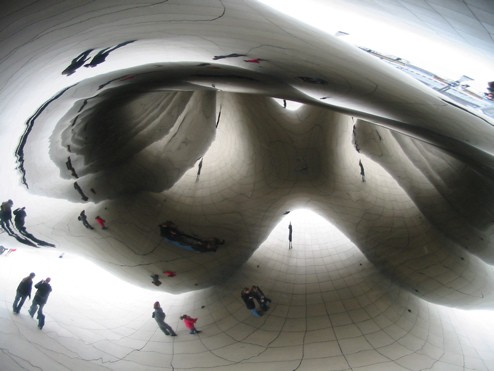
cloud gate.jpg
“Cloud Gate” sculpture in Chicago’s Millennium Park

By Margaret Harris

Is this a strangely shiny cosmic singularity? An artist’s impression of life inside a tokamak reactor? An alien spaceship?

All good guesses, but actually it’s the underside of a sculpture called “Cloud Gate” that sits in a public park on Chicago’s Lake Michigan shore. From the outside, it looks like a giant mirror-clad coffee bean, and it does a nice job of reflecting a slightly warped version of the city’s skyline — plus a few camera-happy journalists who wander past in search of lunch.

I’ll leave figuring out the bean’s optical properties as an exercise for the reader, because I’m on to bigger things: specifically “Our planet and its life: origins and futures,” which is the rather grandiose theme of the 2009 AAAS meeting. In practical terms, this means that most of the scheduled talks seem to fall into one (or more) of three categories: astronomy, environmental science, and evolution.

I plumped for the first and last category this afternoon by attending a briefing on “The Cosmic Cradle of Life.” During the session, Tony Remijan of the National Radio Astronomy Observatory in Charlottesville, Virginia spoke about how observers have found more than 150 different types of molecules — including ethylene glycol, or antifreeze — suspended in the interstellar medium. These discoveries have provided support for the idea that life on Earth (and potentially elsewhere) might not have required a complex homegrown chemical soup to get started — the key ingredients could have come from space instead.

Maybe they got there inside a giant mirrored bean…

New light on Moon’s far side

Much of the history and structure of the Moon remain poorly understood — including why the near and far sides of the Moon are so different to one another. Now four papers in the journal Science from the Japanese SELENE (Kaguya) mission shed new light on this mystery.

Scientists believe that the Moon was formed about 4.5bn years ago when a Mars-sized body collided with the young Earth, ejecting huge quantities of material that bound together in orbit. Much of the young Moon is thought to have been in a molten state, with the resulting magma ocean then partially crystallizing and differentiating and forming a distinct mantle and crust. This crust hardened but was then extensively cratered by meteorites during a period of “late heavy bombardment”, which ended about 3.8bn years ago.

The difference between near and far sides is more consistent with processes originating inside the Moon, rather than outside mechanisms Gregory Neumann, NASA

SELENE was launched in September 2007 and has produced a wide range of new data telling us about different stages of the Moon’s evolution, and in particular about the different conditions that existed on the lunar near and far sides at the time of the late heavy bombardment. On Earth we are only able to see just over one half of the surface of the Moon because the Moon’s period of rotation is almost equal to the time it takes to orbit the Earth.

Very different side

The far side first came into view in 1959, when the Soviet spacecraft Luna 3 flew around the Moon — and we now know that it is very different to the side we see in the night sky. The near side is covered with large dark patches that are low-lying pools of solidified lava — the so-called lunar seas or maria. By contrast, the far side consists mainly of bright and more heavily cratered highland material.

Probing the different historical conditions in the near and far sides has been made possible through radio tracking of the Moon’s gravitational field. This involves monitoring the Doppler shift of radio signals from a satellite — which is affected by changes in the velocity of the craft as it travels over regions of greater or lesser gravitational pull.

Previous missions have revealed a number of areas of high gravity, known as “mascons” (short for mass concentrations), on the Moon’s near side. These mascons coincide with maria and it has been proposed that the extra gravitational tug in these regions is due to the dense volcanic deposits inside the maria. However, one such region on the edge of the far side, beneath Mare Orientale, consists of a core of high gravity surrounded by lower than normal gravity. This feature cannot be readily explained by volcanic activity and scientists believe that this mascon might instead be caused by part of the denser mantle being thrust up into the crust during a meteorite impact.

Mascons found

Scientists have speculated whether there might be other mascons on the far side that exist under craters not filled with maria, and now SELENE has found such features.

Noriyuki Namiki of Kyushu University and colleagues at the National Astronomical Observatory of Japan were able to make a far improved gravitational map of the Moon’s far side using data from SELENE, which relays its signals to and from Earth via a small companion satellite located in a higher elliptical orbit (previous satellites could not carry out radio tracking when the Moon blocked their line of sight with the Earth). The data show a number of farside mascons, each with a central region of high gravity surrounded by a ring of low gravity (Science 323 900).

Gregory Neumann of the NASA Goddard Space Flight Center in Maryland, who has written an article in Science to accompany the four papers, says that this new gravity map tells us that the farside was cooler than the nearside during the late heavy bombardment. This, he explains, is because only relatively cool conditions would have kept the crust solid and capable of preserving some of the energy of the impacts as gravitational potential, in the form of mascons, whereas a hotter mantle on the nearside would have partially melted, causing magma to rise to the surface and erupt. “This means that the difference between near and far sides is more consistent with processes originating inside the Moon, rather than outside mechanisms such as a giant meteorite impact on the nearside,” he says.

Unlikely to contain water

Meanwhile, Hiroshi Araki of the National Astronomical Observatory of Japan in Tokyo and colleagues have used a laser altimeter onboard SELENE to make a very detailed topographic map of the Moon. Spectral analysis of the map reveals that the Moon’s mantle is likely to contain little water, and this is a key factor in the large-scale structure of the lunar surface, given that the water inside the Earth is instrumental in continent formation and plate tectonics (Science 323 897).

In the two other papers, Takayuki Ono of Tohoku University in Sendai and co-workers report how SELENE’s radar instrument has revealed previously unseen reflective layers beneath the maria on the Moon’s near side, suggesting that a lunar-wide cooling was largely responsible for geological formation within the last 2.8bn years (Science 323 909), while a team led by Junichi Haruyama at the Japan Aerospace Exploration Agency in Sagamihara describes the images obtained using SELENE’s Terrain Camera, and how these images indicate volcanic activity on the far side lasted until at least 2.5bn years ago.


Could the Earth be breathing?

gaiablog.jpg
gaiablog.jpg

By James Dacey

Ever since green issues crossed over to the mainstream in the 1980s, James Lovelock’s Gaia metaphor has always felt a little bit passé. Now it may be allowed to flourish once again in the 21st century as a bunch of environmental scientists report that the rocky Earth is “breathing”.

Carbon dioxide and other greenhouse gases produced in the soil get trapped in crevices, before being exhaled as temperatures drop, say the researchers at universities in Israel and the US.

During the summer they expect at least 8 hours of “breathing” each day and in winter up to 20 hour’s worth.

Apparently this convection is taking place in cracks right across the earth’s surface but climate modellers have so far failed to spot it.

Historically, gas exchange models consider diffusion alone, but factoring in “geo-respiration” could increase vapour flux by 50 %

Particularly cracked parts of the earth’s face, where this effect is most pronounced, include permafrost zones, agricultural settings and desert playas.

I contacted Maria Dragila, one of the researchers at Oregon State University and she told me:

“Our next step is to encourage the scientific community to consider this mechanism and quantify the effectiveness of this breathing in different environments by direct field
measurements.”

Full details of this research can be found in Geophysical Research Letters.

Tuning up for teleportation

A new technique for controlling the speed of “teleportation” in quantum systems has been created by physicists in the US and the UK. The researchers have demonstrated a way of “tuning” beams of light to distribute quantum information to specific points in space and time. Manipulating and storing data in this way is an important step towards developing new communication devices and eventually a quantum computer, say the researchers.

In quantum teleportation, the sender (Alice) instantaneously transfers the quantum state of a particle to a receiver (Bob). In 1997 physicists captured public attention by teleporting quantum states between “entangled” photons for the first time. Entanglement is a feature of quantum mechanics that allows particles with two distinct quantum states to share a much closer relationship than classical physics allows.

Over the intervening 12 years teleportation has been demonstrated over increasing distances and between larger particles.

Now, Alberto Marino and colleagues have addressed a different challenge of quantum computing — the need to control the flow of quantum information. In the experiment, two beams of light were “entangled” then slowed down in a controlled manner as they passed through a cloud of hot rubidium vapour (Nature:2009.10.1038).

“In classic computing, information needs to arrive at the processor just at the right time. In quantum computing, exactly the same is true,” says Marino, a quantum-information researcher at the University of Maryland and the National Institute of Standards and Technology (NIST).

Harnessing the random

Until now researchers have sought to develop quantum memory for long-term data storage. Unfortunately, these systems have been highly inefficient, losing at least 80% of the data. By slowing the speed of quantum data flow, Marino and colleagues have created a short-term memory device that is, according to the researchers, significantly more reliable.

First, the team split a laser beam into two before firing the resulting beams at the hot rubidium gas. Rubidium atoms have just one loosely bound electron in the outer shell, leading to a gas that is highly nonlinear in the way it interacts with light. Within the gas the incoming laser beams become entangled in a process known as “four-wave mixing”.

Quantum information is then carried in the form of fluctuations in the phase and intensity of the beams. Initially, the information travels at the speed of light but is then slowed in a controlled way in the atomic vapour.

“This type of delay will be essential for the realization of quantum networks,” says Hans-Albert Bachor, a quantum-computing researcher at the Australian National University.

Applications?

Using this mechanism, detection of quantum information was delayed for up to 27 ns. “Our quantum ‘images’ are the equivalent of the data buses in digital computers,” says Marino. The reason this delay could not be even longer is that the longer data are stored, the more noise is introduced. “Our next challenge is to preserve the quantum correlations while maintaining their quality,” said Vincent Boyer, also at the University of Maryland/NIST.

In Bachor’s opinion, it is too early to consider applications for this system, but this is “limited only by our imagination”.

“Short-term applications might include quantum sensors; these could work with only short fractional delays,” said Boris Blinov, a quantum systems researcher at the University of Washington.

Watch out for the space junk

spacejunk.jpg
Computer-generated images of objects in orbit around the Earth. These are objects, not shown to scale, that are large enough (at least 5 cm across) to be tracked by the US Space Surveillance Network. Some 95% are junk, i.e. not functioning satellites, with most occupying a low Earth orbit up to an altitude of 2000 km (left). Those items of junk in a geostationary orbit some 36 000 km high (right) form a clear ring, since they are located directly over the equator and have the same orbital period as the Earth. (Courtesy:NASA)

By Hamish Johnston

It’s finally happened — a very expensive telecommunications satellite has been destroyed by a piece of space junk. On Tuesday, one of 66 satellites that cover the Earth for the phone company Iridium was taken out by a defunct Russian satellite.

Although space is a big place, humans have managed to put lots of junk up there since the first satellite was launched in 1957 — as you can see in the illustrations above.

The pictures come from an article by Edwin Cartlidge — “Our orbiting junk-yard” — that appeared in the October 2007 issue of Physics World. I’m afraid that the full article is not available on physicsworld.com, but if your library subscribes to the Physics World Archive, you can read Edwin’s article here

Members of the Institute of Physics can read an online version of the Physics World. Simply login here and follow the Physics World link.

Visiting Fermilab

Fermilab's Wilson Hall.jpg
Fermilab’s Wilson Hall

By Margaret Harris

“I know it’s kind of a busman’s holiday for you, but do you want to visit Fermilab?”

The AAAS conference doesn’t officially kick off until tomorrow, so I was supposed to spend today de-jet-lagging myself while visiting my uncle west of Chicago. Now, a rainy February day in the Chicago suburbs is not everyone’s idea of great holiday material, but one of those suburbs happens to host the world’s biggest operational particle accelerator…and several of its scientists have prominent slots on the conference schedule…so…

Fermilab’s striking Wilson Hall atrium is open to the public from dawn to dusk most days, and you can hike in the surrounding prairies, too (just watch out for the resident bison herd — now down to 20 head due to budget cuts). But on Wednesday and Saturday mornings they also run guided tours, so my uncle and I joined the small group of curious local residents following science historian (and UK native – between that and the mist, I felt right at home) Yvonne Twomey around the linear accelerator building.

The ongoing Higgs boson hunt means that the Tevatron is nearly always running, so there’s a limit to what you can see at Fermilab on a public tour. But we poked our heads into the auditorium, peered through glass at the giant Cockcroft-Walton generator and the first few feet of the linear accelerator beam line, and learned a little about the great astrophysicist office-space takeover (they used to be confined to the third floor, but as the lab’s particle physics mission winds down, other sub-disciplines have picked up territory) before going back to the high-rise’s 15th floor to gaze out at the lab’s other buildings. And the mist. And the bison.

And, of course, to the distant skyline of Chicago proper, where I’ll be reporting on the conference from tomorrow on. Until then…

Copyright © 2026 by IOP Publishing Ltd and individual contributors