Polarized electrons pumped at GHz frequencies

A device that emits exactly one spin-polarized electron every billionth of a second has been unveiled by physicists in Germany. Based on a tiny piece of semiconductor called a quantum dot, the device is one of the fastest single electron pumps ever built.

The researchers believe that the device could, with some improvements, be used as a very precise source of electrical current that would allow physicists to redefine SI units in terms of fundamental quantities such as the charge of the electron — a discipline called quantum metrology.

On a more practical level, as the spins of the emitted electrons appear to all point in the same direction, the device could be used as a source of spin-polarized electrons in “spintronic” devices, which exploit both the spin and charge of the electron. In principle, this would allow such devices to operate at gigahertz clock speeds.

Tunnelling devices

The new device has been built by physicists at the PTB standards lab in Braunschweig, Germany. They are among a number of groups at standards labs around the world developing precise single-electron current sources. Many of these sources take advantage of the quantum mechanical effect of tunnelling — whereby an electron has a probability of spontaneously crossing an insulating barrier between two tiny pieces of metal (Applied Physics Letters 94 012106).

Early devices employed a series of tiny metal pieces and barriers. However, tunnelling takes a finite amount of time, which means that there is a gap of about one ten millionth of a second between the emission of successive electrons. In other words the source operates at 10 MHz, and this relatively low frequency results in an electrical current that is too small be of any practical use as a precise current source for quantum metrology.

Much faster single electron pumps that operate at gigahertz frequencies have been made using surface acoustic waves (SAWs) on a semiconductor. These are high frequency sound waves in a semiconductor that drive single electrons across and insulating barrier. However, these are much less precise than those based on tunnelling and therefore are not likely to be of much use for quantum metrology.

In 2007 an international team of researchers including Mark Blumenthal at Cambridge University, Bernd Kaestner at the PTB national metrology lab in Germany and J T Janssen at the UK’s National Physical Laboratory worked out a new way to make a much faster single electron source based on oscillating tunnelling barriers.

Comprising a tiny piece of semiconductor called a quantum dot, the device was initially operated at frequencies up to about 3 GHz. However it was nowhere near precise enough for quantum metrology because it failed to spit out exactly one electron about once in every 10,000 cycles. To be of practical use, a GHz pump could only skip a beat about once every 10 million cycles.

In December last year, Janssen and colleagues in Cambridge and New York showed that the performance of such an electron pump could be improved greatly by placing it in a magnetic field as high as 3 T. Now, Kaestner along with Hans Schumacher and colleagues at PTB have boosted this magnetic field to about 10 T and discovered that the performance is improved even more. What’s more, at such a high field, the pumped electrons are almost certainly spin polarized — according to the researchers.

Oscillating voltage

The PTB device is based on a quantum dot 250 nm in diameter (see diagram). Opposite sides of the quantum dot are connected to two tiny metal wires (700 nm wide) via two thin insulating layers (about 100 nm thick). An electrode carrying an oscillating voltage is placed onto one insulating layer and an electrode carrying a constant voltage is placed onto the other insulating layer.

An electron can move from a wire to the dot by tunnelling through the insulating layer under the oscillating-voltage electrode. This is much more likely to occur at a certain point in the oscillation, when the tunnelling barrier is reduced by the applied voltage. After tunnelling has occurred, the quantum dot then has an extra electron, which then tunnels out into the other nanowire. Electrical repulsion between electrons means that only one electron can squeeze through the tunnel barrier at a time.

Schumacher told physicsworld.com that such devices can operate at gigahertz frequencies because the applied voltages reduce the tunnelling barriers, allowing tunelling to occur much faster than in the metal-insulator devices.

The team found that by applying a high magnetic field to the dot, the precision of the pump went from about one in 10,000 to about one in one million. However, it is not clear exactly why the magnetic field has such a significant boost on the precision.

Schumacher believes that the magnetic field changes how the electron tunnels through the insulator. The electron is deflected by the magnetic field and therefore follows longer curved trajectories through the barriers — which could make it more likely that exactly one electron tunnels in and out per cycle. Janssen adds that the magnetic field also has the effect of confining the electrons into a smaller region of the quantum dot — which sharpens the divisions between electron energy levels, again making it more likely that exactly one electron moves in an out.

‘Interesting’ technology

Jukka Pekola, who studies single electron sources at the Helsinki University of Technology, described the source as “interesting” because the magnetic field gives physicists another parameter to tune its performance — and also because the electrons appear to be spin polarized.

The PTB team is now trying to further boost the precision of the source to about one in 100 million by trying to find the optimum magnetic field, device shape, operating frequency and waveform of the oscillating voltage.

While the team have not actually measured the spin polarization of the electrons, Schumacher is confident that the 10 T field aligns all the spins in the same direction. But just to be sure, the team plans to measure the spin polarization at sometime in the future.

Schumacher adds that the source can easily be adjusted to produce two spin-polarized electrons at a time. Because the pair is created in the same quantum dot, they would be entangled and therefore could be used — at least in principle — in a quantum computer.

Weird analogy of the week

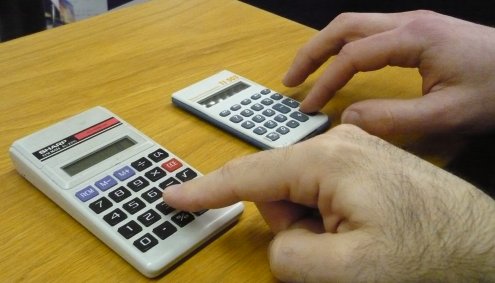
mencalc.jpg
The physicsworld.com supercomputer

by James Dacey

Ever wondered how many “men with calculators” it takes to match a day’s worth of IBM supercomputing?

According to The Times newspaper, it’s 120 billion of them, working for 50 years.

Confused?

Well, it all began yesterday at a press conference in San Francisco…

IBM revealed plans to build a supercomputer twenty times more powerful than today’s record.

The software company’s new baby is called Sequoia will be ready for action by 2012 when it takes up residence at the Lawrence Livermore National Laboratory, California.

Building and running costs will be covered by the US Department of Energy who are employing Sequoia to model the decay of the US nuclear weapons arsenal.

So what is this thing?

IBM’s geekspeak tells us that Sequoia will run at 20 petaflops: “peta” being the prefix for a quadrillion (10^15^) and FLOP standing for floating point operations per second.

The company will use their “Blue Gene” chip to make it different from a lot of other supercomputers which work by stacking up a whole load of servers.

Now, I’m no supercomputer aficionado but this computer seems substantially larger than previous computers, and, for that reason, worth reporting. The British mainstream press also thought so as the story appears on web pages of The Guardian, The Telegraph and The Times, along with a host of smaller sites.

Science journalists are always looking for “world-firsts” and “coo-wow” factor when it comes to new technologies, so it’s no real surprise that this humungous lump of American computer has received this widespread coverage.

And journalists are also committed to presenting facts in understandable, every-day terms. So it was interesting to see how the national papers would describe Sequoia’s processing power.

The Guardian, they went straight for the coo-wow, describing it as “the equivalent of more than 2m laptops.”

The Telegraph were a bit more conservative, focussing on the specific new development – “one order of magnitude quicker than its predecessor”

And then there’s The Times. Their description is – quite frankly – bizarre:

“Given an entire day, the Sequoia could match the output that 120 billion men with calculators might achieve in 50 years.”

What!!

Who are these men?
What are they calculating?
What type of calculator are they using?
Are they allowed bathroom breaks??

Ok, I’m being a little bit silly, but is a weird analogy. Quite creepy too, when you really think about it. And more than a little bit arbitrary.

So, creative physicsworld.com readers, I throw this out to you – how would you describe the computing power of IBM’s new monster machine?

Astronomers find ‘super Earth’

Astronomers using the CoRoT space telescope have found the smallest extrasolar planet to date. The planet, dubbed CoRoT-Exo-7b, is less than twice the radius of the Earth. It has a surface temperature of over 1000 degrees because it orbits extremely close to its parent star — and the exoplanet completes one orbit in just 20.5 hours.

Most of the 330 exoplanets discovered so far are gas giant planets that resemble Jupiter. Very few with masses comparable to Earth’s have been discovered because they are difficult to detect. CoRoT managed to identify such a small object because it is sensitive to a planet’s surface rather than just its mass — as in other methods to detect extrasolar planets, which detect the wobble of a star caused by an orbiting planet. CoRoT also orbits 900 km above Earth and can detect changes in star brightness as small as 0.01%, which is about 10 times better than the best ground-based telescopes.

The exoplanet circles a star about 400 light-years from Earth and was detected by measuring the slight dimming of a star each time an orbiting planet passes in front of it. Although the density of CoRoT-Exo-7b has not yet been determined, the scientists believe it might be a rocky object like Earth and covered with molten rock. It is therefore unlikely to harbour life as we know it on Earth.

Important milestone for planet hunters

The new result is an important milestone for planet hunters, according to Jean Schneider from the Laboratory Universe and Theories at the Paris Observatory, because recent measurements hinted at the existence of planets with small mass but their size had not been determined.

The discovery was also backed up with numerous follow-up measurements from the ground using telescopes and instruments like the VLT-ESO at Paranal, HARPS at La Silla and the Canada-France-Hawaii Telescope on Mauna Kea. Although scientists detected CoRoT-Exo-7b a year ago, they waited for the results from these complementary measurements before announcing their findings.

CoRoT was developed by the French Space Agency (CNES) at the Laboratory for Space Studies and Astrophysics Instrumentation (Paris Observatory), the Marseille Astrophysics Lab, the Institute of Space Astrophysics, Orsay (University of Paris 11) and the Midi Pyrenees Observatory, Toulouse. International partners included teams from Austria, Belgium, the European Space Agency, Germany, Spain and Brazil.

Star-shaking mission

CoRoT stands for “planetary convention, rotation and transits” and its goal is to search for exoplanets, and particularly those similar to Earth. It also detects and analyses star vibrations to determine star composition (also known as stellar seismology).

The work was presented at the first symposium dedicated to CoRoT, held in Paris from 2 to 5 February 2009. The work will be reported in an upcoming special issue of the journal Astronomy and Astrophysics.

CoRoT is the first step to finding Earth-like exoplanets and is a relatively small project that cost just €140m. It will be succeeded in time by KEPLER, a much more ambitious US mission with the same goals.

Doppler effect reversed by metamaterial

Physicists have generated a lot of excitement in recent years by dreaming up specially structured materials with novel applications like invisibility cloaks. What’s more, some of these “metamaterials” have been built in the laboratory and shown to work over a narrow range of electromagnetic wavelengths. Now, a group of researchers from Korea and China has created an acoustic metamaterial that causes the bizarre effect of a reverse Doppler effect. This is an important stepping stone to an acoustic cloak, according to the researchers.

As every physicist is taught in school, the Doppler effect is what causes a pedestrian to hear a high pitch siren as a police car speeds towards them, and a lowering pitch as it races away. Surprisingly, a new material has defied physics textbooks by reversing this effect.

Chul Koo Kim of Yonsei University and his colleagues have achieved this feat by creating an elastic tube that transmits sound with a negative phase velocity. “We have successfully fabricated an acoustic metamaterial whose acoustic refractive index can be controlled; the theoretical models can now be implemented to realize acoustic cloaking as well as other applications,” Kim told physicsworld.com.

Witchcraft and wizardry

In 2006 a group at Duke University, North Carolina, captured public interest when they demonstrated a trick previously confined to the pages of Harry Potter books. Led by David Smith, they created a cylinder from artificial “metamaterials” capable of hiding an object from microwave radiation — waves were literally “steered” around the object as if it wasn’t there.

Another bizarre optical effect to be demonstrated in the past few years is “negative refraction”: light passing between two media, including a metamaterial, is bent in the opposite direction to classic refraction. This effect is most pronounced when the metamaterial is “double negative”, possessing both negative electric permittivity and magnetic permeability.

This research is an important breakthrough Jose Sanchez Dehesa, University of Valencia

This latest research takes the principles of negative electromagnetic refraction and applies them to acoustic vibrations. Here the parameters to be made negative are material density and modulus, the latter relating to a material’s elasticity. Until now engineers have only created metamaterials with either of these properties, but Kim and colleagues have successfully combined them to create the world’s first “double-negative” acoustic metamaterial (arXiv:0901.2772v2 . Their acoustic tube is constructed from thin membranes under tension fed by a carefully controlled air flow, and this manages to create a negative phase velocity for sound travelling through.

Sound is passed into the tube from a moving source via holes pierced periodically along the device. Inside the tube a fixed detector receives the sound before sending an electrical signal to a loudspeaker. According to Kim, the major engineering hurdle was to develop effective absorbers at each end of the tube. “This enabled us to so as to prevent reflections and ensure the quality of data,” he said.

New sound

Kim and colleagues tested the apparatus using sound of 350 Hz with a source moving 5 m/s towards then away from the direction of wave propagation. Contrary to classic Doppler experiments they found that frequency was down-shifted as the source moved towards the receiver and up-shifted as it moved away from it. What the experimenters heard was a decreasing pitch as the source moved towards the detector and increasing one as it moved away from it.

Kim told physicsworld.com that the next stage of this research is to translate their “1D design” into various types of 2D and 3D acoustic metamaterials. “These developments may find uses in medicine and industry. Also easy control of acoustic refractive index will spur new research directions in fiber acoustics,” he said.

Jose Sanchez Dehesa, a metamaterials researcher of the University of Valencia said, “This research is an important breakthrough; if we can now shift this structure to 2D and 3D it could be used to achieve things like sub-wavelength resolution in ultrasonic imaging and many other interesting devices.”

Science in Colour

By Hamish Johnston

fred1.jpg
‘Three-particle distribution function’ (2007/2009) by Frédérique Swist
An artistic interpretation of a distribution function of a third particle around two fixed particles in a two-dimensional colloidal liquid. This image refers to a mathematical model, used theoretically to calculate the probability of each of the three particles existing in a certain spatial position.

If you happen to be in Bristol over the next few weeks why not pop into Cafe-At-Bristol at the Harbourside to see an exhibition of art inspired by the often beautiful forms that are created when scientific data are visualized.

The artist is IOP Publishing’s very own Frédérique Swist, and her show starts today and runs until 27 February.

Fred is Senior Graphic Designer here at Dirac House and she tells me that much of the inspiration for her art comes from her work designing brochures and other literature for IOP Publishing and the Institute of Physics.

She says that her work can be divided into three categories. The first includes images in which she has maintained the core scientific meaning of data, usually used in promotional materials for specific physics journals.

The second includes pieces in which she has made significant changes to the original data, usually used in more general corporate literature. ‘Three-particle distribution function’ is an example of such a work and it appeared on our 2008 Christmas card.

Finally, there are the pieces that are inspired by physics, but have been created artistically by Fred. An example is ‘Split-ring resonator’ — a work in which many physicists will recognize the iconic split rings used to make metamaterials, and others will appreciate for its artistic merit.

Indeed, Fred sums up her work: “Each piece can be appreciated on different levels; from pure abstraction to material inspired by the most advanced physics research, it provides viewers with the opportunity to form their own interpretations, and to choose ways to engage visually and/or intellectually with the imagery.”

fred 2.jpg

Science in Colour
Tuesday 3 – Friday 27 February 2009
Café-At-Bristol, Anchor Road, Harbourside, Bristol BS1 5DB
Opening time: 10am to 5pm daily

Axions hint at a return

Evidence for axions is once again mounting as researchers claim the hypothetical particles can explain how very high-energy photons travel unimpeded through the cosmos.

Such photons and other neutral cosmic rays (aside from neutrinos) should be unable to travel inter-galactic distances because they are absorbed by the universe’s opaque background of microwaves — yet they are still detected on Earth.

“If this could be confirmed, it would be an enormously important discovery” Dan Hooper, Fermilab

Now a group led by Malcolm Fairbairn of King’s College, London, has found a correlation between where detected cosmic rays originate and where photons and axions are more likely to “mix”. The result implies that cosmic-ray photons could reach Earth from distant galaxies by temporarily converting into axions, which can bypass the microwave background without absorption.

“If this could be confirmed, it would be an enormously important discovery,” says Dan Hooper, a physicist from Fermilab in the US who performed a similar study last year.

Old problem

Axions were first proposed in the late 1970s to solve an issue in particle physics known as the strong-CP problem. Theory suggested the elementary particles would be very light and would interact very weakly with matter — so weakly, in fact, that no one has yet managed to detect them.

Fairbairn’s group — which includes Timur Rashba of the Max Planck Institute for Solar System Research and Sergey Troitsky of the Russian Academy of Sciences — has been looking for an astrophysical equivalent of an effect being sought in laboratory axion experiments. In these “shining light through the wall” experiments, a laser is shone onto a wall in the presence of a magnetic field. If some of the laser’s photons covert into axions, they could travel freely through the wall, revert to photons and then be detected on the other side.

The hope of Fairbairn and colleagues is that, on a cosmic scale, the “wall” could be provided by the microwave background, and the magnetic field could be provided by galaxies.

To see if this “shining light through the universe” effect exists, Fairbairn’s group has performed a statistical analysis of neutral cosmic rays of energies above 1018 eV recorded by the High Resolution Fly’s Eye (HiRes) detector in Utah. Previous studies have already highlighted a correlation between the arrival locations of these cosmic rays and the known locations of highly luminous “active” nuclei of distant galaxies. But Fairbairn’s group has shown that there is an additional correlation with the likely profile of our own galaxy’s magnetic field, which determines the probability of photon-to-axion conversions. The researchers say the likelihood of the correlation occurring by coincidence is just 2.4% (arXiv:0901.4085).

Proof is ‘far away’

Fairbairn told physicsworld.com that the result is definitely new evidence in favour of axions but warns that it needs to corroborated by more data. “It’s still far away from proving anything,” he adds. “Very, very far.”

If the axion does indeed exist, it would be particularly light (less than 10–7 eV) and have a particularly weak coupling with photons (an inverse coupling of 1010 GeV). This latter property rules it out as a solution to the decades-old strong-CP problem by several orders of magnitude. However, is there is still a question as to whether it could fulfil the other possible role of axions — that of the cold dark matter that generates most of the universe’s gravity.

Theorists expect dark-matter particles to be heavier than 10–7 eV, because it means they can be generated sooner after the Big Bang and then spread out into the low densities given by experimental cosmology. But Aaron Chou, a spokesperson of the GammeV axion experiment at Fermilab, suggests that we might just live in a region of the universe where dark matter happens to be less dense. “In short,” he explains, “this model could also produce axion-like dark matter, but just not in a generic fashion.”

Nonetheless, the study by Fairbairn’s group does back up work by Hooper, Pasquale Serpico of CERN and Melanie Simet of the University of Chicago, who found a similar correlation for lower energy photons last year (Phys. Rev. D 77 063001; arXiv:0712.2825). Hooper and Serpico point out — and Fairbairn admits — that there is no way of knowing how many of the neutral cosmic rays detected by HiRes are actually photons, as all it can detect are the subsequent showers when the rays collide with the Earth’s atmosphere. Moreover, Serpico has doubts on the effectiveness of the photon-to-axion conversion mechanism at such high energies.

Previous mistakes

It would not be the first time that axions have tempted physicists into believing in their existence. In 2006 there was hope for experimental proof in an Italian experiment called PVLAS, which registered a slight change in the polarization of a laser beam as it passed through a magnetic field in a vacuum. The PVLAS researchers thought the change could have resulted from some of the laser beam’s photons combining with photons in the vacuum to produce axions. However, they later found the signal to be an experimental artefact.

The only course of action for Fairbairn’s group now is to await more data from other cosmic ray searches, such as the Pierre Auger Observatory in Argentina. In the meantime, they can still hope a lab-based experiment will see evidence for the same type of axion.

Konstantin Zioutas of CERN is spokesperson for CAST, the only existing axion experiment that has the potential sensitivity to search for Fairbairn and colleagues’ axion. He says that to begin looking CAST would require an upgrade, which is “within reach” in a few years. “If this idea is definitely confirmed, it will be a breakthrough for cosmology and particle physics alike,” he says.

Another department bites the dust?

By Hamish Johnston

If you’re not a regular reader of the University of Idaho Argonaut student newspaper, you may have missed this article about the possibility that the university’s undergraduate physics programme may be axed.

It seems that physics is one of 41 programmes identified for a possible chop by the university’s Program Prioritization Process (PPP) — which was initiated in 2005 to “increase the overall financial and academic efficiency of the university”, according to the Argonaut.

Bizarrely, the article suggests that the PPP plan involves getting rid of undergraduate physics in order to strengthen the graduate physics offering. I’m guessing that this is a way of trying to hold on to physics faculty members once the axe has fallen on undergraduates.

The Argonaut quotes physics undergraduate Alex Natale as saying “I don’t know how they could cut physics from the College of Science and still be the College of Science”.

I don’t know either…ironically, the University of Idaho’s sports teams are called the Vandals — and they are not the only ones causing damage in Idaho it seems.

Electricity unplugged

The judge was driving back late one cold winter night. Entering the garage, the battery-charging indicator in his wirelessly powered electric car came on. “Home at last,” crossed his mind. He swiped his personal smartcard on the front-door detector to be let in. He heard a “charging” beep from his mobile phone. The blinking cursor on the half-finished e-mail on the laptop had been waiting all day on the side table. He picked the computer up and walked towards his desk. “Good evening, your honour. Your wirelessly heated robe,” said the butler-robot as it approached from the kitchen. Putting on the electric garment, he sat on the medical desk chair. His artificial heart was now beating faster.

Science fiction usually expresses society’s impeding desires and sense of anticipation for certain technological miracles to happen. A society without power cables is pretty much a given in most science fiction. Indeed, today we do live in the “wireless age”, in which the air that we breathe probably contains more information than oxygen. However, this is also an age where mobile phones, MP3 players, laptop computers and domestic robots exist alongside old-fashioned power wires and bulky batteries. Unlike information, electrical energy is still physically confined to these borderline anachronistic appliances. Overcoming these last obstacles would finally make this a truly wireless world. Science? Yes. Fiction? Not anymore.

It all started a few years ago when Marin Soljačić, a physicist at the Massachusetts Institute of Technology (MIT) in the US, was driving back home one cold winter night and he heard an unfriendly beep from his mobile phone. It was the annoying reminder that the battery was running out, once again. It then suddenly occurred to Soljačić how great it would be if the mobile phone could take care of its own charging. The next morning, he returned to his office at the MIT determined to find a solution to the problem.

An exhaustive literature search soon revealed that wireless transmission of power was not an original idea. Back in the 1890s Nikola Tesla, one of great pioneers of electromagnetism, was the first to envisage that electricity, then a newly found form of energy, should be delivered to every house, in every city, in every country on the planet. However, Tesla did not foresee that people would be willing to drag wires around the entire globe to use electricity. Instead, he dreamed of a way of transferring electrical energy wirelessly over long distances. This would be achieved using big, coupled electromagnetic resonators able to generate very large electric fields, which were meant to propagate most likely either via conduction through the ionosphere (presumably including gigantic sparks) or through the Earth (possibly via intermediate coupling to the Earth’s charge resonances, so-called Schumann resonances). The epitome of Tesla’s efforts to achieve his goal was Wardenclyffe Tower, a 57 m high structure in Long Island that was meant to deliver electricity to the entire planet. The construction was interrupted in about 1905, not because the method was considered impractical or dangerous, but because the funder, the famed financier and banker J P Morgan, was concerned that there would be no way to bill remote electricity users. Nowadays, more than a century after Tesla, electricity reaches nearly every home through a global electrical grid. Nevertheless, J P Morgan’s objections meant a premature end to the first attempt at wireless electricity.

No wires attached

Today, we know of a variety of methods to transmit power without wires. The simplest example is electromagnetic radiation, such as radio waves. Omni-directional radiative antennas are one of the most widely used technologies, which are utilized in the provision of wireless Internet services, mobile telecoms, and radio and TV broadcasting. These antennas typically operate in the high-MHz/low-GHz frequency regimes. Even though such antennas are highly robust and suitable for use with mobile receivers, since they can operate in all directions and do not require a line of sight to the receiver, they are highly inefficient. Only a tiny portion of the radiated power in the direction of the receiver is actually picked up, since the vast majority of the radiation is lost in all the other directions. The use of a highly directional antenna, such as a microwave-beam antenna, in principle solves this problem and achieves a high efficiency in power transmission even over long distances (i.e. kilometres). On the other hand, this type of antenna does require an uninterrupted line of sight, which in itself requires a complicated device-tracking and beam-steering mechanism. Also, high-power focused beams may constitute a safety hazard.

An alternative approach to antennas is the use of an inductive transformer, a device commonly used in power circuits and electromechanical motors (for example electrical toothbrushes and chargers). A transformer typically operates up to mid-kHz frequencies. It essentially transfers electrical energy from one circuit to another via induction: the time-varying magnetic flux produced by a primary coil crosses a secondary coil and induces in it a voltage. The primary and the secondary coils are not physically connected, hence the method is wireless. Transformers can be very efficient but the distance between the coils must be very small (typically a few millimetres). For distances a few times the size of the coils, the efficiency drops significantly.

Part of the underlying physics for most of the existing methods for the wireless transfer of electricity is the fundamental principle of resonance: the property of certain physical systems to oscillate with maximum amplitudes at certain frequencies. It follows that, for any type of excitation (mechanical, acoustic, electromagnetic, nuclear) with a given frequency, a receiver will pick up the transmitted energy efficiently only when designed to resonate at the excitation frequency. Only then do successive excitations after each oscillation period add coherently in phase and lead to a build up of energy within the receiver.

To illustrate, consider 100 glasses filled with wine at different levels so that they support acoustic resonances at different frequencies. Now let an electric-guitar player produce and sustain a very well-defined note. Only one of the glasses, the one resonant with the frequency of this note, will respond to the excitation, to the extent that it may even break, while the rest will remain unaffected. Similarly, we tune the electromagnetic antenna of a radio to be resonant with the frequency of the station we want to listen to. Many transformers used in power circuitry and elsewhere are also designed to employ resonance to enhance the power transmission.

Cutting the cord at MIT

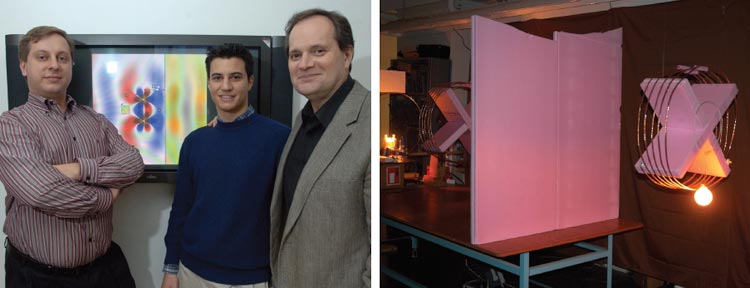
Since these days electricity is delivered to pretty much every single house in the world, it is not necessary anymore to transmit electricity over large distances à la Wardenclyffe Tower. Transmitting electricity within a room, namely over distances a few times greater than the size of the receiving devices themselves (what engineers define as mid-range distances), is sufficient for most modern applications. Achieving this goal with satisfactory efficiency, safety and low cost remains an unsolved problem. That was the challenge for Soljačić and his collaborators at the MIT labs: John Joannopoulos, Peter Fisher, Andre Kurs, Robert Moffatt and me.

Revisiting the fundamental principle of resonance, we posed the question of which physical conditions maximize the efficiency of energy transfer between two resonant objects. The energy of any resonator naturally decays due to intrinsic energy-loss mechanisms (friction for mechanical resonances, radiation and resistive absorption for electromagnetic resonances, collisions with phonons and spontaneous emission for atomic resonances). Losses are typically quantified by the number of oscillation periods that it takes for the energy to decay by a factor of 2.72. This number, represented by the “quality factor” Q, is an intrinsic property of resonators and depends on the strength of the loss mechanisms. (As a simple analogue, water inside a bucket with a hole will leak out at a rate that depends on the size of the hole.)

If two equal resonators exchange energy, it also takes a characteristic number of oscillation periods to transfer the energy from resonator A to resonator B, which is proportional to a constant that quantifies the strength of the coupling between the resonators, Qk. (If water is pumped from one bucket to another via a hose, then the transfer time depends on the strength of the pump.) Clearly, for energy transfer to be efficient, Q needs to be much larger than Qk, i.e. the rate at which energy is being transferred needs to far exceed the rate at which energy is being lost. (Water will be efficiently transferred between two leaking buckets if the pump is faster then the leaks from the holes.) The efficiency of the system can then be characterized by Q/Qk. The transfer of energy is efficient only when this ratio is larger than one, the so-called strong-coupling regime.

For our wireless method, we used one of the most basic electric circuits as a resonator: the LC circuit. This circuit is an electromagnetic resonant circuit that consists of an inductor (L), made by a wire coil, and a capacitor (C). Two such wire coils transfer energy via induction, like a transformer device, and the Qk clearly depends on the distance between the coils. For mid-range distances and long enough wavelengths, the spatial-decay rate of the magnetic field means that Qk is roughly proportional to the cube of the ratio of the distance between the coils, D, and the size of each coil, d, while showing little dependency on the frequency and the geometry of the coils. This means that, for mid-range distances, Qk will be large and the coupling very weak.

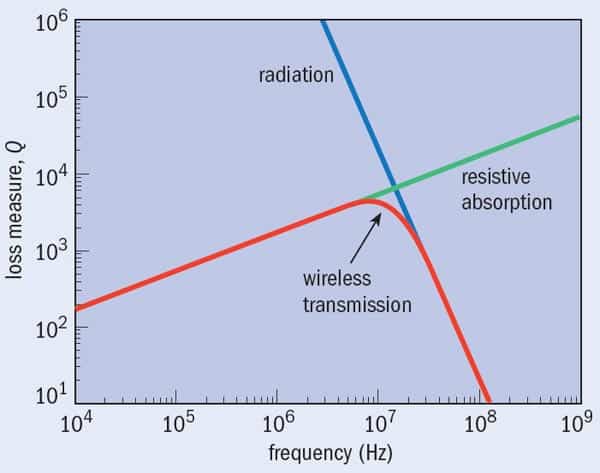
As a result, the best way to maximize the efficiency is to engineer the resonators to have the highest possible value of Q (try to seal the holes in the buckets). The resonance frequency of each coil (which has to be the same for both coils) can be tuned by varying the capacitance (and tuning a circuit element is exactly what the knob is tuning in a radio antenna). Q varies with the tuneable frequency, and this variation is shown in the figure above for a coil with a diameter of 60 cm made of copper pipe with a radius of 2 cm. It can be seen that, for high-MHz frequencies, the resonator loses energy fast (low Q, often even less than 10) due to radiation. This is exactly how an antenna is designed to work. Similarly, for mid-kHz frequencies, it loses energy fast (Q less than 100) via resistive absorption, which is typical of transformers. This explains why both omni-directional antennas and transformers fail to be efficient power transmitters at mid-range distances: the transfer-time measure Qk is large because of D, and Q is small. On the other hand, in the intermediate, low-MHz regime, much longer loss-times are observed, with Q often larger than 1000. That was our chosen regime.

Based on our theory, we started experiments in late 2006. The main challenges consisted of designing a driving circuit that would operate in our desired low-MHz regime and constructing coils that would resonate with a high enough value of Q. After a trial-and-error phase, we realized that a simple coil design without a separate capacitor, but using the coil’s self-capacitance to achieve resonance, was the best option in terms of Q.

We made two copper-pipe coils with 60 cm diameters and with five turns, such that they resonate at 10 MHz and have Q = 1000. A 60 W light bulb was our chosen device, since it operates at the tested frequencies (and what can be a clearer sign of the functionality of a system than the switch on of a light bulb?). We suspended the coils from the ceiling with fishing wire, at a distance of 2 m from each other, tuned them up, turned them on and…there was light. At an efficiency of 45%, this was, to our knowledge, the first-ever demonstration of midrange efficient wireless energy transfer.

On the safe side

The selective property of resonance means that almost all of the source power will be transmitted to the destined device and not to anywhere else. This is because any random object, including a biological organism, is almost always a non-resonant structure. Even if an object happens to be resonant, say a mobile-phone antenna, its resonance will be very different from the precise source-resonator frequency (just like those 99 wine glasses). Furthermore, even in the extremely unlikely case of it having the same resonance frequency, its Q value would be so low that no significant amount of power would be transmitted to it.

In our long-wavelength regime of operation (30 m wavelength at 10 MHz compared with 60 cm coils), power is transmitted from one object to another by spreading away from the source resonator and then “focusing” back into the device resonator. In contrast to higher frequencies, where power would be radiated across as a focused beam with a much smaller cross-sectional area, the former mechanism implies that, in our system, the power density locally and thus the fields will be considerably smaller at all points, except perhaps those too close to the coils. Smaller fields obviously imply safer performance.

Furthermore, our wireless-electricity method uses magnetic, rather than electric, fields to transfer energy. From the point of view of magnetic fields, most poor conductors, like wood, bricks, plastics and people, look a lot like air. On the other hand, electric fields do pose health hazards, because they can interact with biological organisms. With our method, these electric fields are confined to the capacitor inside our resonator. This method is quite similar to induction hobs on cookers, whereby a hob may transmit kilowatts of power to a metallic pot via induction, but it is safe to touch with our non-conducting hands. Note also that even the “large” magnetic fields in our system actually have tiny strength, approximately 10–4 T near the coils for 60 W of transmitted power, about the order of the time-invariant magnetic field of the Earth. It is the high-Q resonance that magically converts this tiny field into considerable usable power.

Wireless mobility

Long-wavelength fields naturally wrap and redistribute themselves around random objects in their vicinity or those standing between the source and mobile receiver. Therefore, while a radiated beam would immediately be interrupted by obstacles, our method stays robust and does not require an uninterrupted line of sight to the source. Sources can be hidden under floors, behind walls or inside furniture, and the receiving devices do not find shade while roaming freely behind random objects or when integrated inside other systems.

The near field produced by a resonant source coil spreads out quite uniformly in all directions, in contrast to a directed radiation beam. Thus, appropriate placement of one or more device coils can guarantee omni-directional coverage with low system complexity and thus cost.

The response of the system to dynamic variations of its parameters due to variable interaction with its environment during motion can be as fast as within 0.1 ms, based on the available frequency bandwidth of the sharp MHz resonances. This is good enough for the changes associated with daily motion.

Ray Bradbury, the prolific science-fiction writer, once said that “Anything you dream is fiction, and anything you accomplish is science.” If our innovation is successfully commercialized, then the concept of a completely wireless world could soon leap from dream to widespread accomplishment. We will forget charging our mobile phones, laptops and other personal digital devices. The maze of cables behind every home or office apparatus will disappear. Cars will drive on electricity for much longer and more cheaply. Robots will completely forget about returning to their charging stations. Micro-robots will forever hide inside electronic chips. Battery-powered sensors buried underground will never die. And the story of the judge will soon belong to history.

“Dad, I found a lamp in the basement, but it doesn’t work, see?” said the 10 year old, while ascending the stairs. “It does my son,” replied the judge, “but it connects to a wall plug and our new house does not have any of those.”


Fusion ambassador

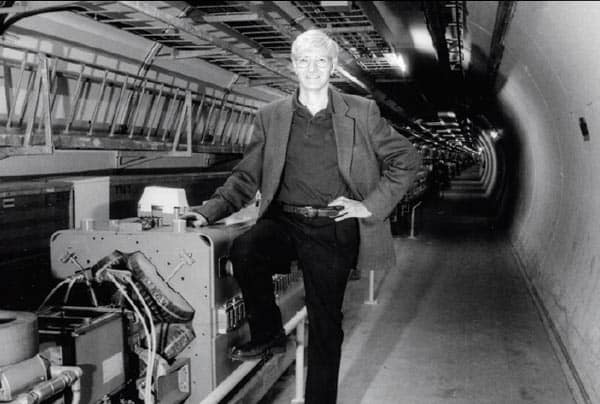
With his glasses and shock of thick, white hair, Chris Llewellyn Smith does not look like a superhero saving the world from peril. Yet the slim, 66-year-old physicist is seemingly becoming a potential saviour in the public eye. At least that is the reaction he says he got while recently moving house in Oxford. “I was quite surprised by my new neighbours’ knowledge of energy issues when they said ‘The world is relying on you to develop fusion!’.”

Yet Llewellyn Smith is certainly not your average physicist. During a career spanning nearly 50 years, he has held numerous high-level positions, notably director general of CERN (see “A passion for particle physics”), provost and president of University College London (UCL), head of physics at Oxford University and director of the Culham site of the UK Atomic Energy Authority (UKAEA), which is home to both the UK fusion programme and the Joint European Torus (JET), which is currently the world’s leading fusion experiment.

Now supposedly retired, Llewellyn Smith is not putting his feet up but is instead involved in the €5bn ITER fusion experiment currently being built in Cadarache, France, where he is chairman of the project’s council. He is also president of the Synchrotron-light for Experimental Science and its Applications in the Middle East (SESAME) in Jordan, and in December last year became a vice-president of the Royal Society, a role where he expects to be involved in briefing the society’s president Martin Rees on energy issues.

One of his functions as ITER chair is to advise the project’s director-general Kaname Ikeda on funding and strategy, but the role also involves him advocating fusion as a possible energy alternative, which has seen Llewellyn Smith give dozens of public lectures on energy. “The public seem to understand that nuclear fusion has the potential to provide essentially unlimited energy, in an environmentally responsible manner,” says Llewellyn Smith as we chat at the Rudolph Peierls Centre for Theoretical Physics in Oxford. “Having another major energy option would be enormously valuable.”

Star power

Nuclear fusion is the energy source that powers the Sun and the stars. Mimicking this source of energy involves heating and controlling a plasma of hydrogen isotopes — deuterium and tritium (D–T) — until it is so hot that the nuclei can overcome their mutual Coulomb repulsion and fuse to produce helium nuclei and 14 MeV neutrons. The idea for a fusion power station is to then to extract the heat of the neutrons, which would be used to boil water and drive a steam-powered electrical generator.

But it is not an easy task: the difficulty lies in maintaining a burning plasma for periods of weeks and getting out substantially more energy than you put in. There are currently two methods that could make it work: confining the plasma with magnetic fields; or “inertial confinement” using laser or particle beams. Magnetic confinement, which is how ITER will operate, is the most developed and more likely to be consistently supplying fusion generated electricity to the grid by the middle of the century.

Yet the ITER project has endured a rough ride since the four initial partners — the European Union, Japan, the former Soviet Union and the US — first agreed in 1985 to build an experimental reactor to demonstrate the scientific and technical practicality of fusion power. The latest setback came last year when the reactor’s designers submitted a plan to upgrade the reactor from the 2001 proposal. This change put back ITER’s start-up date by two years to 2018 and has contributed to construction costs rising above €5bn, although Llewellyn Smith is unwilling to put a specific figure on the increase.

One of the main design changes involves a new method to contain potentially damaging discharges of the plasma onto ITER’s giant 1000 m2 reactor wall. At fixed temperature, the fusion rate is proportional to the square of the pressure. It was originally thought that the pressure falls off smoothly to zero at the edge of the plasma, but in the early 1980s physicists discovered a way of operating a reactor in which the pressure drops off very steeply at the edge, and is uplifted elsewhere by the “height” of this drop. This mode of operation increases the fusion rate, but it also produces instabilities at the plasma’s edge — known as “edge-localized modes” or ELMs — that spit globs of plasma onto the reactor wall.

The original 2001 design envisaged firing frozen pellets of deuterium from outside the reactor into the plasma to produce many small ELMs, rather than a few large ELMs. However, plasma physicists have since realized that this may not be enough to do the job completely, so the new design incorporates an additional way of taming ELMs by applying a random weak magnetic field via small coils within the reactor near the plasma edge. To accommodate the new coils means re-designing the inner reactor. The snag is that this will cost much more than the original design.

The redesigns now need to be funded by ITER’s seven members (since 2001, China, India and South Korea joined and the US rejoined having pulled out). Llewellyn Smith points out that while the new design increases the cost, it is much more likely to achieve ITER’s goal. However, ITER’s price-tag has risen for other reasons too. “People hadn’t been careful enough in tracking the cost increases of commodities, which have gone up much more than general inflation, and they grossly underestimated the difficulty of setting up an international laboratory from zero,” he says. “When the initial costing was done, there were three parties in ITER, but now there are seven.” He points out that since all the members want to obtain technical know-how in a wide range of areas, construction of many of the components is being split between several different countries and companies, which adds to the cost.

Such delays have left critics repeating the well-worn phrase that fusion is always 30 years away. Indeed, Llewellyn Smith says it would not surprise him if there were yet more delays beyond the 2018 “first plasma” start date. “That date, of course, is a big public-relations goal,” he says, “but I think the emphasis on the first plasma is wrong.” This is because initially ITER will only use hydrogen to avoid activating the magnets and walls. Tritium will only be used five or six years later. “The first plasma can be whenever you like as long as you don’t delay, or jeopardise, the success of the first D–T plasma,” says Llewellyn Smith. The first D–T plasma is officially planned for 2023 and he insists that any further redesigns or delays should avoid pushing this date back further than absolutely necessary.

Although Llewellyn Smith is confident that ITER will demonstrate its main goal of generating more power than it consumes, what if ITER does not work? “What might happen then would depend on why it failed,” he says. Whether governments will be interested in pursuing fusion if ITER does not work is a big question, but one that Llewellyn Smith thinks they will have to address. “When we see the lights go out as fossil fuels become increasingly scarce, people will think differently about investing in developing new energy sources,” he says.

Opening SESAME

While his involvement in ITER seems a pretty big job for someone in retirement, Llewellyn Smith has also for the past few months been president of the council of the SESAME synchrotron, which is being built in Jordan. It aims to foster science and technology in the Middle East and to use science to forge closer ties between scientists across the region (see Physics World April 2008 pp16–17, print edition only). Most of his time on this project is spent trying to get funding to complete SESAME, which will produce X-rays that can be used in a range of experiment from condensed matter to biology.

Despite his initial reluctance and lack of knowledge in synchrotron science, Llewellyn Smith sees some advantages of getting involved. “It needed a president from outside the region who is politically neutral,” he says, “but also someone who knows about running big science projects, and knows people in Brussels and bodies such as the Department of Energy in Washington and UNESCO.”

Now it is up to Llewellyn Smith to take the lead in finding the funding to build the remaining piece of the jigsaw — the synchrotron storage ring, which is used to keep the electrons circling while producing X-rays. In addition to Jordan itself, Germany and the UK are the biggest contributors to the project — the former having provided the injector system, based on the old BESSY synchrotron in Berlin, which pumps electrons into the storage ring, while the latter donated some of the beamlines from the recently shut down Synchrotron Radiation Source at the Daresbury lab in Cheshire.

Llewellyn Smith is looking not only to the members of SESAME and to the European Union, but to charitable organizations and philanthropists to fill the gap in these “capital costs” amounting to about $15m. However, the running costs will grow to $4–5m a year, putting further pressure on the tight science budgets of SESAME’s 10 member states, which include Israel, Iran and the Palestinian Authority. Even with many potential stumbling blocks, Llewellyn Smith is hopeful that the synchrotron will be operational in five years’ time.

Despite his prowess in running large research projects, Llewellyn Smith’s career was not always rosy. He had a difficult time after quitting CERN to become president and provost of University College London in 1999. “I didn’t enjoy the job and you don’t do your best when you don’t enjoy it,” he admits. He also concedes that “problems such as how to restructure UCL’s faculties were not what I wanted to think about 24 hours a day”.

It is obvious that particle physics is Llewellyn Smith’s real passion, and indeed he is currently writing a book on the LHC with James Gillies — head of public relations at CERN. Rather than starting on the first chapter, they have already written the last one, entitled “Is it worth it?”. As far as the LHC is concerned, Llewellyn Smith would undoubtedly say yes. Whether the same is true for ITER remains to be seen.

In person

Born: Giggleswick, Yorkshire, 1942
Education: University of Oxford (BA and DPhil)
Career: University of Oxford (1974–1998);
director-general of CERN (1994–1998);
provost and president of UCL (1999–2002);
director of UKAEA Culham (2003–2008)
Family: married, one son, one daughter
Hobbies: reading and singing (having recently joined a choir)

Journeys to greatness

Readers, I hope, will forgive me for a shameless bit of self-publicity about my latest book, The Great Equations: Breakthroughs in Science from Pythagoras to Heisenberg (Norton). But then the book is partly yours too, inspired as it was by the responses of Physics World readers to my request for suggestions of great equations (see “Critical Point: The greatest equations ever”). In the book, I chose to discuss not the most frequently mentioned equations, but those that seem to have engaged their discoverers in the most remarkable journeys.

The journey metaphor may seem misleading if taken to suggest smooth and steady progress to an already known destination. The scientific journeys I recount — which include those culminating in F=ma, and the equations of Maxwell and Schrödinger — were unpredicted, often protracted and erratic. The journey metaphor should also not imply that the travellers passively observed the changing scenery; in fact, the scientists interacted with their environment while altering it.

But the journey metaphor does capture one important aspect of the birth of these equations, which is how their originators’ ideas about what was important changed during the course of their research. Newton, Maxwell, Schrödinger and others each inherited a “landscape” or view of how knowledge about nature was organized. But during their research, new concepts — such as mass and force, entropy and displacement current, quanta and wave equations — appeared on the horizon, grew in importance and displaced others to assume positions as indispensable landmarks in the conceptual landscape.

For the ultimate destination of such scientists was not a particular location that they saw beforehand, but clarity. They were dissatisfied with what they had, perceived a vision of what might take its place, and were able to carry out the inquiry needed to realize it. At each step, they found the world to be somewhat discordant — not fully grasped — with hints of another, deeper order just over the horizon. This discordance is what makes newly realized equations seem, strangely, to be both discovered and invented.

Oliver Heaviside, who transformed Maxwell’s then-convoluted equations into their now-familiar versions, once remarked that “it was only by changing its form of presentation that I was able to see it [electromagnetism] clearly”. The sense of that remark — you transform to clarify — could have been said by any of the scientists mentioned in The Great Equations.

No royal road

Most of the time we are less interested in journeys than in where they take us. But we can learn much from them. One is just how varied such journeys are. Sometimes they are taken by scientists who talk and argue constantly with one another, as with the equations of thermodynamics and the uncertainty principle. Other journeys were undertaken by individuals working essentially by themselves, such as Einstein in his path to general relativity and Schrödinger to his wave equation, though such individuals in effect carried on conversations with colleagues even when working alone. There is no royal road to discovery.

Another thing we learn is that equations are not simply inert tools that work only in the hands of scientists and engineers. They can also exert an educational and even cultural force that shapes our view of the world. The Pythagorean theorem teaches us what proof means, the second law of thermodynamics keeps in check our dreams of free energy, Einstein’s equations changed our understanding of space and time, and the work of Schrödinger and Heisenberg forces us to rethink what being a “thing” means.

We also learn to appreciate how deeply affecting the scientific life can be. The scientists who took those journeys were never blasé, never disinterested. They were infused with curiosity, consternation, bafflement, frustration and wonder. And each scientist had what might be called a particular style. Some succeeded because they were only satisfied when they found what they were looking for, while others succeeded only because they were prepared to see something more than they expected.

Most of all, the journeys allow us to glimpse the mutability of nature and our role in it. The journeys teach us that nature could be otherwise — that it was otherwise for us until a moment ago, and for all we know it could change in the future. In such instances, we experience a transcendent moment in which a higher thought emerges in the middle of an existing one.

The critical point

The Great Equations ends by relating a conversation I had while writing the book, with an elderly physicist who expressed little comprehension and sympathy. To his workmanlike mind, the equations I mentioned seemed so obvious and logical that he could not picture not having known them, and he saw no value in making them more enigmatic. “Such equations”, he told me, “would not be wonderful if people realized how trivial they are. You should help them do so.”

I could have hugged him. At that moment, I finally realized exactly what I was trying to do. It was exactly the opposite — to undo that sense of obviousness and triviality, and to take readers back to the moment just before the equations were discovered, to appreciate how untrivial they are. Readers could, I hoped, thereby relive the wonder of the moment when the equations were first grasped — when they seemed simultaneously discovered and invented.

Scientists such as my physicist acquaintance tend to focus on the formal, discovered — what he meant by “trivial” — aspect of the birth of equations, whereas philosophers and historians tend to focus on the other aspect, having to do with their invention. It ought to be possible, I felt, to capture both aspects at once — which would, I thought, finally provide a more complete picture of the discovery process itself.

Copyright © 2026 by IOP Publishing Ltd and individual contributors