Axions hint at a return

Evidence for axions is once again mounting as researchers claim the hypothetical particles can explain how very high-energy photons travel unimpeded through the cosmos.

Such photons and other neutral cosmic rays (aside from neutrinos) should be unable to travel inter-galactic distances because they are absorbed by the universe’s opaque background of microwaves — yet they are still detected on Earth.

“If this could be confirmed, it would be an enormously important discovery” Dan Hooper, Fermilab

Now a group led by Malcolm Fairbairn of King’s College, London, has found a correlation between where detected cosmic rays originate and where photons and axions are more likely to “mix”. The result implies that cosmic-ray photons could reach Earth from distant galaxies by temporarily converting into axions, which can bypass the microwave background without absorption.

“If this could be confirmed, it would be an enormously important discovery,” says Dan Hooper, a physicist from Fermilab in the US who performed a similar study last year.

Old problem

Axions were first proposed in the late 1970s to solve an issue in particle physics known as the strong-CP problem. Theory suggested the elementary particles would be very light and would interact very weakly with matter — so weakly, in fact, that no one has yet managed to detect them.

Fairbairn’s group — which includes Timur Rashba of the Max Planck Institute for Solar System Research and Sergey Troitsky of the Russian Academy of Sciences — has been looking for an astrophysical equivalent of an effect being sought in laboratory axion experiments. In these “shining light through the wall” experiments, a laser is shone onto a wall in the presence of a magnetic field. If some of the laser’s photons covert into axions, they could travel freely through the wall, revert to photons and then be detected on the other side.

The hope of Fairbairn and colleagues is that, on a cosmic scale, the “wall” could be provided by the microwave background, and the magnetic field could be provided by galaxies.

To see if this “shining light through the universe” effect exists, Fairbairn’s group has performed a statistical analysis of neutral cosmic rays of energies above 1018 eV recorded by the High Resolution Fly’s Eye (HiRes) detector in Utah. Previous studies have already highlighted a correlation between the arrival locations of these cosmic rays and the known locations of highly luminous “active” nuclei of distant galaxies. But Fairbairn’s group has shown that there is an additional correlation with the likely profile of our own galaxy’s magnetic field, which determines the probability of photon-to-axion conversions. The researchers say the likelihood of the correlation occurring by coincidence is just 2.4% (arXiv:0901.4085).

Proof is ‘far away’

Fairbairn told physicsworld.com that the result is definitely new evidence in favour of axions but warns that it needs to corroborated by more data. “It’s still far away from proving anything,” he adds. “Very, very far.”

If the axion does indeed exist, it would be particularly light (less than 10–7 eV) and have a particularly weak coupling with photons (an inverse coupling of 1010 GeV). This latter property rules it out as a solution to the decades-old strong-CP problem by several orders of magnitude. However, is there is still a question as to whether it could fulfil the other possible role of axions — that of the cold dark matter that generates most of the universe’s gravity.

Theorists expect dark-matter particles to be heavier than 10–7 eV, because it means they can be generated sooner after the Big Bang and then spread out into the low densities given by experimental cosmology. But Aaron Chou, a spokesperson of the GammeV axion experiment at Fermilab, suggests that we might just live in a region of the universe where dark matter happens to be less dense. “In short,” he explains, “this model could also produce axion-like dark matter, but just not in a generic fashion.”

Nonetheless, the study by Fairbairn’s group does back up work by Hooper, Pasquale Serpico of CERN and Melanie Simet of the University of Chicago, who found a similar correlation for lower energy photons last year (Phys. Rev. D 77 063001; arXiv:0712.2825). Hooper and Serpico point out — and Fairbairn admits — that there is no way of knowing how many of the neutral cosmic rays detected by HiRes are actually photons, as all it can detect are the subsequent showers when the rays collide with the Earth’s atmosphere. Moreover, Serpico has doubts on the effectiveness of the photon-to-axion conversion mechanism at such high energies.

Previous mistakes

It would not be the first time that axions have tempted physicists into believing in their existence. In 2006 there was hope for experimental proof in an Italian experiment called PVLAS, which registered a slight change in the polarization of a laser beam as it passed through a magnetic field in a vacuum. The PVLAS researchers thought the change could have resulted from some of the laser beam’s photons combining with photons in the vacuum to produce axions. However, they later found the signal to be an experimental artefact.

The only course of action for Fairbairn’s group now is to await more data from other cosmic ray searches, such as the Pierre Auger Observatory in Argentina. In the meantime, they can still hope a lab-based experiment will see evidence for the same type of axion.

Konstantin Zioutas of CERN is spokesperson for CAST, the only existing axion experiment that has the potential sensitivity to search for Fairbairn and colleagues’ axion. He says that to begin looking CAST would require an upgrade, which is “within reach” in a few years. “If this idea is definitely confirmed, it will be a breakthrough for cosmology and particle physics alike,” he says.

Another department bites the dust?

By Hamish Johnston

If you’re not a regular reader of the University of Idaho Argonaut student newspaper, you may have missed this article about the possibility that the university’s undergraduate physics programme may be axed.

It seems that physics is one of 41 programmes identified for a possible chop by the university’s Program Prioritization Process (PPP) — which was initiated in 2005 to “increase the overall financial and academic efficiency of the university”, according to the Argonaut.

Bizarrely, the article suggests that the PPP plan involves getting rid of undergraduate physics in order to strengthen the graduate physics offering. I’m guessing that this is a way of trying to hold on to physics faculty members once the axe has fallen on undergraduates.

The Argonaut quotes physics undergraduate Alex Natale as saying “I don’t know how they could cut physics from the College of Science and still be the College of Science”.

I don’t know either…ironically, the University of Idaho’s sports teams are called the Vandals — and they are not the only ones causing damage in Idaho it seems.

Electricity unplugged

The judge was driving back late one cold winter night. Entering the garage, the battery-charging indicator in his wirelessly powered electric car came on. “Home at last,” crossed his mind. He swiped his personal smartcard on the front-door detector to be let in. He heard a “charging” beep from his mobile phone. The blinking cursor on the half-finished e-mail on the laptop had been waiting all day on the side table. He picked the computer up and walked towards his desk. “Good evening, your honour. Your wirelessly heated robe,” said the butler-robot as it approached from the kitchen. Putting on the electric garment, he sat on the medical desk chair. His artificial heart was now beating faster.

Science fiction usually expresses society’s impeding desires and sense of anticipation for certain technological miracles to happen. A society without power cables is pretty much a given in most science fiction. Indeed, today we do live in the “wireless age”, in which the air that we breathe probably contains more information than oxygen. However, this is also an age where mobile phones, MP3 players, laptop computers and domestic robots exist alongside old-fashioned power wires and bulky batteries. Unlike information, electrical energy is still physically confined to these borderline anachronistic appliances. Overcoming these last obstacles would finally make this a truly wireless world. Science? Yes. Fiction? Not anymore.

It all started a few years ago when Marin Soljačić, a physicist at the Massachusetts Institute of Technology (MIT) in the US, was driving back home one cold winter night and he heard an unfriendly beep from his mobile phone. It was the annoying reminder that the battery was running out, once again. It then suddenly occurred to Soljačić how great it would be if the mobile phone could take care of its own charging. The next morning, he returned to his office at the MIT determined to find a solution to the problem.

An exhaustive literature search soon revealed that wireless transmission of power was not an original idea. Back in the 1890s Nikola Tesla, one of great pioneers of electromagnetism, was the first to envisage that electricity, then a newly found form of energy, should be delivered to every house, in every city, in every country on the planet. However, Tesla did not foresee that people would be willing to drag wires around the entire globe to use electricity. Instead, he dreamed of a way of transferring electrical energy wirelessly over long distances. This would be achieved using big, coupled electromagnetic resonators able to generate very large electric fields, which were meant to propagate most likely either via conduction through the ionosphere (presumably including gigantic sparks) or through the Earth (possibly via intermediate coupling to the Earth’s charge resonances, so-called Schumann resonances). The epitome of Tesla’s efforts to achieve his goal was Wardenclyffe Tower, a 57 m high structure in Long Island that was meant to deliver electricity to the entire planet. The construction was interrupted in about 1905, not because the method was considered impractical or dangerous, but because the funder, the famed financier and banker J P Morgan, was concerned that there would be no way to bill remote electricity users. Nowadays, more than a century after Tesla, electricity reaches nearly every home through a global electrical grid. Nevertheless, J P Morgan’s objections meant a premature end to the first attempt at wireless electricity.

No wires attached

Today, we know of a variety of methods to transmit power without wires. The simplest example is electromagnetic radiation, such as radio waves. Omni-directional radiative antennas are one of the most widely used technologies, which are utilized in the provision of wireless Internet services, mobile telecoms, and radio and TV broadcasting. These antennas typically operate in the high-MHz/low-GHz frequency regimes. Even though such antennas are highly robust and suitable for use with mobile receivers, since they can operate in all directions and do not require a line of sight to the receiver, they are highly inefficient. Only a tiny portion of the radiated power in the direction of the receiver is actually picked up, since the vast majority of the radiation is lost in all the other directions. The use of a highly directional antenna, such as a microwave-beam antenna, in principle solves this problem and achieves a high efficiency in power transmission even over long distances (i.e. kilometres). On the other hand, this type of antenna does require an uninterrupted line of sight, which in itself requires a complicated device-tracking and beam-steering mechanism. Also, high-power focused beams may constitute a safety hazard.

An alternative approach to antennas is the use of an inductive transformer, a device commonly used in power circuits and electromechanical motors (for example electrical toothbrushes and chargers). A transformer typically operates up to mid-kHz frequencies. It essentially transfers electrical energy from one circuit to another via induction: the time-varying magnetic flux produced by a primary coil crosses a secondary coil and induces in it a voltage. The primary and the secondary coils are not physically connected, hence the method is wireless. Transformers can be very efficient but the distance between the coils must be very small (typically a few millimetres). For distances a few times the size of the coils, the efficiency drops significantly.

Part of the underlying physics for most of the existing methods for the wireless transfer of electricity is the fundamental principle of resonance: the property of certain physical systems to oscillate with maximum amplitudes at certain frequencies. It follows that, for any type of excitation (mechanical, acoustic, electromagnetic, nuclear) with a given frequency, a receiver will pick up the transmitted energy efficiently only when designed to resonate at the excitation frequency. Only then do successive excitations after each oscillation period add coherently in phase and lead to a build up of energy within the receiver.

To illustrate, consider 100 glasses filled with wine at different levels so that they support acoustic resonances at different frequencies. Now let an electric-guitar player produce and sustain a very well-defined note. Only one of the glasses, the one resonant with the frequency of this note, will respond to the excitation, to the extent that it may even break, while the rest will remain unaffected. Similarly, we tune the electromagnetic antenna of a radio to be resonant with the frequency of the station we want to listen to. Many transformers used in power circuitry and elsewhere are also designed to employ resonance to enhance the power transmission.

Cutting the cord at MIT

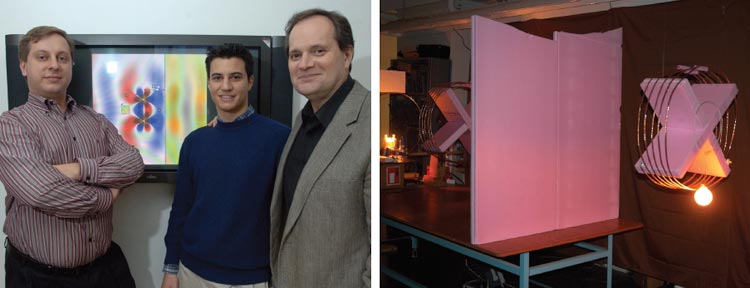
Since these days electricity is delivered to pretty much every single house in the world, it is not necessary anymore to transmit electricity over large distances à la Wardenclyffe Tower. Transmitting electricity within a room, namely over distances a few times greater than the size of the receiving devices themselves (what engineers define as mid-range distances), is sufficient for most modern applications. Achieving this goal with satisfactory efficiency, safety and low cost remains an unsolved problem. That was the challenge for Soljačić and his collaborators at the MIT labs: John Joannopoulos, Peter Fisher, Andre Kurs, Robert Moffatt and me.

Revisiting the fundamental principle of resonance, we posed the question of which physical conditions maximize the efficiency of energy transfer between two resonant objects. The energy of any resonator naturally decays due to intrinsic energy-loss mechanisms (friction for mechanical resonances, radiation and resistive absorption for electromagnetic resonances, collisions with phonons and spontaneous emission for atomic resonances). Losses are typically quantified by the number of oscillation periods that it takes for the energy to decay by a factor of 2.72. This number, represented by the “quality factor” Q, is an intrinsic property of resonators and depends on the strength of the loss mechanisms. (As a simple analogue, water inside a bucket with a hole will leak out at a rate that depends on the size of the hole.)

If two equal resonators exchange energy, it also takes a characteristic number of oscillation periods to transfer the energy from resonator A to resonator B, which is proportional to a constant that quantifies the strength of the coupling between the resonators, Qk. (If water is pumped from one bucket to another via a hose, then the transfer time depends on the strength of the pump.) Clearly, for energy transfer to be efficient, Q needs to be much larger than Qk, i.e. the rate at which energy is being transferred needs to far exceed the rate at which energy is being lost. (Water will be efficiently transferred between two leaking buckets if the pump is faster then the leaks from the holes.) The efficiency of the system can then be characterized by Q/Qk. The transfer of energy is efficient only when this ratio is larger than one, the so-called strong-coupling regime.

For our wireless method, we used one of the most basic electric circuits as a resonator: the LC circuit. This circuit is an electromagnetic resonant circuit that consists of an inductor (L), made by a wire coil, and a capacitor (C). Two such wire coils transfer energy via induction, like a transformer device, and the Qk clearly depends on the distance between the coils. For mid-range distances and long enough wavelengths, the spatial-decay rate of the magnetic field means that Qk is roughly proportional to the cube of the ratio of the distance between the coils, D, and the size of each coil, d, while showing little dependency on the frequency and the geometry of the coils. This means that, for mid-range distances, Qk will be large and the coupling very weak.

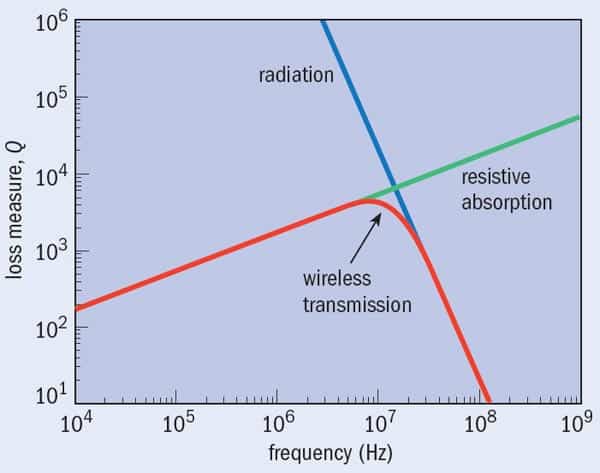
As a result, the best way to maximize the efficiency is to engineer the resonators to have the highest possible value of Q (try to seal the holes in the buckets). The resonance frequency of each coil (which has to be the same for both coils) can be tuned by varying the capacitance (and tuning a circuit element is exactly what the knob is tuning in a radio antenna). Q varies with the tuneable frequency, and this variation is shown in the figure above for a coil with a diameter of 60 cm made of copper pipe with a radius of 2 cm. It can be seen that, for high-MHz frequencies, the resonator loses energy fast (low Q, often even less than 10) due to radiation. This is exactly how an antenna is designed to work. Similarly, for mid-kHz frequencies, it loses energy fast (Q less than 100) via resistive absorption, which is typical of transformers. This explains why both omni-directional antennas and transformers fail to be efficient power transmitters at mid-range distances: the transfer-time measure Qk is large because of D, and Q is small. On the other hand, in the intermediate, low-MHz regime, much longer loss-times are observed, with Q often larger than 1000. That was our chosen regime.

Based on our theory, we started experiments in late 2006. The main challenges consisted of designing a driving circuit that would operate in our desired low-MHz regime and constructing coils that would resonate with a high enough value of Q. After a trial-and-error phase, we realized that a simple coil design without a separate capacitor, but using the coil’s self-capacitance to achieve resonance, was the best option in terms of Q.

We made two copper-pipe coils with 60 cm diameters and with five turns, such that they resonate at 10 MHz and have Q = 1000. A 60 W light bulb was our chosen device, since it operates at the tested frequencies (and what can be a clearer sign of the functionality of a system than the switch on of a light bulb?). We suspended the coils from the ceiling with fishing wire, at a distance of 2 m from each other, tuned them up, turned them on and…there was light. At an efficiency of 45%, this was, to our knowledge, the first-ever demonstration of midrange efficient wireless energy transfer.

On the safe side

The selective property of resonance means that almost all of the source power will be transmitted to the destined device and not to anywhere else. This is because any random object, including a biological organism, is almost always a non-resonant structure. Even if an object happens to be resonant, say a mobile-phone antenna, its resonance will be very different from the precise source-resonator frequency (just like those 99 wine glasses). Furthermore, even in the extremely unlikely case of it having the same resonance frequency, its Q value would be so low that no significant amount of power would be transmitted to it.

In our long-wavelength regime of operation (30 m wavelength at 10 MHz compared with 60 cm coils), power is transmitted from one object to another by spreading away from the source resonator and then “focusing” back into the device resonator. In contrast to higher frequencies, where power would be radiated across as a focused beam with a much smaller cross-sectional area, the former mechanism implies that, in our system, the power density locally and thus the fields will be considerably smaller at all points, except perhaps those too close to the coils. Smaller fields obviously imply safer performance.

Furthermore, our wireless-electricity method uses magnetic, rather than electric, fields to transfer energy. From the point of view of magnetic fields, most poor conductors, like wood, bricks, plastics and people, look a lot like air. On the other hand, electric fields do pose health hazards, because they can interact with biological organisms. With our method, these electric fields are confined to the capacitor inside our resonator. This method is quite similar to induction hobs on cookers, whereby a hob may transmit kilowatts of power to a metallic pot via induction, but it is safe to touch with our non-conducting hands. Note also that even the “large” magnetic fields in our system actually have tiny strength, approximately 10–4 T near the coils for 60 W of transmitted power, about the order of the time-invariant magnetic field of the Earth. It is the high-Q resonance that magically converts this tiny field into considerable usable power.

Wireless mobility

Long-wavelength fields naturally wrap and redistribute themselves around random objects in their vicinity or those standing between the source and mobile receiver. Therefore, while a radiated beam would immediately be interrupted by obstacles, our method stays robust and does not require an uninterrupted line of sight to the source. Sources can be hidden under floors, behind walls or inside furniture, and the receiving devices do not find shade while roaming freely behind random objects or when integrated inside other systems.

The near field produced by a resonant source coil spreads out quite uniformly in all directions, in contrast to a directed radiation beam. Thus, appropriate placement of one or more device coils can guarantee omni-directional coverage with low system complexity and thus cost.

The response of the system to dynamic variations of its parameters due to variable interaction with its environment during motion can be as fast as within 0.1 ms, based on the available frequency bandwidth of the sharp MHz resonances. This is good enough for the changes associated with daily motion.

Ray Bradbury, the prolific science-fiction writer, once said that “Anything you dream is fiction, and anything you accomplish is science.” If our innovation is successfully commercialized, then the concept of a completely wireless world could soon leap from dream to widespread accomplishment. We will forget charging our mobile phones, laptops and other personal digital devices. The maze of cables behind every home or office apparatus will disappear. Cars will drive on electricity for much longer and more cheaply. Robots will completely forget about returning to their charging stations. Micro-robots will forever hide inside electronic chips. Battery-powered sensors buried underground will never die. And the story of the judge will soon belong to history.

“Dad, I found a lamp in the basement, but it doesn’t work, see?” said the 10 year old, while ascending the stairs. “It does my son,” replied the judge, “but it connects to a wall plug and our new house does not have any of those.”


Fusion ambassador

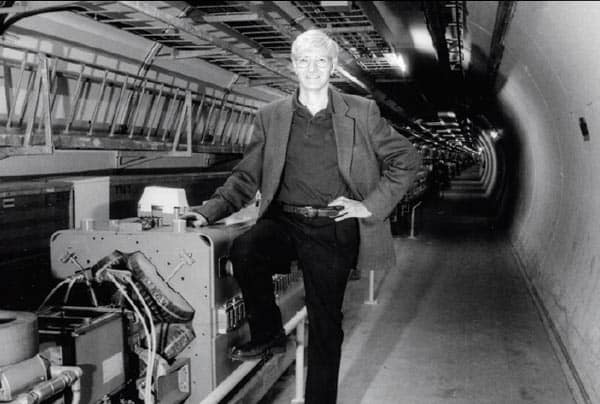
With his glasses and shock of thick, white hair, Chris Llewellyn Smith does not look like a superhero saving the world from peril. Yet the slim, 66-year-old physicist is seemingly becoming a potential saviour in the public eye. At least that is the reaction he says he got while recently moving house in Oxford. “I was quite surprised by my new neighbours’ knowledge of energy issues when they said ‘The world is relying on you to develop fusion!’.”

Yet Llewellyn Smith is certainly not your average physicist. During a career spanning nearly 50 years, he has held numerous high-level positions, notably director general of CERN (see “A passion for particle physics”), provost and president of University College London (UCL), head of physics at Oxford University and director of the Culham site of the UK Atomic Energy Authority (UKAEA), which is home to both the UK fusion programme and the Joint European Torus (JET), which is currently the world’s leading fusion experiment.

Now supposedly retired, Llewellyn Smith is not putting his feet up but is instead involved in the €5bn ITER fusion experiment currently being built in Cadarache, France, where he is chairman of the project’s council. He is also president of the Synchrotron-light for Experimental Science and its Applications in the Middle East (SESAME) in Jordan, and in December last year became a vice-president of the Royal Society, a role where he expects to be involved in briefing the society’s president Martin Rees on energy issues.

One of his functions as ITER chair is to advise the project’s director-general Kaname Ikeda on funding and strategy, but the role also involves him advocating fusion as a possible energy alternative, which has seen Llewellyn Smith give dozens of public lectures on energy. “The public seem to understand that nuclear fusion has the potential to provide essentially unlimited energy, in an environmentally responsible manner,” says Llewellyn Smith as we chat at the Rudolph Peierls Centre for Theoretical Physics in Oxford. “Having another major energy option would be enormously valuable.”

Star power

Nuclear fusion is the energy source that powers the Sun and the stars. Mimicking this source of energy involves heating and controlling a plasma of hydrogen isotopes — deuterium and tritium (D–T) — until it is so hot that the nuclei can overcome their mutual Coulomb repulsion and fuse to produce helium nuclei and 14 MeV neutrons. The idea for a fusion power station is to then to extract the heat of the neutrons, which would be used to boil water and drive a steam-powered electrical generator.

But it is not an easy task: the difficulty lies in maintaining a burning plasma for periods of weeks and getting out substantially more energy than you put in. There are currently two methods that could make it work: confining the plasma with magnetic fields; or “inertial confinement” using laser or particle beams. Magnetic confinement, which is how ITER will operate, is the most developed and more likely to be consistently supplying fusion generated electricity to the grid by the middle of the century.

Yet the ITER project has endured a rough ride since the four initial partners — the European Union, Japan, the former Soviet Union and the US — first agreed in 1985 to build an experimental reactor to demonstrate the scientific and technical practicality of fusion power. The latest setback came last year when the reactor’s designers submitted a plan to upgrade the reactor from the 2001 proposal. This change put back ITER’s start-up date by two years to 2018 and has contributed to construction costs rising above €5bn, although Llewellyn Smith is unwilling to put a specific figure on the increase.

One of the main design changes involves a new method to contain potentially damaging discharges of the plasma onto ITER’s giant 1000 m2 reactor wall. At fixed temperature, the fusion rate is proportional to the square of the pressure. It was originally thought that the pressure falls off smoothly to zero at the edge of the plasma, but in the early 1980s physicists discovered a way of operating a reactor in which the pressure drops off very steeply at the edge, and is uplifted elsewhere by the “height” of this drop. This mode of operation increases the fusion rate, but it also produces instabilities at the plasma’s edge — known as “edge-localized modes” or ELMs — that spit globs of plasma onto the reactor wall.

The original 2001 design envisaged firing frozen pellets of deuterium from outside the reactor into the plasma to produce many small ELMs, rather than a few large ELMs. However, plasma physicists have since realized that this may not be enough to do the job completely, so the new design incorporates an additional way of taming ELMs by applying a random weak magnetic field via small coils within the reactor near the plasma edge. To accommodate the new coils means re-designing the inner reactor. The snag is that this will cost much more than the original design.

The redesigns now need to be funded by ITER’s seven members (since 2001, China, India and South Korea joined and the US rejoined having pulled out). Llewellyn Smith points out that while the new design increases the cost, it is much more likely to achieve ITER’s goal. However, ITER’s price-tag has risen for other reasons too. “People hadn’t been careful enough in tracking the cost increases of commodities, which have gone up much more than general inflation, and they grossly underestimated the difficulty of setting up an international laboratory from zero,” he says. “When the initial costing was done, there were three parties in ITER, but now there are seven.” He points out that since all the members want to obtain technical know-how in a wide range of areas, construction of many of the components is being split between several different countries and companies, which adds to the cost.

Such delays have left critics repeating the well-worn phrase that fusion is always 30 years away. Indeed, Llewellyn Smith says it would not surprise him if there were yet more delays beyond the 2018 “first plasma” start date. “That date, of course, is a big public-relations goal,” he says, “but I think the emphasis on the first plasma is wrong.” This is because initially ITER will only use hydrogen to avoid activating the magnets and walls. Tritium will only be used five or six years later. “The first plasma can be whenever you like as long as you don’t delay, or jeopardise, the success of the first D–T plasma,” says Llewellyn Smith. The first D–T plasma is officially planned for 2023 and he insists that any further redesigns or delays should avoid pushing this date back further than absolutely necessary.

Although Llewellyn Smith is confident that ITER will demonstrate its main goal of generating more power than it consumes, what if ITER does not work? “What might happen then would depend on why it failed,” he says. Whether governments will be interested in pursuing fusion if ITER does not work is a big question, but one that Llewellyn Smith thinks they will have to address. “When we see the lights go out as fossil fuels become increasingly scarce, people will think differently about investing in developing new energy sources,” he says.

Opening SESAME

While his involvement in ITER seems a pretty big job for someone in retirement, Llewellyn Smith has also for the past few months been president of the council of the SESAME synchrotron, which is being built in Jordan. It aims to foster science and technology in the Middle East and to use science to forge closer ties between scientists across the region (see Physics World April 2008 pp16–17, print edition only). Most of his time on this project is spent trying to get funding to complete SESAME, which will produce X-rays that can be used in a range of experiment from condensed matter to biology.

Despite his initial reluctance and lack of knowledge in synchrotron science, Llewellyn Smith sees some advantages of getting involved. “It needed a president from outside the region who is politically neutral,” he says, “but also someone who knows about running big science projects, and knows people in Brussels and bodies such as the Department of Energy in Washington and UNESCO.”

Now it is up to Llewellyn Smith to take the lead in finding the funding to build the remaining piece of the jigsaw — the synchrotron storage ring, which is used to keep the electrons circling while producing X-rays. In addition to Jordan itself, Germany and the UK are the biggest contributors to the project — the former having provided the injector system, based on the old BESSY synchrotron in Berlin, which pumps electrons into the storage ring, while the latter donated some of the beamlines from the recently shut down Synchrotron Radiation Source at the Daresbury lab in Cheshire.

Llewellyn Smith is looking not only to the members of SESAME and to the European Union, but to charitable organizations and philanthropists to fill the gap in these “capital costs” amounting to about $15m. However, the running costs will grow to $4–5m a year, putting further pressure on the tight science budgets of SESAME’s 10 member states, which include Israel, Iran and the Palestinian Authority. Even with many potential stumbling blocks, Llewellyn Smith is hopeful that the synchrotron will be operational in five years’ time.

Despite his prowess in running large research projects, Llewellyn Smith’s career was not always rosy. He had a difficult time after quitting CERN to become president and provost of University College London in 1999. “I didn’t enjoy the job and you don’t do your best when you don’t enjoy it,” he admits. He also concedes that “problems such as how to restructure UCL’s faculties were not what I wanted to think about 24 hours a day”.

It is obvious that particle physics is Llewellyn Smith’s real passion, and indeed he is currently writing a book on the LHC with James Gillies — head of public relations at CERN. Rather than starting on the first chapter, they have already written the last one, entitled “Is it worth it?”. As far as the LHC is concerned, Llewellyn Smith would undoubtedly say yes. Whether the same is true for ITER remains to be seen.

In person

Born: Giggleswick, Yorkshire, 1942
Education: University of Oxford (BA and DPhil)
Career: University of Oxford (1974–1998);
director-general of CERN (1994–1998);
provost and president of UCL (1999–2002);
director of UKAEA Culham (2003–2008)
Family: married, one son, one daughter
Hobbies: reading and singing (having recently joined a choir)

Journeys to greatness

Readers, I hope, will forgive me for a shameless bit of self-publicity about my latest book, The Great Equations: Breakthroughs in Science from Pythagoras to Heisenberg (Norton). But then the book is partly yours too, inspired as it was by the responses of Physics World readers to my request for suggestions of great equations (see “Critical Point: The greatest equations ever”). In the book, I chose to discuss not the most frequently mentioned equations, but those that seem to have engaged their discoverers in the most remarkable journeys.

The journey metaphor may seem misleading if taken to suggest smooth and steady progress to an already known destination. The scientific journeys I recount — which include those culminating in F=ma, and the equations of Maxwell and Schrödinger — were unpredicted, often protracted and erratic. The journey metaphor should also not imply that the travellers passively observed the changing scenery; in fact, the scientists interacted with their environment while altering it.

But the journey metaphor does capture one important aspect of the birth of these equations, which is how their originators’ ideas about what was important changed during the course of their research. Newton, Maxwell, Schrödinger and others each inherited a “landscape” or view of how knowledge about nature was organized. But during their research, new concepts — such as mass and force, entropy and displacement current, quanta and wave equations — appeared on the horizon, grew in importance and displaced others to assume positions as indispensable landmarks in the conceptual landscape.

For the ultimate destination of such scientists was not a particular location that they saw beforehand, but clarity. They were dissatisfied with what they had, perceived a vision of what might take its place, and were able to carry out the inquiry needed to realize it. At each step, they found the world to be somewhat discordant — not fully grasped — with hints of another, deeper order just over the horizon. This discordance is what makes newly realized equations seem, strangely, to be both discovered and invented.

Oliver Heaviside, who transformed Maxwell’s then-convoluted equations into their now-familiar versions, once remarked that “it was only by changing its form of presentation that I was able to see it [electromagnetism] clearly”. The sense of that remark — you transform to clarify — could have been said by any of the scientists mentioned in The Great Equations.

No royal road

Most of the time we are less interested in journeys than in where they take us. But we can learn much from them. One is just how varied such journeys are. Sometimes they are taken by scientists who talk and argue constantly with one another, as with the equations of thermodynamics and the uncertainty principle. Other journeys were undertaken by individuals working essentially by themselves, such as Einstein in his path to general relativity and Schrödinger to his wave equation, though such individuals in effect carried on conversations with colleagues even when working alone. There is no royal road to discovery.

Another thing we learn is that equations are not simply inert tools that work only in the hands of scientists and engineers. They can also exert an educational and even cultural force that shapes our view of the world. The Pythagorean theorem teaches us what proof means, the second law of thermodynamics keeps in check our dreams of free energy, Einstein’s equations changed our understanding of space and time, and the work of Schrödinger and Heisenberg forces us to rethink what being a “thing” means.

We also learn to appreciate how deeply affecting the scientific life can be. The scientists who took those journeys were never blasé, never disinterested. They were infused with curiosity, consternation, bafflement, frustration and wonder. And each scientist had what might be called a particular style. Some succeeded because they were only satisfied when they found what they were looking for, while others succeeded only because they were prepared to see something more than they expected.

Most of all, the journeys allow us to glimpse the mutability of nature and our role in it. The journeys teach us that nature could be otherwise — that it was otherwise for us until a moment ago, and for all we know it could change in the future. In such instances, we experience a transcendent moment in which a higher thought emerges in the middle of an existing one.

The critical point

The Great Equations ends by relating a conversation I had while writing the book, with an elderly physicist who expressed little comprehension and sympathy. To his workmanlike mind, the equations I mentioned seemed so obvious and logical that he could not picture not having known them, and he saw no value in making them more enigmatic. “Such equations”, he told me, “would not be wonderful if people realized how trivial they are. You should help them do so.”

I could have hugged him. At that moment, I finally realized exactly what I was trying to do. It was exactly the opposite — to undo that sense of obviousness and triviality, and to take readers back to the moment just before the equations were discovered, to appreciate how untrivial they are. Readers could, I hoped, thereby relive the wonder of the moment when the equations were first grasped — when they seemed simultaneously discovered and invented.

Scientists such as my physicist acquaintance tend to focus on the formal, discovered — what he meant by “trivial” — aspect of the birth of equations, whereas philosophers and historians tend to focus on the other aspect, having to do with their invention. It ought to be possible, I felt, to capture both aspects at once — which would, I thought, finally provide a more complete picture of the discovery process itself.

Not wrapped up yet

Cosmologists ask questions about the history and evolution of the universe on the largest spatial and temporal scales. How fast is the universe expanding? What are the densities of the various sorts of mass–energy therein? What is its future? And how and when did it all begin? These cosmic questions may at first seem far removed from the branch of mathematics known as topology, which is the study of shapes at their most basic. It is not about the angles, corners and planes of geometry, but of pliable shapes and the handles and holes that cannot be changed by bending and stretching. Topologically, a ball is the same as a glass and a single-handled coffee mug is the same as a ring, but clearly their geometries are different. Similarly, we must separate questions about the geometry of the universe from those about its topology.

Both cosmology and topology reach back to the ancient Greeks and, likely, to the first humans who had any time to think at all. However, it is only in the last couple of centuries that the two have become proper sciences. Each relies on what has come to be known as non-Euclidean geometry, a branch of mathematics that forms a cornerstone of Einstein’s general theory of relativity and is also required to enumerate the possible topologies that could describe the universe.

The Wraparound Universe by the French cosmologist Jean-Pierre Luminet is not just a twofold popular overview of the union of these two sciences, but also a none-too-subtle plug for the author’s idea that the universe might have the large-scale equivalent of handles or holes. The universe, he argues, could be multiply connected, just like a computer-game “world” where moving off the right edge of the screen brings you back onto the left, and moving off the top brings you back to the bottom (see “A cosmic hall of mirrors”).

Luminet’s argument builds on the fact that the possible topologies for a particular surface (a computer screen, say, or the fabric of space–time) are related to the ways in which you can tile, or tessellate, the surface using repeated patterns — like the ones in M C Escher prints hanging in college dorms worldwide. The individual repeating pattern, known as the fundamental domain, determines the underlying topology.

As an example, let us return to the computer-game “world”, for which the fundamental domain is a rectangle. The topology of the computer game “world” is a torus, like the surface of a doughnut. To visualize this, take a rectangular rubber sheet (representing the computer screen) and wrap the left edge against the right, making a cylinder. Now join the two ends. Note that the computer game and a doughnut are topologically equivalent, but they have different geometries: the game is flat, while the doughnut is curved.

We can expand this notion of tiling a surface to higher dimensions easily enough. One possible 3D fundamental domain that tiles Euclidean 3D space, for example, is a cube. Crucially, the same process can be extended to curved surfaces and multidimensional spaces as well — which is just what is needed to make the link to the 4D curved manifold that cosmologists are starting to describe via high-precision measurements of the universe.

Luminet’s book covers these two disciplines, cosmology and topology, and the history of their overlap up to and including these high-precision measurements. He concentrates on observations of the Cosmic Microwave Background (CMB), repeated patterns on which could be a mark of primordial topology. He closes the book proper with the first hints from the background-measuring COBE satellite, together with the MAXIMA and BOOMERANG balloon-based experiments that such data might be compatible with his topological ideas.

In the new English-language edition being reviewed here, Luminet updates the original text (written in 2001) by adding an appendix that discusses the analysis he and colleagues have performed on the more recent data. Their analysis, he claims, reveals a strong preference for a fundamental domain in the shape of a dodecahedron — albeit one inhabiting a curved hyper-spherical universe, rather than the flat 3D Euclidean geometry we can more easily picture.

Alas, a more detailed look at the relevant data obtained using NASA’s Wilkinson Microwave Anisotropy Probe (WMAP) shows that the conclusion seems unwarranted. Among other groups, I, along with my colleagues Anastasia Niarchou and Levon Pogosian, concluded that the “power spectrum” data used in Luminet’s original work does not statistically warrant any explanation beyond the plain-vanilla standard cosmological model: a simply connected, spatially flat universe. Examining the detailed patterns of CMB fluctuations as Niarchou and I have done more recently — with a method that uses all available information — shows that Luminet’s preferred model is actually very strongly disfavoured.

Moreover, Luminet’s explanation ignores a crucial a priori weakness of his proposal: it requires the universe to have a very slightly curved geometry. This, in turn, requires the radius of the hyper-spherical universe (the curvature scale) to be comparable to the so-called Hubble distance (the distance a beam of light could have travelled since the Big Bang). Why should these numbers be nearly equal?

In fact, an interesting topology, especially paired with a curved geometry, is neither required nor particularly supported by the data. In contrast, one of the crucial features of cosmic inflation — the fact that inflation flattens the geometry of the universe so that the curvature scale becomes immeasurably large — is supported by the vast majority of cosmological data, and therefore by cosmologists (lightly mocked as the “inflation lobby” by Luminet). Nonetheless, the paired questions of the correctness of inflation and of the topology of the universe are by no means closed. We await further data, especially from European Space Agency’s Planck Satellite, which is due to be launched in April.

Luminet otherwise presents a workmanlike introduction to modern cosmology and to topology. For a popular-science book, both topics are presented at a sufficiently high level as to confuse the completely uninitiated reader, but I suspect that the audience for this book is one that has already digested some subset of other recent books, such as those by Stephen Hawking, Brian Greene, Janna Levin and João Magueijo. To differentiate this book, Luminet attempts to have its form reflect its content: the reader is presented with arrows and page numbers in the margins, supposedly giving the book multiple connections and a “tree-like structure”. I admire the attempt, and it usefully supplements the index, but I found it easier to read the book straight through (although a Web version might be more successful).

Nowadays, science (or at least physics) progresses not by sustained argument in books but by short snippets. Books serve to consolidate knowledge and present it to students or to the public. So it is heartening to read a book like The Wraparound Universe that not only summarizes the state of the art of a field but also argues for an idea, even if that idea is, in this case, likely to be incorrect.

Once a physicist: Zhengrong Shi


Why did you choose to study physics?

I was born on an island called Yangzhong on the Yangtze River in Jiangsu province, China. Though mainly agricultural, Yangzhong was blessed with a good school system and I dedicated myself to my studies. I followed my instincts and interests in science and built a strong foundation in physics. My family always encouraged me to pursue my studies, so I went on to obtain a Bachelor’s degree in optical science from Chang Chun University of Science and Technology in 1983 and a Master’s degree in laser physics from the Shanghai Institute of Optics and Fine Mechanics in 1986.

What did you do next?

I had been doing laser physics for more than five years when I decided to go to the University of New South Wales in Australia to further my studies. Aside from the initial culture shock, this was a fantastic opportunity to work with like-minded students and accomplished professors.

How did you become interested in solar power?

If I had not left China, I would undoubtedly still be working in laser physics. In the 1980s, this was a very new research area in China, and the Chinese government devoted many human and financial resources to this subject — I was honoured to be involved. But one of my colleagues in Australia suggested I speak to Martin Green, a prize-winning solar specialist, and so it was really by chance that I came to work in the field. Under Green’s tutelage I undertook a PhD in thin-film solar cells. When a breakthrough came, I was ecstatic, and that experience became the basis for a career in solar power.

Why did you decide to shift into industry?

I accumulated a lot of experience developing solar technologies both from my time at university and working in a solar start-up firm, so I knew the challenges involved. Then in 2000 I heard about the massive economic growth in China and the support provided to Chinese citizens based overseas willing to set up new enterprises back in China. I was also acutely aware of the growing need for renewable energy and so I decided to launch a company that helped provide a solution. I have always enjoyed challenges, and the opportunity to create an independent solar company was one that I could not forgo.

How has your physics training affected your approach to your business?

My scientific background was fundamental in the development and growth of Suntech. When I started the company back in 2002, we had very limited resources, and I had to design and build a production line using a mixture of second-hand and new equipment. At that point, I personally managed all aspects of the business, including production, sourcing, R&D and general operations. It was a real challenge, but my training allowed me to wear a number of hats and use our resources sparingly.

Do you still keep up to date with any physics?

The business and the industry are incredibly dynamic, and I do my best to keep track of the latest technical developments. It takes a huge commitment from me to guide the strategic developments of the company to maintain its growth and at the same time ensure that our costs do not get out of hand. In addition, I spend up to 20% of my time educating others about the importance of solar power and the necessity for us to act quickly to avoid the consequences of climate change. I also try to spend as much time as possible with the R&D group and discuss with our scientists the latest improvements in solar technology.

What is the biggest challenge for the future of solar power?

The goal of the solar industry is to reduce the cost and price of solar products to the point where the electricity generated is at or below the cost of energy coming from the grid. Once we reach grid parity, mass adoption of solar technologies will occur without government subsidies, and increased use of solar power will help us tackle issues like global warming, environmental pollution and energy security. To meet this goal we have a number of cost-reduction initiatives under way, including reducing the cost of silicon by improving how we source it; increasing the conversion efficiency of our solar products (which simultaneously increases power output per unit area and reduces production costs); and improving production efficiency through greater automation and lean supply-chain management.

The nuclear threat: a new start

President Obama has said that he intends to “make the goal of eliminating all nuclear weapons a central element in [US] nuclear policy”. He faces enormous challenges in converting this aspiration into a practical reality, both at home and abroad. One reason is that the world has become accustomed to thinking of nuclear weapons the way Winston Churchill described them in 1955: “It may be that we shall by a process of sublime irony have reached a stage in this story where safety will be the sturdy child of terror, and survival the twin brother of annihilation.” Over half a century later, the world has changed and the “sublime irony” is that terror and annihilation still loom over humanity, while safety and survival are still in doubt.

During the Cold War, the US and the former Soviet Union relied on nuclear deterrence to navigate successfully through those perilous years. And, against what seemed to be insurmountable odds, not one of the many thousands of existing nuclear weapons was detonated in military combat, although there were numerous opportunities to do so.

But it would be dangerously wrong to draw comfort from that achievement. Relying on nuclear weapons for deterrence is becoming increasingly hazardous and decreasingly effective in a world in which nuclear know-how, materials and weapons are spreading ever further and faster. Today, the world is teetering on the edge of a new and more perilous nuclear era, facing a growing danger that nuclear weapons — the most devastating instrument of annihilation ever invented — may fall into the hands of “rogue states” or terrorist organizations that do not shrink from mass murder on an unprecedented scale.

With the spread of advanced technology, and a renewed international interest in nuclear technology for civil power generation, there will be more opportunities for the theft or diversion of bomb fuel unless the full nuclear-fuel cycle is under tight, verifiable control, from enrichment to reprocessing. The threat of such proliferation is becoming ever more likely, particularly with more countries now aspiring to enter the nuclear power club.

To prevent such a catastrophe will take strong leadership and a sense of urgency that was lacking when two bold leaders, US President Ronald Reagan and Soviet leader Mikhail Gorbachev, attempted to escape the trap of nuclear deterrence based on mutual assured destruction at their remarkable summit meeting in Reykjavik in 1986. Although they failed to close the deal then — recall that in 1986 the Berlin Wall still stood and we had yet to emerge from the Cold War — Gorbachev and Reagan did start down the path of reducing the sizes of their bloated nuclear arsenals. However, without a vision of a world free of nuclear weapons as a guide beam, the nations of the world have not pursued measures that could reduce the nuclear dangers we face with the intensity and the boldness that the times require.

The challenges ahead

Rekindling this vision of Reykjavik will be President Obama’s main challenge, but realizing that goal will be very difficult. The importance of meeting this challenge is discussed in the new book Reykjavik Revisited: Steps Towards a World Free of Nuclear Weapons published by Hoover Institution Press, which I co-edited. Achieving the goals will require nothing less than a new deal between the states that have nuclear weapons and those that, for now, have volunteered to forego them. Progress will require political co-operation on a global scale between nations with very different economic and strategic aspirations, as well as forms of governance.

Currently, inspections under the Nuclear Non-Proliferation Treaty (NPT) to limit the spread of nuclear weapons are restricted to declared facilities only, and existing institutions like the International Atomic Energy Agency need more political clout and resources, including rights to the on-site inspection of suspect activities such as those currently being pursued under the Additional Protocols to the NPT. It will also be necessary to convince sceptics that it is possible to meet the very difficult challenge of verifying, with an effectiveness consistent with US security, that no nuclear weapons or bomb material have been secretly stored away in violation of a treaty commitment to eliminating them.

Winning over sceptical audiences in the US and elsewhere will take time, but the Obama administration can begin by proposing a series of practical steps to convince sceptics and allies alike that the vision of a world without nuclear weapons is not a flight of fancy but a practical goal. The following are candidates for the first two steps to do this.

First the US should engage the full cooperation of Russia, which, together with the US, possesses more than 90% of the world’s nuclear warheads. The administration must resume and reinvigorate serious negotiations to review and, if appropriate, extend key provisions of the Strategic Arms Reduction Treaty of 1991. Most pressing is the need to negotiate an extension of the essential monitoring and verification provisions of this treaty, which is scheduled to expire on 5 December 2009. The two parties should agree to reduce the limits on the total number of warheads to less than 1700–2200, as agreed in the 2002 Moscow Treaty on Strategic Offensive Reductions

Second, the new administration should adopt a process for bringing the Comprehensive Test Ban Treaty (CTBT) into effect. Nine of the 44 members of the Nuclear Suppliers Group, including the US and China, have not ratified the CTBT, so it is currently not in force. The new administration should initiate a timely, bipartisan, congressional review of the value of the CTBT to US security. The International Monitoring System (IMS), which comprises more than 320 seismic, radio-nuclei, optical and acoustic monitoring stations around the world for identifying and locating treaty violations, has been greatly strengthened since the US Senate questioned its adequacy when refusing to ratify the CTBT in 1999.

Since then, the IMS has been strengthened by additional stations so that it is now approximately 90% complete. The IMS impressively displayed its sensitivity and effectiveness by rapidly locating, identifying and determining the very low yield of a test explosion by North Korea in October 2006. The US has also made considerable technical progress over the past decade in maintaining high confidence in the reliability, safety and effectiveness of the nation’s nuclear arsenal under a test ban. It can be demonstrated that the CTBT not only meets US national-security requirements but enhances security worldwide by constraining further developments and deployments of these weapons with the potential of such devastating destructiveness. Other nations have made it clear that they are looking to the US for leadership to bring the treaty into force.

Vision for the future

It will be a difficult challenge to turn the goal of a world without nuclear weapons into a practical enterprise. But it has also become clear that a global effort to reduce nuclear danger and prevent proliferation of nuclear weapons will require both nuclear- and non-nuclear- weapon states to embrace the vision of Reykjavik as an essential part of the process. Many of the non-nuclear nations have made it clear that they are willing and eager to enter into such co-operative efforts with the US and other nuclear weapons states, but only if they see the world moving away from the current two-tier system of a small number of nuclear nations and many non-nuclear nations towards a level playing field with a common vision of a world free of nuclear weapons.

The necessity of embracing the vision of Reykjavik was emphasized in two letters in the Wall Street Journal by George Shultz, Henry Kissinger, William Perry and Sam Nunn (4 January 2007 and 15 January 2008). In endorsing the vision of a world free of nuclear weapons, and describing the essential steps toward achieving it, they wrote in the first letter that “Without the bold vision, the actions will not be perceived as fair or urgent. Without the actions, the vision will not be perceived as realistic or possible.” With these two steps outlined above, President Obama has a historic opportunity to start down a practical path towards achieving his stated goal of “eliminating all nuclear weapons”.

The science of fine art

When I first saw the painting of an Elizabethan woman — thought possibly to be a portrait of Queen Elizabeth I herself — it was split completely down the middle, with paint flakes hanging off like an outcrop and its two halves curved like a shield. The heating system in the National Trust-owned house in the UK where it was on display behaved erratically in the winter, and the relative humidity had dropped dramatically. The 5 mm thick painted wood panel responded by warping so severely that its frame eventually restrained it, forcing the panel to crack under the pressure.

Conservators and conservation scientists play a key role in physically preserving important parts of our cultural heritage. With the Elizabethan painting, our team’s remit here at the Courtauld Institute of Art in London was to repair the split, find out more about the painting’s provenance, understand its environmental response and provide a suitable mount to protect it from future damage. To do this, we carefully realigned the two halves of the panel and rejoined them with a polyvinyl-acetate adhesive, taking care not to lose the flakes of paint clinging precariously to each side. A surface fill of chalk and gelatine covered the join, which was then retouched using a hydrocarbon compound and dry pigments, before finally being varnished.

We monitored the movement of the panel by simply marking out its profile on graph paper and found it responded almost immediately to small changes (5%) in relative humidity. We were able to slow down this response by applying a coating of ethylene vinyl acetate to the back of the painting, building a flexible support for it and placing it in a sealed, glazed frame. It has now been returned to Trerice in Cornwall, where it is again on display.

Bringing art and physics together

I was first attracted to conservation science by the opportunity to work hands-on with fascinating and often beautiful objects of cultural heritage — each presenting a plethora of interesting and demanding problems for scientists as well as art historians or curators. The complexity and individuality of each object requires us to understand and integrate ideas from many fields. To conserve an object, many different factors must be considered, including its aesthetic, provenance and history; the artist’s intent, choice of materials and original technique; and the object’s physical condition.

I studied both art and science at A-level, and I always assumed they were facets of the same universe. I chose to study physics at Imperial College London because I liked the philosophical as well as the mathematical aspects of the subject. After I finished my undergraduate degree, I decided to do a Master’s degree in applied optics at Reading University because it brought together many of my interests, from the theory of colour and vision to the creativity of designing experiments and specialized lenses.

After I left university and started working on optical-systems design at the Rutherford Appleton Laboratory and then at Chelsea Instruments, I saw an advert for a postgraduate conservation course, and really became aware that I could combine science and art. However, funding was not available at the time so instead I started a PhD in mechanical engineering at Imperial, researching techniques used to look for defects in ceramic tiles. I then realized these same techniques could be applied to non-destructive testing of works of art, so I contacted the scientific departments of the National Gallery in London and the Tate to find out more about the problems encountered in paintings. Seeing the work they did made me decide that this was the area I wanted to work in, so I persuaded my supervisor to let me change my PhD topic to cover the physical properties of canvas paintings.

I soon found out that there are numerous ways in which to apply my physics knowledge to this field. For the past 16 years I have been using a technique called electronic speckle pattern interferometry, which employs lasers and interferometric imaging to measure the strain induced in paintings. I have also experimented with other methods like pulsed thermography and infrared optical coherence tomography to identify subsurface features and adhesion between layers in works of art, and used multispectral imaging to understand artists’ materials and techniques.

Patterns at work

I joined The Courtauld, which consists of the Courtauld Gallery and the Institute of Art, in 2000. The Gallery houses a famous collection of Impressionist and Post-Impressionist paintings (including works by Manet, Monet, Cezanne and Renoir) and the Institute of Art is a college of the University of London that specializes in art history and conservation. My research interest is in non-invasive techniques for measuring the physical condition of paintings, and developing methods for structural conservation treatments.

Working within an academic environment means that the flow of students, lectures and exams provides an overall structure to the year, but beyond that my day-to-day activities vary quite a lot. Our postgraduate students treat paintings starting in their first year, which requires a lot of studio supervision. So on an average afternoon, I might be recording an infrared image to check for any drawings underneath the paint, using ultraviolet light to identify retouching and varnish, or using a technique called energy-dispersive X-ray spectroscopy (EDX) to identify chemical elements in the paint layers. Equally, I could be removing a painting from its wooden support, mending tears, designing a mount for a panel painting, or undertaking an environmental survey at a historic house where paintings — like the Elizabethan portrait — are displayed.

Careers in conservation

Conservation science is a relatively small field, and there is a lot of collaboration between institutions and individuals. In general, paintings conservators work directly on an object; so depending on what is required, they may remove a degraded varnish, repair a tear in the canvas, fill and retouch where paint has flaked off, or, as with the Elizabethan painting, rejoin a wooden panel that has split. Conservation scientists, in contrast, usually take a more indirect approach. For example, we may analyse paintings using X-rays (see “Underneath the surface”), monitor the movement of a painting due to environmental changes with optical or mechanical techniques, or use small original samples or replicas to investigate new cleaning methods in a laboratory setting.

Research and practice are more closely interrelated than in many scientific fields, which makes the work very satisfying. I keep abreast of emerging techniques in applied physics and engineering, and I have longterm collaborations with conservators, scientists and engineers from several institutions, including the National Physical Laboratory, Imperial College London, the Tate and National galleries and the Museum of Modern Art (MoMA) in New York.

For a physicist, there are many ways to work in the field either as a conservator or as a conservation scientist, or as both. The principal employers of conservation scientists are the scientific departments or preventive conservation sections of major museums and public collections in Europe and the US. Many come into the profession as I did, through doing a PhD at a university with external links with a museum. Scientists are sometimes employed at a junior level directly after completing undergraduate or postgraduate courses, without prior training in a conservation-related field; they then learn on the job.

There are also sometimes research-assistant posts in conservation-science research projects. At The Courtauld, we have recently had two projects: one investigating artists’ materials and techniques using microscopy, Raman spectroscopy and EDX spectroscopy; the other working with ultraviolet lasers to investigate their suitability for cleaning 19th-century paintings.

For those wanting to work hands-on with objects as conservators, then a postgraduate training course is the recognized route. There are two- and three-year postgraduate courses available in many areas — including easel paintings, wall paintings, paper, objects, stained glass, preventive conservation and archaeology — for which a first degree in physics is appropriate. Usually, after finishing their postgraduate course, students work on short-term contracts to build up experience. Conservators are employed in museums and galleries or work privately in many countries. Finding permanent posts at institutions is more difficult, but most conservation-trained scientists do eventually find full-time work.

For those wanting to see if conservation might be for them, a good start would be to read the technical bulletins published by the National Gallery, British Museum or similar institutions outside the UK. Several museums and galleries also maintain good conservation webpages, and two conservation-community websites, icon.org.uk and iiconservation.org, contain a number of useful resources. The most important step, however, is to go to museums, galleries and cultural-heritage sites to look at things and find out what really interests you.

Web life: The Internet Plasma Physics Education Experience

What is it?

An educational outreach site maintained by the Princeton Plasma Physics Laboratory in the US, IPPEX features several interactive, game-like tools (applets) for exploring the physics of fusion, the doughnut-shaped “tokamak” reactors used in fusion experiments around the world, and related topics.

What are the simulations like?

Slider bars and pop-up graphs on the Virtual Tokamak applet allow wannabe fusion scientists to determine how plasma density, magnetic field and auxiliary heating in their simulated reactor will evolve over a 20 s “shot”. Once you are happy with your choices, you can fire up the tokamak and watch the program generate a time-dependent graph of how much power your reactor produces. In the Magnetic Confinement applet, the aim is to keep the plasma within the tokamak cross-section by switching magnets on and off. Additional applets appear in tutorials illustrating basic principles of physics like electricity and magnetism.

Where is the physics in these games?

IPPEX head Andrew Zwicker notes that the Virtual Tokamak runs a “fairly sophisticated” performance calculation based on a potential reactor design, albeit with a few computational simplifications. An obvious first step on the simulated tokamak is to crank all variables to their maximum values, but be warned: if you exceed the program’s limits on plasma density or temperature, then you lose control of the plasma and your “score” (a number related to the amount of fusion power divided by the heating power) drops to zero. Similarly, magnetically confining a “mildly unstable” plasma is fairly easy, but “totally out of control” plasmas are more of a challenge. A good analogy among plasma-physics insiders is that confining a plasma is like trying to hold jelly together with rubber bands, and the Magnetic Confinement applet helps drive this point home. The lessons learned are mostly qualitative, however.

Who is it aimed at?

The physics is described on a very basic level, so that even secondary-school students should have little difficulty in following it. The format of IPPEX is ideal for teachers wishing to incorporate the site into lessons on fusion or renewable energy. In addition to the applets, the site also hosts a series of pages where students can explore real fusion data from low-confinement deuterium plasmas, answer a series of questions and submit these answers to a “Fusion Wizard” for online evaluation. In a few months, live data from the laboratory’s NSTX experiment will replace the archived shots, bringing the fusion-analysis exercises even closer to “real physics”. More advanced users may find the lack of in-depth scientific explanations frustrating, but should still enjoy playing with the applets.

Why should I visit?

The site has won several science-education awards, and it is not hard to see why. The Virtual Tokamak, in particular, is surprisingly addictive and requires a fair amount of thought to master. The hints page contains a few suggestions for boosting your score (the current maximum is around 148), but for the most part it simply urges users to play with the variables in a systematic fashion — sound advice for any experimental scientist.

Copyright © 2026 by IOP Publishing Ltd and individual contributors