Happy Chinese New Year

chinese new year.jpg
Lanterns in Kota Kinabalu, East Malaysia

by James Dacey

Last Monday was dubbed Blue Monday after “official” calculations deemed it to be the most depressing day of the year. Thankfully, this Monday, things are a lot more celebratory; the colour red takes centre stage as more than a billion people across the globe celebrate Chinese New Year.

Physics World would like to extend you all a warm welcome to the year of the Ox!

It struck me today that this year’s celebrations have fallen especially close to the Gregorian New Year. In my ignorance I’ve only just realised that the date changes each year – but how and why?

Well, if you were as in the dark as I was, check out this short video by Xinhua, a Chinese Government news agency. It gives a nice overview of key dates in the Chinese New Year Calendar.

And this year’s festivities seem to be in full flow already. According to Xinhua, Beijing last night was covered in 68 tonnes of firework debris.

UN Secretary-General Ban Ki-moon on Friday sent a message in Chinese, which read: “Happy New Year to the Chinese people and all the ethnic Chinese all over the world.”

One more slightly interesting fact for you: 2009 is the year of the Ox — the “brave leader” — and famous “oxen” include Barack Obama…

… but I’ll leave it there because this is rapidly slipping away from physics!

China to lure more scientists from abroad

China has announced a new five year plan to attract more scientists to the country. The Chinese Academy of Sciences (CAS) says that it will pay for “thousands” of overseas scholars and scientists to come and work in China over the next five years.

The country hopes to scoop 1500 “leading” scientists, accelerating the “100 People” plan, begun in the mid-1990s, which sought to attract 100 top overseas scientists each year. In selecting scientists “practical contributions” will be considered over academic achievements, according to a statement on the CAS website.

Long-term plan

This new drive by the CAS follows the release of new government guidelines that call on state enterprises and academic institutions to attract more overseas scientists, especially those on the cutting edge of science and technology.

“With this new talent project, China expects to break technological bottle-necks and enhance its research abilities and sci-tech levels in the least time,” said the CAS statement.

Over the past decade, the Chinese government has doubled the percentage of its GNP that it spends on research and development, representing a total investment of $140bn. This has led to a large increase in the number of articles by Chinese researchers in academic journals across the globe.

During this time, China has tended to focus investment on specific areas of science where practical applications are likely — such as nanoscience, where it is second only to the US in terms of number of published papers.

China plans to double investment again by 2020 and the latest projects will continue to be “in line with the national strategic developments” by concentrating on “key technology, sci-tech industries and new emerging subjects.”

Despite this scientific boom, one concern is that many young Chinese researchers, after training in China, then leave to apply their skills in the US and Europe.

One of the aims of the 100 People programme has been to attract Chinese scientists home after developing skills in the west. According to the academy, 81% of CAS academicians and 54% CES (Chinese Academy of Engineering) academicians are now returnees, and 72% of leaders of the National Key Projects are scientists returned from abroad.

Muons reveal upper atmosphere’s temperature

Scientists interested in the upper atmosphere should turn their attention to measurements made deep underground — says an international team of physicists who have noticed that the number of cosmic-ray remnants hitting Earth is linked to freak warming events in the upper atmosphere. The link implies that measurements of cosmic rays — both future and past — could help scientists improve climate and weather forecast models.

Cosmic rays are mostly high-energy protons and are constantly bombarding atoms in Earth’s atmosphere to create pions. These pions either decay into lighter muons or continue to interact with nearby atoms and avoid decaying into muons. If the atmosphere is cool and thick then the chance of continued interactions is much higher, and the number of muons generated is therefore far fewer than when the atmosphere is warmer.

As a result, underground experiments that detect these characteristic muon flashes tend to see more events in summer than in winter. But now a team of researchers has found that muons can also reveal big changes in atmospheric temperature on very short timescales.

Lurking in the background

The collaboration — which is led by Scott Osprey and others at the National Centre for Atmospheric Science (NCAS) in the UK — began considering this possibility while studying the background particles reaching the underground AMANDA neutrino experiment at the South Pole. In data recorded in 2002, when the upper atmosphere in the southern hemisphere was warmer than usual, they noticed a rise in the number of muons.

“They [the AMANDA team] didn’t know this was in their data until we showed them,” says Giles Barr, an Oxford University particle physicist who is part of the NCAS collaboration.

To confirm that the effect was real, the collaboration turned to their own muon data, taken in the northern hemisphere from the MINOS neutrino experiment at a disused iron mine in Minnesota, US. “It’s much easier to know what systematic detector effects need checking in your own data,” adds Barr. Again, they saw the correlation.

The most surprising feature of the correlations was the fact that they could even flag spikes in high-altitude temperature, sometimes as much as 40 degrees, taking place over just a few days. These events, known as sudden stratospheric warming, are thought to occur owing to the passage of huge atmospheric “Rossby” waves which shift heat from the tropics to the poles. In the past meteorologists had only satellites and weather balloons to study sudden stratospheric warming — now, claims the NCAS collaboration, they could use cosmic ray measurements too.

“They are important to study not only because they represent the most striking display of variability in the stratosphere, but also because of their links with weather occurring [lower down] in the troposphere, where our weather takes place,” explains Osprey, also at Oxford University.

More data needed

Serious measurements of cosmic rays go back more than 50 years, way before satellites began examining the atmosphere. This means that the cosmic-ray measurements could be used to corroborate past balloon data and perhaps give meteorologists a better handle on how the climate has evolved. Also, says Osprey, it is possible that cosmic rays will turn out to have niche applications in weather monitoring.

“Historical records of muon rate might be interesting — certainly the stratosphere was poorly observed prior to the 1960s,” says Peter Haynes, an atmospheric scientist at the University of Cambridge who is not involved with the research. “The muon rate seems to provide an absolute measurement of temperature — that is, there is no bias problem.”

However, Haynes points out that the muons reflect atmospheric temperature at a single location, which may make it difficult to see how the climate is changing as a whole. There are only a handful of other muon detectors in the world, and it would hard to justify building more for weather purposes alone.

Nevertheless, Barr thinks that it is a exciting discovery: “Lots of things affect cosmic rays on their journey through the galaxy, into the solar system and then into the atmosphere. Historically, cosmic rays have been notoriously hard to work with, so to understand how to use them to measure something is very satisfying.”

The research will be reported in an upcoming issue of the journal Geophysical Research Letters.

Atoms teleport information over long distance

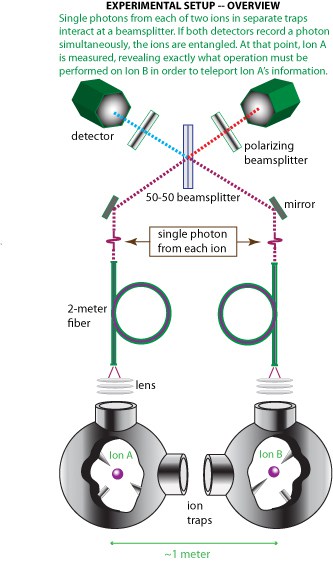
Experimental set-up

Physicists have teleported quantum information between two atoms separated by a significant distance, for the first time. Until now this feat had only been achieved between photons, and between two nearby atoms through the intermediary action of a third. According to researchers, this advance could be a significant milestone in the quest for a workable quantum computer.

Quantum teleportation is a remarkable form of transport only available to particles at the atomic and subatomic scales. Information such as the spin of a particle or the polarization of a photon can be transferred between particles without travelling across a physical medium. Teleportation is made possible by the feature of quantum mechanics known as “entanglement”.

According to quantum mechanics, when particles become entangled the very act of measuring the quantum state of one particle instantly reveals information about the state of the second. In theory, this effect should occur regardless of distance between particles. In practice, it is very difficult to observe because of external influences. If the particles interact uncontrollably with the environment or if you try to record two quantum states directly — entanglement vanishes.

Now researchers at the University of Maryland and the University of Michigan have successfully teleported quantum information between two ytterbium ions separated by 1 m, reporting a 90% success rate. They employ a new method of teleportation where ions are stimulated to emit photons and the quantum states are inferred from the colour of these emissions (Science 323 486).

Our system has the potential to form the basis for a large-scale ‘quantum repeater’ that can network quantum memories over vast distances 

Christopher Monroe, University of Maryland

“Our system has the potential to form the basis for a large-scale ‘quantum repeater’ that can network quantum memories over vast distances” said group leader Christopher Monroe of the University of Maryland.

Double entanglement

In quantum teleportation the sender (Alice) instantaneously transfers the quantum state of a particle to a receiver (Bob). In 1997 physicists achieved teleportation of quantum states between photons for the first time. Their methods exploited the uncertainty principle: Alice could not know the exact state of her photon, but the effect of entanglement meant that she could still teleport her state to Bob.

Then in 2004 separate teams of physicists at the National Institute of Standards and Technology (NIST) in Colorado and the University of Innsbruck in Austria demonstrated teleportation at the atomic scale for the first time. Using slightly different methods, they transferred spin between pairs of ions trapped in a harmonic potential. Unfortunately, teleportation — using these methods — is restricted to very short distances because harmonic potentials are molecular in scale.

Now Monroe and his team have taken teleportation in a different direction. They first isolate the ytterbium atoms in separate vacuum traps surrounded by electromagnetic fields. Each ion — in its ground state — is then irradiated with a microwave burst which puts the ions in a superposition of two different quantum states. Next, a short laser pulse excites each ion which subsequently leads them to emit photons whose colour is a superposition of red and blue — linked with the two available quantum states.

The red photon or the blue one?

Once generated, these photons are then directed towards a beamsplitter where they have an equal chance of passing through or being reflected. There is a detector on either side of the splitter. According to the researchers, a red-blue combination detected at exactly the same time is a clear sign that the ytterbium atoms are entangled. When this occurs the researchers immediately return to the ions where they determine the quantum states using a process known as quantum tomography.

“One particularly attractive aspect of our method is that it combines the unique advantages of both photons and atoms,” said Monroe. “Photons are ideal for transferring information fast over long distances, whereas atoms offer a valuable medium for long-lived quantum memory.”

The next step for this research is to further improve the success rate of the measurements. “We are looking into putting an optical cavity around each atom — which could yield orders of magnitude improvement in the success rate of the system,” said Steven Olmschenk, a member of the research team.

Boris Blinov at the University of Washington told physicsworld.com: “Olmshenk and his colleagues have generated an entanglement and used it to teleport quantum data in what I consider the most promising ‘qubit’ [quantum bit] candidate yet — the trapped ion system.” He added, “We are one major step closer to the our elusive goal.”

Chu sworn in as DOE head

The Nobel-prize winning physicist Steven Chu has been sworn in as secretary of the US Department of Energy (DOE) — a post that makes him a member of President Barack Obama’s cabinet.

Chu is the first working scientist to head the Department of Energy — which is a major source of physics research funding — since it was created in 1977. He is an expert on energy policy and well matched to the challenges he will face. In his previous role as director of the Lawrence Berkeley National Laboratory in California, he refashioned the lab to focus on alternative-energy research and is a passionate advocate of biofuels.

Meanwhile, Obama has named physicist and long-time arms reduction advocate John Holdren as his science advisor. Holdren will be an “assistant to the president”, which should see him attending Cabinet meetings.

More money for physics?

Elsewhere in Washington, members of the Democratic Party in the US House of Representatives have unveiled an $800bn bill to stimulate the US economy. It includes an extra $3bn this year for the National Science Foundation — half its 2008 total of $6bn. Similarly, the Department of Energy’s science office, which received $4bn last financial year, stands to gain an extra $2bn, including $400m to start up an Advanced Research Projects Agency for Energy, modelled on an existing network for defence technologies.

The National Institute of Standards and Technologies does even better, with $520m extra; its FY 2008 budget was $737m. NASA, meanwhile, whose budget totalled $17.1bn last year, would receive $600m, $400m of which will go towards science projects.

While some of this money could find its way to US physicists, how much of this two-year package will go on new research projects as opposed to infrastructure — or even if the bill will be passed at all — is not yet clear.

Aspiring physicists should rock

may.jpg
Astrophysicist Brian May shows how it’s done

By Hamish Johnston

…or dance or act, if they want to succeed.

If you are a British teenager aspiring to a career in physics, you could be better off at a “School of Rock” or “Fame Academy” than a school that specializes in science — at least according to a study by researchers at the University of Buckingham.

The work, which was reported today by the BBC, reveals that students who attend schools that focus on the arts do better on physics exams than those at schools that were set up to encourage the sciences.

In 2007, for example, about 24% of students at specialist science schools who wrote the “A-level” physics exam achieved an A grade. Compare this to the 36% of pupils who achieved a physics A grade at music schools.

This is a big difference — but you must keep in mind that 124 science schools were polled, whereas only seven music schools were looked at — so I’m not sure of the statistical significance of the 36% figure.

When the team looked at 34 schools that specialized in languages, they found that 26% of students bagged an A in physics. Meanwhile, aspiring physicists enrolled at specialist maths and computing schools managed 24%.

The study focussed on physics and didn’t look at other science exams such as chemistry or biology.

Why do students at music schools do better?

(more…)

Micromotor could navigate human bloodstream

Researchers in Australia have built an electric motor just 250 µm wide that could be used to power tiny robots narrow enough to be injected into the human bloodstream, making new kinds of surgery possible.

The motors work by converting the vibrations of a piezoelectric material into rotary motion that could then be used to drive whip-like structures called flagella — mimicking how some bacteria and other micro-organisms swim.

The team claims that their piezoelectric motor is the first such device to be smaller than 1 mm and — with some improvements — could be powerful enough to drive a robot against the flow in the human bloodstream.

Propulsion is a challenge

Modern vascular surgery often involves inserting a very thin tube — or catheter — into a blood vessel in order to remove a blockage or repair damage. While this technique is often much safer than cutting open a patient, it is sometimes not possible to perform because blood vessels can be too narrow or to labyrinthine to navigate using a catheter.

Some researchers believe that surgery could be made even less invasive by using tiny, self-propelled robots that could be injected into a patient and controlled remotely by a surgeon. One challenge facing designers of such devices is how to propel them through the bloodstream to the right place in the body.

The new motor, built by James Friend and colleagues at Monash University, could do the trick. It comprises a tubular “stator” with a helical slit cut in it and mounted on a piezoelectric material (J. Micromech. Microeng. 19 022001). When an alternating voltage is applied to the material, it vibrates at about 660 kHz. This causes the stator to act like a whip, with its free end following an elliptical path. The free end of the stator is in frictional contact with a rotor, which is spun around by being whipped by the stator.

While this design is not new — much larger piezoelectric rotational motors were first developed in 1980s — Friend told physicsworld.com that the Monash design is much simpler than existing motors, making it easier to scale down to sub-millimetre dimensions.

Nearly enough power

The team was able to operate the motor at 1295 revolutions per minute at a torque of 13 nNm — which is a swimming power of about 4 μW. This power could then be used to propel the motor through a fluid by attaching a whip-like structure called a flagellum to the rotor.

Calculations done by the team suggest that the motor can only deliver about one-fifth of the power needed to drive a tiny robot against the flow in a small human artery — however, the team are hopeful that the power could be boosted in the future.

Friend added that he hopes that tiny piezoelectric motors could be commercially available by 2020.

A video of the micromotor can be seen here.

Quantum-dot device detects DNA

A device that can detect DNA using quantum dots has been built by physicists in Spain. The researchers say that the device is highly sensitive, portable and cheap to build, and could one day be used by doctors to diagnose and detect disease.

Bioscientists have in recent years made huge progress in determining the human genetic code and that of many other organisms. One application of this data is to test patients for hereditary conditions — such as cystic fibrosis — by taking a DNA sample from them and comparing it with the known genetic code related to that condition.

Comparisons are usually made by mixing single strands from separate sources, which join to form their iconic double-helix structures. The speed and efficiency with which double helices form determines their genetic relatedness.

Until now, detecting double-stranded DNA has involved labelling the strands using fluorescent dyes, enzymes or radiolabels. However, the sensitivity of these techniques has been limited. Arben Merkoci and his colleague at the Autonomous University of Barcelona have overcome this problem by using quantum dots as labels; this also removes the need to chemically dissolve samples before testing (Nanotechnology 20 055101).

A quantum of semiconductors

Quantum dots are nano-scale crystals that were first developed in the mid-1980s for optoelectronic applications. They comprise hundreds to thousands of atoms of an inorganic semiconductor material.

Merkoci and his colleague have created a “sandwich assay” that can be filled with DNA for testing. “Samples are inserted inside the sensor in the same way that a glucose biosensor tests for glucose levels in blood,” Merkoki told physicsworld.com. In their test report, single-strands of DNA linked to cystic fibrosis are mixed with cadmium sulfide quantum dots and inserted between two screen-printed electrodes.

When two strands form a pair they pick up a quantum dot; this affects the electrical properties of the quantum dots which leads to a detectable change in the current across the two electrodes.

Advance for DNA testing?

Nanoparticle-based detection systems for DNA have been developed in the past few years but this is the first one to incorporate screen-printed electrodes; this enables direct detection of the DNA pairs without the need for chemical analysis. However, this test used an isolated, prepared sample of DNA so the next step is to test the device using “real-world” DNA samples. “We need to conduct further study of possible interferences that could come during testing of real patient samples,” said Merkoci.

A longer term goal is to develop an array composed of several electrodes where the same quantum dot can be used to test for a range of different DNA strands, each affecting the quantum dot electrical properties by different extents. A further aim of the researchers is to create a “lab-on-a-chip device”. “It could see applications in fields where fast, low cost and efficient detection of small volumes is required,” said Merkoci.

Merkoci and his team have not yet applied for a patent but are currently looking for companies to collaborate with to develop the technology further.

The Sun and Mars

Sun.jpg
The Sun‘s so-called scoop

By Matin Durrani

Scientists have a habit of complaining that there’s not enough science in the mainstream press. So I suppose they should be glad that Britain’s best-selling newspaper, The Sun, had a story on their front page last Thursday (15 January) emblazoned with the headline “Life on Mars”.

The story was refering to a paper in Science by a team of NASA scientists that reported the finding of methane in the Martian atmosphere. And as the Sun (the real one that is) destroys methane, could it be that living organsims are constantly regenerating the gas?

Turns out that the story is not the scoop it seems: scientists already had evidence for methane on Mars, so this latest research only confirms those findings.

Moreover, according to Paul Sutherland – the journalist who wrote the story – Science was not happy that The Sun had broken the embargo on the story, which was set at 7 p.m. UK time on Thursday 15 January. Indeed, he says that Science staff rang The Sun at 3 a.m. local time, demanding the story be removed from the paper’s website.

But Sutherland denies that he ever broke an embargo. As he explains on his blog, he simply put two and two together based on NASA’s original press release, along with a couple of Google searches and a chat with an astronomer friend.

Now when a newspaper or website reports on a story before an embargo deadline, what normally happens is that the organisation that imposed the deadline lifts the embargo so that other media outlets can report the story too. But Science maintained the embargo because, it said, this “unfortunate tabloid teaser” contained nothing from the research paper and was “a purely speculative narrative”.

Which says it all about The Sun‘s coverage of science I guess. Still, fair play to them: they got planetary science on the front page and it seems churlish to complain.

But the final twist in the tale is that Nature, which each week sets embargoes of its own, reported the story back in October last year

What goes around comes around.

And the winner is…

higgs.jpg
A Higgs Boson, as envisaged by <a href="http://www.particlezoo.net

“>The Particle Zoo

By Margaret Harris

Congratulations to Alexandra Gade of the National Superconducting Cyclotron Laboratory at Michigan State University for winning Physics World’s 2008 Quiz of the year, which took a lighthearted look at physics events ranging from an Indian moon mission to the discovery that some granite countertops “might heat your cheerios a little” due to their low-level radioactivity.

In addition to the everlasting glory of victory, Dr Gade will also receive a cheque for £50, which works out at around $75 at today’s exchange rate. It’s a pity about the declining pound, but sadly there’s nothing we can do about it.

If your entry didn’t win this year, better luck in 2009 – and here are the answers in case you’d like to check your memory skills.

(more…)

Copyright © 2026 by IOP Publishing Ltd and individual contributors