Can science help solve the economic crisis?

By Hamish Johnston

I was trained as a physicist, many of my friends are scientists and I believe that science has made the world a much better place.

But, would I trust my economic well being to “a group of good scientists…some who know a lot about economics and finance, and others, who have proved themselves in other areas of science..”

Probably not…

I suppose I’m old fashioned in the sense that if water is pouring from my ceiling, I would call a plumber, not a physicist — even though the physicist would probably have a better understanding of how gravity and fluid dynamics had conspired to ruin my day.

The above quotation comes from the introduction of an article called Can science help solve the economic crisis? that has been published on a website called Edge, where clever people expound on various topics of general interest to society.

The article is written by four intellectuals — including the physicist Lee Smolin of the Perimeter Institute — who argue that scientists should be given chance at “developing a scientific conceptualization of economic theory and modeling that is reliable enough to be called a science”.

The article goes on to identify several failures of neoclassical economics, which has been the guiding philosophy for markets and economies worldwide. Many of these criticisms seem to deal with how principles of science — such as the concept of equilibrium — have been naively applied to economics with dire consequences.

Then, it suggests a way forward — applying the concept of self-organized critical systems to economics.

Hmm, better call for that plumber!

Water confirmed on distant planet

Any lingering doubts about whether water exists on a planet orbiting a star 63 light years away have been quashed by astronomers in the US. The team measured infrared light emitted by the planet, known as HD 189733b, and found distinct spectral features that, they say, can be explained only by the presence of water. Researchers had been puzzled because a previous attempt by the team to find water on the planet had failed, even though other astronomers claimed to have spotted the stuff.

One of over 300 extrasolar planets that astronomers have so far spotted, HD 189733b is a gas giant similar to Jupiter, orbiting its parent star once every 2.2 days and passing between Earth and the star as it does so. The first signs that HD 189733b contains water came last year when Giovanna Tinetti of University College London and colleagues studied the planet using the Spitzer Space Telescope. They looked at how the exoplanet absorbs light and found that absorption was at higher at infrared wavelengths associated with water.

Then another team (that also included Tinetti) used the Hubble Space Telescope to confirm the standard theory that the atmosphere of such a “hot gas giant” contains lots of water.

However, before either of these studies were published Carl Grillmair and colleagues at the Spitzer Space Centre in California and several US universities had studied HD 189733b using Spitzer. They found no evidence for water and these conflicting results left astronomers scratching their heads.

Subtracted light

Instead of looking at the light absorbed by the exoplanet, Grillmair and colleagues had studied the light given off by the planet itself. To do so, the team had collected light when the planet was in front of the star and when it was behind the star. Subtracting the two signals gave them the light emitted from the planet itself. In 2007 the team did this for two orbital periods and found no evidence of water.

Now, however, they have had another try, looking at 10 revolutions and found clear evidence for water. The team looked at infrared light with wavelengths between 5-14 μm, where they found a “bump” in the spectrum at 6.2 μm, which corresponds to a specific vibrational bending mode of water – a spectral feature that astronomers expect to see in such a hot giant (Nature 456 767 ).

Tinetti told physicsworld.com that she was pleased that her group’s 2007 sighting of water has been confirmed by Grillmair and puts the original discrepancy down to the extreme difficulty of making such measurements.

Help in the search for life

She added that the techniques developed by Grillmair and colleagues — as well as by other groups — could be used to look for water on rocky exoplanets that resemble Earth and could harbour life. However, she added that this may have to wait for the next generation of space telescopes such as NASA’s James Webb, because Earth-like exoplanets are much more difficult to find — and give off much less light — than their Jupiter-like counterparts.

In a related development, Tinetti and colleagues announced yesterday that they have used the Hubble Space Telescope to show that there is carbon dioxide in the atmosphere of HD 189733b. The team did so by making a measurement similar to Grillmair’s but instead looked in the 1.5-2.5 μm range. Earlier this year, methane was also found on HD 189733b, making it the most understood of all known exoplanets, according to Tinetti.

Supermassive blooper found at the BBC

blooper.jpg

By Hamish Johnston

Imagine my surprise when I turned on the radio this morning to be told by the BBC that astronomers have “found” a supermassive black hole at the centre of the Milky Way…

Didn’t we know this already, I thought?

A quick trawl through the physicsworld.com archives revealed that yes, we have long known about this black hole, roughly where it is, its mass, and that it is probably spinning.

I pointed this out to the BBC, which has since changed the headline from “Black hole found in Milky Way” to ” Black hole confirmed in Milky Way”. However, the home page still carries a supermassive banner using the word “found”.

I find it slightly worrying that one of the world’s most respected news outlets has decided that the most important thing we should know about today, is something that has been accepted by many physicists and astronomers for some years.

Europe plans future research facilities

Europe should build a test facility for carbon capture and storage within the next three years according to a roadmap published today by the European Commission. The report also recommends a further ten projects to be constructed across all sciences with three new projects in environmental research alone.

The European Strategy Forum for Research Infrastructures (ESFRI) is part of the European Union’s Seventh Framework Programme (FP7) to forward plan large research projects that would be then recommended to ministers in member states. It splits money across six categories such as energy, biomedical and medical science, and social sciences and humanities. “We wanted to have a roadmap that is unique in the world in that it covers every topic, not just physics and energy,” says Carlo Rizzuto ESFRI chair.

The first roadmap in 2006 recommended 34 projects to be completed across all research areas within the next ten years. These included seven in the physical science such as the €950m European Extremely Large Telescope, an underwater neutrino detector in the Atlantic and the Facility for Antiproton and Ion Research (FAIR) currently being constructed in Darmstadt, Germany.

One more for physical science

The newly revised ESFRI roadmap, published today, recommends one more physical science-based project — the Cherenkov Telescope Array (CTA). The CTA, which is expected to be complete in 2017 costing €150m, is a high-energy gamma ray observatory studying gamma rays with energies of tens of GeV to hundreds of TeV.

The €81m European Carbon Dioxide Capture and Storage Laboratory Infrastructure (ECCSEL) is the latest addition to the three existing projects in the energy category, which contains the HiPER fusion facility that will test the possibility of using lasers to ignite fusion in small fuel pellets. “New areas of research such as energy are very important to us,” says French Minister for Higher Education and Research Valerie Pecresse at a press conference in Paris.

Three new projects in environmental sciences are recommended including an upgrade to the Scandinavian-based European Incoherent Scatter (EISCAT) radar system which studies the Earth’s atmosphere. The others are a €500m European Plate Observing System (EPOS), which will connect already existing facilities around Europe to study plate tectonics, and a €50m project to upgrade the existing Svalband Integrated Arctic Earth Observing System.

ESFRI has a budget of €1.7bn over seven years, which it uses 60% to support existing facilities and the rest to fund new projects. “The roadmap is the consensus for steering policy in Europe,” says Janez Potocnik, European commissioner for science and research.”It will also be a catalyst to develop national roadmap.”

Cosmic-ray mystery deepens

Cosmologists mapping out the origins of high-energy cosmic rays reaching Earth have discovered two unexpected “hotspots”. Their observations are in stark contrast to current theories — which predict that our own galaxy’s magnetic fields should “scramble” incoming cosmic rays , making it look like they come from all directions.

Although the results are puzzling, an explanation for the hotspots could provide insight into the still unexplained origins of some cosmic rays and how they propagate through space.

Cosmic rays are energetic particles consisting mainly of protons, some helium nuclei, and other heavier nuclei. Although first discovered about 100 years ago, it has proven very difficult to pin down where they are coming from. In 2007, researchers at the Pierre Auger Observatory in Argentina found that rare ultra-high energy cosmic rays with energies greater than about 1019 eV were created in the vicinity of black holes at the centre of nearby galaxies.

However, some physicists believed that the origins of the much more common lower-energy TeV (1012eV) cosmic rays would remain a mystery. This is because the paths of charged particles with energies less than about 1018 eV are bent by galactic magnetic fields, as they travel through space, causing them to follow a meandering path that obscures their origin.

Two unexpected hotspots

Now, Milagro — the first observatory capable of continuously monitoring the Northern sky for TeV cosmic rays — has put this in doubt by revealing two cosmic-ray hotspots (Phys. Rev. Lett. 101 221101).

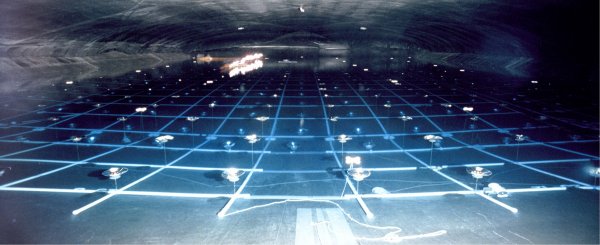
Located in the mountains near Los Alamos National Laboratory in New Mexico, Milagro does not detect comsic rays directly, but rather looks for “air showers” of millions of secondary particles that are created when a cosmic ray collides with a nucleus in the atmosphere. Shower particles are detect in a large pool of water filled with photomultipliers — which detect flashes of light (Cherenkov radiation) that occur when particles pass through the water. Shower data are then analysed to determine the energy and arrival direction of the cosmic ray.

In a seven-year run ending in April 2008, Milagro worked out the direction of over 200 billion cosmic rays with TeV energies. Crucially, it found an excess of cosmic rays arriving from two small isolated regions of the sky, roughly 10 degrees across.

“The most straightforward explanation of this excess – a region of the sky where cosmic rays are produced – could not account for how the cosmic rays reach us without bouncing around and losing any directional information in the process,” explains Allen Mincer at New York University and a member of the Milagro team. One possibility, according to Mincer, is that a special structure of magnetic fields is somehow guiding the cosmic rays from their source to Earth. It is also possible that the cosmic rays are electrically neutral particles such as neutrons, however Mincer points out that neutron lifetime is too short to make this likely.

Cosmologists are puzzled

Other cosmologists are equally mystified by the results. “This is a very strange result as protons should be randomized by the galactic magnetic field,” says Dan Hooper at the Fermi National Accelerator Laboratory in Illinois. “Somehow, a fraction of these particles are coming from one direction and I know of no especially plausible explanation.”

Troy Porter at the University of California, Santa Cruz, also points out that the Milagro researchers have investigated the signal thoroughly and it persists even after they have accounted for all the likely factors that could cause spurious detections, such as atmospheric distortions.

“It is interesting that the direction of the excess signal is in the direction of the tail of the heliosphere — the solar magnetic field,” says Porter. “However, it is hard to know what to make of this, since we don’t expect a lot of material to be concentrated in this region that could interact with ‘normal’ cosmic rays and produce secondary particles such as neutrons that could travel in a straight line to the Earth, thereby accounting for this effect.”

Next generation may give the answer

The Milagro researchers are now looking forward to their proposed next generation experiment — the High Altitude Water Cherenkov experiment (HAWC) in Mexico, which will be at a higher altitude and sensitive to lower energy cosmic rays.

“We are nearing the 100-year anniversary of the discovery of cosmic rays and we still do not have proof of where they come from,” says John Pretz at the Los Alamos National Laboratory in New Mexico. “If these hot spots are due to a source of cosmic rays, then it would be the solution to a 100 year old riddle. It is also exciting because, for the first time, we are starting to see isolated features in the cosmic-ray sky and that can help us understand their origin.”

Do religion and nanotechnology mix?

By Hamish Johnston

No, at least according to a paper published yesterday in Nature Nanotechnology by researchers in the US and Singapore.

The team discovered that people who live in countries with a relatively high level of “religiosity” are less likely to agree that “nanotechnology is morally acceptable”.

Their study on public attitudes towards nanotechnology involved surveys of over 30,000 people in the US and 12 European countries. Americans topped the religiosity scale with a score of about 9 out of a possible 10, and also had the highest percentage of respondents (25%) who did not agree that nanotechnology is morally acceptable.

At the other end of the scale were countries such as the Netherlands and Sweden (5 and 4 on religiosity respectively) where far fewer respondents had negative moral issues with nanotechnology.

On the surface, this study seems to go against the popular notion of Europeans as Luddites, and Americans being keen to embrace new technologies.

The study is also interesting in relation to another paper published in the same issue of the journal but by a different team. This concludes that, “people who had more individualistic, pro-commerce values tended to infer that nanotechnology is safe”.

In terms of national stereotypes, that sounds more like your average American than your average Swede. Indeed, the UK and Ireland — which are usually thought of as individualistic and pro-commerce — also tended to be less morally accepting of nanotechnology than many of their more “socialist” neighbours.

Lamb shift spotted in solid qubit

A tiny shift in quantum energy levels usually associated with individual atoms has been seen in a solid for the first time by physicists in Switzerland and Canada. The team spotted the Lamb shift in a small piece of superconductor that functions as a quantum bit or “qubit”.

The interactions that cause the Lamb shift are also responsible for making qubits unstable, and therefore the team believes that insights from their experiments could be used to create more robust qubits that could be used in quantum computers.

The Lamb shift is a tiny change in certain atomic energy levels. It occurs because the atom is interacting with the empty space surrounding it by absorbing and emitting “virtual” photons. Discovered in 1947 by the American physicist Willis Lamb, the shift provided important experimental evidence for the then emerging theory of quantum electrodynamics (QED), which describes the interaction of charged particles in terms of the exchange of photons.

While the Lamb shift should also affect electrons in a solid, it has proven difficult to see because electron energy levels in solids are wide bands, rather than discrete atomic levels.

Shifting transmon

Now, Andreas Wallraff and colleagues at ETH Zurich in Switzerland and the University of Sherbrooke in Quebec have spotted the Lamb shift in the energy levels of a qubit called a “transmon”, which is made from two tiny pieces of superconductor connected by two tunnel junctions (Science 322 1357).

The superconductor contains a large number of “Cooper pairs” of electrons that can move through the material without any electrical resistance. The energy levels of the qubit are defined by the precise distribution of Cooper pairs between the two tiny pieces of superconductor.

The team’s transmon is placed in a microwave cavity and its shape was chosen to give it a large electrical dipole moment. This increases the strength at which it interacts with both microwave photons and the virtual photons of the vacuum. In addition, the shape and size of the cavity were designed to enhance the photon’s electric field in the region of the qubit.

Transitions between qubit energy levels occur when electrons in the superconductor collectively absorb or emit photons at certain wavelengths. This process can be enhanced by tuning the frequency of microwave radiation injected into the cavity so that a single photon of the correct wavelength bounces back and forth across the qubit many times.

In their experiment, the team used a cavity to enhance the effect of the virtual photons related to the Lamb shift — which makes it more likely that the qubit absorbs and emits virtual photons. Indeed, Wallraff and colleagues measured a cavity-enhanced shift of 1% in the difference between the two energy levels. This is 10,000 times greater than the Lamb shift seen in hydrogen without a cavity.

Tricky measurement

Despite its relative magnitude Wallraff told physicsworld.com that the tricky part of the experiment was measuring the shift. This is because any measurement on the qubit must be made using photons as a probe — and their presence in the waveguide could cause a shift in the energy levels (the a.c. Stark effect), which would overwhelm the Lamb shift.

To get around this problem, the team used a very small number of probe photons that were off-resonance with the cavity. This means that they remain in the region of the qubit only long enough to measure the transition energy but not cause any a.c. Stark shifts.

The discovery of such a large Lamb shift is a mixed blessing for those trying to design practical qubits. On one hand, the virtual photons induce spontaneous emission in qubits, which limits their usefulness for quantum computing. On the other hand, Wallraff and colleagues have established that the Lamb shift can be minimized in a transmon qubit if it is set far from resonance with the virtual photons. This suggests a way of making qubits more robust, as demonstrated in a recent work by a Robert Schoelkopf and colleagues at at Yale University (Phys. Rev. Lett. 101 080502).

Detecting the Lamb shift in a solid system also suggests the possibility of seeing the effects of other virtual particles such as phonons — which are quantized vibrations in solids. According to Wallraff, such an acoustical Lamb shift due to the mechanical quantum fluctuations of nanometer-scale electromechanical oscillators could similarly affect the energy levels of a qubit.

LHC will restart end of June 2009

The Large Hadron Collider (LHC) will switch on again the end of June next year, according to a report that will be published later today by CERN.

On 19 September 2008, nine days after the highly successful “switch on” day in which the LHC circulated its first proton beams, commissioning of the accelerator was interrupted as an electrical fault damaged part of the machine. The fault generated an electrical arc that punctured the cooling enclosure, allowing some six tonnes of liquid helium to evaporate into the tunnel with such ferocity that it broke floor anchors and magnet connections.

At the time, the LHC operations team was commissioning for operation at energies of 5 TeV, and had not yet collided any protons.

Upgrade of pressure-release valves

James Gillies, the chief spokesperson for the CERN particle-physics lab near Geneva, told physicsworld.com that engineers will upgrade pressure-release valves on the machine’s focusing or “quadrupole” magnets to prevent such a helium discharge being so damaging in the future.

This involves warming up the relevant sectors and lifting out 53 magnets to perform the necessary repairs. So far three sectors have been warmed up and 28 magnets have been lifted out. Two magnets have already received the upgrades and are back in place.

Engineers will also upgrade the valves on the dipole magnets, which steer the proton beams. However, they will only do this when the sectors containing those magnets are warmed up for other reasons. “It really is extremely cautious to do this,” says Gillies.

Although it is unlikely that beams will reach their full energy of 7 TeV next year, they should be able to collide at a record-breaking 5 TeV.

BLAST takes off

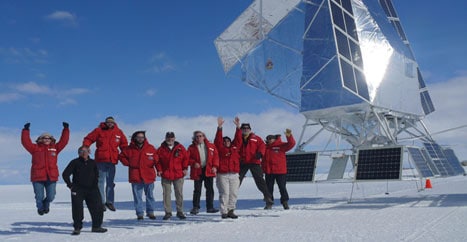
BLAST_TeamPortrait.jpg
The BLAST team. Credit: Mark Halpern

By Margaret Harris

Things are not going well for the astrophysics “balloonatics” at the bottom of the world. After weeks spent waiting for decent weather, their Balloon-Borne Large Aperture Submilimeter Telescope, or BLAST, has hit a stumbling block. Fairly literally, in fact: the fragile, sensitive instrument has just slammed into the truck being used to launch it. “Oh, you’re (expletive) kidding me,” someone cries in the background, as the stricken telescope sways gently beneath its balloon in the still Antarctic air.

“Step by tedious step, we stumble away from abject failure,” says Barth Netterfield, a Canadian astrophysicist and co-star of the feature-length documentary BLAST, which chronicles the 18 rocky months leading up to the equally rocky launch of the telescope. “And that’s on a good day.” It’s a statement that will bring grimaces of recognition to many an experimentalist’s face, and as a summary of the film, it’s as good as any. If you’re reading this as a PhD student, and your experiment is not going well, take heart: at least it isn’t scattered over a 120-mile stretch of frozen wilderness, with the bulk of it halfway down a crevasse.

(more…)

‘Echoes’ shine a light on Tycho Brahe’s supernova

The supernova first observed by Tycho Brahe in 1572 helped change our conception of the universe, by undermining the Aristotelian idea of the immutability of the heavens. Now, a new study of this massive explosion could help shed more light on the nature of the cosmos.

Research carried out by astronomers in Europe and Japan on SN1572, as the event is known, should help us understand exactly how supernovae occur and might also lead to a better understanding of how the universe has been expanding. By analysing “echoes” of light from SN1572 reflected off a nearby dust cloud, Oliver Krause of the Max Planck Institute for Astronomy in Heidelberg, Germany, and colleagues have proved that it is a so-called type-Ia supernova (Nature 456 617).

Supernovae are the explosions of aging stars, that produce enough light to outshine entire galaxies for a few weeks. They are important scientifically because they seed the universe with heavy elements, providing the raw material for successive generations of new stars. The very well defined luminosity of type-Ia supernova also makes them ideal “standard candles”, allowing astronomers, by comparing their observed and actual luminosities, to gauge distances within the universe and thereby chart the cosmic rate of expansion.

Supernovae occur throughout the universe continually, but those close enough to be of use to researchers happen only rarely. Indeed, in the last 1000 years only six supernovae have been observed taking place in the Milky Way. Unfortunately, the historical observations of these events are not of a high enough quality to reveal precisely what happens during a supernova. Astronomers can study the material left over, known as the remnant, but this cannot provide detailed information on the explosion itself.

Scattered from dust

To get round this problem, Krause and colleagues have instead studied light from SN1572 that has been scattered by a nearby dust cloud. This has been made possible because the cloud, of a suitably high density, is located several hundred light years from the site of the supernova, thereby allowing observation of this light “echo” on the Earth today.

Using the 8.2 m Subaru telescope in Hawaii, Krause’s team found a tell-tale patch of brightness in the night sky close to the supernova remnant that was moving away from the remnant. This, they say, is the echo formed as the flash of light produced by the explosion moves through the cloud.

Echoes of runaway fusion

The discovery of light echoes from SN1572 and another ancient supernova was announced by Armin Rest of Harvard University and colleagues earlier this year. What Krause’s team has done is to use echoes to establish the nature of Brahe’s supernova. Indirect evidence, such as radio and X-ray observations of the remnant, had suggested that SN1572 was a type-Ia supernova, which occurs when a white dwarf star accumulates enough material from a companion star to raise its core temperature sufficiently that it initiates runaway fusion reactions.

However, it had also been suggested that the event could instead have been either a type Ib, Ic or II, which occur when an aging massive star no longer undergoes fusion reactions and its weight causes it to collapse in on itself, flinging off its outer layers in the process.

Krause and colleagues have proved that SN1572 is in fact a type-Ia supernova. They did this by measuring the absorption spectrum of the echo, showing that the event generated silicon but no hydrogen, as would be expected of a type Ia. The researchers also found evidence of calcium ions moving at much higher velocity than the bulk of the explosion debris, suggesting, they say, that the explosion could have been asymmetrical and as such a challenge to existing models of type-Ia explosions.

Comparing old to new

The observation of light echoes will now allow astronomers to characterize other historic supernovae, enabling them to correlate the many observations of the remnants with new direct measurements of the corresponding explosions.

In addition, says Krause, studying light echoes from different parts of the sky could enable researchers to perform a three-dimensional study of supernovae and hence identify any asymmetry in the explosions. Krause also points out that an improved knowledge of the luminosity of type-Ia supernovae could have implications for our understanding of how the universe expands.


Copyright © 2026 by IOP Publishing Ltd and individual contributors