Space to explore

When someone at a party asks you what you do for a living, working in space science is always a plus — you are virtually guaranteed to get a few raised eyebrows and some interested questions. While the day-to-day reality of my job does not quite match up to the rocket scientist clichés, it is certainly never boring.

I joined the Space Science and Technology Department of the Rutherford Appleton Laboratory (RAL) in Oxfordshire, UK, in 2002. While many people working in space science have always wanted to be involved in the subject, my career path was less planned. I enjoyed physics at school because I liked knowing how the world fits together, so it was not a difficult decision to study the subject at Manchester University.

After graduation, however, I was not keen on settling down to a regular job right away, and a career in research seemed a little too specialized. Instead, I decided to do a Master’s degree in applied optics at Imperial College London, which led to a job at a small firm designing commercial optical systems (such as specialist cameras for the electronics industry). After nine years there, I was looking for a change, and a job advert in Physics World for an optical physicist at RAL led me to work on space instruments.

Our department at RAL designs, develops and manufactures scientific instruments for both space-science missions and ground-based astronomy projects. A typical mission might have several scientific instruments on one satellite, each dedicated to making a particular measurement. Such projects are impossible to carry out in isolation, and we work with university groups, companies and national space agencies to make each project a reality. Our role in a project can range from defining the scientific requirements and designing the instrument right through to assembling and testing the flight hardware.

Of gravity and glue

When I first joined RAL, I worked on the Laser Interferometer Space Antenna (LISA) Pathfinder project. Its aim is to detect gravitational waves produced by massive objects like black holes, and I was part of the team that designed and constructed a prototype interferometer for the satellite, which is due to be launched at the end of 2009 (see Physics World September 2007 pp10–11, print version only).

One of the aims of LISA Pathfinder is to measure displacements of a pair of gold–platinum cubes that are free-falling in space. A passing gravitational wave will change the separation of the cubes but, because gravity is a relatively weak force, the effect is tiny and we need to be able to sense positions to an accuracy of picometres (10–12 m) to detect a gravitational-wave signal.

The project became especially entertaining when we started building the interferometer. The lenses and mirrors were stuck onto a glass baseplate using a technique that ensured the bond line would not flex under changes in temperature — essential for reducing displacement noise due to thermal expansion that might otherwise swamp the gravitational-wave signal. Although the experiment will be operated in a room-temperature environment stable to millikelvin, tiny movements of the optics can still be enough to ruin the measurement.

Unfortunately, the glue we had to use took only about 30 seconds to cure. Within that short time, each part had to be precisely aligned, with little possibility of repair if something became stuck in the wrong place. This required meticulous preparation and planning, and ultimately a steady hand and nerve. However, after several weeks of tense work in the lab, by June 2004 we had built an instrument with a unique measurement capability. I have always enjoyed having a job with a tangible end product, and it is particularly satisfying when you know that you have built the first example of something.

Room for creativity

One of the advantages of working on scientific instruments is that you get involved in a variety of projects spread over many areas of physics. In my current job I can move between topics like solar physics and environmental observation of the Earth as well as gravitational-wave detection. This often means being the person in the room who knows least about a subject, particularly when the project scientists have been working on a proposal for many years. Asking questions all the time can feel intimidating, but if you enjoy thinking on your feet, then it can also be a stimulating way to learn.

Having the chance to be creative is another attractive aspect of working in space science. My job is fundamentally about problem solving, and when you are trying to do new science, you often need to find solutions without a textbook to guide you. You always want the next experiment to do more than the last one, and this pushes the boundaries of your ingenuity as well as the limitations of current technology and materials.

One downside of working in space science is that projects can take a long time to come to fruition. Occasionally a project is cancelled and you may find that your hard work has been in vain. When this happens, you need a robust, long-term outlook and the ability to shrug off disappointments and start looking for the next challenge. Fortunately, there is always a new project around the corner and each comes with a unique set of problems to get your teeth into.

On a day-to-day basis, my job involves a mixture of project management, instrument design, and assembling and testing hardware. I find it refreshing to have a variety of roles, and sitting round a table with a team of people to figure out how to solve a problem can be a welcome break from hours spent in front of a computer screen. Physicists who are used to logical problems with deterministic outcomes, however, may find managing budgets, schedules and teams of people a bit of a culture shock.

People (and sometimes budgets) are much less predictable than experiments, and to get the most out of the opportunity to build an instrument, you need to balance a mission’s science requirements against competing factors like finite budgets and timescales. This can be one of the most difficult aspects of the job, but it is also one of the most rewarding; when you get it right, you have the personal satisfaction of shaping the design of an instrument and an experiment.

For those interested in working in a similar field, my advice would be to keep your eyes open for opportunities and go in the direction that most interests you. There are opportunities to work in national laboratories like RAL, universities, commercial space companies and agencies such as the European Space Agency and NASA. A degree in physics and a willingness to have a go at things will get you a long way. I have found that there is no well-defined career path for a physicist; this can be a bit daunting at times, but it also means that you can find yourself doing things like building instruments for space missions and keeping people entertained at parties.

Renewable energy source inspired by fish

An engineer in the US has built a machine that can harness energy from the slow-moving currents found in oceans and rivers around the world. By exploiting the vortices that fish use to propel themselves forward, the device could, he says, provide a new kind of reliable, affordable and environmentally friendly energy source.

Turbines and water mills can generate electricity from flowing water, but can only do so in currents with speeds of around 8–10 km/h if they are to operate efficiently. Unfortunately, most of the currents found in nature move at less than 3 km/h.

The new device is called VIVACE, which stands for vortex induced vibrations for aquatic clean energy, and its inventor claims it can operate in such slow-moving flows.

VIVACE has been developed by University of Michigan engineer Michael Bernitsas, and in its prototype form exists as an aluminium cylinder (91 cm long with a diameter of 12.5 cm) suspended by a pair of springs inside a tank. The tank, located in the university’s marine renewable energy laboratory, contains water that flows across the cylinder at around 2 km/h. The device does not convert the energy of the flow directly into electricity but instead exploits the vortices that form on opposite sides of any rounded object placed in a flow (J. Offshore Mech. Arct. Eng. 130 041101).

Vortex-driven fish

As such, it works like a moving fish. Fish cannot propel themselves forward using muscle power alone; instead they curve their bodies so that they form a vortex on one side of their body, straighten out, and then curve the other way to form a vortex on their other side, in order to glide between vortices. VIVACE remains in a fixed position in the water but is pushed and pulled by the vortices on either side, and these vibrations are then converted into electrical energy (the current cylinder is smooth, but future versions will have scale-like structures on the surface to enhance vortices).

It dawned on me four years ago that I can enhance these vibrations to harness energy Michael Bernitsas, University of Michigan

Bernitsas explains that engineers usually do all they can to suppress such vibrations, which can occur in either water or air, as they can cause enormous damage. They were, for example, responsible for destroying the Tacoma Narrows bridge in the US in 1940. “But,” he says, “it dawned on me four years ago that I can enhance these vibrations to harness energy. My colleagues and I searched the scientific literature and patents and found out to our surprise that no one had done this before.”

The total amount of energy generated by the Earth’s slow-moving currents is vast, but the density of this energy is low. This means that the VIVACE technology, like any other ocean-based device, will only ever be part of the solution to the world’s energy needs. However, Bernitsas believes it has a number of advantages over alternative ocean-based sources, pointing out that, unlike wave devices, for example, it is unobtrusive, and should also pose no harm to marine life.

Tests in the Detroit River

The group is currently installing a 3 kW device in the Detroit River to provide energy that will light a new pier being built there. Bernitsas says that the technology could then be scaled up by constructing arrays of cylinders, either suspended from ladders or built upwards from the river or sea floor, in order to build power stations large enough to power tens of thousands of houses. The electricity from such a plant would be cheaper than many alternative renewable sources, he adds — some 5.5 cents per kilowatt hour, compared with 7 for wind and at least 16 for solar.

“The device is highly scalable”, said Bernitsas. “It could be used to build small devices of 5 kW, medium of 50 kW, larger of 500 kW and put them together to build large stations of 10 MW”, he said. “The next step up is 100 MW and finally huge offshore underwater stations of the size of 1 GW, the size of a nuclear power plant”.

Stephen Salter of Edinburgh University, who has carried out research on tidal and wave energy, believes that low-velocity flows are an important potential source of renewable energy. He points out that there are several kinds of structure that could be used to harness this energy, including, for example, hydrofoils. But he believes that cylinders could turn out to be cheaper and more efficient than the alternatives, if they can be made to move with sufficiently high velocities.

Bernitsas has founded a company called Vortex Hydro Energy to commercialize the technology.

Breakthrough in the physics of ice-shelf break-up

Ice shelves are the floating expanses that form when the ice sheets of Greenland and Antarctica flow into the surrounding ocean. These ice shelves ultimately break up and form icebergs in a process called “calving”.

To date there hasn’t been a law based on physical principles that explains ice-shelf calving, which has made it tricky to model ice-sheet behaviour. Predicting the future of the ice sheets under global warming is of considerable interest to scientists and therefore a physical model of calving would be very welcome.

Now Richard Alley of Pennsylvania State University and colleagues at five other academic institutes in the US have come up with a simple law that explains much calving behaviour (Science 322 1344).

Earthquake prediction comes to mind, or guessing whether a tea cup pushed off the table will break or bounce Richard Alley, Pennsylvania State University

“Fracture-mechanics problems are invariably difficult,” explained Alley. “Earthquake prediction comes to mind, or guessing whether a teacup pushed off the table will break or bounce upon hitting the floor. With the teacup, a drop from 1 mm high won’t break it, and a drop from 100 m almost surely will — one term, the height of the drop, explains a whole lot of the behaviour. Our hope was to find such a dominant term in calving of bergs from ice shelves.”

Surprisingly simple hypothesis

And indeed, that’s what the researchers managed to do. “Our first hypothesis was that spreading is required to open a crack that isolates a new iceberg, so the spreading tendency in the direction of ice and berg motion should play the role of the height of your teacup,” explained Alley. “Almost surprisingly, this simple hypothesis explains most of the variance in a data set we assembled to test [it].”

The team’s basic equation for ice calving is the rate of spreading times the width of the shelf times thickness multiplied by a constant. For narrow shelves between two ridges, the sides hold back the ice, slowing the overall movement and making it harder to break the ice. And thicker ice shelves tend to spread more quickly.

“The spreading rate can be calculated from ice thickness and a few other things that are already solved for in numerical models, so we have provided a practicable calving law,” said Alley. “At present, models rarely if ever calculate physically where the ice ends, instead stopping the model before the ice ends or using some other relation that is not fully physical.”

Pinning points

According to Alley, in its simplest implementation this calving law requires a “pinning point” such as an island to stabilize an ice shelf. “And we typically see such pinning points,” he said. “Without such stabilization, the law almost always produces unstable shelves, that either elongate greatly or calve back rapidly. We believe this is an interesting line of inquiry to be followed.”

The team used both new and previously published data, putting together a data set for a representative range of ice shelves.

Now the team plans to follow the discussion that emerges following publication of their work and to “make sure that new data sets coming in remain consistent with our results”. The researchers are also implementing the law in models to further understand the implications. “We believe this matters for understanding the history and projecting the future of ice shelves,” said Alley.

NJP shines a light on cloaking

njp.jpg
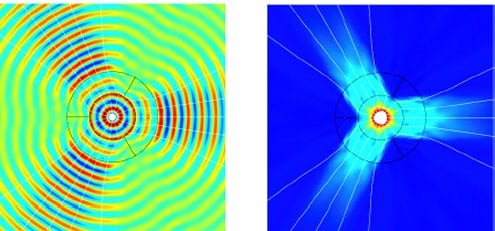
Simulation of a treble beam splitter by Xiaofei Xu et al

By Hamish Johnston

Our very own New Journal of Physics has just published a special issue on cloaking and transformation optics — a subject dear to our hearts here on physicsworld.com.

The first article in issue — by cloaking wizards Ulf Leonhardt and David Smith — begins with a quote from the late Arthur C Clarke that sums the field up nicely. “Any sufficiently advanced technology is indistinguishable from magic”.

So, what kind of magic has been unveiled in the (virtual) pages of this special issue?

(more…)

Modelling civilization as ‘heat engine’ could improve climate predictions

The extremely complex process of projecting future emissions of carbon dioxide could be simplified dramatically by modelling civilization as a heat engine. That is the conclusion of an atmospheric physicist in the US, who has shown that changes in global population and standard of living are correlated to variations in energy efficiency. This discovery halves the number of variables needed to make emissions forecasts and therefore should considerably improve climate predictions, he claims.

Computer models used to predict how the Earth’s climate will change over the next century take as their input projections of future man-made emissions of carbon dioxide. These projections rely on the evolution of four variables: population; standard of living; energy productivity (or efficiency); and the “carbonization” of energy sources.

When multiplied together, these tell us how much carbon dioxide will be produced at a given point in the future for a certain global population. However, the ranges of values for each of the four variables combined together leads to an extremely broad spectrum of carbon-dioxide emission scenarios, which is a major source of uncertainty in climate models.

Changes in population and standard of living might best be considered as only a response to energy efficiency Timothy Garrett, University of Utah

Timothy Garrett of the University of Utah in the US believes that much of this uncertainty can be eliminated by considering humanity as if it were a heat engine (arXiv:0811.1855). Garrett’s model heat engine consists of an entity and its environment, with the two separated by a step in potential energy that enables energy to be transferred between the two. Some fraction of this transferred energy is converted into work, with the rest released beyond the environment in the form of waste heat, as required by the second law of thermodynamics.

However, the work is not done on some external task, such as moving a piston, but instead goes back to boosting the potential across the boundary separating the entity from the environment. In this way, says Garrett, the boundary “bootstraps” itself so that it can get progressively bigger and bigger, resulting in higher and higher levels of energy consumption by the entity.

Like a growing child

Garrett points out that this model serves as a basic description of what happens to a growing child, which consumes more and more energy as it increases in size, in turn allowing it to grow, resulting in still greater energy consumption, and so on. But he also believes that the model can describe the functioning of humanity as a whole, with the boundary — the sum of people, their buildings, machines etc — continually increasing in size as energy is continually removed from primary resources such as oil, coal and uranium, in turn allowing ever higher levels of energy consumption.

The goal for Garrett was to work out if there is some way of linking this thermodynamic description to economics. He believes there is. He argues that “if what physically distinguishes civilization from its environment is a thermodynamic potential, then civilization implicitly assigns monetary value to what this potential enables — the rate of energy consumption”.

Garrett proposes that the global rate of energy consumption is therefore proportional to the world’s total (inflation-adjusted) economic production generated to date. And this, he shows, leads to an interdependence between population, standard of living (in other words, economic production per person), and energy efficiency which means that only energy efficiency need be considered when predicting future trends of global energy consumption. Combined with predictions of how green or otherwise the world’s energy sources will be in the future then allows carbon-dioxide emissions to be forecast.

Bootstrapping civilization

“So, perhaps surprisingly,” he writes in his paper, “changes in population and standard of living might best be considered as only a response to energy efficiency. As part of a heat engine, creating people and their lifestyles requires energy consumption. Doing so efficiently merely serves to bootstrap civilization into a more consumptive (and productive) state by increasing the dimensions of the boundary separating civilization and its environment.” He also notes that gains in energy efficiency therefore accelerate rather than slow energy consumption, contrary to conventional wisdom.

To support his argument, Garrett plotted the relationship between global energy consumption and accumulated economic production using energy statistics from between 1970 and 2005, and found that the two were indeed proportional. He admits that this is not a very long sample period but points out that energy consumption has doubled and global GDP has tripled in this time. He says his work has received positive reviews from physicists, but less enthusiastic responses from economists.

Peter Cox, a climate scientist at the University of Exeter in the UK, says he finds the work “intriguing”, but adds he is “a little concerned that arguments from linear thermodynamics are being applied to a system — the human-environment system — which is clearly far from equilibrium.”

European synchrotron secures €177m upgrade

Europe’s first multi-national synchrotron has been given the green light for a €177m upgrade that will see the facility improve the experimental resolution of a third of its existing 40 experimental beamlines.

The European Synchrotron Radiation Facility (ESRF), located in Grenoble, France, provides intense beams of X-rays that are used by over 5000 visiting scientists each year to probe the structure and properties of materials for experiments in condensed-matter physics, biology and materials science.

The planned upgrade, to be fully completed by 2015, includes improvements to beamline optics that will focus the diameter of the X-ray beam to just 10 nm. This will allow researchers to study nanometre-scale objects such as quantum dots as well as resolve the structure of objects smaller than one micrometre.

The upgrade will try to meet the increasing demands of biologists who use synchrotron radiation to solve the structure of new drugs. New instruments at the ESRF will be able to measure thousands of biological samples per day.

Light moves tiny devices

Engineers at Yale University in the US have shown that the force of light can be harnessed to drive nanomachines. The result could lead to all-optical mechanical devices made from nanometre-sized photonic circuits.

The work successfully combines two important emerging fields of research, nanophotonics and nanomechanics, and could make it possible to create tiny optical and mechanical components on the same silicon chip.

Although the force exerted by photons is too weak to be felt in everyday life, it can be greatly enhanced by concentrating light in nanosized photonic circuits.

Until know, the force of light has only been used to move small objects in a technique called “optical tweezers”. They work by trapping micrometre-sized objects near the focus of a laser beam. The technique allows objects to be picked up and moved to another place using just light. Now, Hong Tang and colleagues have taken this concept a step further and have shown that optical forces can be exploited to move an entire semiconductor device (Nature 456 480).

Moving machinery with light

The researchers showed that, when they passed concentrated light through a free-standing nanomechanical photonic resonator, which also acts as a waveguide for light, the resonator bends. The optical force causing this displacement can be measured as a change in the coupling between the resonator and an underlying substrate. The force (which can be as high as 8 pN per micron per milliwatt) would be large enough to move nanoscale machinery on a chip, say Tang and colleagues.

The optical force produced in the new method actually acts perpendicular to the direction of the light beam. This is in contrast to previous systems where the optical force was parallel to the direction of light propagation. This now means that mirrors or cavity configurations, which are difficult to implement in integrated chip-scale systems, are no longer required. And that’s not all: the light force is intrinsically fast and can thus drive nanomechanical devices at very high frequencies, possibly surpassing the current milestone of a few gigahertz, Tang told physicsworld.com.

He explained that the magnitude of the force is about the same size as other forces commonly used to actuate nanodevices, such as electrostatic and magnetic forces, but no external fields are needed. “All this implies that it will be possible to develop a complete photonic nanoelectromechanical system with integrated optical sensing and actuation in the near future.”

All optical devices would also require much less power than devices that use electrons.

Accelerating medical isotope production

Researchers in Canada have proposed a new way to make key medical isotopes that avoids the need for nuclear reactors and weapons-grade uranium.

The alternative technique uses a particle accelerator and could help secure a long-term, reliable supply of technetium-99m, which is a radioisotope that is used in around 80% of all diagnostic nuclear medicine tests worldwide.

Technetium-99m is a metastable nuclear isomer, that decays (with a half life of about six hours) to the much longer lived technetium-99 by emitting a gamma ray. It can be bound into a variety of special molecules that target specific parts of the body when ingested or injected. It’s location within the body can then be pinpointed by detecting the gamma rays.

Technetium-99m is created during the natural decay of the molybdenum-99. Nearly all of the global supply of molybdenum-99 is produced at just five nuclear reactors in a process that involves neutron-induced fission of enriched uranium-235 targets. Most of these sites rely heavily — or even exclusively — on weapons-grade enriched uranium.

Preventing future shortages

Concern is now mounting about the age, safety and reliability of these reactor operations following a series of well publicized technical problems and unscheduled plant shutdowns. New reactors are urgently needed to prevent future shortages of molybdenum-99, and hence technetium-99m. But gaining consent, funding and political support for such plans is proving to be far from easy.

So why not abandon the reactor-based approach altogether? A report released by the TRIUMF accelerator lab, the University of British Columbia, and the firm Advanced Applied Physics Solutions (AAPS), suggests that a reactor may not be needed.

The molybdenum-99 manufacturing method outlined in the report replaces the neutrons in the fission process with a highly intense photon beam, which is generated by an electron accelerator. The enriched uranium-235 target is also replaced by natural uranium (mostly uranium-238).

Much lower yield

This photofission process produces almost exactly the same fraction of molybdenum-99 as the neutron-induced fission of uranium-235 does. However, the probability of the uranium nucleus splitting is much, much lower. “All things being equal, you would need about 3000 photons for every neutron to get the same yield,” said Nigel Lockyer, Director of TRIUMF.

Up until now, this factor has prevented cyclotron accelerators such as the one at TRIUMF from being seen as a viable way of making molybdenum-99 — although the technology is applied to make many other medical isotopes.

Achieving a high yield of molybdenum-99 from uranium-238 photofission will require an extremely high-powered particle accelerator, and that’s exactly what researchers at TRIUMF hope to build. “Our nuclear medicine people have been used to working with micro-amps of beam current. I’m talking about using about 100 milliamps,” Lockyer said.

Less energy efficient

Researchers accept that an accelerator-based molybdenum-99 production facility would require substantially more electrical power to run than a reactor-based facility. However, the proposed set-up has many advantages compared with existing methods of commercial molybdenum-99 production. It will be possible to halt and re-start isotope production according to demand, something that can’t be achieved with a nuclear reactor.

The natural uranium targets will also be easier to handle, transport and dispose of than highly-enriched uranium. Low-enriched uranium is being phased in at some reactors used for isotope production, but the large-scale commercial supply of molybdenum-99 from these targets has yet to be established.

The next stage is to build a demonstration machine that can be used to validate the proposed system, Lockyer says. Construction is scheduled to start in 2010 with a view to commencing tests in 2013.

One important unknown is whether the multi-watt photon accelerator will literally be too hot to handle. Finding a way to remove the heat generated from the uranium target will be a “critical technical challenge,” according to Lockyer. The solution may be to scan the photon beam across multiple mini-targets. “You reduce the problem by the number of small targets that you have. We think this is something we can do,” he said.

An ethnic theory for plane crashes

By Joao Medeiros

Malcolm Gladwell
Malcolm Gladwell (Courtesy; Brooke Williams)

Malcolm Gladwell, the virtuoso author of Tipping Point (which covered the work of physicists like Duncan Watts and Albert-Laszlo Barabasi and Blink, came to London for one day to present his new book, Outliers, to a packed audience at the Lyceum Theatre.

Gladwell is a maverick science journalist (or what “maverick” used to mean pre-Sarah Palin). He invented “pop economics” with his writing, spawning a whole new class of books like Freakonomics, The Long Tail, Here Comes Everybody, …. He works for the New Yorker, where he regularly writes about his niche subject: everything.

Gladwell is not a typical science journalist. He’s an original observer (not necessarily an original thinker — he defines himself as a communicator of science) that is driven by his own curiosity rather than following the agenda of scientists. Whereas most science journalists browse the scientific literature in search for the “what’s hot in science”, Gladwell follows his own instinct and curiosity. He starts his stories by asking by asking very simple questions about pretty much anything that crosses his way: “What is Cesar Milan ( from the TV show “The dog whisperer”) secret?”, “Why is there only one variety of Ketchup?”, “Why do we usually relate genius to precocity?”, etc etc These are questions that most people probably dismiss as random daydreaming divagations.

(more…)

Europe unveils 20-year astronomy roadmap

Europe’s funding agencies must increase astronomy spending by 20% in order to construct the next generation of space and ground-based telescopes. That’s the main conclusion of a roadmap published by scientists and funding bodies from 28 European nations as well as the European Space Agency (ESA) and the European Southern Observatory (ESO). The report also makes two ground-based projects — the European Extremely Large Telescope (E-ELT) and the Square Kilometer Array (SKA) — “clear top priorities” for construction within the next 10 years.

The ASTRONET Infrastructure Roadmap: A Strategic Roadmap for European Astronomy, recommends how €2bn of European funds should be spent on astronomy over the next 10–20 years by prioritizing projects due to be built both within Europe and worldwide. The ASTRONET consortium was set up in 2005 as a European version to the US National Research Council’s decadal survey of astronomy and astrophysics.

Of course it is down to governments to decide, but we believe we have a strong argument for the additional funding Michael Bode, ASTRONET Roadmap task leader

The consortium recommends five ground-based projects to be constructed in the next 10 years. The E-ELT costing €800m, and the €1.5bn SKA are among the large ground-based projects that are deemed “high priority” in the roadmap.

Largest optical telescope ever

The E-ELT will be the largest optical telescope ever built with a 42 m mirror consisting of 900 hexagonal segments to study visible and infra-red light. The SKA, to be built in either South Africa or Australia, will be an array of radio telescopes that will search for dark matter and look back to the first 100 million years after the Big Bang to study the evolution of galaxies.

The three other projects considered to be top priority in the roadmap are the Cherenkov Telescope Array to study high-energy gamma rays from black holes, Km3NeT — a 1 km3 neutrino detector in the Mediterranean — and a 4 m-class European Solar Telescope to be built in the Canary Islands.

Among space-based projects, ASTRONET recommended the space-based Laser Interferometer Space Antenna (LISA) project to detect gravitational waves and XEUS — a next-generation X-ray observatory — designed to explore how large black holes influence galaxies.

Mission to a gas giant

Also on the list is one of two missions to study Jupiter or Saturn and their satellites. The LAPLACE mission would study Jupiter and its ice-covered moon Europa, while TANDEM would place a balloon probe in the hazy atmosphere of Saturn’s moon Titan. One of these missions will be selected for launch next year, which it will then compete with XEUS or LISA to be the first to be launched.

To fund all the projects recommended in the roadmap, Europe would have to increase spending on astronomy from €2bn to €2.4bn a year. “Of course it is down to governments to decide, but we believe we have a strong argument for the additional funding,” says Michael Bode task leader for the ASTRONET Roadmap and head of the astrophysics research institute at Liverpool John Moores University in the UK.

Bode also points to the positive effect that astronomy has on science education and the potential spin-offs into the high-tech industry. “The figure [of €2.4bn per year] we estimate includes everything from employees to construction”, Bode told physicsworld.com. “To put it in context, a 20% increase on this represents around 1 euro per citizen in Europe per year”, he added.

Copyright © 2026 by IOP Publishing Ltd and individual contributors