Excess of electrons could point to dark matter

An experiment that dangled from a balloon high above the Antarctic may have found the most convincing evidence yet that dark-matter particles are annihilating within our own galaxy. Indeed, Earth could even be whizzing through a clump of annihilating dark matter right now.

The Advanced Thin Ionization Calorimeter (ATIC) detected an excess of high-energy cosmic ray electrons in the 300–800 GeV range — an unexpected feature that could be caused by the annihilation of weakly interacting massive particles (WIMPs) — one of the leading candidates for dark matter. If confirmed, the signal could be the first direct detection of dark matter and help physicists understand the nature and origin of this mysterious stuff that appears to make up about 22% of the mass of the universe.

The discovery comes hot on the heels of a similar report of an excess of cosmic-ray positrons by the PAMELA experiment, which could also be a signature of WIMP annihilation.

In either case, we believe this is an unexpected and exciting result John Wefel, principal investigator for ATIC

According to the international team of scientists running ATIC, the excess of cosmic electrons cannot be explained by the standard model of cosmic ray origin and propagation in the galaxy. Instead, it suggests the existence of a hitherto unknown and nearby source of high-energy electrons (Nature 456 362).

WIMPs or a new astronomical object?

“We have possibly either the first detection of a nearby source of particle acceleration from an as yet unstudied object, or the detection of the signature of predicted dark matter particle annihilation,” explains John Wefel at Louisiana State University in the US. Wefel, who is principal investigator for the ATIC experiment added, “In either case, we believe this is an unexpected and exciting result.”

Indeed, the team was not searching specifically for dark matter — ATIC was launched in 2002 to gain a better understanding of the very-high energy cosmic ray electron spectrum.

The researchers had expected to see electrons from unknown sources outside our galaxy and those cosmic ray electrons produced closer to Earth in the interstellar medium by the interactions of cosmic ray protons and helium nuclei with interstellar gas. Instead, they found something very different.

Mysterious ‘bump’

Their measured spectrum followed the predicted spectrum up to about 100 GeV but then began to rise to produce a distinct ‘bump’ between about 300 and 800 GeV, far exceeding the predicted flux of electrons, before having a cliff-like drop-off to return back to the predicted spectrum above 800 GeV.

What is unique is that it is the first time a feature of this kind has been discovered in the cosmic ray electron spectrum James Adams, NASA

“This bump was not expected and at its peak, the excess flux of electrons is about three times above the predicted flux,” says James Adams, a member of the team at NASA’s Marshall Space Flight Center in Alabama. “What is unique is that it is the first time a feature of this kind has been discovered in the cosmic ray electron spectrum and it cannot be explained by the standard model of cosmic ray origin and propagation in the galaxy.”

One possible explanation may be that the bump is due to a strong nearby cosmic ray electron source, such as a supernova remnant, a pulsar wind nebula or an intermediate-mass black hole. However, no suitable nearby object is known to exist.

A more intriguing alternate explanation is that the source is caused by the annihilation of dark matter particles. Scientists now believe dark matter makes up the bulk of all matter in the universe, outnumbering normal matter by 5 to 1. However, its nature remains a mystery. It is fundamentally different from normal “luminous” matter such as stars as it is invisible to modern telescopes, giving off no light or heat, and interacts only through gravity, making it difficult to detect.

Physicists believe dark matter particles such as WIMPs can collide and annihilate each other, producing electron-positron pairs and emitting tell-tale electron patterns that could be detected by space-based telescopes.

Kaluza-Klein a likely candidate

“There is such a candidate dark matter particle, the Kaluza-Klein particle,” explains Adams. “The electron spectrum from the annihilation of Kaluza-Klein particles fits the measured bump well, if we assume that there is a local clump of Kaluza-Klein particles with a density about 200 times the galactic average.”

Other cosmologists are excited by the finding. “The possibility that we may be seeing the products of dark matter annihilation within a short distance from the Sun is very exciting,” says Piero Madau at the University of California, Santa Cruz.

The possible dark matter interpretation is exciting, but it may be quite some time before the smoke clears on this and a consensus emerges Stephane Coutu, Pennsylvania State University

Others are more cautious. “The electron excess they observe is intriguing as cosmic electrons must come from relatively local sources, but what these sources are is very speculative,” says Stephane Coutu at Pennsylvania State University. “The possible dark matter interpretation is exciting, but it may be quite some time before the smoke clears on this and a consensus emerges.”

Meanwhile, there are other hints of interesting signals, for instance in the recent cosmic positron measurements by the PAMELA satellite experiment. While everyone isn’t sure yet whether the two results are fully consistent with each other, both seem to indicate either “new physics” or “new astrophysics” in the 100–500 GeV region of the cosmic-ray spectrum.

“We will have to see what other instruments observe, such as the Fermi satellite project now in operation to detect energetic cosmic gamma rays,” says Coutu. “Only through a convergence of many separate independent hints will the interpretation crystallize.”

New accelerator enhances radiotherapy accuracy

A new linear accelerator for calibrating the energy doses delivered during radiotherapy has been unveiled at the National Physical Laboratory (NPL) in the UK.

Costing £1.5m, the new accelerator (or linac) will be used to calibrate radiation dosimetry equipment used in hospitals in the UK and Ireland. The linac replaces an accelerator installed in 1974, and will allow much quicker and more accurate equipment calibration than possible before.

Quality assurance plays a fundamental role in radiation treatment of cancer: while modern techniques offer the ability to deliver precise doses of radiation to tumour tissue, this advantage is lost if the equipment is not stable and accurate. Regular and precise calibration of radiotherapy apparatus is thus an essential procedure for hospitals.

The new clinical linac — officially launched at NPL last week — is scheduled to provide its first calibration services early next year. The custom-designed system will enable NPL to calibrate the full range of energies currently in therapeutic use in the UK, as well as characterize newer techniques such as intensity-modulated radiotherapy (IMRT) and image-guided treatments.

“I am absolutely convinced that this facility will play an important part in ensuring radiotherapy in this country is of the highest quality and contributes to the overall fight against cancer,” Mike Richards, national clinical director for cancer at the UK’s Department of Health, told the assembled crowd at the formal opening ceremony.

Absolute standard

As the UK’s National Measurement Institute, NPL is tasked with developing, maintaining and disseminating the UK’s primary standards of absorbed dose (as well as locking these into international standards). Radiotherapy facilities throughout the UK and Ireland (and potentially further afield) can then send their secondary standards — such as ionization chambers or other newer dosimetry devices — for calibration against the primary standards.

Such a service is not a new venture for NPL, which has been offering radiation dosimetry calibration since 1969. However, the existing linac was installed in 1974 (and was second-hand then) and is reaching the end of its operational life. In addition, while the old linac offered calibration using beam qualities “similar to those used for photon radiotherapy”, the new system will provide calibration using identical set-ups to those employed clinically to irradiate cancer patients.

The machine in question is an Elekta Synergy digital linac, manufactured not too far from NPL at Elekta’s Crawley facility. The Swedish medical technology vendor designed a one-off system for NPL that can deliver seven X-ray energies (as opposed to the two or three usually used in hospital linacs), plus up to ten electron-beam energies.

“Instead of spending two to three hours coaxing beams out of a 40-year-old linac, we can now just press a button and a stable beam comes out,” said Martyn Sené, interim managing director of NPL. “This streamlined quality assurance maximizes the availability of radiotherapy facilities without compromising treatment quality.”

Crucially, the Elekta Synergy enables dosimetry of the small fields and composite fields employed in advanced modalities such as stereotactic radiosurgery and IMRT. The machine also comes with a range of image-guidance facilities, including iViewGT portal imaging and Synergy XVI 3D X-ray volumetric imaging, and NPL plans to support research into new procedures for using such imaging capabilities more accurately.

Work in progress

NPL researchers are now pulling out the stops to test and commission the new equipment. Current work includes performing Monte Carlo modelling of beams from the old and new linacs to compare the standards operating in the two facilities. To date, three X-ray energies have been characterized (6, 10 and 15 MV photon beams), plus nine electron beams, enabling NPL to deliver first batch of calibration services early next year.

The first stage, scheduled for spring 2009, will be the transfer of existing reference dosimetry services (using the abovementioned X-ray beams) into the new facility. Further down the line, NPL will commission the remaining beams (4, 8, 18 and 25 MV) around June of next year and begin offering calibration of small and composite fields. The new facility will also be employed for training in dosimetry techniques, with courses scheduled to start next summer.

As well as offering calibration services, NPL is putting a strong emphasis on the R&D capabilities offered by the advanced linac. “We plan to exploit the new features on this facility to support radiotherapy developments,” said Sené. “We want to ensure that all radiotherapy facilities can take advantage of the latest technologies such as IMRT or IGRT that enable delivery of dose exactly where it’s needed.”

Having been the first to come up with ideas for tomotherapy standards, NPL is focusing much research effort on developing new techniques and recommendations for reference dosimetry of non-standard fields. “We are building a calorimeter to perform absorbed-dose calorimetry on small-field treatments like IMRT, tomotherapy and the Gamma Knife,” said Mark Bailey, senior research scientist at NPL.

UK schools to get 1000 telescopes

ras.jpg
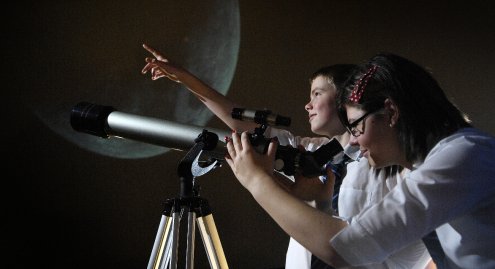
More UK pupils could soon be peering through telescopes (Courtesy: RAS).

By Hamish Johnston
In 1609 the Tuscan polymath Galileo Galilei was the first astronomer to point a telescope skywards. He went on to discover sunspots, mountains on the Moon and four of the moons of Jupiter.

To mark this milestone in the development of modern science, the United Nations has declared 2009 the International Year of Astronomy.

Now, to celebrate the 400th anniversary of telescope-based astronomy, 1000 secondary schools in the UK will be given telescopes — paid for by the Society for Popular Astronomy, the Royal Astronomical Society and the UK science-research funding body STFC.

(more…)

Nanorotors move together

Researchers in China and the UK have made a new type of nanometre-sized rotor with an off-centre axis of rotation. The researchers have also made arrays of the devices that spread over distances as large as micrometres.

The individual rotors in the arrays work in concert, something that the team believes will be crucial for making molecular machines. Such machines could be used as tiny autonomous “nanorobots” in the future that would perform a wide range of tasks, such as assembling electronic circuits or delivering drugs to specific parts of the body.

Easier to control

Although physicists have been able to make molecular rotors, previous devices had no fixed axis and were thus not easy to control, which made it difficult to integrate them into real working devices. Using scanning tunnelling microscopy, Hongjun Gao and colleagues of the University of Liverpool, UK, and the Chinese Academy of Sciences have now shown that single tetra-tert-butyl zinc phthalocyanine molecules on gold surfaces have a well-defined rotation axis fixed on the surface (Phys. Rev. Lett. 101 197209). “The result is an important milestone in making practical single molecule devices,” Gao told physicsworld.com.

The researchers made the device by evaporating molecules of tetra-tert-butyl zinc phthalocyanine onto a gold crystal. The molecules adsorb by attaching to a single gold atom off centre, at the position of nitrogen molecules on the zinc phthalocyanine.

Thermal excitation

The device works using thermal excitation — the molecules are not in their ground state and so rotate. The fact that the centre of rotation is at the edge of the device and not at its molecular centre means that it acts like a wheel with an axle attached at the perimeter, explained Gao. “We can therefore also excite rotations by means other than heat, such as electron transport through the molecule from its gold attachment,” he said.

The device might also be rotated by placing a magnetic atom at the molecular centre. In this way, current travelling through the molecule from the gold lead would interact with the magnetic moment at the centre, and the magnitude of the current used to determine rotation velocity. “Now we have a rotating magnetic field — a key component of a generator,” explained Gao.

Back in the lab, the team is currently trying to create arrays with magnetic atoms at the centre. The researchers are also trying to change the rotation direction of their rotors with current flow.

Droplets wobble and dance

athene.jpg
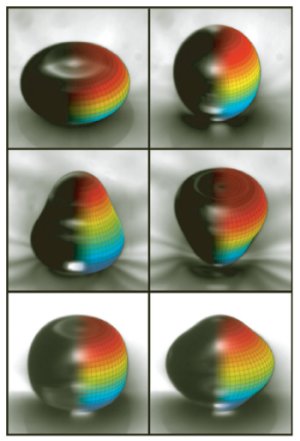
High-speed photos of actual dancing droplets (grey left half of objects) along with the mathematical description of the normal modes (coloured right half of objects).

By Hamish Johnston

There’s a paper in the New Journal of Physics today about how to make droplets of oil “dance” on the surface of a vibrating bath.

As well as floating over the surface, the droplets also seem to deform periodically in a number of distinct normal modes. In my favourite example, a droplet literally goes pear-shaped before wobbling back to something resembling a doughnut.

The research suggests that it may be easier than previously thought to levitate tiny amounts of liquid.

You might be wondering why it is important to levitate droplets? Well, it could be used to manipulate tiny amounts of liquid without actually touching it — something that could be useful in chemical or biological analysis techniques that are very sensitive to contamination.

Movies of real-life droplets as well as computer simulations can be seen here. WARNING: Their lava-lamp-like oscillations can mesmerize!

The trick to talking science: explain the ‘how’ and the ‘why’

By Jon Cartwright

DeRegules.jpg
De Regules: “Science is the stance that the scientist adopts vis-à-vis the natural world”. (Credit: Sergio de Regules)

One of the best features of the web is that it allows readers to give their opinion freely on the news, and at physicsworld.com we appreciate all your comments. In fact, it was while looking back at an article I wrote earlier this year that I came across an interesting comment by a reader called Sergio de Regules, who suggested we ought to have more “science commentators” to cover the history, philosophy, controversies and murkiness that make science so fascinating.

De Regules, 44, is a physicist, writer and musician living in Mexico City. As he tells me via e-mail, he has written a science column for the English-language newspaper The News (a selection of which are now archived on his blog, has edited at the Mexican science title Cómo Ves, has written several other books, and has appeared on radio shows and talks. Presently he is a science communicator at the National Autonomous University of Mexico (UNAM).

I decided it would be worthwhile to ask him for his thoughts on science writing, and what academia is like in Mexico.

JC: What do mean by “science commentator”?

SdR: I like to think of science communication as a way of sharing science with the public. But we all know that science is not so much in the results of research as in the spirit of research, or in the stance that the scientist adopts vis-à-vis the natural world. If the scientific results reported in the news can be viewed as newly conquered territories, science is the strategy by which they are conquered. Explaining the what in a scientific development is very good, but it is the how and the why which are memorable. The science commentator provides these.

(more…)

Rocket to study origin of radio loss in Northern Lights

By Jon Cartwright

JoranMoen.JPG
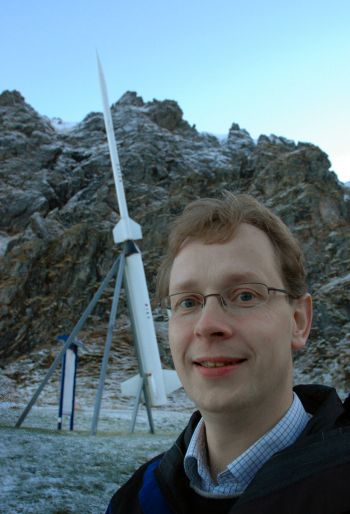
Joran Moen waits to fire his rocket to investigate radio-transmission loss in the Arctic (Credit: Yngve Vogt)

Flying over the Arctic can be like being on the far side of the moon: if the Northern Lights are particularly active, they will sometimes block all radio signals, thus severing communications with aircraft.

Joran Moen, a physicist at the University of Oslo, might have the key to explaining this phenomenon. Over the next few weeks he will be waiting for the right moment to launch his rocket ICI-2 so that it can fly 350 km into the sky to find the origin of the radio blocking, or “high-frequency backscattering”.

Scientists think the backscattering is caused by turbulent structures in the ionosphere’s electron plasma, which are related to the Northern Lights, so Moen is going to investigate. “The formation mechanisms of the structures are not yet determined, not even the altitude range,” he writes in an e-mail. “We want to study the instability mechanisms that drive the electron plasma turbulent.”

(more…)

First ‘bona fide’ direct images of exoplanets

Two teams comprising researchers from Canada, the US and the UK have taken what appear to be the first “bona fide” direct images of planets orbiting stars outside our solar system, an achievement that has long been considered vital in the search for planets like our own.

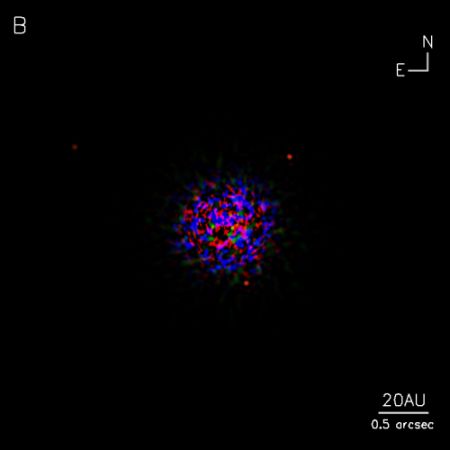
Christian Marois of the Herzberg Institute of Astrophysics in Canada and colleagues have used the ground-based Gemini telescopes in Hawaii and Chile, and the Keck telescopes, also in Hawaii, to take infrared images of three giant planets that they claim are orbiting a star about 130 light-years away in the Pegasus constellation (Science Express 10.1126/science.1166585).

These two papers are quite important because they show how far we have come developing the techniques for direct imaging Andreas Quirrenbach, University of Heidelberg

Meanwhile, a team led by Paul Kalas of the University of California has used a camera onboard the Hubble telescope to image a giant planet that appears to be orbiting Fomalhaut, a bright star that lies about 25 light-years away in the Piscis Austrinus constellation (Science Express 10.1126/science.1166609). The planet imaged by Kalas’s team is also the first giant planet to be observed over visible-light wavelengths since Neptune in 1846 — a particular boon for astronomers as this faint part of the spectrum is where they hope to see evidence for life-supporting atmospheres.

Indeed, it is because of the potential for observing atmospheric spectra that direct imaging is often referred to as the “holy grail” of searches for planets outside our solar system. “Imaging discoveries like this are important because they give us the best glimpses into the planets’ luminosities, temperatures and characteristics,” says Joseph Carson, an astronomer at the Max–Plank Institute for Astronomy in Germany.

Exoplanets galore

Astronomers first began detecting extra-solar planets or “exoplanets” in the late 1980s, and since then have found more than 300. The majority of these discoveries have resulted from two methods: either looking for a star’s “wobble” caused by the gravity of a planet as it orbits; or looking for the dimming of a star as a closely orbiting planet moves in front and blocks the star’s rays.

Both of these methods can reveal the orbits and masses of the exoplanets, and the latter “transiting” method can also imply other properties, such as radii and atmospheric composition. But to get good view of the atmosphere of exoplanets orbiting at a reasonable distance — that is, where criteria for habitable conditions are likely to be met — a direct image is essential.

Unfortunately, direct imaging is not easy. Ground-based telescopes suffer from distorting turbulence in the Earth’s atmosphere, and often exoplanets will be hidden in the glare of their parent star. Although astronomers have laid claim to the first direct images of exoplanets before — most recently in September — others have questioned whether these planets are really orbiting, or in fact whether they are planets at all.

To get around the problems of direct imaging, Marois’s team has made use of the wide, 8–10 m apertures on Gemini and Keck together with “adaptive optics” which help cancel out atmospheric distortion to get their images of a trio of exoplanets. Kalas’s team has used a device onboard Hubble known as a coronagraph, which artificially eclipses the parent star to make the glow of their orbiting exoplanet more distinct.

Reliance on theory

The fact that Marois’s team has imaged three exoplanets around one star will reassure astronomers that there are other systems like ours with many orbiting bodies. On the other hand, both parent stars are much more massive than our Sun, and this feature will add to the growing body of evidence suggesting that it tends to be larger stars that harbour the bigger planets.

However, Andreas Quirrenbach, an astronomer at the University of Heidelberg in Germany and a member of the Exoplanet Task Force set up by NASA and the US National Science Foundation, cautions it is “a matter of debate” whether the two teams’ observations mark the first “unambiguous” direct images of exoplanets, because their mass may be too large. Although all four of the new exoplanets are thought to be well below the threshold of 13 times the mass of Jupiter, which is when a planet technically becomes a brown dwarf, the teams’ estimates rely on models of planetary evolution that are subject to sizeable uncertainties.

Still, Quirrenbach agrees that the observations are the most “bona fide” direct images to date. “These two papers are quite important because they show how far we have come developing the techniques for direct imaging,” he says.

Phoenix unlocks the icy history of Mars

NASA’s Phoenix mission has captured the imagination of millions thanks to objectives that include studying the history of water on Mars. Since landing on the northern polar plains of Mars on 25 May this year, Phoenix has returned more than 23,000 images and has made some truly amazing discoveries. Sadly, this is all about to come to an end as the Sun sets on the mission later this month.

“We have confirmed the presence of water ice on Mars,” Peter Smith, Phoenix principal investigator from the University of Arizona at Tucson, US, told OLE. “There is absolutely no doubt that it is water ice and that is a major step forward. We also have the first operational LIDAR on Mars and have even seen ice crystals snowing out from below clouds, but not reaching the ground. We have some fabulous data sets.”

These remarkable findings come thanks to what is arguably some of the most sophisticated and advanced technology that has ever been sent to Mars. Among the suite of seven science instruments onboard Phoenix are a scientific laboratory for determining the chemistry and mineralogy of soils, a stereoscopic imager, a camera at the end of a robotic arm and an optical microscope, all of which benefit from the expertise housed at the University of Arizona.

Winning the right

It has been a long journey for all involved in the Phoenix mission, with the time spent on Mars being the culmination of many years of work and dedication. Phoenix is a “proposed” mission, meaning that it was not a NASA core mission. The team in fact won the right to go to Mars through a competition. “This was NASA’s first scout competition and we proposed an entire mission,” explained Smith. “In fact 25 different groups, each led by a scientist with a vision, wrote proposals about how they would carry out their missions. It took us 18 months of hard work to win the Phoenix mission. We were awarded the contract in August 2003 and finally launched on 4 August 2007. I had to clear my calendar for five years.”

But what gave Phoenix the edge? For Smith and his team, the priority was to meet the science goals within the cost cap. That’s why they opted to use an existing spacecraft built for the Mars Surveyor Program 2001, as well as existing instrumentation.

“In our favour, the cost was lower because we had used existing instrumentation and were bringing 10 years of NASA investment back to flight condition,” said Smith. “Against us was the fact that the sister spacecraft had crashed and no-one knew why. Because of the reuse of previous mission hardware, we called it Phoenix after the mythological bird reborn from the ashes of his predecessor. There was at least one fatal flaw in this spacecraft, maybe many. We started with a test programme trying to uncover and fix all of the problems that we could find.”

And as for giving the mission a science goal, as fate would have it, the Mars Odyssey Orbiter found large amounts of subsurface water ice in Mars’ northern arctic planes in 2002 using its gamma-ray spectrometer. To build on this finding, Smith targeted the polar region and designed Phoenix with a robotic arm that could dig through the top soil layer and bring both water ice and soil to a lander platform for analysis. All in all, it was a winning combination.

Weather reports from Mars

Phoenix’s meteorological station (MET), which includes the LIDAR instrument, has monitored the weather on a daily basis since landing on Mars. Designed and built by Canadian company Optech in partnership with MDA Space Missions, the LIDAR probes the local atmosphere and investigates the vertical distribution of dust, ice, fog and clouds.

“When you study an atmosphere, the point of interest is the boundary layer – on Earth, this is typically from the surface to the bottom of the clouds,” explained Smith. “Studying the lower boundary layer from orbit is extremely difficult as you have to look through the entire upper atmosphere. In order to make a good measurement, you have to be on the surface and you have to have an instrument that measures distance to the local clouds. This is so important for us.”

The Phoenix LIDAR has generated invaluable data that charts the cloud-forming height as a function of time of day and season. “All previous atmospheric models for Mars have put estimates on these things because there have never been actual measurements,” commented Smith. “Ours is a calibration point for future atmospheric models.”

The laser that makes all of this possible is a passively Q-switched Nd:YAG emitting at both 1064 and 532 nm. It operates at a repetition rate of 100 Hz and is capable of firing 10 ns, 1 mJ pulses into the atmosphere to probe heights of up to 20 km. Backscattered light is collected by a 10 cm lens and detecting at the two different wavelengths allows the instrument to discriminate between ice and dust, as they have slightly different signatures.

“A photodiode performs analogue detection at 1064 nm and for the green light we have a photon-counting system,” explained Smith. “This has allowed us to see ice crystals snowing out from below clouds. It’s really quite amazing what this LIDAR has been able to do.”

The eyes of Phoenix

Optical innovations can be found throughout the entire suite of scientific instruments, not just the MET and its LIDAR. Other examples include the surface stereoscopic imager (SSI), the robotic arm camera (RAC) and a microscopy and chemical analyser.

The SSI is essentially the eyes for the Phoenix mission and is mounted on a turreted head so that it can see in all directions and provide information in three dimensions. “This is really important when we are digging,” explained Smith. “We have to know where the surface is and how deep our hole is.” Smith explains that the SSI uses a Cooke triplet lens, which is focused to a hyperfocal point so that everything is in focus from the surface to the horizon. “It is accurate to about 1 cm for the depth and the resolution is about the same as the human eye,” he said. “The SSI uses a standard CCD so spans the spectral range from 400 nm to 1 µm.”

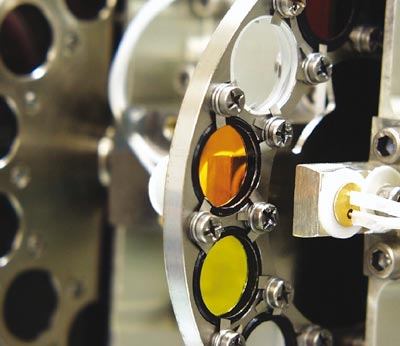
The SSI also comes into play when the team wants to observe the soil samples that are being returned. These images would be out of focus but for a lens placed in a filter wheel in front of each detector. “Each eye has 12 filters, so we have 24 filters available on this camera system,” explained Smith. “This includes a diopter ‘reading’ lens for looking at soil samples up close. We also have a polarizer for looking at the sky and special narrowband low transmission filters so that we can look at the Sun directly and get the opacity of the atmosphere.”

Next up is the RAC, which is on the wrist of a long 2.3 m arm. With the requirement of needing to focus on objects just 11 mm away right out to infinity, the challenge for the development team at the University of Arizona and the Max Planck Institute for Solar Systems was to find a lens with minimal aberrations. The answer was a modified double Gaussian lens, which Smith says works extremely well.

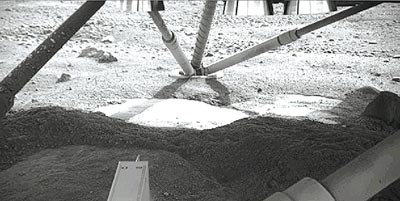
One of the defining moments for the RAC was when it was positioned to look under the spacecraft, just five days after landing. “What we discovered was ice that had been exposed by the thrusters during touchdown,” enthused Smith. “The power of the thrusters was enough to blow away the 5 cm of soil that covers the ice so we had ice exposed under the lander. We couldn’t have asked for anything better.”

Back to everyday business and the RAC can characterize soil samples in terms of colour, grain size down to around 50 µm, texture and porosity. When taking a close-up image, the imaging scale is 1:1 and each pixel of the 256 × 512 CCD corresponds to 23 µm at the location of the target. The RAC also has two lighting assemblies mounted above and below the camera objective containing 26 red, 26 green and 52 blue LEDs, allowing it to capture true colour images of a target.

Finally, optical and atomic force microscopes complement the microscopy, electrochemistry and conductivity analyser’s (MECA) wet chemistry experiments. “The optical microscope uses a telecentric doublet and has a resolution of 4 µm per pixel so instability precluded an arm location, it had to be on the deck and we had to bring samples to the microscope,” said Smith.

Once an area of interest has been identified using optical analysis, the team can switch to the atomic force microscope, which has a resolution of just 100 nm and can show the detailed structure of soil grains.

The trouble with landing at the pole, just like here on Earth, is that while summer offers perpetual daylight, winter plunges the land into constant darkness. And when you are powered by solar panels, this spells game over.

Phoenix’s primary mission was scheduled to last just 90 Martian days, taking it to around mid-August, however NASA extended the mission to allow scientific experiments to continue. Crucially, Phoenix will now witness the turn of the season from summer into winter when the temperature starts to plummet and solid carbon dioxide ice starts to form.

“It will be over soon, Phoenix is going to die,” said Smith. “We will be finished probably late November, we just have to wait and see. Reincarnation is questionable because of the intense cold and the carbon dioxide ice. But we have been successful beyond my wildest dreams.”

For more information on the Phoenix mission, visit http://phoenix.lpl.arizona.edu.

• This article originally appeared in the November 2008 issue of Optics & Laser Europe magazine.

Measuring ultrashort pulses needs precision


Rick Trebino is the Georgia Research Alliance-Eminent Scholar and chair of Ultrafast Optical Physics at the Georgia Institute of Technology, US. He is the co-inventor of frequency-resolved optical grating (FROG) and the inventor of grating eliminated no-nonsense observation of ultrafast incident laser light E-fields (GRENOUILLE) — two methods for measuring ultrashort laser pulses. In 2001, Trebino founded Swamp Optics, a US company that offers innovative and cost-effective devices for measuring ultrashort laser pulses.

Can you summarize how ultrashort pulses can be characterized?

An ultrashort pulse is a light pulse less than about 1 ns in duration. In the 1960s, it became possible to generate such pulses, which were shorter than the temporal resolution of even the fastest electronics, and the field of ultrashort-light-pulse measurement was born. The problem is that, in order to measure an event in time, you need a shorter event. But, because ultrashort pulses are the shortest events ever created, you can’t, so you must use the event to measure itself, which isn’t good enough.

Early techniques based on this idea yielded only a blurry picture of the pulse intensity versus time and provided little or no information about the pulse phase.

Recent techniques have improved on this idea. For example my colleagues and I realized that by simply spectrally resolving an autocorrelation and applying clever mathematics from the field of phase retrieval we could completely measure a pulse. We were able to measure the pulse intensity and phase versus time and frequency, without the need for a shorter event. We called this method FROG. Since then, other methods, including many variations on FROG, have been proposed and developed. However, spatio-temporal pulse distortions and other complexities significantly complicate measurements of ultrashort pulses, so a technique must also provide some sort of confirmation of the measurement.

Why is this research important and what are the main applications?

The first application was in ultrafast spectroscopy. Another significant application is multiphoton microscopy, in which an ultrashort pulse is focused tightly into a sample, and the two-photon fluorescence (or other nonlinear-optical signal) is collected versus position. Here, the complete spatio-temporal measurement of the pulse is important because its spatial width determines the spatial resolution, and its temporal width determines the sensitivity. Other applications include ultrahigh-intensity lasers, micromachining, high-bandwidth telecommunications and coherent control of chemical reactions.

Is it easy to transfer this technology from the lab to the market?

The majority of ultrashort-pulse measurement devices are difficult to commercialize because they are very complex, require frequent re-alignment, work only for very simple pulses, and give no feedback as to whether their result is correct. We have avoided this problem by developing methods that are experimentally very simple and insensitive to calibration parameters. Our methods also give immediate feedback when a problem occurs, so the user knows if, for example, the pulse has spatio-temporal distortions. These new methods are so simple, compact and reliable that, in large quantities, they are very inexpensive and can be included in most ultrafast laser systems. This is particularly important for ophthalmological applications, where the correct pulse is critical for eye safety.

What is the most important recent advance in this field?

Recently it has become possible to measure the complete spatio-temporal electro-magnetic field of an ultrashort pulse. My group has demonstrated two different techniques, one based on spectral interferometry and another based on holography. The first method can measure even a tightly focused pulse and has seen a wide range of complex aberration-induced spatio-temporal distortions. The second technique can measure an unfocused pulse in a single shot. Both approaches can measure very complex pulses, simply and cheaply, and are ideal for most applications.

What key challenges remain?

Several techniques for measuring attosecond pulses have recently been developed and even include the much-needed measurement confirmation. But more remains to be done. Another challenge is educating those who use ultrashort pulses as to which techniques work well, which are obsolete and which are still under development and should be avoided.

What is the next big breakthrough?

Most pulse-measurement problems have now been solved and it is easy to measure the complete spatio-temporal electro-magnetic field of even an arbitrary ultrashort pulse. Breakthroughs are likely to come from using these recently developed methods for new applications or to improve old ones.

• This article originally appeared in the November 2008 issue of Optics & Laser Europe magazine.

Copyright © 2026 by IOP Publishing Ltd and individual contributors