Nature’s statute book

During the 17th century, when the scientific revolution was in full swing, people started to talk about the “laws of nature”. Newton set the example when, in the Principia, he proposed his three “axioms, or laws of motion” (axioms surely being a nod to Euclid). Then, throughout the 18th and 19th centuries many laws were propounded. In the 20th century, however, law-naming became less popular in science.

But why the word “law”? What, if any, is the connection with the laws of a nation? National or even international laws are things that we are supposed to obey but often do not. Yet nature cannot help but “obey” its laws. Perhaps Newton and his contemporaries thought of the laws of nature as being God-given, and so therefore unbreakable.

There are also several other words that scientists apply to ideas that they deem important: in addition to axiom, we have hypothesis, principle, equation, theory, theorem and model. The usual practice is to reserve the word “law” for something that can be formulated in one or two sentences, with at most one simple mathematical equation. This, at any rate, is roughly the criterion for inclusion in noted science writer Clifford Pickover’s latest book, Archimedes to Hawking: Laws of Science and the Great Minds Behind Them. Pickover’s other criteria seem to be that a law should be at least moderately important and should hold true — with the usual caveats about appropriate circumstances and approximations.

Some of the deepest ideas in science, however, are too subtle to be encapsulated as a law — for example Darwin’s theory of evolution and Einstein’s theories of relativity. Even Newton’s laws are preceded by eight definitions and a “scholium”, or explanatory comment, asserting that space, time and motion are absolute. Indeed, the latter could be called Newton’s zeroth law.

Schrödinger’s equation, on the other hand, is short enough when written in symbols but is difficult to translate as a sentence, and even harder to explain, so it does not qualify as a law. The Navier–Stokes equations of fluid flow are presumably too mathematical and complex to be included, and even the apparent simplicity of E=mc2 is deceptive.

Pickover’s book presents 40 scientific laws together with explanations of what they mean and short biographies of those who developed them. Applications of these laws are also described, even recent ones. The laws are all from the physical sciences, but I think it is a pity that, say, Mendel’s laws of genetics or Crick’s “central dogma” (another interesting word there) about the flow of information in molecular biology have been excluded.

The list starts with Archimedes and Kepler, whose three laws of planetary motion were not, incidentally, called “laws” by either him or Newton. The 19th century provides 25 laws and the 20th century only four, with the last being Hubble’s law in 1929. After that the flow dries up. Is this because of a different theological view, or because scientists became more modest (for example, naming particle physics’ most successful theory the Standard Model)?

The book ends with short sections on 47 “great contenders” — a sort of reserve list. However, I think that some of these deserve a place in the original selection. Pauli’s exclusion principle might have been called a law (and Heisenberg’s principle did indeed get picked), and either Maupertuis’ rule of least action or Hamilton’s related principle are surely as important as they come.

Stephen Hawking only gets in as a great contender, although the laws of black-hole thermodynamics that he helped formulate are nice examples of late 20th-century laws. Another possibility from the second half of the 20th century might have been the “CPT theorem”, which asserts, roughly, that every charged particle has an oppositely charged mirror antiparticle with otherwise identical properties.

The laws in the book could be classified into two sorts: those (like Boyle’s law) that are consequences of some more general theory; and those that have not been explained in this way (or at least not yet). I am not sure that any of the laws in the main list are of this second type, but some of the great contenders are and the latter sort perhaps have more claim to be “fundamental”.

Pickover’s book contains all sorts of interesting information and asides. For example, David Brewster (of the law of reflection of polarized light) invented the kaleidoscope, but he failed to benefit from its wide popularity because his patent was faulty. There are also many quotations and some, which are of a philosophical nature, are used as “conversation starters” between the chapters. The reader might well get interested in either the science or the history, and there are plenty of references for further reading. However, some line diagrams might have helped explain the more mathematical laws.

A question that often came to my mind as I read the book, and which I did not always find answered, is whether a law was first derived in just an empirical way, and if so, whether it was later derived from a bigger theory. I notice that many of the laws state just a proportionality between two quantities, which suggests that their inventors were attracted by simplicity. Poiseuille’s law about fluid flow through a tube is an exception, with a fourth-power dependence on the radius.

With such a wide range, this book cannot be expected to be equally authoritative about everything that it covers. However, like some of the quotations given, it is an excellent conversation starter.

Once a physicist: Subhankar Banerjee


Why did you originally choose to study engineering and physics?

I was born in Berhampore, a small town in West Bengal, India. I was immersed in literature and cinema from early in my life, and at 13 my great uncle introduced me to painting. But growing up in a middle-income family, art was not something I could pursue as a career. I chose science and engineering as a practical option.

How much did you enjoy the subject?

I studied electrical engineering as an undergraduate in India before doing physics and computer science as a graduate student in the US. However, it was always physics that intrigued and challenged me the most. I got bored with computer science so I switched to theoretical physics with a focus on particle physics and field theory. I immensely enjoyed theoretical physics as I could immerse myself in thought. I have difficulty memorizing things, so I found refuge in physics, where I could survive with thought rather than memory. Also, with physics, I felt closer to poetry and philosophy. During this time I attempted to continue in the arts by taking classes in painting and photography, only to abandon them due to the extreme pressure of studying physics.

What did you do when you left university?

After I got my Masters degrees in physics and computer science from New Mexico State University in 1994, I was offered a wonderful research position at the Advanced Computing Laboratory of the Los Alamos National Laboratory. The work involved using high-performance computers to solve problems in energy research. Later, I accepted a research position at the mathematics and computing technology division of Boeing in Seattle, Washington.

How did you get into photography?

During graduate studies in New Mexico, I fell in love with the wide open spaces of the desert. At the same time I started learning about land conservation through the Sierra Club, which is a grass-roots environmental organization. As outings chair of my local club, I led outdoor trips for students and community members. During this time I had an SLR Minolta camera and I took photos on trips across the American southwest.

What made you decide to become a full-time artist?

In Seattle I joined photography clubs at Boeing and also got involved in mountaineering. I started thinking about combining my passion for art and my concerns for disappearing land, wildlife and indigenous cultures. I left Boeing in 2000 to become a full-time artist, educator and activist.

Why did you choose to focus on the Arctic?

It was serendipitous. In late 2000 I went to Churchill in Manitoba, Canada, where most photographers go to see polar bears. I came back with decent photographs but having had a very disappointing experience — I would see a bear, and then eight large vehicles would converge on it with everyone happily snapping pictures. I wanted to find a place untrammelled by tourism or industry, and this eventually led me to the Alaskan Arctic. Also, I suppose opposites attract — coming from a tropical land, the Arctic had always intrigued me.

What are you working on at the moment?

Much of my work as a photographer and environmental activist is with the Inupiat people of Alaska and the Gwich’in people of Alaska and the Canadian Yukon. Most recently I started working with the Yukaghir and the Even people in the Siberian Arctic. Contrary to its established position as the “last frontier”, in my mind the Arctic is the most connected land on Earth. Hundreds of millions of birds migrate from every corner of the globe to the Arctic each spring to nest and rear their young — a planetary celebration on an epic scale that connects the Arctic to every land and ocean of the planet. On the other hand, climate change, toxin migration and resource wars connect the lives of Northern people and animals to the lives of people in faraway lands in a tragic manner.

Does your scientific background influence how you work now?

My scientific background has helped me immensely in understanding the Arctic ecology and preparing for harsh Arctic climates — both for personal survival and for photography in such conditions. But my Arctic work is also deeply influenced by philosophy, history and literature, including Rabindranath Tagore, Mahasweta Devi and other prominent writers from India, and films by Satyajit Ray, Mrinal Sen and Hrittik Ghatak. I approach the Arctic simply from the experience of “land as home” — a place that supports communities of our species and many other species with whom we share this planet.

Do you still keep up to date with physics?

I wish I could, but time is so limited. My only contact with physical theories is when I am trying to understand some aspect of a climatic theory or how toxins migrate from all over the world to the Arctic.

• To see some of Banerjee’s photographs, visit his website www.subhankarbanerjee.org

One year left to go

The final year of university is a time of transitions. After years of lectures and formal laboratory sessions, many physics undergraduates will spend a significant chunk of this period doing real research for the first time, as part of an honours thesis, MSci degree, Diploma or other “capstone” course. Some will apply to do a PhD as a result of this experience. Others will be inspired to seek a career tackling problems in industry, or to share their knowledge with the next generation of physicists, as teachers. Some (as our regular Once A Physicist column proves) will go off in entirely new directions, bringing their skills and mindsets to areas outside the traditional physics strongholds.

Regardless of their decisions, this is the year when career plans start to become reality — and when many students grow thoroughly sick of the question “What will you do next year?”. Physics World joins the legion of well-meaning inquisitors by asking final-year students — from the UK, US and Europe — to reflect on how their courses have gone so far, their plans for the future, and their advice for students who are just starting out.

Astronaut dreams

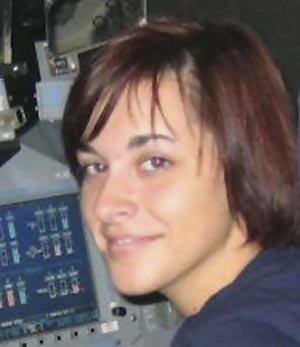
Name: Jessica Snyder
Course: BS in engineering physics with an aerospace focus and BS in astronomy at the University of Kansas, US
Originally from: Clearwater, Kansas, US

My mother teaches high-school physics, so I was encouraged early on to take physics-oriented classes. I started out at Kansas University doing a purely engineering degree, but the people and atmosphere in the physics department were very inviting, which was part of the reason that I switched courses. The engineering-physics major gave me exposure to both the conceptual background and some practical applications of the principles used to understand and interact with the physical world.

Right now I’m looking at graduate schools with some sort of energy-systems engineering programme. I’ve known since childhood that I wanted to be an astronaut, but in this past year, many of my long-term goals have shifted and my career path has diverged from my childhood dream to a more “practical” direction. I guess that I have made a distinction between my ideal job and my dream job: my ideal job would be as an engineer designing and implementing systems involving renewable-energy technologies; but in my dream job, I’d walk in space.

My advice for first-year students is to make sure that you get started on the right foot. I did not take my freshman year nearly as seriously as I should have. And get involved early! Join clubs and groups to make an impact on your environment.

On course for teaching

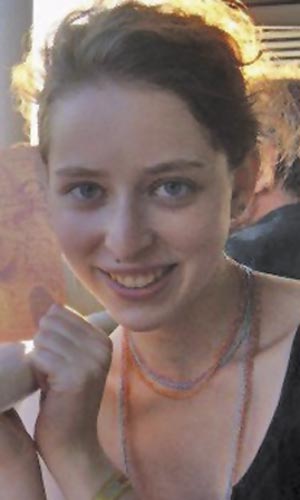
Name: Carole Kenrick
Course: BSc in physics at Bristol University, UK
Originally from: London, UK

I decided to study physics because it challenged and fascinated me. The best part has been finally getting my head round some difficult concepts in quantum mechanics. I enjoyed this so much that I am taking a module on the philosophical foundations of physics, which explores topics that physicists usually ignore so that they can focus on calculations. I’ve come to understand far more physics than I ever expected to, and discovered that doing physics is actually quite tricky!

Along the way, I’ve also learned some Spanish, thanks to Bristol University’s policy of allowing first-year students to take modules in other subjects. Given how international the scientific community has become, it might come in handy. If I could give any advice to first-year students, it would be to do as much maths as you possibly can, because it will eventually be useful. My only regret is not being involved in more societies in my first year, although it does take time to settle in.

My dream job is to be an ethical fashion designer who writes and illustrates children’s books about science on the side. My love of working with children is part of the reason that I decided to take up a place with Teach First next year. Teach First is a charity that encourages graduates who might not have otherwise considered teaching to spend at least two years in challenging schools. It will probably be the most demanding experience of my life, but I know it will be worth it.

Robots and research

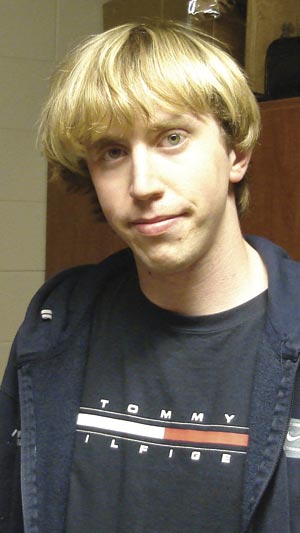
Name: Scott Watson
Course: BS in physics at College of William & Mary in Williamsburg, Virginia, US
Originally from: Reston, Virginia, US

I enjoy mathematics, and being able to apply mathematical concepts to understand the world around us fascinates me. Plus, as we learn more about how the world works, we can find ways to improve it, which I feel is very important.

My course offered me a wide variety of physics topics to study. I have also had a taste of doing real scientific research when working with one of my lecturers on interpreting sensor data for robotics. My professors are all interesting people, and very fun to get to know and talk to. They also love working with us, and talking to us about what they do.

My advice for students in the early years of their course is to find friends in your subject in order to work on coursework problems together. That way, you can get help from others when you run into trouble or they can explain things that you did not understand in class. Plus, it helps make the work less stressful.

I plan to go on to graduate school to do research in either physics or applied science. Eventually, I’d like to become a professor. I enjoy doing research, as I love the idea of exploring the topics I’m interested in and contributing the knowledge I gain to the community as a whole. I also enjoy working with other people, and being able to explain my work to them.

Super furry physics

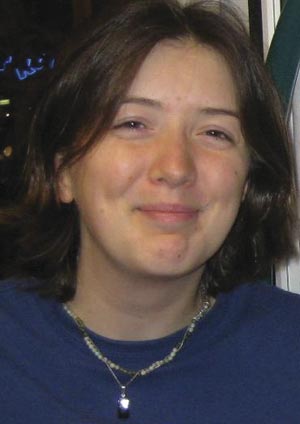
Name: Nia Bell
Course: MSci in theoretical physics at Durham University, UK
Originally from: Narberth, Pembrokeshire, UK

I decided to study physics after completing a year in industry, where I worked in a civil-engineering company. I would really recommend a placement year to younger students, as it is a great opportunity to get some quality experience, earn some money and grow up a little before university. There is no real rush to graduate, and I think the year off helped me feel confident in my choice of degree from the beginning. Although I enjoyed my placement, I soon realized that engineering was not for me. I felt that a more hi-tech, cutting-edge field would have greater appeal. The most advanced, groundbreaking form of engineering is, of course, physics.

The best part of my degree so far has been my decision to take a maths workshop suitable for theoretical physicists in my third year instead of the usual laboratory module that most people choose. I found the maths extremely difficult and I struggled with it for the entire year, but I am glad that I chose to take this module because it has given me some useful mathematical tools and, probably more importantly, the confidence to use them.

I did not realize until my third year at university that the concepts we had learned in previous years all had important applications in research and new technologies. This appreciation has reinvigorated my interest in physics and made me seriously consider a career related to it. In the coming year, I plan to produce a thesis of which I can be truly proud. I also intend to make the most of student life. Durham University is a very friendly place with a vast number of extracurricular activities, making it difficult to claim that there is nothing to do here.

As for the future, my dream job would be to play saxophone with the band Super Furry Animals, or to invent something amazing that I could put into production in a factory by the seaside where I grew up in Pembrokeshire. More realistically, I would like to do something I care about and can get excited about for many, many years. I hope to spend next summer in the most exotic place I can afford, but after that I would love to return to physics as a PhD student. I am still undecided about what to specialize in, but I would like to continue my studies abroad. I am also interested in possible industrial positions in which physics could be applicable.

Three paths

Name: Balazs Karcsai
Course: Degree in physics with astrophysics at Eotvos Lorand University, Hungary
Originally from: Budapest, Hungary

When I was a secondary-school student, my physics teacher asked me to give a lecture about particle physics, so I read Leon Lederman’s book The God Particle. My lecture ended up being five hours long, and it inspired me to be a physicist! At university I found out that particle physics is very hard, and so I started my student research in material physics. But when I selected my specialization, I chose astrophysics.

The best part of my course is that I have learned a lot about things beyond just the laws of physics. For example, I have learned how to give talks and write articles, how to simplify problems, and how to convince people. I got involved in my physics student association, organizing scientific and social programmes and finding sponsors to fund the society. I edited the weekly paper of the science faculty, and I have written articles in Hungarian scientific magazines about high-energy astrophysics. These skills and experiences have helped me both in and outside of science. For me, one downside of being a physics student in Hungary is that fewer than 10% of the students in my year are women, but I solved this problem by getting to know people in the humanities departments as well.

When I started my course, I had different conceptions about studying physics. At first, I was sure that I would eventually want to work as a researcher. But now I can see many other interesting possibilities, too. I have three different plans for the next year. The first is an astrophysics PhD somewhere in western Europe, the second is to work for a multinational company and earn some money, and the third is to be a science writer or a journalist.

Ideally, I would get a job where I am always with people and I need to use my brain and be creative. It is important to manage my own time, because I do not like getting up early and I am more effective in the evening. But I know the real world is usually different from dreams.

My advice for first-year students is to learn computer-programming languages as soon as you start your degree. I had many problems with programming when I started research on my thesis. And, have a good social life, go abroad as often as you can and be open to new things.

Calculations and more

Name: Konstantin Ottnad
Course: Diploma in physics at the University of Bonn, Germany
Originally from: Freiburg, Germany

I decided to study physics because I was interested in how things work. I was also good at mathematics in school, so I never had to think much about what to study — it was pretty clear that it would be either maths or physics. In fact, I started studying maths — there was a project at my school that allowed you to attend courses at university during your final three years — but then I decided that physics was more interesting. Now I am working on my final thesis about chiral perturbation theory, a topic in quantum chromodynamics.

In Germany, after the first two years of study, the course is flexible. There is a big selection of lectures and seminars that you can choose from, with very few restrictions. Personally, I did not like most of the lab courses (which are obligatory) because I am more interested in theoretical physics. From my point of view, the lab sessions just created a lot of work without giving me the feeling of learning something I would need later.

The best parts have been the lectures and seminars during my third and fourth years that I chose on my own and that have dealt mainly with theoretical particle physics and quantum field theory. If I could do it over again, though, I would probably try to be a bit more careful about which lectures I attended. That probably could have saved me a semester.

I did one semester abroad at the University of Glasgow in the UK, which was great fun. In addition to going to lots of parties, I also did a Masters project there for about four months. This helped me to decide which field I should pick for my final thesis, and I even won a prize for it, which was nice.

I will be working on my thesis for the next 12 months. After this I am probably going to do a doctorate, which will take at least three more years. Ideally, I would like a job where I could do calculations and programming all day long, and get paid lots of money for doing so.

My advice for new students is simple: as someone once said, shut up and calculate! It really helps in most cases, believe me. I think it is extremely important to work hard right from the beginning of your studies. Otherwise you are likely to lose a lot of time just trying to catch up with the subsequent lectures.

Physics in action

Name: Julie Feldt
Course: BS in astronomy and physics, University of Kansas, US
Originally from: St Louis, Missouri, US

My high school physics teacher sparked my interest in physics. She was a great teacher. She would talk with me about what was going on in physics in the real world and encouraged me to go to lectures at the universities in St Louis. She showed me how cool physics really is.

The best part of my degree has been getting to do a lot of the experiments that we learned about in lectures, like Faraday rotation and the Michelson interferometer. We have measured the speed of light, the temperature of the Sun and the lifetime of muons. It was so much fun to actually see the experiments in action. I have also had really good professors. One major downside has been working with students who do not really care about understanding the subject — they just want to get the answers right and be done with it. Working with those students can be draining.

In my degree, I have taken several field-specific courses like nanotechnology, and next semester I will take space plasma physics and molecular biophysics. After that, I want to go to graduate school to get a Master’s degree in space physics and planetary science. I am not completely sure yet what I would like to do after that, but I would like it to involve research — maybe at a place like the National Oceanic and Atmospheric Administration or the Laboratory for Atmospheric and Space Physics.

I would really encourage students to get involved in research as soon as they know they are interested in the field. Research will tell you more about what things are really like, and then even if some of the classes seem hard they end up feeling more worth it. I have had a lot of research experience through the National Science Foundation’s Research Experience for Undergraduates (REU) programme, as well as undergraduate research courses. So when I have had a class that I was not as excited about, I just concentrated on how much I love working in my field and told myself that this was just one step out of many that I had to get through to reach my goals.

Love life, love physics

Name: Jelmer Renema
Course: MSc in experimental physics, specializing in quantum optics and quantum information, Leiden University, Netherlands

I always knew I was going to study a “hard science,” but I settled on physics only in my last year of high school, partially because the physics teacher that I had then was very enthusiastic about his subject. The strange thing was that he was not a very good teacher — he once had to suspend a lecture because he couldn’t find a sign error when he was deriving the of equation of motion of the simple harmonic oscillator — but his enthusiasm shone through and convinced me that physics was worth spending time on.

The best part of my course so far has been the theoretical course on quantum computing, which introduced a lot of concepts very quickly but has given me a broad grounding in the subject. It also provided a good overview of current research on the subject. I constantly draw on my knowledge from this course at conferences or when listening to colloquia.

I really like the academic atmosphere of openness and accessibility at the Leiden Institute of Physics, and I hope to make a career in academia. Barring that, a job as a science communicator or journalist would be nice.

I would advise first-year students to get involved in many associations, projects, etc. Now is the time of your life when you discover what you’re good at and what you like, and there is no better way to do this than to immerse yourself in as many different activities as possible. After a while, you are going to have to narrow it down a bit and get to work on graduating, but do not worry too much about that when you start.


The large hadron computer

In the mid-1990s, when CERN physicists made their first cautious estimates of the amount of data that experiments at the Large Hadron Collider (LHC) would produce, the microcomputer component manufacturer Intel had just released the Pentium Pro processor. Windows was the dominant operating system, although Linux was gaining momentum. CERN had recently made the World Wide Web public, but the system was still a long way from the all-encompassing network it is today. And a single gigabyte (109 bytes) of disk space cost several hundred dollars.

This computing environment posed some severe challenges for the computer scientists working on the LHC. Firstly, physicists’ initial estimates called for the LHC to produce a few million gigabytes — a few petabytes (1015 bytes) — of data every year. In addition to the sheer cost of storing these data, the computing power needed to process them would have required close to a million 1990s-era PCs. True, computing capabilities were expected to improve by a factor of 100 by the time the LHC finally came online, thanks to Moore’s law, which states that computing power will roughly double every two years. However, it was difficult to predict how much computing power the LHC experiments would need in the future and CERN computer scientists had to be aware that the computing requirements could grow faster than Moore’s law. Farming out the number-crunching to other sites was clearly part of the solution, but data transmission rates were still comparatively slow — in 1994 CERN’s total external connectivity was equivalent to just one of today’s broadband connections, a mere 10 megabits per second.

The chief sources of the LHC data flood are the two larger detectors, ATLAS and CMS, which each have more than 100 million read-out channels. With 40 million beam crossings per second, constantly reading out the entire detector would generate more than a petabyte of data every second. Luckily, most collisions are uninteresting, and by filtering and discarding them electronically we reduce the flow of data without losing the interesting events. Nevertheless, ATLAS, CMS and the two other LHC experiments, ALICE and LHCb, will together produce 10–15 petabytes of data every year that have to be processed, permanently stored and also kept accessible at all times to researchers around the world. Dealing with such huge amounts of data was dubbed the “LHC challenge” by the IT departments at CERN and the other institutes that worked to solve the problem.

Building on past efforts

The estimated requirements of the LHC experiments were up to 10,000 times greater than the data volume and computing power of their predecessors on the Large Electron Positron (LEP) collider, which CERN closed in 2000. In the time between the end of LEP and the start-up of the LHC there have been a number of experiments on the Super Proton Synchrotron (SPS) that marked important steps towards computing for the LHC. For example, just before LEP was dismantled to make way for the LHC, the NA48 experiment on kaon physics produced data at peak rates of about 40 megabytes per second — only about a factor of five to eight less than what we expected from the LHC experiments during proton–proton collisions. Knowing that the available hardware could deal with such data rates was reassuring, because it meant that by the time that the LHC went online, the hardware would have improved enough to handle the higher rates.

Colliding heavy ions produces about two orders of magnitude more particles than proton–proton collisions, and so data rates for heavy-ion collisions are correspondingly higher. By late 2002 and early 2003, the specifications for the ALICE experiment, which will use both types of collisions to study the strong nuclear force, called for it to take data at a rate of about 1.2 gigabytes per second. Since the requirements for ALICE were so much greater than for the other experiments, it was obvious that if the computing infrastructure could handle ALICE, then it could handle almost anything — and certainly data coming from the other experiments would not be a problem.

To address this challenge, CERN computer scientists and members of the ALICE team collaborated to design a system that could receive data at a rate of 1.2 gigabytes per second from an experiment and handle them correctly. The first large-scale prototype was built in 2003 and was supposed to be able to handle a data rate of 100 megabytes per second for a few hours. It crashed almost immediately. Later prototypes incorporated lessons learned from their predecessors and were able to handle ever higher data rates.

Another project from the LEP era that helped computer scientists build the LHC computing environment was the scalable heterogeneous integrated facility, or SHIFT, which was developed in the early 1990s by members of CERN’s computing division in collaboration with the OPAL experiment on LEP. At that time, computing at CERN was almost entirely done by large all-in-one mainframe computers. The principle behind SHIFT was to separate resources based on the tasks that they perform: computing; disk storage; or tape storage. All of these different resources are connected via a network. This system became the basis for what is now called high-throughput computing.

The difference between high-throughput computing and the more familiar high-performance computing can be understood by considering a motorway full of cars, where the cars represent different computing applications. In high-performance computing, the goal is to get from A to B as fast as possible — in a Ferrari, perhaps, on an empty road. When the car breaks down, the race is over until the car is fixed. In high-throughput computing, in contrast, the only thing that matters is to get as many cars as possible from point A to point B. Even if one car breaks down, it does not really matter, because traffic is still flowing and another car can get on the road.

High-throughput computing is ideally suited to high-energy physics, because the “events” recorded by the experiments are completely independent of each other and can therefore be handled independently as well. This means that data analysis or simulation can be carried out on a large number of computers working independently on small chunks of data: the workload is said to be “embarrassingly parallel”. In contrast, applications on a good, old-fashioned supercomputer are “highly” parallel: all available computing resources, perhaps tens of thousands of processors, are used for a single computing task.

Separating the different resources made SHIFT very scalable: each resource could grow independently in response to new demands. Also, the physical make up of each resource was largely irrelevant to the system as a whole. For example, more tape drives could be added to the system without the need to “automatically” add additional disk space as well, and old computer nodes could easily be retired and new nodes installed without disturbing the overall system. These aspects of SHIFT — an embarrassingly parallel network of computers, each of which could be updated to take advantage of Moore’s Law, all working independently on different bits of data — proved to be the best possible basis for computing in the LHC era.

Distributed computing: the LHC grid

While researchers were developing and testing their respective software frameworks for data taking, data analysis and simulation, the computing environment at CERN and elsewhere continued to mature. Almost immediately after planning for the LHC began in the mid-1990s, it became clear to computer scientists that the computing power at CERN itself would be significantly less than the computing power needed to analyse the LHC data and perform the required simulations. Therefore, computing power had to be made available elsewhere. The challenge was to build a system to allow physicists easy access to computing power distributed worldwide. That system is now known as the Worldwide LHC Computing Grid (WLCG).

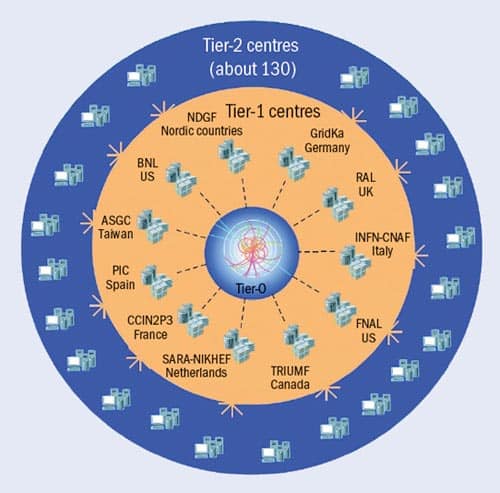
The WLCG was built in a tier structure (see “Number-crunching network”). The CERN Computing Center is Tier-0, and all raw data are permanently stored here. There are 11 Tier-1 grid sites outside CERN, including the UK’s Rutherford Appleton Laboratory, Fermilab in the US and the Academia Sinica Grid Computing Center in Taiwan. All of the Tier-1 sites have space for permanent tape storage, and the LHC experiments export their raw data from CERN to these Tier-1 sites. Most of the actual data analysis and simulation is done at about 130 Tier-2 sites.

In total, CERN will export 2–5 gigabytes of raw data to the Tier-1 sites every second. When planning for the LHC started, such rates did not seem feasible. However, by the turn of this century, fibre-optic technology had advanced far enough to make the first 10 gigabit transcontinental and (especially) transatlantic network links commercially viable. In response, CERN teamed up with other institutes and network providers to form the DataTAG project, which explored the potential of such fast links. The resulting collaboration set a number of speed records for transmitting data over long distances, starting with 5.44 gigabits per second between Geneva and Sunnyvale, California, in October 2003. (For historical reasons, network experts measure data in bits per second, while data-transfer specialists measure in bytes per second. A byte contains eight bits.)

Within a year, transfer rates reached 7.4 gigabits per second, or about 9 DVDs per minute, for data transfers from the main memory of one server to the main memory of another server. This rate was limited not by the network but by the capabilities of the servers. Memory-to-memory transfers were just the beginning, since the actual data will be transferred from disks. This is a lot more demanding; nevertheless, in 2004, using servers connected to an experimental disk system, it was possible to transfer 700 megabytes, or one CD of data, every second, from Geneva to California with a single stream reading from disk — more than 10 times faster than a standard hard drive in a desktop computer today. This showed that the network connections would not be a problem and that the data could actually be transferred from CERN to the Tier-1 sites with the desired data rates. CERN is now connected to all the Tier-1 sites with at least one network connection capable of transferring data at a rate of 10 gigabits per second.

What to do with the data?

The challenges of LHC computing also included much more mundane issues, such as figuring out how to efficiently install and configure a large number of machines, monitor them, find faults and problems, and ultimately how to decommission thousands of machines. Data storage was another seemingly “ordinary” task that required serious consideration early in the planning phase. One major factor in the planning was that for CERN, and high-energy physics in general, permanent storage does actually mean “permanent”. After LEP was switched off, physicists painstakingly re-analysed all 11 years worth of raw data that it had produced. The LHC might generate up to 300–400 petabytes of raw data over its estimated 15 year lifetime, and physicists expect all the data to remain accessible for several years after the collider has been switched off.

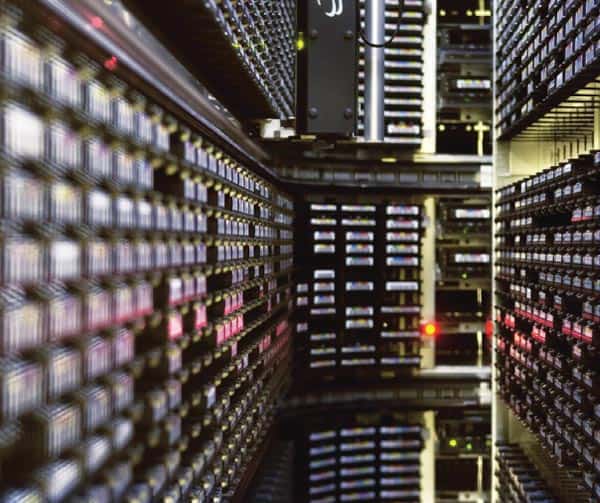
Data that are being used for computations are stored on disk, of course, but in the long term only data stored on tapes is considered “safe”. No other technology has been proven to store huge amounts of data reliably for long periods of time and still have a reasonable price tag. These tapes are housed in libraries that can hold up to 10,000 tapes and up to 192 tape drives per library.

To ensure that the data stay accessible, all raw data are copied to a new generation of tape media as it becomes available. Historically, this has happened every three to four years, although the pace of change has accelerated recently. In addition to protecting precious raw data against routine wear and tear on individual tapes, such regular updates also reduce the number of tapes, because newer versions generally have higher capacities. Access to the data becomes faster with each successive upgrade, since the speed of new tape drives is faster. Old tapes are put onto pallets, wrapped in plastic and stored together with a few tape drives just to be sure that it is possible to access the original tapes again. Back-up tapes are also stored at multiple sites and in different buildings, to try to minimize the loss if any disaster was to occur.

In addition to the actual data on particle collisions, the LHC experiments also have to store the “condition” of the detector (i.e. details about the detector itself, like calibration and alignment information) in order to be able to do proper analysis and simulation. This information is stored in the so-called conditions databases in the CERN computing centre and is later transferred to the Tier-1 sites as well. The LHC experiments needed to make changes to the database 200,000 times per second, but the first fully functional data-handling prototype could only handle 100 changes per second. After some intense efforts to solve this problem, Oracle, the relational database manufacturer that supplies CERN, actually changed its database software to allow the LHC experiments to meet the requirements.

One thing that industry partners say about CERN and high-energy physics is that the requirements are a few years ahead of virtually everything else. Pat Gelsinger, a senior official in the digital enterprise group at Intel (which has worked with the IT team at CERN in the past), has said that CERN plays the role of the “canary in a coal mine”. By coming to CERN and collaborating with the physicists working on the experiments or with the IT department, industry is able to tackle, and solve, tomorrow’s problems today.

The LHC challenge presented to CERN’s computer scientists was as big as the challenges to its engineers and physicists. The engineers built the largest and most complicated machine and detectors on the planet, plus many other achievements that can only be described with superlatives. For their part, the computer scientists managed to develop a computing infrastructure that can handle huge amounts of data, thereby fulfilling all of the physicists’ requirements and in some cases even going beyond them. This infrastructure includes the WLCG, which is the largest grid in existence and which will have many future applications. Now that the physicists have all the tools they have been wanting so long for, their quest to uncover a few more of nature’s secrets can begin.

Hubble is back, and seeing as clear as ever

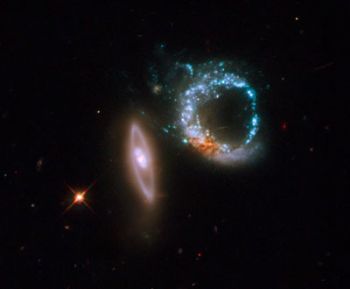
Perfect10.jpg
Hubble’s “perfect 10” (Credit: NASA, ESA, and M. Livio)

By Jon Cartwright

After a month in “safety mode” following an error on its onboard data formatter, the Hubble is back online and taking photos again.

To evidence its good health, the grand old telescope has produced a “perfect 10” image of the galaxy pair Arp 147. According to a press release, the blue ring of the right galaxy formed its “0” shape when the left galaxy (the “1”) passed through. At the moment of impact a circular wave of dense material rippled through the right galaxy, colliding with material moving inwards from the galaxy’s gravitational pull. The resultant shockwaves and dense gas stimulated stars to form in a circle.

Optical textile tests MRI patients from afar


Researchers in Europe have developed a wearable textile fitted with optical sensors that could be used to remotely monitor a patient’s breathing patterns while they undergo magnetic resonance imaging (MRI) scans. The new textile will allow medical staff to keep an eye on children and other vulnerable patients who often have to be calmed with sedatives or anaesthetic drugs to keep them still during a scan.

The technique will be particularly useful if proposed European Union (EU) legislation that is designed to protect medical staff from being exposed to the high magnetic fields of MRI systems comes into force in 2012. The new rules would prevent nurses from being in the room where the scan is taking place.

Developed by members of the EU funded OFSETH project, the textiles are plastic optical fibres woven into an elastic bandage that is worn around the chest and abdomen. In the part of the bandage that surrounds the abdomen, fibres are aligned sinusoidally with each other. As the patient breathes, the material expands and contracts causing the radius of the sinusoid to alter. This then changes the intensity of light being emitted from the fibre, which in turn reveals the breathing rate.

Stretching changes colour

In the chest region, a “fibre Bragg grating” is constructed in a short segment of the optical fibre that reflects a different colour of light depending on how much it is stretched. “By detecting which colour is reflected and by measuring the frequency of the modification of the colours you can determine the frequency of the patient’s respiration,” says François Narbonneau of the Multitel research centre in Mons, Belgium, which is coordinating the project. The researchers are also developing a fingertip sensor that monitors blood-oxygen levels based on the absorption of near infra-red light through body tissue.

Unlike alternative remote-monitoring systems, the light-based system contains no metallic parts, thereby eliminating the risk of burns from induced currents and thus making it safe during lengthy MRI examinations. A prototype textile harness is currently being tested on adult volunteers at the Centre Hospitalier Régional Universitaire de Lille, France, one of the project partners.

Solar activity could dictate river flow

What do sunspots and the Paraná river in South America have in common? The answer, say physicists in Argentina, is that when the number of sunspots goes up, so does the river’s level. Indeed, the correlation between the two is so strong that the physicists believe that solar activity could be used to predict when the Rio Paraná will flood.

Rising in southern Brazil and flowing through Paraguay and Argentina before reaching the Atlantic Ocean near Buenos Aires, the Paraná is the world’s fourth largest river in terms of water flow. Because much of the river is navigable and flows through heavily populated regions, its rate of flow has been recorded continuously since 1904.

Meanwhile, 149 million km away on the surface of the Sun, sunspots are dark areas that form at regions of intense magnetic activity. The number of sunspots rises and falls in an 11-year cycle and physicists know that the amount of radiation given off by the Sun (solar irradiance) is greatest when there are lots of sunspots.

Climate researchers have already found evidence that solar irradiance can affect Earth’s climate — boosting rainfall in the Asian monsoon, for example.

Now, though, Pablo Mauas and colleagues at the University of Buenos Aires and the National Institute of Agricultural Technology have shown that the Rio Paraná’s flow at Corrientes — about 900 km upstream from Buenos Aires — is strongly correlated to the number of sunspots visible on the surface of the sun at that time (Phys. Rev. Lett. 101 168501).

Three factors affect flow

The team analysed flow data from 1904–2003 and concluded that three factors have affected water levels on three different timescales. One is climate change, which Mauas believes has boosted the flow of the river by about 20% since 1904 — an increase that seems to have occurred mostly over the past 30 years. The team also found the Paraná was affected by el Niño — a climate oscillation in the South Pacific that usually occurs about once every five years. After removing both of these effects from the data the team found what Mauas calls a “striking correlation between the solar data and the stream flow”.

According to Mauas, the flow of a major river is good indicator of how much precipitation has fallen over its basin because — unlike other ways of measuring rainfall — it smoothes out local variations. Mauas believes that the increased rainfall could be caused by higher temperatures in tropical regions during periods of high solar irradiance. This, he believes causes greater evaporation in the tropics with this moist air transported southward to the Paraná basin.

The team is now working on a way to use sunspot number and the el Niño index, which quantifies the oscillation, to predict future water levels on the Paraná.

‘Nanoshuttle’ gives electrons a ride

A tiny mechanical shuttle that can move just four electrons at a time has been built by physicists in the UK. The device could lead to the development of a new generation of nanoelectromechanical devices (NEMS) — including logic devices and memories.

The idea of shuttling electrons around a circuit — rather than having them flow through wires — was first proposed a decade ago as a new way to transport charge in electronic devices. Such nanoshuttles could move a few as one electron at a time, leading to the development of ultralow current electronic devices that consume very little energy and operate at high frequencies.

Early attempts at creating nanoshuttles included semiconductor pillars that were set vibrating by applying an alternating current. However, these devices tended to be fairly large (measuring hundreds of nanometres) and operated at fixed frequencies. Other attempts included trapping a single carbon-60 molecule (or “buckyball”) between two electrodes. While this system appeared to behave like a nanoshuttle, the buckyball was too small (1 nm diameter) to take microscope images that confirmed it was actually moving back and forth.

Tiny metal shuttle

Now, Sergey Gordeev and colleagues of the University of Bath have succeeded in making the first shuttle junctions in which the role of the shuttle is played by a metal nanoparticle 20 nm in diameter (arXiv:0810.2430).

The researchers measured current–voltage characteristics of the fabricated devices and found that they worked as predicted by a charge-shuttling theory proposed in 1998. The team, which includes researchers from the University of Loughborough, made shuttle junctions consisting of a gold nanoparticle embedded in the gap between two gold electrodes. The nanoparticle is attached to the electrodes via a single layer of flexible organic molecules that act as tiny springs. When a voltage is applied to the electrodes, the nanoparticle starts to oscillate, transferring electrons from the negative to the positive electrode (see movie).

Thanks to the small size of the shuttle, the number of electrons transferred per cycle is very small (as few as four) and the same for each cycle. It can be varied, however, by changing the voltage applied between the electrodes.

The device produces a current that is proportional to the oscillation frequency of the device. But the current through the shuttle junction can also be varied by changing the mass of the nanoparticle and the elasticity of the linking molecules. What’s more, it could be controlled by applying a voltage bias through a third electrode (or gate), much as in a field-effect transistor.

‘Variety of novel nanodevices’ possible

“All these advantages promise to provide a variety of novel nanodevices that should be able to operate at room temperature and over a very large frequency range,” Gordeev told nanotechweb.org. Such devices should allow single electrons to be transferred at very high rates of 109–1011 Hz.

The team is now working on making three-electrode shuttle transistors. The third (gate) electrode will allow the potential energy of the shuttle to be varied and thus control the number of electrons transferred by the shuttle in one cycle. “One of the main goals of our experiments is to realize the single-electron regime in which electrons are transferred just one by one,” said Gordeev.

Practical applications of dark-matter searches

By Hamish Johnston

Pure knowledge isn’t enough these days and physicists often feel pressured to justify their work in terms of “practical applications”. You would think that dark-matter researchers would find this particularly difficult, given the esoteric nature of the stuff that they are looking for, but Leo Stodolsky at MPI-Munich begs to differ.

He has posted an article on the arXiv preprint server outlining how biology and materials science have benefitted from dark matter research in very different ways.

The former is the more straight forward application. Cryodetectors — developed to measure the tiny amounts of energy that dark-matter particles could impart to conventional matter — have been used to boost the sensitivity of mass spectrometers used to study large biological molecules.

The latter application is much more bizarre. In the early days of the CRESST dark matter search, strange signals were observed in the sapphire detector crystals. It turned out that the crystals were clamped too tightly and were cracking. However, because the detector was so sensitive, the signals represent some of the best data ever on microfractures — leading to a better understanding of this process.

The CRESST website also has a page describing these two applications.

So you want to succeed Stephen Hawking?

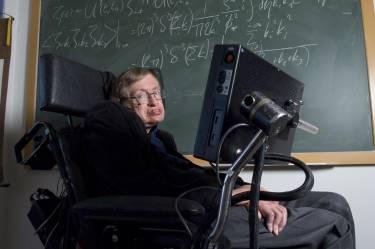
Hawking2.jpg
The search for his successor is on.

By Matin Durrani

Now here’s a job that very few physicists can possibly have a chance of securing.

The University of Cambridge is inviting applications for the position of Lucasian professor of mathematics to succeed Stephen Hawking, who is set to retire next year at the age of 67.

According to the 22 October issue of the Cambridge University Reporter, candidates should be “working on mathematics applied to the physical world, with strong preference for the broad area of theoretical physics”. The successful candidate is expected to take up the appointment in October next year.

Quite who will get the job is anyone’s guess. Previous Lucasian professors include Paul Dirac, George Stokes, Charles Babbage, George Airy and, most famously, the great Isaac Newton himself.

Hawking has certainly made the job, created in 1663 by the then Cambridge member of parliament Henry Lucas, one of the most well-known academic positions in the world.

If you fancy following in Hawking’s footsteps as the next — and 19th — Lucasian professor, applying for the job sounds fairly easy. All you need to do is submit a CV, list of papers, details of current and future research plans and details of two referees. The deadline is 15 December.

But be warned – Hawking may be retiring but will still be hanging around as “emeritus Lucasian professor”. Stepping out of his shadow won’t be easy.

Copyright © 2026 by IOP Publishing Ltd and individual contributors