Fluid videos make a big 'bounce-splash'

By Hamish Johnston

Have you ever wondered what would happen if you dropped a sphere of jelly on floor?

The answer to this and other pressing questions in fluid dynamics have appeared on the arXiv preprint server as a series of videos that have been submitted to the Gallery of Fluid Motion — part of next month’s American Physical Society Division of Fluid Dynamics meeting .

In the movie I watched, drops of “viscoelastic” material — mixtures of gelatin and water — pancake onto the floor before rising phoenix-like back into the air.

But instead of coming back as a sphere, the jelly rises as a slowly-vibrating dumbell.

This particular video was posted by Federico Hernandez-Sanchez and colleagues at the National University of Mexico and you can read about their experiment here — where you can also link to their videos.

Other papers linking to videos include Dynamics of Water Entry, The Clapping Book, and Liquid Acrobatics .

Neutron source begins studies in nuclear physics

By Jon Cartwright

A new instrument at the Spallation Neutron Source (SNS) in the US proves that Europeans are not the only scientists equipped to study the Big Bang.

The Fundamental Neutron Physics Beamline (FNPB) has just become operational at the SNS, which is based at Oak Ridge National Laboratory. Although just one of 25 instruments that will eventually power up at the SNS, the FNBP will not be using neutrons to study other materials. Rather, scientists will use it to perform studies of the neutron itself.

(more…)

Physicists pull off the gecko’s feat

For years scientists have tried — and failed — to engineer materials that would enable robots to mimic the gecko’s ability to scale walls, windows and seemingly any other surface. Now, a team from the US has developed a nanotube material that is not just a match for gecko feet but 10 times more adhesive.

Look close enough at a gecko foot and you will see an ordered, forest-like structure — roughly half a million fine hairs that each sprout into hundreds of even thinner, spatula-shaped tips. When these tips come into close contact with a surface they induce strong van der Waals forces that keep the foot anchored — that is, until the gecko decides to peel it off.

In the past scientists have attempted to copy this hair structure by fabricating arrays of polymer pillars, but these can sustain little more than a third of the gecko’s adhesive force. Although nanotubes have proved better, it is difficult to replicate the delicate tip structure of gecko hairs that would enable the nanotubes to reach their theoretical limit.

Stuck on you

The US team, led by Zhong Lin Wang of Georgia Institute of Technology, has made a structure that looks at least similar to gecko feet through chemical vapour deposition of an ethyne–hydrogen–argon gas over a silicon substrate. By introducing an iron catalyst on the substrate and controlling the temperature and duration of deposition, the team end up with an array of vertical nanotubes with spiralled, fuzzy tips.

In tests on glass, sandpaper and plastic, Wang and colleagues found that their nanotube material exhibited adhesive forces of about 100 Ncm–2, almost an order of magnitude greater than a gecko foot (Science 322 238). That is strong enough for a 4 × 4 mm pad of the material to suspend a 1.5 kg hardback textbook. “In future work modifying the surface of the nanotubes with polymers, proteins, etc, we should be able to make the adhesive nanotubes stick to a wide variety of surfaces,” Liming Dai, one of the team members, told physicsworld.com.

Mark Geoghegan, a physicist from the University of Sheffield, UK, thinks an advantage of the US team’s fabrication technique is that it does not use expensive lithography — although it is still not cheap. “A pack of 20 super-strong carbon-nanotube post-it notes would probably cost well over $1000 per note,” he jokes.

Pulls off normally

A more fundamental advantage of Wang and colleagues’ material is that it is not stoutly adhesive in all directions. If the material is stuck to a wall it will resist a strong downwards tug, but if it is pulled directly away (that is, along the normal) the nanotubes can peel off one by one. It is this property that allows geckos to hang from walls while being able to prize off their feet to scurry around.

Dai says he and the team are now planning to optimize the structure and scale it up so that they can make “Spider-man” gloves.

Quantum encryption sets speed record

Internet security systems based on the quirky principles of quantum mechanics are closer to being a reality thanks to researchers in the UK, who have achieved a one-hundred fold increase in the rate at which quantum cryptography can be carried out.

The team showed that quantum keys can be sent along a 20 km section of optical fibre at a rate of over 1 Mbit/s — an achievement that could allow users to communicate with complete security across computer networks. Indeed, the announcement comes as European researchers gather in Vienna to demonstrate the world’s first use of quantum cryptography within a commercial telecommunications network.

Quantum cryptography is a way of ensuring the security of electronic data transfer by exploiting the strange rules of quantum mechanics. It allows users to exchange keys encoded in individual quantum states, such as the phase of photons, which they then use to encrypt and decrypt their messages. This approach is in principle, impossible to decipher, because quantum mechanics dictates that any eavesdropper will alter the keys through their very act of measuring them.

Limits on commercialization

A number of companies are commercializing quantum cryptographic products, and a number of potential customers, including banks, governments and network operators, are trialling these products. However, to date it has only been possible to send quantum keys between two fixed points.

Andrew Shields, who leads research on quantum information at the Cambridge Research Laboratory, points out that being able to carry out cryptography across a network has a number of advantages. These include the possibility of forming a secure link to any other location covered by the network; communication between multiple users; greater robustness, since communications can be rerouted if single links are severed; and communication over larger areas, since each link has a maximum length of about 100 km because of signal attenuation in the fibre.

Quantum cryptography has thus far not been possible across networks because of the need to share quantum key bandwidth between many different users; up to now this bandwidth has simply been too low. Typically, this has been less than 10 kbit/s for a 20 km-long fibre link. Shields and colleagues have boosted this to 1.02 Mbit/s by improving the semiconductor devices used to detect the single photons that make up quantum keys. It is essential to use single photons for this purpose otherwise an eavesdropper could syphon off the excess photons without revealing their presence.

Detecting one photon at a time

These devices are called avalanche photodiodes since they produce an avalanche of electrons whenever they detect a photon. These electrons can then be registered as a current in an electric circuit. Unfortunately, some of these electrons can get trapped in the device and then go on to register a spurious signal at a slightly later time, which means that the device must wait until all potential signals have died away before accepting the next incoming photon; something that limits the speed at which it can work. Toshiba’s new photodiode is sensitive to much weaker avalanches that entail a much smaller probability of false signals, which means it can operate at a higher frequency.

The Toshiba group has also installed its existing kilobit per second technology in a city-wide quantum cryptography network in Vienna. Developed by scientists from across Europe in an EU-backed project known as SECOQC, the network uses existing commercial telecommunications infrastructure to send and receive quantum keys between six nodes that span links ranging from 6 km to 82 km. Shields says that Toshiba’s technology, one of six different kinds used in the network, has functioned without problem for the last two months in the Austrian capital.

The next step, according to Shields, is to replace the kilobit per second devices with the new megabit technology. The latter is currently spread out over an optical bench in Cambridge but should be shrunk down so that it can fit into a standard 19 inch communications rack within about two years, says Shields. “Quantum key distribution can have a very bright future,” he adds. “I believe it will be fully commercialized within the next three to five years, and one day could be a standard for information security in all communication networks.”

Japan shows interest in hosting the ILC

By Michael Banks

Since the Nobel Prize for Physics was awarded this week to three Japanese-born researchers, it seems like Japan has gone particle-physics crazy, or at least the Japanese government has.

So much so that Japan now wants to host the next big experiment in particle physics – the International Linear Collider (ILC). The ILC is the successor to the $8bn proton smasher the Large Hadron Collider (LHC) near Geneva that switched on, and then off, following a magnet failure almost a month ago.

According to a design study unveiled in early 2007, the machine is estimated to cost $8bn with the host country expected to pay $1.8bn – around 22% of the total cost – to dig the 40 km tunnel and supply electricity and water. When operational, the ILC will smash together electrons and its anti-particle twin, positrons, as they are accelerated to near the speed of light.

After the Nobel Prize was announced on Tuesday, a Japanese government spokesman said they will use the prize as “a tailwind” to advance its involvement with physics research. This comes as good news to particle physicists who saw the US cut its funding for the ILC last year by 75% to $15m, and with the UK now only carrying out basic research into the project following a funding crisis at one of its main research councils.

Indeed, the Particle Physics Project Prioritization Panel (P5) – set up by the US Department
of Energy last year to plan the next decade in high-energy physics – published a report in June saying the US should have “a significant role in the ILC wherever it is built”, but stopped short of saying that it should be constructed in the US.

“If the Japanese do make such a strong bid, I think it is highly unlikely to be opposed by the US, although it might catalyse other interest, potentially China or Russia,” says particle physicist Brian Foster from Oxford University. “However, I think the Japanese would be in a very strong position and, after ITER, in some sense they are ‘owed’ the next major international project.”

So maybe the time is right for Japan to stake its claim.

‘Stamp’ method brings bendy, transparent solar cells

Imagine solar cells that are flexible enough to be rolled up like a sheet of paper or so transparent that they can be hung over a window. Such solar cells are a step closer now that researchers in the US have devised a new method for printing thin wafers of silicon onto many other types of material.

John Rogers and colleagues at the University of Illinois at Urbana-Champaign and Northwestern University liken their method to the way a rubber stamp transfers ink from a pad to paper. First, they etch a striped pattern onto a wafer of crystalline-silicon (the “pad”) before lifting the resulting segments (the “ink”) with a soft piece of polymer (the “stamp”). Then they push the polymer onto the desired substrate (the “paper”) to print on the segments. Finally they evaporate metal onto the back of the material and etch it to leave electrodes running down the sides (Nature Materials advance online publication doi:10.1038/nmat2287).

The benefit of this stamp method is that Rogers and colleagues can use a wide variety of substrate materials, including flexible plastics. Although other researchers have tried to make flexible cells before — for example, using amorphous silicon or polymers for the active material — the performance or reliability of the cells has always suffered. In tests, Rogers and colleagues’ cells had a solar-energy conversion efficiency of 7.2% — significantly under commercial devices, which operate at about 18% — though were flexible enough to be rolled around a pencil.

Another advantage of the US team’s method is that the cells can be printed thinly or in sparse arrays so that they are partially transparent, which means they could, for example, be fixed over windows. Using sparse arrays, Rogers and colleagues could vary the transparency between 35 and 70%.

Rogers told physicsworld.com that his team has created a start-up company called Semprius Inc to develop commercial devices, although it will be focusing on gallium arsenide (GaAs) — a more expensive though more efficient material than silicon — for the cell designs. “GaAs appears to offer the greatest near-term commercial potential,” he says.

Aside from working on GaAs themselves, Rogers’s team is now exploring the different cell layouts so that they can get high efficiencies while still using cheaper, low-purity silicon. “This important capability, which is suggested by our theoretical modelling efforts, could reduce substantially the cost of the silicon,” he adds.

Simple temperature change creates spin current

Physicists in Japan have discovered a new way to create spin-polarized currents of electrons by simply heating one end of a magnetic sheet. The team was able to make a spin current in the sheet flow 6 mm, which is about 10,000 times further than spin currents can flow in copper wire. The team believes that the phenomenon — called the spin Seebeck effect — could help overcome technological barriers preventing the creation of practical spintronic devices, which use both the spin and charge of electrons to process information.

The intrinsic spin of the electron can either be “up” or “down”, and some physicists believe that this property could be used to store and process information in spintronic devices. Such circuits could be smaller and more energy-efficient than conventional electronic circuits.

But before spintronics can become a commercial reality, researchers have to come up with a reliable way of generating spin currents while also ensuring that these currents can move around a circuit without losing polarization. In copper, for example, a spin-polarized current will only flow about 500 nm before vanishing.

Temperature gradient

Now Eiji Saitoh and colleagues at Keio University in Yokohama have addressed both of these issues with their discovery that a current of spin-polarized electrons can be generated by creating a temperature gradient along a length of a magnetic metal (Nature 455 778).

The team first deposited a 20 nm-thick layer of a Ni81Fe19 alloy onto a sapphire substrate to create a sheet that is 6 mm long and 4 mm wide. They then kept the two opposite ends of the sheet at different temperatures by placing the ends in contact with two independently heated copper blocks.

Ni81Fe19 is a permanent magnet and the sheet was magnetized in the long direction — the same direction as the temperature gradient. The presence of a magnetic field means that electrons of one spin have a different chemical potential energy than electrons with the opposite spin. This imbalance causes an excess of spin-up electrons to build-up at the cool end of the sheet and an excess of spin-down electrons at the warm end.

According to Saitoh this imbalance can be thought of as a “spin voltage” along the sheet, which drives a current of spin-up electrons in one direction and spin-down electrons in the other.

The researchers measured the spin polarization at either end of the sheets with the help of two thin platinum wires — one laid across the cold end and the other across the warm end. As spin current flows into a platinum wire its polarization decays rapidly, creating a voltage across the electrode via the “inverse spin Hall effect” (ISHE).

By measuring the voltages across the electrodes, the team concluded that spin-currents of opposite polarity were flowing out of either end of the sheet. Measurements also showed that the spin voltage was proportional to the temperature difference and that it grew linearly along the length of the sheet — suggesting that spin-currents with well-defined polarization values could be extracted at different lengths along such a sheet.

Spin currents over large distances

Another potentially useful feature of the spin Seebeck effect is that the spin current persists for the entire 6 mm length of the sheet. According to Saitoh, the ability to sustain spin currents over such large distances could “revolutionize” research into the development of spintronic devices.

The team is now looking at whether spin currents generated by the spin Seebeck effect could be used to move magnetic domain walls. If successful, the effect could be used in spintronic “racetrack” memory devices in which data are stored and retrieved by pushing magnetic domains along tiny wires using spin currents.

Europe moves forward with laser-fusion plans

Physicists and politicians from across Europe and beyond gathered at London’s Science Museum on Monday to mark the beginning of a three-year “preparatory phase” of a new €1bn project known as the European High Power Laser Energy Research Facility (HiPER). So why do we need another fusion energy project? physicsworld.com looks for the answers.

What is HiPER?

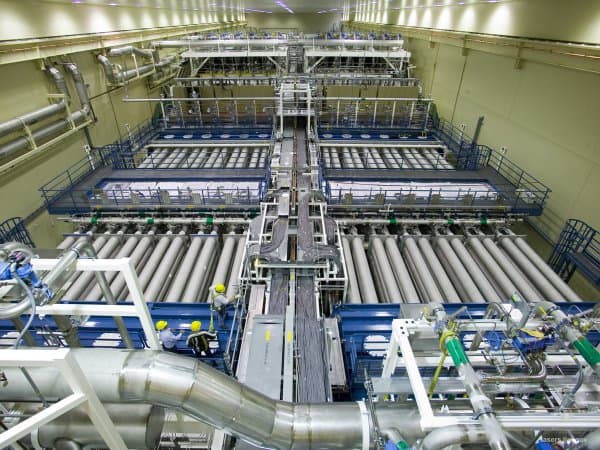
HiPER is designed to show that laser-driven fusion can provide the world with energy in the future. The idea is to direct a series of extremely powerful laser beams onto a small capsule of deuterium-tritium fuel, heating up the outer surface of the capsule and forcing it to expand outwards, which, by Newton’s third law, causes the centre of the capsule to implode.

Another ultrahigh-power laser heats this high-density core to around one hundred million degrees Kelvin. This energizes the deuterium and tritium nuclei sufficiently so that they overcome their mutual repulsion and fuse, releasing excess energy in the form of neutrons, which can be used to produce electricity.

ITER will cost a fortune, why should we spend even more money on fusion?

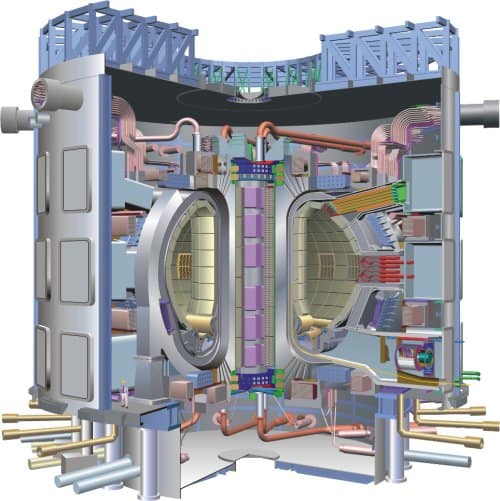
The approach adopted by the €10bn-plus International Thermonuclear Experimental Reactor (ITER), currently under construction in the south of France, is to contain the fuel at relatively low densities for several minutes at a time using magnetic fields.

Despite its huge price tag, however, no one can be sure that it will generate a significant gain in energy, or at least do so economically. Physicists therefore believe it also makes sense to investigate “inertial-confinement” fusion, which involves holding the fuel at extremely high pressures for very brief periods using lasers or ion beams.

Aren’t physicists already studying inertial confinement?

They are, but of a different sort. Scientists know that inertial-confinement works, since experiments carried out by the US military in the 1980s showed that the X-ray output from an atomic bomb could ignite little capsules of deuterium-tritium. These bombs use an initial fission explosion to rapidly compress a deuterium-tritium mixture, with shock waves created inside the mixture heating it to the point of ignition. This “central ignition” process is being reproduced in a controlled way at billion-dollar facilities — the National Ignition Facility (NIF) at the Lawrence Livermore Laboratory in the US and the Mégajoule laboratory in France — where a single set of lasers both compresses and heats the fuel. HiPER, on the other hand, will use a separate laser pulse to do the heating, a process known as “fast ignition” because the second laser must heat the fuel within 10–11 s of the implosion.

What are the advantages of fast ignition?

It is more efficient than central ignition. Setting up shock waves requires the fuel to be compressed to enormous densities, which needs very high laser energy per unit mass of fuel. Since fast ignition requires only intermediate densities, it can in principle be used to ignite a larger mass of fuel for a given input energy. And more mass equals more output energy, which means higher efficiencies. In fact, proponents of fast ignition reckon that it is some two to three times more efficient than central ignition. In addition, fast ignition does not require the same degree of precision in the uniformity of the compressing laser pulses and the shape of the fuel pellet.

Do we know if fast ignition works?

There lies the rub. In 2001 Ryosuke Kodama and colleagues at Osaka University in Japan, along with physicists from the UK, used compression and heating lasers to generate fusion neutrons from a fuel pellet. But to demonstrate that the technique can be used as an energy source, physicists will have to prove it can cause ignition.

This may be possible with a higher energy laser system being put in place at Osaka or possibly on similar facilities starting up at the University of Rochester in the US and at a French Atomic Energy Commission site near Bordeaux. However, it would be more likely to occur at the much higher energy NIF, if, as has been suggested, the American facility is refitted so that it can carry out fast ignition experiments.

Achieving fast ignition will require a much better understanding of how energy is transferred from the heating pulse to the fuel, whether through relativistic electrons or protons. “We haven’t yet convinced ourselves that fast ignition works,” says Mike Dunne, a physicist at the Rutherford Appleton Laboratory in Oxfordshire and head of the HiPER project. “But if it does it would undoubtedly be more attractive to use than central ignition.”

So where does HiPER fit in?

HiPER is being designed to show that fast ignition, once proven in principle, can then be used as an energy source. This means demonstrating that the fusion process can be repeated at high frequencies. Inertial confinement is a pulsed technique — similar in principle to the repeated cycles of chemical combustion in the engine of a car — and at NIF the laser system fires every two to four hours, whereas a commercial power plant would need to fire about five times a second to provide the 2 gigawatts typical of a large power station. HiPER will trial the fully robotic process needed to achieve such a frequency.

What happens next?

The six countries that have officially backed HiPER — the UK, France, Spain, the Czech Republic, Italy and Greece — marked the formal start of a three-year “preparatory phase” for the project on Monday. This phase, which will involve detailed studies of short-pulsed lasers and fuel pellets, as well as decisions on costs, location, etc, is being funded with €13m of cash and €50m of work in kind.

Some two to three years down the line another €100m will be needed to develop prototypes, and a few years after that the remainder of the roughly €1bn construction costs will be needed to actually build the thing. Operating costs over the facility’s roughly 20-year lifetime will also be about €1bn. If all goes well, the facility should start up by around the end of the next decade. As to where it will be built, this depends ultimately on who is prepared to commit the cash, but the UK, which is coordinating the project, is certainly in the running.

When might a commercial fusion plant start operating?

The billion-dollar question. The quest to derive energy from nuclear fusion has been plagued by wildly optimistic expectations in the past, and critics have quipped that fusion is always 40 years from commercialization. Fusion advocates, however, are confident that it could happen by about 2050. Indeed, Dunne thinks this estimates holds good for both magnetic and inertial confinement. He concedes that magnetic fusion is “a generation ahead” of its laser equivalent, but believes that fast ignition could potentially close the gap quickly.

David Meyerhofer of Rochester University believes that fusion reactors could ultimately replace all large power plants and be used to extract hydrogen from water for transport. “Thus,” he says “it is possible that fusion could eventually produce more than 50% of the world’s energy needs.” However, he adds that this estimate is “very speculative”.


Nobel prize: there should be no controversy

Cabibbo.jpg
Should Nicola Cabibbo have shared this year’s Nobel prize? (Credit: Marcella Bona)

By Jon Cartwright

There was a reason why science reporters like me groaned at the announcement of the Nobel Prize for Physics yesterday. “Drat,” we thought in synchrony. “Now I have to explain what symmetry breaking is.” Maybe that’s why we on physicsworld.com all hoped for more fathomable research, like dark energy or neutrino oscillations.

For some particle physicists, there was a less selfish reason to be irritated. Two of the three new Japanese-born laureates, Toshihide Maskawa of the Yukawa Institute for Theoretical Physics and Makoto Kobayashi of the KEK lab, were awarded the prize for figuring out how to encompass so-called charge–parity violation in the Standard Model. The crucial part of their work was in describing the decays of quarks, for which they created the CKM matrix — “M” for Maskawa and “K” for Kobayashi. So why did the Nobel committee appear to disregard the first initial — “C” for the Italian physicist Nicola Cabibbo?

(more…)

Particle physicists pick up Nobel prize

Much to the delight of particle physicists, this year’s Nobel Prize for Physics has been shared among three chief architects of the Standard Model.

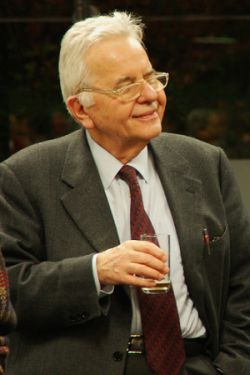
The Nobel committee has awarded one half of the 10 million kronor (£800,000) prize to Yoichiro Nambu of the University of Chicago in the US “for the discovery of the mechanism of spontaneous broken symmetry in subatomic physics.”

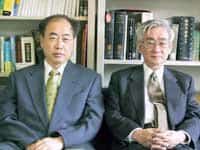
Meanwhile, the committee has awarded the other half jointly to Makoto Kobayashi of the KEK lab and Toshihide Maskawa of the Yukawa Institute for Theoretical Physics, both in Japan, “for the discovery of the origin of the broken symmetry which predicts the existence of at least three families of quarks in nature.”

Nambu’s work is a cornerstone of the Standard Model Tim Gershon, University of Warwick

Breaking symmetry

Physicists know that, besides energy, “stuff” in the universe comes in two forms: matter and antimatter. The Big Bang should have created equal amounts of both, but the universe of today appears to be dominated by matter. Symmetry breaking — a key concept in particle physics — seeks to explain the subtle differences in physics that enabled normal matter to tip the balance.

The first suggestion of a way in which the symmetry of matter and antimatter could be broken came in 1956 from Chen Ning Yang of Chicago University and Tsung Dao Lee of Columbia University. They proposed that mirror or “parity” symmetry — one of the three fundamental symmetries of nature — might break in the weak force. Experiments on the decay of cobalt atoms swiftly verified their belief while marking them down for the Nobel prize a year later.

Despite this proof that symmetries could at least be broken individually, most assumed that combined parity and charge symmetry, or so-called CP symmetry, would hold. But in 1964 tests on the radioactive decay of particles known as kaons showed that even CP symmetry could break, a result that won physicists James Cronin and Val Fitch the Nobel prize in 1980.

CKM matrix

It is the theory that explains this broken symmetry that has handed the 2008 prize to Maskawa and Kobayashi. In 1972, using calculations based on quantum mechanics, the Japanese researchers — following the concept of “quark mixing” proposed by Italian physicist Nicola Cabibbo — formulated the 3 × 3 “CKM” matrix that describes how the strange quark and anti–down quark inside a kaon can change flavour into an anti-strange quark and a down quark. Moreover, the CKM matrix predicted another third family of quarks, all of which were discovered over the following three decades.

Nambu’s work focuses on “spontaneous” symmetry violation, which describes how unstable, symmetrical systems can suddenly turn unsymmetrical. In 1960, Nambu was working on how spontaneous symmetry violation can cause substances to become superconducting when he discovered that the principle could also be extended to particle physics.

The importance of Nambu’s work becomes apparent when one considers that it underpins the mechanism for the Higgs boson — the particle that will likely be discovered at the Large Hadron Collider (LHC) in Europe after the machine begins taking data next year. Sometime in the very early universe, spontaneous symmetry violation caused the field of the Higgs boson to lose its symmetry, which is why all particles today have different masses.

At a stroke, Kobayashi and Maskawa predicted a mechanism extending the Standard Model to accommodate the matter–antimatter asymmetry Paul Harrison, University of Warwick

‘Astonishing insight’

Tim Gershon of the University of Warwick in the UK says he is “thrilled” at the recognition of the three particle physicists. “Nambu’s work is a cornerstone of the Standard Model,” he explains. “With results from the LHC expected in the next few years, [the award] provides a timely reminder of the crucial insights into nature provided by Nambu.”

Gershon adds that the 1972 work of Maskawa and Kobayashi was an “astonishing insight”. “I would say that such a predictive theory is physics of the very best kind, and highly deserving of the Nobel Prize,” he continues. “The award also serves as recognition of the many theoretical and experimental physicists who have worked towards the successful tests of their theory — they are of course too many to name, or award prizes to, but they deserve at least a drink in celebration.”

Paul Harrison, also at Warwick, agrees that the awards are well-deserved. “At a stroke, Kobayashi and Maskawa predicted a mechanism extending the Standard Model to accommodate the matter–antimatter asymmetry, and predicted two new particles that together added five new fundamental constants to the laws of nature. It’s great news for flavour physics.”

Copyright © 2026 by IOP Publishing Ltd and individual contributors