Improving measurements of space and time

Physicists in France have proposed a new scheme for using pulses of light to make an accurate measurement of the distance between two objects in space. The technique, which has not yet been confirmed experimentally, could allow measurements to be made at the highest possible accuracy allowed by quantum mechanics. The method could someday be used to boost the performance of some space-borne instruments, say the researchers.

The standard quantum limit (SQL) in space-time positioning exists because of the quantum nature of light, which introduces fluctuations in measurements that rely on the exchange of light pulses. The SQL could never be reached for light pulses sent through Earth’s atmosphere, which introduces too much noise in the signal, but it could be relevant for some space applications where the distance between spacecrafts must be accurately controlled.

The Einstein protocol

Scientists routinely measure the position in space between two objects A and B using the “Einstein protocol”, which involves repeatedly exchanging light pulses between the objects. Object A sends a light pulse at time t1 (measured with a clock in A), which is then received at time t2 in B (measured with a clock in B). The signal is then immediately sent back to A with a return time t3 (measured with A’s clock).

What is new in our scheme is that we extract the timing signal with the best accuracy ever Brahim Lamine, Pierre and Marie Curie University

The distance between A and B can be calculated using the equation D=c(t3–t1)/2, where c is the speed of light. This is the Einstein definition of distance and is also known as a two-way ranging signal. The offset, Δt, between the times given by the two clocks is Δt=t2–( t3+t1)/2, which is called the Einstein synchronization protocol, or two-way clock synchronization.

This method involves performing pulse timing to measure the three time values. Although highly accurate, a fundamental limitation arises from the quantum nature of light, which introduces fluctuations in these timing measurements, leading to SQL. Light always contains quantum fluctuations — which come from the fact that photons are not regularly spaced in the light beam.

Reaching the yoctosecond range

Brahim Lamine and colleagues of the Pierre and Marie Curie University in Paris have shown that it is possible to reduce the noise in the observable signal being measured, so reducing the SQL (Phys. Rev. Lett. 101 123601). The researchers say they can do this by using a technique that combines “homodyne detection” and “mode-locked” femtosecond lasers. This leads to a new SQL in time transfer between two clocks, potentially reaching the yoctosecond range (10–21 s to 10–24 s). The secret behind the scheme lies in the use of “squeezed” light beams from the femtosecond lasers that redistribute the noise, so making timing measurements less noisy overall.

Mode-locked femtosecond lasers are simply a succession of pulses where the relative phase between the “carrier” — the oscillation of the electric field inside the light pulse envelope — and envelope is well defined. For example, it can have a constant value, or can be equal to zero. The coherent light pulses from the lasers carry time information in their oscillations, or wave phase, and on their envelope.

Lamine and colleagues aim to extract information from both phase and envelope using homodyne detection (the difference between two interference signals obtained from the incoming pulses and some reference pulses). Any change in distance between objects A and B leads to a modification of the interference signal. “What is new in our scheme is that we extract the timing signal with the best accuracy ever — that is, we extract the signal from both envelope and phase inside the envelope,” explained Lamine.

“Although our protocol is not directly useful for GPS — because propagation of the pulses in the atmosphere causes too much noise in the signal — it could be used for improving the positioning between satellites for future space applications,” he told physicsworld.com. “Here, external perturbations are small and high accuracy can be achieved.”

Good examples are LISA (Laser Interferometer Space Antenna), which will detect gravitational waves, post-GRACE (Gravity Recovery and Climate Experiment) missions, which will determine Earth’s gravity field and DARWIN, a flotilla of spacecraft to detect Earth-like exoplanets.


Italian space agency still in flux

saggese.jpg
Enrico Saggese

By Michael Banks

Yesterday afternoon here at the International Astronautical Congress in Glasgow, I had a brief chat with Enrico Saggese, the controversial new commissioner of the Italian Space Agency (ASI). Saggese was recently installed by the Italian government after it sacked his predecessor (and one-time Physics World author — Giovanni Bignami — following the mass resignation of the agency’s seven-member administrative council. The space agency is normally led by a president who chairs the council. But in August, prime minister Silvio Berlusconi replaced the council with a commissioner and deputy commissioner, discarding Bignami, who had been president, in the process.

I asked Saggese why Berlusconi changed the structure of the agency when Bignami was replaced. “There are situations which happen where you have to reorganise the agency internally”, Saggese explained rather opaquely, “but there are a group of people around me, such as a magistrate taking care of what I am doing, so I am not a powerful man.”

(more…)

Space fair starts with a shower

By Michael Banks

The weather was dry as I arrived yesterday at the armadillo-shaped congress centre in Glasgow for the 59th International Astronautical Congress (IAC). But there was no need for delegates to ask what the weather forecast would be for the rest of the week. Even before I had had the chance to register, I had already picked up two conference freebies. They were both umbrellas.

The IAC is a huge global meeting at which the international space industry and national space agencies come together to show their wares and find out what everyone is up to. In the afternoon, just as the first rain clouds were opening up, the heads of national agencies came together for a briefing session. NASA boss Mike Griffin was joined on the panel by other space-agency chiefs such as ROSCOSMOS deputy head Alexander Medvedchikov from Russia, the Chinese National Space Administration’s boss Sun Laiyan, Japan Aerospace Exploration Agency head Keji Tachikawa as well as Byrana Suresh, director of the Indian Institute of Space Science and Technology.

(more…)

Proton-beam technique dates fine wine

Nuclear physicists in France have invented a way to authenticate the vintage of rare wine without needing a sommelier’s keen nose or even a corkscrew. The technique, which involves firing high-energy protons at wine bottles, can determine how old the bottles are and even where they come from. The new method could help unmask counterfeit wines — a growing problem in the wine industry, where a bottle can sell for thousands of Euros.

Hervé Guégan and colleagues at the Centre d’Etudes Nucléaires in Bordeaux Gradigan (CENBG) bombard wine bottles with a 3 MeV proton beam produced by the AIFIRA particle accelerator. They then determine the chemical composition of the glass through an analysis of X-rays emitted by 15 different elements in the material (including silicon, sodium, iron and magnesium). Finally, Guégan’s team compare the chemical make-up of the glass with that of 80 other bottles of known origin studied by the researchers. These bottles, which date from 1859 to the present day, come from private collections and museums in the Bordeaux region of southwest France.

Good year or bad?

Thanks to improvements in processing, the chemical composition of glass has changed over the last 100 years. Hence, a bottle’s chemical “signature” depends on where and by whom the glass was produced. These year-on-year changes mean that bottles from a “good” year for wine can be distinguished from a “bad” one. “The technique as it stands is accurate to about 15 years, but we hope to improve this precision to one or two years when the database is extended,” Guégan told Physics World.

A previous technique developed at the CENBG by Philippe Hubert and colleagues dated the wine itself by measuring the amount of caesium-137 — a radioactive isotope produced during atomic-bomb tests — the wine contained. But the bottles had to be opened and the wine destroyed to achieve reliable results and the technique could not date wines produced before bomb tests began.

However, the caesium-137 test might be combined with the new technique to dissuade unscrupulous people from filling authentic old bottles with newer wine. The team now hopes to extend its database to 160 bottles with the help of the Antique Wine Company, a London-based rare-wine merchant, which has agreed to finance future research on the technique in exchange for an exclusive 10-year agreement with the CENBG group to unearth counterfeit wines.

Once the procedure becomes fully operational next year, an independent offshoot of Antique Wine, VinCert, will take over from Guégan’s team at the CENBG.

A triplet of rovibrational ground states

rovibrational.jpg
The weakly bound rubidium molecules (upper image) are transferred into the rovibrational ground state with a STIRAP laser pulse. (Courtesy: Austrian Academy of Sciences).

By Hamish Johnston

Rovibrational ground states are a bit like buses — you wait a long time for nothing and then three come along one after another.

A few weeks ago, we reported on the first realization of a quantum gas of ultracold polar molecules by Deborah Jin, Jun Ye and colleagues at JILA in Boulder, Colorado.

The big challenge in creating the 350-nK gas was to put the potassium-rubidium molecules into their “rovibrational” ground state, where they have the smallest amount of rotational and vibrational energy allowed by quantum mechanics.

Normally, the molecules heat up the gas when they give up their excess rovibrational energy. Jin and Ye avoided this by using lasers to get the molecules to give up their energy as light that exits the gas without heating it — a technique called “stimulated Raman adiabatic passage” (STIRAP).

Now, Rudi Grimm and Johannes Hecker Denschlag at the Austrian Academy of Sciences have used the same technique to create an ultracold gas of rubidium-rubidium molecules in the “triplet” rovibrational ground state (Phys. Rev. Lett. 101 133305). Such a triplet state is interesting because the molecules have large magnetic moments, and therefore the gas could be useful as a “quantum simulator” of solid magnetic materials.

In the same issue of Physical Review Letters, Matthias Weidemueller and colleagues at Germany’s University of Freiburg explained how they created an ultracold gas of lithium-caesium molecules in the rovibrational ground state (Phys. Rev. Lett. 101 133304).

Like the potasium-rubidium, lithium-caesium molecules have electric dipole moments — which means that they could someday be used as quantum bits that are controlled by the simple application of an electric field.

Self-assembly goes square-shaped

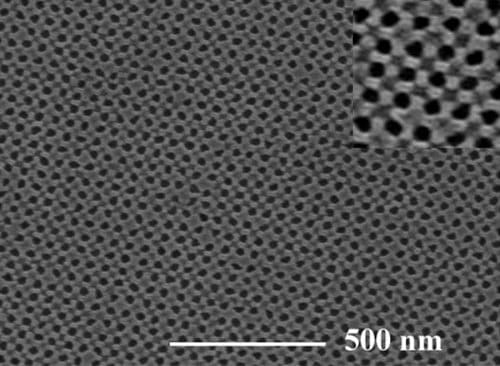
Researchers in the US are the first to use self-assembly to make highly-ordered square arrays from block copolymers. Each square measures about 20 nm and the team believes that the technique could someday be used to make extremely small electronic devices. Until now, block-copolymer self-assembly methods could only produce hexagonal-shaped arrays, which are not compatible with the industrial processes used to make integrated circuits.

Self-assembled square arrays are a major goal for researchers because the semiconductor industry’s circuit design, software and fabrication processes are all based on a rectilinear coordinate system. Although hexagonal patterns can now routinely be produced using conventional self-assembly techniques, adopting these shapes would mean rethinking semiconductor industry protocols, which would be very expensive and time-consuming. To this end, the Semiconductor Industry Association has set up a challenge to scientists working in the field of “block copolymer” lithography to develop square arrays of etchable block copolymer domain patterns.

Integrating the new technique into semiconductor manufacturing will be much simpler and will not require any modification to chip designs or layouts Craig Hawker, UCSB

Block copolymer lithography is a simple approach to make features smaller than 20 nm, which is less than half the size of today’s smallest mass-produced circuits. Block copolymers are two different kinds of polymer strand (called blocks) that are joined end-to-end to create one long strand. Although the ends of the blocks are stuck together, the blocks tend to repel each other along their length. These competing forces tend to organize the copolymers into well defined patterns with length scales of tens of nanometers.

A thin film of block copolymers on a semiconductor substrate provides the initial nanostructure pattern. Then a chemical treatment can be used to remove one type of block, exposing some of the substrate and creating a mask that can be used create devices through standard lithography processes such as etching and deposition. Feature sizes can be controlled by adjusting the molecular weights of the blocks — however, the traditional way of creating the films by the phase separation of the polymers automatically leads to hexagonal arrays of features.

Two copolymers are better than one

The new technique developed by a multidisciplinary team at the University of California, Santa Barbara is very similar to block copolymer lithography but involves using an mixture or “alloy” of two different block copolymers that have an attractive hydrogen-bonding interaction with each other (Sciencexpress 10.1126/science.1162950).

The block copolymers used by the team were based on polyethylene oxide-b-polystyrene (PEO-PS) and polymethylmethacrylate-b-polystyrene (PMMA-PS). Such a blend combines the photodegradability of the PMMA with the long-range ordering characteristics of the PEO. Hydrogen-bonding occurs between phenolic and pyridyl units in the copolymers. Degrading the PMMA domains using UV light, followed by etching, allows nanoscale features to be made with high fidelity, which leads to highly-ordered square arrays that are around 20 nm across.

Simple integration

“The square arrays produced match the layout of microelectronics devices,” team member Craig Hawker told physicsworld.com. “As a result, integrating the new technique into semiconductor manufacturing will be much simpler and will not require any modification to chip designs or layouts.”

The team now plans to make features over larger areas and fabricate devices using a combination of traditional processing techniques and square arrays produced by block copolymer lithography.

US Nobel laureates: vote Obama

On the eve of the first US presidential debate, a host of Nobel Prize winners in the sciences signed an open letter to “urge” the nation to vote for the Democratic nominee, Barack Obama.

Sixty-one US Nobel laureates, including 22 who won the prize for physics, made the stand yesterday after Obama and his running mate, Joe Biden, published an 11-page policy document entitled, “Investing in America’s future: Barack Obama and Joe Biden’s plan for science and innovation”. The plan builds on aspects of Obama’s science policies that he drafted at the end of last month in response to 14 questions posed by the organization ScienceDebate 2008.

The letter signed by the laureates reads: “The country urgently needs a visionary leader who can ensure the future of our traditional strengths in science and technology and who can harness those strengths to address many of our greatest problems: energy, disease, climate change, security, and economic competitiveness.

Voting for Obama is a no-brainer Phil Anderson, Princeton University

“We are convinced that Senator Barack Obama is such a leader, and we urge you to join us in supporting him.”

Phil Anderson, who shared the 1977 Nobel Prize for Physics and who was one of the signatories, told physicsworld.com that voting for Obama in November would be a “no-brainer”. Referring to why he would not choose John McCain, the Republican nominee, he added: “There are too many obvious reasons to pick one. Let me name three. 1. Torture; 2. Tax cuts for the rich; 3. A [running mate, Sarah Palin] who believes in the Apocalypse and not in evolution.”

Five-point plan

In their plan, Obama and Biden herald a “new era” of scientific innovation that will, in essence:

  • Restore “integrity” to US science policy by employing a presidential assistant who is well-versed in science. This assistant will be announced quickly to “signal the importance of science” and “participate in critical early decisions”. Obama also vows to pick those with “unquestioned reputations for integrity and objectivity” when appointing managers who must consider scientific advice. Moreover, he intends to establish guidelines that will guarantee scientific results “are released in a timely manner and are not distorted by ideological biases”.
  • Double over 10 years federal spending on basic research to better understanding “from the size of the universe to the nature of subatomic particles”. The Democratic candidate criticizes current under-investment in the sciences, promising greater support for high-risk, high-return research and for young scientists. But he notes that he will specifically push multidisciplinary research because “the challenges we face, such as the transition to a low-carbon economy, cannot be addressed by researchers from any single discipline”.
  • Commit to science and education training by boosting numbers of K-12 (primary and secondary) maths and science teachers. Obama will offer a fully refundable, $4000 credit to tempt students into college in return for 100 hours of public service. He also promises to triple graduate research fellowships from the National Science Foundation from 1000 to 3000, while striving to educate other US citizens on science through the media and internet.
  • Encourage US innovation by establishing a permanent tax credit for R&D, increasing patent quality to “reduce uncertainty and wasteful litigation”, and improving visa programmes to attract overseas contributors to the technology industry.
  • Address the “grand challenges” of the 21st century such as developing clean, affordable energy. The Illinois senator pledges double the current spending on clean energy R&D. In addition, he wants to “restore” the Defense Advanced Research Projects Agency in supporting technological breakthroughs, in particular areas such as microsystems, nanotechnology and information technology.

Cool with science

Obama beat McCain by more than two weeks to answering the questions posed by ScienceDebate — an organization formed last year that tried, and failed, to persuade the presidential candidates to attend a televised debate on science policy. On Wednesday, Obama again trumped the Republican by being the only candidate to answer 18 science-related questions asked by the journal Nature.

Now the decision to put those all of those answers on a surer footing will make the Democratic hopeful appear to take the opinions of scientists seriously.

• You can read the full version of Obama and Biden’s science and innovation plan here.

Hope fades for neutrino dark matter

Physicists in the US have cast further doubt on whether a controversial neutrino is a potential candidate for dark matter — a mysterious substance that makes up nearly a quarter of the mass of the universe.

John Beacom and Hasan Yuksel from Ohio State University and Casey Watson from Millikin University, Illinios have analysed data from the International Gamma-Ray Astrophysics Laboratory (INTEGRAL) satellite to rule out a range of possible mass values that “sterile” neutrinos, a candidate for dark matter, can take.

Neutrinos, which do not have an electric charge, currently come in three types or “flavours” — electron, muon and tau — that are each “active” meaning they interact via the nuclear weak force. Neutrinos also oscillate from one flavour to another as they travel, implying they have a mass.

In 1995, researchers based at the Liquid Scintillating Neutrino Detector (LSND) at Los Alamos looked at the oscillations between anti-muon and anti-electron neutrinos. To account for a discrepancy in the measured mass difference — a property that governs neutrino oscillation — they proposed a fourth, or “sterile” neutrino, which does not interact via the electroweak force and has a mass below about 1 eV.

Now you see them, now you don’t

But last year an experiment at MiniBooNE at Fermilab, which was more sensitive than the LSND experiment, saw no evidence for these sterile neutrinos. However, dark matter also doesn’t interact via any force except gravity. So the lack of interaction between sterile neutrinos and the three fundamental forces, bar gravity, means that higher mass sterile neutrinos — that weren’t looked for in the MiniBooNE experiment — could be a potential candidate for dark matter.

Beacom and colleagues used a certain property of sterile neutrinos to detect their possible existence: that over the lifetime of the universe a tiny fraction of them decay and produce detectable X-rays (Phys. Rev. Lett. 101 121301).

X-rays emitted by sterile neutrinos at a certain energy determine its mass while the flux of the X-rays determines the strength of the oscillation or so-called “mixing angle” — a parameter needed to fully characterize neutrino oscillations.

The researchers calculated the expected X-ray emission from the decay of sterile neutrinos in the Milky Way and compared it with the findings of the INTEGRAL satellite, which is sensitive to X-ray fluxes in the energy range of 20 keV and 8 MeV. INTEGRAL has a better energy resolution than previous satellites and allows physicists to better differentiate between X-rays concentrated at certain energies from other astrophysical sources that produce X-rays over a broad energy range.

Search is far from over

Using their theoretical models and observations from INTEGRAL, Beacom and colleagues have now discounted the existence of sterile neutrinos with a mass between 40 keV and 1 MeV and with mixing angles between 10-14 to 10-6. Though their finding means the search is far from over, “realistically, until someone, someday, finds a signal for dark matter, we will keep looking everywhere to test all possible candidates,” says Beacom.

Next, Beacom and colleagues hope that further analysis of the data will allow even smaller masses and mixing angles for sterile neutrinos to be tested.

A simpler way to test quantum computers

Physicists in Canada have invented a new way of testing optical components that could someday be used to build quantum computers. They claim that their technique is much simpler than conventional tests because it uses standard laser light, rather than relying on the creation of photons in special quantum states.

A quantum computer could, at least in principle, exploit the weird laws of quantum mechanics to vastly outperform classical computers on certain tasks. In such a computer, data would be input and stored in terms of quantum states — such as the polarization of individual photons. These data would be processed by devices that involve transitions in quantum systems, such as the absorption and emission of photons by a single atom.

But before any quantum computer can be made, these processing devices must be tested to ensure that they give the appropriate output state for a given input state — an exercise called quantum process tomography (QPT).

The conventional way of doing QPT is to systematically apply all possible inputs to a device and watch what comes out the other end. However, such input states are often very difficult to create in a reliable way — one of many reasons why physicists have yet to make a practical quantum computer.

A more classical approach

Now, Alex Lvovsky and colleagues at the University of Calgary have come up with a way of doing QPT without the need to generate these tricky quantum states. It involves using much simpler, and more “classical”, states of light from a conventional laser along with some high-powered mathematics (Sciencexpress 10.1126/science.1162086).

The team demonstrated their technique using a continuous beam of coherent laser light that is shone through an electro-optical modulator (EOM) and then a polarizer. The EOM and polarizer can change both the amplitude and phase of the laser beam. At the microscopic level, this is a quantum process comprising a simultaneous absorption and phase shift of a quantum state.

To fully characterize this quantum process, the team adjusted the laser to create 11 different input states — which were beams with different amplitude and phase conditions. They then measured how these states were changed after passing through the EOM and polarizer.

This gave them 11 different “views” of how the quantum process was affecting the laser light. The team then used this information to construct a multi-dimensional set of equations that defines how any input quantum state is transformed into an output state. The technique is similar in some ways to medical imaging tomography, in which a 3D image is created from a series of 2D X-rays, for example.

Like a network analyser

Lvovsky likened their approach to that of a network analyser, an instrument that treats electronic circuits as “black boxes” by inputting a series of simple signals and measuring the outputs. “We study how the ‘black box’ processes simple coherent states, and this lets us know what it will do to any other state,”he said.

Lvovsky told physicsworld.com that the team is now applying the technique to the study of quantum memory devices that store the information encoded in light. He also believes that the technique could be adapted for testing some non-optical quantum devices such as those based on the charge state of a tiny piece of superconductor.

New magnetic field could help explain Earth’s magnetic-field flipping

Geophysicists in the US are proposing a new magnetic field generated in the Earth’s core, the existence of which could help us understand why our planet’s magnetic moment has flipped several times in the past.

By measuring ancient field patterns frozen into the volcanic rocks of West Eifel in Germany and Tahiti in French Polynesia, Kenneth Hoffman of California Polytechnic University and Brad Singer of the University of Wisconsin–Madison have recorded the first data to suggest that the Earth’s dipolar magnetic field is accompanied by a second magnetic field with a distinct origin in the Earth’s core (Science 321 1800).

Although geophysicists know that the Earth’s magnetic field is complex, most think that it is based on one field with a single source. “Many see the field as a unified thing,” says Hoffman, “but if these two field sources are mostly independent, then when they interact in a certain manner, that may start the reversal process.”

A natural tape recorder

The Earth’s magnetic field can reverse polarity in just 10,000 years, during which time its intensity reduces to a fraction of its normal value. Geologists know this because magnetic minerals, which align with the prevailing magnetic field, get frozen into lava as it cools into volcanic rock, forming a “palaeomagnetic record”.

At the Earth’s surface the magnetic field is dominated by an axial dipole component, and it is with this that a compass needle aligns. But there are also weaker, non-axial dipole (NAD) components that are frozen into the palaeomagnetic record.

At present, there is no general theory to explain the origin of the Earth’s magnetic field but it is believed to originate from convection in the fluid, outer sector of Earth’s iron-rich core. Since the 1950s there has been a suggestion that the dipole field is generated at a deeper location than the NAD components but until now there has been no data to support this claim.

Almost reversals

Hoffman and Singer analysed palaeomagnetic data from antipodal locations in Germany and French Polynesia covering the 780,000 years since the last reversal. By measuring the ratio of argon–40 to argon–39 isotopes to date the rocks, they found a number of “events” when the dipole field intensity had reduced, threatening a reversal before returning to its normal state.

Surprisingly, after analysing these palaeomagnetic events along with recordings from the past 400 years, Hoffman and Singer found that the NAD field has remained virtually unchanged over the past 780,000 years. They believe this dichotomy results from the fields having two separate sources: the dipole field comes from convective flow deep within the liquid iron core, while the NAD component comes from the very top of the outer core. Here, physical changes in the overlying mantle rock, which occur over timescales of millions of years, govern the patterns of convection.

The mechanism of polarity reversal has puzzled earth scientists for many years but Hoffman believes new theories and models should consider the interaction between these two physically distinct layers in the Earth’s core.

David Gubbins, an Earth scientist at Leeds University who has also published research linking the lower mantle with convection patterns in the outer core, warns that the US researchers have only used data taken from two sites. However, Hoffman told physicsworld.com that he and Singer intend to develop their research by broadening their analysis to volcanic rocks in other parts of the world.

Copyright © 2026 by IOP Publishing Ltd and individual contributors