The LHC, one week later

By Jon Cartwright

Many of you will be wondering how the Large Hadron Collider (LHC) has been getting on since last Wednesday’s celebrated “switch on”. Well, if you are willing to overlook one 30 tonne hitch, commissioning is still going well.

On the switch-on day itself, if for some reason you left the planet, the operations team managed to get proton bunches all the way around the LHC’s 27 km-long ring in both directions. But even though the media had trickled away by early evening, the LHC team didn’t stop ploughing ahead, as I discovered when I went to the control centre the morning after. By then they had already had an anticlockwise bunch endlessly circulating, albeit spread or “de-bunched” around most of the ring. To correct the de-bunching, the team initiated their radio-frequency systems, which by Friday had been successfully tuned in both frequency and phase.

Friday, unfortunately, also brought difficulties. A transformer weighing some 30 tonnes developed a short circuit, forcing the team to replace it. As I hear from Lyn Evans, the LHC project leader, the new transformer has been lifted into place and the electrical systems, which feed the vital cryogenics systems, should soon be back on line.

The good news, however, is that Evans is planning to try some low-energy collisions next week. Hang on to your hats.

Pulsar signal for mobile phones

Mobile phones that get signal even in the remotest parts of the world could soon be a reality if a technology being developed by researchers in the US and UK gets off the ground. John Singleton of the Los Alamos National Laboratory in New Mexico and colleagues say that their “polarization synchrotron”, which they claim mimics the distinctive emission of pulsars, will enable extremely long-range or low-power radio communication.

Singleton’s team built and tested a proof-of-principle version of the device some five years ago. It consisted of a 2 m–long arc of dielectric with a series of electrodes embedded along its length. By applying a sinusoidally varying voltage across each electrode, but offsetting the phase of this voltage very slightly between neighbouring electrodes, they were able to produce a changing pattern of polarization along the dielectric that they say travelled faster than the speed of light (noting that no material object actually exceeds light speed).

Inspired by the Crab pulsar

They were inspired to do so by the work of team member Houshang Ardavan of Cambridge University, who had previously calculated that it was superluminal charge patterns that are responsible for the way in which pulsars — rapidly spinning neutron stars — generate their beams of radio waves that are visible on Earth as pulses. According to Ardavan, the electromagnetic radiation given off by the rotating charge pattern piles up into a tightly focused beam and this beam swings round like that of a lighthouse, a theory that the group says is backed up by recent observations of the Crab pulsar (Mon. Not. R. Astron. Soc. 388 873).

Singleton’s team believes that its polarization synchrotron also produces a tightly focused beam of radio waves in this way, and that the intensity of this radiation falls off as 1/r, rather than the 1/r2 of normal spherically decaying radiation. The group backed up this claim by measuring the output of the device over 3 km of airfield and is now putting the finishing touches to two much smaller, laptop-sized versions that they hope will demonstrate its commercial viability. The first of these, which they say should be finished early next year, will be circular, while the second, planned for later in the year, will be straight.

Patents pending

The group claims that the devices will allow spacecraft to transmit low-powered signals to Earth, or allow mobile phones to communicate directly with satellites, rather than having to rely on base stations. Singleton and colleagues have filed patents on various aspects of the technology and are talking with several interested potential sponsors. However, John Hannay, a theoretical physicist at Bristol University, told physicsworld.com that the group should first test its technology over at least several tens of kilometres.

Jefferson lab upgrade approved

A massive $310m upgrade to the Thomas Jefferson National Accelerator Facility in Virginia has been approved, which will provide physicists with beams of 12 GeV electrons to study the fundamental structure of protons and neutrons. The upgrade will allow scientists to investigate the origins of why quarks — fundamental building blocks of matter — do not exist on their own.

“The upgrade is really a big deal for us. It will also enable us to maintain the 1200 users per year that use our facility from around the world,” Jefferson lab director Hugh Montgomery told physicsworld.com. Construction is expected to start in January with the upgrade ready by 2015.

Researchers at Jefferson currently use beams of 6 GeV electrons produced from the Continuous Electron Beam Accelerator Facility (CEBAF). This is a 1500 m long oval-shaped track built 25 m underground that accelerates electrons by using superconducting radio-frequency (SRF) modules, which are radio frequency cavities coated in a superconducting material.

Inner secrets

The beam smashes into the experimental targets and huge detectors collect the fragments. By studying the speed, direction and energy of the scattered fragments, scientists can unveil the inner secrets of protons and neutrons to test quantum chromodynamics and the Standard Model of particle physics.

The new money, announced yesterday by the US Department of Energy (DOE), will let the lab build ten new SRF modules on top of the 40 currently used now. Higher energy electrons will allow higher momentum transfer — corresponding to smaller distance scales — so that the beams of 12 GeV electrons will enable researchers to produce “exotic” mesons that will provide clues into why quarks do not exist on their own. If these mesons are not found then it could mean that our understanding of the fundamental theory of quantum chromodynamics would have to be revised.

When the electrons are accelerated they are then sent to three separate experimental halls that house spectrometers and detectors. As part of the upgrade, a new experimental hall will also be built, which will use the full 12 GeV energy to perform exotic meson spectroscopy — a new technique at the lab.

‘What’s going on in the nucleon’

The three remaining halls will also be improved to enable researchers to take advantage of 11 GeV electron beams that will allow the exploration of quark-gluon structure of hadrons – particles composed of quarks and gluons — as well as performing tests of the Standard Model of particle physics. “The upgrades to existing experiments will able us to get a full 3D picture of what’s going on in the nucleon,” says Allison Lung, deputy project manager for the upgrade.

The Jefferson lab operates with a budget of $100m per year and is funded by the DOE, which yesterday gave the go-ahead for construction known as critical decision three.

Massive planet spotted around Sun-like star

Astronomers have obtained what could be the first direct image of a planet orbiting a star much like the Sun. The planet is about eight times the mass of Jupiter and appears to be in an extremely large orbit around the star. The discovery could “pose a serious challenge to theories of star and planet formation”, the researchers say.

Since the first extrasolar planet (or exoplanet) was discovered in 1995, astronomers have detected over 300 such “companions” orbiting stars other than the Sun. Most exoplanets have been discovered by looking for tiny changes in the starlight itself — a small dip in the brightness of a star when an exoplanet crosses between it and Earth, for example.

However, it has not been easy to actually “see” exoplanets with a telescope because the star usually far outshines the relatively dim light from the planet. Those few exoplanets that have been imaged directly tend to be very large bodies (some are even classified as brown-dwarfs) that orbit relatively dim stars much smaller than our Sun.

Direct image

Now, Marten van Kerkwijk and colleagues at the University of Toronto have used the Gemini North telescope in Hawaii to obtain a direct image of an exoplanet orbiting a star called 1RXS J160929.1-210524. Lying about 500 light-years from Earth, the star is about as big as our Sun (arXiv:0809.1424).

The trick to successful direct imaging, according to van Kerkwijk, is to concentrate on young stars because they tend to be dimmer than their older cousins. The star in question, which is only about 1000-times brighter than the exoplanet, was seen with the help of “adaptive optics” that corrects for the blurring of Earth’s atmosphere.

A curious feature of the system that made it easier to image is that the exoplanet is about 330-times the Earth-Sun distance from the star. While the astronomers are pleased with their find, they are also puzzled by how the planet could have formed so far from the star.

Two stars or one?

According to conventional theories of star and planet formation, there are two ways that the system could have come about. It could have formed like a binary star with the smaller star somehow shrinking to become a planet. While in line with the large separation between the two bodies, this explanation cannot account for the star being 1000 times heavier than the exoplanet: such a large discrepancy is extremely rare in binary stars, according to van Kerkwijk.

On the other hand, the large mass of the exoplanet is in line with models of planet formation. The problem then, according to van Kerkwijk, is that the planet is too far from the star. Conventional theories of planet formation suggest that such young stars do not have enough material to form a planet so far out — and even if this star did, formation at that distance would take longer than the estimated age of the exoplanet.

One solution to this dilemma is that the exoplanet formed nearer to the star and somehow wandered further out — perhaps by interacting with debris orbiting the star. While such “wandering giants” are not unheard of — most astronomers believe that they move in the opposite direction, forming some distance from the star and then moving inwards.

“I don’t really know how to choose between the two [theories of formation] and believe that either is possible,” said van Kerkwijk.

Looking for more planets and debris

To get a better idea of how the planet formed, the team is now looking for other planets and debris around the star. As well as using existing telescopes, van Kerkwijk and colleagues hope to use the new wide-field camera to be installed on the Hubble Space Telescope next month. The team also plan to use Gemini’s Near Infrared Coronagraphic Imager (NICI), which will be available next year.

And van Kerkwijk admits that there is a slight possibility that the two bodies are not actually orbiting each other — and it is just a coincidence that they appear in the same place in the sky. To confirm that the bodies are locked in orbit will take further observations.

Lehman Bros 'killed by complexity'

By Hamish Johnston

Have rocket scientists built ‘financial weapons of mass destruction’?…

The answer is yes — at least according to the investment guru Warren Buffett, who has been warning for some time that complex financial instruments such as ‘derivatives’ are far too complicated for mere mortals to understand. Indeed, five years ago Buffett described derivatives as a “financial weapons of mass destruction“.

Now that derivatives have apparently helped bring down one of the world’s largest investment banks, should the rest of us be blaming the rocket scientists — PhD physicists and other bright sparks — who helped develop these financial instruments and the mathematical algorithms needed to make sense of them?

In an 1999 editorial, then Physics World editor Peter Rodgers weighed the pros and cons of physicists abandoning careers in research for high-paying jobs in finance. Would the raised profile of physics in society offset the loss of talented people from academia?

What Peter didn’t ask was: “What if the rocket scientists make a mess of it?”.

Avarice, not algorithms, is of course to blame for the credit crunch, but one can’t help wondering if this is the end of the love affair between physics and finance?

Holes prevent sound from passing through plate

The best way to silence a noisy piece of machinery could be to drill holes in the casing that surrounds it. That is the remarkable conclusion of physicists in Spain, who have discovered that an array of holes in a solid plate actually reduces the amount of sound it transmits at certain wavelengths. Dubbed “extraordinary acoustic screening” (EAS), the effect could someday be used to design acoustic shields that block sound while allowing air and light to pass through.

The effect was noticed by a team led by Francisco Meseguer of the Polytechnic University of Valencia and colleagues from there and the Institute of Optics in Madrid. The team placed a series of millimetre-thick metal plates in a tank of water. Ultrasonic waves from a transducer were fired at one side of a plate, and the sound transmitted through was measured with another transducer. Measurements were carried out as the wavelength of the ultrasound was varied from 4.5-8.8 mm (Phys Rev Lett 101 084302).

Experiments on solid plates showed that the materials shielded sound as predicted by the “mass law”, which says that doubling the mass per unit area of a solid will reduce the intensity of the sound passing through by -5 dB However, when holes were drilled in the plates, the team saw a big drop in transmission at certain wavelengths. For example, ultrasound with a wavelength of 7mm was attenuated a further -10 dB by a perforated plate, compared to a solid plate of the same thickness.

Spacing between holes important

The team found that the thickness of the plates, the diameter of the holes, the spacing between the holes and the way in which they holes were arranged (whether in square lattices or randomly) all affected the ultrasound transmission. The attenuation was greatest when the spacing between the holes was about the same as the wavelength of the sound.

Meseguer believes that EAS occurs when the incident sound creates acoustic waves on the surface of the plates. The presence of equally-spaced holes causes the acoustic waves to interfere, preventing some of the sound energy from being transmitted through the plate.

More bizarre acoustic properties

This is not the first time that a perforated plate has been seen to have bizarre acoustic properties. Last year Yan-Feng Chen, Ming-Hui Lu and colleagues at Nanjing University in China reported that the transmission of sound through a plate with an array of narrow slits increased greatly at certain wavelengths (Phys Rev Lett 99 174301).

Chen and Lu dubbed the effect dubbed “extraordinary acoustic transmission” (EAT) and they told physicsworld.com that EAT and EAS are manifestations of the same interference effect.

A similar effect called ‘extraordinary optical transmission’ (EOT) has been seen to occur when light is shone through a metal plate with holes in it.

Meseguer and colleagues made their measurements in water not air, because the acoustical properties of water made it possible to do the experiment on a bench top rather than in a room-sized chamber. However, he believes that EAS should also occur in air.

As a result Meseguer speculates that EAS could be used to reduce the noise from some types of machinery that give off sound at specific frequencies — with the added bonus of letting light and air in and out of the acoustic enclosure.

Looking further into the future, Meseguer believes that perforated plates could be used to make acoustic metamaterials for use in acoustic cloaks and other novel devices.

Acoustic metamaterial researcher José Sánchez-Dehesa — who is at the Polytechnic University of Valencia but is not part of Meseguer’s group — described EAS as a “fundamental” discovery in acoustics. However, he pointed that more work was needed to establish how perforated materials could be used to create acoustic metamaterials.

Tessella gets to work on ITER’s computer systems

In about 10 years time, physicists will take a significant step towards commercial fusion power with the opening of the ITER experimental reactor in Cadarache, France. ITER will use magnetic fields to confine an extremely hot mixture of tritium and deuterium in a torus-shaped chamber with the aim of developing the know-how to build a commercial fusion reactor.

ITER will achieve fusion in a “pulsed mode”, with each pulse lasting hundreds of seconds. Researchers will analyse data from successive pulses and use this information to improve their experimental strategy — with the ultimate goal of sustaining fusion over much longer periods of time. This will involve the acquiring and rapidly processing vast quantities of data.

Founded in 1980 by the physicist Kevin Gell, Tessella began by supplying software for mainframe computers at the United Kingdom Atomic Energy Authority’s (UKAEA) Harwell research facility in Oxfordshire. A few years later, the firm’s scientific software specialists began work on many of the key computer systems used at the Joint European Torus (JET) experiment at the UKAEA’s nearby Culham facility. From these beginnings, Tessella now employs more than 200 technical staff in the UK, mainland Europe and the US.

Long list of ‘firsts’

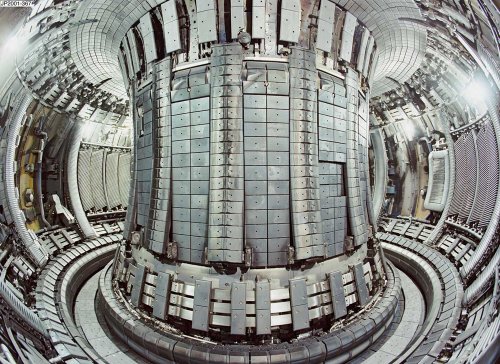
JET has been the world’s leading centre for research into fusion power since it opened in 1983. The experiment has achieved a long list of ‘firsts’, including the record for the amount of energy generated by a fusion reactor. The facility has kept its pre-eminence through an ongoing programme of enhancements, and JET is now being used to study potential operating scenarios for ITER. This essential work is expected to continue over the next decade.

More than 70,000 experiments have so far been carried out at JET — with around 30 experiments (or “pulses”) being run on a typical operating day. Collecting and managing all of this data is no mean feat.

During any one pulse, a large number of physical parameters are measured using over a hundred diagnostic instruments. The data are then processed using a workflow process that turns raw scientific data into more useful information through a complex chain of software. The raw and processed data are stored, and presented to the operators ready for use in setting up the next pulse. Summary data are generated for scientists to plan the pulse programme and complex models are run to predict the plasma behaviour.

Throughout the lifetime of JET, the amount and complexity of data gathered, processed, presented and modelled has increased dramatically. An ongoing challenge for people developing its IT systems has been meeting the demands of the fusion researchers, while evolving JET’s computer systems over many generations of hardware and software.

Key roles at JET

Tessella has fulfilled many key roles as part of the team supporting JET’s evolving research programme. These includes the support and enhancement of some of the facility’s main computing platforms from the mainframes of the 1980s to the Linux clusters of today as well as successive generations of software architectures that manage the processed pulse data.

Tessella has optimized the between-pulse processing workflow on the current Linux cluster and has produced a number of data visualization and statistical analysis systems using various mathematical packages. We have also developed complex plasma behaviour models as well as PC-based data-acquisition systems for the experiment itself.

Throughout the dramatic changes required in computing architecture, software and dissemination of data, Tessella has worked hard to ensure that all processed data have remained accessible — even information dating back to the first-ever pulses back in 1983. This attention to digital archiving allows JET to achieve one of its primary aims: to provide data to physicists designing ITER and other fusion experiments of the future.

Sharing fusion data around the world

ITER researchers are located throughout the world and must be able to access and share relevant information as easily as possible. To this end Tessella has been involved in revamping the ITER technical website and intranet while migrating both to the Microsoft SharePoint platform — and ensuring that both are coupled to the ITER Document Management System (IDM).

Over the past two decades Tessella has gained a thorough understanding of what fusion scientists and engineers need to manage and present data and technical documents. This has allowed the firm to improve the search methodology and knowledge-management capabilities of the ITER technical website and intranet. In addition users are now able to update their own web pages and more advanced users are able to edit content and create richer content.

As Tessella’s project manager for fusion, I have been working directly on JET for a number of years and I believe that our success and longevity with the facility is a result of our ability to field professional software engineers and project managers who have exactly the right academic backgrounds. Today, the company has physicists, mathematicians and engineers working on both JET and ITER, which is fundamental to Tessella’s continued involvement with these projects and to our ability to support other large research projects.

Fusion Symposium looks to ITER and beyond

The The 25th Symposium on Fusion Technology is being held on 15–19 September 2008 in the northern German coastal city of Rostock. The conference is expected to attract nearly 700 delegates who will present and discuss more than 500%nbsp;papers and posters on a wide range of topics in fusion technology.

The event is organized by the Max Planck Institute for Plasma Physics and the European Atomic Energy Community (EURATOM). Not surprisingly, many presentations will cover aspects of the ITER experimental reactor that is currently being built in Cadarache, France.

Invited speakers who will cover ITER include Octavi Quintana Trias, director of EURATOM, who give the first lecture of the event at 9.40 a.m. on Monday, 15 September. Quintana Trias will outline the European Union’s present and future contributions to the development and operation of ITER .

Later that day Norbert Holtkamp, ITER’s construction leader, will provide an overview of the status of the ITER design and how construction efforts are progressing in Cadarache. Holtkamp will highlight recent design changes and will report that all the modifications needed to meet French safety and licensing requirements have been made successfully.

An update on the design and construction of the ITER superconducting magnets will be presented on Monday by Neil Mitchell, deputy head of the project’s tokamak department. Mitchell will explain how ITER is dealing with the challenge of ensuring that construction gets underway in good time, while making sure that the latest breakthroughs in plasma and fusion physics are incorporated into the ITER design.

Schemes for plasma heating

Tuesday morning will feature a talk by Jean Jacquinot of EURATOM and the French Atomic Energy Commission (CEA), who will explain the electron cyclotron resonance heating and ion cyclotron resonance heating systems, which ITER will use to heat its plasma to temperatures high enough for fusion to occur.

Jumping ahead to Thursday there will be a series of invited talks on ITER-related research that is being carried out at other fusion facilities. Francesco Romanelli, European Fusion Development Agreement (EFDA) associate leader for the Joint European Torus (JET) in the UK, will start the morning with an explanation of how that facility is being used to perform a wide range of physics- and engineering-related studies for ITER, including the evaluation of the use of tungsten and beryllium heat shielding tiles.

Bernard Saoutic of EURATOM and the CEA will then take the podium to explain how researchers at the Tore Supra fusion reactor in Cadarche are contributing to the development of ITER by establishing techniques for plasma control; testing a new type of carbon-based heat shielding tiles; and developing a new type of lower hybrid current drive for creating currents within the ITER plasma.

Other ITER-related talks on Thursday include one by Otto Gruber, project leader at Germany’s ASDEX Upgrade in Garching, where researchers are studying a range of physics and engineering problems relevant to ITER. Gruber will outline how the reactor’s control and data-acquisition systems have been updated to mirror the system to be used at ITER. He will also discuss how the inside of the ASDEX reactor has been recently redone in tungsten-coated heat tiles, which should provide insight into the performance of similar tiles that will be used in certain parts of ITER.

Excursion to Wendelstein 7-X

Of course, not everyone will be speaking about ITER. For example, Lutz Wegener of the Max Planck Institute for Plasma Physics will provide an update on Monday about the construction of the Wendelstein 7-X stellarator fusion reactor. Currently being built at the Institute’s facility in Greifswald, Wendelstein 7-X is due for completion in 2014. Greifswald is about 100 km from Rostock and a tour of the facility will take place on Wednesday.

Back in Rostock on Tuesday, Toshihide Tsunematsu of the Naka Fusion Research Institute in Japan will be speaking about the broader approach (BA) research activities – a collaborative effort between researchers in Japan and Europe that aims to pursue fusion research that is complementary to that being done for ITER.

Tsunematsu will discuss three projects planned by the BA – the Engineering Validation and Engineering Design Activities for The International Fusion Materials Irradiation Facility (IFMIF/EVEDA); the conversion of Japan’s JT-60 tokamak to a satellite research facility that will support ITER and, ultimately, the development of fusion power reactors; and the planned creation of an International Fusion Energy Research Centre.

On Wednesday, Didier Gambier, director of a new Barcelona-based organization called Fusion for Energy (F4E), which was set up last year by the European members of ITER, is due to explain how F4E is establishing a fast track strategy for the accelerated development of fusion power and how F4E is recruiting scientists and engineers so that it can become a “centre of excellence for fusion engineering in Europe”.

Looking ahead to DEMO

If ITER is successful, the next step will be to build a demonstration fusion reactor that actually produces electricity. The EFDA has spent the last two years developing preliminary plans for such a reactor, which has been dubbed DEMO. On Friday Jerome Pamela of the EFDA Close Support Unit in Garching, Germany, will discuss long- and midterm targets that have been set for the development of DEMO.

Also on Friday, Minh Quang Tran of the Swiss Federal Technical University in Lausanne will provide and overview of the current work being done towards the development of a R&D strategy for DEMO.

Finally, the symposium also includes a Fusion Technology forum commercial exhibition, which will run from Monday to Friday and will feature about 35 companies. Exhibitors include Babcock Noell of Germany, France’s Air Liquide, Oerlikon Leybold Vacuum of Germany, and UK-based Oxford Technologies and D-TACQ. Other firms showing their wares at the exhibition include Linde-Kryotechnik of Switzerland, the UK’s MG Sanders, and Siemens of Germany.

Thales Electron Devices of France, Switzerland’s Thomson Broadcast & Multimedia and WEKA, and Pfeiffer Vacuum of Germany will also be exhibiting at the Fusion Technology forum.


Industrial procurement in fusion

Realizing the potential of nuclear fusion as a large-scale energy source depends on engaging industry to build reactor facilities and to supply the specialist engineering skills that are needed to sustain, monitor and control the fusion reaction. To help in that endeavour, the UK Atomic Energy Authority (UKAEA) has a dedicated fusion and industry team based at the Culham Science Centre in Oxfordshire. Its role is to encourage UK companies to bid for international supply contracts arising from fusion research, in particular ITER, the power-plant-scale fusion experiment currently under construction in Cadarache, France.

ITER is a significant business opportunity for UK engineering and high-technology companies, and is a high priority for our fusion and industry team. UK firms are already helping to provide the innovative engineering solutions required for the project, but more companies need to get involved. Construction of the facility offers a number of options for different sectors, ranging from civil, mechanical and electrical engineering, consultancy services and project management through to instrumentation, advanced materials and precision engineering. Areas of particular relevance to ITER include the development and manufacture of high-heat-flux components, high-power electrical engineering, vacuum and pumping systems, remote handling, multi-megawatt particle beams and radio-frequency-wave heating systems, laser and optical diagnostics, a wide range of instrumentation, and computing, data acquisition and control systems.

The fusion and industry team has good contacts with Fusion for Energy (F4E), the domestic agency based in Barcelona, Spain, that manages the European procurements for ITER. Some 90% of all ITER procurement will be handled by the domestic agencies of the seven ITER partners, with Europe being responsible for more than one-third of all the contracts. Most of the ITER contracts that are open to UK companies will, therefore, be placed via F4E. Some initial procurement has taken place, but most contracts will be offered over the next 10 years and will amount to at least €2bn.

Procurement by F4E will be partly database driven. Companies can register on the F4E procurement database to receive requests for expressions of interest . Currently there are more than 200 UK companies registered, but there are many more firms in the country with the suitable expertise. My message to UK industry is to look seriously at these opportunities, which range from conventional to leading-edge engineering, and also include consultancy and project management.

I see subcontracting as presenting perhaps the best option for many UK firms. This is largely because F4E is expected to break Europe’s contribution to ITER into relatively large contracts (perhaps ranging from two to many tens of millions of Euros) for the supply of components and systems, plus smaller service contracts for engineering design/support during the project’s construction phase. Companies intending to bid as main contractors are unlikely to have the complete range of skills required in-house, and so will be seeking subcontractors. Early consortia opportunities involving UK firms are currently being actively pursued.

The team at Culham also arranges occasional trade missions for UK companies to visit F4E headquarters and the ITER site. A visit to F4E will typically include meetings with the procurement teams, engineers and possibly senior management, while visits to ITER normally allow companies to meet the engineers working on the project, as well as local French companies, with a view to possibly forming consortia.

Opportunities also exist for industry involvement in fusion research that is taking place in the UK. The Culham Science Centre is home to the UK’s fusion programmes and what is currently the world’s largest fusion experiment — the Joint European Torus. To hear details about fusion contracts from the various UK-based programmes, and also ITER, companies should register with the Culham team’s database. Registered companies receive alerts about tendering opportunities, fusion news, plus details of technology-related events, workshops and exhibitions.

Fusion research and ITER in particular offer great opportunities for UK companies to win new business, either as a single supplier or as part of a consortium of firms. The first step is to register with both the F4E and the Culham fusion and industry databases, and then to let the fusion and industry team help you become part of this multibillion Euro sector.

Tritium–deuterium plasma puts the heat on ITER’s first wall

When the ITER fusion reactor is up and running in 2018, its plasma of tritium and deuterium is expected to reach 100 million K, which is hotter than the core of the Sun. One of the main challenges in designing the reactor is how to stop the plasma — contained by powerful magnetic fields — from being contaminated by unwanted materials that evaporate from the inside “first wall” of the torus-shaped vessel (or tokomak) that surrounds the plasma.

Most existing fusion reactors, such as the Joint European Torus (JET) in the UK, use carbon-composite (CFC) tiles for the first wall. Although such tiles can withstand extremely high temperatures, they are not suitable for use throughout ITER because the material tends to absorb tritium, which can weaken the tiles and remove lots of tritium from the plasma.

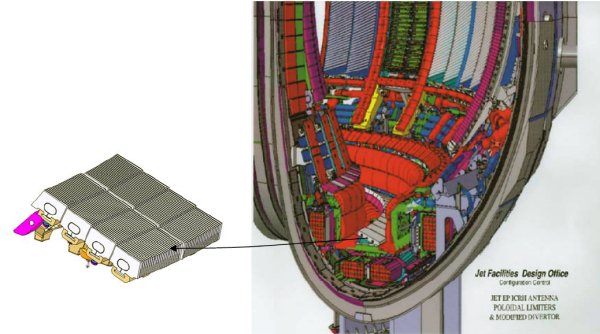
As a result, CFC tiles in ITER will be reserved for the hottest parts of the first wall — the divertor strike points where the plasma is actually deflected from the wall. Tungsten-coated tiles will be used elsewhere in the divertor, which guides heat and particles around the torus. The main chamber will be clad with beryllium tiles.

The combination of beryllium and tungsten has never been tested in a tokamak and both materials offer benefits and challenges. Tungsten is very resistant to high temperatures (melting at 3695 °C). However, it is a heavy element that ionizes easily in extremely hot plasmas. The evaporated tungsten will then react very strongly with the plasma, causing the tritium and deuterium ions to lose huge amounts of energy. Beryllium, in contrast, is a very light element that does not cause massive energy loss; the problem is that it melts at just 1284 °C.

The use of beryllium and tungsten as first-wall materials will be tested next year at JET in Culham, UK, as part of the ITER-like Wall (ILW) project. Tiles are currently being installed and the task should be completed by next year. Then the JET experimental programme will focus on the optimization of operating scenarios compatible with the ITER first wall.

The level of retained tritium and its dependence on plasma parameters will be measured by ILW to understand how tritium is being absorbed by the CFC tiles. Plasma performance will be tested to ensure that the amount of tungsten reaching the core plasma is acceptably low. The lifetime of the wall will be studied by operating JET at power levels similar to those expected in ITER.

While ITER will use a mix of materials for the first wall, many fusion researchers expect that the next generation of reactors will have an all-tungsten design. Indeed, researchers at the ASDEX Upgrade tokamak in Garching, Germany, are currently exploring the viability of such an approach.

It has become clear that the tungsten-plated tiles available today would have unacceptably short lifetimes if used in the hottest regions of a divertor. To address this problem, a solid-tungsten tile concept has been developed under the leadership of scientists at the Jülich Research Centre in Germany.

An important design requirement was to minimize the electromagnetic forces in the wall, while making it as mechanically stable as possible. This was achieved using tiles made of 6-mm thick tungsten layers packed together in four poloidal stacks and bolted together in a toroidal direction. The tungsten layers are separated by electrically isolating spacers to reduce eddy currents and therefore electromagnetic forces.

Each layer has dedicated electrical contact points to the support structure to avoid arcing and reduce halo currents, which also result in electromagnetic forces. A prototype of this design has survived cycling heat-flux tests at temperatures above 3000 K.

The tiles are clamped to the wedge using a chain that passes through cutouts in the tiles and spacers, and uses spring-loaded pull-down bolts to hold the tiles and spacers on to the wedge. The chain combines this clamping action with a second function: it keeps individual tiles together by compressing the tungsten stack.

The tiles will be installed in JET as part of the tungsten load bearing system replacement plate divertor modules (W-LBSRPs), which are being built by MG Sanders under a €5 m contract with JET and the European Fusion Development Agreement (EFDA). Each W-LBSRP includes carriers (or wedges) that support the tungsten layers and are made from the nickel-based alloy Inconel 625. The firm is also supplying the intermediate insulating spacers, which are made of an alloy of titanium, zirconium and molybdenum.

A total of 48 divertor modules will be installed at JET, and together they comprise about 80,000 individual components. To complete the project in an 18-month period, MG Sanders has invested in new CNC 5-axis computer-controlled machine tools, class-7 assembly facilities, electrical discharge machining capability for working with hard metals and additional metallurgical management resources.

Fusion research is a relatively new market for MG Sanders and one in which the firm sees great potential for its tungsten products and precision engineering skills.

Copyright © 2026 by IOP Publishing Ltd and individual contributors