

Cold fermions could simulate superconductors

Physicists in Switzerland and France have produced a gas of cold, trapped atoms which mimics features of solid-state superconductors. By confining potassium atoms at temperatures a fraction of a degree above absolute zero in a pattern of deep potential wells – similar to eggs in an egg carton — researchers led by Tilman Esslinger at ETH Zurich have created the first example of fermionic atoms behaving like a Mott insulator.

A Mott insulator forms when interactions between electrons in a crystalline solid prevent the conduction electrons from moving freely between atoms. Many important phenomena in condensed matter physics, including high-temperature superconductivity, occur when the material is nearly in a Mott insulating phase. The reasons for the transition to high-temperature superconductivity are not fully understood, however, and applying the reigning theoretical model (known as the Hubbard model) to complex solids at relatively high temperatures creates computational headaches.

‘Quantum simulators’

Atomic systems like the potassium lattice in Zurich are far simpler and easier to manipulate, and can be used as “quantum simulators” in which one quantum system imitates the behaviour of a more complex one. In the atomic analogue to a Mott insulator, intersecting laser beams form a crystal-like “optical lattice” of potential wells, with one atom in each well. If the wells are deep enough, atoms can no longer hop or tunnel between lattice sites and an “insulator” is formed.

What we do is to simulate this very interesting quantum system in a more controlled fashion Henning Moritz, ETH Zurich

The first atomic Mott insulator was created in 2002 by researchers at Munich using ultracold bosonic rubidium atoms. But electrons are fermions, so the Zurich experiment is one step closer to a quantum simulator for solid-state systems, says Henning Moritz, an author of the Zurich group’s paper, which appeared in Nature on 11 September.

Difficult to observe

Bosons undergo an abrupt and relatively easy-to-detect phase transition from a Bose-Einstein condensate to a Mott insulator. Such a transition does not occur in fermions due to differences in their quantum properties, so the onset of the Mott insulator is harder to observe directly.
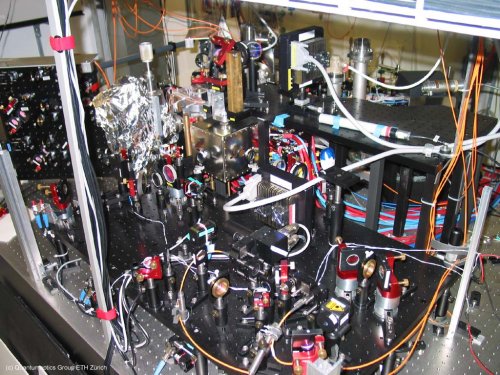
Instead, the Zurich team demonstrated that almost none of the lattice sites in their experiment were occupied by more than one atom — a key requirement for a Mott insulator to exist (Nature 455 204 ).

To do this, they first exploit a phenomenon known as a Feshbach resonance to make pairs of atoms repel each other, so that even fermions in different spin states (which can have the same energy under the Pauli exclusion principle) are no longer as “happy” to share the same lattice site. The trapped atoms are then subjected to a pulse of radio frequency light, which flips the spins of one atom in every pair, but leaves lone atoms untouched. By recording “shadow” images of atoms in different spin states, the team was able to show that only 1% of lattice sites contained more than one atom.

They definitely see very nice evidence of strong interactions between the particles suppressing double occupation, but in my view this is not sufficient for proving a Mott insulating state Immanuel Bloch, University of Mainz

More to be done

Some scientists sounded a note of caution about the result. “They definitely see very nice evidence of strong interactions between the particles suppressing double occupation, but in my view this is not sufficient for proving a Mott insulating state,” says Immanuel Bloch of the University of Mainz, who led the team which demonstrated the first atomic Mott insulator. Another key requirement, he says, is to show that the system cannot be compressed – besides having no doubly-occupied sites, the lattice also must not have “holes”. A related paper by Bloch and colleagues at Mainz and Cologne, in which they describe a competing method for creating and detecting a Mott insulator in atomic fermions, appeared yesterday as a preprint on the arXiv preprint server (arXiv:0809.1464).

Moritz accepts that the Zurich experimenters have no direct evidence of an incompressible or “hole-free” lattice, but says that their system is cold enough that few holes can exist. “A direct measurement of compressibility would be a beautiful thing, but even without that we are very clear that what we have seen is only consistent with a Mott insulator,” he says.

Both Moritz and Bloch agree that a Mott insulator is only the first step towards using cold atoms to test our understanding of high-temperature superconductivity. The next landmark, Moritz says, would be to demonstrate an antiferromagnetic Mott insulator, in which fermionic atoms in neighbouring lattice sites have opposite spins, and can therefore hop between lattice sites for brief periods.

Turn down the heat

To achieve this, experimentalists need to produce temperatures two or three times colder than have so far been reached for fermions, Bloch said, while imitating high-temperature superconductivity would probably require a further factor of 100.

Still, the current result is important, Moritz said, because it represents a new way of studying solid-state systems. “What we do is to simulate this very interesting quantum system in a more controlled fashion,” he said.
Mission complete for LHC team

Tonight the Large Hadron Collider (LHC) operations team can go home happy in the knowledge that they completed both their “principal” and “personal” goals.

The principal goal — the one for the benefit of the world’s media — was completed at 10:24 am CET (9:24 am BST) by sending a proton beam clockwise all the way around the LHC’s 27 km-long ring. But later today, at 3:02 pm CET, the team’s secret hope came true as it successfully repeated the exercise for the anticlockwise direction.

The time taken to complete both these feats — just under an hour for the first, and precisely an hour for the second — has come to be known as the two “golden hours”.

In an interview with physicsworld.com after the day’s events, Robert Aymar, director general of CERN, the European lab hosting the LHC, maintained he was confident all along that the team would achieve beam circulations in both directions. “We were prepared, and anything could happen,” he said. “But there was always a risk.”

“It is proof that we are now ready for new physics,” he added.

‘We’ve learned a lot’

Although today went more smoothly than anyone had hoped, there were some minor problems. In the control room at 4 am this morning a yellow signal lit up on the monitors, indicating that one of the sectors had heated up slightly as the result of a cryogenics failure. An hour later engineers were busy at work on the faulty compressor that caused it, and within a few hours it was fixed.

However, cryogenics briefly returned to haunt the operations team at lunchtime. Steve Myers, the head of the accelerators department, said that his team is planning look into the cause of that occurrence. “[Cryogenic issues are] to be expected because this is an enormous system and it still has its teething problems,” he explained. “But we’ve learned a lot about the system today and I’m sure that from today onwards we’ll be learning even faster.”

During a press conference, director generals of CERN, both past and present, lauded the LHC for the strength of its international collaboration and the new physics it is expected to bring.

Chris Llewellyn Smith, who was director general between 1994 and 1998 and who took the case for a proton–proton collider to the CERN council in the late 1970s, called it a “fantastic day”. “We are now continuing a quest that is as old as civilization,” he added. “And if you were being pompous, you would say that that quest was the definition of civilization.”

Herwig Schopper, who was director general between 1981 and 1988, compared today’s LHC “switch on” with the event for CERN’s previous flagship accelerator, the Large Electron-Positron collider (LEP), in 1989. “I remember 19 years ago in the LEP control room it took 12 hours,” he said. “Today it took one — and this is based on the competence of the CERN engineers. Without this competence, CERN would not be where it is today.”

Home run complete, LHC set to repeat it backwards

Half a day into the hotly anticipated “start up” day of the Large Hadron Collider (LHC), the operations team has scored a home run going clockwise and is now trying to circulate a proton beam in the anticlockwise direction.

Inside the state-of-the-art control room at CERN, the European lab hosting the accelerator, some 50 to 100 senior members of the project have had their eyes fixed on an array of plasma-screen monitors as bunches of protons made their way step-by-step through the 27 km-long ring. The first proton beam fired into the ring at 9:30 am CET (8:30 am BST) and in just under an hour a beam had made it all the way round.

I think we are quite excited and quite happy Robert Aymar, director general of CERN

For the throng of journalists packed into the science and innovation “globe”, the 10,000 or so other CERN staff and users, and the many thousands of physicists worldwide all on the edge of their seats, that time seemed almost unbelievably short.

“I think we are quite excited and quite happy,” said Robert Aymar, director general of CERN. He then thanked all those who participated, particularly Lyn Evans, the project leader.

Just as the champagne corks popped, Evans was overheard saying he had “won the bet”. He later admitted that the bet was with Steve Myers, the head of the accelerators department, that they would get a beam round in less than an hour. “[Myers] refused to put the money up,” he added, though did not specify the amount.

‘Exceeded expectations’

Although the feeling among many at CERN yesterday was that today is an arbitrary date for a “switch on” — the LHC first received protons on 8 August — there is no understating the excitement that is now flooding through the European lab.

The priority is to get both beams circulating…then I think everyone will be so tired we won’t get anything else done Verena Karin, LHC operators

Roger Jones is a physicist from Lancaster University in the UK who is working on the ATLAS experiment, which was the last to see its detectors light up as the proton beam passed through today. “I predicted the beam would get round by 11:00 am,” he said, “so it exceeded my expectations.” Because Jones was working in the upstairs control room at ATLAS where there is no video link, he kept up to date with events by listening to the radio.

The operations team now expects that the €6.3 bn particle accelerator, which is by far the world’s most powerful, will have managed to circulate a proton beam in both directions by the end of day.

“The priority is to get both beams circulating…then I think everyone will be so tired we won’t get anything else done,” said Verena Karin, one of the LHC operators, during a long-distance interview from the control room. When asked whether the feeling in the control room was similar to that felt in NASA mission control during a Mars landing, she said: “I have not been there, but yes, I imagine it was exactly like that.”

physicsworld.com asked Karin what her message would be to all the other researchers who are eagerly watching the events unfold. “Keep watching,” she answered. “It’s really really good, it’s really really exciting. It’s like the Olympics.”

Sci Fi meets science at the LHC

torchwood.jpg
Ready for action at the LHC (Courtesy: BBC).

By Hamish Johnston

Clearly the world didn’t end earlier today when the first protons made their way around the LHC.

But what if something unexpected had happened…what if physicists (including our own Jon Cartwright) started vanishing and what if something was lurking in the accelerator tunnel…who would we turn to?

Torchwood’s Captain Jack, of course, who will be leaping from the tallest toroids later today in a special radio edition of the Dr Who spin-off set at the LHC.

You can listen to Torchwood: Lost Souls on BBC Radio 4 today at 14.15 BST and for the next seven days as a podcast.

And for more LHC fun, check out this story in The Sun: Boffins in ‘Doomsday’ rap

LHC milestone day gets off to fast start

The official “start up” day of the Large Hadron Collider (LHC) has begun, with a low-energy beam of protons making it all the way round the 27 km-long ring.

At 9:30 a.m. CET (8:30 a.m. BST), control-centre scientists Stefano Radaelli and Rassano Giachino — given the go-ahead from project leader Lyn Evans — injected a proton beam with an energy of 450 GeV from the Super Proton Synchrotron into the LHC.

The beam travelled through one of the eight sectors and past the ATLAS experiment before being stopped by a purposefully inserted screen. At that moment the screen generated a flash — and an applause from all those in the control room.

After just a few minutes the operations team decided to remove the screen and take the beam through another sector. That, too, was successful.

At 9:44 a.m. CET the team removed the screen preventing access to the third and fourth sector, and tried to get the beam to the halfway point where the CMS experiment is located. The first attempt failed, but the second produced the tell-tale flash, and even CMS saw some particle tracks.

Clearly on a lucky streak, Evans gave the order to allow the proton beam past the halfway point into sector four, where the “beam dump” point is located. At 9:54 a.m. CET, the operations team cheered as their plasma monitors revealed the beam’s successful progress. However, Evans decided — in French — that the beam was not “beautiful” enough and needed it to be “more corrected”.

“At this rate, we hope,” he said, “we should get a beam all the way around the LHC within an hour.” Minutes later at 10:06 a.m. CET another ovation marked the successful passage of the proton beam through the 700 m-long beam-dump tube.

By 10:13 a.m. CET the beam had made it round to the seventh sector past the LHCb experiment. Then, at 10:17 a.m., it reached ATLAS, the biggest of the four experiments at the LHC.

After several moments of tense silence, the home run came at 10:24 a.m. and 30 s to a huge applause.

Robert Aymar, the director general of CERN, said he was “too happy to be on TV”.

The injection marks the beginning of a milestone day for CERN, the European lab hosting the €6.3 bn accelerator. Hundreds of journalists have packed into the lab’s science and innovation “globe” to report on the day’s events, while at least three international satellites are relaying a live video and data stream to institutions worldwide.

LHC switch-on: a preview

control room.jpg
The LHC control room (heavy lever obscured from view).

By Jon Cartwright

Until a few months back I had an excited vision of the moment the great LHC “switch on” would take place. Here’s how it goes: The control room, normally frantic with the workings of scientists, falls under tense silence as a lone technician grips a heavy lever. Just as the quiet becomes unbearable, the director general mutters: “OK, let’s go.” Beads of sweat trickling down his temples, the technician heaves back the lever while averting nervously to a dial that has coloured bars going from green to yellow to red (450 GeV…5 TeV…7 TeV…DANGER) . “Faster!” cries the director general, his eyes glowing with a sort of manic intensity, “Faster!” Then the control room begins to shake and the scientists dive under their workstations to avoid the plaster and tiles falling from the ceiling.

Needless to say, the real event tomorrow will not satisfy onlookers with any cinematic clichés (and nor will the beams break any speed records — they will be strictly cruising at their injection energy of 450 GeV). But that’s not to say the event will be without drama, as I found out today when I went to CERN’s Meyrin site for for lunch with Paul Collier, head of the accelerator operations team.

“It’s not like blasting off from Cape Canaveral,” he said, referring to the fact that there is no definite countdown for performing certain tasks. Rather, the operations team will be learning as it goes, and we will get to watch — milestones, mistakes and all. The current plan is to inject the first beam into the ring at around 9:30 am, but it could happen anytime between 9 and 10 am (keep an eye out on this blog for the decisive moment). From then on, the team will take the beam round the LHC’s 27 km-long ring in a dozen or so sections, each initially fenced-off by a physical barrier.

(more…)

Bar brief power failure, LHC ready for start up

By Jon Cartwright

In my last blog entry on the Large Hadron Collider (LHC) I asked if CERN could make it to Wednesday without any further difficulties. Well, there’s been one — a thunderstorm-induced power cut that took out the cryogenic systems for the weekend — but other than that it’s all systems go for the eagerly awaited “start up”.

On Friday evening, according to CERN spokesperson James Gillies, the LHC operations team successfully performed a third and final synchronization test. Unlike the previous two tests, which concerned “kicking” proton beams from the Super Proton Synchrotron into the LHC’s ring, the aim on Friday was to make sure the protons could be booted out of the ring at the “beam dump” point located between sectors five and six. The latest test also demonstrated that the team could navigate the protons around two sectors, or about 7 km. That means they’ve already reached 25% of their target for Wednesday, when they plan to get a low-energy beam cruising around the 27 km ring in one direction.

Talking about Wednesday, physicsworld.com is now reporting from CERN to bring you all the news in the run-up to the big day. You can also expect an analysis of the events in the October issue of Physics World.

LHC fever hits the UK

By Hamish Johnston

You would have to be living under a rock in the UK not to know that the Large Hadron Collider will be fired up next week at CERN in Geneva. BBC Radio 4 is dedicating an entire day of programming to the LHC (called ‘Big Bang Day’, and this is being promoted with great fervour across the corporation’s many TV and radio outlets.

This morning Chris Llewellyn Smith,former director general of CERN, was on Radio 4’s Today Programme to reassure listeners that the world will not be destroyed by a black hole — or turn into a “strange goo” — when the LHC is switched on.

Meanwhile over on Radio 5 Live, CERN physicist John Ellis was chatting about his new paper  ‘Review of the safety of LHC collisions’ with host Nicky Campbell. This is surely the first time that an article in the Journal of Physics G: Nuclear and Particle Physics has been deemed to have the same news value as the latest exploits of Newcastle United’s ex-manager Kevin Keegan.

Indeed, one could be forgiven for thinking that the LHC is ‘brought to you by the BBC’. In today’s Times, gossip columnist Adam Sherwin suggested that the LHC start-up date was pushed back to 10 September because BBC superstar Andrew Marr — who will be presenting live from CERN on the day — is on holiday this week. The BBC has denied exerting undue control over the world’s largest physics experiment.

Another ‘quality daily’, The Independent, ran the headline ‘It’s sex and drugs and particle physics as D:Ream star recreates the Big Bang’ earlier this week. For those too young to remember, the article refers to Brian Cox, who is sort of a Liam Gallagher of particle physics and one of the many stars that the BBC will be rolling out next week.

And leave it to The Sun to say: ‘End of the world due in nine days’ …unless Andrew Marr decides to extend his holiday, of course.

Cloud-seeding ships could combat climate change

It should be possible to counteract the global warming associated with a doubling of carbon dioxide levels by enhancing the reflectivity of low-lying clouds above the oceans, according to researchers in the US and UK. John Latham of the National Center for Atmospheric Research in Boulder, US, and colleagues say that this can be done using a worldwide fleet of autonomous ships spraying salt water into the air.

Clouds are a key component of the Earth’s climate system. They can both heat the planet by trapping the longer-wavelength radiation given off from the Earth’s surface and cool it by reflecting incoming shorter wavelength radiation back into space. The greater weight of the second mechanism means that, on balance, clouds have a cooling effect.

’Twomey effect’ boosts reflectivity

Latham’s proposal, previously put forward by himself and a number of other scientists, involves increasing the reflectivity, or “albedo”, of clouds lying about 1 km above the ocean’s surface. The idea relies on the “Twomey effect”, which says that increasing the concentration of water droplets within a cloud raises the overall surface area of the droplets and thereby enhances the cloud’s albedo. By spraying fine droplets of sea water into the air, the small particles of salt within each droplet act as new centres of condensation when they reach the clouds above, leading to a greater concentration of water droplets within each cloud.

Latham and co-workers, including wave-energy researcher Stephen Salter of Edinburgh University, claim that such spraying could increase the rate at which clouds reflect solar energy back into space by as much as 3.7 Wm-2. This is the extra power per unit area that scientists say will arrive at the Earth’s surface following a doubling of the concentration of atmospheric carbon dioxide compared to pre-industrial levels — 550 ppm vs 275 ppm (Phil. Trans. R. Soc. A DOI:10.1098/rsta.2008.0137).

New spin on sailing

The 300-tonne unmanned ships used to seed the clouds would be powered by the wind, but would not use conventional sails. Instead they would be fitted with a number of 20 m-high, 2.5 m-diameter cylinders known as “Flettner rotors” that would be made to spin continuously. This spinning would generate a force perpendicular to the wind direction, propelling the ship forward if it is oriented at right angles to the wind (Phil. Trans. R. Soc. A DOI: 10.1098/rsta.2008.0136).

These rotors would be easier to operate remotely than sails and would also serve as the conduits for the upward spray, with the spray consisting of droplets 0.8 µm in diameter generated by passing sea water through micro nozzles. The power for the spray and the cylinder rotation would be provided by oversized propellers operating as turbines.

The immediate effect of seeding clouds in this way would be a local cooling of the sea surface, and as such the technique could be targeted at coral reefs, diminishing polar ice sheets or other vulnerable regions. However, the great thermal heat capacity of the ocean and the currents within it mean that these initial effects would eventually spread across the globe.

Fleet of 1500

Latham and colleagues calculate that, depending on exactly what fraction of low-level maritime clouds are targeted (with some regions, notably the sea off the west coasts of Africa and North and South America, more susceptible to this technique than others), around 1500 ships would be needed altogether to counteract a carbon doubling, at a cost of some £1m to £2m each. This would involve an initial fleet expanding by some 50 ships a year if the scheme is to keep in step with the current rate of increase in atmospheric carbon-dioxide levels.

This cloud-seeding proposal is one of a number of ideas put forward by scientists in recent years to “geoengineer” the Earth in response to climate change rather than, or as well as, deal with the causes of the change. A series of papers on several proposals, including Latham’s, have been published in a recent issue of the journal Phil. Trans. R. Soc. A entitled Geoscale engineering to avert dangerous climate change.

Latham maintains that his group’s idea is not pie in the sky and that its feasibility is supported by two of the world’s leading computer climate models, as well as recently obtained experimental cloud data. He points out that, unlike rival techniques, the system could be used to vary the degree of cooling as required and could be switched off instantaneously if needed. However, he adds more research must be done to find out a number of unknowns — such as exactly what fraction of spray droplets will reach the clouds — and to establish that the technique would not create any harmful climatic side effects. More work must also be done on the spray technology, he says.

Should cameras be banned at conference presentations?

By Jon Cartwright

Physicists used to be able to show preliminary results at conference presentations, safe in the knowledge that no-one would steal their data. Now, with the advent of the “physics paparazzi”, things have changed.

It started a few weeks back when, at a high-energy physics conference in Philadelphia, a member of the PAMELA team flashed a slide that depicted an excess of high-energy positrons in the ionosphere. Although several conference attendees suggested the positron excess could be evidence for dark matter — the elusive substance thought to make up some five-sixths of all matter in the universe — the team did not make the slide available to journalists or other scientists.

That, however, didn’t stop Marco Cirelli of CNRS in France and Alessandro Strumia of INFN in Italy. Those attendees managed to take a snapshot of the slide during its momentary disclosure and use the picture as the basis for an analysis which they published on the arXiv preprint server.

(more…)

Copyright © 2026 by IOP Publishing Ltd and individual contributors