Seeing animals in a new light

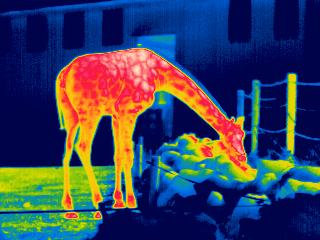
Ir_0053.jpg
(Credit: Chris Lavers)
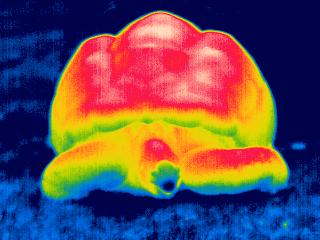
galapagos.jpg
(Credit: Chris Lavers)

By Jon Cartwright

At first glance these images look like snapshots from that classic eighties sci-fi flick Predator.

It turns out, though, that the pre-eminent being responsible for them is not a brawny, gun-toting alien, but Chris Lavers, a technology lecturer at Britannia Royal Navy College in Dartmouth, UK. The images are infrared portraits of various animals dwelling at Paignton Zoo in Devon.

“I have been involved in thermal imagery for about 10 years now, and thermal imagery of wildlife with Paignton Zoo since 2002,” writes Lavers in an email. “My interest is concerned with highlighting the plight of endangered species under pressure from both man and climate change, deteriorating environments, etc.”

Lavers explains that thermal images can be used to observe animals without stressing them. “It enables a healthy baseline assessment of animals to be established and thereby aids veterinarian diagnosis,” he writes.

Aside from giving giraffes, tortoises and other creatures a once-over, Lavers is also interested in using thermal imaging to copy some of nature’s designs, such as iridescent butterfly wings. These could be employed in future stealth devices, he says.

If you want to see more of Lavers’s images — and are out and about in the south-west of the UK — you can visit his exhibition. It starts on 15 September at Paignton Zoo, and moves onto the Living Coasts zoo in Torquay until the third week of October.

Spin-flip speed is pushed to the limit

Researchers in Germany have devised an extremely fast way of changing the value of a magnetic data bit using a current of spin-polarized electrons.

They claim that their technique could soon be used to create magnetic random access memories (MRAMs) that are as fast as conventional memory chips and have storage densities that are just as high. The big advantage of MRAMs is that they retain their data when switched off, which also means they could be used to create energy-efficient electronic devices.

Conventional fast memory chips, such as dynamic and static random access memories (DRAMs and SRAMs), store data bits in the form of electrical charge in tiny capacitors. When their power is shut off, the data rapidly leak away.

As well as being responsible for the annoying “boot time” when a computer is first switched on, in which data get transferred from the hard-drive to the memory, conventional memory also needs lots of energy just to store information.

Magnetic nanopillars

Most chipmakers believe that MRAM — in which data bits are stored in tiny “nanopillars” of magnetic material — offer the best way of creating a fast memory that does not need to be powered all the time.

Most MRAMs use a tiny magnetic coil near to the nanopillar to switch the direction of its magnetization and so flip the bit from, say, “0” to “1”. However, it is a tricky business making coils small enough to achieve MRAM chips with bit densities as high as those found in DRAM or SRAM.

One solution is to forget about having a bulky coil and instead flip the nanopillar by passing a pulse of spin-polarized electrons through it. Most spins in such a pulse point in a specific direction (up or down) and their magnetic moment exerts a “spin torque” on the magnetization of the nanopillar.

In prototype spin-torque MRAMs made to date, however, this process is much too slow. The snag is that the magnetic moment oscillates for about 10 ns before settling into its new orientation, which is about 10 times too long to be practical.

This has frustrated physicists, because in theory it should be possible to flip the magnetization in about 1 ns.

Speedier flip

Now Hans Werner Schumacher and colleagues at the PTB standards lab in Braunschweig and the University of Bielefeld have shown that by carefully controlling the temporal shape and length of the pulse — and by applying a small constant magnetic field — a nanopillar can be flipped in just 1 ns (Phys Rev Lett 101 087201).

Shumacher told physicsworld.com that the magnetic field “puts the magnetization into a well-defined position where switching is easiest”.

The team carried out their experiments using commercial prototype spin-torque MRAMs made by Singulus Nano Deposition Technologies in Frankfurt. While external coils were still used to generate the magnetic field, Schumacher believes that a similar magnetic field could be created in the vicinity of each nanopillar by carefully designing the shape of the memory bit.

Commercial technology

“Our technique is the first way of getting reliable switching to one nanosecond”, said Schumacher, who believes that the technology could be included in commercial MRAMs by 2010.

Massive young stars defy tidal forces

Astrophysicists have long wondered why the centre of our galaxy is populated by massive young stars that, one might think, would be unable to form close to the supermassive black hole that lies at its heart. Now, however, that mystery may have been solved by two researchers in Scotland.

They have carried out computer simulations that suggest that some of the gas swirling into the black hole can form dense clumps that orbit — but do not disappear into — the hole before turning into massive stars. The research could improve our understanding of both star formation and supermassive black holes.

Startling discovery

Astronomers have known for about a decade that the cores of many galaxies — including our own Milky Way — contain supermassive black holes. The discovery was made by charting the motions of the very bright and very massive stars that populate the region near to the centre of the Milky Way.

But it wasn’t long before astrophysicists started to wonder how those stars got there in the first place. Conventional theories of star formation suggest that violent tidal forces would prevent stars from forming close to a supermassive black hole — and the stars appear to be too young to have been created elsewhere and then pulled into the galactic core.

The new simulations, carried out by Ian Bonnell at St Andrews University and Ken Rice from the University of Edinburgh, suggest that the stars were in fact formed near to the black hole. They also found that the process favours the creation of massive stars over their smaller counterparts, which could explain why the core of our galaxy — but not the rest of it — is dominated by very large stars (Science 321 1060).

Two different clouds

In their simulations, Bonnell and Rice used over a year of computing time on a SGI Altix supercomputer to predict what would happen when two differently-sized gas clouds (one about 10,000 times the mass of the Sun and the other about 100,000 times the mass of the Sun) are sucked into a black hole.

The simulation suggested that the intense gravitational field of the black hole (which itself is about one million times the mass of the Sun) heats the incoming gas, creating shock waves that transfer energy outwards from the black hole. These waves appear to deflect as much as 90% of the incoming gas into an oval-shaped disk that orbits the black hole – with the remaining gas disappearing into the abyss.

The simulations also tracked the progress of the gas in the disk. They found that the black hole’s violent tidal forces heat the clumps, which increases their internal pressure. Only larger clumps have enough gravitational energy to overcome the pressure effects of tidal heating, which is why — say Bonnell and Rice — the formation of larger stars is favoured.

Close eccentric orbits

The researchers have so far tested two possible types of incoming clouds. The first, which involved 100,000 solar masses of gas, suggested that about 200 stars with masses between about 10 to 50 times that of the sun would be formed in close eccentric orbits around the black hole. However, a second simulation, involving 10,000 solar masses of gas, failed to generate a preponderance of massive stars and instead suggested that mostly Sun-sized stars would be created further away from the black hole.

“These results match the two primary properties of the young stars in the centre of our Galaxy: their high mass and their eccentric orbits around the supermassive black hole,” says Bonnell.

One drawback of the study is that it only considered two of the many possible shapes and sizes of clouds that could fall into a black hole. The pair now plans to simulate a few more scenarios to understand the relationship between star formation and the initial conditions of the cloud.

Reinhard Genzel , one of the astronomers who originally discovered the Milky Way’s supermassive black hole, told physicsworld.com that the simulations will further our the understanding of supermassive black holes and their relationship to the formation of galaxies and exotic structures such as quasars.

Genzel believes that theoretical work on star formation near black holes is “now becoming sophisticated and realistic enough such that …we can expect to obtain a fairly robust understanding of these wonderfully puzzling phenomena in the very near future”.

Do citations take the shine off the Nobel prize?

Come October, it will be the 10 million kronor question: who’s going to win the 2008 Nobel Prize for Physics?

Of course, every physics buff will have a tip to share. But if a study by researchers in Canada is anything to go by, it is much harder to predict — and perhaps choose — winners today than it was half a century ago.

Yves Gingras and Matthew Wallace at the University of Quebec, Montreal, based the study on citation data of physics and chemistry Nobel laureates from the prize’s inception in 1901, when Wilhelm Röntgen picked up the first physics award for the discovery of X-rays, through to last year, when Albert Fert and Peter Grünberg shared the physics prize for their discovery of giant magnetoresistance.

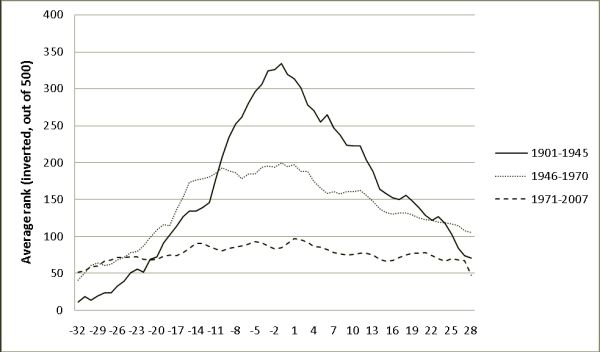
Using this data, Gingras and Wallace ranked the laureates among their contemporaries in terms of how often their papers are cited by others, and then analyzed how the ranks changed with time. The result was a year-by-year list of the most influential scientists, which the researchers could compare with the awarding of Nobel prizes.

‘More difficult now than ever’

In the run-up to 1945, Gingras and Wallace’s analysis portrays Nobel laureates as leading lights in physics (see graph). The data reveal that, during the course of the scientists’ careers, their citation rankings peaked strongly about a year before their Nobel recognition, implying they were a dead-cert. After they received the prizes, their rankings decreased more slowly — presumably, say Gingras and Wallace, propped up by the kudos or “halo effect” of being a laureate.

After 1945, however, it is a different story. With every year gone by, the ranking of Nobel laureates goes down and down until they are barely distinguishable from other top-level scientists. In fact, in the period from 1971 to 2007 there appears to be no peak in the citation ranking of the prize winners at all (arXiv:0808.2517).

Gingras and Wallace attribute the lack of stand-out laureates to the growing number of sub-disciplines in science: “It is obvious that science has grown exponentially over the 20th century…to such an extent that the fragmentation of science makes it more difficult now than ever to identify an obvious winner for a discipline as a whole.

“Whereas it was still relatively easy around 1910 to know who the most important scientists in a discipline were, such a judgement is much more difficult since at least the 1970s.”

Prediction is ‘almost futile’

The analysis raises the question of whether the Nobel Prize for Physics is as prestigious as it was in the first half of the 20th century. Gingras and Wallace stop short of making this connection, though they do suggest that the Nobel committee has a much harder time picking out the best candidates; this might be borne out in the fact that there have been no unshared awards in the past 15 years. Certainly, they say that “the game of prediction” is “almost futile”.

“It is true that it takes longer for recognition now than, say, in the 1920s and 1930s,” says Lars Brink, a member of the 2008 Nobel Prize for Physics Committee. “This is partly due to the fact that physics is more developed and that it takes a longer time to do experiments and to verify theoretical ideas.”

Brinks adds, however, that he does not think that fact makes it harder for him and his colleagues. “It has always been a difficult and time consuming job,” he says.

The Quebec researchers also avoid the fact that Nobel prizes are, more often than not, awarded on the basis of a single discovery — not on their performance in league tables. As Arne Tiselius, erstwhile head of the Nobel chemistry committee, wrote: “You cannot give a Nobel for what I call ‘good behaviour in science.’”

Spinning electrons make for an unconventional metal

An international team of physicists has turned a common semiconductor material into an unconventional type of metal called a “non-Landau–Fermi liquid”.

While this is not the first such metal to be made, the team claims that it is the first that can be described by a simple theoretical model. This could help physicists understand more complicated non-Landau–Fermi liquids such as high-temperature superconductors and also could lead to new ways of controlling spin-polarized electrons.

One of the most remarkable properties of individual conduction electrons in most metals is that they appear to go about their business oblivious to the fact that they are crammed into a solid lattice along with 1022 other electrons and ions. Instead of ricocheting from one collision to the next, the electrons appear to flow smoothly through a metal much like a fluid through a pipe.

Non-interacting electrons

This behaviour was first explained in 1956 by the Soviet physicist Lev Landau, who argued that the effects of the interactions between the electrons could be accounted for by describing the system as a collection of non-interacting electrons, called “quasiparticles”, each with an “effective mass” greater than the mass of a free electron.

The Landau-Fermi model relies on the idea of “screening” — that the electrostatic forces within a cloud of negatively charged electrons are cancelled exactly by the positively charged ions. Similarly, the interactions between the spin magnetic moments of electrons and ions are also screened.

Landau–Fermi liquid theory has been extremely successful at describing the behaviour of systems as varied as metals and liquid helium. However, physicists have discovered a small but growing number of materials in which electrons move freely, but cannot be described by the Landau–Fermi liquid model. The most notable being the high-temperature cuprate superconductors, which have proven very difficult to understand.

Researchers are therefore keen to understand the properties of such “non-Fermi liquids”, but have yet to find a simple system that can be studied both experimentally and theoretically.

Simple theory

Now Gabriel Aeppli at the London Centre for Nanotechnology and University College London, and colleagues at the National University of Lesotho, Louisiana State University and Bell Laboratories in New Jersey, have discovered that doped iron silicide (FeSi) can be a non-Landau–Fermi liquid. What’s more, they say that the behaviour can be predicted by a simple theory (Nature 454 976).

FeSi is a small gap semiconductor that has been widely studied because its optical and electronic characteristics can be easily altered by doping it with impurities such as aluminium and cobalt . While this creates disorder in the material, the doped FeSi samples previously studied were Landau-Fermi liquids.

In this new work Aeppli and colleagues doped FeSi with manganese atoms, contributing an ionic core with a spin magnetic moment of one. However, each manganese impurity also creates a positively-charged “hole”, which is a quasiparticle with a spin magnetic moment of 1/2. This means that the spin magnetic moments of the impurities cannot be fully screened by the spins of the holes.

Quantum ambiguity

At very low temperatures of a few Kelvin, quantum mechanics dictates that some manganese impurities will be fully screened, while the rest are not screened at all. According to Aeppli, this ambiguity as to which impurities are being screened at a particular time means that the quasiparticles in the material cannot endure on time scales long enough to constitute a Landau-Fermi liquid.

The team confirmed this by measuring the electrical conductivity of the doped material as a function of temperature. The conductivity of a disordered Landau-Fermi liquid always varies as the square-root of the temperature, but that was not the case for the manganese-doped FeSi. The team also applied a relatively weak magnetic field to the sample – which caused the material to conduct like a disordered Landau-Fermi liquid. The team believes that the manganese spins tend to align themselves in the direction of the magnetic field, thus removing the quantum-mechanical ambiguity.

According to Aeppli, it should be possible to take advantage of this effect in electronic devices in which the electrical current flowing through a junction can be switched between a Landau–Fermi liquid and non-Landau–Fermi liquid. Such devices could find use in spintronics — electronic circuits that use both the charge and spin of electrons to process information.

This quantum ambiguity is an example of quantum entanglement – a process that is vital to the operation of quantum computers. As a result Aeppli believe that this effect could be used control the translation of quantum information from stationary electrons found near the cores of ions to moving electrons.


Mooning over ultrahigh-energy neutrinos

By Hamish Johnston

When it comes to designing detectors for neutrinos, the bigger the better.

At the South Pole, for example, physicists have begun work on the IceCube experiment, which will pepper a cubic kilometre of ice with over 4000 photomultiplier tubes with the aim of detecting tiny bursts of light created when neutrinos interact with the ice.

However, this experiment is tiny by comparison to the NuMoon experiment, which is trying to use the Moon to detect ultra-high energy neutrinos from the far reaches of the universe.

The NuMoon collaboration has just published an analysis of the first 10 hours of observation on the arXiv preprint server.

NuMoon uses the Westerbork Synthesis Radio Telescope in the Netherlands to look for short radio pulses that are believed to occur when an ultra-high energy neutrino creates a cascade of charged particles within the layer of rocks and sand that covers the Moon.

These particles move through this rubble at speeds faster than the local speed of light, creating pulses of Cherenkov radiation that can be detected on Earth using a radio telescope.

The NuMoon team reckon that 100 hours of data will allow them to set the best limit yet on the “GZK neutrino flux” — the number of neutrinos with energies in excess of 10^20^ eV that pass through the Moon.

Such neutrinos are believed to be produced when ultra-high energy cosmic rays from distant sources scatter from the cosmic microwave background. While this scattering prevents the cosmic rays themselves from reaching Earth, much could be learned about their origins (such as massive black holes) by studying GZK neutrinos.

This is not the first time that astronomers have tried to use the moon as a giant neutrino detector. The idea was first proposed about 20 years ago and there have since been two other experimental attempts — including the GLUE experiment, which failed to spot any ultra-high energy neutrinos.

And if NuMoon fails to detect any neutrinos, the team plan to use successively more powerful radio telescopes such as the Lofar array currently under construction in the Netherlands and ultimately the Square Kilometer Array that should be built by 2020 in either South Africa or Australia.

In the dark about dark matter

By Jon Cartwright

Has a European satellite detected dark matter? That’s the question on many people’s lips who attended the recent International Conference on High-Energy Physics (ICHEP) in Philadelphia, US.

Several physicists who attended the conference have told me that Mirko Boezio, a representative of the PAMELA (Payload for Antimatter Matter Exploration and Light-nuclei Astrophysics) mission, briefly showed data depicting an excess of high-energy positrons in the ionosphere. If true, it would seem to be evidence of annihilation dark matter — an elusive substance thought to make up some five-sixths of all matter in the universe.

Unfortunately, neither Mirko Boezio nor the principal investigator of PAMELA, Piergiorgio Picozza, wants to comment on their data. They told me this was because they are planning to publish in either Nature or Science, and are therefore prohibited from talking to journalists because of those journals’ embargo policies. (Another little birdie told me that the PAMELA team is specifically aiming to submit to Nature by September, so if they fast-track it we might get to see the paper before Christmas.)

I’m going to tell you all I know about this, because frankly it’s not that much at the moment. The slides available from the ICHEP website only show positron data up to about 6 GeV, which doesn’t show much. Slightly better is this slide below from another PAMELA team member, Elena Vannucinni, who gave a presentation at the recent SLAC Summer Institute.

(more…)

Entanglement remains a mystery

If two particles are “entangled”, so quantum mechanics says, any tinkering with one can cause an instantaneous change in the other, no matter how separated they are.

Einstein rejected this notion as “spooky action at a distance”. But what if quantum mechanics is not quite right — that the change is not instantaneous, but instigated by a signal transmitted between the two entangled particles? Now an experiment performed in Switzerland has showed that, if such a signal does exist, it would have to travel at least as fast as light, and probably thousands of times faster.

The experiment, which has been performed by Nicolas Gisin and colleagues from the University of Geneva, is similar to other experiments that attempt to test entanglement, albeit on a larger scale. The researchers first entangle two photons at Geneva, and then send them 9 km in opposite directions — due east and west — to interferometers based at the Swiss villages of Jussy and Satigni. At these two locations they look for any interference between the photons. If the interference is above a reasonable level — given by the so-called Bell inequality — it implies the photons are changing their properties instantaneously to suit each other.

Any reference frame

On its own, this experiment would not rule-out the possibility that the photons are signalling to one another. This is because, according to Einstein’s theory of special relativity, the measurements may not be synchronous from the point of view of a moving observer or “reference frame”. In other words, there may be a finite time gap for the signal to be sent.

To get around this, Gisin and colleagues performed their experiment many times over a 12-hour period. The rotation of the Earth throughout this time means that the researchers could put a limit on the duration of the time gap for any reference frame. They found that even for a reference frame that would produce the biggest gap — one moving relative to the Earth at close to the speed of light — the signal itself would have to travel more than 10 times the speed of light. For more realistic reference frames — say, one moving at a thousandth the speed of light relative to Earth — the signal would have to travel even faster, at more than 10,000 times the speed of light (Nature 454 861)

Gisin told physicsworld.com that his team’s work, which is the first time the possibility of any hypothetical reference frame has been taken into account, “confirms the predictions of quantum theory”. He also hopes it will enable other researchers to find a more palatable explanation for the mysteries of entanglement.

Feynman 50 years ago

By Matin Durrani

It’s time for me to bow out of the LT25 low-temperature conference here in Amsterdam, which has just ended. The cool crowd will reconvene in three years’ time for LT26, which, I can reveal, will take place in Beijing, at a venue next to the current Olympic park. It’ll be the first time that China will host this triennial shindig.

Conference organiser Peter Kes from the University of Leiden gave some amusing insights into organising a conference of this scale, which saw a staggering 1482 participants. For example, stuffing the massive 380-page (double-sided) conference brochure into delegates’ shoulder bags required a small army of students, who hit a peak rate of 450 bags stuffed per hour.

Then there were the logistics of bussing 640 delegates on a trip to the University of Leiden to see the lab where Heike Kamerlingh Onnes won the race against Scottish physicist James Dewar to liquefy helium 100 years ago last month. Plus sorting out the conference dinner for nearing 600 people, which included hiring a flotilla of nine boats for the trip from the conference halls into town.

(more…)

Freezing physics

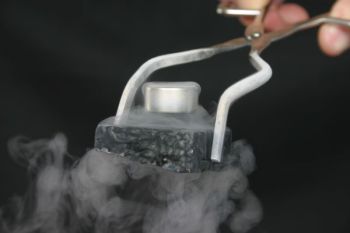
LiquidNitrogen.jpg
Levitating a magnet using liquid nitrogen. (Credit: Yorick van Boheemen)

By Matin Durrani

Tucked away in the corner of the foyer at the RAI Convention Center in Amsterdam, where the 25th International Conference on Low-Temperature Physics has been taking place for the past week, I found a series of great little demonstrations by a group of students from the University of Leiden.

The students were showing highlights from a roadshow — dubbed “Freezing physics” — that they perform at about 120 schools and numerous science fairs around the Netherlands each year in an attempt to get people hooked on physics.

You won’t be surprised to find the usual “ooo, watch how this rubber band/tennis ball/banana goes really stiff when we dunk it into a bucket of liquid nitrogen” demonstrations, which are a staple of many public shows of this kind.

But the students, known collectively as the Rino Foundation, had some clever stuff up their sleeves too. One involved using the frozen banana to hammer a nail into a piece of wood. Another saw a hand-bell being cooled in liquid nitrogen and then rung after being frozen. As the material had stiffened considerably, the bell’s ring tone was much higher than when warm.

(more…)

Copyright © 2026 by IOP Publishing Ltd and individual contributors