Camera captures at record rate

Around 130 years ago, a wealthy businessman enlisted the expertise of British photographer Eadward Muybridge to settle, once and for all, the then-popular question of whether horses lift all four of their legs off the ground at once when they trot. Rigging together a dozen or so cameras with a neat shutter mechanism, Muybridge not only proved that trotting horses do indeed spend fleeting moments in mid-air, he demonstrated a way to expose images within two-thousandths of a second of one another.

High-speed photography has come a long way since then, and is used for more prosaic tasks, such as examining crash tests, ballistics and biomechanics. Modern systems can take photos hundreds of thousands of times per second at high resolutions, or even millions of times per second at lower resolutions. But now researchers in Jordan and the US have come up with a system that could potentially give the best of both worlds. “The combination of image quality, frame rate and frame count [our] camera system is capable of is unprecedented,” says Ala Hijazi of Hashemite University.

The main problem with achieving high frame rates in photography is that cameras are, on the whole, slow to respond. It is possible to get instantaneous images by leaving a camera exposing permanently in the dark and then only lighting up a desired object for an instant with a flash lamp. Unfortunately, if this principle is extended with more cameras and flashes, the result is a string of messy multiple exposures.

Selective wavelengths

Hijazi and his colleague Vis Madhavan of Wichita State University found that they can get around this problem by four using camera-and-flash combinations that are only sensitive to one particular wavelength — either 440, 532, 600 or 650 nm. This means that each camera can get its own instantaneous image without the interference of the other three.

“This concept allows the time separation between each image that is captured to be infinitesimally small,” explains Hijazi. “[It] results in a camera system that can capture a sequence of high-resolution images at ultra-high speeds.”

Hijazi and Madhavan’s prototype system — which employs charged-coupled devices (CCDs) for the cameras and dual-cavity, Nd:YAG lasers for the flashes — is capable of producing four images in succession at 200 MHz (200 million times per second), or eight images per second at 8 MHz (Meas. Sci. Technol. 19 085503). However, Hijazi thinks that the system should be able to take up to 100 megapixel-resolution images in the gigahertz range. This would make it faster than both electronic high-speed cameras, which can only produce frame rates of the order of 100 kHz, and “rotating drum” or “rotating mirror” cameras, which can produce low-resolution images at up to 20 MHz.

The researchers think their system will be useful in imaging materials during high-speed machining. They have already set up a company called Spectrum Optical Solutions, which they say will begin marketing the high-speed camera system in the second quarter of next year.

Are supersolids not so super?

By Matin Durrani

This is my second full day at the 25th International Conference on Low-Temperature Physics in Amsterdam — LT25 in the jargon — and it’s been a busy morning, despite last night’s marathon conference dinner at the five-star Hotel Krasnapolsky that lasted until gone 11 p.m.

Almost 600 delegates, myself included, were treated to a fairly decent three-course dinner that culminated in what was billed as a “grand dessert buffet”, which seemed to take forever to set up. Thankfully the wait for the profiteroles, fruit slices and cheesecake was ameliorated by a performance by a Dutch philosophy-graduate-turned-magician, whose name escapes me but who did some clever things with various delegates’ wedding rings.

We were also serenaded by a roving accordion player and guitarist who went from table to table and who claimed they could sing songs in 24 different languages. Which was great, I suppose, as long as you didn’t mind the fact they were all sung with a painfully thick Dutch accent. A Malaysian guy on my table, for example, seemed pretty unconvinced by the pair’s children’s song about a parrot.

But back to the physics. This morning I sat in on a session on “supersolids” — a strange new form of matter that some physicists think exists when helium-4 is cooled down to sufficiently low temperatures and subject to high enough pressure. The jury is still out on whether this form of matter exists, although the consensus, as far as I could tell from today, would be that it does.

(more…)

LHC sees first protons

Physicists at the CERN laboratory near Geneva are starting the week with a spring in their steps, having successfully injected the first protons into the Large Hadron Collider (LHC) over the weekend. The test saw protons travelling 3 km through one of the LHC’s eight sectors, which bodes well for the start-up proper on September 10.

“There are lot of very happy people here today,” says CERN spokesperson James Gillies. “The test couldn’t have gone better.”

The main purpose of the injection test was to synchronize the LHC with the smaller accelerators that will feed it with protons. When the machine is up and running, pulsed magnets have to “kick” the proton bunches from one accelerator into another with nanosecond precision.

At 15:20 on Friday, a small bunch of protons was successfully kicked out of the Super Proton Synchrotron (SPS) using a pulsed magnet and sent down a 2.7 km-long transfer line towards the LHC. Then at 21:40, after a few hours spent optimizing the process, one bunch was kicked out of the transfer line into the LHC where — to the surprise of many — it travelled about 3 km until it was stopped by a screen (see image).

“The passage of the beam first time caused some excitement in the control room, and champagne was rolled out,” machine operator Roger Bailey told physicsworld.com. “We expected to have to thread the protons round using position detectors and local correction magnets, but now we know that the fields and polarities of several hundred superconducting magnets are pretty much okay.”

The test was repeated several times on Saturday, giving the operations team lots of data to help make the start-up as smooth as possible. A similar test for protons in the other (counter clockwise) direction is planned for the weekend of August 22.

Start up fever

In its search for new fundamental particles, the LHC will produce the highest energy densities ever created in a lab. But the project has not been a smooth ride, with inevitable technical problems and cost overruns that have forced the machine to slip at least five years behind schedule.

Now, after nigh-on three decades — half of which has been spent building the CHF6bn collider and its four gargantuan detectors — CERN is on the finishing stretch. Almost all of the 1600 superconducting magnets that will guide the protons around the LHC ring have been cooled to their operating temperature of 1.9 K. The next step is some 1400 hardware and electrical tests that must be performed over the next few weeks until the machine is finally ready to go on September 10.

On the start-up day itself, the 24/7 operations team will attempt to thread a single, low-intensity bunch containing a few billion protons all the way around the 27 km circumference of the LHC. Following that they will do the same in the other direction, taking perhaps a few days in total. Then they will adjust magnets so that the protons can circulate happily for periods of hours without veering off course.

Next, strong focussing magnets will bring the counter-rotating beams into collision at the LHC’s four interaction points (requiring the beam to be configured in four bunches). Initially the beams will have an energy of 450 GeV (the energy at which protons are injected from the SPS), producing 900 GeV collisions. But the target this year is to provide record-breaking 10 TeV collisions (5 TeV per beam) with 43 bunches each containing a few tens of billion protons. If all goes well, the first LHC data could be streaming out of the experiments just in time for the official LHC inauguration on October 21.

The LHC will be shut down for the winter, during which time the main bending magnets will be “trained” to handle beams at the full energy of 7 TeV (producing 14 TeV collisions) in March or April 2009. When the machine is running at full whack, nearly 3000 bunches each containing up to 100 billion protons could be hurtling around in each direction, producing half a billion collisions every second. Picking through the debris, physicists hope to find traces of particles such as the Higgs boson — which would complete the standard model of particle physics — or even more exotic entities such as black holes and extra dimensions. However, it will likely take at least a year for physicists to amass enough data and to understand their detectors well enough to be sure what they’re seeing is real.

Let's romp

Onnes.jpg
Laura Greene (left) and Setsuko Tajima (right) with the bust of Heike Kamerlingh Onnes, who liquefied helium 100 years ago last month. (Credit: Dirk van der Marel)

By Matin Durrani

With term over and no students to teach, the summer has always been peak season for scientific conferences. There’s no shortage of interesting meetings to pick from, but I am representing Physics World at the 25th International Conference on Low-Temperature Physics in Amsterdam.

One reason for attending is that the Dutch capital is a short flight from Physics World’s base in Bristol in the UK — so I am either saving money or minimizing my carbon footprint, depending on how you look at things.

Another reason is that IOP Publishing, which publishes Physics World, has had a big presence at the meeting as the proceedings are to appear in our very own Journal of Physics Conference Series.

More importantly, though, there’s just loads going on at this three-yearly bash — from fundamental studies into liquid helium to a host of talks on ultracold atom optics. But one of the highlights so far has been a special “romp” session last Friday on a new class of iron-based superconductors, known rather cumbersomely as the “oxy-pnictides”.

(more…)

Physics hits the festival circuit

GreenMan.jpg
The Green Man festival. (Credit: Stinco di Porco)

By James Dacey

If you read my colleague Michael Banks’s blog entry on Tuesday, you will have heard that Queen guitarist — cum doctor of astrophysics — Brian May is poised to unleash his PhD on popular bookstores from September.

Being a geophysicist — cum amateur guitarist — I am in no position to critique the quality of his astrophysics (nor his ear for a guitar riff!). But I am intrigued by May’s activities.

It remains to be seen whether “A Survey of Radial Velocities in the Zodiacal Dust Cloud” will fly off the shelves. Even less guaranteed is the number that will be bought, read AND understood by non physicists. But leaving aside these concerns for May and his publishers, the point is that a rock star status can provide a platform to encourage non-physicists to take an interest in the subject.

Another public engagement project with a musical stage is “Physics in the Field” and it plays its next gig at the Green Man festival next weekend (14–17 August).

Let me explain.

During the widely-celebrated International Year of Physics in 2005, the Institute of Physics (IOP) sent a small group of volunteers to brave the Somerset mud and host a workshop called “Einstein at Glastonbury”. The idea was to try and spark public interest in physics by dragging demonstrations from the laboratories and plonking them in the more informal setting of a music festival. Being something of an Einstein tribute act, demonstrations linked the physicist’s ideas to music including the inner workings of Rolf Harris’s didgeridoo.

(more…)

The most direct signal of dark energy?

It makes up some three-quarters of the mass–energy content of the universe and it’s responsible for cosmic acceleration, but that’s about all we know about dark energy. So what should we make of a bold claim for the “most direct” signal of dark energy yet? physicsworld.com roots out all the answers.

So who’s making the claim?

A group of astrophysicists led by István Szapudi at the University of Hawaii. They have analyzed the glow of microwave photons emanating from space to see how the size of massive galaxy “superclusters” changes over time. If our universe is flat — and observations suggest this is indeed the case — Einstein’s theory of gravity predicts supercluster size should stay the same. However, the Hawaii researchers have found that the superclusters are being stretched apart — the hallmark of repulsive dark energy.

This doesn’t happen everyday, especially for theorists like us who mainly deal with abstract mathematical concepts István Szapudi, University of Hawaii

How do they analyze the photons?

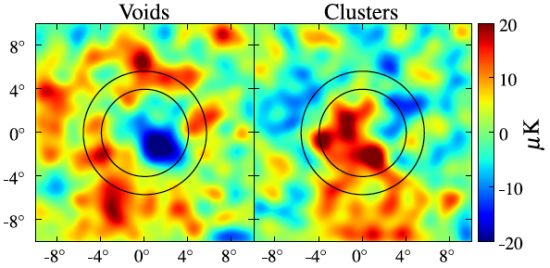
The microwave photons in question, known as the cosmic microwave background (CMB), have permeated the entire cosmos since matter and radiation first “decoupled” some 380,000 years after the Big Bang. In fact, the glow of the CMB is so regular that astrophysicists can use it to illuminate the dynamics of large structures like galaxy clusters and superclusters. Taking data from a galaxy catalogue called the Sloan Digital Sky Survey, Szapudi’s team plot the location of superclusters on a map of the CMB. They can then compare how the CMB map looks in regions where there are superclusters with regions where there is empty space, or supervoids.

How does the comparison show that the superclusters are being stretched?

In the same way you gain gravitational potential energy as you walk up a hill, a photon gains energy when it is fronted by the huge jump in gravity of a supercluster. One might think that the photon loses the same energy when it leaves the other side. However, if the supercluster is stretched as the photon is passing through, the photon will experience a smaller change in gravity when it leaves than when it arrived. In other words, the photon will get to keep a token of its extra energy. Szapudi and his colleagues look out for these slightly more energetic photons by monitoring temperature. The difference isn’t big — only about a millionth of a Kelvin.

Is Szapudi’s team the first to see this extra energy?

No. The phenomenon is called the Integrated Sachs–Wolfe (ISW) effect, and the idea of using it to look at the dynamics of superclusters was first proposed by cosmologists Rob Crittenden and Neil Turok while they were at Princeton University in 1995. Since then a handful of astrophysicists have taken up the challenge, including teams led by Bob Nichol and Crittenden of Portsmouth University in the UK, Enrique Gaztanaga of the Institute of Space Sciences in Spain and Nikhil Padmanabhan of Lawrence Berkeley Laboratory in the US. In the past few years these teams have detected the ISW effect with increasing confidence.

2008 is the coming of age for the Integrated Sachs–Wolfe effect Bob Nichol, Portsmouth University

Is Szapudi’s team now even more confident?

Well, it’s not so much the statistical confidence that’s a big deal — they claim to detect the ISW effect at just above four sigma (or 99.9995% certainty), which is in the same league as other confidence values reported this year. The important aspect of the Hawaiian researchers’ work is that they have focussed their attention on a single sample of the biggest superclusters and supervoids. The result is a cleaner, less noisy signal that is more trustworthy. In the words of Szapudi: “…We were ecstatic. It is a very subtle and small effect, and this was the first time we could actually see it, which is very different from detecting it from more abstract statistics.”

So why is it the most direct signal of dark energy?

There are many ways to infer dark energy, but almost all rely on large-scale effects and, arguably, unproven assumptions. For example, cosmic acceleration (and hence dark energy) was originally discovered in 1998 by looking at the receding light of distant supernovae, yet the precise mechanism behind a supernova explosion itself is unknown. Few doubt the dark-energy interpretation of those supernovae observations now, of course, but that’s mostly because they have been corroborated time and time again using other techniques. Observations of the ISW effect are part of that corroboration also, but are “direct” in the sense that they relate to the growth of individual structures.

What’s been the reaction to the work?

Szapudi for one is pleased. After he had convinced himself that the results were real in February this year, which was about the time of his 42nd birthday, his team offered him a jelly birthday cake in the shape of a hot and cold spot in the CMB (see figure above). Celebrations aside, Nichol of the Portsmouth group thinks the Hawaiian team has presented “perhaps the most complete analysis” of the ISW effect to date. Nichol also describes 2008 as the “coming of age” of the ISW effect because groups working on the ISW effect now agree over the strength and reliability of the data.

So what’s next for the ISW effect?

Until more precise galaxy surveys come out, which will probably be sometime next decade, all’s pretty much done and dusted from the astrophysicist’s point of view. Theorists, however, can have endless fun examining the analyses by Szapudi and others to try and get a better grip on the nature of dark energy. Current opinion seems to be veering in favour of a “cosmological constant” which manifests as a vacuum energy, although there are several other options. One is that Einstein’s theory of gravity — general relativity — is not 100% complete and needs to be tweaked to account for cosmic acceleration. The ISW effect is particularly good for testing such “modified gravity” theories because it looks specifically at the apparent strength of gravity on large scales.

• Preprints of the observations of the ISW effect by Szapudi’s group can be found at arXiv:0805.3695v2 and arXiv:0805.2974v2. There are also preprints of recent research by Padmanabhan’s group at arXiv:0801.0642 and Nichol’s group at arXiv:0801.4380v2.


Carbon nanotubes, but without the ‘nano’

There are carbon nanotubes, fullerenes and nano-foams, but now researchers have discovered yet another new type of carbon material: colossal carbon tubes. Thousands of times bigger than their nano counterparts, these tubes have exceptional mechanical and electrical properties and could find applications from microelectric devices to bullet-proof body armour.

In the last 20 years, researchers have discovered several new forms of carbon in addition to graphite (the type of carbon found in pencils) and diamond. The colossal carbon tubes, invented by Huisheng Peng and colleagues at Los Alamos National Laboratory in the US and Fudan University in China, are 40–100 µm in diameter and are centimetres long, which makes them — unlike carbon nanotubes — visible to the naked eye. The researchers make them using a chemical vapour deposition process that involves heating a mixture of ethylene and paraffin oil at up to 850 °C in a quartz tube furnace (Physical Review Letters in press).

Scanning electron microscopy shows that the walls of the tubes, which are around a micron thick, contain rectangular pores that range in size from hundreds of nanometres to microns. High-resolution transmission electron microscopy further reveals that the walls have a layered graphite crystal structure, and the inter-layer distance, determined by X-ray diffraction, is 0.34 nm — the same as graphite.

Colossal carbon tube

Light and strong

The tubes are very light and have densities similar to those of carbon nano-foams, or around 10 mg per cm3. Moreover, they are strong, with a maximum tensile stress of nearly 7 GPa, which is higher than that of carbon nanotube fibres. Indeed, this makes them 30 times stronger than Kevlar and 224 times stronger than cotton, says Peng.

And that’s not all: colossal carbon tubes are ductile and can be stretched, which makes them attractive for applications requiring high toughness. They also have high electrical conductivities of around 103 siemens per centimetre at room temperature, compared with 102 siemens per centimetre for multi-walled carbon nanotube fibres. Conductivity also increases with temperature, which implies that the tubes are semiconducting.

All these good properties mean that applications could be diverse, including lightweight body armour, such as bullet-proof vests; high-strength composites that can be shaped into parts for high-performance and lightweight vehicles; microelectronic systems and machines; and super strong cloth.

The team now plans to understand how the colossal carbon tubes form and how to control their structure better. “We also hope to improve their properties and investigate practical applications,” says Peng.

Stretching the boundaries of electronics

Physicists in Japan have found a way to disperse carbon nanotubes into a liquid polymer in order to create a rubbery material that conducts electricity. The inventors say that their material, which is more conductive than other elastic materials, is an important step towards realizing “stretchy” electronics for robotics and other electronic devices.

In the past when researchers have tried to create nanotube–polymer composites, strong intermolecular forces between the nanotubes has always made the structures clump together, producing a weak material. However, by grinding nanotubes with an ionic liquid, the Japanese group — led by Takao Someya from the University of Tokyo — has managed to make them evenly dispersed.

Using this technique, the researchers can swap as much as a fifth of the polymers’s weight for nanotubes without reducing its mechanical flexibility. The resulting material — fused with the electrical conductivity of nanotubes — can be stretched up to 70% without being damaged (Science Express 10.1126/science.1160309).

“This expands the application horizon of carbon nanotubes in an important new direction” says Ray Baughman at the University of Texas. “The most surprising discovery is that the addition of up to 20 %wt nanotubes does not reduce elastic deformability”.

Stretchy electronics

While many engineers focus their efforts on miniaturizing electronic devices, the pursuit of stretchy electronics presents engineers with some altogether different challenges. Desirable materials need to exhibit both excellent electronic performance and physical robustness.

Early attempts to make stretchy electronics have tended to either embed standard electronic components in rubber or to directly integrate them with plastic films. Although Someya recognizes there have been some significant advances, he believes devices have been held back by inelastic wiring.

Someya’s team begin creating their stretchy electronic material by grinding nanotubes with an ionic liquid of 1-butyl-3-methylimidazolium bisimide. They add the resulting thick, black paste or “bucky gel” to a liquid polymer and spread it on a glass plate. Finally, they coat it with silicone rubber and leave it to set.

Currently the team are optimizing the electric and mechanical properties of their elastic conductors. They are also investigating new economical printing processes which could enable the material to replace the fine wires in integrated circuits.

As well as improving existing technologies, Someya hopes the elastic conductors will open the doors to applications that have been closed for conventional silicon-based electronics — for example, electronic artificial skins.

CERN points to early September start-up date for LHC

The Large Hadron Collider — the biggest experiment in particle physics — will start in earnest on 10 September, according to officials at the European laboratory CERN. The officials say that on this date engineers will make the first attempt to circulate proton beams around the 27 km-long accelerator.

With all eight sectors of the LHC now cooled to 1.9 K, the first proton beam will be injected in the clockwise direction this weekend. The test will involve synchronising the LHC with the Super Proton Synchrotron (SPS), the final stage of the accelerator’s injector chain from which high-intensity proton beams are injected into the LHC ring.

Tests will continue until early September with engineers also testing proton injection in the anti-clockwise direction.

Assuming there are no major glitches, CERN is gearing up for first full circulation of protons on 10 September when they will be injected with an energy of 450 GeV. Once this has been established, the two proton beams will be made to collide, and the final step of the LHC commissioning — accelerating the protons to 5 TeV per beam — will begin.

Dark-matter simulation reveals lumpy haloes

Cosmologists in the US and Switzerland have made the most detailed simulation yet of how gravitational interactions have led to the “haloes” of dark matter we see near the centres of galaxies today. The feat could help future experiments grasp the nature of the dark matter, an elusive substance thought to make up nearly a quarter of the universe.

The simulation, which took over a month to run on a supercomputer, charts the evolution of over a billion dark-matter particles since a few million years after the Big Bang. It reveals that the dark-matter haloes are less smooth than previously thought.

“This is the best resolved calculation of the Milky Way’s halo ever carried out, with a mass resolution five to sixty times better than the previous largest computations,” explains Piero Madau at the University of California, Santa Cruz. “Previously, the inner regions of the halo came out smooth but now we have enough detail to see dense clumps of dark matter.”

It’s like taking a picture of a cricket stadium and being able to see individual grass leaves, instead of just patches of green Asantha Cooray, University of California at Irvine

Small-scale structure

Physicists believe dark matter makes up the bulk of all matter in the universe, outnumbering normal matter by roughly five to one. Invisible to modern telescopes, it gives off no light or heat and interacts only through gravity. Its prevalence also means that dark matter has had a significant impact on the structural evolution of the universe.

Madau — together with colleagues at Santa Cruz, the Institute of Advanced Study, New Jersey, and the University of Zurich — performed his simulations using the widely accepted “cold” dark-matter model of the universe. According to this model, gravity acted initially on slight density fluctuations present shortly after the Big Bang to pull together the first clumps of dark matter. These merged and grew into ever larger clumps, creating “gravitational wells” that ordinary matter fell into and formed stars and planets, giving rise to galaxies in the centres of dark matter halos.

Although past simulations have had reasonable success at describing cosmological evolution, understanding the nature of dark matter would be helped by knowledge of its smaller-scale structure. To achieve this, Madau and colleagues had to use 3,000 processors in parallel for around a month to follow the gravitational interactions of 1.1 billion particles of dark matter. The simulation started 20 million years after the Big Bang and took into context 13.7 billion years of evolution, producing a halo the same size as the one in the Milky Way.

Their results revealed a Russian-doll structure, with entire generations of progenitor dark matter clumps preserved as a series of nested substructures. The simulation showed that dense clumps should lurk in the inner regions of a halo (Nature 457 735).

Looking for evidence

“For the first time, a numerical simulation is now able to study the dark matter makeup of a typical galaxy down to mass scales of a thousand solar masses instead of a few hundred thousand as before,” says Asantha Cooray, a cosmologist at the University of California, Irvine. “This is equivalent to taking a picture of a cricket stadium and finally being able to see individual grass leaves, instead of just patches of green.”

Physicists believe dark matter particles, such as so-called weakly interacting massive particles (WIMPs), can collide and annihilate each other while emitting gamma rays. These could be detected by space-based telescopes, including the recently launched GLAST. According to Madau and his colleague Juerg Diemand, the denser clumps predicted by their simulation should emit lots of gamma rays, allowing for easy detection.

Robert Caldwell at Dartmouth College, New Hampshire, thinks the team’s simulation should help understand the potential signals from GLAST and other particle dark matter searches. “It would be tremendously exciting to see astrophysical evidence,” he says, adding: “and imagine the timing, just as searches are pushing the limits of our conception of dark matter!”

Copyright © 2026 by IOP Publishing Ltd and individual contributors