Chinese particle collider turns up the charm

Twenty years after it smashed electrons and positrons together for the first time, China’s foremost particle-physics accelerator could soon be boosting the rate of its collisions a hundred times over.

The increase in output will be the result of a four-year-long upgrade at the Beijing electron–positron collider (BEPC) and a redesign of its detector, the Beijing spectrometer (BES), at a cost of ¥640m ($77m). Two weeks ago the overhauled facility saw a return to particle collisions, and researchers are now tweaking it for optimum collision luminosity.

“I think people are working hard to push the upgrade, to tune the machine for higher performance and to get data as soon as possible,” says Hesheng Chen, director of the Institute of High Energy Physics (IHEP), which runs the collider. Chen told physicsworld.com that he expects the first useable data from the collisions to be taken in the autumn.

‘Need more statistics’

BEPC is a dual-purpose facility, providing a testing ground for particle physics as well as hard X-ray synchrotron radiation for studies in materials and life sciences. In its original form, it had a single 240 m-long ring of magnets that accelerated bunches of electrons and positrons in opposite directions, colliding them with a luminosity of 1031 particles per square-centimetre per second (cm–2s–1).

The collisions produced particles containing a charm quark and an anticharm quark, which decayed rapidly into other mesons. Using BES to measure the energy and momentum of this debris, researchers have been able to measure various properties of the parent charmed particles, such as the J/Ψ — a particle containing a charm and an anticharm quark. The researchers could also measure the so-called R value, which tells how often the collisions produce hadrons (particles containing quarks).

The upgraded collider, called BEPC-II, has added another ring to the outfit. This means that the electrons and positrons can be accelerated separately, so that up to 93 bunches — as opposed to just one — can be fit into each ring. Luminosity has so far been tripled, but Chen thinks should reach 3 x 1032 cm–2s–1 by the end of the year and 1033 cm–2s–1 in two years, which would mark a hundred-fold improvement. The detector redesign, called BES-III, uses stronger superconducting magnets to measure the energy and momentum of the debris particles with higher precision.

“During the past five to eight years there have been interesting results in the charm quark region — the pentaquarks, and the pp(bar) bound state, which was observed in the BEPC,” explains Chen. “But so far we do not really understand those particles; we need more statistics to pin them down.”

‘Best machine’ for charmed particles

Chen thinks that the increase in data will help in the search for rare decay events. It should also give better error bars for the R value in the charm energy region, which are currently around 6% but which BEPC-II should reduce to around 1–2%.

In terms of electron–positron colliders, BEPC-II sits somewhere close to the middle of collision energies, at around 3–5 GeV. DAFNE — an accelerator based at the Frascati National Laboratories near Rome that has also recently installed an upgrade — smashes electrons and protons at about 1 GeV to produce phi-mesons. At higher energies, there’s KEKB at KEK in Japan and the recently closed PEP-II at SLAC in the US, both of which have operated at about 10 GeV to produce B-mesons. There are also higher-output versions of these latter “B-factories” in the pipeline. “The BEPC-II is the best machine in the charm energy region,” says Chen.

Tiny microscope aims for Third World market

When the Dutch scientist Antonie van Leeuwenhoek first demonstrated the potential of the microscope in the 17th century, medicine was without vaccination, anaesthetic or antiseptic. Three centuries later, medicine has become far more specialized, but the microscope — crucial to many sub-disciplines like cell biology and pathology — has remained largely unchanged.

For physicians in the West this may not be a significant problem, but in developing countries diagnostic labs in the field struggle to equip themselves with conventional microscopes, which are both large and costly.

Now, scientists at the California Institute of Technology (Caltech) have developed a microscope the size of a penny piece that matches the resolution of its larger counterparts. What’s more, they claim it could be produced for as little as £5 a pop. Bioengineer and study leader Changhuei Yang told physicsworld.com that his new invention was inspired by the “floaters” in our eyes.

Direct projection

Floaters are small clumps of cells that have broken loose from the eye’s inner lining and drift through the watery gel known as the vitreous humour. We glimpse floaters as dark dots or scratches that occasionally enter into our field of vision.

Normally we see the world because light reflected from objects is focussed through the eye by a lens onto the retina. However, we see floaters by a different mechanism. These cells sit behind our lens and accumulate on the retina, and so we only obtain a scan or “direct projection” of them. Because the dots appear larger than the cells themselves, our body has a natural microscope that needs no lens.

In the Caltech replica of this effect, the specimen to be magnified is placed directly onto a complementary metal-oxide semiconductor (CMOS) sensor, which converts optical images into an electrical signal. Direct projection using this method was first demonstrated in 2005 by Dirk Lange of Stanford University, but so far resolution has not competed with conventional microscopes. At best the resolution has been the size of the pixels, or around three microns.

Yang and his colleagues get around this limitation by laying a thin film of aluminium over the sensor and then piercing it over the centre of each pixel. This simple idea restricts pixel sensitivity to the areas directly beneath the holes — effectively creating a smaller pixel that can match conventional microscope resolution. The researchers then suspend the specimen in an “optofluid” and let it flow into the holes.

‘Immediate application’

So what do the medics make of the pocket-sized microscope? “For diagnosis or screening of samples which contain macro parasites — such as worm eggs — this [microscope] has an almost immediate application,” says Dr Chris Drakely of the London School of Hygiene and Tropical Medicine. Unfortunately, Drakely warns, the microscope’s magnification factor of just 20 means it is not yet suitable for detecting malaria parasites, which requires magnification to be five times greater.

Yang recognises the need to further improve resolution but says his next plan is to pack several sensors into the same chip. If an array of thousands of microscopes could return data to the same interface, users could view a large sample but easily switch to a focussed view.

The tiny microscopes could also be inserted under a patient’s skin to monitor the spread of cancer. Some forms of cancer spread by tumour cells entering the blood stream, a process known as metastasis. Chips would be inserted in the appropriate region to “look out” for these cells. Yang points out, however, that this idea would be very difficult to implement, and at best the technology would be 10 to 15 years away.

Yang says that he has secured a patent and is “in talks with various multinational biotech companies”. He hopes his microscope will soon benefit developing countries, but does not want to take a major role in promoting the invention.

Read all about it


(Credit: Amazon)

By Michael Banks

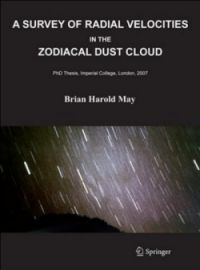
When I was a PhD student, I remember having to go through a few rounds of thesis revision, which was usually greeted with a painful moan of once again ploughing through 200 plus pages of dry, technical language, with a few equations thrown in as well. But I never thought about anyone other than a physicist really wanting to read it — even my mum only got as far as the abstract.

Well for all those Queen fans out there, guitarist and astronomer Brian May, who has recently completed his PhD in astronomy at Imperial College London, has now had his PhD thesis published as a book by Springer and Canopus Publishing Ltd.

May’s thesis, and the book too for that matter, is snappily entitled “A survey of radial velocities in the zodiacal dust cloud” and covers the Zodiacal light — a faint diffuse cone of light seen in the west after sunset and the east before sunrise.

(more…)

Ring out the old

daresbury.jpg
The Daresbury laboratory (Credit: STFC Daresbury Laboratory)

By Matin Durrani

Reporting the opening of new facilities is grist to the mill for us on Physics World. That’s why we ran a long article in last month’s print issue about the opening of the new “second target station” at the ISIS pulsed-neutron source at the Rutherford Appleton Laboratory near Oxford in the UK.

The £145m upgrade to the ISIS facility, which is used for a wide range of neutron-scattering experiments, moved a step closer to completion today when the first neutrons were created in the new station.

But spare a thought for the Synchrotron Radiation Source (SRS) at the Daresbury Laboratory in Cheshire, in the north-west of England, which officially closes today after 28 years of operation and two million hours of science.

(more…)

Nobel-prize trivia

By Matin Durrani

Who’s the only physicist to have won a Nobel Prize for Literature?

It’s one of those tricky questions that you either know or don’t. And obviously because I know the answer, I couldn’t resist raising it today.

His death last night at the age of 89 has been reported in most media outlets, including the New York Times, which has published a lengthy account of his life.

I’ll drip-feed you a few clues to help you along, if you haven’t got the answer already.

He was born in Kislovodsk in the Caucasus on 11 December 1918, graduating from Rostov University in 1941 with a degree in physics and mathematics.

In February 1945 he was arrested by the Soviet spy agency Smersh and was banged up for eight years in a labour camp.

(more…)

Ballistic breakthrough could lead to molecular logic gates

The first highly-conductive connection between a single organic molecule and a metal electrode has been made by an international team of physicists. This achievement could lead to the development of ‘molecular electronics’ devices with the potential to be smaller and faster than conventional transitors and logic gates.

The majority of electronic devices are made from just a handful of semiconductor materials — the most common being silicon. However, some organic molecules such as DNA appear to have electronic properties similar to traditional semiconductors and some researchers believe that some types of molecules could be used to make electronic devices.

A potential benefit of such devices is that molecules are extremely small compared to semiconductor structures, which could help manufacturers pack more and more circuits onto a chip.

However, it has proven very difficult to connect single molecules to a metal electrode such that electrons are conducted easily between the two. These junctions are essential for making real-world devices like transistors and logic gates.

Significant barrier

Previous attempts at making single-molecule junctions involved using “anchoring groups” such as thiols to bind organic molecules to metal electrodes like gold. However, the metal-molecule link creates a significant potential barrier across the junction and electrons end up tunnelling across the molecule when a voltage is applied between the electrodes. This inevitably leads to a low conductivity, and thus poor performance in the finished devices.

A higher conductance would be possible if electrons were allowed to travel ‘ballistically’ across the metal-molecule junction – whereby every electron that enters the junction travels straight through more or less unhindered. This occurs in many carbon nanotube devices or single-atom contacts, which reach the quantum of conductance — the maximum conductance possible for a single electron channel. However, this has never been achieved in single-molecule junctions before.

Now, Jan van Ruitenbeek of the University of Leiden in the Netherlands along with colleagues in Australia, Germany and Spain may have solved this problem by making the first highly conductive molecular junctions. This involved binding benzene molecules directly to platinum metal electrodes, and the team found that the conductance of these devices reaches the maximum value possible for a single electron channel.

Direct coupling

The physicists showed that it is possible to couple the metal electrodes, in their case platinum, ‘directly’ to the carbon backbone of an organic molecule (benzene), which allows the electrons to travel more easily across the junction. Indeed, the conductance of the junction has a value of G0, which equals 2e2/h, where e is the charge on the electron and h is Planck’s constant. This is the maximum conductance possible for a single electron channel — around 7.7 x 10⁻⁵ ohm-1 (Phys Rev Lett 101 046801).

The researchers say that they regard benzene as a “starting point” for building such molecular junctions and they will soon be investigating more advanced organic compounds. Benzene is ideal for such early work because it is a simple system that can be easily studied using techniques like vibration mode spectroscopy, isotope substitution, shot noise measurements and local density functional computations.

The team achieved its results using mechanically controllable “break junctions”, which allowed them to produce atomic-sized junctions of any metal at liquid helium temperatures. Once the scientists had verified that the junction was clean, they introduced benzene vapour through a capillary tube onto the structures. They observed the molecules arriving at the junction by measuring the change in conductance properties of the device. The junction was then stretched to nearly breaking point so that a molecular bridge spontaneously formed across it.

Detailed investigations

“The most important property of these junctions is that their conductance is at least an order of magnitude higher than comparable junctions made using thiol anchoring groups,” van Ruitenbeek told physicsworld.com. “Under our experimental conditions, the junctions can be held stable for a very long time, which, when combined with the cryogenic temperatures used, allows us to make detailed investigations.”

The team now plans to study metals other than platinum, which is expensive, for use in molecular electronics applications.

“What makes this work stand out is that [the scientists] have presented a new way to attach organic molecules to metal electrodes, by forming a direct metal-carbon bond, and have proven conclusively that their devices have a strong metal-molecule link,” commented Latha Venkataraman of Columbia University in an American Physical Society Viewpoint article on the research. “This enables them to overcome a major barrier in molecular based devices,” she said.

Cold atoms could help build ‘spintronics’ transistor

They can engineer them smaller and pack more in, but there will always be a limit to how fast semiconductor devices can be made to perform.

One way to improve this limit, and broaden applications, is to design “spintronic” devices that exploit electron spin as well as electron charge. Now, physicists in the US and Lithuania have come up with an idea for a test bed that could help in the realization of one of the most important spintronic devices — the so-called Datta–Das transistor (DDT).

Like normal transistors, the DDT would control a current passing between two of its electrodes. But because the DDT is a spintronic device, it would control a “spin polarized” current — one in which most of the electrons have the same spin orientation: up or down.

The key to controlling this spin-polarized current is a spin filter, which forms part of the second electrode. The filter is set to one spin orientation — say, up — which means that a current of spin-up electrons flowing from the first electrode is always let through. To control the size of this current, the DDT has a third electrode, which emits an electric field that “twists” the spin the electrons downwards. Depending on the extent of the twist, more or less current is blocked by the filter.

Putting it into practice

That’s the theory, anyway. Since US physicists Supriyo Datta and Biswajit Das proposed the DDT in 1989, experimentalists have not had much success making a working version. But Charles Clark and Jay Vaishnav from the National Institute of Standards and Technology (NIST), together with Julius Ruseckas and Gediminas Juzeliunas of Vilnius University, think they have an idea that could help experimentalists on their way — an analogous system in which basic parameters can be tweaked.

Vaishnav and colleagues’ system would be a beam of ultracold atoms, such as rubidium. These atoms would effectively have two possible states, which are analogous to the “up” and “down” spin states of electrons.

To control these atoms, say the researchers, the system would need the light from three laser beams that slightly overlap. As the atoms pass through the first laser beam — like electrons flowing from the first electrode in a DDT — they would be put in the same atomic “spin” state. But as the atoms pass through the region where the three laser beams overlap, their atomic states would begin to shift — like the twisting effect of the DDT’s third electrode. By controlling the manner in which the laser beams switch on and off, Vaishnav and colleagues think they should be able to replicate the entire function of a DDT (arXiv:0807.3067). “It may help understand problems in real systems,” says Vaishnav.

Although the cold-atom analogue is just an idea for now, Vaishnav told physicsworld.com that it uses “common experimental techniques”, which some of her colleagues would be well-equipped to implement. “There are people at NIST who are working on similar experiments,” she notes.

A light in the dark?

If you can bear to hear the truth you’ve spoken
Twisted by knaves to make a trap for fools,
…you’ll be a Man my son!

It is rare that poetry enters modern scientific discourse, which is why the above quote from the poem “If…” by Rudyard Kipling catches the attention of the visitor to the homepage of DAMA, a group of dark-matter hunters in Italy. Although the physicists in the group do not spell out explicitly what the poem refers to, its meaning seems fairly clear. The quote is an eloquent retort to their critics (the “knaves”), who for the last 10 years have been unconvinced of the researchers’ claim to have made the first-ever direct observation of dark-matter particles (“the truth”). The poem illustrates the unusual intensity of the debate surrounding their claim.

DAMA is a collaboration of physicists from the University of Rome “Tor Vergata”, the University of Rome “La Sapienza”, the Italian National Institute for Nuclear Physics and the Institute of High Energy Physics in Beijing, China. Led by Rita Bernabei of Tor Vergata, the group operates a sodium-iodide detector buried 1400 m beneath the Gran Sasso mountain in central Italy. It says that it has observed a seasonal variation in the signal from the detector caused by dark-matter particles interacting with the sodium iodide. If that is true, the researchers will have hit the cosmology and particle-physics jackpot.

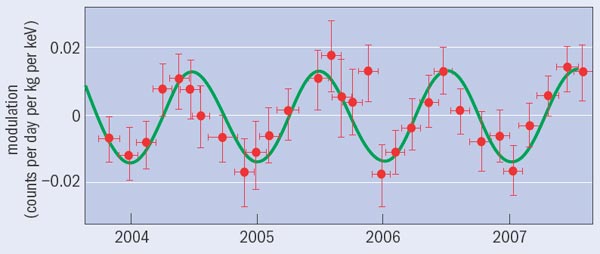
The DAMA signal is a sinusoidal modulation that peaks in early June and goes through a minimum in early December — a signature that the group interprets as being caused by the Earth’s motion through the “halo” of dark matter that surrounds the Milky Way. The rationale is that the Earth travels through the halo (which is assumed to be static) as the Sun orbits around the galactic centre with a velocity of about 230 km s–1. Since our planet travels “with” the Sun in June and “against” the Sun in December, its own velocity relative to the dark-matter halo will be at a maximum and minimum at these respective times. This variation should then manifest itself as an annual variation in the rate of dark-matter particles passing through the DAMA detector — a dark-matter wind. At least, this is how the DAMA researchers interpret the results.

The group originally made its claim in 1998, with an experiment called DAMA/NaI that used 100 kg of detecting material. It repeated its claim in 2000 and 2003 after having collected more data. Then at a conference in Venice in April this year, the group announced four-years worth of results from its upgraded DAMA/LIBRA (Large Sodium Iodide Bulk for Rare Processes) experiment, which added an extra 150 kg of sodium iodide to the apparatus. The group maintains that, using the combined data from the two experiments, “the presence of dark-matter particles in the galactic halo is supported at a confidence level of 8.2 standard deviations”, which equates to a chance of less than one in 4 ×  1015 that the result is a statistical fluke (arXiv:0804.2741; accepted for publication in European Physical Journal C).

That the DAMA group has seen an annual modulation in its signal is now widely acknowledged by other researchers in the field, who had previously doubted that the group’s original experiment had collected enough data to show this. However, the DAMA researchers remain at odds with others as to what is causing the modulation.

That disagreement is best articulated by Juan Collar from the University of Chicago, who is a spokesman for the dark-matter experiment COUPP (Chicagoland Observatory for Underground Particle Physics) at Fermilab in the US. Blogging for Cosmic Variance, he wrote that “There is evidence for a modulation in the data at 8.2 sigma, stop. Compatible with what would be expected from some dark-matter particles in some galactic halo models, full stop. Anything beyond this is wanting to believe, and it smears on the rest of us in the field. Of course…there is no other observed process in nature that peaks in the summer and goes through a low in the winter, so this must be dark-matter, right? (Occam is turning in his grave, rusty razor still in hand…).”

In response to such criticisms, Bernabei remains adamant of her group’s claim. “I don’t believe logically our results can mean anything other than the dark-matter signature,” she says. “We’ve been looking at this for over a decade, and in that time no-one has come up with an alternative explanation.”

Dark-matter hunting

In the current cosmological paradigm, the existence of dark matter is inferred indirectly from its gravitational effects. The particles do not emit electromagnetic radiation (hence, “dark”), and, for all we know, they might not have any other means of interaction. However, some theories outside the Standard Model of particle physics predict a number of possible candidates for dark matter, such as axions, sterile neutrinos or WIMPs (weakly interacting massive particles), that can interact via the weak nuclear force. Most ongoing dark-matter experiments are in fact tuned to find direct evidence for WIMPs, as these are the most popular candidates among theorists.

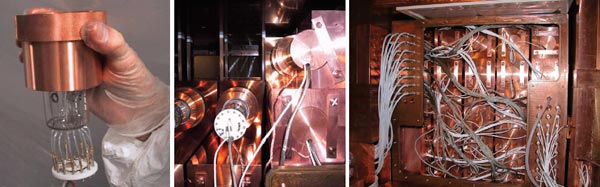
According to such theories, a standard dark-matter detector will never observe more than a handful of WIMP collisions every year, even though trillions of dark-matter particles are believed to stream through the Earth every second. To improve their odds, physicists must therefore design dark-matter detectors with as large a detecting mass as possible. They also need to shield it from interference as best they can, so as not to swamp the tiny signals that are collected. The detector material itself, the surrounding casing and the rest of the lab must all have extremely low levels of radioactivity. Furthermore, the lab should be located deep underground so that interference from cosmic rays is kept to an absolute minimum (a kilometre of overlying rock reduces the cosmic-ray flux by about a factor of a million), and the detectors must be placed inside a shield made of lead or other suitable materials (see “Inside DAMA/LIBRA”).

In building these experiments, however, there is a trade off in the amount of data that can be collected and the degree to which background radiation can be filtered out. Most dark-matter experiments concentrate on enforcing the latter, and these include CDMS in the Soudan mine in Minnesota, EDELWEISS in the Modane Underground Laboratory under the Franco- Italian Alps, ZEPLIN in the Boulby mine in the north-east of England, and CRESST, also at Gran Sasso.

The crystals used in these detectors allow the experiments to distinguish between two distinct kinds of event: a dark-matter particle colliding with nuclei in the detecting material; and background signals — such as gamma rays or electrons — colliding with the crystal’s electrons. CDMS, for example, consists of stacks of silicon and germanium discs cooled to just a fraction of a degree above absolute zero, and it measures the vibrational energy deposited by a collision in the crystal lattice as well as the amount of ionization generated in neighbouring atoms by a recoiling particle. For a given energy deposition, the degree of ionization in germanium or silicon differs significantly depending on whether this is caused by electron or nuclear recoil, which allows the CDMS researchers to distinguish between these two types of event.

DAMA takes a different, and unique, approach. It measures the light given off when putative dark-matter particles collide with the nuclei inside the sodium iodide and excited neighbouring electrons drop back down to a stable energy level. On its own, this process of “scintillation” cannot be used to distinguish between electron and nuclear recoils, making it harder to clearly identify dark-matter signatures.

DAMA’s big advantage with respect to other experiments is that sodium iodide can be grown to make very large crystals. The DAMA/LIBRA detector’s mass of 250 kg dwarfs the 4 kg CDMS detector. So whereas CDMS filters out all gamma rays, electrons and neutrons, and has recently racked up 100-days worth of data without recording a single event, DAMA/LIBRA has collected over 800,000 (mostly background) events in four years. This far greater volume of data allows the researchers to look for an annual modulation signature, which is a variation of just a few per cent in the overall signal.

Separating the dark matter from the chaff

To demonstrate that the modulation is not caused by a background source, the DAMA researchers have performed a number of analyses. They have shown that the modulation occurs at energies between 2 and 6 keV, while there is no modulation between 6 and 14 keV, a signature that would also be expected if the cause was background radiation. Another important piece of evidence is that the modulation is only seen in “single-hit” events (those in which one of the 25 individual parts of the detector generates a flash of light in a photomultiplier tube) and not in multiple-hit events. Dark-matter particles could not generate the latter because the chances of them interacting with any given particle in the detector are so low.

The researchers also found no significant annual variation in a number of specific experimental parameters that could potentially mimic the dark-matter signature, including the temperature and levels of radon gas inside the experimental apparatus. In addition, using data on the cosmic-ray flux reaching the lab obtained by the neighbouring MACRO experiment (a flux that is known to vary annually with the temperature of the atmosphere), the researchers also showed that the variation in muon flux is far too small to account for the modulation in their dark-matter data.

But other researchers in the field are not convinced. Richard Gaitskell from Brown University in Rhode Island in the US, who is involved in several dark-matter searches, points out that there could be plenty of other background sources that the DAMA researchers have not yet thought of that have a period of a year, a maximum in June and a minimum in December. “Even if you ruled out 50 mundane sources, who is to say that you’ve ruled them all out. There could be 100. The trouble is that there are so many things that are annually modulated,” he says. Although there are no known background sources that produce this effect, Gaitskell suggests that the only way to remove this doubt is to provide greater detail of the signals in the different parts of the detector, which should be very similar if the signal is dark matter but different if the culprit is instead a mundane background source.

Gaitskell’s concern over backgrounds and possible systematics is shared by Collar, who points out that the lowest energy data — between 1 and 2 keV — may be contaminated by noise from the photomultiplier tubes. He maintains that if this noise is modulated, then it would to some extent “invade” higher energies and therefore replicate the dark-matter signal. As such, he would like to see the data plots (see “A sign of dark matter?”) extended down to 1&2dash;2 keV. “People have been asking for this data analysis for years,” he says. “The fact [the DAMA researchers] haven’t responded to this and other requests for specific data analyses stinks to high heaven.”

Collar is also surprised that the DAMA group has yet to publish data on any possible “diurnal” variation in its data, in other words the tiny daily variation in dark-matter particles reaching the detector due to the Earth’s rotation. Although a very subtle effect, he believes that the DAMA researchers have now collected enough data to look for it. “Maybe they have seen something that confirms this and are waiting for more data,” he adds. “Or maybe they haven’t seen anything and are hoping it will show up.”

Indeed, Collar claims that the DAMA group’s reluctance to reveal such data is indicative of a general lack of openness on the part of the Italy-based researchers. Bernabei maintains that all serious comments and suggestions that have been put forward by other dark-matter researchers have been dealt with, but Collar does not agree. “If you claim something like they have, you will be under the microscope. Five years ago people started asking questions but [the DAMA researchers] clammed up. That secrecy has not changed,” he says.

Data conflicts

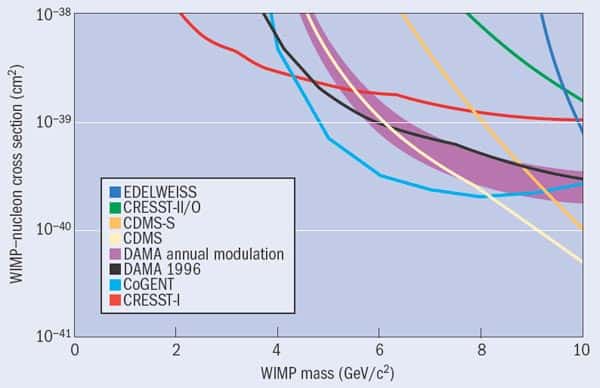
At the root of the scepticism towards the DAMA group’s claim is the fact that the results appear to conflict with those of other experiments. Not only have other experiments so far not detected dark matter, the levels of sensitivity that they have obtained suggest that DAMA ought not to have done so either. The CDMS data collected to date show that the “WIMP–nucleon cross section” — a measure of how readily a WIMP interacts with a nucleon (neutron or proton) — for WIMPs with masses in the region of about 60 GeV/c2 must be less than 6 ×  10–8 picobarns. (A barn is the standard unit to denote cross sections in high-energy physics, which approximately corresponds to the cross-sectional area of a uranium nucleus, i.e. of the order of 10–28 m.) However, the analysis the DAMA group published in 2003 was consistent with WIMPs having a cross section of 7 ×  10–6 picobarns: in other words, a value at least 100 times higher than the CDMS limit. In addition, the XENON collaboration at Gran Sasso and the CoGENT collaboration, led by Collar, claim their experiments prove that the DAMA experiment cannot be observing WIMPs with lower masses. This was reinforced by a report last month from Collar’s group (see “Limiting factors”).

But the fact that the DAMA results are in apparent conflict with null results from other dark-matter experiments is a delicate one and the “apparent” in “apparent conflict” boils down to the fact that the DAMA experiment’s design is fundamentally different from other experiments, which makes it difficult to make comparisons. This view is defended by Bernabei, who believes her collaboration’s claim is not refuted by other experiments. In particular, she points out that the DAMA set-up follows a “model-independent approach” since it is not constrained, unlike the other experiments, to look for a specific kind of recoil event. She claims that her group’s results are consistent with a variety of hypothetical candidates, like axions or “light” dark matter, and not just WIMPs. “The [other researchers] should be more cautious and more honest in claiming the exclusions that they do,” she adds.

Indeed, Petr Vogel, a nuclear theorist at the California Institute of Technology in the US, believes that DAMA could be detecting something else other than WIMPs, since the experiment is sensitive to any type of recoil, including those involving electrons. “That would be rather unexpected, but not totally out of the question,” he adds. “So, unless somebody finds some prosaic explanation to the annual variation observed by DAMA, this exotic possibility needs to be explored.”

Axions, very light particles predicted to exist by extensions to the Standard Model, are the most obvious candidates to cause an electron-recoil signal. Bernard Sadoulet, a physicist at the University of California Berkeley and a spokesman for CDMS, says that his collaboration will shortly start analysing electron-like recoil events obtained by its experiment, which up to now have been filtered out but which are nevertheless present in the data. He says that a peak in the energy spectrum of these kind of events at about 3 keV would suggest DAMA is detecting axions.

This peak at 3 keV is also currently being investigated by Collar’s group using the germanium CoGENT detector, and Collar believes that the outcome will have a decisive effect on the DAMA results. “If we see something, then people will go crazy trying to reproduce DAMA’s results. But if we see nothing then people will probably lose interest in the claim.”

One experiment cannot by itself irrevocably confirm the direct observation of dark matter — the DAMA result needs to be replicated by an independent experiment such as CoGENT, CDMS or another sodiumiodide detector. But, whatever happens, it is not going to be easy for the DAMA researchers and other groups in the field to reconcile their differences. Like many others, Peter Cooper of Fermilab, who works with Collar on COUPP, believes that the DAMA group should be more open in its dealings with the rest of the community. But he also says that other physicists must be prepared to accept the DAMA claims, should they be vindicated. He hopes that people on both sides “calm down a bit and return to the science”, adding that scientific debate should be solved by rigorous experimentation and analysis, and not by whoever can shout the loudest. “People can say whatever they want,” he says. “It’s what nature says that matters.”


A question of trust

I used to host family dinners at which the guests included my uncle Eugene, who was a Marxist, and my great-aunt Debbie, an ardent anti-Communist. Debbie and Eugene were interesting people for different reasons. However, they knew that their beliefs were incompatible, and so they avoided each other in public.

One Thanksgiving, it finally happened — Debbie and Eugene exchanged words! The rest of us froze, hoping to overhear every penetrating remark, sure that sparks would fly. It was the biggest let-down in family history. The two politely discussed a local road-construction project — safe territory. It wasn’t worth the eavesdropping.

I remember that dinner whenever I hear of encounters between science and religion. The battle lines in what is usually cast as a clash of beliefs are clearly drawn on one side by books like Christopher Hitchins’ diatribe God Is Not Great: How Religion Poisons Everything, and Richard Dawkins’ The God Delusion, and on the other side by Christian fundamentalists who dismiss evolution, and by some Buddhists who see science — as the Dalai Lama remarks, regrettably, in his eyes — as a “killer of religion”. In such an atmosphere, encounters are generally uninformative battles or polite and inconsequential exchanges. Is stimulating conversation at all possible?

Belief versus trust

I think it is. The trouble with the way that most such encounters are framed, strange as it may sound, is that neither science nor religion is ultimately about beliefs. If they were, they would be as insubstantial as the houses in the Monty Python sketch in which the buildings, held up by the beliefs of the occupants, crumble when those beliefs wavered. Science and religion stand on thicker ground than that. Each involves its practitioners in a powerful network of ties to the world, though any particular tie can be replaced or modified. The name for these bonds — a name applicable both to specific ties and to the network itself — is trust.

Much human experience — from having relationships, hiring nannies and electing politicians to mailing letters, boarding aircraft, playing with toys and eating food — depends on trust. But trust is particularly important to both scientists and to the religious, whether ordinary churchgoers or theologians. Both groups have to exercise trust — that is defer to others about something beyond one’s immediate knowledge — in a set of specific things.

For scientists, these things include knowing which data, theories and findings to credit; for the religious, it includes knowing which leaders, rituals and prophets’ words to honour. Such trust must be exercised carefully and reflectively, not indiscriminately; those who blindly follow the orders of leaders are not acting religiously but fanatically. And trust is always open to re-evaluation.

But both groups also have to trust something more intangible: the scientific life and the religious life, respectively. For at the core, if sometimes not the surface, of science and religion is a kind of humility. For scientists, it is the awareness that we do not know enough about the natural world; we know only fragments, and not all that we can. For the religious — and especially for Christians, Jews and Muslims — the humility lies in the awareness that the way we humans ordinarily lead our lives is imperfect; that we are not all that we can be. The idea that the truly religious life is marked by humility and the awareness of one’s own ignorance is hardly controversial, and is the thesis of the New York University theologian James P Carse’s new book The Religious Case Against Belief.

Responding to humility

Scientists react to this humility by engaging in scientific inquiry; the moment one ceases to think such inquiry is the proper route to answering even the most intractable puzzle about the natural world, and instead invokes a supernatural cause, one ceases to be a scientist. The religious respond to humility by living a spiritual life, in viewing one’s life as a response to a call rather than as a career or a life of blind obedience. (Both kinds of humility can overlap in the same person.)

Thus trust plays a two-fold role in both science and religion. It is placed both in a set of tangible things (“ontic” things, philosophers say) and in a more intangible (“ontological”) way of life. The tangible things help shape the way of life, but in living that life (conducting research, living spiritually) trust in specific tangible things can be gained, lost and regained.

Many differences exist between the way that this two-fold interaction plays out in science and religion. In science, the process is collective and public, with consensually agreed upon concepts and evidence, while in religion it is personal. Scientists tend to be interested in the objects of trust — in what makes for trustworthy theories, techniques and data. Religious authors tend to be more concerned with first-person experiences of trusting and betrayal. They are more conscious that trusting is not something we choose but is forced on us from birth.

Scientific and religious organizations are periodically shaken by controversies involving trust. Scientific institutions are sometimes found to have covered up unsafe practices or allowed fraud, while allegations of sexual abuse by priests have undermined trust in religious institutions. Finally, both scientists and the religious have encountered those who deliberately seek to disrupt trust — politicians, for instance, who cultivate controversy about global-warming data in order to be able to ignore it.

The critical point

Trust, then, is one issue about which both scientists and the religious have a backlog of experiences that might be mutually illuminating. It would be interesting to see what would happen if we got them talking, not about their beliefs, but about how they form and defend those beliefs. That would be a conversation worth overhearing.

• This column is adapted from an article that appeared in Newsday on 1 July 2007

Blog life: Michael Nielsen

Blogger: Michael Nielsen
URL: www.michaelnielsen.org/blog
First post: August 2003

Who is the blog written by?

Michael Nielsen is a theoretical physicist who, up until June, was based at the Perimeter Institute for Theoretical Physics in Waterloo, Canada. He is a pioneer of quantum computation, contributing significantly to the theory of entangled quantum states. Last year, however, he announced a major change in the focus of his research, which now centres on the development of new tools for scientific publication and collaboration.

What topics does the blog cover?

The blog strongly reflects Nielsen’s interest in scientific publishing, and in how scientists can take advantage of the Internet in particular. He is currently writing a book about how science will change over the next few years as a result of the Web, and many of his posts consist of notes and comments on articles or books he has read on this topic. Twice a week Nielsen also publishes a list of links to interesting websites, articles or posts on other blogs that he has come across, which are much more general. For example, he has recently linked to an article from the New York Times suggesting that bonuses actually reduce workplace productivity and to a post on the Galaxy Zoo blog about a mysterious blue blob spotted in one of the images analysed by the project.

Who is it aimed at?

Given its focus on the process of science, this blog will primarily be of interest to other scientists. The content is not strictly science related however, and the discussion is usually non-technical.

Why should I read it?

If you are at all interested in how science is done and communicated, and what part the Internet plays in this process, then this blog is for you. Nielsen’s biweekly collections of links provide a great round-up of interesting Web articles related to these topics. And his other posts, although infrequent, are always insightful and well written.

How often is it updated?

Nielsen puts up his biweekly collections of interesting links every Friday and Monday, with other posts interspersed at random intervals.

Can you give me a sample quote?

Harvard’s amazing Berkman Center for Internet and Society had their tenth anniversary celebration last week. During one of the talks, the founder of the Berkman Centre, Charles Nesson, asked the following question about the relationship between universities and Wikipedia: “Wikipedia is the instantiation of the building of the knowledge commons. Why didn’t it come out of a university?” I think it’s an important question. It bothers me a lot that Wikipedia didn’t come out of a university. Academics make a big song and dance about their role in advancing human knowledge, yet they’ve played only a bit part in developing one of the most important tools for the advancement of human knowledge built in my lifetime.

Copyright © 2026 by IOP Publishing Ltd and individual contributors