Where are all the physics teachers?

By Hamish Johnston

The British media were talking about physics today, and I’m afraid the news wasn’t good.

The BBC was reporting on a study on the state of physics teaching in England by Alan Smithers and Pamela Robinson of the Centre for Education and Employment Research at the University Of Buckingham.

Robinson and Smithers found that in 2007 just 12% of scientists accepted on teacher training programmes were trained as physicists — down from 30% in 1983. If this trend continues, it could be very difficult for the government to hit its target of having 25% of all science teachers specialising in physics by 2014.

The decline in physics teachers has meant that many education authorities have opted for “general science” teachers who cover biology and chemistry as well as physics. Indeed, the researchers found that half the schools in inner London have no teachers specialising in physics.

However, all is not gloom and doom for teaching physics in England. Last week we had our summer company meeting and Bob Kirby-Harris, chief executive, the Institute of Physics (which owns the company that publishes physicsworld.com) told us about how the organization was tackling the problem. The IOP has set up the Physics Enhancement Project, which aims to boost the physics expertise of trainee science teachers who don’t have formal qualifications in physics.

Most of our readers are outside of the England, so please let us know about the state of physics teaching where you are.

Gamma-rays put limit on universe’s background light

A team of astronomers has detected a burst of very-high-energy gamma rays that was created over five billion years ago – the oldest such burst ever detected. On their journey to Earth, the gamma rays had to travel through the extragalactic background light (EBL), which is known to be a strong absorber of such gamma rays.

The fact that the burst was detected at all means that astronomers may be able to use such gamma rays to determine how the EBL changed over billions of years – something that could shed considerable light on how stars and galaxies form and evolve.

The universe is bathed in diffuse background light that comes from every star that has ever shone. As a result, the nature of this EBL could tell us much about the evolution of stars and galaxies over the history of the universe. However, because it is so faint compared to nearby stars and galaxies, it is very difficult to measure the EBL directly. As a result there are currently several theories about how much background light should be out there, and they make very different predictions.

History of the EBL

Very-high-energy gamma rays with energies between about 80 and 500 GeV can be used to probe the history of the EBL, particularly if they have travelled great distances across the universe. This is because the EBL is very good at blocking such gamma-rays and by measuring this effect, physicists can get a handle on the density of the EBL.

Now, Rudolf Bock of the Max Planck Institute for Physics in Munich along with other members of the MAGIC gamma-ray telescope collaboration have used the ground-based instrument to detect the oldest burst of such gamma rays ever seen (Science 320 1752). The radiation came from a distant quasar called 3C 279, which the team know is over 5bn light-years from Earth.

According to Bock, a key result of the measurement is that most current theories tend to over estimate the density of the EBL. This is actually good news for astronomers because it suggests that gamma-ray telescopes can be used to trace the evolution of the EBL much farther back in the history of the universe than most models had predicted.

He told physicsworld.com that it is likely that the technique developed by the MAGIC team “will teach us much more about the history of star formation”.

The measurement is also in line with estimates of the EBL made by the Hubble Space Telescope and Spitzer Telescope.

Dark energy at the Science Cafe

By Hamish Johnston

There’s nothing more annoying than the sound of your own voice…

I have come to this conclusion after spending many painful hours transcribing hundreds of taped interviews that I have done with scientists, industrialists and other luminaries.

But today, the shoe was on the other foot (or ear). At noon I was in a radio studio speaking to the host of the BBC Radio Wales programme The Science Cafe about dark energy.

2008 marks the tenth anniversary of the discovery of dark energy and Adam Walton wanted an update on the stuff from Physics World.

I’ll be the first to admit that cosmology is not one of my strengths and I know that I don’t have a voice for radio — but no-one else on the editorial team seemed to be available, so I agreed.

I spent the last few days reading up on dark energy — indeed, Physics World recently published three articles to mark the 10th anniversary, all of which were very helpful.

I did my best to answer Adam’s questions and I hope that after some skillful editing, his listeners will learn something about dark energy.

One thing I learned from the experience is that many of the things that I find interesting about dark energy — the huge discrepancy between the cosmological constant invoked to explain dark energy and the “cosmological constant” that can be derived from quantum field theory, for example — are very difficult to explain in sound bites.

If you live in Wales, you can listen to the show on Sunday, 29 June at 5pm. The rest of us can listen online.

I was pretty nervous during the interview, so I can’t really remember half of what I said. It will be interesting to hear what they use and what ends up on the cutting room floor.

Glass arrested on the road to crystallization

Humans have been making glass for thousands of years and have benefited from its many useful properties. However, understanding the glassy state — a solid-like state in which the atoms are in irregular positions much like atoms in a liquid — is one of the great unsolved mysteries in condensed-matter physics.

Now, researchers in the UK, Japan and Australia have shed new light on this old problem by studying how atoms in glass could become “jammed” into irregular arrangements when molten glass is cooled. Their results confirm predictions made some 50 years ago that the cooling atoms first join together to form icosahedral structures (20-sided objects), which then find it impossible to orient themselves into a crystalline lattice. The team believe that their insights into the formation of glass might lead to the creation of new materials, such as “metallic glasses”.

Physicists believe that glass is formed when a liquid is cooled and its constituent atoms are unable to arrange themselves in a stable crystalline state. Instead, the atoms become trapped in a state of “dynamical arrest” — the atoms can be likened to cars in a perpetual traffic jam that never reach their final destination of a crystalline structure. Understanding why this occurs has proven very difficult because the individual atoms are much too small to be tracked using optical microscopes — and electron microscopes cannot image the atoms in 3D.

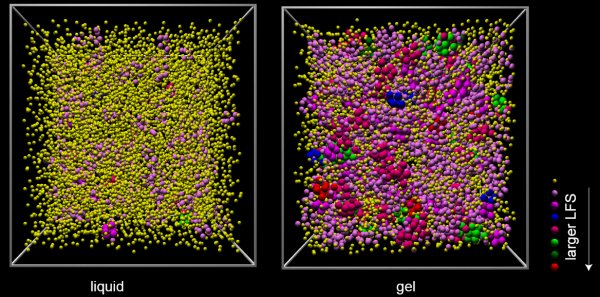
Dynamical arrest is also involved in the formation of many gels, which comprise micrometre-sized colloidal molecules that can be observed using a microscope. Now, Paddy Royall of the University of Bristol together with colleagues at the University of Tokyo and the Australian National University have studied such gels to gain an insight into how dynamical arrest could occur in glasses (Nature Materials doi: 10.1038/nmat2219).

Five-fold rotational symmetry

The researchers watched as a colloidal liquid cooled to become a gel and saw the formation of structures with five-fold rotational symmetry — a hallmark of icosahedral structures. Using computer analysis, they found that these structures became more numerous upon cooling to form jammed icosahedra-like structures.

Crystallization requires space to be filled by a repeating pattern of atoms or molecules — but the icosahedra seen by Royall and colleagues cannot fill space without leaving gaps. This is the 3D analogue of the fact that repeating 2D pattern cannot be made using five-sided tiles.

“These structures are not compatible with crystallization, which supports an idea going back to Sir Charles Frank, also from the University of Bristol,” Royall told physicsworld.com. “In the 1950s, he was the first to identify such low-energy structures and emphasized the five-fold symmetry of icosahedral arrangements of atoms.”

Royall believes that the team’s insights into dynamical arrest may even help make metallic glasses — metals with the same structure as glass. This is unlike coventional metals, which are crystalline and contain “grain boundaries” between regions that are perfect crystals.

Defects at these boundaries often cause the metal to fail under stress. Such boundaries would not occur in metallic glasses, making them less prone to failure. Metallic glasses might find use in a variety of products that need to be flexible, such as aircraft wings and engine parts.

The researchers are now expanding on their work to consider more examples of systems that undergo arrest. They will also apply their experimental and analysis techniques to study other major outstanding problems in condensed matter physics, and develop novel materials.

Viruses get X-rayed

A group of physicists and biologists in the US has extended the power of X-ray diffraction for imaging biological specimens. Jianwei Miao of the University of California, Los Angeles and colleagues have used X-rays to image single viruses, by separating the diffraction pattern of the virus particles from that of their surroundings. The researchers say that their technique could improve the imaging of a broad range of biological entities, from protein machineries to whole cells (arXiv 0806.2875).

X-ray crystallography generates images of the structure of crystalline materials by scattering a beam of X-rays from the electrons within a material and measuring the diffraction pattern that results. While it has been used since the 1950s to determine the 3D structure of many biological molecules, the technique requires that the materials studied be in crystalline form. Unfortunately, many biological specimens, including cells, organelles and viruses, are difficult or impossible to crystallize.

Scientists are currently developing a number of other ways to image biological samples, but each has its own drawbacks. Transmission electron microscopy, for example, can generate images with very high resolution, but multiple electron scattering from a sample means that specimens must be very thin (less than 0.5-1 µm thick).

Coherent beam of X-rays

The technique used by Miao and co-workers is called “X-ray diffraction microscopy”. This involves illuminating a non-crystalline sample with a coherent beam of X-rays. The intensity of the resulting diffraction pattern is measured and the relative phases of the X-rays within the pattern are recovered using an algorithm.

However, because the atoms within the sample are not arranged in a regular pattern the signal that results is very small. As a result this technique has been limited to imaging specimens that are at least a micrometre in size or those having a high molecular mass.

Miao’s group has adapted the technique in order to obtain diffraction patterns from single, unstained viruses whose molecular masses are about three orders of magnitude smaller than those of previous specimens. The researchers carried out their experiment at the SPring-8 synchrotron radiation facility in Japan, suspending single particles of herpesvirus-68 in methanol, supporting them on 30-nm thick silicon nitride membranes, and then exposing them to monochromatic X-rays with an energy of 5 keV. Diffraction patterns were recorded using a liquid-nitrogen cooled CCD camera.

Higher contrast

To obtain diffraction patterns from single virus particles, known as virions, the researchers measured the diffraction intensities both with the virions present in the samples and with them absent. By subtracting the latter measurements from the former they were able to generate high-contrast images of virions with a resolution of 22 nm, allowing them to identify the structure of the layer of proteins that protects the genetic material within the virion. They compared these images with images of similar virions taken using electron microscopy and found that the X-ray diffraction image provided the highest contrast.

Miao and colleagues believe that this high contrast combined with high spatial resolution will make X-ray diffraction microscopy “an important imaging technique for unveiling the structure of a broad range of biological systems including single protein machineries, viruses, organelles and whole cells”. They say that employing the technique on more advanced synchrotron sources with greater brilliance or in X-ray free electron lasers should lead to yet higher resolutions. They also point out that recent demonstrations of small-scale X-ray sources could allow biologists to exploit this technique in the comfort of their own labs, without having to venture out to large, central facilities.

Rising cost of oil ‘due to speculation’

As long as oil prices continue to spiral, pundits seem destined to argue over the reasons why. Increasing demand from emerging Chinese and Indian markets is sure to be at least partly to blame, but no-one can agree on the influence of another possible cause: financial speculation.

Speculation drives up the price of a commodity beyond its natural value and can happen in several ways — for example, when investors hedge against future oil prices if they are expected to appreciate.

Now, econophysicists Didier Sornette of ETH Zurich, Switzerland, and Wei-Xing Zhou of the East China University of Science and Technology, together with Ryan Woodard of ETH Zurich, claim that speculation must have driven some of the escalation in oil prices. They have found evidence for a “bubble” — an indicator of speculation — in prices since 2003, when the cost of an oil barrel was four times lower than it is today.

Super-exponential growth

Bubbles are a controversial topic in academic finance because there is no clear way to define them. However, Sornette’s group says it can pin them down by examining the precise rate of growth in prices.

In an economy without speculation, the price of commodities tends to grow by a fixed percentage every year; this is an exponential rate of growth. But when an economy is influenced by speculation, the percentage increase can grow too. This gives rise to a power-law growth or, as the researchers call it, a “super-exponential growth”.

Sornette’s group has looked at three different models to see if oil prices exhibit super-exponential growth. Each of these models is based on a “log-periodic power law”, which characterizes the super-exponential growth, and contains three main parameters: the time when the bubble is expected to end; the exponent of the power law; and a scale factor. The researchers found that all three models fitted the oil-price data well, implying that the growth has indeed been a bubble (Physica A submitted; preprint at arXiv:0806.1170v2).

‘99% certain’

Could it be that there is no financial speculation, but that the demand for oil from China and India is growing super-exponentially, like a bubble? Sornette’s group cites figures on world oil supply and demand from the International Energy Agency that suggest this cannot be the case. Sornette told physicsworld.com that he is “99% certain” speculation is influencing current oil prices.

Sornette group first came up with his theory of super-exponential growth as a symptom of economic bubbles in 1996. In 2005, they used it to predict the burst of the US housing bubble.

Table-top experiment could explain why continents drift

Physicists in the US have performed a simple table-top experiment that could provide new insight into why the Earth’s continents drift apart and then move back together over several hundred-million years.

Jun Zhang and Bin Liu of New York University tracked the motion of a handful of millimetre-sized balls at the bottom of a heated tank containing a mixture of water and glycerol. They found that convection currents in the tank caused the balls to pack together tightly in a clump — before drifting apart to form another clump on the opposite side of the tank.

According to Zhang, this is the first experiment that studies how convection currents interact with a collection of solid objects — a process that is thought to drive continental drift.

Supercontinent breaks up

About 200m years ago most of the Earth’s landmass existed in the form of a “supercontinent” called Pangaea, which has since broken up into the seven continents that we know today. This process, however, appears to be cyclical and Pangaea was probably formed when the remnants of an earlier supercontinent were drawn together.

Many geophysicists believe that this cyclical pattern could be related to regular disruptions in the convection currents in the Earth’s mantle, upon which the continents float.

However, scientists have had little practical understanding of how the presence of solid objects affects convection. Now, Jun Zhang and Bin Liu have done a simple table-top experiment that reveals that the presence of solid objects can have a significant effect on convection (Phys Rev Lett 100 244501).

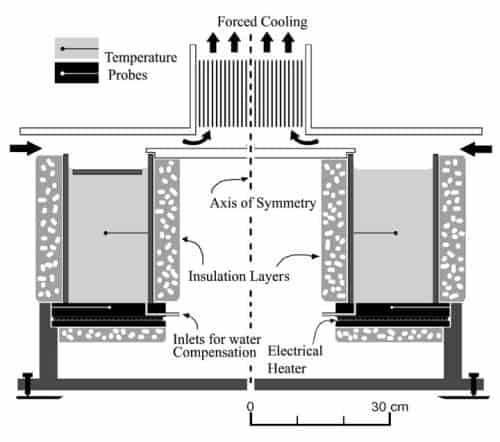
The physicists filled a 3-litre rectangular tank with a mixture of glycerol and water. The liquid is heated from below by a hot plate and heat is removed at the top of the tank by a water-cooled plate. The sides of the tank are transparent and a video camera is used to study the motion of the fluid.

In the absence of any solid objects, the tank becomes one large convection cell, with the fluid rotating in one sense (clockwise or anti-clockwise) for many hours. Occasionally, however, the rotation will reverse in a spontaneous process that is believed to be related to the rare occasion when random fluctuations in the flow are sufficient to overcome the energy barrier between clockwise or anti-clockwise convection.

400 nylon spheres

Zhang and Liu then placed about 400 nylon spheres (with a diameter of 3.2 mm) into the tank. The spheres are denser than the fluid and therefore sink — covering about half the area of the bottom of the tank. The balls can roll around the bottom of the tank, and their presence had an immediate effect on the convection process, which switches direction every hour or so — rather than enduring for many hours.

The video camera revealed that the balls create a set of patterns on the bottom of the tank that changed along with the convective flow. As the liquid moved in one direction along the bottom of tank, it jammed the balls together at one end of the rectangular bottom of the tank. When about one half of the tank bottom was completely covered in close-backed balls, the convective current began to weaken and eventually reverse — sending the balls to the opposite end of the tank.

According to Zhang, the reversals occur because the carpet of close-packed spheres acts as an insulator that reduces the amount of heat flowing upward at one end of the tank. Meanwhile at the other end of the tank — where fluid had been flowing downward — the absence of balls means that heat can flow freely up from the bottom, disrupting the downward flow. The overall effect is a reversal in the rotation of the cell.

While a few hundred balls rolling around the bottom of a small tank may seem to have little to do with continental drift, Zhang says that the systems are similar. This is because the crust under a continent is much thicker than the crust under the oceans, causing heat to become trapped under continents. This could disrupt convective flow in the same way as the insulating carpet of balls.

”You may regard those spheres as small (micro) continents and the convective fluid as the mantle of the Earth”, he explained. ”Our finding implies that supercontinents like Pangaea can be periodically created and also periodically broken apart”.

Zhang told physicsworld.com that the team are now working on a system that is more ‘Earth-like’. In particular, the fluid and balls are not restricted by walls in a rectangular tank. Instead, they are in a tank with vertical walls that are concentric cylinders.


CERN hopes LHC report will dispel doomsday fears

A report from the CERN laboratory near Geneva has restated the conclusion that the Large Hadron Collider (LHC) — the biggest experiment in particle physics — poses “no danger” to humankind. CERN hopes the report will dispel public fears that the accelerator will produce black holes or hypothetical particles known as strangelets that could destroy the Earth.

If all goes to plan, CERN expect to inject the first proton beams into the LHC in August. These beams will collide at energies close to 14 TeV — enough to generate a hoard of new particles and possibly even the highly anticipated Higgs boson. However, amid all the excitement about the discovery of new physics, some of the public have worried that particle collisions at the LHC might create other, more sinister entities. Recently Walter Wagner, a trained nuclear physicist, and colleague Luis Sancho filed a lawsuit in Hawaii to prevent the LHC from starting up based on these worries.

In 2003 CERN’s LHC safety study group produced a report that concluded that there is “no basis for any conceivable threat” of either dangerous black holes or strangelets. The new report — written by the LHC safety assessment group (LSAG) including John Ellis, Gian Giudice, Michelangelo Mangano, Igor Tkachev and Urs Wiedemann of CERN — has come to exactly the same, though “reinforced”, conclusion.

“With this report, the laboratory has fulfilled every safety and environmental evaluation necessary to ensure safe operation of this exciting new research facility,” said Robert Aymar, director-general of CERN, in a statement.

No danger

The LSAG report draws attention to the fact that cosmic rays collide continually with the Earth and other astronomical bodies at much higher energies than the LHC, yet do not appear to create either large black holes or strangelets. “We estimate that the universe is replicating the total number of collisions to be made by the LHC over 1013 times per second, and has already done so some 1031 times since the origin of the universe,” the report states.

With regards to black holes, the report maintains that “if they can be produced in the collisions of elementary particles, they must also be able to decay back into them.” If the black holes do not immediately decay, however, “they would be unable to accrete matter in a manner dangerous for the Earth.”

The report compares the likelihood of strangelets being produced at the LHC with the likelihood of them being produced at the Relativistic Heavy Ion Collider (RHIC), which came online at the Brookhaven National Laboratory, US, in 2000. Given experimental measurements taken at the RHIC, the report claims that “in the event they exist, strangelets would be less likely to be produced at the LHC than at [the] RHIC.”

• A simple summary of the LSAG report can be read here.

US: question your congressional candidates

By Jon Cartwright

Reports of rumour-mongering, pettiness and mud-slinging may still be rife, but I think it’s safe to say that the fever surrounding the US primaries has at least partly subsided. Among those who have not been taking time to convalesce, however, are the folks at ScienceDebate 2008. According to an email they dropped into my inbox this morning, they’ve been busy working with a dozen national science organizations to prepare a list of 14 questions related to science policy for the presidential candidates. Get ready, they’ll be announcing it shortly.

Until then, check out this page on the Scientists and Engineers for America (SEA) website. Together with ScienceDebate 2008, the American Association for the Advancement of Science, the American Institute of Physics, the American Physical Society and 11 other organizations, the SEA has drawn up a list of seven questions on science policy for the 2008 congressional candidates.

Two candidates have already posted some responses. If you want to pester your local candidate, SEA gives you the option to send him or her an email.

‘Excitonic integrated circuit’ is a first

Physicists in the US have created a new kind of integrated circuit that can switch light without first converting it into an electronic signal. The light is instead transformed into a quasiparticle called an “exciton”, which consists of an electron bound to a hole. The excition can then be manipulated within a semiconductor chip before being converted back into light.

As well as boosting the performance of optical communications networks, the breakthrough could provide physicists with a new kind of quantum gas to study.

Optical telecoms networks are very efficient at transmitting vast quantities of data in the form of light pulses. However, processing all this data involves converting the light into pulses of electrons that can be manipulated using semiconductor devices — a process that involves expensive and power-hungry components.

The problem is that there is currently no practical way of performing logical operations on light itself. Some physicists believe that the solution lies in a compromise of sorts — converting light into excitons, which behave like both photons and electrons.

Electron-hole pair

An exciton is created when a photon is absorbed by a semiconductor, creating an electron-hole pair that propagates through the material until it annihilates to create another photon. While a photon cannot be easily controlled with an applied voltage, an exciton comprises two charged particles and can therefore be manipulated by applying a voltage across the semiconductor.

Now, Leonid Butov and colleagues at the University of California at San Diego and Santa Barbara, have used this property to create the first excitonic integrated circuit (EXIC).

Their device is made from three identical switches that were fabricated on a wafer of gallium arsenide (GaAs). Each switch contains two quantum wells (extremely thin layers of doped GaAs) that are separated by several nanometres. When an exciton is created in the region of the wells, the electron and hole move apart and the electron travels through one quantum well and the hole through the other (Sciencexpress).

Less likely to annihilate

Because the electron and hole are separated, these “indirect” excitons are much less likely to annihilate and can therefore travel hundreds of micrometres along the quantum wells, before annihilating at the output of the switch to create light.

However, if a voltage is applied to the wells, the pairs face an energy barrier and cannot travel along the wells. As a result, no light reaches the output.

The switches were arranged in a “three beam star”, with one optical terminal of each switch connected at a central axis point. This circuit can be used in a number of different switch configurations — depending on the voltages applied to the individual switches and which terminals of the star are used as inputs and which are used as outputs. For example, the device was operated as a two-way switch in which an input optical signal to one switch could be routed to the output of one of two other switches.

One downside of the EXIC in the GaAs structure is that it only works at temperatures below about 40K, because at higher temperatures the electron and hole will not bind to create an exciton.

However, this binding temperature is a property of the semiconductor and higher temperatures could be achieved using a material other than GaAs.

The team have also shown that these long-lived excitons can be cooled rapidly to very low temperatures. As a result, Butov’s next project is to study the fundamental physics of an ultracold gas of excitons, which is an ultracold bosonic system.

Copyright © 2026 by IOP Publishing Ltd and individual contributors