Peer review informed ILC pull-out

The UK government claims that the controversial decision to pull the country out of plans for the International Linear Collider (ILC) was taken on the basis of peer review. The government’s claim is made in its response to a petition on the Downing Street website, signed by over 17,500 people, that called on the prime minister Gordon Brown to “reverse the decision to cut vital UK contributions to particle physics and astronomy”.

The response to the petition also pours cold water on any prospect of the funding shortfall being reversed. Indeed, the government insists there has been no cut in the STFC’s budget. “Claimed reductions in STFC’s budget appear to have been derived from STFC’s aspirations for the three-year comprehensive spending review period from 2008/9 to 2010/11,” the statement says. “These aspirations never constituted an agreed set of activities or funding for them, and the suggestion that £80m has been cut from its budget is wrong.”

Funding shortfall

The UK’s withdrawal from the ILC, which is set to be the next big experiment in particle physics after the Large Hadron Collider at CERN, was announced late last year by the Science and Facilities Technology Council (STFC) after it was left with a shortfall of £80m in its budget.

The pull-out shocked many in the particle-physics community, including Brian Foster of Oxford University in the UK, who is European director of the ILC’s global design effort. Speaking to physicsworld.com in February, he claimed that the council had never discussed the matter with him but “presented it as a fait accompli”.

Now, however, the government says that the decision was taken on the basis of peer-review evidence. The government’s statement also tries to implicate the US in the decision in the withdrawl from the collider, saying that “the US Congress seems to share this sceptical view of the prospects for the ILC”.

“I think the statement about peer review is government spin at its worst,” says Foster. “The whole process was driven by top-down nudges and winks that ILC couldn’t be afforded. Fortunately now we are into a phase of consultation where I hope that we can have constructive dialogues on the way forward.”

But John Wormersley, director of science programmes at the STFC, says that the decision to pull out of the ILC was discussed before it was made. “The government is referring to the fact that the ILC action was discussed in STFC’s PPAN [particle physics, astronomy and nuclear physics]science committee and our science board,” he says. “The science board then made a recommendation to [STFC’s] council, before council made its decision.”

Testing quantum gravity at the LHC

Finding a quantum theory of gravity has eluded the world’s best physicists for almost a century. As well as the fearsome mathematical challenge of marrying quantum theory with Einstein’s general theory of relativity, the extreme conditions at which quantum gravity applies — corresponding, for example, to the first 10-43 seconds of the universe — make it virtually impossible to test in an experiment. At least that’s what researchers used to think.

In 1998, physicists realized that the natural scale of quantum gravity (the Planck scale, which corresponds to an energy of 1019  GeV) could be 15 orders of magnitude lower if the universe has additional spatial dimensions into which the true strength of gravity can “leak”. This raises the prospect of studying quantum gravity at CERN’s Large Hadron Collider (LHC), which will soon be smashing protons into one another to produce an energy of 14 TeV (about 104 GeV).

Taking the existence of large extra dimensions as a starting point, Daniel Litim of the University of Sussex and Tilman Plehn of the University of Edinburgh have now calculated that quantum gravity would modify the rate of a which leptons, such as electrons and muons, are produced in the LHC’s collisions — and that the effect could be present at energies as low as 6 TeV (Phys. Rev. Lett. 100 131301). While there are hundreds of papers predicting the effects of large-extra dimensions at the LHC, most notably the production of mini black-holes, most have large uncertainties and do not make such quantitative predictions.

Fluctuating fields

The most advanced progress in quantum gravity comes from string theory, which describes particles as vibrations of 1D strings that oscillate in a higher dimensional space (and is the inspiration behind large-extra dimension models). An alternative attempt is loop quantum gravity, which tears up our basic notions of space-time at the smallest scales. Litim and Plehn took a more conventional approach by allowing the “metric” in general relativity, which connects the curvature of space-time to the local matter present, to fluctuate as if it were a quantum field.

In 1979 Steven Weinberg performed this exercise for 2D gravity, revealing that the strength of the gravitational interaction between two particles depends on the energy at which those interactions are probed. Similar behaviour is observed for the electromagnetic and the strong interactions, which are described by quantum field theories. Like the strong interaction, the gravitational coupling turns out to be weaker at large energies.

Using computational tools developed in the last two years, Litim and Plehn found the same behaviour in four and higher dimensions. As such, they avoided the “divergent” calculations that normally yield uncertain predictions in quantum gravity theories based on metric fluctuations. “To my understanding, this the first time the effect of these fluctuations for LHC observables has been calculated without any unphysical cut-off,” Litim told physicsworld.com.

Computing observables

Taking the energy-dependence of the gravitational coupling into account, Litim and Plehn worked out the rate at which pairs of leptons are produced from virtual gravitons (the “messenger” particles of gravity that come from fluctuations of the metric) created in the LHC’s collisions. Because this rate is predicted with great precision by the standard model of particle physics, any increase could be a signal for quantum gravity. Despite gravity becoming weaker at high energies, the LHC turns out to be sensitive to this quantum gravitational phenomenon up to a fundamental Planck scale of 6 TeV. Furthermore, says Litim, the well-behaved nature of gravity at high energies yields a consistent theory of quantum gravity.

The researchers are currently working out how to differentiate an effect due to quantum gravity from others due to different theories, such as string theory or supersymmetry. For some, however, the likelihood of observing such an effect is slim. “The existence of gravitational fixed points [which arise from the variation of the gravitational coupling with energy] would alter the standard signal for extra dimensions,” says JoAnne Hewett of Stanford University, who perfomed a similar calculation around the same time as Litim and Plehn (JHEP 12(2007)009). “These are cute calculations, but it is a long shot to connect them with reality.”

Sweat glands are tiny antennas

A group of scientists in Israel has discovered that human sweat glands act like tiny antennas, and could in principle be used to remotely monitor a person’s emotions. This is because the emission of the glands, which lies in the sub-terahertz range, varies according to sweat levels.

Humans have several million sweat glands, which lie in the middle layer of the skin called the dermis. When the glands produce sweat, it is transported roughly 100 µm to the surface, called the epidermis, through a duct.

Researchers had assumed that these ducts are basically straight, but recent images taken using 3D optical coherence tomography showed that they are in fact helical. Because the sweat ducts were already known to be conductive, and because the dielectric permittivity of the dermis is higher than that of the epidermis, Yuri Feldman, Aharon Agranat and colleagues at the Department of Applied Physics at the Hebrew University of Jerusalem speculated that the ducts might function as helical antennas that emit over a broad range of frequencies.

Given the length of the ducts, which would have to be just a fraction of a millimetre, the structure would have a resonant frequency of around 100 GHz, in other words the low terahertz region. Unfortunately, ions in the ducts would move far too slowly to create current alternating at this speed. Feldman and colleagues therefore proposed that the high-speed movement of charge could be provided by a common biological process known as “proton hopping”, in which protons jump from one water molecule to the next.

Tried and tested

Now, The Israel researchers have tested this hypothesis. They bounced sub-terahertz radiation between 75 and 110 GHz off the hands of various people and measured the strength of the reflected radiation as a function of frequency. They did this when the people were fully relaxed and then following 20 minutes of intense jogging, taking successive measurements as the subjects returned to a relaxed state. They found that the spectra of reflection intensity were curves centred on a dip at about 90 GHz, and that the dip became less pronounced as people relaxed (Phys. Rev. Lett. 100 128102).

These results supported their theory, since emission by the sweat ducts would weaken reflection at terahertz frequencies. The fact that this weakening was most pronounced when people were sweating the most suggested that the strength of the ducts’ emission depended on sweat levels.

To see if this was true, the researchers carried out computer simulations in which terahertz beams were sent through an idealized section of a person’s skin containing eight helical sweat ducts. Because the dip became more pronounced as they increased the conductivity parameter — that is, as they increased sweat levels — the researchers concluded that sweating increases terahertz emissions. In fact, the terahertz emissions correlated well with pulse rate and blood pressure measurements too.

Signs of emotion

Feldman proposes that, in principle, simultaneous measurements of a person’s reflectance spectra at different parts of the body could provide information about their emotional state. There are number of areas of the body that have high concentrations of sweat glands, such as the forehead, the palms of the hand and the soles of the feet. The relative change in sweatiness between these different areas varies according to what caused the body to sweat — whether, for example, it was due to heat, excitement or spicy food.

“What we have shown is just the beginning,” says Feldman and Agranat. “We are very sure that the experiments validate our antenna hypothesis.”

New probe measures magnetic fields inside solids

A new 3D imaging technique using neutrons has been invented by physicists in Germany. The technique, which can visualize magnetic fields inside bulk objects, is an improvement on existing magnetic methods that are limited to surfaces. The method could find use in a range of science and engineering fields and shed more light on various magnetic phenomena in solids, including superconductivity.

Neutrons are subatomic particles that have a net zero charge and can therefore penetrate thick layers of material. They also have a magnetic moment (or spin) and so are sensitive to magnetic fields). When all the spins point in the same direction, a neutron beam is said to be spin-polarized.

Rotating moments

Nikolay Kardjilov of the Hahn-Meitner Institute in Berlin and colleagues used a beam of polarized neutrons from a nuclear reactor to irradiate samples in their experiments (Nature Physics doi: 10.1038/nphys912). As the neutrons travel through a sample, their magnetic moments rotate around the magnetic fields they encounter and the direction of their spin changes. The researchers measure the different spin angles, which depend on the strength of the magnetic fields traversed by the neutrons.

These angles are then converted into intensities by a polarization analyser, located behind the sample. Next, a position-sensitive detector measures these intensities to build up a map of the magnetic fields inside the sample.

“The spin-polarized neutron imaging technique is non-destructive and non-invasive and is better than conventional 2D imaging techniques,” Kardjilov told physicsworld.com. “The method can be employed in a variety of environments—for example, at high or low temperatures — and samples can be investigated from almost any viewing angle. In this way 3D information about the magnetic field distribution is revealed.”

Megapixels in minutes

Moreover, measurements are fast. Each image contains about a million pixels and is taken in just seconds or minutes depending on the sample. “No other method can compete — even in free space,” added Kardjilov.

Our aim is to achieve a spatial resolution of 50 µm in just a few minutes per imageNikolay Kardjilov, Hahn-Meitner Institute

The technique might be used to investigate magnetic flux distribution and pinning in superconducting samples, which could be important for understanding high-temperature superconductivity. Indeed, the researchers have already investigated the trapped magnetic flux inside a polycrystalline lead cylinder, a type-I superconductor. The method could also be used to visualize magnetic domain distributions in bulk ferromagnets in 3D for the first time.

The team, which includes researchers from the Berlin Institute of Technology, Ruprecht Karls University Heidelberg and the University of Applied Sciences Berlin, are now working on improving the spatial and temporal resolution of its technique. “Our aim is to achieve a spatial resolution of 50 µm in just a few minutes per image,” explained Kardjilov. The researchers also hope to increase the sensitivity of the method by further developing an iterative algorithm to quantify results obtained.

‘Remarkable technical advance’

Bruce Gaulin , who is Brockhouse Chair in the Physics of Materials at Canada’s McMaster University, described the team’s work as a “remarkable technical advance”. “As a proof-of-principle measurement, it should allow even more detailed mappings of magnetic field distributions in matter”, Gaulin told physicsworld.com.

Kardjilov and colleagues are not the only team developing imaging techniques based on spin-polarized neutrons. “We consider these studies as pilot tests to demonstrate magnetic imaging using polarized neutrons,” commented Eberhard Lehmann from the Paul Scherrer Institute in Switzerland, whose team is working on a similar but “more sophisticated” experiment called “neutron spin phase imaging” (Nucl Instr Meth A 586 15).

Lehmann suggests that dedicated beam lines at suitable intense neutron sources would help advance the field of neutron imaging and so allow for more detailed technical studies.

Fibre sensor secures optical networks and pipelines

Imagine a line of security guards standing 10 m apart guarding a 40 km section of a border or perimeter. Now imagine that these 4000 guards never get hungry or tired and are invisible. That’s how QinetiQ of the UK asks potential customers to think about OptaSense – a fibre-optic acoustic sensor where every 10 m length of the optical fibre acts as an independent element capable of reporting any disturbance.

“We originally looked at this technology for perimeter and border protection,” OptaSense product manager David Hill told OLE. “But other relevant uses include monitoring for third-party interference or damage on oil and gas pipelines, as well as on optical telecommunication fibres and networks.”

The product works on a similar principle to conventional optical time delay reflectometers (OTDRs) that are used to characterize optical fibres. An OTDR injects a series of optical pulses into the fibre under test and monitors the returning pulses.

In the case of OptaSense, the optical fibre is buried in the ground and when a propagating seismic signal passes through the fibre it displaces the fibre by a minute amount – many orders of magnitude less than a millimetre.

“This minute displacement creates a strain on the fibre and we measure this dynamic strain,” explained Hill. “OptaSense takes an OTDR to a significantly greater level. We send a conditioned pulse down the fibre and look at changes on that pulse when it returns. It can tell you in much greater detail what the strain was at every location along the fibre.”

A new use for dark fibre

QinetiQ has a long history of developing fibre-optic sensors, in particular acoustic sensors such as hydrophone arrays for military applications. When QinetiQ started to diversify into commercial applications, one area it began investigating was intruder detection and perimeter monitoring.

The firm’s next move was to team up with UK company Sensoptics, a fellow expert in fibre-optic sensors. After a highly successful partnership, the end result is today’s OptaSense product that combines Sensoptics’ specialist optical knowledge with QinetiQ’s experience of acoustic signal processing.

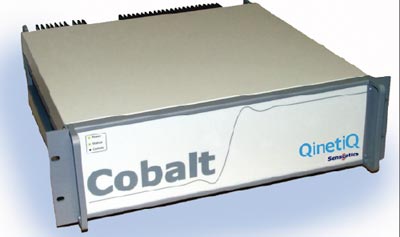
OptaSense is made up of three elements: a standard singlemode telecommunication fibre that acts as the sensing element, a Cobalt interrogation unit produced by Sensoptics that houses the optical technology, and a graphical user interface and processing capability that allows the customer to interact with the system.

“You can use any existing fibre that is available,” commented Hill. “We suggest that it should be dark fibre optimized for wavelengths around 1550 nm. If there is no fibre available, it can be installed using standard direct burial cable installation techniques and does not require any special ground preparation. In soft ground, a ploughed installation of 10 km per day is not uncommon.”

Hill adds that although the company quotes a maximum fibre length of 40 km, longer deployments are possible. “40 km is half the typical distance between repeater stations in a telecommunications network,” he said. “If you want to go longer you can, but then you start to trade-off performance with the noise floor increasing and the sensitivity decreasing.”

Intruder alert

The Cobalt box uses the optical fibre as its sensing element. The system monitors the entire length of the fibre continuously and can detect, classify and locate (DCL) any number of simultaneous disturbances anywhere along the fibre with a resolution of 10 m.

Crucially, the signal extracted from each 10 m section of the fibre is unaffected by the vibration on any other section of the fibre, including those immediately adjacent. Hill adds that multiple simultaneous disturbances do not reduce the system’s ability to DCL other activity along the fibre.

But just how sensitive is the system? “The performance depends on the type of soil surrounding the fibre,” explained Hill. “However, we can typically detect a person walking when they are 5–10 m away from the buried fibre. We can detect vehicles that are 50 m away from the fibre and diggers/other larger machinery that are between 300 to 500 m away. These are conservative estimates.”

This aspect of the system makes use of QinetiQ’s signal-processing expertise. Cobalt automatically learns the normal background level of vibration along each 10 m section of fibre and then sets appropriate amplitude thresholds for each location. “The system looks at the acoustic signal from the event to classify the disturbance,” said Hill. “To date, we can classify a vehicle and a person but we will be increasing this library considerably over time. We are using our SONAR processing capabilities to process the 4000 output channels from Cobalt simultaneously.”

According to Hill, a 40 km length of optical fibre has a frequency response of 0, or DC, to around 1.25 kHz, and this upper limit reaches 5 kHz for a shorter 8 km fibre. “The majority of seismic signals tend to be at low frequencies of sub-100 Hz, with the ground attenuating all of the higher frequencies” he added. “OptaSense is ideal for seismic-type measurements.”

User experience

Hill and QinetiQ are keen to stress that the system is simple to operate thanks to an intuitive graphical user interface that presents everything that you need to know in three windows.

The first window displays an aerial photo or an ordnance survey map of the area and details the precise route of the fibre such that when an event is triggered OptaSense can tell the user the exact GPS coordinates of the disturbance.

The second window contains two histograms – one showing the activity along the entire length of the fibre and one showing a selectable zoomed length of the fibre. Each histogram displays the amplitude of the signal detected on every 10 m length of fibre. The third and final window gives an alert history showing what has been detected, when and where.

In addition to the automatic alarm, the system’s operator can also put on a pair of headphones and listen to the sounds detected at any position along the fibre. For example, the user could hear the characteristic sounds of someone walking or a pneumatic drill.

One additional point is that the output acoustic signals from Cobalt are available via a TCP/IP Ethernet connection although the Cobalt system can also be configured and monitored remotely over the internet.

Testing and potential applications

The Cobalt interrogation unit has been through a rigorous testing process, with evaluators including the US Department of Defense and US telecoms giant AT&T, and is now available as an off-the-shelf product. Hill recalls working with AT&T, where its intended use was cable protection.

“AT&T attached OptaSense to one of its live telecom cables in Atlanta, Georgia, to monitor for any third party interference occurring in the surrounding area,” he explained. “Sensoptics was monitoring the system remotely over the web from the UK and one day saw a huge amount of activity along the fibre route. They phoned AT&T and advised them to go to the exact GPS coordinates and they found builders digging foundations to a house about 3 m from a main telco trunk cable.”

According to Hill, the four primary industries that could benefit from deploying OptaSense are security for perimeters and borders, oil and gas, telcos and transportation.

“In the oil and gas industry, third party interference could be a farmer digging up a pipe or intentional interference where people drill into the pipe and attempt to steal the oil or gas,” he explained. “But OptaSense could also be used to detect leaks or ringfence storage facilities to provide intruder detection.”

With the price of copper rising, one emerging area is protection against theft. “The rail and telco industries have a big problem with copper cable theft,” said Hill. “It is organized crime in the rail industry where people would go to a remote site and remove up to 500 m sections of the cable from ducting running alongside the track. Fortuitously, the cable ducts that contain the copper cable increasingly include a telco cable as well. We can use some of the dark fibre in the telco cable to immediately detect when someone is tampering with the copper cable.”

For further information, see www.QinetiQ.com/OptaSense.

• This article originally appeared in the February 2008 issue of Optics & Laser Europe magazine.

SQUID maker sets its sights on X-ray detection

What does a dark-matter experiment buried deep under a mountain in Italy have in common with an airborne system that prospects for minerals in the Australian outback? The answer is that they both use SQUIDs (superconducting quantum interference devices) made by Star Cryoelectronics of Santa Fe, New Mexico.

The company makes a range of magnetic SQUID sensors that are based on both low- and high-temperature superconductors, as well as electronic control systems for these devices. The firm was founded in 1999 by the physicist Robin Cantor, who had previously been manager of the SQUID technology group at the firm’s predecessor Conductus (now part of Superconductor Technologies) in Sunnyvale California and who also worked on developing superconductor sensor technologies at the Los Alamos National Laboratory in New Mexico.

The company started by taking over the manufacturing of SQUIDs from Conductus. Since then Star Cryoelectronics has expanded its customer base and now supplies SQUIDs for a wide range of applications, including biomedical imaging, non-destructive materials testing, geophysical exploration and basic research.

While up to now the company has focused on supplying components and systems that are integrated into instruments made by other firms, it is poised to launch its first instrument: a SQUID-based X-ray spectrometer for use with electron microscopes that offers an energy resolution that is 10 times better than that of conventional silicon X-ray detectors.

Tunnelling current

A SQUID consists of a circuit of superconducting material that includes one or two Josephson junctions — regions where the superconductor is interrupted by a very thin layer of insulating material. Electrons are able move through the insulator thanks to a quantum-mechanical process called tunnelling. The tunnelling current and thus the voltage across the insulator is strongly affected by the presence of an external magnetic field.

If the strength of this magnetic field is increased steadily, then the voltage will vary sinusoidally. Each cycle corresponds to the addition of one fluxon — the quantized unit of magnetic flux — to the area enclosed by the circuit. This relationship between voltage and flux can be exploited to make a very sensitive magnetometer.

SQUIDs make useful sensors because they can detect extremely small magnetic fields — the best devices can measure fields as low as several femtotelsas (10–15 T), which is about 11 orders of magnitude smaller than Earth’s magnetic field.

Most SQUIDs are made using low-temperature superconductors (LTS) such as niobium or a lead alloy and need to be cooled to just a few degrees above absolute zero to operate. The best LTS devices are easily capable of detecting the tiny magnetic signals that are related to activity in the human brain. As a result, systems for magnetoencephalograpy (MEG), or magnetic imaging of the brain, are one of Star Cryoelectronics’ key markets.

Brain waves

One of the firm’s customers is Eagle Technology, which makes a MEG system that surrounds the subject’s head with a helmet-like array of dozens of SQUIDs. The main advantage of this technique over other probes of brain function such as magnetic resonance imaging and positron emission tomography is that the SQUIDs can resolve brain activity on millisecond timescales.

Cantor is confident that SQUIDs could also be used in the emerging field of magnetocardiography (MCG), which involves detecting tiny electrical signals from the heart. MCG could be used to screen patients for susceptibility to fatal heart disorders such as ventricular tachyarrhythmia — the rapid and irregular beating of parts of the heart.

While LTS-based SQUIDs are extremely sensitive, they must be cooled with liquid helium — or more recently “cryogen-free” mechanical coolers — which adds extra expense and complexity to measurements. In particular, it limits the development of portable magnetometers based on SQUIDs.

High-temperature SQUIDs

It is also possible to make SQUIDs from high-temperature superconductor (HTS) materials such as yttrium–barium–copper-oxide (YBCO) that can be cooled using liquid nitrogen, which is much cheaper and easier to work with then liquid helium.

Although HTS SQUIDs are not generally as sensitive as the best LTS components, Star Cryoelectronics offers several HTS devices with sensitivities approaching those of LTS devices. Accord to Cantor, the company’s predecessor, Conductus, was the first commercial entity to release a product containing HTS technology — “Mr SQUID”, which debuted in 1992. This is an educational system that aims to teach students about superconductivity and magnetism. According to Cantor, Conductus and more recently Star Cryoelectronics have since sold over 300 such systems to schools and universities worldwide.

Since then, Star Cryoelectronics’ HTS SQUIDs have used for a number of different applications. The devices have been integrated into instruments that can perform the non-destructive evaluation (NDE) of materials — which is used to identify flaws such as cracks in solid materials without having to destroy the object. The SQUIDs measure the defects by monitoring the changes to tiny eddy currents in the material. This capability is particularly important in the aerospace industry, where the firm’s HTS SQUIDs are used to image defects in jet-engine turbine blades and other critical components.

Airborne mineral surveys

The company’s PC-based pcSQUID control systems are widely used in a wide range of geophysical exploration activities, including sensors lowered down boreholes to perform magnetic profiling as a function of depth. Scientists at Australia’s national research laboratory CSIRO are using HTS SQUIDs onboard aeroplanes to survey for minerals. CSIRO has also used the firm’s control systems in its SPINMAG system, which is used to determine the mineral composition of rock samples.

The company’s devices are also used in a number of specialist instruments in research labs around the world. These include the CRESST underground experiment at the Gran Sasso National Laboratory in Italy, which is trying to detect dark-matter particles called WIMPS. The idea is that when absorbed, these weakly interacting particles would create a heat pulse that can be detected using an extremely sensitive thermometer read-out that uses SQUID sensors controlled by Star Cryoelectronics’ pcSQUID system.

Foray into instrument making

Despite its success in supplying SQUIDs to a wide range of instrument makers, Cantor believes that in order to remain successful, the company must begin to manufacture and sell its own instruments. The company’s first such foray is the MICA-1600 X-ray spectrometer, which will be launched later this year.

According to Cantor, the system takes advantage of the fact that superconductors can be used to make X-ray detectors with extremely high energy resolution. Called transition-edge sensors (TES), these detectors contain small pieces of superconducting material that are kept within the transition-temperature range above which the material is no longer a superconductor. The superconductor is in thermal contact with a material such as bismuth, which heats up when it absorbs an X-ray. This in turn heats up the superconductor, thereby boosting its resistance and therefore reducing the current flowing through it. The difference in magnetic field associated with this change in current is then detected by a SQUID. The result is a very accurate measurement of the total energy deposited in the bismuth when an X-ray is absorbed.

According to Cantor, the new X-ray system has an energy resolution of better than 15 eV at 6 KeV — which is about 10 times better than a conventional silicon X-ray detector at the same energy. In principle, this could be further reduced to 2 eV.

Overlapping X-ray lines

Cantor told physicsworld.com that having such good energy resolution is important when doing energy-dispersive X-ray spectroscopy in conjunction with an electron microscope. In this technique, the electron beam is scanned across a sample, which creates X-rays that are characteristic of the elements present in the sample. By detecting these X-rays, the elemental composition can be determined. Unfortunately, X-ray lines from different elements normally overlap, which makes it difficult to tell them apart. But with a resolution of 15 eV, the new system is capable of resolving all elemental X-ray lines.

The instrument is designed to be mounted on a scanning electron microscope and Cantor says that potential customers include major semiconductor fabs as well as national and university research labs.

For a small company with only five employees, Star Cryoelectronics has played important roles in an impressive range of scientific, medical and industrial endeavours including the search for dark matter, studies of the brain and ensuring the safety of aircraft. With the launch of the MICA-1600 X-ray spectrometer, the firm hopes to open brand new markets for its SQUID technologies.

The ‘Measurement Fair’ returns to Nuremberg

Visitors to the Sensor + Test 2008 exhibition and conferences in Nuremberg next month will be able to sample the wares of nearly 600 companies selling everything from the tiniest sensors based on nanotechnology to full-blown test and measurement systems for use in the automotive, aerospace and other industries.

New products on display at the exhibition — which will run 6–8 May — include what is claimed to be the world’s smallest and most precise absolute pressure sensor. Produced by VTI Technologies of Finland, the device is said to consume only 6 µA of current, which means that it could be integrated within a wristwatch or mobile phone to allow such devices to function as precision altimeters.

Fibre–Bragg gratings

A number of firms will be exhibiting sensor technologies based on optical fibres, including Belgium’s Fibre Optic Sensors and Sensing Systems. The firm offers a range of temperature, strain, displacement and pressure sensors that are all based on fibre–Bragg gratings. These are regions within an optical fibre with optical properties that are very sensitive to mechanical or temperature changes. Because such detection systems are based on the transmission of light — rather than electrical signals — they are immune to most electromagnetic interference, making them increasingly popular for use in cars and aeroplanes.

The exhibition also features an “Action Area” where more than 20 companies will offer hands-on demonstrations of their sensors and testing systems. Germany’s Microtech Gefell, for example, will be demonstrating its “acoustic camera”, which will be used to create images of the vibrational properties of vehicle engines. Future-Shape of Germany will invite delegates to try out its flooring and glass-pane products that have built-in sensors to help guide people with vision or mobility problems around their home. Stiegele Data Systems of Germany will be showing off its data acquisition and analysis software, which will be connected to a number of different sensors mounted on a mountain bike that will be ridden over a test course.

History of strain gauges

Delegates will also be treated to a history lesson on the invention and development of strain gauges in a retrospective exhibition sponsored by two German firms: ADDITIVE and imc Meßsysteme.

A little over 60% of exhibitors are from Germany, with most of the remaining firms hailing from the rest of Europe. Those coming from beyond Europe include more than 30 firms from North America and eight companies from China.

Sensor + Test includes two major conferences: the 8th OPTO conference on research and development in optical and optoelectronic sensors and the 10th International Infrared Sensors and Systems Conference.

Both meetings will run 6–7 May and each day will kick off with joint plenary talks aimed at delegates to both conferences. On the first day, Holger Vogel of Germany’s Carl Zeiss Optronics will talk about how to improve imaging systems by combining data from several different optical sensors. This will be followed by the second plenary talk by René Beigang, head of the ultrafast photonics and terahertz physics group at the Technical University of Kaiserslautern, Germany (see “The terahertz revolution”). Beigang will talk about the rapidly expanding field of terahertz sensing, which has been used by NASA to improve the safety of the space shuttle and could soon be used in airport security scanners.

Plenary talks

On the second day of the conferences, one plenary talk will be given by Georg von Freymann of the Center for Functional Nanostructures at Karlsruhe University, Germany. Von Freymann’s research group is developing three-dimensional photonic crystals — materials comprising periodic nanostructures that have a number of distinct optical properties such as “optical band gaps”. Von Freymann will talk about the prospects for using photonic crystals in optical sensor systems.

The OPTO conference will also include sessions on optical sources and modules, fibre-optic sensing and optical measurement technologies. In addition to several sessions devoted to thermal imaging and temperature measurement, the Infrared Sensors and Systems Conference will also include a session on the latest developments in sensors and arrays.

The terahertz revolution


What is so special about terahertz radiation?

Many materials used in everyday life are highly transparent in the terahertz (THz) region, while others absorb the radiation in very characteristic ways. We can therefore use THz radiation to see through materials such as clothes or plastic film and to analyse other materials using spectroscopy. In solids, weak non-covalent interactions between molecules can be observed, which can provide information about their crystalline structure; and metals are opaque at THz frequencies, so they can also be easily identified.

“Terahertz radiation is ideal for detecting non-metal objects hidden under clothing”

It is a non-ionizing radiation, which means that it is safe to use on humans. For example, at airports, it is ideal for detecting non-metal objects hidden under clothing. And, in the pharmaceutical industry, it could be used to perform chemical analysis of samples through containers such as blister packaging. No other region of the electromagnetic spectrum has these properties.

Why is there currently so much interest in this region of the spectrum?

The THz part of the spectrum is located between microwave and infrared radiation (100 GHz – 10 Hz) and has, until recently, not been easily accessible due to the a of efficient sources and detectors. Research in THz radiation is now benefiting from advances in other areas of physics, such as the development of lasers that can reliably produce femtosecond-long light pulsesand advances in non-linear optics — both of which can used to generate THz radiation. Now that good sources and detectors are available, companies and research groups have made impressive progress in developing products and applications utilizing this region of the spectrum.

What has been the most important technical advance in this area in the last few years?

The development of THz time-domain spectroscopy (TDS) — a powerful tool for material identification and chemical analysis — would not have been possible without advances in femtosecond lasers. The generation and detection scheme is sensitive to the effect of a material on both the amplitude and the phase of THz radiation. In this respect, the technique can provide more information than conventional Fourier-transform spectroscopy, which is only sensitive to the amplitude.

Are THz measurements being used today in industrial applications?

Yes, and the number is growing every day. But the industries that could make the most use of the technique — aerospace, defence and pharmaceutical — are notoriously cautious about adopting new technologies, making progress slow. Several companies have already launched passive THz cameras for use in airport-security systems and some are also developing active systems. For example, the UK companies ThruVision and QinetiQ have systems on the market.

Many people believe that THz technology has the potential to replace X-rays and metal detectors at airports, but I have my doubts. Security screening is a very challenging application because of scattering from clothing and the need to perform imaging and spectroscopy in real time. However, I think that the detectors will be a useful supplement to current screening techniques and I am that convinced we will find such systems at airports in the next few years.

Another UK company, TeraView, is exploring an interesting application in the pharmaceutical industry. The company claims that its system can be used to make high-speed measurements of the coating thickness of tablets while the pills are in random motion in a coating pan. For this application, the non-contact, non-destructive nature of the measurement technique is an advantage, plus it gives 3D and chemical information about the contents of tablets and capsules — something not normally possible with conventional monitoring techniques.

“NASA has used THz products developed by US-based firm Picometrix to examine the exterior of the Space Shuttle”

THz technology can also be used to detect defects in materials. For example, in the plastics industry it can be used to find air bubbles in extruded products, check the integrity of welded plastics and to monitor product thickness. NASA has used THz products developed by US-based firm Picometrix to examine the exterior of the Space Shuttle. THz measurements are used to detect flaws and poor adhesion in the sprayed-on foam insulation of the shuttle’s external fuel tank. NASA is also evaluating the use of THz measurements to determine the integrity of the tiles on the shuttle’s heat shield. As a shuttle ages, corrosion can form under the tiles potentially causing them to detach. By examining the layers that attach the tiles to the orbiter, NASA can determine which tiles to replace, and which tiles are still in good working order.

As it is safe to use on humans, THz technology can also, in principle, be used for medical imaging applications and in dentistry. Applications for this technology are endless.

Are there any problems with its use?

Yes, the radiation does have its limitations. Most polar molecules in the gas phase interact with THz radiation, which means that, in principle, it could be used to detect gases. However, the sensitivity of such techniques are not comparable with other, more established, methods of gas detection. The biggest problem for applications of THz radiation is water vapour, which interferes with measurements. This makes it challenging to use THz systems in outdoor settings.

What are the future innovations that are needed to help this industry develop and grow?

The main issues are cost, speed and complexity. THz systems are expensive because the femtosecond lasers used to create the radiation are very costly. The use of low-cost femtosecond fibre lasers, in particular at telecommunication wavelengths, should bring down the overall cost of systems. The use of continuous-wave devices based on electronic or optical generation may also reduce the cost considerably, although these systems cannot be used for all applications.

“In order to be useful in industrial applications, the systems have to become robust, compact and easy to use”

In order to be useful in industrial applications, the systems have to become robust, compact and easy to use. The time it takes to make measurements is another important issue that has to be addressed. In particular, for online process monitoring or security applications, new 2D measuring techniques have to be developed, including fast evaluation algorithms. The ongoing improvement of quantum cascade lasers as THz sources could enable more industrial usage of these systems.

As the technology has many different fields of application, it will not be possible to use a single THz system for all these applications simultaneously. Therefore, all the systems currently under development have their advantages and problems depending on the application being considered. To make most use of single systems, a modular set-up with flexible emitters and detectors is advantageous as it can be easily adjusted to a particular situation without changing the whole THz system. This is one route that many commercial companies and research institutes are following in order to make THz technology useable for different industrial applications.

Prof. Beigang will be making a plenary address on advances in THz technologies at the International Infrared Sensors and Systems Conference 2008 on Tuesday 6 May in Nuremberg, Germany.

Neutron detector to sniff out explosives

A team of Russian scientists has designed a device that they claim would provide a quick and easy way of detecting explosives, drugs and other illegal substances hidden inside enclosed spaces such as trucks and shipping containers. The device would provide a 3D image and information on the chemical composition of the material inside a vehicle by bombarding that material with neutrons, allowing authorities to combat criminals and terrorists without the need for expensive and time consuming manual inspections.

The design, produced by researchers at the Institute of Solid State Physics , the Joint Institute for Nuclear Research, and the company Aspect, all based near Moscow, involves taking deuterons (nuclei comprising one neutron and one proton) from high-pressure deuterium gas and accelerating them in a sapphire tube. These deuterons collide with a tritium target, producing high-energy neutrons that leave the tube, penetrate any casing and interact with the nuclei of the material under inspection. Gamma rays produced in this interaction are then detected by an array of fibre optic scintillator detectors.

Intersecting trajectories

This device, say the researchers, would create a 3D image of a container’s contents, with a resolution of a few centimetres, and identify its various chemical components — allowing inspectors, for example, to identify heroin or the explosive trinitrotoluene within bags of sugar. The image is created by intersecting the trajectory of each emitted gamma ray with that of its associated neutron. Although the direction and speed of each neutron cannot be measured directly, these data are worked out by detecting the alpha particles that are generated alongside each neutron and which travel away from the tritium target in the opposite direction. The chemical composition, meanwhile, is revealed by the energy of the emitted gamma rays, since this energy depends precisely on which element was involved in the interaction.

Such neutron-based detectors have been built by other research groups in the past. They have the disadvantage that inspectors must keep their distance during irradiation. Furthermore, according to Dennis Slaughter of the Lawrence Livermore National Laboratory in the US, who has developed such a device, these kinds of detector sometimes struggle to distinguish between explosives and common materials such as wool, leather and many hydrocarbons, because the relative proportions of hydrogen, carbon and oxygen inside each are quite similar.

Crystalline structure

Nikolai Klassen of the Institute of Solid State Physics, a member of the Russian team, acknowledges Slaughter’s criticisms but he points out that the new device, in addition to identifying the chemical composition of any substance, would also be able to identify its crystalline structure via neutron scattering. He points out that the characteristics of two different crystalline forms of the same chemical can often be very different.

Klassen also points to a number of advantages that he says his group’s device would have over existing instruments. One of these is compactness, since sapphire can accelerate deuterons to a given energy in a shorter distance than the more commonly used quartz — resulting in a total volume of some 3–4 m3, allowing the device to be put in a medium-sized truck and taken to wherever it is needed. Klassen also maintains that his group’s device would require less power and operate more quickly, since its array of scintillation detectors would require less time to scan an object than would the single row of detectors employed up to now.

Unfortunately, the Russian researchers need more funding to realize their design. They have constructed a prototype version, which fired gamma rays instead of neutrons, but they have still to perfect the technologies needed to build the sapphire tube and scintillation array.

Cuts threaten UK role at LHC

As particle physicists around the world gear up for the switch on of the Large Hadron Collider (LHC) at CERN later this year, UK researchers working on two of the collider’s four giant particle detectors are fighting to stave off funding cuts that would diminish their role in the multibillion euro project and may even jeopardize the operation of the detectors.

We should be on a high right now … Instead we’re facing an up-hill struggleNick Brook, Bristol University

“We should be on a high right now,” says Nick Brook of Bristol University, who has worked on the LHCb experiment for more than 10 years. “Instead we’re facing an up-hill struggle whereby we have to convince our paymasters that already agreed and peer-reviewed scientific goals are worth continued investment.”

In a review of its scientific programme released on 28 February, the Science and Technology Facilities Council (STFC), which funds all UK particle physics and astronomy, ranked the LHCb and ALICE experiments as “medium lower” and “lower” priority, respectively. LHCb is designed to study B mesons and help researchers understand the matter-antimatter asymmetry of the universe, while ALICE will recreate an extreme state of matter called a quark-gluon plasma thought to have existed immediately after the big bang.

£80m budget gap

As a result of the poor ranking, funding for the two experiments could be slashed to help plug an £80m hole in the STFC budget that emerged late last year. The council gave the community until 21 March to respond, and some 1400 letters and emails are now being assessed by 10 panels each devoted to a particular area of STFC science.

At a “town” meeting held on Tuesday at the Institute of Physics’ annual high-energy physics conference in Lancaster, UK, Val Gibson of Cambridge University, who is the country’s principal investigator of the LHCb experiment, called for the experiment be re-categorized as “high” priority.

“The STFC cannot claim that it supports world-leading science while grading LHCb as medium-lower priority,” Gibson told a packed auditorium. Her statement, which was one of many that were critical of the way the STFC has handled the funding situation, comes on top of several strongly-worded letters signed by over 400 people in support of the experiment.

Particle physicists accept that cuts to projects are inevitable, but many question the way in which projects were ranked. Combined with the council’s sudden decision in December for the UK to pull out of the International Linear Collider (the potential next big thing in particle physics after the LHC), some researchers have lost faith in the STFC management and fear the UK’s international standing in particle physics is being damaged.

Finite funds

Along with the ILC, the STFC pulled funding for ground-based solar physics experiments straight away and also withdrew UK membership of the Gemini observatory. The latter decision has since been reversed, in part thanks to strong opposition from the community. (Indeed, the situation for ILC is also better than it looked three months ago, with “non-zero” funds having been allocated to fund a minimal programme in generic linear-collider research.) Astronomers are now trying to ensure the future of the Jodrell Bank observatory as a result of the eMerlin radio-telescope project having been ranked in the same “lower priority” category as ALICE.

The LHC is the most powerful particle accelerator ever built, and will ram protons into one another at unprecedented energies for at least a decade. Its two largest detectors—ATLAS and CMS, employing over 4000 members of which about 200 are at UK institutes—were ranked “high priority” by the STFC-appointed particle physics, astronomy and nuclear physics science committee (PPAN). This is mainly due to their potential to discover new phenomena, such as the Higgs boson or supersymmetry, and means their funding is 100% secure.

Because LHC projects have become the major component of our programme, we have had to look more subtly at differences between them and consider investment priorities John Womersley, STFC Director of Science Programmes

Numerical scoring system

“Because LHC projects have become the major component of our programme, we have had to look more subtly at differences between them and consider investment priorities,” STFC Director of Science Programmes John Womersley told physicsworld.com. Although STFC has refused to release details of the numerical scoring system used by PPAN to rank projects, the physics that LHCb would produce “was not expected to have as high an impact as that the LHC general purpose detectors”.

However, while few dispute the ranking of ATLAS and CMS, many particle physicists do not understand why LHCb (which has about 100 UK members) and ALICE (a dozen or so) do not even make it into the second highest “medium high” category. As stated in a letter to STFC from the LHCb management, which is not UK based, this appears to conflict with STFC’s own statement that “full exploitation of the LHC” is one of its most important future activities.

STFC has failed to understand the discovery potential of LHCb Val Gibson, Cambridge University

“STFC has failed to understand the discovery potential of LHCb”, said Gibson, pointing out that the experiment may even be the first to find new particles via the subtle quantum effects they would have on the properties of B mesons. At a practical level, she says, a 10% cut in funding could reduce the resources for data analysis (e.g. post-docs and graduate students) by 25%. Furthermore, since the UK built and is operationally responsible for two of LHCb’s inner detectors, a loss of UK expertise could degrade the performance of the experiment.

Cutting funding for ALICE could have similar consequences. This is because, while small, the UK group is responsible for the “trigger” that will check the LHC collisions to see whether they are worth reading out. “It would be crazy to pull out at this stage because it would mean the experiment wouldn’t run for the first year,” says group leader David Evans of Birmingham University. “It’s like buying a brand new car and leaving it in a field to rust because you can’t afford to put petrol in it.”

Moving forward

Jenny Thomas of University College London, who is a member of STFC’s Science Board, points out that while the community has expressed plenty of anger about the programmatic review, it has been short on solutions to the funding problem. “Were funding for ATLAS or CMS to be shaved off [as some researchers have suggested], there is no reason why those funds should go to LHCb rather than to an astronomy or astrophysics project,” she told the Lancaster meeting, adding that negative stories in the press are not helping anyone.

Womersley agrees. “What was needed to be said has been said and noted, and there is not much to be gained by repeating it endlessly,” he told physicsworld.com. “While we can’t increase the amount of money available, we can address things like communication and make sure we do a better job of listening.” Many in the community have been frustrated with the lack of transparency in the council’s decision making, invoking the UK’s Freedom Of Information act to obtain minutes of meetings.

Several senior figures — including European director of the ILC project Brian Foster and Dave Wark of Imperial College (whose neutrino experiment, T2K, was ranked lower than he would have liked) — also appealed for the community to accept the funding situation and move on to embrace the LHC era. How easy that will be now depends on the outcome of the consultation process. Each of the 10 panels is due to report back in May, and PPAN will then digest the reports and present a revised recommendation to the Science Board. The STFC executive will then consider the final proposal and aims to make budget announcements in early July.

“We will try to do our best,” said particle-physics panel chair Steve Lloyd of Queen Mary University, who faces the onerous task of distilling 100 or so responses — half of which concern LHCb. “But don’t expect miracles.”

Copyright © 2026 by IOP Publishing Ltd and individual contributors