Do cosmic rays cause climate change?

The Intergovernmental Panel on Climate Change (IPCC) released a major report in 2007 saying that most of the Earth’s warming over the last 50 years has been manmade. However some researchers believe that the observed temperature changes could instead be caused primarily by variations in natural phenomena — including changes to the flux of galactic cosmic rays striking the Earth’s atmosphere.

Now, two particle physicists in the UK claim to have shown that there is little evidence that variations in the cosmic ray flux affect Earth’s climate — although a group in the Ukraine believes that such a link can explain long-term temperature trends.

Cosmic rays and clouds

The idea that cosmic rays — high-energy particles that bombard Earth from space — could be affecting the Earth’s climate was put forward by physicist Henrik Svensmark of the Danish Space Research Institute in Copenhagen and colleagues in the late 1990s. Svensmark found that variations in global cloud cover at altitudes of up to 3 km, as revealed by satellite data from 1983 onwards, correlated neatly with the incident cosmic ray flux measured by neutron counters located around the world. Furthermore these variations matched changes in sunspot activity, which varies on an 11-year cycle, with the peak in sunspot activity, which occurred around 1990, corresponding to a minimum in incident cosmic rays and coverage of low clouds.

Svensmark and colleagues proposed that greater sunspot activity, which causes the Sun to emit larger numbers of charged particles (the solar wind), decreases the flux of cosmic rays reaching the Earth from elsewhere in our galaxy because the solar wind’s increased magnetic field deflects more of them away from our planet. Because, he claims, these cosmic rays ionize the atmosphere and water droplets then condense on the ions, a decrease in the cosmic ray flux will lead to a reduction in cloud cover. Lower cloud cover, he says, will then, on balance, cause the Earth to heat up.

Significant uncertainties

However, significant uncertainties in Svensmark’s theory have meant that the IPCC did not include cosmic rays as a possible cause of climate change in their report issued last year.

Now, new research by Terry Sloan of the University of Lancaster and Arnold Wolfendale of the University of Durham has cast further doubt on the link between cosmic ray flux and cloud cover (Environ. Res. Lett. 3 024001 ). The pair says that the observed correlation between cosmic rays and cloud cover does not imply that variations in the former cause changes in the latter. They came to this conclusion after looking for correlations between the two observables beyond the simple global averaged data from the sunspot cycle.

No such correlation

The first of two such correlations they looked for was that between cosmic ray flux and cloud cover at different magnetic latitudes. Galactic cosmic rays are also deflected by the Earth’s own magnetic field, but this deflection is lower at the poles than it is at the equator, so it is at the former that the full effect of changes to the solar wind is felt and hence the “dip” in cosmic ray flux at the time of the solar maximum is more pronounced here. Sloan and Wolfendale looked to see if there was a corresponding variation in the cloud cover dip across magnetic latitudes but found none. They also looked to see if sudden bursts or reductions in the cosmic ray flux, which do occur throughout a solar cycle, were accompanied by increases or decreases in low cloud cover. Again they found no such correlation.

We have shown that Svensmark has no ground on which to challenge the IPCCTerry Sloan, University of Lancaster

By performing a statistical analysis on their first correlation, the UK researchers concluded that no more than 23% of the reduction in global low cloud cover at the time of the 1990 solar maximum was caused by the lower cosmic ray flux, pointing out that there are all sorts of other effects that could have been to blame instead. They believe their analysis can be used by climatologists to put an upper limit on the impact of cosmic rays on global warming. “We have shown that Svensmark has no ground on which to challenge the IPCC,” says Sloan.

Direct connection?

However, Sloan and Wolfendale are not the only physicists to have recently turned their attention to the cosmic ray hypothesis. Vitaliy Rusov of the National Polytechnic University in Odessa, Ukraine and colleagues do not agree with the IPCC’s view that man is to blame for the recent warming. To prove their point, they looked for a direct connection between cosmic ray flux and temperature.

The team constructed a model of the Earth’s climate in which the only significant inputs were variations in the Sun’s power output and changes to the galactic cosmic ray flux (arXiv: 803.2765 ). They found that the model’s predicted evolution of Earth’s surface temperature over the last 700,000 years agrees well with proxy temperature data taken from Antarctic ice cores (arXiv: 0803.2766 ).

Rusov agrees that Svensmark’s cosmic ray ionization mechanism cannot fully account for the observed correlation between cosmic ray flux and cloud cover, as Sloan and Wolfendale have demonstrated. But he believes that a small but direct link between cosmic rays and clouds could itself trigger a mechanism which causes further, and greater, changes in cloud cover.

Physicists discover the ‘superinsulator’

An international team of researchers has discovered what it describes as the reverse side of a superconductor — a “superinsulator” that indefinitely retains electrical charge.

Christoph Strunk of Regensburg University in Germany, whose team includes Valerii Vinokur of Argonne National Laboratory in the US and other colleagues from Germany, the US and Belgium, found the state in thin films of titanium nitride cooled towards absolute zero in a magnetic field. Although the material is usually a superconductor, in which electrical current can propagate without resistance, the team have found that in these conditions the material’s resistance rises to infinity (Nature 452 613).

“In the 1990s it became apparent in a number of measurements that a quantum phase transition — that is, a transition between two ordered states at zero Kelvin — is a great place to look for new kinds of ordered states,” says Stephen Julian, a low-temperature physicist at the University of Toronto, Canada. “This [research] seems to be quite an unexpected and beautiful example of this: a superinsulator on the boundary between the ordinary insulator and the superconducting ground state.”

Superconducting ‘puddles’

In a superconductor, the lack of resistance arises because electrons bind together into pairs called Cooper pairs. These pairs act collectively, moving as single quantum entity. When a superconducting material is flattened into a granular film, however, the entity becomes partitioned. Strong disorder forces the Cooper pairs into isolated “puddles” separated by insulating regions known as Josephson junctions, and individual Cooper pairs can only pass between puddles by quantum tunnelling.

Physicists have previously found that, very near to absolute zero, the insulating regions can become clogged with charge, blocking the flow of current. But Strunk, Vinokur and colleagues have found that, given a magnetic field of 0.9 T, their films of titanium nitride persist with this zero-conduction state as warm as 70 mK.

To explain this superinsulation, in which current is blocked even at finite temperature, the team has suggested the roles of charge and magnetic flux become mirrored. In the superconducting phase, a magnetic field penetrates the material in quanta called vortices, which rotate in alternate directions. The Cooper pairs are free to circulate the vortices by tunnelling between puddles.

But in the superinsulating phase, the roles of charge and vortices are swapped. Vortices circulate bound pairs of opposite charge, which prevents a current from flowing. “A superinsulator cannot appear at all without the existence of superconductivity in the same film,” explains Vinokour. “That is why we refer to the superinsulator as the reverse side of superconductivity.”

Storing charge

Vinokour told physicsworld.com that the phenomenon could be exploited to make “ideal” batteries, because a superinsulating material — as well as blocking the transit of charge — would never let charge escape. “It is still a long way to commercial devices,” he says. “However, as usual, the speed of technological development is hard to predict.”

Nevertheless, the team might face some more immediate problems in getting their work accepted by other condensed-matter physicists. “[Their] theoretical interpretation is still under heavy dispute,” says Paul Mueller of Erlangen–Nuernberg University in Germany. “It seems to me that the community needs a little time to digest this stuff.”

Back to school

My first brush with science outreach occurred in 1997 while I was in the second year of an MPhys degree in astrophysics at Cardiff University in the UK. During that year’s national science, engineering and technology week I gave a 30 minute talk on cultural cosmogenesis (creation myths to you and me) to the general public. At the end of this talk, I was surprised to find that the audience asked interesting and probing questions, and I felt that I had really achieved something. The experience left me keen to do more public speaking, although the prospect was a little daunting.

For the rest of my undergraduate years I delivered talks related to my course to an audience of my peers, but it was not until my first year as a postgraduate student (also at Cardiff) that I started thinking about being involved with public outreach again. At around this time I saw a flier for the organization Researchers In Residence that had been casually abandoned in our department.

Researchers in Residence (RiR) aims to build mutually beneficial relationships between researchers, who develop communication skills, and secondary-school students, who get to learn more about current scientific research. The organization, which is funded by the Wellcome Trust and Research Councils UK, arranges placements for junior researchers in schools throughout the UK. The organization also supports the researchers during these placements by giving training in how to discuss science with students (while not patronizing them) and by providing projects to work on with students. It also offers a small monetary incentive.

A researcher in residence typically spends 24 hours in total at a school over the course of a year. I chose to spread my placement, which I began in 2000, over a whole year by visiting the school regularly for short periods, but a researcher could instead spend a whole week in a school for an extended activity such as science week, or any other combination that suits the researcher and the school. This degree of flexibility makes the RiR scheme unique among outreach organizations, which, from what I have seen, are usually quite prescriptive about volunteer involvement. RiR trusts its researchers to build a relationship with their school partners, and allows them to work with more than one school and on nearly any project.

Just rewards

The idea of spending a long period with a school immediately appealed to me. Full-time research can be quite an isolated and insular existence, especially for a student in my situation who does not belong to a large research group (or who has a tyrannical supervisor). I, like many conscientious PhD students, worked antisocial and unhealthy hours, and RiR provided a fantastic opportunity to be involved in something stimulating and rewarding but completely removed from my research, which at the time seemed to be going round in ever-tighter circles.

Initially I was involved with two schools. At Whitchurch School in Cardiff I worked with the whole of Year 6 — children of 10–11 years of age — on an alternative-energy project. This involved me giving short talks at the beginning of each class about solar power, wind turbines and the importance of finding alternative sources of energy, and then helping the students with activities such as making miniature wind turbines out of everyday objects. At Howells Girls School in Llandaff I worked with the A-level students and the astronomy club on activities such as finding asteroids and quasars.

Standing in front of a classroom full of school students is a world apart from speaking to members of the public who are “science aware”. The younger students were the most challenging to work with. But in some ways they were also the group that I learned most from, because, although they were undoubtedly the most rowdy, they were not afraid of to ask questions about subjects that older students often take for granted, for instance why stars have to be spherical. At both schools a teacher was always present and was very much involved in the activities, which I found enormously helpful because it meant that I did not have to worry about classroom management.

Being sidetracked by questions from the students was one of the unexpected pleasures of these placements. I was amazed at how enthusiastically the students responded to having a researcher come into their classrooms. I had been fully prepared for them to be uninterested, but instead they were brimming with questions about the Big Bang, dark matter, quantum theory and the old favourite of why the sky is blue. Being there to do science that supplemented the curriculum gave the lessons a certain freedom that the students might not have usually enjoyed, and I really believe this helped the students to see science in a different and more exciting light.

Reaching further

When I completed my PhD in 2005, I moved from astronomy research to astronomy education and public outreach. RiR proved to be my first step to understanding the importance of communicating science to the public in an effective manner and it made me realize that only a fraction of people are able to learn from a subject presented in a talk. For most of us, experiencing science in a hands-on manner leaves a far more valuable and lasting impression. This is something RiR strongly promotes.

I am currently the educational operations manager for the Las Cumbres Observatory Global Telescope Network (LCOGT) and work with the Faulkes Telescope Project, which is supported by the UK philanthropist Dill Faulkes, at Cardiff University. We provide observing time on two robotic telescopes in Hawaii and Australia for UK school pupils and other users in education, as well as facilitating collaborations between schools, amateur societies and professionals around the world. At the core of our education programme are activities for school students, which any researcher is very welcome to use during an RiR placement.

I would encourage every PhD student and postdoc to consider RiR. The organization’s website is packed with useful information about the practical arrangements and guides to the sorts of activities you could take into schools. It is hugely important for us as scientists to show the next generation that physics is a subject that is exciting, dynamic and enjoyable — just think of the first spark that gave you an interest in science. Even if the only outcome of your placement is that the students you meet think differently about science in the future, your time will have been well spent.

Blog life: Life as a physicist

Blogger: Gordon Watts
URL: gordonwatts.wordpress.com
First post: December 2006

Who is the blog written by?

Gordon Watts is an experimental particle physicist at the University of Washington in the US. Since mid-2007 he has been on sabbatical at the Centre de Physique des Particles de Marseille in France, and is currently working on the ATLAS detector for the Large Hadron Collider at CERN.

What topics does the blog cover?

Watts writes in the blog that he loves particle physics because it is the perfect intersection of physics, computers and hardware, and these interests are reflected in the subjects he posts about. There is a fair amount about computer programming, which will not mean much to anybody unfamiliar with this topic (and, to be fair, Watts seems well aware of this), but many of his discussions of the physics itself are interesting and accessible to readers outside the field. Like most bloggers, Watts likes commenting on interesting or amusing articles he comes across, and in a recent post drew attention to an article in Science suggesting that a Higgs boson may have already been found — just not the one that everyone is looking for. Understandably, politics has also featured quite heavily of late, as the US primaries are in full swing.

Who is it aimed at?

Primarily other physicists — although even physicists without a very good knowledge of how computers work might struggle with some of the posts. Watts also frequently discusses his family (several of whom are also physicists), food (for instance the superiority of French cheese) and politics, all of which means that there is also plenty to interest the non-physicist.

Why should I read it?

It gives a good insight into life as an experimental particle physicist, and the fact that Watts divides his time between France and the US adds an extra dimension of interest. It is also very useful for particle physicists who want to know where the best sandwiches can be found (the Tastee Sub Shop near Rutgers University, apparently).

How often is it updated?

Every day or every other day, and posts generally run to several hundred words.

Can you give me a sample quote?

They say that [the reason people decide to become physicists] is usually the high-school teacher — if you have a good high-school teacher, it is likely that you will be open to studying that field when you get to university. For me it was my Dad. He is also a particle physicist. He used to take me to work when I was a kid — at 10 years old I got to play with a PDP-10 computer. But a good part of the reason I liked going into Rutgers was the food we’d pick up on the way in. Tastee Sub Shop. I don’t know what it is about their subs that they get so right. The tomato and the oil and vinegar are somehow so much better than anyone else’s. And these things are nothing fancy — just the standard ingredients. Puts the Subway sandwiches I eat when I’m at Fermilab to shame.

Industrial concerns

“If a man can make a better mousetrap than his neighbour…the world will make a beaten path to his door.” That quotation, which was apparently inspired by a comment that the American essayist Ralph Waldo Emerson made during a lecture in 1871, has long been used to illustrate the power of invention and innovation. While the lowly mousetrap may hardly seem the pinnacle of technology in today’s world of iPhones and Blu-ray DVDs, an effective tool to kill mice was certainly a desirable object in Emerson’s day (p52; print version only).

But what the quotation fails to underline is the fact that inventing a new product is only ever the first step if it is to succeed. The product — be it a mousetrap, gamma-ray detector or high-voltage power supply — needs to be well built, reliable, cost-effective and simple to use. An efficient manufacturing process is required and the product needs to be backed by effective sales and marketing efforts if it is to sell in sufficient quantities that a company can turn a profit from it.

While scientists play a key role in the process of invention, sadly many physicists — mainly those in academia — too often regard this as the zenith of activity, rather than just a start. John Bardeen, who was born 100 years ago next month, rightly deserved his first Nobel prize for helping to invent the transistor while working at Bell Labs (see “John Bardeen: an extraordinary physicist”). But he gave up on developing the technology a few years later after William Shockley, his boss at the time, prevented him from taking the research much further. It was others who actually turned the transistor from what he correctly saw then as a mere laboratory gadget into a commercial device.

One problem for physicists in industry is that what they do is often obscured by the contributions of those they work with, particularly engineers. Indeed, many physicists take on jobs where they are called “engineers”. Physicists who leave academia also end up being fragmented across a huge range of business sectors, from optics and semiconductors to energy, medical physics, aerospace and defence. There is no such thing as the “physics industry” even though physics itself is crucial to what many technology-based firms do.

All of which makes it hard for a publication like Physics World to report on physics in industry. It does not help that physicists in industry often do not have time to — or are not allowed to — speak to reporters or write articles for the media. Commercial confidentiality can be a barrier to coverage as well. However, more than half of the lead articles in our Careers section have been by or about physicists in industry over the last three years, while our monthly Innovation column (p5; print version only) flags research that could — or is just about to — come onto the market. A new series of technology focuses — on sensors, microscopy, semiconductors and optics — will also appear online at physicsworld.com over the coming months.

The question remains, though, exactly what is physics in industry? Does it matter that, say, the author of this month’s feature on new forms of spray technology, inspired by the bombardier beetle (see “Insect inspiration”), is not a physicist but an applied mathematician by training? Does it matter that what he does could be termed engineering? At the fringes, where physics shades off into other disciplines, it is a difficult call to make and deciding whether to cover such work is ultimately a question of editorial judgement. Something may not be straight physics, but if it is likely to interest physicists at a professional level, that surely is the deciding factor.

Lab architecture

There are few more dramatic illustrations of the vicissitudes of laboratory architecture than the contrast between Building 20 at the Massachusetts Institute of Technology (MIT) and its replacement, the Ray and Maria Stata Center. Building 20 was built hurriedly in 1943 as temporary housing for MIT’s famous Rad Lab, the site of wartime radar research, and it remained a productive laboratory space for over half a century. A decade ago it was demolished to make way for the Stata Center, an architecturally striking building designed by Frank Gehry to house MIT’s computer science and artificial intelligence labs (above). But in 2004 — just two years after the Stata Center officially opened — the building was criticized for being unsuitable for research and became the subject of still ongoing lawsuits alleging design and construction failures.

Science historians find laboratory architecture fascinating, for it often reflects and reinforces assumptions about scientific life that may or may not pan out. In an article to be published next month in the journal Historical Studies in the Natural Sciences, Stuart W Leslie — a historian at Johns Hopkins University in the US — explores the tensions that can arise between the visions of a lab’s director and its architects. The article forms part of a larger book project, The Architects of Modern Science, which will include chapters on the likes of I M Pei and also William Pereira, who designed General Atomics’ lab in La Jolla, California.

Corporate image-making

Leslie’s early work examined the career of Charles Kettering, the powerful founding director of the research labs at General Motors (GM) and a man who dominated the firm’s R&D from 1919 until his retirement in 1947. Kettering, who was not a PhD scientist and detested academics, thought that industrial labs should be practical environments closely linked to product improvement. The machine-shop atmosphere of GM’s Delco Radio lab in Kokomo, Indiana, for instance, which Kettering oversaw, mingled scientific equipment with lathes, presses, grinders and other machinery.

But Leslie later became fascinated by the drastically different style of the laboratory that GM built after the Second World War — the high-Modernist GM Technical Center outside of Detroit, Michigan. Designed by the Finnish-born architect Eero Saarinen and completed in 1956 at a cost of $125m, the lab was a huge contrast with GM’s prewar research buildings. As Leslie explains in an article he wrote with Scott Knowles in 2001 (Isis 92 1), top managers at GM — as well as those at other corporate giants like AT&T and IBM — abandoned Kettering’s original vision after the war.

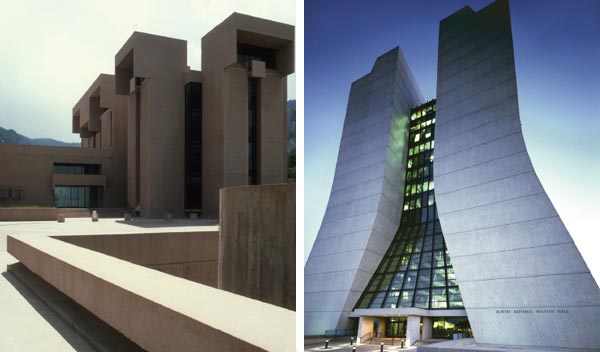
The Mesa Lab and Wilson Hall

Bosses at these firms decided that “the isolated campus was the ideal model for R&D and that basic research required a new spatial and symbolic identity, and an elaborate public stage”. Indeed, it was to forge this new identity that the help of famous architects like Saarinen was sought. But the outcome, Leslie and Knowles found, eventually harmed the companies by interrupting the link between labs and both products and production.

This came about not only through the often strange designs of the labs but also because they were isolated from other company facilities. “More and more,” Leslie and Knowles wrote, “the crucial task of linking research to production fell to branch laboratories located near manufacturing facilities, such as the IBM laboratory at San Jose, where disk storage was invented, [and] Bell Laboratories’ branch at Allentown, Pennsylvania, where Western Electric [the manufacturing wing of AT&T] produced state-of-the-art vacuum tubes and, later, semiconductors and integrated circuits.”

Similar stories unfolded when Saarinen built IBM’s T J Watson Research Center in 1961 to replace the firm’s lab in North Street and when he designed a new facility for Bell Labs in Murray Hill, New Jersey, the following year. Both buildings won architectural awards for their glass facades, modular interiors and other innovative features. However, as Leslie and Knowles discovered, the architecture served corporate image-making better than science.

The designs tended to cater to the companies’ appearance on the public stage rather than to the performance of those working inside, in a way that would prove detrimental to the corporations. Leslie and Knowles (borrowing a contemporary term meant as praise) dubbed these architectural marvels “industrial Versailles”, for the buildings symbolized “an increasingly dangerous isolation from the outside world that would eventually threaten to undermine the very legitimacy of the regimes they so powerfully expressed”.

Architectural tension

In Leslie’s new article, he considers two labs that, in terms of their architecture, exhibit “the essential tension between an imaginative client and an inspired architect at its best”. In both cases, the interaction between science manager and designer resulted in relatively successful structures that did not pin the research that took place inside to one model, but instead allowed for growth and adaptation.

The first is the Mesa Lab of the National Center for Atmospheric Research (NCAR) in Boulder, Colorado, which opened in 1966 (above left). Its design emerged from a collaboration between the centre’s director, the solar astronomer Walter Roberts, and the architect I M Pei. Roberts wanted something to “represent the dignity and importance of the centre as a national scientific laboratory” and Pei largely delivered on this request, creating a building with a distinctive look that was praised by critics.

However, a few features of the lab proved embarrassingly useless in practice. The most notorious of these was a set of top-floor “crows nests” — accessible only by small circular staircases and equipped with tiny balconies — where Pei envisioned individual scientists retreating to meditate in solitude. Few did. As for the beautiful courtyard that Pei envisioned would bustle with activity, it was mainly deserted.

Moreover, the building, designed for small teams of researchers working independently, was soon at odds with the new world of large, formally managed projects linked to huge computers and international networks of other researchers. Additional underground space for computers helped overcome this, and — unexpectedly — other parts of the building provided the social space and arena for networking that the researchers desired. As a result, the Mesa Lab has remained a viable — even outstanding — lab, while retaining its distinctive architecture.

The other building Leslie looks at is the Salk Institute in La Jolla, California, which is a not-for-profit private lab dedicated to the biological sciences. Both the institute’s founder Louis Salk and its architect Louis Kahn were inspired by the monastery at Assisi — an early model of a planned community — and came to think that a lab also should protect researchers from distractions such as teaching and grant writing.

But both Salk and Kahn came to appreciate that a lab has to be flexible; Salk liked to speak of his laboratory as “like a living organism”, containing working space that “is capable of differentiation in response to evolving needs”. This requirement, plus a sudden budget crisis, inspired Kahn to modify his early, monastic design and open up much of the planned space. This did a lot to contribute to the eventual success of the laboratory, allowing it, as Leslie says, to grow into “a conventional academic laboratory in an unconventional building”.

Pedestrian architecture may suit a laboratory for the simple reason that it does not project, and set literally in concrete, a single way of doing science. This may explain why, as Leslie says in his upcoming article, many of the world’s most renowned laboratories, such as the Cavendish Laboratory in Cambridge, MIT’s Rad Lab, Los Alamos and Bell Labs at Murray Hill, “rank among the least architecturally distinguished”.

Consider the Cavendish, which moved into new premises on the outskirts of Cambridge in 1974. From the outside, it is a grey, grim functional building that looks like a series of giant Portakabins designed by a 10 year old on an Etch-a-Sketch. It is nowhere near as attractive as the Victorian edifice that it replaced, which was poky, cramped and unsuited to modern research. The new lab will never win any architectural awards, but it does its job well when measured by the quality of work that is performed there.

Indeed, the high standard of Cavendish research may be more a function of the quality of the people it attracts and the size of the grants it wins. Would a more attractive lab boost morale and prestige, and thus lead to even better research? Or does the down-atheel nature of the lab inspire a dogged team spirit among its researchers, a case of low living and high ideals?

The critical point

Thoughtful design can help a lab’s scientific mission both internally and externally, and in pragmatic and symbolic ways. Internally, a well-designed building can promote good management, morale and research by fostering collaborations and unexpected connections, and by allowing the lab to adapt to changing research patterns. Externally, architecture can promote a lab’s mission by attracting the recognition, support and pride of politicians as well as the scientific and surrounding communities — a classic case being the “high-rise” central building at Fermilab near Chicago (left). A dramatic building can even attract media attention. The Mesa Lab, for instance, appears in the Woody Allen movie Sleeper.

Yet there are also dangers. A lab’s architecture invariably embodies some interpretation of the scientific life, which often evolves in unexpected ways. “Science often changes,” Leslie told me, “but once it’s physically there, a building can only change so much. You have to be careful not to freeze into your architectural forms a particular way of doing science so that you wind up having to work against the building.”

The notion prevalent in the 1950s, for instance, that scientists were a special breed of people needing a special kind of space to work in a special kind of way turned out to be constraining when embedded literally in concrete. Today, laboratories are nodes in numerous networks — of computers, of other laboratories, of other projects — that a building’s architecture has to facilitate. Leslie’s work indicates that the challenge is to continue to allow scientific life to guide the architecture — and not the other way round.

Once a physicist: Kris Gopalakrishnan

How did you first get into physics?

When I was at school, I found physics very interesting. I participated in science fairs because I liked to experiment and play around, and I also enjoyed reading about physics. I studied physics at Kerala University and then went on to do a masters in the subject at the Indian Institute of Technology at Chennai, which is one of the leading science and engineering institutes in India.

How much did you like your university life?

I really enjoyed those days. But as I progressed through my physics Masters I became interested in electronics, and from electronics I got into computer programming. I then had an opportunity to switch course to computer science, so I completed my Masters in physics and then did another Masters in computing.

What did you do after that?

I took a job as a software developer with Patni Computer Systems in Mumbai, where I stayed for two years. Then, together with six other software engineers from Patni, I set up Infosys in 1981.

What does Infosys do?

Infosys is a global IT-services company that delivers technology-enabled business solutions that help firms to compete in a globalized economy. It also provides a complete range of services by leveraging its domain and business expertise and its strategic alliances with leading technology providers.

What do you think is the key to your success?

Initially it was about having a clear vision of delivering technology remotely. In addition, since we wanted to do that from a country like India, which is a developing nation, we had to ensure the highest level of quality. In the 1990s we invested in improving the quality, so when the market really opened up and demand picked up we had a world-class service capability. This allowed the company to grow very rapidly without any impact on quality.

What have been your career highlights?

The first, of course, was starting up Infosys. Initially my focus was the engineering side and the technical side of the company — I was the technical director. Over time, however, I’ve worked in all of the functional areas, from R&D to support functions such as training, sales and marketing. In 2002 I became the chief operations officer, and in June last year I was appointed chief executive.

Does your physics training help the way that you work?

Yes, definitely. First, my interest in electronics, and hence the fact that I understand all the hardware as well as the software, gives me a really good appreciation of how computers work. My physics training also gives me the ability to look at problems in a very scientific and methodical way — to break down the problem into smaller pieces and then to try and solve them systematically. Finally, the fact that I studied in one of India’s best institutions gave me a lot of confidence that I could compete with the best people in the world and do very well.

Do you still keep up to date with any physics?

I don’t get much time, but I do try to read up on developments in the physics world — I keep up to date with the popular kind of physics.

Risky business

Riccardo Rebonato is a man with a clear and deep understanding of the most complex elements of the financial markets. His first book, Interest Rate Option Models, was one of the earliest proper mathematical texts on the complexities of “interest rate options” — investment tools in which the pay-offs depend on the future level of interest rates — and it is still relevant today. But is he the right person to write a book, without equations, about the fundamental problems underlying risk management in the markets? Before I opened Plight of the Fortune Tellers I have to confess to being dubious.

How wrong I was. This is an enjoyable, approachable book that may be read by anyone with an analytical mind. It is free of mathematics, yet it makes no concessions when it comes to explaining the complexities of a problem. The rather dry text of Rebonato’s previous books is utterly gone; instead, I found a flowing prose that was a pleasure to read.

With this book, Rebonato — who is global head of quantitative analysis at the Royal Bank of Scotland and a visiting lecturer in mathematical finance at Oxford University in the UK — seeks to explain what is wrong with financial risk management today, and to suggest ways of putting it right. It is a big subject. Why, when financial institutions spend many millions of dollars on people and computers to manage their risk, do they fail so spectacularly and so regularly? It is not long ago that the UK witnessed the ridiculous sight of long queues of people outside the offices of Northern Rock, a large and respectable bank. They were waiting to withdraw every penny they had, as they had lost confidence in the institution. A run like that on a bank has not been seen in the UK for 140 years. Surely in that time we should have learned enough to stop it happening again?

It takes someone of Rebonato’s intelligence and experience to understand what has happened. It is so tempting to assume — as the media frequently do — that events like this are due to some selfish individuals who use subterfuge to pursue highly risky and improper activities. This is not so, apart from in a few isolated cases. Northern Rock, for example, had no wild card like Nick Leeson, who brought down Barings Bank in the mid-1990s. The problems are systemic and are largely due to the very levels of sophistication that are supposed to guard against them.

Early in the 20th century it became apparent that the failure of a bank was rather different from the failure of, say, a department store. The collapse of the latter would only have a big impact on its immediate employees — customers might be inconvenienced and annoyed but that would be all. The collapse of a bank, on the other hand, can financially ruin hundreds of thousands of people. As a result, governments appointed regulators to draw up “safe” operating practices that banks have to follow, to ensure that such events do not happen.

Rebonato details the initial crude but effective methods that the regulators used in the early days, which were based on rough estimates and rules of thumb as to the amount of capital that the banks needed to set aside to cover the risk of transactions. They might have been rough but they worked — at least until product complexity grew exponentially in the 1990s. Regulators decided, naturally enough, to cope with this growing complexity by adopting the same techniques that the financial institutions themselves used to manage the risk involved in financial deals. At this point the author shows how a process of disconnection occurs, due to different sets of well-meaning people misunderstanding the limits of each others’ tools and knowledge.

Indeed, the highly sophisticated techniques that the regulators borrowed or licensed for use from the traders were only designed for short timescales and risk events that might happen one day in 20. They were not meant for periods of years and 99.97th percentile events, which happen maybe two or three times in 30 years. It might seem that such situations are “safer”, but in fact there are just not enough historical data to correctly judge the probabilities and at these points the limitations of the techniques become severely exposed. The fact that it is mathematically possible to extend them in this manner does not mean that it is right to do so. Rebonato shows the reader clearly and simply why and how the current state of affairs arose, and why the techniques that were supposed to prevent crashes and loss ended up, in many cases, exacerbating them. It is a fascinating tale and well told.

The author then, as a responsible risk manager should, goes on to consider what should be done about the current situation. Here I found the book less satisfactory, but this could be simply due to the fact that it is not a problem with an easy solution. Rebonato advocates the use of Bayesian methods, so that initial views and judgements about risk elements may be incorporated into final decisions. He advises us to rely less on “frequentist” approaches, which assume that the future will be like the past, even when there are not very many past data to go on. While it must surely be a sound idea to give less weight to risk estimates that are derived from small data sets — regardless of the degree of sophistication used to generate them — I remain uneasy about placing reliance on prior judgements. In general, economic forecasts are difficult to do, and rare is the economist who persistently makes the right calls.

Nevertheless, Plight of the Fortune Tellers is a great wake-up call for the industry. It deserves to be widely read since we all would like to be able to rely on the stability of the financial sector. It would be nice to get the risk management right.

• The views expressed in this article are the author’s own and not necessarily reflective of those of Citigroup

The search for astroengineers

“If they are out there, where are they?” That is the conundrum famously expressed more than 50 years ago by the Italian-born physicist Enrico Fermi when referring to the possibility that intelligent extraterrestrial civilizations may lie beyond the confines of our solar system. Given the vast age of the universe and its enormous number of Sun-like stars, it seems logical that the Earth is not the only place where intelligent life has evolved. Yet for the past half century, researchers have been actively looking for signs of such extraterrestrial civilizations and thus far have come up empty-handed.

These searches have almost all involved looking for electromagnetic waves at radio or optical frequencies that might have been transmitted by alien civilizations. The first such interstellar surveys were undertaken by US astronomer Frank Drake at the National Radio Astronomy Observatory in 1960, and since then their efficiency has increased exponentially. Indeed, the recent inauguration of the purpose-built Allen Telescope Array in California will allow those involved in the search for extraterrestrial intelligence (SETI) to survey a million Sun-like stars for intelligent radio signals within a distance of almost 1000 light-years.

Having so far analysed a multitude of candidate extraterrestrial signals to no avail, a growing number of SETI researchers are advocating more radical methods to address Fermi’s question. One of the most innovative, which will be discussed this month at the Astrobiology Science Conference at Santa Clara in California, involves searching for evidence of extraterrestrial handiwork in the form of large-scale “astroengineering” projects.

Science-fiction writers have long postulated that advanced civilizations might be capable of harnessing all of their parent star’s energy by “macroengineering” their entire solar system, or even by harnessing the energy of an entire galaxy. While such feats of astroengineering remain the stuff of science fiction, there is nothing unscientific about asking what such structures would look like if others had built them and then searching the sky for evidence of their possible astronomical signature.

Dyson spheres

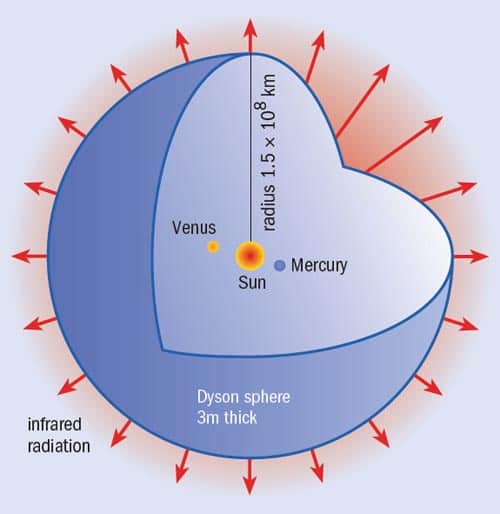
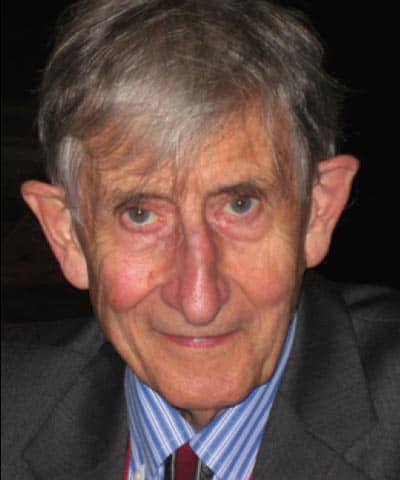
In 1960, inspired by science-fiction writer Olaf Stapledon’s 1937 novel Star Maker, the theoretical physicist Freeman Dyson posited that advanced civilizations might undertake massive astroengineering projects, which came to be known as Dyson spheres (Science 131 1667). Dyson described civilizations capable of harnessing their star’s energy by deconstructing a planet the size of Jupiter and creating from it a spherical shell 2–3 m thick that would rotate around the star. The sphere would have an average radius of 150 million kilometres (slightly larger than the distance between the Earth and the Sun). In principle, the inner surface of a Dyson sphere would capture and then transfer the solar radiation towards collection points where it could be converted into useable energy (see “Harnessing a Sun”).

This raises an intriguing prospect in the search for extraterrestrial life. In 1964 the Soviet physicist Nicolai Kardashev classified extraterrestrial civilizations in terms of how advanced they are — ranging from KI to KIII. The US astronomer Carl Sagan estimated that humankind is barely on the cusp of being a KI civilization, which is defined as one that can harness all the solar radiation striking its atmosphere. A KII civilization, in contrast, can use a Dyson sphere to directly harness its home star’s energy; while a KIII civilization can harness a whole galaxy’s energy.

“The sky is crowded with objects that are bright infrared sources but invisible in the optical band,” says Dyson. “There is no reason to suppose that any of them are artificial, but they look just the way a Dyson sphere is supposed to look.”

The problem is that it would be hard to pick out such artificial astronomical objects from the many other natural objects that look the same. While a perfect Dyson sphere would, in theory, absorb its star’s energy and therefore emit none of the optical or ultraviolet radiation that stars give off during most of their lives, the shell would reradiate waste heat and give rise to a strong infrared emission. At the beginning and end of their lives, however, stars are immersed in warm clouds of dust that also cause them to radiate strongly in the far infrared. Indeed, measuring a star’s infrared excess is currently the preferred method for finding putative protoplanetary disks around young stars (see “Observational challenge”).

The abundance of natural infrared sources would thus make it difficult to identify an artificial one using infrared radiation alone. Still, Dyson says that we could get lucky and detect an infrared source with a peculiar spectrum or a time variation that cannot be explained as a natural phenomenon. “We cannot say with certainty that such things are impossible,” says Dyson, who is an emeritus professor at the Institute for Advanced Study in Princeton.

Dan Werthimer, director of the SETI programme at the University of California at Berkeley, agrees. “You can argue until you’re blue in the face about whether civilizations build Dyson spheres, but if it’s a possibility then why not look?” he says.

Infrared inferences

There have already been a handful of searches for Dyson spheres. In 2004, Werthimer and his then undergraduate Charlie Conroy analysed spectral data from 1000 solar-type stars that were at least a billion years old, which ensured that the stars had long shed the dust associated with protoplanetary disks. The pair searched 32 stars with excess infrared emission for signs of anomalous radio emission or optical nanosecond laser pulses that would indicate an artificial-intelligent origin, but they found no verifiable signals. Werthimer says that the most likely explanation for these candidates was that there is some dust present even though they are old stars.

Meanwhile, retired Fermilab particle physicist Dick Carrigan, who still works from the high-energy physics lab just outside Chicago, has spent the last five years painstakingly whittling 11,224 sources identified by the Infrared Astronomical Satellite (IRAS) down to a handful of candidates with excess infrared emissions. Carrigan even accepted the possibility that some spheres might not be completely finished. From a survey region containing more than a million solar-type stars, two were scanned for anomalous radio signals: none were found.

One of Carrigan’s main selection criteria, in addition to a lack of dust and the absence of certain spectral lines that would indicate an artificial construct, was that sources must have infrared temperatures of 200–600 K. His reasoning was that life as we know it hovers around 200 K and that temperatures above 400 K could create problems for an alien civilization’s electronics. Unsurprisingly, not everyone agrees with this.

“It’s hard to predict that if civilizations build Dyson spheres, they will reradiate their waste heat at 200 K,” says Werthimer. “I also don’t buy the argument that they are going to have electronics identical to ours. You can’t rule out advanced civilizations just because you didn’t find excess heat with a wavelength of 12 μm [corresponding to a temperature of 250 K].”

Dyson spheres may not be easy to find, but looking for them is a bargain compared with real-time SETI searches, which usually involve an active observing programme with racks of sophisticated electronics and hi-tech telescopes. Furthermore, unlike most radio and optical SETI searches, astronomers looking for evidence of astroengineering need not assume that extraterrestrials have an active interest in interstellar communication. For all we know, they may be hi-tech hermits who simply want stellar longevity.

Astrophysicist James Annis at Fermilab has applied that philosophy to his own limited search for KIII civilizations. A few years ago he analysed the rotational dynamics of 137 different galaxies from the Ursa Major and the Virgo galaxy clusters. He plotted their stellar luminosity versus their stellar velocity dispersion, which is a measure of the dynamics and kinetics of stellar populations as the galaxies move in and through their host galaxies. An engineered galaxy, in which almost every Sun-like star within that galaxy had been enclosed within a Dyson sphere would have a very high infrared emission, low optical luminosity and a high galactic stellar rotational velocity in the case of spiral galaxies; or a high velocity stellar dispersion in the case of elliptical galaxies.

According to Annis’ calculations, one such macroengineering signature might be that you would see only about 100th of 1% of the light from the galaxy. “If you were to see obvious dust clouds around a candidate galaxy in the infrared, then it could be a dusty starburst galaxy where the dust is very clumpy and you can see ongoing star formation,” he says. “But if you got an infrared galactic image that was completely smooth with no lumpiness, that’s an interesting object.” To create such optical dimming on a galactic scale, a KIII galactic civilization would have needed to colonize almost every Sun-like star within its galaxy.

“We can already rule out certain kinds of civilizations,” says Werthimer. “I don’t think that there are civilizations out there that harness the whole power of their galaxies or cluster of galaxies. My guess is that just from the astronomical data on file we would have discovered such a civilization by accident.”

Stellar rejuvenation

Even if extraterrestrial civilizations do not decide to build Dyson spheres on galactic scales, they may be interested in rejuvenating their host stars. Our Sun is about halfway through its main-sequence phase, which will last for another five billion years or so. After it burns through about 10% of the hydrogen near its core, the Sun will start to go into its “red-giant” phase, when solar-mass stars leave the main sequence and expand outwards burning everything in their wake. Mixing any of the remaining hydrogen into the central region would therefore help stabilize the star and hinder the onset of this expansion. For example, if — one billion years from now — the inhabitants of the Earth were to somehow mix just 10% of the hydrogen in the Sun’s envelope deep into its core, then they would extend the star’s lifetime by another 10 billion years or so.

Planetary scientist Martin Beech at the University of Regina in Saskatchewan, Canada, says this might be possible using a laser. “If you could use a laser to create a hot spot near the Sun’s fusion core, then that would lead to natural convective mixing of extra hydrogen,” he says. That is hardly an option for the human race at this stage of our development, but is there any way we could find evidence that a more advanced KII civilization has achieved such a feat?

Fred Rasio, an astrophysicist at Northwestern University in Illinois, says that any process that would reinject fresh hydrogen fuel into a stellar core after the star has already burned for a while would make it look like a “blue straggler”. These stars are straggling along the main sequence at the hydrogen-burning turn off point, and are therefore hotter, brighter and bluer than all the other stars in the surrounding cluster. Blue stragglers are thought to be formed by collisions with other Sun-like stars or by a stellar binary merger, which redistributes hydrogen and causes them to evolve differently to stars with similar masses. About 5000 blue stragglers are known, and are usually found in young, open galaxy clusters like the one in which our Sun formed some 4.5 billion years ago and in older dense globular clusters of stars that encircle our galaxy.

Beech believes some fraction of blue stragglers could be astroengineered and would look essentially like a naturally evolved blue straggler, although many astrophysicists disagree. “These globular clusters are extremely inhospitable environments for life,” says Rasio. “The stars in them crash into each other on timescales that are shorter than their lifetimes.”

Mario Livio at the Space Telescope Science Institute in Maryland also points out that globular clusters are notoriously metal poor and are therefore not expected to be fertile hunting grounds for Earth-like planets. “Why invoke astroengineering within globular clusters to explain what is a very natural blue-straggler phenomenon?” he asks.

“At present this is a thought experiment,” says Beech, who is currently studying models that may allow natural and artificial blue stragglers to be distinguished. “Natural blue stragglers will presumably start to evolve to cooler temperatures, whereas a blue-straggler star that is being mixed artificially will always evolve to hotter temperatures. A blue straggler found to have temperatures hotter than those produced by natural mergers would become a likely candidate for an artificially engineered star,” he says.

Energy assumption

It is hard to second-guess what sort of engineering billion-year-old civilizations capable of colonizing every Sun-like star in the galaxy might have in mind. Werthimer realizes that if extraterrestrial life were ever found, it may be serendipitously through some experiment that has nothing to do with SETI — such as via neutrino, gravity-wave or monopole experiments. As Dyson points out, it is impossible to predict which form of stellar energy an alien civilization would choose.

“Some people think that advanced civilizations may have grown out of their technological phase into a more esoteric phase,” says Werthimer. “It’s not clear to me that just because right now our civilization is concerned about the price of oil, that’s what other civilizations are going to be into. You could have very advanced civilizations out there that aren’t thirsty for infinite amounts of energy.”


Physicists find new material for storing hydrogen

Physicists in the US may have found a promising new class of material that can absorb and store large amounts of hydrogen. Adam Phillips and Bellave Shivaram of the University of Virginia measured around 12% by weight of hydrogen uptake in the metal-based composites. This is significantly higher than the target of 5.4wt% set by the US Department of Energy to support the development of hydrogen-powered vehicles — although the physicists say much work still needs to be done.

A low-cost, high-capacity hydrogen-storage medium is essential for the commercialization of hydrogen fuel-cell technologies in the future. While scientists have investigated various classes of material, such as carbon nanotubes, hydrogen-clathrate-hydrates and other nanostructured materials over the past few decades, no one satisfactory material has yet been found.

Transition metal-ethylene complexes

Now, Phillips and Shivaram report on transition metal-ethylene complexes with promising hydrogen-storage properties (Phys. Rev. Lett. 100 105505). “Several theory papers have suggested that if you isolate a titanium (Ti) atom with a carbon nanostructure, the Ti is capable of weakly bonding with three to five hydrogen molecules,” explained Phillips. “Our experiments focused on a Ti-ethylene structure predicted to bond up to 12wt% for 1:1 Ti:ethylene or 14wt% 2:1 Ti:ethylene — in agreement with our results.”

Phillips and Shivaram obtained their results by first vaporizing Ti atoms in an ethylene atmosphere. The Ti atoms are thought to bond with the ethylene before being deposited on surface acoustic wave (SAW) mass sensors. Once the deposition is complete, the researchers evacuate the excess ethylene from the chamber and introduce one atmosphere of hydrogen.

It is critical to say that our work is at a very early stage Adam Phillips, University of Virginia

Throughout the process, the scientists measure the mass of hydrogen accumulating on the sensors using a nanogravimetry technique. Here the resonant frequency of the SAW device decreases with increasing mass, so the precise amount of hydrogen loading onto the Ti-ethylene complexes can be determined by simply measuring this frequency.

‘Goldilocks’ regime

“We believe that isolated transition metals (as we think we have) can bond to hydrogen molecules in a ‘Goldilocks’ regime — stronger than physisorbtion but weaker than chemisorbtion,” said Phillips. This is an advantage because most physisorbtion materials absorb hydrogen only at very low temperatures. In contrast, chemisorbtion materials dissociate the hydrogen molecule during absorption, which means that the materials form strong bonds with hydrogen that require elevated temperatures.

The researchers now plan to scale up the nanogram quantities of materials that they have studied. They also hope to investigate the bonding mechanism by vaporizing Ti in gases, such as benzene and other cyclic organic compounds.

“It is critical to say that our work is at a very early stage,” added Phillips. “While we have measured the hydrogen uptake, we have not yet been able to determine how the material desorbs. However, we are very optimistic about the possibility of scaling up and overcoming many of the other hurdles we now face.”

Copyright © 2026 by IOP Publishing Ltd and individual contributors