

Phononics gets hot

When it comes to transporting energy, nature has two vital tools at its disposal: conduction by heat and by electricity. But these two phenomena have never been treated equally by scientists. Electricity, via the transistor and other electronic devices, has enabled technological developments that have transformed many aspects of our lives. But similar devices that allow the flow of heat to be controlled are still not available, despite many decades of research.

The problem is that it is much harder to control the flow of heat in a solid than it is to control the flow of electrons. Unlike electrons, the carriers of heat (phonons) are not point particles with definite properties but bundles of energy that have no mass or charge and are therefore unaffected by electromagnetic fields. However, nature has been managing the flow of heat for billions of years, especially inside living bodies — you only need consider how the body manages to keep each internal organ at just the right temperature to see why. It must therefore be possible, even if it requires a totally different physical mechanism, to control heat technologically.

We may, however, be about to turn “phononics” from a dream into reality. Specifically, researchers have recently built thermal diodes, thermal transistors and thermal logic gates, which are the basic components of functional thermal devices. Such components also raise the possibility that heat — long regarded as useless or harmful in electronic circuits — could be used to process information. Phononics would therefore add a new physical dimension to information processing in addition to electronics and photonics.

One-way heat flow

The most fundamental phononic component is the thermal diode — a device that can conduct heat in only one direction. The directional thermal effect was first observed in a copper–cuprous-oxide interface by the physicist Chauncey Starr at Rensselaer Polytechnic Institute in New York in the 1930s. Over the next three decades, researchers made extensive studies of heat flow across such material interfaces, often involving steel and aluminium. But without a rigorous theoretical foundation such as nonlinear dynamics, or sufficient computing power to simulate the process, these early heat diodes remained nothing more than interesting toys.

That situation has changed dramatically over the last few years. In 2002 Marcello Terraneo at the Universitá degli Studi dell’Insubria in Como, Italy, and co-workers proposed a simple model of a thermal diode based on resonance (Phys. Rev. Lett. 88 094302). All physical systems have a natural frequency, which means that energy can be transported very efficiently by exciting the system with vibrations at that frequency. This is what makes it possible to push a child high on a swing with only minimal effort. Since thermal energy corresponds to the vibrations of atoms or molecules, the same principle applies to materials: heat is easily exchanged between two materials if their resonant frequencies match; if they do not match, then transferring heat becomes much harder.
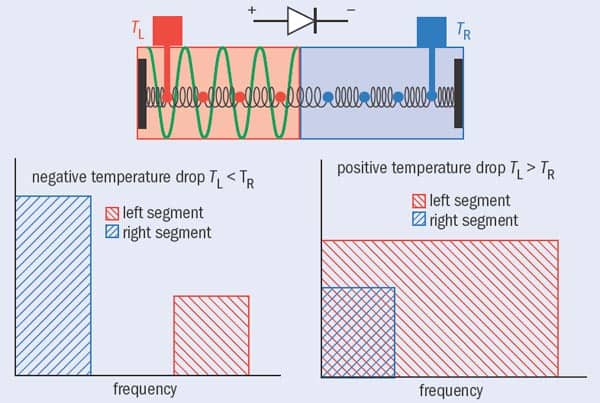
Terraneo looked at what happens when a nonlinear material with a resonant frequency that depends strongly on temperature is sandwiched between two nearly linear segments, the frequencies of which hardly vary at all with temperature. He found that the frequencies of the materials match one other when a temperature drop (analogous to a voltage drop in an electric circuit) is introduced in one direction and mismatch one another when the temperature drop is in the other direction. The net result is that heat can easily flow in one direction through the sandwich but not the other.

In 2004 the present authors modified this model using segments made up of a chain of particles subject to a sinusoidal potential, which has a resonant frequency that depends much more sensitively on temperature than that in Terraneo’s model (see “Thermal diodes”). We also reduced the number of segments from three to two, thus forming a single interface. Overall, this increased the rectification effect (i.e. the ratio of the heat currents in different directions) by up to three orders of magnitude (Phys. Rev. Lett. 93 184301).

Inspired by this theoretical progress, in 2006 Chih-Wei Chang and co-workers at the University of California at Berkeley built the first microscopic solid-state thermal rectifier (Science 314 1121). The researchers attached a heater and a sensor to the two ends of a nanotube, which allowed them to calculate its thermal conductivity. They then deposited heavy, platinum-based particles non-uniformly along half the length of the nanotube so that the temperature dependence of the resonant frequency varies along the tube. This match/mismatch of frequencies meant that the conductance was 3–7% greater in one direction than it was in the other. The rectification observed by Chang is smaller than the predicted maximum. This is mainly because the Berkeley system (which is a few microns in length) is much larger than the system that was modelled, which meant that the role of the interface was suppressed. Nevertheless, the work was a great step forward. We should remember that the first electric diode and transistor in 1940s were also much less efficient than those available today.

In fact, just a few months later Ralf Scheibner at the University of Würzburg in Germany and co-workers reported a rectification of 11% using a quantum dot — a nano-scale semiconductor device in which the electron wavefunction is localized. Here, the asymmetric flow stems not from the mismatch of resonant frequencies at an interface but from physical differences in the connections between the quantum dot and the two connecting leads: transport is favourable through states with non-zero orbital momentum, therefore leading to large thermal rectification (arXiv:cond-mat/0703514).

One obvious application of the thermal diode is in energy saving. For example, in a tropical country such as Singapore, the outdoor temperature is usually much higher than the indoor temperature, so one would like to prevent heat flowing from outdoors to indoors in order to remain cool inside. During the night, however, the outdoor temperature might be lower than the indoor one, so one would like to allow heat to flow from indoors to outdoors. Currently, air-conditioning is used to maintain a comfortable indoor temperature. But if the walls or windows of buildings were made of thermal diodes, which can automatically increase their heat conduction at night and act as an insulator during the day, huge energy savings could be made.

Phononic switching

The thermal diode was a major step towards phononics. But the next big challenge was to build a thermal transistor that could control heat flow like a transistor controls the flow of electric charge. Thermal transistors would greatly improve our ability to control heat flow because they can act as either thermal switches, which turn the heat current “on” and “off”, or as modulators that adjust the heat current continuously across a wide range.

Like its electronic counterpart, a thermal transistor has three terminals: the drain, the source and the gate (see “Thermal switches and transistors”). When the temperature at the drain and the source is fixed, the thermal current passing from one to the other is controlled by the temperature at the gate. Importantly, if the transistor is to amplify the signal, then changes in the heat current through the gate need to induce an even larger change from the drain to the source so that the transistor can amplify the signal. But how can we ensure that this condition is met?

It is well known that temperature drops lead to heat currents. When fire meets water, for example, heat flows from the high temperature area to the low temperature area and heats up the water. Generally speaking, the larger the temperature drop, the larger the heat current, which is called a positive differential thermal resistance. However, we found that a thermal transistor can only amplify a heat current if it has a negative differential thermal resistance (NDTR), which means that a large temperature drop leads to a small heat current and a small temperature drop leads to a large heat current. NDTR might seem counterintuitive, but it is perfectly possible because heat does still flow from hot to cold. (Negative thermal resistance, whereby heat flows from the cold to the hot, is of course forbidden by the second law of thermodynamics.)

In 2006 we demonstrated NDTR in a system based on the same resonance phenomenon that makes thermal diodes possible, thereby realizing the world’s first thermal transistor (Appl. Phys. Lett. 88 143501). The key part of the device consists of a material made up of two segments with different resonant frequencies, similar to that of a thermal diode. In fact, we had already detected a weak NDTR effect when we built the thermal diode, so all we had to do to make a transistor was to adjust the parameters so that the effect was enlarged. This opened the door to building logic gates.

Thermal logic

In an electronic circuit, the two states “1” and “0” are defined by two standard voltages, but in a thermal circuit they are defined by two standard temperatures: Ton and Toff. The first step towards processing information using heat is therefore to build a “signal repeater”, which ensures that whenever the input signal is slightly different from a preset standard temperature, the output is exactly that standard value.

This can be easily achieved in a thermal transistor. When the temperature of the gate, TG, is close but not exactly equal to either Ton or Toff, then the direction of the heat current in the gate always makes the temperature in the junction node between the source and the gate closer to either Ton or Toff. Therefore, by connecting transistors in series, which involves plugging the output of one transistor into the gate of the next one, the final output increasingly resembles a digital signal, i.e. it will either be very near to Ton or very near to Toff. This laid the foundations for logic gates that together would allow thermal information processing.

In our latest work, we first modelled a NOT gate, which gives out a “1” when it receives “0” and vice versa. To make a thermal NOT gate, therefore, we need the output temperature to fall when the input temperature increases and vice versa. But how can we cool down one part of a system by warming up another part? The answer is to feed the signal from the source segment and collect the output from the drain segment, between which NDTR is possible: a higher temperature in the source segment induces a larger thermal current in the drain and therefore increases the temperature drop. This produces a negative response, and the system therefore serves as a thermal NOT gate.

Next we turned our attention to AND and OR gates, both of which have two inputs and one output. Such gates are easily made by plugging two inputs into the same thermal signal repeater: when both inputs are “1”, then the output is also “1”; and when both inputs are “0”, then the output is also “0”. By simply changing some parameters of the repeaters we were also able to make the final output either “0” or “1” when the two inputs are different, therefore realizing either an AND or an OR gate (Phys. Rev. Lett. 99 177208).

Given the fact that the thermal diode was realized experimentally just two or three years after the theoretical models, prototype thermal transistors and thermal logic gates — perhaps even thermal computers — will be available in the near future. In the meantime, phononics might provide the necessary technology for energy saving.

Of course, there are still a lot of technical problems to be overcome. In particular, phonons travel at speeds of just 1000 m s–1 or so — hundreds of thousands of times slower than electromagnetic waves — which means that we have to find some way of maximizing the operational speeds of thermal components if complex thermal networks are to be of any practical use. Even more challenging problems undoubtedly await us en route to phononics.

The best job in physics?

Some jobs in physics are better than others. Working a seven-day week installing sensors on an oil rig in Azerbaijan, as one physicist writing in Physics World recently described having to do, is perhaps not as rewarding as, say, studying the atmosphere of Venus (see “Venus: our non-dentical twin”), creating new “thermal” transistors based on the flow of heat rather than electrons (see “Phononics gets hot”), or devising new ways to make ships invisible (see “Invisibility rules the waves”). But according to Rolf-Dieter Heuer, who is currently research director for particle and astroparticle physics at the DESY lab in Hamburg, he will have “the best job in physics” when he replaces Robert Aymar as director-general of the CERN particle-physics lab near Geneva next January (see “Full steam ahead”).

Being CERN boss — 15 people have so far held the post — has always been one of the top jobs in physics. It is not a job that anyone ever applies for: as is common when big labs look for new heads, candidates are “proposed” by a search committee and a shortlist is interviewed by members of the CERN council. But with the lab’s Large Hadron Collider (LHC) — the biggest experiment ever in physics — set to smash its first protons together this summer, the job will be better than ever, particularly for an experimentalist like Heuer.

Taking charge just as the first real data from the LHC start pouring in, Heuer will be in the hot seat at a great time, with scientists and the public itching for signs of the Higgs boson, the particle that can shed light on the origin of mass. But therein lies the challenge. Particle physicists “sold” the LHC as a Higgs-spotting machine, and if it takes years for reliable evidence of the particle to turn up, then the long delay could leave politicians wondering if the LHC was a wise investment.

Another problem for Heuer will be deciding what to do if hints of a Higgs leak out before physicists are certain of the result, which could lead to a dirty priority battle fought out in the media. He is wise therefore to try to forestall this possibility by following Fermilab’s lead in introducing guidelines on how researchers should use personal blogs to discuss new data. Even more tricky for Heuer, though, will be if the LHC turns up nothing new at all. Apart from forcing particle physicists to rethink the Standard Model, finding nothing could leave Heuer having to defend the LHC from accusations that it is the world’s most expensive white elephant.

Other challenges on Heuer’s plate will be to plan for the LHC’s upgrade in 2015 and to ensure that CERN plays a greater role in the proposed International Linear Collider (ILC), which — if funded — would make precision studies of the Higgs boson, assuming that it is found at the LHC. If CERN wins the race to host the ILC — the lab has its own variant known as the Compact Linear Collider, or CLIC — its victory could give the lab an unhealthy dominance in high-energy physics, with labs like Fermilab and DESY having to scale back their work in this area. Only the KEK lab in Japan seems to be going from strength to strength in particle physics.

Thankfully for Heuer, who will serve a five-year term, that particular problem will probably be one that his successor will have to deal with. In the meantime, Heuer should expect the unexpected. He is after all dealing with a machine of unprecedented complexity on which thousands of physicists are pinning their careers. Heuer will need to be at his best to make the most of the “best job in physics”.

The best years of your life?

If you are coming to the end of your undergraduate physics degree, the chances are that you have considered — at least for a brief moment — staying on at university to do a PhD. Careers advisors will give you a host of reasons to take this path: better long-term career prospects; the chance to get paid to do something that you are really interested in; and more time to decide what career path you eventually want to take. But are PhDs really all they are cracked up to be, and what is life actually like for physics graduates who take this option?

The postgraduate experience largely depends on where and what you choose to study — and how well those choices suit you. A PhD usually takes three to four years to complete and at least three of these years will be spent doing hands-on research, so it is important to pick a topic that really interests you, be it medical physics, particle physics or astronomy. You also need to decide whether you would rather spend your days taking measurements in the lab or doing computer modelling or theory; or whether you want to work in a small university department or at a large facility such as CERN. “Being a scientist is hard work, and the requirement is a genuine interest,” says Erik Olofsson, a first-year PhD student at the Royal Institute of Technology in Stockholm, Sweden, whose research involves modelling magnetohydrodynamic systems such as plasmas.

Equally important is that you end up in a location that you like, and that you are among people whom you get on with. “The worst part of my PhD was actually the weather,” says Bo Jayatilaka, who recently completed a PhD at the University of Michigan that involved measuring the mass of the top quark. “By choosing to work in hadron-collider physics, I was committing myself to living in the Chicago area — and so enduring brutal winters — for at least two years.”

Sheila Kanani, who is in the first year of an astrophysics PhD at University College London in the UK researching Saturn’s magnetosphere, believes that it is definitely worth visiting the places that you are thinking of applying to. “Talking to students already there will give you the best, unbiased, view,” she says.

Many physics students decide to embark on further study because they enjoyed their final-year undergraduate project — and indeed the option is often open to stay at the same university to do a PhD, sometimes even with the same supervisor. This has the advantages that you already know the place and at least some of the people whom you will be working with. Louise Wheatland, who is in the second year of a PhD with Lancaster University’s ultra-low-temperature group, chose to go down that path. “During my undergraduate physics degree at Lancaster I did some low-temperature work, which I really enjoyed,” she explains. “I wanted to stay in the city, and if I hadn’t got a place, I probably would have got a job for a year and then tried to reapply.”

Broadening your horizons is no bad thing, however, when it comes to finding the perfect PhD project, and there is no reason why you cannot apply to any university worldwide that has a research group in your area of interest. Indeed, a PhD offers a great opportunity to spend a few years living in a different country, experiencing a new culture and improving your language skills. Going abroad also means that you have a much wider variety of research groups and potential supervisors to choose from.

Subject matters

Having a research topic in mind is absolutely essential when applying for PhD positions in the UK and elsewhere in Europe, since you will usually begin working on your chosen research problem straight away. In the US, however, PhD students spend two years doing coursework and exams in all areas of physics and only then begin proper research.

“Most physics students in the US start their PhDs without a specific research field in mind,” says Jayatilaka. This adds at least an extra year to the process, but it makes the US a good option for those who want to learn a bit more physics before choosing an area to specialize in, or for students who want to undertake a PhD project in an area that they do not have much experience in.

As a PhD student, how you spend your days depends mostly on the nature of your project. Researchers in some theoretical fields spend much of their time working alone, but many PhD students — particularly those doing experimental projects — say that the best thing about their work is how social it is. “In the ultra-low-temperature group we all work together on the experiments, so it’s a nice little community,” says Wheatland.

According to Jayatilaka, teamwork is also at the heart of high-energy physics. “The collaborative and largely social nature of the field was an eye-opening experience for me,” he says. “Getting to live at the facility where the research is done and interact with dozens if not hundreds of people on a regular basis was fantastic.”

Some experiences are common across all locations and fields, however. All PhD students are usually expected to help teach undergraduates by taking tutorials and being lab demonstrators — when they are not being confused with them that is. “I still get mistaken for a fresher every year and asked if I’m lost, and I’ve even been mistaken for an undergraduate in classes where I’m a teaching assistant,” comments Karina Williams, who is in the fourth year of a particle-physics PhD at the University of Durham in the UK. Although perhaps not the most exciting aspect of doing a PhD, teaching does develop valuable communications skills and is a good way to earn extra money, with rates starting from about £10 per hour. “I’m quite a shy person so I’m not too happy about having to do teaching, but it is good personal training,” says Olofsson.

The high life

Money is no longer the problem for science PhD students that it once was, in the UK at least. Most projects will come with a tax-free allowance of at least £12,000 per year. Once tax is taken into consideration, this is nearly as much as many new graduates in the UK earn during their first few years in work. One of the best perks, however, is the opportunity for travel. PhD students are expected to attend lectures, workshops and conferences in their field, many of which take place away from home. “I have only had one full week in the lab so far — all the other weeks I’ve spent at least one day at a lecture or conference in different parts of the country,” says Kanani. “And next year I should get to go to Germany or the US for conferences.” Olofsson agrees: “In the six months since I started my PhD I’ve been to Oxford, Warsaw, and New York.”

If the postgraduate life sounds like the right choice for you, then you can look at available projects on www.findaphd.com, and among the recruitment adverts published by magazines like Physics World. You might also want to visit www.phdcomics.com, a US site featuring a regularly updated comic strip about life as a post-graduate student, which is a good source of light-hearted information about the problems and pitfalls encountered by PhD students.

“The comic strips often mirror exactly what’s happening to me and my office mates at that moment, for example fighting over office space or getting scooped,” says Williams. She also offers this advice to potential new PhD students: “The things that will help you get through the tough bits are your friends and co-workers, or possibly lots of cake. I’m especially lucky as my fellow PhD students are very good at baking cakes.”

When science meets capitalism

When I joined the University of Southampton’s microelectronics group in 1987 after spending 10 years in industry, I shared some of my commercial ideas for advancing the group into the 21st century with my academic colleagues. To say that my personal vision of paradise was close to their vision of hell is probably a pretty accurate observation. Two decades on, I now understand why they felt that way. Science for Sale contains a lot of information that explains this vast difference in perception, and the book also does a good job of highlighting how academia and industry differ on practical and ethical levels.

My first worry on picking up the book was that it would be almost totally inapplicable to the current situation in the UK. Daniel Greenberg is a US journalist who usually writes about American science policy and practice, so I was expecting to find very little overlap with the reality of academic and business life in the UK. Much to my surprise, however, the overlap was almost 100%, with the only major discrepancy being the role of athletes in the US university system. As Greenberg puts it, “For bringing glory and public attention to a university, the science-related departments are exceeded only by the athletics department”. Thankfully it has not come to that in the UK — at least not yet. Indeed, as I delved further into the book, it became clear that Greenberg has done his homework — there are plenty of references to the UK.

In fact, our two systems are remarkably similar. Both do not do well at funding scientists right at the beginning of their careers and both have big differences in how much researchers in industry and academia earn. There is also the same low success rate for grant applications in both countries, the same movement of academic high-flyers (and their valuable grant money!) between rival institutions, and — contrary to popular opinion — in both the UK and the US companies provide only a very small percentage of a university’s overall funding.

The UK, as far as I am aware, does not have its own equivalent of the American Bayh–Dole Act — a piece of legislation that allows US universities to retain intellectual property rights over their inventions — but we nevertheless still encourage entrepreneurial academics. Greenberg touches on a major problem of academic entrepreneurialism, namely that if you publish your research before patenting the work, then your prior disclosure makes patenting impossible. Greenberg points out, quite rightly, that most patents do not blossom into profitable products but he does not make it clear that it is papers — not patents — that are the currency of academia, which is one of the reasons why it is hard for academics to become entrepreneurs. He does, however, correctly observe that most universities do not cover the expense of patenting and licensing an academic’s idea.

Although Greenberg initially tries to maintain a balance in the fields for which he discusses technology transfer from campus to industry, it is biotechnology that dominates the book’s scientific material. This is perhaps not too surprising as Greenberg is very fond of large dollar numbers, of which there are plenty where AIDS treatments and cancer drugs are involved, not to mention the lawsuits that follow these big-money trails. One example, which concerns the unfortunate death of two human volunteers during clinical drug trials, resulted in an explosive cocktail of events that drew in the supervising academic consultants, their respective university departments, the National Institutes of Health, and, of course, the lawyers. It all makes unpleasant and sobering reading.

A minor criticism I have is that the first part of the book contains far too much of this bureaucratic fine detail concentrated on this one topic alone. It is clear that Greenberg has done plenty of research, but I was left feeling rather hungry as I wanted to see such detailed analysis applied to the physical sciences as well.

In the second part of the book we see the academic/industrialist interface from the viewpoint of the academic, which for me was more interesting. Unfortunately, biotechnology continues to dominate and by the end I felt the title of the book really should have been Biotechnology for Sale rather than Science for Sale. However, Greenberg’s discussion with the Florida State University chemist Robert Holton finally brings to light the conflicts and problems encountered by academics dealing with industry. Holton played a key role in the 1980s in developing the drug Taxol, which is used to treat breast and ovarian cancer. It is refreshing to see Holton “telling it as it is” and being absolutely clear that he is against universities carrying out contract research for industry — after all, there are plenty of contract-research organizations out there to provide just that service.

In the following chapter we get a glimmer of a more positive academic/industrialist interaction from Robert Dickson, a chemist at the Georgia Institute of Technology in the US. The interview was undertaken early in Dickson’s research programme and it is clear that he was not only creating a lot of valuable intellectual property, but also generating a lot of commercial interest, and he was very enthusiastic and open regarding his work.

But as the monetary implications for Dickson increase over the following 12 months, what was initially a very open interaction between researcher and interviewer becomes more and more closed. Finally, just one year after Dickson’s initial interview with Greenberg, the door is firmly shut to the author’s enquiries about further developments in Dickson’s laboratory and his relations with the company that had licensed his research. It goes to show that a great deal can happen in a year in the life of a successful and innovative clinical researcher.

Overall this book does an excellent job of listing in detail the problems and the successes of trying to link the industrial world with academia in the area of biotechnology. However, as an academic who has gone through the trauma of spinning out a non-biotech university company, and then resigning from that company to return to the relative sanity of academia, I feel this book will be of marginal use to a budding entrepreneur–academic as a reference of what — or what not — to do. But then again, it is clearly not meant to be that kind of book.

Greenberg’s comments at the end of the very first chapter make an excellent synopsis of the entire book: “The pursuit of money is at the heart of modern university administration. The presidents [vice chancellors] are judged by their fund-raising prowess. Rare among them today is a statesman or philosopher of higher education.”

Protons bring fusion into view

Fusion is a word that rarely crops up in headlines devoted to tackling climate change, and there are good reasons for this. In theory, a fusion power plant could harness the energy released when certain light nuclei bind together to produce the same annual output as a typical coal-fired plant — while burning a million times less fuel by mass and releasing no greenhouse gases. But despite 50 years of research, finding a way to sustain and contain fusion reactions remains a major technological challenge, in part because they require temperatures of hundreds of millions of degrees.

Researchers in the US have now developed an imaging technique that could help bring fusion power to fruition. Richard Petrasso and colleagues at the Massachusettes Institute of Technology and Wolfgang Theobold and colleagues at the University of Rochester have used “proton radiography” to map the electromagnetic structure of the extremely hot, dense plasmas in which fusion reactions take place. The technique has revealed hitherto unseen magnetic and electric fields, and could help researchers to get fusion plasmas to ignite — the key to electricity generation.

Inertial confinement

The MIT-Rochester technique applies to inertial-confinement fusion (ICF), which is one of two possible routes to a fusion reactor. The idea behind ICF is to bombard fuel capsules (typically containing deutrium and tritium) with high-powered laser pulses so that they implode, generating a small volume of hot, dense plasma in which the deutrium and tritium nuclei can overcome their electrical replusion and produce a helium nucleus plus a free neutron. Since these reaction products are lighter than the original nuclei, copious energy is released via Einstein’s mass–energy equivalence.

The other, more advanced, approach to fusion power involves magnetic confinement. Here, the fuel is heated slowly and the plasma confined in large, doughnut shaped devices called tokamaks using strong magentic fields. The culmination of this approach is the International Thermonuclear Experimental Reactor (ITER) currently being built at Cadarache in France and due to switch on within a decade.

‘Backlighter’ capsule

In the new work, the MIT and Rochester researchers used 36 beams at the high-powered OMEGA laser facility at Rochester to symmetrically implode ICF fuel capsules (Science 319 1223). The same beams also struck a different capsule 1 cm away which was filled with deuterium and helium-3 gas. Protons released from this “backlighter” capsule all have the same (known) energy, so by measuring the deflection of the positively charged protons that had transited some plasma the team was able to map the electromagentic fields present in ICF implosions for the first time.

The resulting images reveal complex magnetic fields comprising many radial filaments with an enormous (60 T) field strength. In addition, the team saw evidence for centrally directed electric fields with a strength of about 1 GV/m close to the capsule surface. Although the team does not understand the origin or evolution of the structures, Petrasso thinks that such large fields could potentially impact the movement of charged particles, plasma and energy and therefore affect the symmetry of the capsule implosion.

“In order to to ignite the plasma we need to compress the capsule radius by a factor of about 30 in a near spherically symmetric fashion,” he says. “The coherent electric field could give us a sensitive probe on the pressure gradient within the capsule which might help us tailor the implosion to achieve ignition,” he says. Once ignition is achieved, which will likely be at the National Ignition Facility at the Lawrence Livermore National Laboratory in 2010-2012, Petrassso says the next challenge will to be to address how such energy could be used for generating economic electrical power.

Unexpected fields

“This paper is an outstanding example of the need for fundamental measurements in complex scientific subjects,” says plasma expert Paul Drake at the University of Michigan, who was not involved in the work. “Applying proton radiography to ICF implosions has revealed large magnetic fields under conditions where no one expected them, and large electric fields where such fields were previously ignored,” he says. “Understanding the two effects will lead to potentially important improvements in target designs for inertial fusion.”

UK makes U-turn on Gemini funding

The UK has been reinstated as a full member of the Gemini Observatory following an agreement yesterday between the Gemini board and the UK’s Science and Technology Facilities Council (STFC). The new deal appears to reverse a decision made three months ago by the STFC to pull the UK out of the observatory — and means that UK astronomers can now participate in all future observing semesters at the Gemini telescopes in Hawaii and Chile.

The initial withdrawal from Gemini came as a surprise to both UK astronomers and partner countries within the observatory. The exit was blamed on a £80m shortfall in STFC budget that came to light late last year. A 25% reduction in university grants for particle physics and astronomy and pullout from the International Linear Collider were also announced in December 2007.

This is a sensible way to deal with this, as pulling out altogether would have meant penalties, which would have been the same as the subscription itself Michael Rowan-Robinson, Royal Astronomical Society

Withdrawing from the observatory would have saved the STFC about £4m per year in running costs. But the STFC now plans to recoup some of this money by selling some of its observing time to partner countries within the project.

23% stake in Gemini

The Gemini Observatory consists of two 8 m telescopes that work in the optical and infrared regions. The UK, which was a founding member and has a 23% stake in the project, has invested a total of £35m in Gemini North in Hawaii and Gemini South in Chile.

“This is very good news” says Michael Rowan-Robinson from Imperial College London, who is president of the Royal Astronomical Society. “This is a sensible way to deal with this, as pulling out altogether would have meant penalties, which would have been the same as the subscription itself.”

The STFC science board will announce on Monday 3 March final plans of which projects will be affected by the £80m funding shortfall.

Glassy metals are tougher than steel

Researchers in the US have developed a class of materials that have the potential to be tougher than the best titanium or steel alloys, ranking them among the toughest known.

Bulk metallic glasses (BMGs) have shown promise in engineering for the past 15 years but have been let down by poor ductility, making them brittle and prone to fracture. But Douglas Hofmann, William Johnson and colleagues from the California Institute of Technology in Pasadena have found a way of modifying the structure of BMGs so that their ductility increases significantly.

BMGs are like metals in that they contain metallic bonds and conduct, yet their atoms are disordered like glass. A disordered structure cannot contain defects, which means that BMGs should withstand high loads before fracturing. This is as least true when they are bent or compressed, but when they are pulled their poor ductility fails them — parts of the materials begin to slide past each other in “shear bands”, which grow quickly into cracks.

One way of improving ductility and avoiding cracks, which has been adopted by the California team, is to introduce elements in the hot, initial BMG alloy that will nucleate dispersed crystals or “dendrites” when finally cooled. These dendrites act as a barrier to growing shear bands, preventing them from every developing into cracks. Instead, pulling the composite BMG will simply produce more, small shear bands, allowing the material to stretch and withstand a greater load.

We’ve taken alloys that are among the most brittle metals and made them among the toughest Douglas Hofmann, California Institute of Technology in Pasadena

The right dendrites

The idea of incorporating dendrites was first tried back in 2001 by Johnson with different group members, who cooled a BMG alloy from the molten state. This produced relatively small dendrites, and only increased the ductility marginally. Since studying those initial results, however, Hofmann, Johnson and colleagues have found two properties of the dendrites that will optimize ductility: they must be as large as the maximum length of the shear bands, and they must be softer than the BMG itself (Nature 451 1085).

To get such properties, they start with alloys of titanium, zirconium, niobium, copper and beryllium. By holding the alloys molten at a temperature between 800 and 900 °C, dendrites of titanium, zirconium and niobium can grow to a large size. As these grow, the relative proportion of beryllium and copper in the remainder of the bulk, which cannot form crystals, increases. The Californian team found that when the proportion of beryllium in the bulk reaches about a third, the composite reaches equilibrium, and the dendrites no longer grow. So by adding less beryllium to the initial alloy they can get less of the glassy phase and bigger dendrites. “We found this to be quite remarkable,” says Hofmann.

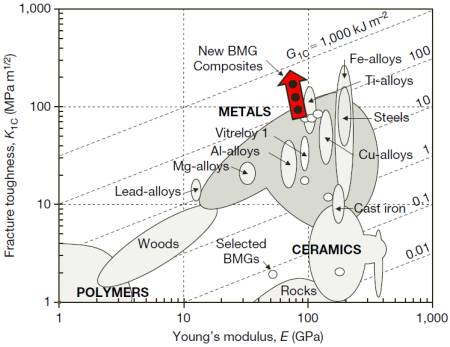
Out of three cooled BMG ingots with different amounts of dendrites, Hofmann, Johnson and colleagues found that the ingot with the highest proportion of dendrites (67%) demonstrated the greatest fracture toughness, K, at 173 MPa m1/2 — comparable with those of the best titanium, iron and steel alloys. However, their values for strength — defined by a high shear modulus, G — set new benchmarks (see fig: Ashby map for composite BMGs). “We’ve taken alloys that are among the most brittle metals and made them among the toughest,” says Hofmann.

Hofmann explains that although BMGs are primarily used for cosmetics at the moment, his group would like to exploit their new-found toughness in structural applications, for example in the aerospace industry. “We are hoping to acquire some of the market for high-performance titanium alloys,” he adds.

Graphene continues to amaze

Is there anything that graphene—sheets of carbon just one atom thick — can’t do? Since this wonder material was disovered in 2004, it has been shown to be an extremely good electrical conductor; a semiconductor that can be used to create transistors; and a very strong material that could be used to make ultra thin membranes. Now, researchers in the US have confirmed that graphene is also a very good conductor of heat.

The team, which had to invent a new way to measure thermal conductivity in order to study the material, is now investigating how graphene’s thermal properties could be used to cool ultrafast silicon chips (Nano Letters 10.1021/nl0731872).

Physicists had suspected that graphene can conduct heat very well because carbon nanotubes, which are essentially graphene rolled into tiny tubes, are themselves very good thermal conductors. However, graphene can be very difficult to work with and researchers had struggled to determine its thermal properties using traditional techniques that involve attaching heaters and other devices to the material.

Raman scattering

Alexander Balandin and colleagues at the University of California-Riverside have instead devised a new measurement technique that uses a laser to both heat the graphene and measure its temperature. The team suspended sheets of graphene across micrometre-wide trenches cut into a silicon-oxide surface. The sheets were several micrometres long and were pinned-down at both ends by layers of graphite, which acted as heat sinks.

The centre of the sheet is then exposed to a beam of laser light, which heats the graphene and changes the frequencies at which its carbon atoms vibrate. Some of the laser light changes frequency as it undergoes Raman scattering off the vibrating atoms and the size of the frequency shift is proportional to the temperature of the illuminated region.

Frequency shift

By measuring the frequency shift — and hence the temperature of the graphene — as a function of laser power, the team was able to calculate the thermal conductivity of graphene, which was found to be a whopping 5300 W/(m K) at room temperature. This is the highest known value of any solid — 50% higher than carbon nanotubes and more than ten times greater than metals like copper and aluminium.

Balandin told physicsworld.com that the team were surprised to find that graphene is a much better conductor of heat than carbon nanotubes — even though some theoretical work had suggested that this could be possible.

Graphene’s high thermal conductivity is probably a result of the relative ease with which atomic vibrations can move through graphene compared to other materials. Balandin and collegues are now working on a theory that explains why this is so.

Balandin believes that graphene’s high thermal conductivity, flat shape and ability to be integrated with silicon means that it could play an important role in removing heat from electronics devices. The team are also working on the design of graphene-cooled ultrafast transistors.

Feeling the force on a single atom

Researchers have long used scanning tunnelling microscopes (STMs) to move single atoms around on the surface of material with atomic-scale precision — allowing them to make nanometre-scale structures such as “quantum corrals”, which confine electrons to tiny regions on a surface. However, it has never actually been possible to measure the force required to move an individual atom, something that could improve our understanding of the structural and mechanical properties of materials.

Now, however, an international team of physicists has used a modified STM to measure the force needed to move a single cobalt atom on both platinum and copper surfaces (Science 309 1066). The breakthrough could help researchers build new nanoscale devices such as high-density magnetic memories.

An STM involves placing a tiny metal tip very near to a surface of interest and applying a voltage between the surface and tip. The tip is scanned with great precision across the surface and an image is generated by measuring the current of electrons that tunnel between tip and surface. The tip also exerts a force on the surface atoms and can be used to move individual atoms around on a surface.

Flexible tip

The strength of the tiny forces required to move an atom could, in principle, be measured by fitting an STM with a flexible tip that vibrates much like the prong of a tuning fork. When tip and atom are brought very close together, the force between the two would change the frequency of vibration — which is how some atomic force microscopes (AFMs) work. The problem is that a very stiff and stable tip is needed to move an individual atom with sufficient spatial accuracy, while a relatively floppy tip is needed to measure the force accurately.

Now, Markus Ternes and colleagues at IBM’s Almaden Research Center in California, the Swiss Federal Institute of Technology in Lausanne and the University of Regensburg in Germany hove found a way around this dilemma. To do this, the team modified a STM by mounting the tip on one prong of a quartz oscillator similar to that used to keep time in a wristwatch. The prong is about 40 times stiffer than a silicon-based cantilever used in an AFM.

Hopping atoms

The force need to move an atom from was measured by scanning the vibrating tip back and forth above a cobalt-occupied adsorption site and an adjacent empty site. At each successive pass, the tip was lowered by as little as 10 pm at a time until it hovered less than 100 pm from the cobalt atom. At first, the atom did not move, but as the tip got closer to the surface, the force exerted by the tip caused the atom to hop to the adjacent site. By looking at how the vibrational frequency of the tip changed during the hop, the team were able to determine the threshold force required to move the atom.

Using the modified STM, Ternes and his team found that it took about 210 pN (2.1 × 10–10 N) to move a cobalt atom 160 pm (1.6 × 10–10 m) between two adjacent adsorption sites on platininum. While this might not seem like much of a force, it is about 1014 times the force of gravity on a cobalt atom. A much lower force of about 17 pN was needed to move cobalt on copper.

Tiny oscillation

According to Ternes, the team’s success was down to their ability to limit the amplitude of the tip oscillation to about 25–30 pm, which is a fraction of the distance between adsorption sites. As well as allowing the team to move the atoms with great precision, this tiny amplitude allowed them to study the short-range chemical-bonding forces that affect how the cobalt moves from on site to another.

Ternes told physicsworld.com that the team plan to use the instrument to assemble atomic-scale magnetic structures on insulating surfaces – something that a standard STM cannot do because — unlike an AFM — it is unable to image and insulator. The tem believe that such structures could form the basis of very high-density data storage devices.

Earth is doomed (in 5 billion years)

Life will have fried, oceans will have boiled away, but no one has ever been sure what will happen to Earth itself when the Sun finally swells into a red giant. Now, astrophysicists from Mexico and the UK are forecasting a dismal fate for our rocky planet: it will get caught up in the Sun’s outer layers, spiral inwards and vaporize.

Like all dwarf stars, the Sun converts hydrogen nuclei into helium nuclei by fusion to produce immense amounts of radiation and outward pressure. But in five billion years or so the core will run out of hydrogen fuel, lose pressure and collapse under its own gravity. As this inward crush boosts the temperature of the core, the remaining shell of hydrogen around it will heat up and trigger a new period of fusion, which in turn will cause the Sun’s outer envelope to expand to around 250 times its current radius and cool from white to red.

Once the Sun is in this red-giant phase, Mercury will certainly be engulfed, and going on the increase of the Sun’s radius alone it would appear that Venus, Earth and Mars will suffer the same fate too. During expansion, however, the Sun is also expected to shed mass in a powerful solar wind. The resultant drop in gravity will let the orbits of the planets drift outwards, and some models suggest that Earth — and possibly Venus — might escape the fiery death. Indeed, astrophysicists have even spotted a distant solar system in which a planet with Earth’s orbital radius has survived its star’s red giant phase.

Klaus-Peter Schroeder of Guanajuanto University and Robert Smith of Sussex University are not so optimistic. They have performed calculations of Earth’s fate that include not only the favourable effects of solar mass loss, but also the speed of the Sun’s rotation, which will diminish as the Sun gets bigger. Currently completing one rotation in about a month, at red-giant size the Sun will rotate once every few thousand years, allowing the Earth’s gravity to draw out a large tidal bulge on the solar surface. Such a bulge will haul the Earth back into the Sun’s outer layers, while the drag will steadily reduce the rocky planet’s orbital angular momentum. Earth will spiral inwards until it eventually vaporizes (Mon. Not. R. Astron. Soc. to be published; preprint available at arXiv:0801.4031).

We would say this is the definitive answer to the fate of the Earth Robert Smith, Sussex University

A history of fates

This is not the first time that tidal bulges have been taken into account when predicting Earth’s fate. In 1996, Mario Livio at the Hubble Space Telescope Science Institute and colleagues also found that the effect would be strong enough to swallow up Earth. Then, in 2001, Kacper Rybicki of the Polish Academy of Sciences and Carlo Denis of the European Centre for Geodynamics and Seismology in Luxembourg suggested that the Earth would survive in spite of tidal bulges.

But Rybicki and Denis’s analyses were mostly qualitative, while the calculations performed by Livio’s group were based on an old formula for the Sun’s mass loss. Schroeder and Smith, on the other hand, have performed their calculations using a recent mass-loss equation devised by Schroeder along with Manfred Cuntz from the University of Texas at Arlington, which was calibrated using precise observations. “We’re confident that our mass-loss equation is the best that’s currently available,” Smith told physicsworld.com. Furthermore, Schroeder and Smith have consulted with Jean-Paul Zahn of the Paris Observatory, who is regarded as the authority on tidal physics, to make sure they have considered the effect of tidal bulges properly.

Still, predictions for the fate of the Earth have bandied about for decades, so is this the final say in the matter? “We would say this is the definitive answer to the fate of the Earth,” says Smith. “But I dare say someone will come up in a few years and say that we’re wrong.”

Smith points out, however, that any further developments will likely come to the same conclusion because he and Schroeder have “probably underestimated” the total drag. The solar wind, which the pair did not include in their calculations, should also hinder the motion of the Earth in its orbit and encourage it to spiral inwards.

Copyright © 2026 by IOP Publishing Ltd and individual contributors