Dave Bacon is a physicist at the University of Washington in the US who works in the departments of physics and of computer science and engineering. He is interested in quantum-information science; in particular how to build a quantum computer, and what to do with one once it is built.
What topics does the blog cover?
Anything that Bacon finds interesting. There is a fair amount about quantum computing, and computing and physics in general, but also plenty of links to random news articles, forums and websites. Posts range from one-line comments to lengthy monologues extolling Bacon’s thoughts about topics such as giving scientific talks and why he is still in the field of quantum computing. He also regularly posts adverts for job opportunities in quantum information and related areas.
Who is it aimed at?
Many of the references to people and topics in quantum computing will only make sense to those within the field, but the blog is generally nontechnical and most of the posts discuss things from Bacon’s day-to-day life or poke fun at nonsensical articles about physics. For example, he recently drew attention to an article on the website Inquirer.net that claims that since “the world of particle physics that quantum physicists see is indescribable from the Newtonian stand point”, it cannot be understood rationally and scientifically, and hence is the same as the world that mystics describe. These posts will appeal to anyone who appreciates science.
Why should I read it?
Bacon’s blog is written with plenty of humour and considerable knowledge about and enthusiasm for science and computing. And if you’re looking for an academic position in quantum computing, then it is certainly more entertaining than most recruitment websites!
How often is it updated?
It varies — Bacon often posts short comments on interesting online material as he comes across it, resulting in several posts a day. At other times it can be a few days between postings.
Can you give me a sample quote?
Tonight I watched NOVA’s Judgement Day: Intelligent Design On Trial. Ah shucks, us quantum physicists never get to have so much fun (err, I mean, experience so much pain and deal with so much silliness) trying to defend our science. It’s not like, you know, there aren’t people who think quantum theory is wrong or that quantum theory is somehow related to the Vedic teachings of Maharishi Mahesh Yogi. So why is it that quantum theory (which after all is “just a theory” wink, wink, nod, nod) doesn’t illicit courtroom battles of such epic scope as the Dover trial?
When I left the University of Reading in 2005 with a BSc in physics and meteorology, it was an easy decision to join the energy industry. I had studied climate science during my degree and I wanted to do something that would help curb the impact of electricity production and confront the challenge of climate change. With my physics background, the nuclear industry seemed a logical place to invest my skills and a few months later I joined British Energy as a graduate trainee.
The firm is the largest producer of electricity and the lowest carbon emitter of the major UK electricity generators. I had never heard of the company before I started looking for jobs, but I soon found out that it has a workforce of 6000 people spread over nine power stations, which include seven advanced gas-cooled reactors and the UK’s only pressurized water reactor at Sizewell B in Suffolk. The company also operates a coal-fired power station, and has several engineering and corporate offices across the UK.
British Energy’s graduate training scheme is a two-year programme that gives graduates the chance to experience every facet of the nuclear-energy business by undertaking a series of “attachments”. These attachments are tailored to each graduate’s academic background and personal interests, and they enable trainees to experience every department within the company — from reactor systems to environmental safety. The programme is also interspersed with technical training and soft-skills courses during which trainees learn about the company’s overall aims. During the scheme I moved between four different nuclear power stations as well as the central engineering support office in Gloucester, which provides specialist technical expertise and support for the power-plant fleet.
My bespoke training plan began within the nuclear-safety group at Dungeness B nuclear power station in Kent. My role was to help ensure that the site complied with safety regulations, which involved analysing and interpreting daily reactor-performance data and writing guidance material on controlrod position indications for the engineers who operate the reactor. I joined just as one of the reactors was returning from its triennial maintenance shutdown. To support this operation I had to identify all the coolantgas temperatures and pressures encountered during a start-up, to ensure that the reactor would remain within new operating specifications. I was given responsibility from the beginning, and by the end of the five-week placement I had attained a good understanding of operational reactor physics.
Powerful contribution
My next attachment was at Heysham 2 nuclear power station in Lancashire, where I spent six months. Part of my time there involved helping the technicians who operate the plant, i.e. turning valves and testing equipment. This work was physically challenging — especially having to test complex nitrogen equipment at 3 a.m. in a very warm area of the power station! I also worked in the supply-chain department at Heysham, which involved procuring spares and managing contracts, and did a stint with the work-management group during which I scheduled planned maintenance activities on safety-critical systems.
The skills that I picked up on this attachment enabled me to tackle my first major project, which involved planning a multimillion- pound programme for exchanging a 180 tonne generator stator (the stationary conductor-wrapped iron core) at Hinkley Point B nuclear power station in Somerset. This took three months of hard work at the central engineering-support office in Gloucester, after which I had to present my plan to the power station’s management team. I was subjected to a barrage of questions, which was one of the toughest moments of my career so far.
Another highlight of my training was being involved in the periodic shutdown at the Sizewell B nuclear power station. This is a 24/7 operation during which the core fuel assemblies are removed from the reactor and transported underwater to the fuel storage ponds. In these ponds new fuel assemblies are mixed with the irradiated ones, tested extensively and then reloaded into the reactor. My role was to initiate and direct the movement of the fuel assemblies. This was an intricate task, based in the control room, which involved directing the operations team that was handling the fuel. It required maximum concentration at all times and proved to be quite stressful.
Varied experience
The British Energy graduate training scheme has given me the broadest possible range of assignments at a very exciting time for the nuclear industry in the UK. Last year, for example, I spent one week attending a business and finance course in Scotland, while the next week I was learning technical drawing and welding at the Royal Navy’s School of Nuclear Engineering in Gosport.
I now have an excellent understanding of the civil nuclear industry, while the technical training courses and hands-on experience have given me the confidence to represent British Energy at many local, national and international events, including the International Youth Nuclear Congress held in Sweden and Finland. This event also gave me the chance to work with fellow nuclear professionals from the British Nuclear Energy Society’s Young Generation Network.
British Energy wants to play a key role in building the UK’s next generation of nuclear power plants. Until then, the company is improving the long-term reliability and extending the life of its power stations while producing more electricity and optimizing its plants. The graduate scheme — which is accredited by the Institute of Physics — has given me a fantastic overview of British Energy and how it goes about the business of generating electricity safely. Since completing the scheme, I have accepted a post at Dungeness B power station in Kent within the safety-case and reactor-physics team. A worldwide nuclear renaissance is gathering pace, and my aim is to be a leader in the safe provision of this low-carbon technology.
I was really interested in science at school, and I also read a couple of fascinating popular-science books about quantum mechanics and special relativity. My interest in these topics made me decide to study physics at Oxford University. Straight after I graduated in 1967 I did a theoretical-physics DPhil, also at Oxford.
What did you do next?
I was awarded a Harkness fellowship to do theoretical particle-physics research at the California Institute of Technology in the US. On my first day there I met a guy with a beard sitting on the steps who said “Hi, I’m Murray”. It turned out to be Murray Gell-Mann, the Nobel-prize winner. I was in a group with him and Richard Feynman, which was a very transformative experience. It soon became clear that Europe was just a minor player in the world of physics. After two years at Caltech I did another postdoc at CERN, and then in 1974 I moved to the physics department at the University of Southampton in the UK.
How much did you like studying physics?
I enjoyed it immensely. It was very rewarding to feel part of a global community and be able to visit friends around the world.
Why did you switch to computer science?
After the revelations of quantum chromodynamics and the Salam–Weinberg model of weak interactions, there was relatively little to do in theoretical particle physics except confirm the details of the model. I became interested in non-perturbative problems, which can only be solved by simulating quantum field theory on a powerful computer. Eventually I became more interested in designing and programming these computers than in the physics itself. Also, after 20 years working on quarks and so on I wanted to move to an area of research that would have a real impact on people’s lives. Therefore, in 1986 I moved to Southampton’s electronics and computer-science department and started working on parallel computers, where I remained until I joined Microsoft in 2005.
Why did you decide to move into industry?
I had a very worthwhile time at Southampton, but I feel that UK universities are overburdened by process — when I gave a lecture, I had to worry about learning outcomes and objectives rather than being free to be inspiring and stimulating. As a result, in 2001 I took a leave of absence to run the UK research councils’ e-science programme, the aim of which was to develop technologies that would allow networked, distributed, collaborative, multidisciplinary science. This needed, in my view, a mix of commercial and open-source software, so I thought there was a genuine role for IT companies, Microsoft in particular.
What is your role at Microsoft?
I am responsible for building partnerships with the academic community. Essentially I match up Microsoft researchers with a major scientific problem that computer-science technology can help to solve. At the moment I’m funding one of our leading machine-learning researchers to work with HIV researchers. He’s developing data-mining tools that can be used to find genetic correlations between HIV and AIDS patients in the hope that this will help scientists to develop an effective vaccine. That’s one example of how we’re using computer-science research to actually help people.
How does your physics background help you?
I think my physics training is invaluable as it’s given me a thorough understanding of mathematics, equations and the like. This gives me the ability to talk to most scientists and understand their work.
Do you still keep up to date with physics?
I review physics books regularly, which is a good way to keep up to date. I’m also still in contact with several former physics colleagues at CERN and various universities. One of the reasons that I moved away from theoretical physics was that after the Standard Model of particle physics became accepted, string theory was one of the main areas of research, and I was concerned that it doesn’t produce many testable results — it seemed like theoretical physics was becoming more and more a mathematical exercise looking for an application. I’m interested to see that the slight scepticism I have about string theory is becoming more widespread. I’m also very excited about the Large Hadron Collider coming online this year — I hope that it will produce new results to guide the theory.
Do you have any advice for physicists wanting to get into computer science?
This is an interesting time for the whole of the IT industry because we’re coming to the end of Moore’s law. We’re not seeing processors getting faster and faster any more because increasing the clock speed further means that the chips get so hot that they melt. Instead we’re seeing a trend for having multiple processors, and the issue for the IT industry is how you program these. I think there are wonderful opportunities for smart physicists to play a role in this regard.
Upon receiving this book I was somewhat sceptical to see that the author, David Toomey, is not a physicist but instead has a PhD in English literature and teaches technical and non-fiction writing at the University of Massachusetts in the US. As I began to read it, however, my attitude changed. To many physicists, a book about time travel would be virtually indistinguishable from a piece of science fiction, particularly when there are no equations or experimental results provided. To have any chance of presenting the work in a convincing manner, therefore, any author of such a book must be quite skilled. Toomey not only accomplishes this, but also makes the book an enjoyable read.
It is well known that special relativity allows time travel into the future; it is travel into the past that is the problem. The book is a well-balanced mix of physics, science fiction and biographical details of the “new time travellers” — the physicists who, in recent years, have been publishing serious articles about the physics of time travel. They include people such as Kip Thorne, Igor Novikov, Richard Gott, Stephen Hawking, Matt Visser and David Deutsch. Thorne started thinking seriously about the possibility of time travel in 1985 following a request from Carl Sagan, who was writing a science-fiction novel and wanted the physics to be as accurate as possible. Serious publications in respected physics journals by Thorne and others followed.
The potential time machines described in Toomey’s book all rely on distorting space–time in some manner, with the standard device being the wormhole. The time traveller enters one end of the wormhole at a particular time and emerges at the other end at an earlier time. As with most time machines, this raises the possibility of closed timelike curves, or causal loops. These can lead to paradoxes, such as the well-known “grandfather paradox”: what happens if you go back in time and kill your grandfather before he has children? If you succeed, then you will not exist so you cannot have killed him, in which case you will exist and so on.
The simplest way to avoid such situations is to adopt Hawking’s “chronology protection conjecture”, which states that the laws of physics prevent the formation of closed timelike curves, and therefore rules out time travel. Visser, a mathematician at the Victoria University of Wellington in New Zealand, has added what he dubs the “boring physics” conjecture; he feels that in dismissing time machines physicists are also dismissing a large set of interesting questions.
A second way of avoiding the grandfather paradox is to assume that the physical laws in some way force all causal loops to be self-consistent — in other words, they ensure that the probability of an event that would give rise to a paradox occurring is zero. This assumption has a very long history and is indeed the substance of many science-fiction stories. It has also been discussed in serious scientific literature since at least the middle of the last century. The late philosopher David Lewis treated the problem as one of logic and pointed out that every event in a closed causal loop is both in the past and in the future of every other event in the loop. Thus because you did fail to kill your grandfather, you will fail to kill your grandfather.
Novikov’s work also gave some support for self-consistency in terms of the principle of least action, which states that nature behaves in the way that minimizes action. For some particular cases he found that of all the possible paths along a closed timelike curve, those that were self-consistent were the most economical in terms of action. This idea was not universal accepted, however. Visser, for example, called it the “Novikov consistency conspiracy” because nature somehow seems to conspire to prevent you from killing your grandfather despite your every intention to do so. Presumably, however, just as quantum mechanics dictates that the probability amplitudes for paths not near the path of least action must cancel, the probability amplitudes for inconsistent loops would also cancel, thus leaving only consistent loops with a non-zero probability of occurring.
A third way of avoiding causalloop paradoxes involves the Everett–DeWitt multiverse, or the many-universes interpretation of quantum mechanics. In a 1991 article in Physical Review D Deutsch describes a scenario in which a time traveller, in attempting to force a paradox, removes himself entirely from one universe and adds his presence to another universe. In other words, when you travel back and kill your grandfather, you remove yourself from the universe in which you were born and remain in a universe in which you were never born. In this way, a time machine could be a gateway between universes and permit a number of interesting and remarkable circumstances. There is certainly no boring physics here.
The multiverse model also addresses the problem of a “jinn” — something created from nothing. In order to write a book review without much labour, I travel into the future, collect the memory stick containing the completed review, bring it back with me, submit a copy of the review and leave the memory stick where I can find it in the future. In the multiverse model, when I collect the stick, I will have travelled into a universe in which I did read the book and write the review. In returning to my past I will have transported the review from a universe where it was created into one where it was not created.
Overall, I found this book to be skilfully written and, indeed, quite thought provoking. It held my interest throughout. I can certainly recommend it to physicists with wider interests than their own specialities, to students, to science-fiction readers and to general readers with some interest in physics.
Sometimes the simple things in nature can be the most puzzling. Take the humble snowflake, that familiar winter icon immediately recognizable by its beautiful structure and distinctive symmetry. One might think that the process whereby water vapour condenses into crystalline ice would be well understood. A closer look, however, reveals that even some very basic questions about how snow crystals form remain unanswered.
In fact, our understanding of crystal growth in general is remarkably primitive compared with our knowledge of crystal structure. Using X-ray scattering at advanced synchrotron light sources, researchers can routinely determine the exact placement of every constituent atom in crystals made from exceedingly complex biological molecules. Yet because we cannot predict exactly how these crystals will grow under different conditions, producing large samples for analysis remains something of a black art.
The underlying difficulty is that crystal growth is a complex problem of molecular dynamics. The macroscopic development and morphology of a crystal — i.e. whether it forms facets or not, how fast it grows under different conditions and whether it develops into a single large crystal or many smaller ones — is governed by the precise way that the constituent atoms jostle into place as they solidify. While the static problem of crystal structure is relatively easy, the dynamical problem of crystal growth is sufficiently difficult that we cannot yet predict the growth behaviour of even relatively simple crystals — including ice.
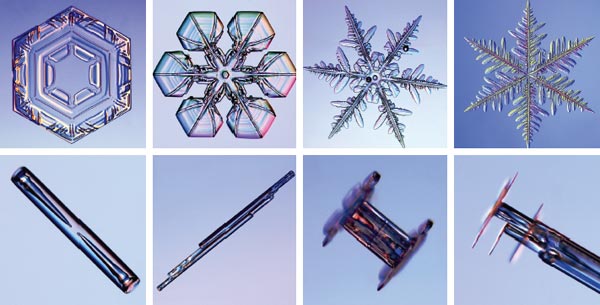
To reveal the extent of our ignorance, you need little more than a magnifying glass and a gentle snowfall. The variety of snow crystals that you will see is extraordinary (figure 1). For instance, you might first encounter the complex, branched morphologies of stellar snow crystals, which are essentially elaborate thin plates about 50 times thinner than they are wide. In a different snowfall, you might find mostly slender hexagonal columns and needles that are perhaps 20 times longer than they are wide. How can such different forms arise from the same material?
1 Crystal variety Natural snow crystals appear in a wide variety of morphologies or shapes. Stellar snowflakes (top row, left to right) include simple hexagonal plate crystals with surface markings; “sectored plate” crystals in which the plate-like branches are decorated with distinctive ridges; stellar dendrite crystals with moderate side branching; and “fern-like” stellar dendrites with numerous side branches. Columnar snowflakes (bottom row, from left to right) include simple hollow-column crystals; needle clusters; and “capped column” crystals in which thin stellar plates (seen edge on in far-right image) grow on the ends of stout columns or needle clusters. (Courtesy: snowcrystals.com)
Each column, needle and stellar plate falling from the clouds started out as a simple hexagonal prism — the most basic form of snow crystal — that is defined by two “basal” facets and six “prism” facets. This hexagonal shape, which gives snow crystals their six-fold sym metry, derives from the underlying molecular structure of the ice lattice. But the overall shape of a snow crystal depends on the relative growth rates of the facet surfaces: a columnar crystal forms when water vapour condenses preferentially on the basal surfaces; while plates form when vapour condenses more readily on the prism surfaces. The fact that both columnar and plate-like snowflakes exist means that the ratio of basal and prism growth rates must change by a factor of 1000 under different conditions.
The challenge is to explain how the condensation of water vapour into solid ice can result in such a remarkable variety of crystalline forms. By examining the growth of snow crystals we hope to understand how interactions at the molecular level determine structures at much larger scales. In doing so, we should also gain insights into more general questions about pattern formation and self-assembly in nature.
Crystal morphologies
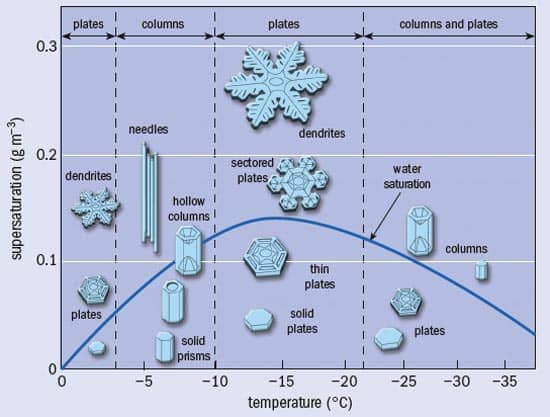
One of the first people to tackle the science of snowflakes was the physicist Ukichiro Nakaya at the University of Hokkaido in Japan in the 1930s. Nakaya grew his own snowflakes in the lab, which allowed him to study their growth under known conditions. His systematic observations are often summarized in a snow-crystal morphology diagram, which displays crystal shapes as a function of temperature and humidity (figure 2).
Two features in this diagram immediately stand out. First, the crystals become more complex as the humidity increases: simple prisms arise when the humidity is low; while complex, branched forms appear when the humidity is high. Second, the overall morphology behaves peculiarly as a function of temperature, whereby it changes from plate-like to columnar and back again as the temperature is lowered. The latter behaviour has proven particularly difficult to explain, even at a qualitative level. Indeed, after 75 years we still cannot explain why snow crystals grow so differently when the temperature changes by just a few degrees.
2 Morphology dimensions Snowflakes can be characterized by the snow-crystal morphology diagram, which shows crystal shapes as a function of the temperature (x-axis) and humidity (y-axis) in which they grow. Here the humidity axis actually refers to the supersaturation – the excess water-vapour density above a humidity of 100%. The water saturation line (blue) shows the supersaturation that would be found in a dense cloud of water droplets. The dramatic dependence of snow-crystal morphology on temperature has yet to be explained. (Courtesy: snowcrystals.com)
In fact, the snow-crystal morphology diagram is but a single 2D slice through a much higher-dimensional “morphology space”. For instance, one could also add a time axis, which would reveal that the crystals become larger and more complex with time, or an axis showing the background gas pressure. In 1975 Takehiko Gonda at the Science University of Tokyo found that growing snow crystals in a low-pressure inert gas results in simple prisms, while higher pressures yield more complex crystals. A comprehensive model of snow-crystal growth could explain all the dimensions of morphology space, but many vital pieces of such a model are still missing. As a result, our investigation of the underlying physics of snow-crystal morphology is very much a work in progress.
The morphology diagram clearly shows that snowcrystal growth depends sensitively on temperature and humidity, and this explains why stellar snow crystals develop structures that are complex yet symmetrical. As a growing crystal descends through the clouds, it encounters different temperatures, humidities and other conditions that affect its growth. The particular path that a crystal follows through the turbulent atmosphere determines its final form, so no two crystals end up exactly alike. However, the six arms of a single crystal all travel together, so they all grow in synchrony. Because the growth is very sensitive to temperature and humidity, each falling crystal develops a unique and intricate structure with a recognizable symmetry.
Diffusion-limited growth
The complexity seen in a snow crystal ultimately arises from the way water molecules are transported to it. As a crystal grows, the surrounding air becomes depleted of water vapour, which must then diffuse in from afar. Water molecules are more likely to diffuse to a protruding point on a crystal, essentially because it sticks out farther into the surrounding humid air. This causes the protrusion to grow more rapidly than other parts of the crystal, which, in turn, increases the relative size of the protrusion. This positive feedback results in a growth instability that produces complex structures spontaneously. In particular, the instability is responsible for the dendritic branching and side branching seen in stellar snow crystals.
In 1947 the Russian mathematician G P Ivantsov discovered a family of dynamically stable solutions to the diffusion equation (a differential equation that describes how the density of a material changes while undergoing diffusion) that shed considerable light on the growth of dendritic structures. The solutions correspond to needle-shaped paraboloids in 3D or simple parabolas in 2D. As diffusion transports particles that condense onto the solid surface, the needles grow longer while preserving their parabolic shapes exactly. In other words, both the radius of curvature of a needle tip and its growth velocity remain constant with time.
With snow crystals, the branch tip of a growing stellar dendrite is a rough approximation of the 2D Ivantsov solution, since the crystal is nearly flat and the tip is roughly parabolic in shape. The branched shape of the dendrite is more complex than a simple parabola, but the added complexity is a relatively small perturbation on the behaviour near the tip. Measurements show that the tip radius and growth velocity are essentially constant with time, just as the Ivantsov solutions predict.
Interestingly, ice forms nearly the same dendritic structures whether it is grown from water vapour in air or from freezing liquid water. In the latter case, the growth is mainly limited by the diffusion of latent heat generated at the solid–liquid interface. In a snow crystal, on the other hand, growth is mainly limited by the diffusion of water-vapour molecules through the surrounding air. The resulting dendritic structures are similar in both cases because both are described by the diffusion equation.
The Ivantsov needles are a family of solutions because any tip radius is mathematically allowed, and for each needle the growth velocity is inversely proportional to the radius. For a given system we therefore need additional physics beyond the diffusion equation to be able to select a single, physical solution from the Ivantsov family. This turns out to be a surprisingly subtle problem that depends on details of the molecular dynamics during solidification. Even this easily measurable macroscopic effect — the tip velocity of a growing dendrite — depends on complex physics at the molecular level.
Growing snow crystals in high electric fields adds an interesting twist to the Ivantsov solutions for diffusionlimited growth. By producing an isolated ice dendrite on the end of a wire, one can easily induce novel growth behaviour by applying a high voltage. As there is a negligible flow of current into the surrounding air, the ice surface quickly becomes charged. As a result, the high field gradients near the electrified dendrite tip enhance the diffusion of the polar water molecules, thus pulling molecules in and increasing the growth rate. (The growth is also affected in important ways by electrically induced changes in the equilibrium vapour pressure.)
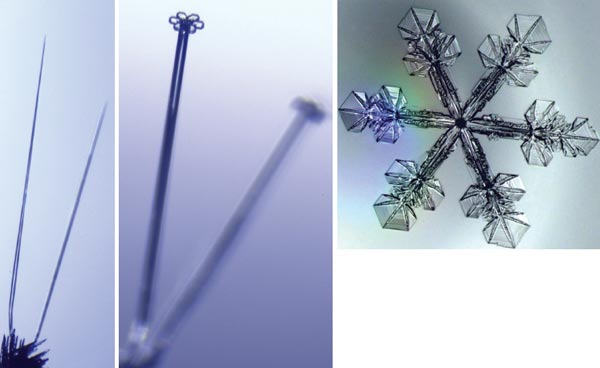
Plugging these effects into normal dendrite theory yields a new type of growth instability whereby the tip radius becomes considerably smaller and the needle grows markedly faster above a threshold voltage. Experimentally, this can result in “electric needle” crystals with tip radii as small as 100 nm and growth velocities 10 times faster than normal dendrites. These electrically grown ice needles provide useful pedestals for growing isolated snow crystals in the lab, thus allowing us to make controlled measurements of ice-crystal growth dynamics. Once a needle has been grown and the applied voltage removed, normal growth commences and a single plate-like or columnar crystal forms on the end of the needle (figure 3). As such, the thin ice needle supports the growing crystal while barely perturbing its development.
Digital snowflakes
Although much work has gone into developing an analytical theory of dendrite growth based on the Ivantsov solutions, numerical modelling is necessary to reproduce the complex structures that appear in diffusion-limited growth. This approach is particularly useful when both faceting and branching are present, since the corresponding anisotropy in growth dynamics is not easily included in an analytical theory.
3 Electric ice Researchers can produce “electric needle” crystals by applying a high voltage to ice crystals growing on the end of a wire. Here, two needles about 2 mm long are shown during their electrically modified growth phase (far left). When the field is switched off and the temperature is reduced to –15 °C, small stellar plates start to grow on the ends of both needles (left). Using this technique, researchers can grow elaborate stellar snow crystals in the laboratory on the ends of electric needles (above). (Courtesy: snowcrystals.com)
This problem has received considerable attention from metallurgists, since freezing a metal from its melt often produces micro- or even nano-scale dendritic structures that can profoundly affect the strength, ductility and other properties of the final material. To numerically model the solidification process, we must first solve the diffusion equation of the growing surface, then use that solution to propagate the growth, before solving the diffusion equation again with the new solid boundary, and so on. Since errors in each step propagate to all subsequent steps, the challenge is to develop robust computational techniques that include enough relevant physics to model realistic situations.
Several popular numerical approaches have been championed over the years. These include “fronttracking” techniques, which specify the solid–liquid or solid–vapour interface explicitly; “phase-field” techniques, which digitally smooth the interface; and cellular-automaton methods that replace numerical differential-equation solvers (available via commercial software) with a grid of pixels that interact with one another according to well-defined rules. The techniques have different merits, but all have yielded acceptable results for simple dendrite growth. In the case of structures like snow crystals, however, the numerical problems become considerably harder, because the surface dynamics are highly anisotropic.
In 2006 mathematicians David Griffeath at the University of Wisconsin and Janko Gravner of the University of California at Davis, both in the US, showed that cellular automata are especially powerful for solving the problem of snow-crystal growth. The intrinsic anisotropy of the cellular-automata grid, on which individual cells are fixed, seems to stabilize the propagation of numerical errors, although exactly how this works is not yet known. Using this method, Griffeath and Gravner were able to generate the first simulated snow crystals that exhibit complex forms with realistic branching and faceting (figure 4). The underlying surface physics in these models is still somewhat ad hoc, but this recent work appears to provide the long-sought answer to the question of how one can simulate the growth of solids with highly anisotropic growth dynamics.
Subtleties of the surface
The biggest hurdle preventing researchers from constructing a comprehensive model of snow-crystal formation is knowing with certainty the rate at which water molecules condense at the ice surface. This question is vital because the varying growth rates of the basal and prism surfaces are what ultimately determine the temperature dependence seen in the morphology diagram. Unfortunately, so far no-one has been able to measure these growth rates with sufficient accuracy, nor do we have a model of the ice surface that allows us to calculate condensation rates.
4 Model crystals Cellular-automaton models, in which a grid of cells are left to interact with one another according to a set of well-defined rules, have recently enabled researchers to simulate the growth of snow crystals. More technically, these models are beginning to incorporate physically derived rules that imitate reasonable “attachment kinetics” at the crystal surface in addition to solving the diffusion equation of a growing crystal (see main text). As these techniques become more refined, we should be able to generate numerical models of snow crystals that look and grow like the real thing. (Courtesy: D Griffeath and J Gravner)
Once again, the detailed molecular dynamics of ice make it difficult to observe and model ice surfaces. At temperatures near the freezing point, for example, water molecules in the air bombard the surface at such a rate that a single molecular layer of ice would be deposited every millisecond if the impinging molecules all stuck to the surface. Using molecular-dynamics simulations to model the growth of such agitated surfaces is not feasible, and the molecular motions are too fast to be imaged using scanning probe microscopy.
Fortunately, it is not necessary to comprehend every detail of the surface dynamics in order to model growth behaviour. As is usually the case in condensed-matter physics, one need only possess a reasonably accurate caricature of the underlying physics to make progress. For crystal growth, this caricature is called the “surface attachment kinetics”, where one uses statistical theory to parametrize the growth velocity as a function of temperature, humidity and perhaps other conditions at the surface. The parametrized theory is then constrained using empirical measurements of growth velocities.
Obtaining suitable measurements is surprisingly difficult because one must carefully control the growth conditions to reduce systematic errors. For example, the most accurate measurements are made in low-pressure environments, where the growth is not complicated much by diffusion, and laser interferometry is used to measure the growth rates of individual facets on single, isolated crystals. Researchers are now building up precise measurements of ice-growth rates as a function of temperature, humidity and other parameters, but new puzzles appear as the data improve.
For instance, recent results from my group at the California Institute of Technology show that in these lowpressure environments the prism and basal facets grow at roughly the same rates, with no dramatic dependence on temperature. The data are especially puzzling near a temperature of –15 °C, which is where the thinnest plate-like crystals form. These measurements naively suggest that thin plates would not form at –15 °C, in stark contrast to numerous observations. With these new data, we have only deepened the mystery of the morphology diagram: not only can we not explain the well-known morphological changes with temperature, but now we cannot adequately explain even the formation of thin plates at just one temperature!
There are several ways to reconcile the different observations. One possibility is that the attachment kinetics is strongly affected by the presence of air at the ice surface, which was removed for our growth measurements. Another is that the attachment kinetics depends on the surface structure itself, so that the growth of large facet surfaces differs from the narrow edges of plate-like crystals. Unfortunately, these and other suggestions are all speculative, and to date none has emerged as the correct explanation of the conflicting data sets. How perplexing it is that such a simple phenomenon — the growth of thin, plate-like ice crystals — can be so difficult to understand. For now at least, we are left with the unsettling fact that we still cannot explain, even at a qualitative level, some of the most basic characteristics of snowflakes.
Crystalline conundrums
In many ways, the growth of snow crystals is an excellent case study for the general problem of crystal-growth dynamics. Ice is a relatively simple, monomolecular material with well-characterized intermolecular interactions, and growing ice crystals from water vapour is straightforward and inexpensive. Yet, even simple experiments yield a rich variety of interesting morphologies that cannot be readily understood.
Explaining how snow crystals grow involves a variety of physical processes that take place on a range of length scales. At the small scale, the challenge is to work out the molecular dynamics of growing surfaces and to understand how surface processes vary with temperature and other parameters. At larger scales, one must describe the transport of heat and particles via diffusion and large-scale flows. In order to successfully model morphologies, computational techniques must be developed that incorporate the relevant physics at all these scales. Moreover, trace amounts of chemically active gases have been found to dramatically alter snow-crystal formation, adding a largely unexplored chemical dimension to the morphology diagram.
The lowly snowflake exhibits an impressive phenomenology that stems from the subtle interactions between seemingly simple physical processes. There may be no direct industrial applications for snow crystals, but understanding them requires us to explore fundamental questions about how solids form and how structures arise during crystal growth. This basic research could lead to new discoveries in metallurgy, nano-scale self-assembly and other areas.
However, beyond the intrinsic scientific questions, beyond the practical applications of crystal growth, and beyond the meteorological significance of atmospheric ice, we who ponder snowflakes are motivated by a simple and essential desire to comprehend the natural world around us. These marvellous ice sculptures, so elaborate and beautiful, simply fall from the sky in great abundance. We ought to understand how they are created.
“Total disaster”; “crazy”; “catastrophic”; “scientific vandalism”; “savage”; and “bombshell”. These were some of the words used by physicists and astronomers last month to describe the potential impact of an £80m funding shortfall in the budget of the UK’s Science and Technology Facilities Council (STFC). Rumours of a deficit had been circulating for several months, and researchers’ worst fears were confirmed when the government announced how much it will spend on science over the next three years (see p7, print edition only).
On the face of it, the science budget is not at all disappointing — it will rise by an average of just under 6% a year from £3.38bn in 2007/08 to £3.97bn in 2010/11. But the lion’s share of the increases will go to the Medical Research Council, while the STFC will have to make do with an average rise of just 4.5% a year during that period. That is an above-inflation increase, but the STFC not only has to allocate research grants in particle physics and astronomy, but also has to pay for subscriptions to international labs like CERN as well as build and maintain large facilities.
Given the damaging shortfall, the STFC has decided to give priority to exploiting new facilities, while — seemingly with little consultation — choosing to pull the country out of cutting-edge projects like the International Linear Collider (ILC) and the Gemini telescopes, and axing support for certain fields like high-energy gamma-ray astronomy. It is also being forced to slash research grants in particle physics and astronomy by up to 25%, which will hit university departments that carry out significant research in those areas. Job losses are almost certain.
Quite why a shortfall has arisen is unclear. The STFC told Physics World that its programmes have been cut partly to pay for the operating costs of the new Diamond synchrotron near Oxford. Indeed, the House of Commons publicaccounts select committee recently reported that Diamond’s running costs are expected to overrun by 89%. However, Diamond bosses dispute this figure, saying its costs “have been known for a long time and have not changed”.
It sounds like a mess that the STFC should — and could — have avoided when negotiating its budget with the government and civil servants. The president of the Royal Society has referred diplomatically to “sub-optimal planning”; the rest of us would call it a cock-up. Physicists are particularly perplexed because the UK government has given generous increases to science over the last 10 years — and now, for the want of just £80m, the STFC is forcing researchers to pull out of key projects.
Scientists are also angry because former science minister Malcolm Wicks assured them that they would not be affected when the STFC was created last year from a merger between the Particle Physics and Astronomy Research Council and the Council for the Central Laboratory of the Research Councils. The withdrawal from the ILC is particularly embarrassing internationally: in November the research councils had only just identified the ILC as “the highest priority for a major new accelerator”, while several high-profile researchers had also been attracted to the UK to help plan it. The cuts also send out the wrong signals to young people who are considering studying physics at university.
Ministers have promised a review of physics funding. Unfortunately, it is expected to take six to nine months, while the STFC wants to make savings now. Unless the cuts are reversed immediately, UK physics could be irreparably damaged.
Its progenitor once described the New Dictionary of Scientific Biography — or DSB, as it is known to historians — as a “gothic cathedral”. The analogy is apt: this vast 18-volume reference work is a landmark collaboration, painstakingly crafted by experts, the scope and influence of which have grown over time.
The first volume of the DSB appeared in 1970 and it became the most important reference work in history of science, with over 5000 biographies from Thales to Einstein. Due to the huge amounts of time and money needed to prepare it — plus the impact of the Web as an information resource, or what might be called “wiki-influence” — the DSB is likely, and regrettably, the last great published reference work containing entries, composed by leading scholars, that are mainly works of scholarship themselves.
Like a cathedral, too, the DSB is open to change by future generations; last month it was substantially updated for the first time with the publication of eight new volumes largely dedicated to scientists who have died since the original came out. A searchable electronic version is now also available.
Birth of an idea
The DSB was the brainchild of Charles Scribner Jr, who died in 1995 at the age of 74. (The Scribner family includes over a half-dozen generations of Charles Scribners, but to avoid sounding monarchical they recycle the Jr.) Scribner graduated from Princeton University in 1943 in classics, but often found scientists more stimulating than novelists. Once, while at Princeton, he was offered the choice of lunch with Albert Einstein or Thomas Mann and chose the latter — a decision he soon regretted, finding the novelist “pretentious and deadly boring”.
A code-breaker during the Second World War, Scribner entered the family publishing business and became president of Charles Scribner’s Sons in 1952. However, he continued to take an interest in history of science, and was a particular fan of Newton and Einstein; indeed, he owned a red velvet-covered chair from Newton’s sitting room. Once, reading Einstein’s 1905 article on special relativity, Scribner noted it had been wrongly rendered into English and in 1963 published a correction in the American Journal of Physics (Am. J. Phys.31 398), demonstrating instincts that would make him an excellent encyclopedia editor.
Scribner loathed the trendy authors chased by other publishers, and instead cultivated scientist-writers such as C P Snow. In 1963, longing to create a work of intellectual durability, he approached Princeton historian Charles Gillispie to discuss the idea of a “dictionary of scientific biography”. It would be a scientific analogue of the Dictionary of American Biography, which itself had been created by Scribner’s grandfather as a US version of the British Dictionary of National Biography.
Gillispie, president of the History of Science Society, realized that such a work could make history of science more collective and scholarly, boost the interaction and morale of its small band of scattered practitioners, and attract attention to the field. The National Science Foundation covered the editorial costs, Scribner’s paid for the publishing, while the American Council of Learned Societies oversaw the editorial effort.
Who’s in and who’s out
To Scribner’s consternation, a clerical error led to Newton’s omission from the initial entry list. Non-Western science was another problem. Chinese scholars then were not communicating with the West — but thanks to the ongoing publication of Joseph Needham’s monumental, multivolume work Science and Civilization in China, the editors did not need to cover that area. A supplement to the DSB includes essays on science in India, Mesopotamia, Egypt, Japan and the Mayan civilization.
Then there were the Soviets. Gillispie collaborated with A P Youschkevitch, the foremost scholar in the Institute of History of Science of the Soviet Academy of Sciences. However, Soviet apparatchiks insisted on certain strings as a condition of participation, including obligatory entries on Marx, Engels and Lenin. Gillispie agreed, but wrung the concession that these entries would be subject to the same editorial standards of accuracy as the others.
The editorial board defined its approach — focusing on people not subject matter — by saying that “history of science like other aspects of history is made by men and not by themes or abstractions”. The project grew beyond all expectations: there were initially meant to be just four volumes, not 16. (Two supplements were also published in 1990.) The index alone, published in 1980, cost over $100 000 to produce, and managing editor Marshall de Bruhl wrote that it may be “the last large, complete, topical index produced for a major reference work by a commercial publishing house”.
The eight new volumes, edited by Indiana University philosopher and historian of science Noretta Koertge, appeared last month both in print and — together with the original — online (http://gale.cengage.com/ndsb). They contain about 800 new articles: 600 new entries and 200 updates. Physicists who appear for the first time include Hans Bethe, Richard Feynman, Andrei Sakharov, Edward Teller and accelerator physicist M Stanley Livingston (whose entry I wrote).
The critical point
A historian of science once wrote, concerning certain biographical questions in the life of Ernest Rutherford, that “none of these things really matter”. They do not — in the traditional, topic-oriented approach to history of science. But biographies do bring to light aspects of science that are otherwise hidden. They show that science history is more than puzzles and solutions. They reveal the intimacy of creation — why specific individuals were pulled to certain problems, and how these individuals brought to bear their culturally and historically shaped imaginations to solve them.
The DSB has helped to demonstrate the value of this knowledge. It is therefore a testament not only to scientists, but also to the historians who created it.
Eighty years ago theoretical physicists had a problem: they lacked a mathematical description of elementary particles that was consistent with the principles of both Einstein’s special theory of relativity and the newly formed theory of quantum mechanics. In 1927 Erwin Schrödinger had written down the quantum mechanical equation of motion for the electron, but this did not take into account the fact that electrons are relativistic particles. Troubled by this situation, Paul Dirac set about finding a solution.
The equation Dirac arrived at the following year was a mathematical tour de force, which predicted two totally unexpected physical phenomena. The first was the existence of antiparticles, which was proved in 1932 with the discovery of the positron (an anti-electron). The second was that the electron must have an intrinsic angular momentum or “spin” that has only two possible orientations in an applied magnetic field: aligned with the field, or “up”; and anti-aligned, or “down”.
The electron lies at the heart of the microelectronics revolution, where it is shuttled around in semiconductors (usually silicon) to allow transistors and other such devices to operate. Yet these devices — which underpin everything from microwave ovens to cosmological probes — only exploit the charge of the electron, while for 70 years following Dirac’s groundbreaking discovery the electron’s spin has largely been ignored by the device and semiconductor industry.
One reason for this is the phenomenal success in miniaturizing devices. For the last 40 years the number of transistors per unit area that can be etched onto a silicon chip — which, for example, governs the processing power of a computer — has doubled every 18 months, a trend known as Moore’s law. But we are now rapidly approaching the limit of how small and closely packed these transistors can become before the heat that they generate cannot be dissipated fast enough, or unwanted quantum-mechanical effects prevent them from functioning properly.
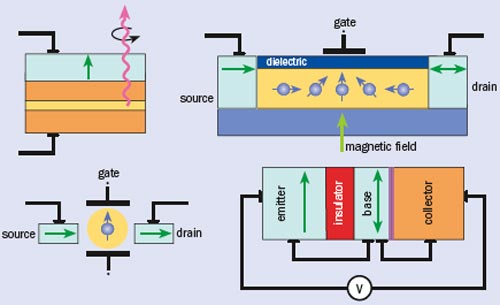
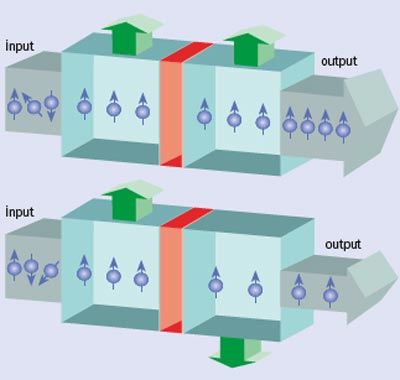
If Moore’s law is to continue, we need to find an alternative to conventional microelectronics — at long last it is time to exploit the electron’s spin in semiconductor devices. Whereas conventional electronic devices rely on only controlling the flow of charge, a “spintronic” device would also control the flow of electron spins (the so-called spin current) within the device, thereby adding an extra degree of freedom.
Because the spin of an electron can be switched from one state to another much faster than charge can be moved around a circuit, spintronic devices are expected to operate faster and produce less heat than conventional microelectronic components. One of the ultimate goals is to build a spin-based transistor that would replace conventional transistors in integrated logic circuits and memory devices, thus allowing the miniaturization trend to continue. However, spintronics also opens the door to entirely new types of device, such as a light-emitting diode (LED) that generates left or right circularly polarized light for use in encrypted communication (see “Spin-based devices”). Looking further into the future, spintronic devices could even be used as quantum bits, the units of information processed by quantum computers.
For the spintronics revolution to happen, however, researchers need to find a way to inject, manipulate and detect the spin of electrons in semiconductors, since these materials are likely to remain central to device physics for the foreseeable future. Spin manipulation should in theory be relatively straightforward, but injecting and detecting spin under practical conditions are huge challenges.
Giant achievement
Electron spin is already big business outside the semiconductor industry. In fact, metal-based spintronic devices can be found in the hard disks of virtually every computer on the planet. In 1988 Peter Grünberg at the Research Centre Jülich in Germany and Albert Fert at the Université Paris-Sud in France independently discovered that the flow of spin-polarized electrons between two thin layers of ferromagnetic metal separated by a layer of non-magnetic metal can be increased by about 3% by changing the relative magnetic alignment of the ferromagnetic layers from antiparallel to parallel — a discovery that earned them the 2007 Nobel Prize for Physics (see Physics World November 2007 p7, print edition only). This effect — called giant magnetoresistance (GMR) — made it possible for the magnetic read heads of hard disks to be much more sensitive to changes in magnetic fields, which boosts storage capacity by allowing information to be stored in much smaller regions on the disks’ surface.
The ability to transport electron spins between two metals also underpins magnetoresistive random access memory (MRAM) — a novel type of computer memory that can retain information without requiring any power. MRAM is based on a similar effect to GMR known as tunnel magnetoresistance (TMR), which arises when two layers of ferromagnetic metal are separated by a thin layer of insulating material, such as aluminium oxide or magnesium oxide. Instead of the spin-polarized electrons diffusing slowly from one ferromagnetic layer to the other as happens in GMR, in TMR they tunnel quantum mechanically (a classically forbidden process in which a particle passes through a potential barrier higher than its kinetic energy) through the barrier layer — as such these devices are called magnetic tunnel junctions (MTJs) (see “Magnetic tunnel junction”). The Pauli exclusion principle then comes into play. Tunnelling — and therefore spin transport across the barrier — can only occur if empty (i.e. unoccupied) wave states with the same spin are available on the other side of the barrier: the result is spin-dependent tunnelling.
Such spin-dependent tunnelling was demonstrated at low temperatures in 1975 by Michel Jullière at the Institut National des Sciences Appliquées de Lyon in France. But it was not until 1995 that Terunobu Miyazaki at Tohoku University in Japan and Jagadeesh Moodera at the Massachusetts Institute of Technology (MIT) in the US independently showed that it was possible to achieve TMR at room temperature. Unfortunately, the change in tunnel current as the spin alignment of the ferromagnetic layers is switched between parallel and antiparallel — known as the TMR ratio — was just 12–18% in Miyazaki’s and Moodera’s devices, which is far below what was needed to make a practical memory device. However, thanks to a major research programme on tunnel magnetoresistance supported by the Defense Advanced Research Projects Agency (DARPA) in the US, as well as a significant industrial research effort, the TMR ratio was eventually increased to 70% by the late 1990s.
More recently, the ability to fabricate atomically flat interfaces between the metal and the oxide layers has enabled Stuart Parkin’s group at IBM’s Almaden Research Center in California, and Shinji Yuasa and colleagues at the AIST in Japan to independently achieve TMR values of about 400% via coherent tunnelling. TMR-based commercial MRAM arrays are already starting to become available, and these could one day be used to build PCs that switch on instantly.
TMR relies on a large number of electrons with the desired spin state being transmitted across interfaces between ferromagnetic metals and insulating metal oxides. To make semiconductor spintronic devices possible, however, we need to achieve such behaviour across interfaces formed between a semiconductor and a material that can serve as a spin injector or detector.
Magnetic appeal
Silicon and gallium arsenide are the two most widely used semiconductors, so the challenge is to find spinpolarized materials — i.e. materials in which most of the electron spins are aligned in a particular direction — that can be combined with them. Promising candidates are “dilute magnetic semiconductors” (DMS) — semiconductors that, when doped with impurity atoms, display ferromagnetism.
In 1999 two groups independently injected spinpolarized electrons from a magnetic semiconductor into gallium arsenide. Laurens Molenkamp and colleagues at Würzburg University, Germany, maintained a polarization of 90% during spin injection from a spinpolarized semiconductor material into a gallium-arsenide structure at low temperature, although the semiconductor injector required an external magnetic field to maintain its polarization. Hideo Ohno’s group in Tohoku, Japan, in collaboration with David Awschalom’s group at the University of California, Santa Barbara, on the other hand, managed the same feat from a “true” DMS that does not require an applied magnetic field, although the researchers only achieved an injected spin polarization of about 1%. Together, these experiments demonstrated that it was possible to inject spin into a semiconductor; to develop a practical device, the next step was to find DMS materials that would allow robust spin injection at room temperature with only modest (or zero) applied fields.
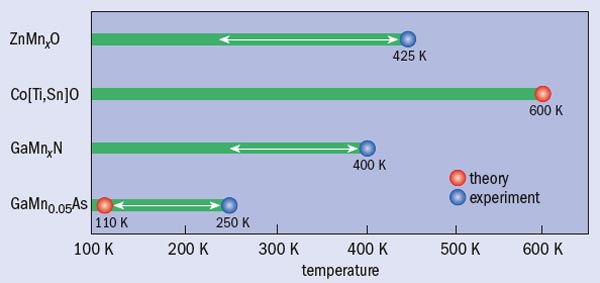
In 2000 Thomas Dietl of the Polish Academy of Sciences in Warsaw made an important breakthrough in this regard. He showed that the highest (Curie) temperature at which ferromagnetism occurs in certain DMS materials should increase significantly as they are doped with increasing concentrations of, in particular, the magnetic elements manganese or cobalt. His calculations were based on a concept first proposed by the late US physicist Clarence Zener in the 1950s, in which interactions between the magnetic moments of the localized impurity atoms and those of the delocalized holes in the semiconductor can cause the moments to align as they would in a ferromagnet. Furthermore, this effect should overcome the misaligning effect that is caused by high temperatures. Notably, Dietl’s calculations suggested that the commonly used semiconductors zinc oxide and gallium nitride should, with sufficient doping, exhibit ferromagnetism well above room temperature, thus sparking a major worldwide effort to develop practical DMS materials (see “Raising the Curie temperature”).
Finding a material that exhibits spin polarization well above room temperature, however, is not the only challenge in developing a practical spin injector. First, it must have a large polarization in order to be able to inject enough spin-polarized electrons into a semiconductor. Second, it must be possible to control the properties of the interface that forms when the injector material is deposited on the semiconductor. While developing magnetic tunnel junctions in the 1990s, researchers learned that the properties of the few atomic layers close to the interface have a critical effect on spin-injection efficiency. This is because very small amounts of chemical intermixing between the layers can scatter the electrons into new states and therefore substantially lower the amount of electrons that make it across the interface while remaining polarized. It is difficult to control the properties of DMS materials in bulk form, and even more so when the material is deposited in a thin film, as is required when fabricating a device. Achieving clean interfaces between DMS materials and semiconductors, therefore, poses a considerable challenge for researchers trying to build DMS-based spintronic devices.
Tunnel vision
There is, however, an alternative and fundamentally different approach to achieving spin injection. While many researchers concentrated on DMS materials, others reasoned that if spin-polarized electrons could be transmitted across an interface between a semiconductor and a ferromagnetic metal, the metal could then be used as a highly effective spin polarizer. Furthermore, since metal interfaces have been studied for decades, it should be much easier to control the interface properties in such device structures.
In the late 1990s several research groups attempted to inject spin-polarized electrons from ferromagnetic metals and alloys deposited directly onto gallium arsenide, but these early studies achieved injected polarizations of just a few per cent. A further blow to the idea was dealt in 2000, when Georg Schmidt and colleagues at Würzburg University used a simple model of a resistor network to show that a spin polarization of nearly 100% would be needed in the ferromagnetic metal in order to inject a useful spin polarization into the semiconductor. Such high polarizations are impossible to achieve in practice, so for a brief period it seemed that semiconductor spin injectors were likely to be the only possible way forward.
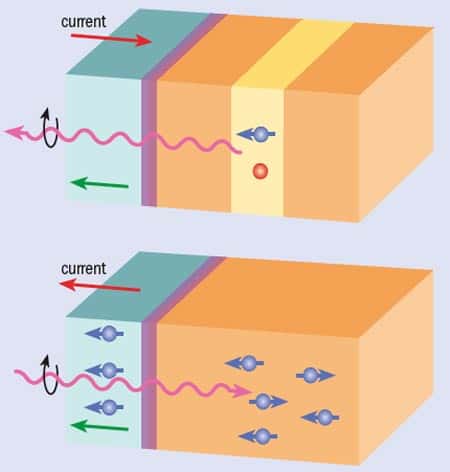
This view was turned on its head almost immediately, however, when Emmanuel Rashba at MIT realized that creating a tunnel barrier between the ferromagnetic metal and the semiconductor would solve the problem. He predicted that the spin polarization in the conductive metal would be preserved during tunnelling, and therefore that the ferromagnetic-metal–barrier spin injector was analogous to a magnetic tunnel junction. Following this development, a concerted effort was made to investigate the injected spin polarization in a ferromagnetic-metal–gallium-arsenide structure. In such samples, electrical charge is redistributed as the junction between the metal and the semiconductor forms, thus creating a “Schottky” tunnel barrier at the interface. It turns out that this type of structure also demonstrates the concept of a spin-LED (see “Electro-optical injection and detection”): when a polarized electron is injected from the ferromagnetic layer into the semiconductor, it recombines with a hole, which results in the emission of circularly polarized light. (In a conventional LED, in contrast, unpolarized electrons and holes combine to produce unpolarized light.) Several research groups are currently trying to exploit this phenomenon to develop a practical spin-LED device.
Since the number of spin-polarized electrons that make it across the barrier depends on its properties, however, some researchers tried replacing the Schottky barrier with a thin insulating layer in an attempt to increase the spin-injection signal in ferromagnetic-metal–semiconductor systems. In 2003 Pol Van Dorpe and colleagues at the Interuniversity Microelectronics Centre (IMEC) in Leuven, Belgium, achieved an injected spin polarization of just over 20% at low temperature with an aluminium-oxide insulating layer. Then, two years later, Parkin’s group at IBM showed that using magnesium oxide as an insulator improved the performance further, but that the injected polarization is highly sensitive to the crystal structure of the barrier material.
Meanwhile, progress was also being made in the other big challenge that needs to be overcome in order to build a spintronic device: spin detection. One way to do this is to reverse the process that allows a spin-LED to work (see “Electro-optical injection and detection”). By shining polarized light at a ferromagnetic-metal–Schottky-barrier–gallium-arsenide heterostructure, a population of spin-polarized electrons is generated within the gallium-arsenide substrate (via the optical-selection rules for this semiconductor). These electrons can then tunnel back across the Schottky barrier into the ferromagnetic metal where they can be detected electrically, so offering a way to detect electron spins. In 2004 our group in Cambridge used such a structure to show that this effect produces a voltage that depends on the percentage of the electrons in the ferromagnetic metal that are polarized.
Since then, we have found that by replacing the single layer of ferromagnetic metal with a metal GMR spin valve (i.e. two thin layers of ferromagnetic metal separated by a thin layer of non-magnetic metal), the current flowing into the metal can be determined separately from the current flowing in the semiconductor, since the valve acts as a gate that switches the current flowing to the metal on or off according to the magnetic alignment of its layers. Using the spin valve in this way allowed us to quantify the spin-filtering effect of the interface; and hence estimate the polarization of the detected current.
Interface matters
We are now six years on from Dietl’s predictions that the Curie temperature of certain DMS materials should increase significantly with ferromagnetic doping. Yet still no-one has found suitable ferromagnetic semiconductor materials that operate at room temperature and can be used in practical semiconductor spintronic devices. While the effort to develop DMS-based spintronics continues, however, the remarkable development of magnetic tunnel junction technology has given great impetus to using ferromagnetic metals in combination with semiconductors. While ferromagnetic transition metals do not offer 100% spin polarization, this may not be necessary for practical devices: theoretical predictions suggest that by controlling the interface structure and composition, and using appropriate barriers, future ferromagnetic-metal systems could yield dramatic increases in spin transmission over the injector/detector materials tried so far.
The successful development of MTJs has already shown that the properties of the few atomic layers close to the interface have a critical effect on spin transmission. In the future it will be important to precisely control the structure of the materials used in semiconductor spintronic devices by matching the crystal orientation of the interface with that of the spin injector/detector material, and it is clear that there are many promising new routes to investigate. While it is not possible to say how long this will take, it looks increasingly likely that the semiconductor spintronics revolution will be kicked off by devices that use the magnetic transition metal films already found in MRAM and MTJ devices.
At a Glance: Semiconductor spintronics
In addition to their charge, electrons have an intrinsic angular momentum or “spin” that has only two possible orientations in an external magnetic field
The electron spin is currently exploited in computer hard disks and magnetoresistive random access memory via the giant magnetoresistance and tunnel magnetoresistance effects, which occur in layered metal structures
Semiconductor devices that exploit spin as well as charge would operate faster than conventional microelectronic devices and would offer new functionality
The main challenge in building such a device is transporting spin-polarized electrons efficiently into and out of the semiconductor region of the device
Currently, researchers are following two approaches to spin injection and detection: dilute magnetic semiconductors deposited onto conventional semiconductors; and ferromagnetic metals deposited onto semiconductors
More about: Semiconductor spintronics
D D Awschalom et al. 2007 The diamond age of spintronics Scientific American297 58 J A C Bland et al. 2005 Optical studies of electron spin transmission Ultrathin Magnetic Structures IV (ed) B Heinrich and J A C Bland (Springer, New York) pp59–100 T Dietl 2003 Dilute magnetic semiconductor: functional ferromagnets Nature Materials2 646 B T Jonker and M E Flatté 2006 Electrical spin injection and transport in semiconductors Nanomagnetism (ed) D L Mills and J A C Bland (Elsevier, Amsterdam) pp227–272 H Ohno et al. 2000 Electric-field control of ferromagnetism Nature408 944 S A Wolf et al. 2001 Spintronics: A spin-based electronics vision for the future Science294 1488 I Zutic et al. 2004 Spintronics: fundamentals and applications Rev. Mod. Phys.76 323
• Physics World notes with regret the death of Professor Tony Bland shortly after the completion of this article. An obituary appears on page 9 (print edition only).
It was the year that the first “commercial” quantum computer was unveiled, and 2007 also saw a flurry of research into the supersolid state of matter. Astronomers improved our understanding of the cosmos by zeroing in on the origins of ultra-high energy cosmic rays and providing the best-ever map of dark matter in the universe. While the Nobel Prize in Physics – awarded for the discovery of giant magnetoresistance – demonstrated how investing in fundamental research could lead to rapid improvements in technology, the year ended on a sour note with some physicists in the US and UK facing significant cuts in their research funding.
While physicists are fairly certain that the universe is full of dark matter, no-one has managed to make a direct observation of the mysterious stuff. The best astronomers can do is work out where the dark matter is by watching how its considerable gravitational pull bends light from distant galaxies. In January, astronomers from the Cosmic Evolution Survey (COSMOS) unveiled the first large-scale map of the distribution of of dark matter. It reveals a universe permeated by filaments dark matter that intersect at galaxies and other major structures – adding further weight to the theory that the universe owes its structure to the gravitational pull of dark matter.
In February, an international group of particle physicists outlined their design for the proposed International Linear Collider (ILC). The ILC could be built by about 2019 to search for the Higgs boson, exotic “supersymmetric” particles and to study the nature of dark energy and dark matter. The 31 km-long behemoth is the next big facility after the Large Hadron Collider, which is due to switch on at CERN in 2008. The ILC could cost as much as $15 bn to build and international cooperation will be crucial to its success. Sadly, this began to unravel towards the end of 2007, with the UK pulling all its funding from the ILC in December. Things are also not looking good in the US, where particle physics in general looks set to suffer a significant cut in funding.
Graphene and negative refractive-index materials were two of the hottest topics in physics in 2007. So it should not be that surprising that in March a team of researchers came up with a proposal linking these previously unrelated topics. According to calculations done by the physicists, graphene could be used to make a tiny lens to focus electrons through negative refraction. Graphene, which is a sheet of carbon only one atom thick, made the news throughout 2007 – including in September, when physicists resolved the “mystery of the missing pi” and reconciled the measured conductivity of the material with the value predicted by theory.
In April, physicists working on the MiniBooNE experiment at Fermilab in the US ruled out a puzzling result that had threatened to undermine the Standard Model of particle physics. The team confirmed that nature contains just three types of neutrino – not four as suggested by an experiment carried out in 1995 at the Los Alamos National Laboratory in 1995.
Later this year in Italy, the existence of another controversial particle was put into doubt by the very team that had claimed its discovery. In March 2006, physicists at the PVLAS experiment shone a laser beam through a strong magnetic field and saw that the beam’s polarization rotated slightly. At the time many physicists thought that this was due to an ultralight particle coupling with photons in the beam, and so heralded it as the first glimpse of the “axion”. However, in June 2007 the team reported that the apparent rotation was an artefact related to how the experiment had been performed.
Dubbed the “Isaac Newton of our time” by the Nobel-Prize committee, the French physicist Pierre-Gilles de Gennes died at the age of 74 in May. De Gennes was awarded the Nobel Prize in Physics in 1991 for his ground-breaking work on liquid crystals and polymers and also had an interest in many other fields of science including cellular adhesion and brain function. He was also a passionate advocate of physics education and visited over 200 schools after receiving the Nobel prize.
In 2007, the physics community also lost the particle physicist Wolfgang Panofsky, who was founding director of the Stanford Linear Accelerator Center (SLAC) in California, and cosmologist Ralph Alpher, whose pioneering calculations supported the concept of the Big Bang.
The ILC wasn’t the only “big physics” project to suffer setbacks in 2007. In March, scientists performing preliminary tests on quadrupole magnets for the Large Hadron Collider (LHC) at CERN witnessed a serious failure when structures supporting one of the magnets broke. As a result of this failure, CERN announced in June that the €6.3bn LHC would not start up in 2007 as scheduled. Instead, the world’s largest particle physics experiment will skip its “engineering run” and is expected to switch on in either late March or early April 2008 with an aim to start data collection two months later.
The first convincing evidence for the supersolid state of matter came in 2004, when US physicists Moses Chan and Eun-Song Kim noticed that a small fraction of a sample of solid helium-4 started to behave like a fluid at extremely low temperatures. Subsequent experiments questioned the initial explanation that this effect was caused by lattice vacancies in the solid condensing into a superfluid, leading to a flurry of experimental and theoretical work. In July, theorists put forth the latest explanation for supersolidity – atoms flowing along screw dislocations in the solid helium. In June, Chan showed that supersolidity occurs in single crystals, which appeared to rule out the possibility that atoms were flowing along grain boundaries in the solid helium.
Physicists are always up for a challenge, and dreaming up new ways to slow-down or even “stop” light was a popular pastime in 2007. In August, physicists in Israel came up with a way to store 2D images in an atomic gas for up to 9 µs. The team used a laser technique called electromagnetically-induced transparency (EIT), which resulted in a storage time about 1000-times longer than the previous record. In December, Physicists in the US unveiled a simple way to “store” light pulses in a material by converting them into sound waves using just two lasers and a piece of standard optical fibre.
Quantum computers could someday work exponentially faster than their classical counterparts by entangling multiple quantum bits – or qubits. However for this to happen, physicists must work out ways to link qubits without destroying their delicate quantum nature. In September, two independent groups in the US unveiled “buses” for transferring information between two microchip-based qubits. The buses could allow a number of qubits to be joined together to make quantum computers using standard chip manufacturing processes.
While most physicists agree that it will be sometime before practical quantum computers are a reality, in April a small Canadian company called D-Wave said that had built the world’s first commercial quantum computer. However, not everyone was convinced by the firm’s claims.
In October, the Nobel Prize in Physics was awarded jointly to Albert Fert of the Université Paris-Sud in France and Peter Grünberg of the Forschungszentrum Jülich in Germany for their independent discovery of giant magnetoresistance in 1988. Dubbed “the Nobel Prize inside your iPod” by the press, the award recognized that the discovery has led to dramatic rise in the amount of data that can be stored on computer hard-disk drives and is now standard technology found in nearly all computers worldwide and is also used in some digital cameras and MP3 players.
Fert and Grünberg are pioneers in “spintronics”, which could be used in devices that exploit the spin – as well as the charge – of electrons to store and process information more quickly and efficiently than conventional transistors. In August, researchers in the US unveiled the first silicon spin field-effect transistor (spinFET), which uses an applied voltage to control a current of spin-polarized electrons. The component is an an important step towards the first commercial “spintronic” devices.
Ultrahigh-energy cosmic rays were first discovered in the 1960s and the origins of these extremely rare charged particles have been hotly debated ever since. In November, astronomers using the Pierre Auger Observatory produced the best evidence yet that ultrahigh-energy cosmic rays striking the Earth come from black holes lying at the heart of nearby galaxies. Having solved the mystery of where these cosmic rays come from, researchers now hope to get a better understanding of exactly how these charged particles are accelerated to such high energies.
Many physicists in the US and the UK can look forward to a bleak 2008 thanks to major cuts to research funding announced by their respective governments. In the US, particle and fusion physics will bear the brunt of the cuts, with the US slashing its funding of the International Linear Collider and the international ITER fusion experiment. In addition, up to 200 staff at the Fermi National Accelerator Laboratory (Fermilab) could lose their jobs.
Particle physics in the UK will also be hit hard, with the Science and Technology Facilities Council (STFC) pulling its funding of the ILC. The UK will also stop investing in high-energy gamma-ray astronomy, withdraw from the Gemini telescopes, and cease all support for ground-based solar-terrestrial physics facilities.
The US has slashed funding for the International Linear Collider (ILC) by 75 % as the budget for 2008 has been finally agreed between the Republican Bush Administration and Democratic Congress. The new budget legislation, which US president George W Bush is expected to sign by 31 December, will see up to 200 scientists at the Fermi National Accelerator Laboratory (Fermilab) lose their jobs. Funding for the international ITER fusion experiment, which is about to be built in France, has also been cut.
After 11 months of debate between the political parties, the budget compromise left the Department of Energy’s Office of Sciences, which funds much of American physics, with $4.02 bn for the financial year which began this October – a rise of 2.6 % compared to 2007 and $504 million below the Administration’s original request. “The appropriation falls so far short of the request that there will be painful cutbacks in laboratory plans,” says Kei Koizumi, a budget analyst at the American Association for the Advancement of Science.
Fusion hit hardest
High-energy physics will bear the brunt of the cuts, falling by 8.5 % to just $688 m. Research into nuclear fusion takes an even larger hit falling by 10.2 % to $287 m compared to last year .
The cuts, announced at extremely short notice, have immediate and significant impact at Fermilab. The lab learned to their astonishment that they will have just $310 m to spend this financial year from an expected $372 m. The budget process has even specified which Fermilab programmes will receive the bulk of the cuts – the most prominent being the 75 % cut for the ILC, which is set to be the next big experiment in particle physics after the Large Hadron Collider at CERN. Funding will fall from $60 million to just $15 million. But as Fermilab has spent roughly that much since the start of the financial year on the project, further spending on the ILC is effectively zero. Funding for the initial construction of the NOvA neutrino experiment at Fermilab has also been cut. “It’s a devastating blow,” said Fermilab’s director Pier Oddone.
Lay-offs and unpaid leave
Oddone moved fast to deal with the situation. At a meeting of the entire lab on 20 December, he announced that he would lay off 200 members of the 1,900-member Fermilab staff. Since severance payments will eat up some of the savings, Oddone announced that staff will have to take 2 days of unpaid leave per month. In making those decisions, Oddone has a two-fold goal: To ensure that the Tevatron accelerator continues to chase the Higgs boson until its scheduled closure in 2009, and to guarantee that Fermilab will continue to make significant contributions to elementary particle physics after that date. “We have a rugged plan to deliver results that matter,” says Fermilab spokesperson Judith Jackson.
The ILC is not the only international venture to suffer in the budget. The US contribution to the International Thermonuclear Experimental Reactor (ITER) also falls to zero compared with a requested amount of $160 million, although the budget includes $10.72 m for American R&D on the project. The budget document adds a warning that “funding may not be reprogrammed from other activities within Fusion Energy Sciences to restore the U.S. contribution to ITER.”
The effect on ITER’s progress may be relatively small. “I don’t expect much of a delay,” Koizumi says, “because the other international partners are paying for most of the construction, and it’s already facing some delays.” However, cutting ITER’s funding has one virtue: allowing three American fusion facilities – the DIII-D in San Diego, the Alcator C-Mod at the MIT plasma science and fusion center, and the National Spherical Torus Experiment at the Princeton Plasma Physics Laboratory, to be funded at close to their requested levels.
The new budget legislation has put American physicists into a grim mood. A year that started with great hope of increased funding is ending on a note of near despair coming just days after the UK announced that it plans to pull out of the ILC altogether.