Superexchange spotted in optical lattice

Physicists in Germany and the US are the first to see the superexchange interaction between atomic spins in an optical lattice. Superexchange leads to magnetism in a wide range of materials — including some that are high-temperature superconductors — and the team believes that their technique could shed light on the electronic and magnetic properties of these materials.

Superexchange is an interaction that normally occurs between electron spins in a crystalline material. Unlike the more familiar exchange interaction, which affects electrons that are close enough together to have overlapping quantum-mechanical wavefunctions, superexchange does not require an overlap. Instead, the interaction has its basis in the “virtual hopping” of electrons from one lattice site to another. This is a quantum mechanical process by which an electron can “tunnel” through the region separating neighbouring lattice sites and join its neighbour, only for the electron or its neighbour to hop back a moment later.

The likelihood of this happening is governed by the relative orientations of the spins of the electrons. As a result superexchange can either cause the spins of neighbouring electrons to point in the same direction, or opposite directions, depending on the exact composition of the material.

10,000 double potential wells

Now, Immanuel Bloch of the Johannes Gutenberg University in Germany along with researchers at Harvard University and Boston University in the US have observed superexchange in an optical lattice of ultracold rubidium atoms (Sciencexpress). The team crisscrossed several laser beams to create 10,000 identical double potential wells, each containing two atoms. The double wells were arranged in a line creating a 1D lattice (see figure “Superexchange in action”).

The lattice was set up such that the pairs of atoms had their spins pointing in opposite directions — something that would occur in an antiferromagnetic material. The team then adjusted the lasers to reduce the potential barrier between the pairs of atoms. This made it more likely that tunnelling between wells would occur, thereby increasing the strength of the exchange interaction.

The team then watched as the atomic spins responded to this change. While they were unable to monitor individual atoms, they could measure the average direction of the spins in the right and left sides of the double wells.

Oscillating spins

The directions of the spins were seen to oscillate back and forth between wells. For example, if the atoms in the left wells began as spin up and the right wells as spin down, about 25 ms later the left wells would contain spin down atoms and the right wells spin up. The team claims that this observation is in agreement with the theory of superexchange between pairs of atoms.

Bloch and colleagues were also able to change the superexchange coupling from antiferromagnetic to ferromagnetic — in which spins of neighbouring pairs point in the same direction — by raising one side of the double well relative to the other side.

Bloch told physicsworld.com that the team hope to extend their technique to create a 2D optical lattice. This could be used to study a wide range of exotic magnetic systems, including those with antiferromagnetic interactions along one axis and ferromagnetic interactions along the other.

Such optical lattices could also be used to gain insight into some high-temperature superconductors, which are known to have magnetic properties related to superexchange. These materials consist of stacked 2D layers, and therefore a 2D optical lattice could be very useful in understanding the interactions that bring about superconductivity.

Bloch also believes that the ability to fine-tune superexchange interactions between atoms in an optical lattice could be used to create logical components for quantum computers.

Cosmology hub launches in the UK

The Centre for Theoretical Cosmology, an “international hub” that will draw together cosmologists young and old to answer the big questions of the universe, was launched at the University of Cambridge in the UK yesterday. The event was marked by the unveiling of a bust of Stephen Hawking, who founded the new centre.

Some of the most fundamental discoveries in physics have been made at Cambridge, including those by Isaac Newton, James-Clerk Maxwell and Paul Dirac. But, speaking at the launch, Hawking said that future discoveries will need a global effort among physicists. “Over the past few decades science has become a worldwide activity,” he said. “Theoretical cosmology optimizes this.”

Hawking went on to summarize what the big remaining questions in cosmology are: “How did the universe begin? What ‘banged-up’ the Big Bang? What of dark matter and dark energy? How were the laws of physics determined? What lies to our future?”

In the past we have collaborated as individuals, but in the future we will be collaborating as centres George Smoot, University of California in Berkeley

The centre, which is based at the existing Centre for Mathematical Sciences, is being funded by the Stephen Hawking Trust Fund. Currently the only dedicated space is a refurbished seminar room where the launch took place, but organizers said they were hoping to have a building to house the centre in the future.

The bust, which was created by the late UK sculptor Ian Walters — famous for his statue of Nelson Mandela in Parliament Square, London — was unveiled by Alison Richard, the vice chancellor of the university. Roughly half a metre tall, it is a contemporary portrayal of Hawking with his characteristically staid expression gazing across the room.

Hawking’s introduction was followed by brief words from three eminent physicists: George Smoot, who shared last year’s Nobel Prize for the discovery of anisotropies in the cosmic microwave background radiation; Franck Wilczek, who shared the 2004 Nobel Prize for discovering asymptotic freedom in the theory of the strong force; and Katsuhiko Sato, previous director of the Research Center for the Early Universe at the University of Tokyo in Japan.

Smoot, who recently launched his own cosmology centre at University of California in Berkeley, US, said: “In the past we have collaborated as individuals, but in the future we will be collaborating as centres.”

Ampere could be defined one electron at a time

There could soon be a new and more accurate method of defining the standard unit of current, the ampere, thanks to a tiny electronic device built by physicists in Finland and the US. The team, led by Jukka Pekola of the Helsinki University of Technology, has made a single-electron transistor that converts an oscillating voltage into a very precise electrical current.

The ampere, volt and ohm are the three fundamental units of electricity. While physicists have devised modern microscopic definitions of the volt and ohm – through measurements of the Josephson voltage and quantum Hall resistance respectively – the most accurate measurements of the ampere are made using a refined version of a technique first developed in the 19th century.

Today, the ampere is defined as the current which, when flowing through two parallel conductors one metre apart, exerts a certain force between the conductors. This is a macroscopic measurement involving a specific geometrical configuration of conductors – which limits the accuracy of the measurement.

Measuring tiny currents

Instead, physicists would like to define the ampere by creating an extremely precise source of electric current capable of delivering one electron at a time. Although researchers have already tried to make such single-electron devices in order to redefine the ampere, none have been successful because detecting such tiny electron currents has proved very difficult.

Now, Pekola and colleagues have made a single-electron transistor that could be used to overcome this problem (Nature Physics doi: 10.1038/nphys808 ). Their device consists of a small conducting island that is connected to two tunnel junctions. Electons can flow into the island via one junction and out via the other. The device also includes a gate electrode, which can be used to control the flow of electrons through the island by applying a voltage.

Each tunnel junction contains a very thin insulating layer, through which the electrons can quantum mechanically tunnel. The junctions are so tiny that the electric repulsion between electrons prevents more than one electron tunnelling at a time – creating a single-electron device.

Cooled to 0.1 K

The device is cooled to 0.1 K to reduce thermal noise and the team applied a constant voltage across island and junctions. An oscillating voltage is applied to the gate electrode. The precise number of electrons that pass through the device during one cycle of the oscillation is determined by the amplitude and mean value of the gate voltage.

The current flowing through the device is simply the number of electrons that tunnel per gate cycle multiplied by the charge of the electron and the frequency of the gate voltage. The gate frequency and number of electrons per cycle can be determined and the charge on the electron is fixed – which means that the device is a very precise source of current.

Although the researchers still need to improve the accuracy of their device, Pekola believes that the transistor is one of the best candidates to create a “metrological current pump” for defining the ampere. He told physicsworld.com that his could be done by placing about ten of the devices in parallel, which would deliver a current of about 100 pA, which is large enough to measure.

“Our simple one-gate device is easy to operate and it is straightforward to put many devices in parallel to make the output current larger,” said Pekola. “The small current level has been the bottleneck in making single electron current pumps in the past.”

Quantum metrological triangle

The device might also help close the so-called “quantum metrological triangle” that relates current, voltage and resistance. Voltage can be measured using the AC Josephson effect, while resistance can be related through the quantum Hall effect. Both these relationships include the same two fundamental constants — the Planck constant, h and the charge on the electron. A metrological current pump would allow physicists to relate current directly to frequency.

“The result looks very interesting and may be important if it achieves its promise of providing a reliable way of making accurate devices that can both pump more than one electron per cycle and be placed in parallel,” said Ian Robinson of the National Physical Lab in the UK. Robinson works on the “watt balance” that will contribute to setting the values of h and e in new definitions of the SI kilogram and ampere. The apparatus presently uses the Josephson and Quantum Hall effects to measure current with an uncertainty of about 1 x 10⁻⁸. “The technique described here has around a factor of 1 million to go before it approaches the 1 x 10⁻⁸ level but it shows promise,” he added.

Conduction seen in DNA backbone

Physicists in Japan have gained important new insights into how DNA might behave as an electrical conductor. Their discovery could help provide a better understanding of the role that conduction plays in how living cells detect and repair damaged DNA and could ultimately lead to strands of DNA being used in “molecular electronics” technologies of the future.

Biophysicists are keen to understand how electrons are conducted in DNA because conduction is thought to be an important mechanism by which enzymes recognize damaged DNA that, if not repaired, could lead to cancer. Some scientists also believe that conduction through DNA could protect the genomes of some organisms by transmitting the damage caused by oxidizing chemicals to certain locations on chromosomes where the damage causes the least harm.

Tiny electronic circuits

A better understanding of conduction could also lead to the engineering of new forms of DNA with properties more suited to electronic applications. DNA is an attractive building block for tiny electronic circuits because of its ability to assemble into complex interconnected patterns that would be required for assembling circuit components.

Not long after the double-stranded structure of DNA was revealed by Watson and Crick in 1953, scientists suspected that the molecule it might support electrical conduction. This is because the bases in the middle of the double helix stack in a way reminiscent of graphite – which is an excellent conductor. At about the same time, the physicist Leon Brillouin suggested that the DNA backbone – the long strands that support the bases and give DNA its structure – rather than the bases, might support conduction because of its periodic structure.

While the conductive properties of DNA have been studied using a wide range of techniques, most experiments have focused on understanding conduction in terms base stacking and have yielded conflicting results. Alternative or complementary conduction mechanisms – such as Brillouin’s backbone conduction – have been largely ignored.

Now, Tetsuhiro Sekiguchi of the Japan Atomic Energy Agency and Hiromi Ikeura-Sekiguchi at the AIST research centre are the first to measure how electrons move through the DNA backbone using a technique called resonant Auger spectroscopy ( (Phys. Rev Lett. 99 228102 ).

Spectator Auger decay

The team directed a beam of X-rays onto DNA to excite electrons from phosphorus atoms in the backbone of the molecule. If these electrons remain near to the site of their excitation, other electrons with a specific energy distribution indicative of “spectator Auger decay” will be emitted from the sample. However, if excited electrons are able to conduct along the backbone, the emitted electrons will have an energy distribution associated with “normal Auger decay.”

By comparing the relative intensities of Auger electrons with spectator and normal decays, the team could determine the time that it takes for an electron to move away from a phosphorous atom and take part in conduction – called the delocalization time.

What they found is that electrons in the backbone delocalize in less than one femtosecond (10-15) in wet DNA. These results imply that electron movement occurs a thousand times faster in the DNA backbone than in the bases stacked in the core.

This first observation of conduction along the backbone could help reconcile the seemingly contradictory results of the many base-stacking studies of conduction. Indeed, these latest results suggest that focusing on the interplay between electron transport through the backbone and the stacked bases could be crucial to understanding DNA conduction.

Photonic crystal bends light round corners

Physicists in the US have created the first true 3D waveguide in a photonic crystal, enabling light to be transmitted around sharp bends. The research is a step towards optical integrated circuits and low-threshold lasers.

A photonic crystal contains regularly alternating regions with high and low refractive indices. This structure creates a “photonic bandgap”, holding back light of certain frequencies while letting light of other frequencies through.

An offshoot of this property is that photonic crystals can confine light to travel along predetermined paths inside waveguides. Such waveguides could be used to process optical signals in telecommunications, or to serve as small laser cavities that only require a low power to start lasing. Unfortunately, nearly all waveguides made so far have been 2D, and until now no-one has come up with a method that can create 3D waveguides at any place within a photonic crystal and with any dimensions so that useful devices can be created.

Marking out

Paul Braun and colleagues at the University of Illinois at Urbana Champaign have pioneered a flexible process for a fabricating 3D photonic-crystal waveguide by using a focused laser to mark it out (Nature Photonics advance online publication).

The researchers begin by crystallizing a colloid of silica spheres either 725 or 925 nm in diameter onto a substrate to create a structure similar to an opal — a well known natural photonic crystal comprising high-refractive-index silicon interspersed with pockets of low-refractive-index air. To this structure they then add a monomer solution, and sweep the focal point of the focused laser beam over the desired waveguide region to make the monomers bond together to form a polymer. With this region now cordoned off, the researchers fill the rest of the structure with silicon and etch away the original silica spheres with acid. (See figure: Method.)

The entire process leaves an “inverse opal” photonic crystal containing a polymer waveguide, which is transparent to near-infrared light, with features less than 100 nm in resolution. To check it works, the researchers made a waveguide with two sharp bends and found that light only with a wavelength of 1.48 µm — corresponding to the photonic bandgap of the material — was transmitted through the waveguide.

Braun’s group says that their method could lead to the first devices that manipulate photons in 3D.

In praise of Lord Kelvin

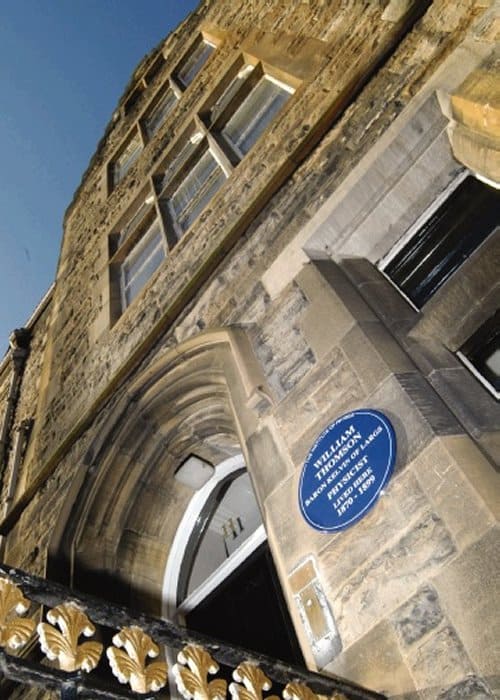
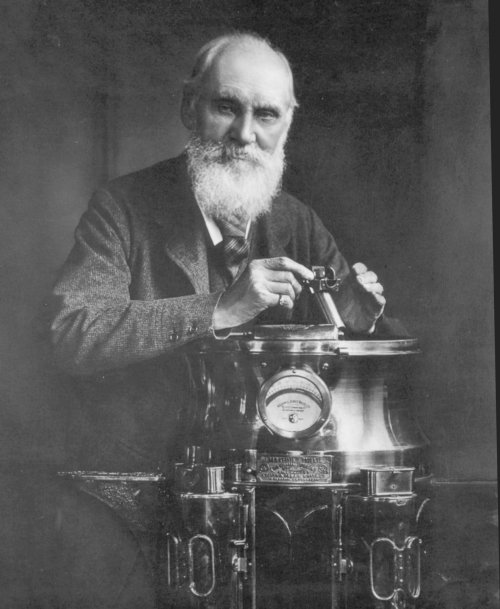
A physicist visiting the city of Glasgow for the first time is often heard to wonder, “Is everything here named after Lord Kelvin?” With places like Kelvinside, Kelvindale and Kelvingrove, it certainly feels like that, but it is really the other way around. The great physicist, who died 100 years ago on 17 December 1907, took the title Baron Kelvin of Largs from the River Kelvin that curls around the foot of the University of Glasgow’s spectacular campus. Prior to his enoblement in 1892 as the first ever scientist peer, he was William (later Sir William) Thomson.

Born in Belfast in 1824, Kelvin moved to Glasgow in 1830 when his father, James Thomson, was appointed to the chair of mathematics at the university. At the age of 10, Kelvin enrolled at the university as its youngest ever student. Ironically, he is also the university’s oldest ever student — after retiring, aged 75, he immediately re-registered as a student; such was his interest in physics.

Personal fortune

In 1840, Kelvin left for Cambridge University before returning to Glasgow six years later to become professor of natural philosophy, a position he held for 53 years. Along the way, Kelvin amassed a personal fortune as an inventor and investor in new technologies such as electrical lighting.

Above all, Kelvin was the dominant figure in science in the second half of the 19th century. Indeed, he is buried in Westminster Abbey next to Isaac Newton, and a nave window there pays tribute to him as “Engineer, Natural Philosopher.” To quote one of Kelvin’s early biographers, Alexander Russell: “His work lives and will continue to live. To him it has been given to make history which will live so long as intelligent man survives on earth. As the years roll on our indebtedness to him increases.”

With Kelvin’s work on Fourier series, the classical physics of continuous media was born.

Despite his greatness, Kelvin’s achievements are often unheralded and he is remembered for his reactionary approach to the new physics that emerged in the last decade of his life, epitomized by the crisp statement, “X-rays are a hoax.” To appreciate his achievements, we need to go back more than half a century to 1841, when at the age of 16 he wrote his first scientific paper, based on his correspondence with Philip Kelland, professor of mathematics at Edinburgh University. Kelland and others had argued that mathematical instabilities at sharp boundaries meant that Fourier series could not be used to solve the partial differential equations that describe the flow of heat. Kelvin proved otherwise and thus the classical physics of continuous media was born.

Kelvin’s first paper is all the more remarkable because at the time there was no firm understanding of what heat actually was — a mystery that began to unravel two years later when James Joule showed that work was the mechanical equivalent of heat. Indeed, crucial to Kelvin’s approach was that he took to heart Fourier’s message that one can describe in mathematics the behaviour of heat without knowing precisely what heat is. Kelvin continued his study of heat and in 1848 he introduced the word “thermodynamics”.

What is energy?

By the mid 19th century the demands of the industrial revolution had put the “standard model” of physics in a crisis surrounding the question “What is energy?” In particular, the development of the steam engine had thrown the issue of energy and how to harness it into strong focus. However, what we now know as the second law of thermodynamics had yet to be formalized. Without a clear understanding of the roles of energy and entropy in thermodynamic processes, the theories of Joule and Sadi Carnot appeared to allow the construction of limitless energy sources from “perpetual motion” machines.

The key discovery that overcame this paradox of perpetual motion was actually made by Kelvin’s brother James Thomson, who was professor of engineering at Glasgow. James was two years older than Kelvin and discovered that the temperature at which ice melts falls when external pressure is applied — we now know that this is why ice skates work.

With this observation the thermodynamic contradictions of the past vanished and the first and second laws of thermodynamics could at last be written down. An absolute scale of temperature was defined and the absolute zero (the [unattainable] minimum temperature) determined. The first and second laws meant that physics could be rewritten in terms of energy. Indeed, the terms “kinetic” and “potential” energy were introduced by Kelvin and the Edinburgh physicist Peter Tait, with whom he co-authored Treatise on Natural Philosophy in 1867 — the first textbook on physics.

The second law of thermodynamics can be stated in various ways that turn out to be logically equivalent statements. Kelvin’s 1851 formulation is: “It is impossible, by means of an inanimate agency, to derive mechanical effect from any portion of matter by cooling it below the temperature of the coldest of the surrounding objects.” The law has stood the test of time and the efforts of many would-be inventors. Indeed, it has been argued that everything we know in science may be wrong, except the first and second laws of thermodynamics, which must be right. In the simplest layman’s paraphrase, the laws state: “you cannot get something for nothing” and “you cannot even break even”.

Epic undertaking

Kelvin was also successful at applying his considerable intellect to solving the problems of industry. His most notable enterprise was the laying of the first transatlantic telegraph cable between Ireland and Newfoundland in 1858–1866. This was an epic undertaking with huge practical difficulties and Kelvin did much of the original scientific work and invention that made it possible.

A fundamental problem facing the Atlantic Telegraph Company, of which Kelvin was a director, was that no one knew how deep the ocean was. Attempts to measure the depth by simply dropping a very heavy weight at the end of a cable always resulted in the cable reel breaking. Kelvin solved this problem by inventing a compact device that could be lowered on a piano wire and measured the pressure difference between the surface and sea floor, from which the depth could be calculated.

The achievement of the transatlantic cable shrank the world more than anything before or since.

Kelvin also solved the problem of extracting the very weak telegraph signal at the receiving end of the cable. An earlier attempt at doing so by Edward Whitehouse, chief electrician of the Atlantic Telegraph Company and Kelvin’s rival in the development of telegraph technology, ended in disaster in 1858. Whitehouse raised the signal voltage ever higher until the insulation failed — destroying the first cable and leading to a parliamentary enquiry.

Kelvin’s ultimate strategy for signal extraction was to develop a receiving and recording device that required minimal signal power — the “siphon recorder”. A precursor of the modern inkjet printer, the recorder’s only moving part was a jet of ionized ink that recorded the Morse code signal on paper.

The achievement of the transatlantic cable shrank the world more than anything before or since. It has the same logical structure as e-mail — digitally encoded, packet switched and seeking the least crowded route. Kelvin’s contributions earned him his knighthood and set him on a path to riches and invention after invention.

Inventions and theories

In 1884, at the age of 60, Kelvin joined forces with the Glasgow instrument maker James White to create a company that would become Kelvin and James White Ltd. Perhaps its most famous product was Kelvin’s compass for iron ships. This was the first instrument that could provide a true reading of magnetic North in spite of the permanent magnetic moment of the ship and the additional moment induced in the hull by its orientation in the Earth’s field.

Kelvin played important roles in the burgeoning science and technology of electricity. He worked to refine the accuracy of electrical units of measurement, ultimately chairing the committee that named the Ampere, Volt, Ohm, etc as we know them today.

Kelvin also pioneered electric light, and in 1881 made his home in Glasgow the first house in the world to be fully lit by electricity, using 106 lamps. That same year he began research and development work with Joseph Swan, who was a pioneer in the design and manufacture of incandescent light bulbs. International students flocked to work in Kelvin’s laboratory including Gerard Philips, the co-founder of a Dutch light bulb manufacturer that would later become Royal Philips Electronics.

Kelvin had a keen interest in the geosciences and was the first to apply mathematics to the question of the ages of the Earth and the Sun. He approached the problem of the Sun by looking at all known energy sources and calculating how long they could sustain the Sun’s heat output.

Kelvin estimated the age of the Earth by calculating how long mountains could survive against wind and water erosion.

At one point the most promising energy source for the Sun was gravitational shrinkage. Kelvin had to abandon this theory because he knew that Alexander the Great had seen a solar eclipse when he crossed the River Oxus in 329 BC. This put an upper limit on the size of the Sun at that date, suggesting that the Sun was not shrinking fast enough to provide the required power. Kelvin estimated the age of the Earth by calculating how long mountains could survive against wind and water erosion.

Of course, Kelvin did not know about the mountain-building processes of plate tectonics or the nuclear fusion that powers the Sun, and therefore his ages were hugely underestimated. He believed the Earth to be a mere 100 million years old, for example, which caused uproar amongst evolutionists, leading to a controversy that lasted some time. Although his answers were wrong, Kelvin’s methods were right: the quantitative approach was both new and correct, but the data were incomplete.

Aware of his failings

Despite his great advances in science and engineering, towards the end of his life Kelvin was acutely aware of the failings of the classical physics that he was so instrumental in creating. He shared this sentiment at a celebration of his 50th anniversary as professor in words that surely would have shocked his audience: “One word characterizes the most strenuous of the efforts for the advancement of science that I have made perseveringly during 55 years. That word is failure. I know no more of electric and magnetic forces or of the relation between aether, electricity and ponderable matter, or of chemical affinity than I knew and tried to teach to my students of natural philosophy 50 years ago in my first session as professor.”

This lament harks back to his beginnings, to the joy that Kelvin felt in learning that you can describe how heat flows in mathematics without ever knowing what heat is. This is the triumph and tragedy of classical physics. It is brilliant phenomenology, but falls short of explaining how the structure of atoms forces the behaviour of the material.

Kelvin’s era was closing. It would be a task for others to elucidate the new phenomena — the electron, X-rays, radioactivity, the photoelectric effect, relativity — that came crowding into his last decade. We should honour him for what he achieved and for his yearning for what remained to be achieved. He felt himself to be like Isaac Newton in old age, playing with the odd attractive pebble on a beach while an ocean of truth lay undiscovered before him, and he felt the frustration of this.

Boundless energy

Kelvin’s life was characterized by boundless energy that would keep a whole laboratory of scientific assistants jumping and would lead to more than 650 scientific papers and to 75 patents. A modern comparator could be Richard Feynman. Both were brilliant mathematical physicists and problem solvers. Both made major contributions to many areas of physics, had a wide interest in other areas and were inspirational teachers.

If we are to look for one thing to remember Kelvin by, scientists might pick the absolute temperature scale as his crowning achievement; members of the public might opt for the telegraph cable across the ocean. Russell’s eulogy, “His work lives and will continue to live”, is not inappropriate for the scale of his achievements.

About the author

David Saxon is Kelvin Professor of Physics, University of Glasgow.

Kelvin in his own words

“When you are face to face with a difficulty, you are up against a discovery.”
“The more you understand what is wrong with a figure, the more valuable that figure becomes.”
“To measure is to know.”
“If you cannot measure it, you cannot improve it.”
“When you can measure what you are speaking about, and express it in numbers, you know something about it; but when you cannot measure it, when you cannot express it in numbers, your knowledge is of a meagre and unsatisfactory kind.”
“I am never content until I have constructed a mechanical model of the subject I am studying. If I succeed in making one, I understand, otherwise I do not.”
“There is nothing new to be discovered in physics now. All that remains is more and more precise measurement.”


Compact synchrotron is unveiled

The first synchrotron radiation source small enough to fit in a university laboratory has been built in the UK. Instead of relying on a particle accelerator the size of a football field, the instrument uses a high-intensity laser to accelerate electrons to close to the speed of light. These high-energy electrons are then used to create a beam of electromagnetic radiation that could be used to study the structural and chemical properties of materials as diverse as semiconductors and living cells.

Traditional synchrotrons, like Diamond in the UK and Soleil in France, are large and costly accelerator facilities that generate high-energy beams of charged particles using electric and magnetic fields. The particles are then passed through arrays of very strong magnets – called “undulators” – which cause the particles to emit intense beams of radiation at precise wavelengths covering the terahertz to the X-ray portions of the electromagnetic spectrum.

Table-top accelerators

The ability to “dial-up” a specific wavelength by adjusting the undulators, makes the synchrotron an invaluable facility to a wide range of scientists. However, researchers have to put up with the inconvenience of having to travel to national synchrotron facilities to do their experiments – which is why some physicists are developing “table-top” accelerators that could be deployed in a typical university lab.

The most promising compact accelerator technology involves firing intense laser pulses into a plasma. As the pulse travels through the plasma, it drags nearby electrons away from the positive atomic nuclei, which creates a large electric field in the wake of the pulse. This “wakefield” can accelerate electrons to very high energies over the space of a few centimetres.

Now, Dino Jaroszynski of Strathclyde University in the UK, together with colleagues at Friedrich-Schiller-Universität in Jena, Germany, and Stellenbosch University in South Africa are the first to have combined a laser-driven plasma wakefield accelerator with an undulator to make a compact source of synchrotron radiation.

Terahertz to X-rays

The team’s wakefield accelerator can accelerate electrons to 1 GeV, which can create X-ray synchrotron radiation with a very narrow bandwidth. What’s more, the wavelength of the radiation can be tuned from the far infrared (terahertz frequencies) to hard X-rays by simply changing the energy of the electron beam (Nature Physics doi:10.1038/nphys811).

The device produces pulses of radiation that are just femtoseconds (10-15s) long, which could make it useful for studying chemical processes that occur on very short time scales.

The project is part of the Strathclyde-led ALPHA-X programme, which aims at developing laser-powered X-ray sources. The team is now working on reducing the size of the whole system. “We will start to do this by replacing the undulator by the plasma so a future synchrotron might fit in the palm of your hand,” Jaroszynski told physicsworld.com. The researchers would also like to make a “tabletop” free-electron laser (FEL) using their technique, which will be much more challenging.

“This work is very promising, and the scientific community was waiting for this kind of demonstration to show the huge potential of compact laser accelerators,” said Antoine Rouse, team leader at the Applied Optics Lab in Palaiseau, France.

Noise might cause huge ocean waves

Every so often mariners report the sighting of a huge wave towering up to 30 m above the regular swells of the ocean surface. No one is sure why these rogue waves form, but now physicists in the US and Germany have managed to produce equivalent optical rogue waves by launching laser pulses into photonic-crystal fibres. Having performed computer simulations of the optical system, the researchers suggest that optical rogue waves, and therefore oceanic rogue waves, are seeded by noise.

A photonic-crystal fibre is a transparent strand containing hundreds of regularly-spaced air holes running throughout its length. The alternating refractive index produced by this structure has a non-linear effect on light waves, shifting their frequency depending on the wave intensity.

When a wave pulse — which comprises many waves with a bell-shaped distribution of frequencies — enters a photonic crystal fibre, its frequency spectrum is broadened. Rogue waves are examples of wave pulses, but their short, sharp nature requires too broad a frequency spectrum to be produced by this process alone.

Now, Daniel Solli and colleagues at the University of California at Los Angeles, together with Claus Ropers from the Max Born Institute for Non-linear Optics and Short Pulse Spectroscopy in Berlin, have discovered that noise on either side of a wave pulse’s frequency spectrum can occasionally strike just the right wavelength and intensity to make the broadening process in a photonic-crystal fibre much faster, leading to the production of a optical rogue wave (Nature 450 1054). “Understanding optical rogue waves can help us to understand the oceanic phenomenon,” Ropers told physicsworld.com. “It could, in the future, enable us to predict when and where oceanic waves form.”

The mathematics that describes optical wave production is extremely similar to that which describes water waves in the deep sea

Unusual distribution

The first hint of the underlying cause of optical rogue waves came when Solli, Ropers and colleagues used a laser to send trains of pulses into a photonic fibre without attempting to reduce noise. They found that more high-amplitude rogue waves were produced than would be expected from a usual Gaussian distribution.

To make sense of the findings, the researchers modelled the pulses’ propagation numerically using the non-linear Schrödinger equation. It appeared that, with the photonic-crystal fibre shifting all the frequencies differently, sometimes the noise by chance sums with the main pulse to make it very broad. As soon as this happens, part of the pulse detaches into a soliton — a special type of wave pulse that resists having its shape modified while it propagates because of a balancing act between dispersion and the fibre’s properties. Taking much of the main pulse’s energy and having a very broad frequency spectrum, this soliton stands out from the pulse train as a rogue wave.

Similar mathematics

How is this analogous to the ocean? Just like a photonic-crystal fibre, the ocean is a non-linear medium. It also has a lot of noise, produced, among other things, by the bombardment of wind. “The mathematics that describes optical wave production is extremely similar to that which describes water waves in the deep sea,” said Solli.

Still, to check if rogue waves really are produced by the same mechanism, scientists will have to find ways of accurately measuring the parameters of the non-linear Schrödinger equation — the degree of non-linearity and dispersion — for the open ocean.

CERN reveals next director general

The German physicist Rolf-Dieter Heuer has been appointed as the next director general of the CERN particle-physics lab near Geneva. Heuer, 59, will take over from Robert Aymar on 1 January 2009, serving for a period of five years. During his time as lab boss, Heuer will oversee the first scientific results from the Large Hadron Collider, which is due to come on-line next summer. “Becoming director general is probably the best job in physics research today,” he said.

Heuer is currently research director for particle and astroparticle physics at the DESY laboratory in Hamburg, Germany, a position he took up in 2004. Heuer has also been a professor at the University of Hamburg since 1998, where he set up a group planning for a possible future electron-positron collider. Indeed, most of his career has involved building and operating large particle-detector systems for studying electron-positron collisions.

“My first priority is to ensure the LHC is running well and taking data,” he told physicsworld.com. “My second is to see, from the results from the LHC, where particle physics will take us in the future.”

Heuer is a familiar face at CERN, having been a staff scientist at the lab for 14 years from 1984, where he worked on the OPAL experiment at the Large Electron Positron (LEP) collider, including a spell as spokesman from 1994 to 1998. He was previously a post-doc at the University of Heidelberg, having obtained a PhD there in 1977. He obtained his first degree in physics at the University of Stuttgart in 1974.

As research director at DESY, Heuer has also been responsible for the lab’s HERA accelerator, which closed down earlier this year, and reorienting the lab towards LHC research.

Speaking in a personal capacity, Heuer said he failed to comprehend the UK’s recent decision to withdraw from plans for an International Linear Collider, the next big experiment in particle physics after the LHC. “For many years there has existed a world-wide consensus that the proton collider at CERN would need to be complemented by a linear collider. In 2004, [the UK science minister] Lord Sainsbury voted in favour of a linear collider. To drop out suddenly is incomprehensible. I can only hope that this decision can be reversed.”

Light is stored as sound

Physicists in the US have discovered a simple way to “store” light pulses in a material by converting them into sound waves. The technique, which involves just two lasers and a piece of standard optical fibre, could be used to create memory devices that could boost the performance of optical telecommunications networks.

Modern telecommunications networks transfer vast amounts of data along optical fibres in the form of packets of light pulses. However, if a network is extremely busy, two packets can arrive at the same node at the same time. Ideally, one packet would be stored for a very short period so that both packets could be processed in turn.

Optical storage

Today this can be done by converting the excess pulses into electrical signals, which can be stored in a memory chip before being converted back into light. However, this generates a lot of heat and researchers are therefore looking for ways of storing light pulses without having to convert them to electricity.

Now, Dan Gauthier and colleagues at Duke University and the University of Rochester have discovered a way of storing optical pulses in an optical fibre by converting the pulses into sound waves (Science 318 1748).

They did this by sending two consecutive 2-ns long laser “data” pulses into one end of a glass fibre, while a 1.5 ns “write” laser pulse is sent into the other end. When the data and write pulses collide within the fibre they interfere with each other, which causes the data pulses to transfer nearly all of their energy to the fibre in the form of acoustic waves – a process called stimulated Brillouin scattering.

Read and write pulses

Then, a few nanoseconds later a 1.5 ns “read” pulse is fired through the fibre in the same direction as the write pulse. This scatters from the acoustic waves, creating two light pulses that propagate back in the same direction as the original data pulses. Significantly, these pulses have approximately the same width and spacing as the original data pulses.

By varying the delay between the write and read pulses, Gauthier and colleagues were able to “store” data pulses in the fibre for up to 12 ns.

Gauthier told physicsworld.com that unlike other techniques under development for storing light, such as spectral-spatial holography and electromagnetically induced transparency (EIT), their method does not require very cold temperatures and is not limited to specific wavelengths.

However, Gauthier says that further improvements are needed before the technology can be used in a practical device. The team is currently trying to find ways of storing more pulses for longer periods of time, while decreasing the intensities of the read and write pulses required. Gauthier believes that this can be achieved by searching for materials with the right combination of optical and acoustical properties.

Copyright © 2026 by IOP Publishing Ltd and individual contributors