

Reactor shutdown delays medical procedures

A longer-than-expected maintenance shutdown of the Canadian nuclear reactor that produces North America’s entire supply of molybdenum-99 — from which the radioactive isotopes technetium-99 and iodine-131 are made — has caused delays to the diagnosis and treatment of thousands of seriously ill patients.

Now in a surprise move the Canadian government has overruled the Canadian Nuclear Safety Commission (CNSC) — which is still concerned about the reactor’s safety — so that production can be restarted sooner.

The National Research Universal (NRU) reactor in Chalk River, Ontario, was closed down on 18 November for a planned five days of maintenance. However, Atomic Energy of Canada Limited (AECL), the government-owned company that owns the 50-year-old reactor, had to extend the shutdown amid concerns about its safety back-up equipment. On 7 December the company announced that the reactor would be unlikely to come back online until January 2008.

If the disruption continues much longer, our therapeutic capacity will also be compromised

By that point hospitals had begun to run short of the molybdenum isotope — which has a half-life of just 66 hours — forcing them to cut back on their technetium-based scans, which account for 75 to 80 per cent of the roughly 400,000 nuclear medicine scans carried out each week in North America. “Presently only the diagnostic aspect of nuclear medicine is affected,” the Canadian Society of Nuclear Medicine declared in a statement released on 6 December. “But if the disruption continues much longer, our therapeutic capacity will also be compromised.”

Radioactive isotopes tend to accumulate in particular organs in the body, and the radiation they emit can be used to produce images of these organs. Unlike purely structural scans such as CT, nuclear medicine provides radiologists with information about how well organs are functioning, since they can see how the isotope disperses and circulates. Tc-99 — which emits gamma radiation that is detected by a gamma camera — is used to, among other things, spot cancer and infections in bones and to monitor their healing. “A lot of therapy decisions are made on the basis of a nuclear medicine scan,” says Sandy McEwan, who is also chair of oncology and director of the imaging department at the Cross Cancer Institute in Edmonton, Alberta.

Alternative sources

Few alternative sources are available to compensate for the loss. Hospitals can use thallium-201 as an alternative to Tc-99 for cardiac imaging, but it yields images that are more difficult to interpret. The other three commercial producers of molybdenum-99 — in Belgium, the Netherlands and South Africa — have stepped up production but their capacity is insufficient to overcome the loss of NRU’s output as well as supplying the rest of the world.

As a result the medical community in North America has been exerting pressure on Canada’s government to restart production. On 11 December the Canadian parliament agreed a bill that temporarily suspends the CNSC’s oversight role, allowing the reactor to start up again even though it still does not fully meet safety standards. The AECL can now complete the rest of the maintenance work while the reactor is in operation, which it expects to take around 16 weeks. A date for the restart has not yet been announced.

The next time the NRU needs to be shut down for maintenance work the AECL should be prepared. It has built two new reactors, MAPLE 1 and MAPLE 2, for exclusive production of medical isotopes, which will have the capacity to meet the world’s entire needs for Mo-99 and other medical isotopes. Originally scheduled to go online in 2004, they are now due to start up in October 2008 and October 2009 respectively.
Tony Bland: 1958–2007

The condensed-matter physicist Tony Bland from Cambridge University in the UK died on 2 December at the age of 49. Bland had a wide range of research interests, but was best known for his pioneering work on the magnetic properties of thin films. In particular, he developed techniques to “inject” — and also detect — spin-polarized electrons into semiconductors such as silicon.

Such techniques are essential in the emerging field of “spintronics”, which could lead to the development of devices that exploit the spin as well as the charge of electrons. Because the spin of an electron can be switched from one state to another much faster than charge can be moved around a circuit, spintronic devices are expected to operate faster and produce less heat than conventional microelectronic components.

Bland also made seminal advances in the field of biomagnetism, in particular the use of magnetic tags for bioassays and chaired an international workshop on this topic organised by the European Science Foundation in September.

Born in Middlesbrough on 19 September 1958, Bland gained a first-class degree in physics from Cambridge in 1980. This was followed by a PhD in surface particle scattering at the Cavendish Laboratory, under the supervision of Roy Willis. After a year as a research scientist at the Institute Laue-Langevin in Grenoble, France, and three years as a research Fellow at the Clarendon Laboratory at Oxford University, Bland returned to Cambridge in 1987.

“Tony’s group is recognised as a world leader in the field of nanomagnetism, focusing on the atomic-scale origins of magnetism, spintronics, magnetic nanostructures and materials,” says Peter Littlewood, head of physics at Cambridge. “He was held in high esteem and those who met him were stimulated by his enthusiasm and charisma.”

A fellow of Selwyn College and professor in the Cavendish Laboratory, Bland held several visiting professorships and was awarded a number of scholarships and prizes including the Peter Wohlfarth prize from the Institute of Physics. He was also a highly accomplished pianist, who could have pursued a career as a professional musician. More recently he and his wife Catherine developed a passion for sailing, co-opting the more able members of his group as crew.

Bland wrote or co-wrote over 350 scientific papers and edited three books on magnetism and spintronics. His final article, entitled “The spintronics challenge”, which he co-wrote with Kiyoung Lee and Stephan Steinmuller, will appear in the January 2008 issue of Physics World. Bland had completed the finishing touches to it shortly before his death. His wife Catherine had died just a few days earlier.

UK pulls out of plans for ILC

A funding crisis at one of the UK’s leading research councils has forced the country to pull out of plans for the International Linear Collider (ILC). The Science and Technology Facilities Council (STFC) says in a report published today that it does not see “a practicable path towards the realization of this facility as currently conceived on a reasonable timescale”. The report also says that the UK will stop investing in high-energy gamma-ray astronomy, withdraw from the Gemini telescopes, and cease all support for ground-based solar-terrestrial physics facilities.

The withdrawal from the ILC is perhaps the highest profile casualty from the funding crisis that is rocking the STFC, which runs large UK research facilities such as the Diamond synchrotron, pays for the country’s subscriptions to labs like CERN, and hands out grants in physics and astronomy.

Shortfall of £80m

Following the government’s comprehensive spending review, however, the council will have a budget of £574m in 2007/08, rising to just £651m in 2010/11. This is a shortfall of £80m once inflation, increased running costs for facilities such as Diamond, and the need for research grants to now pay a much larger proportion of a lab’s running costs are taken into account. The STFC says that to establish “a robust programme”, it will have to withdraw from major facility programmes that are not of the highest priority and cut spending on research grants.

The ILC, which will collide beams of electrons and positrons, is being planned as the next accelerator following the Large Hadron Collider, which is set to come online at CERN in 2008. The UK has played a significant role in building the LHC and the withdrawal will come as a blow for the particle-physics community. The STFC has also confirmed that it will revamp plans for a fourth-generation light source with a view to deliver a new proposal by summer 2009.

Furious physicists

“This is one whole great big bombshell,” says particle physicist John Dainton from the Cockcroft Institute at Liverpool University in the UK, which is involved in planning the ILC. “How can administrators in government departments and the STFC get this so wrong? There must be a reason and incompetence comes to mind. We are furious. You are killing off the exploitation of years of investment.”

The STFC defends its plans in its report. “Change is unavoidable and necessary if we are to move forward on a stronger sustainable financial footing and deliver the strong vision we have for the council,” it says. The STFC promised to work with the research community and the UK’s international partners “to manage the process of change and limit disruption”.

Largest ever telescope gets $200m to proceed

The prospect of a ground-based telescope that can directly see extrasolar planets, the earliest stellar systems and the birth of distant galaxies is nearing reality. The Gordon and Betty Moore Foundation has pledged $200m for the design and construction of the Thirty Metre Telescope (TMT), which is being developed by a consortium of astronomers in the US and Canada, including the California Institute of Technology and the University of California.

“I feel very proud of the team that is carrying out the design of TMT, and I’m grateful for the generosity of the Moore Foundation and the TMT partners,” said Gary Sanders, project manager of the TMT. “With this lead commitment to construction funding, we can confidently complete the TMT design and plan to initiate construction according to our plan.”

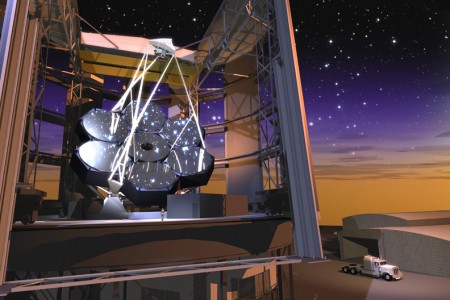
As its name suggests, the TMT will consist of a mirror 30 m in diameter, giving it eight times the collecting area of any current telescope. But unlike conventional telescopes, the size of the mirror means that it will have to be split up into 492 individual hexagonal segments, all packed together into a curved honeycomb arrangement. Furthermore, it will need a complex system to correct for distortion of light in the atmosphere, shining six laser beams onto fixed points in the sky to assess the amount of turbulence.

The $200m donation from the Moore Foundation, which was set up by the co-founder of Intel Corporation and his wife, will be spread over nine years. The cash will be added to gifts from the California Institute of Technology and the University of California, bringing the total funding of the TMT to $300m — enough to allow astronomers to finish developing the telescope and start building it in April 2009. The TMT is expected to be completed in late 2016, although before then the consortium will have to raise the rest of the estimated $700m building costs.

Not alone

In the same year, astronomers might see the completion of a rival giant telescope being developed by eight US institutions and the Australian National University. With an equivalent resolving diameter of 24.5 m, The Giant Magellan Telescope (GMT) may be slightly smaller than the TMT, but it has already selected its construction site in central Chile and is presently polishing the first of its seven petal-like mirrors. Although the GMT is now lagging behind in terms of funding having raised around $35m of its required $550, Wendy Freedman, leader of the GMT board, insists that the GMT project is just as likely to go ahead. “Our partners are also actively engaged in raising significant funding,” she told physicsworld.com. “The Moore gift, and the seriousness with which these big projects are being taken, is exciting for all of astronomy.”

The European Organisation for Astronomical Research in the Southern Hemisphere (ESO) is thinking even bigger. It is expecting to start building a 40-m telescope called the European Extremely Large Telescope (E-ELT) in three years’ time, and has a 60 to 100-m telescope known as the Overwhelmingly Large Telescope (OWL) in the pipeline.

Microscope reveals spins on the move

Researchers in Switzerland have obtained the first direct images of magnetization being transported through a material by the diffusion of nuclear spins. The work was done using a special magnetic resonance imaging (MRI) microscope developed by the team, who claim that their achievement will lead to a better understanding of nuclear spin diffusion – which plays an important role in nuclear magnetic resonance (NMR) studies of large molecules such as proteins and polymers.

Nuclear magnetic resonance works by applying a strong magnetic field to a material, which lines up its nuclear spins. The spins are then knocked out of alignment by applying radio-frequency signals – a process that can deliver a wealth of information about the chemical and structural properties of the material.

Flip-flop transitions

Spin diffusion is a process by which nuclear spins transport magnetization from one region of a solid to another and it plays an important role in how a material responds to NMR. Diffusion occurs through a series of “flip-flop” transitions involving pairs of neighbouring spins — a pair with spins pointing “up” and “down” respectively is transformed into a pair with spins pointing “down” and “up”, for example. These flip-flops tend to even-out imbalances between the numbers of up and down spins in a region of a solid by diffusing excess spins away.

Spin diffusion was discovered nearly 60 years ago and its effects have been used to determine molecular distances in NMR studies of proteins. However, physicists had been unable to actually watch the process occur in space and time. This is because diffusion occurs over distances of only a few hundred nanometres – and until very recently, it was impossible to obtain MRI images at this spatial resolution.

The magnetic resonance force microscope allows us to image the magnetization distribution at length scales small enough to directly visualize the spin-diffusion process

Now, Kai Eberhardt and Beat Meier at ETH Zurich, along with their colleagues at EPFL in Lausanne have used a relatively new technique called magnetic resonance force microscopy (MRFM) to see spin diffusion for the first time (Phys. Rev. Lett. 99 227603 ). The team mounted their sample – a calcium fluoride crystal 25 micrometres across – on a tiny cantilever. The sample and cantilever are placed in a 6 Tesla magnetic field near to an iron tip, which creates a magnetic field gradient in the region of the sample. A coil is also placed near to the sample, which broadcasts a radio signal that causes the cantilever to vibrate.

The magnetic force on the cantilever is determined by how many spin up and spin down nuclei are in the sample. By carefully monitoring the motion of the cantilever as it vibrates back and forth through the magnetic field gradient, changes in this force and therefore changes in the directions of spins can be determined. In this way, the team are able to measure the magnetization of the fluorine nuclei in the sample at nanometre distances.

To do this, Meier and his colleagues first magnetized the sample and then allowed spin diffusion to evolve and propagate through the system. MFRM was then used to obtain 1D images of the changing magnetization at regular time intervals. From these images, the team was able to calculate the spin diffusion rate for calcium fluoride – which was in agreement with values previously measured using different techniques.

Better understanding

“The magnetic resonance force microscope allows us to image the magnetization distribution at length scales small enough to directly visualize the spin-diffusion process,” Meier told physicsworld.com. “This will let us study this fundamental process directly and understand it better.”

A better understanding of spin diffusion could lead to improvements in the way that NMR is used to study the structure of proteins and polymers. The ability to measure the movement of spin on the nanometre scale could also help in the development of tiny “spintronic” devices that use both the spin and charge of the electron to store and process information. Eberhardt told physicsworld.com that the team are now working on a way to obtain 3D images of spin diffusion in materials – something that would allow the technique to be used to study spintronic systems.

US centre tackles the big questions

George Smoot, who shared the 2006 Nobel Prize for Physics, has donated the majority of his winnings to help set up a new centre that will seek to explain the mysteries of the cosmos. The $8.1m Berkeley Center for Cosmological Physics will draw together some 50 scientists as well as 20 post-doctoral researchers and PhD students from the University of California in Berkeley and the Lawrence Berkeley National Laboratory in the US.

Smoot, 62, who is based at the University of California, was awarded last year’s Nobel Prize with colleague John Mather for the discovery of anisotropies in the cosmic microwave background radiation. But recent declines in science funding have prompted him to part with $500,000 of his $700,000 prize money so that the “next generation” of cosmologists have the facilities to make their breakthroughs. “It seemed to me that the winnings could be matched by others and make a significant difference in many young people’s lives, allowing them to go forward with their education and careers,” Smoot told physicsworld.com. He added that he did consider using the money to pay off his mortgage, but didn’t think the ensuing security would really change his life.

The other endowments include $1.5m from the Gordon and Betty Moore Foundation and $600,000 from Saul Perlmutter, based at the Lawrence Berkeley lab, who shared this year’s Gruber Cosmology Prize with Brian Schmidt for discovering that the expansion of the universe is accelerating. These funds will be used to hire post-doctoral fellows and visitors, support students and the faculty, and run educational outreach programmes such as lectures and workshops.

The centre will occupy the same space as the University of California’s Center for Theoretical Physics on the top floor of LeConte Hall, where Robert Oppenheimer and Edward Teller once had offices. Currently there are numerous cosmologists strewn between the astronomy and physics departments of the University of California and the Lawrence Berkeley lab. “The centre brings all of these people in a way that will generate new ideas, lead to more collaborations and ideally spawn new experimental tests of cosmological theories,” said Bob Sanders, manager of science communications at the University of California.

Tiny sphere detects bacteria

A team of physicists and chemists in the US has used a tiny rotating sphere to detect individual bacterium. The researchers claim that the technique could be used for a range of applications including defending against biological attacks and reducing the time it takes to develop new antibiotics.

The creation of biological sensors for the detection of bacteria and other dangerous micro-organisms is making it easier for doctors to diagnose some diseases. While micro-electromechanical systems (MEMS) have been developed to detect bacteria, they rely on bacteria sticking to tiny vibrating cantilevers and changing the frequency of oscillation. However, these techniques are very difficult to implement in liquids – a more natural environment for most bacteria – because any viscous fluid will dampen the vibrations, which greatly reduces the sensitivity of these techniques.

Now physicists Brandon McNaughton, Raoul Kopelman and colleagues at the University of Michigan have develeoped a new detection technique that can detect bacteria in a liquid. The device uses a 2-µm diameter magnetic sphere that is rotated in a liquid by an external magnetic field. The sphere is coated with antibodies that grab hold of certain bacteria.

Asynchronous rotation

If the sphere is spun fast enough, it is no longer synchronized with the rotation of the external field. This “asynchronous rotation rate” is highly sensitive to small changes in the drag of the surrounding fluid. When a bacteria attaches to the sphere, the rotation slows down significantly – something that can be observed using standard optical microscopy techniques (Appl. Phys. Lett. 91 224105).

According to McNaughton the sensor can also determine when subsequent bacteria stick to the sphere by measuring step shifts in the sensor’s rotational frequency. It can even tell if an attached bacterium changes in size. The team used its technique to detect the common bacterium E. Coli but according to McNaughton, the method could be adapted for other bacteria.

“This detection aspect can be used for bio-defence applications, where rapid and sensitive techniques are needed,” said McNaughton. “There are also potential applications for detecting bacteria in water and food. However, our main focus has been to identify bacterial strains (like “superbugs”) and determine the strain’s susceptibility to antibiotics.” The researchers say they are also working on monitoring bacterial growth.

The team are building a stand-alone prototype device that can both detect bacteria and measure growth responses to antibiotics. “The prototype will hopefully have a test turn-around-time of hours, instead of the current waiting time of days.” The team has applied for a patent on the technology.

Mission illuminates solar mysteries

An unmanned space craft has shed new light on one of our Sun’s enduring mysteries: why its outer atmosphere – or corona – is much hotter than the surface of the star itself. The first results from Japan’s Hinode mission point to a special kind of magnetic wave as the main mechanism in heating the corona. Data from Hinode show that the corona is swarming with these “Alfvén waves”, which could also be responsible for the solar wind – the origin of which has been another long-standing mystery.

The corona is a region of ionized gas – or plasma – that extends millions of kilometres from the surface of the Sun. Physicists have known for nearly 70 years that it has a temperature of several million Kelvin, while the solar surface is a relatively mild 6000 K.

Although there is no shortage of energy in the solar interior to heat the corona to such high temperatures – only about 0.01% of the total solar output is needed – the mechanism by which energy is transferred from the interior of Sun and to the corona has eluded physicists. A related mystery is the origin of the solar wind, which is a stream of charged particles that flows at very high velocity out of the open parts of the corona into interplanetary space. One of the prime candidates for coronal heating and the solar wind are Alfvén waves – torsional transverse magnetic oscillations that are believed to propagate at very high speeds along the magnetic field lines that run out of the surface of the Sun and into the corona. However, these waves have proved very difficult to see.

Now, in this week’s issue of Science, Bart De Pontieu of the Lockheed Martin Solar and Astrophysics Laboratory in Palo Alto, California, and colleagues in the US, Norway and Japan have shown that the surface of the Sun is apparently swarming with Alfvén waves, making it even more likely that they are responsible for heating the corona. Using data acquired by Hinode’s Solar Optical Telescope (SOT), they also concluded that Alfvén waves are responsible for accelerating the solar wind to hundreds of kilometres per second.

Wiggling spicules

The team focussed the SOT on the Sun’s chromosphere – the relatively thin region between the surface and the corona — where they observed thin, short-lived jets of hot gas, known as “spicules”, that shoot out of the chromosphere and into the corona at over 100,000 km/h. “Our observations show that many of these jets wiggle sideways while they form”, De Pontieu told physicsworld.com. According to De Pontieu, these wiggles are caused by the transverse motion of the magnetic field – which occurs in Alfvén waves.

The team came to this conclusion by performing advanced computer simulations of the surface and atmosphere of the Sun, which produced waves similar to those that were wiggling the spicules. By comparing the simulations to the Hinode observations the team were able to conclude that the waves were Alfvén waves.

De Pontieu and colleagues were also able to make direct observations of the amplitudes of the Alfvén waves. Then by using computer simulations of how this wave energy leaks into the corona, they concluded that it is sufficient to power the solar wind.

The team is less sure whether the Alfvén waves are sufficient to heat the corona to its very high temperature because, according to De Pontieu, their current models of process are not sufficiently detailed to allow them to draw this conclusion.

Polar prominences

In the same issue of Science, Takenori Okamoto of Japan’s National Astronomical Observatory and colleagues in Japan and the US report the first ever evidence for Alfvén waves in solar prominences – large structures of relatively cool plasma that form in the corona. These prominences were known to contain thread-like features that support the continuous flow of material. Using the SOT, Takenori and colleagues were able to observe oscillations in these threads and conclude that they are consistent with Alfvén waves propagating along the threads. The team also concluded that such Alfvén waves could be responsible for heating the corona.

Meanwhile, Jonathan Cirtain of the Harvard-Smithsonian Center for Astrophysics and colleagues in the US and Japan have published the first evidence of Alfvén waves in X-ray jets — fast-moving eruptions of hot plasma that occur near the solar poles. The team studied thousand of jets and found that many of them moved at about 3 million km/h – which is the speed at which Alfvén waves are believed to propagate. The team concludes from this that Alfvén waves are responsible for high-speed elements of the solar wind.

Robertus Erdélyi of the UK’s University of Sheffield told physicsworld.com that the Alfvén waves seen by De Pontieu and colleagues are important because they are a very plausible mechanism for transferring huge amounts of energy into the corona. However, Erdélyi cautions that Hinode is only capable of gathering 2D images of the corona, whereas proving that the oscillations are Alfvén waves – rather than other magnetic waves called “kink” waves – requires either 3D images or spectroscopic observations are needed. He therefore believes that the results need to be verified using, for example, using data from NASA’s STEREO mission, which involves two spacecraft that work together to obtain 3D images of the sun.

‘Dark stars’ may have populated early universe

Annihilation of dark matter may have prevented fusion igniting the first stars, leaving them as huge orbs of faintly glowing hydrogen and helium, claim physicists in the US. Such “dark stars”, which have not yet been observed, could explain why black holes formed so quickly after the Big Bang — although their existence could force physicists to rethink how the early universe evolved.

Dark matter was originally put forward to explain how galaxies manage to hold themselves together, given that they appear to have just a small fraction of the mass needed to produce enough attractive gravity. Although no-one knows what dark matter is, cosmologists think it also played a big role in the early universe, helping hydrogen and helium atoms to clump together until they were dense enough to begin fusing and form the first stars.

Now, Paolo Gondolo from the University of Utah, together with colleagues from elsewhere in the US, says that interactions within dark matter itself could have hindered star formation. The researchers modelled star formation involving the neutralino, a particle predicted by the popular “supersymmetric” extension to the Standard Model of particle physics and a favoured candidate to comprise dark matter.

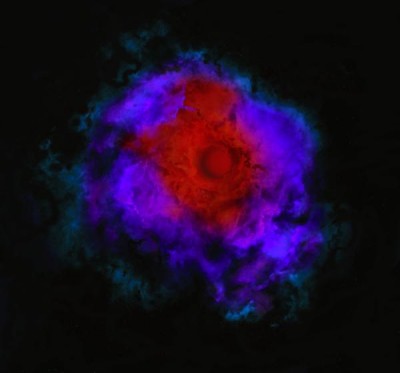
Neutralinos are believed to annihilate occasionally and produce heat, but Gondolo’s group has calculated that a primordial clump of hydrogen and helium would trap this heat in its core, keeping the clump from compacting and thus stemming fusion. The resultant dark star could grow up to 2,000 AU in diameter — 200,000 times that of our Sun — while glowing with infrared radiation (Phys. Rev. Lett. in publication; preprint available at arXiv:0709.2369).

Clumping matter

The researchers began modelling the star formation with an existing simulation of how hydrogen and helium gas contract into clumps, supplementing it with a new simulation of how neutralino dark matter contracts under the gas’s gravitational pull. They then calculated how the heat produced by neutralino annihilation would balance with the heat lost through cooling, and found there was a critical density beyond which the cooling is outweighed by the heating.

Gondolo’s group are not sure how long a dark star produced by this mechanism would last, because even if the dark matter is depleted by annihilation it could be replenished again. Even so, the existence of dark stars could have several consequences. They could explain why supermassive black holes, which are thought to be produced over billions of years in star clusters, appear to have been present a few hundred million years after the Big Bang. A dark star might attract enough surrounding gas so that inward pressure gets greater and greater, until it is finally overwhelmed and collapses into one of these black holes.

Unfortunately, dark stars might also spoil cosmologist’s understanding of reionization, when ultraviolet photons from the first stars stripped electrons from neutral hydrogen. If some or all of these first stars were dark, the source of the reionization would have to come from somewhere else. Moreover, lacking fusion, dark stars would not be able to generate the elements heavier than hydrogen and helium we see today.

Gamma ray evidence

In principle, dark stars could be detected by looking for the signature by-products of annihilation, such as gamma rays, which do not normally come from regions of hydrogen and helium gas. But even though observational evidence is currently lacking, Tom Theuns, a computational cosmologist from the University of Durham in the UK, told physicsworld.com that he thought the idea of having very different first stars is interesting. “But how this affects other things, for example the amount of metals these stars produce, their supernova or gamma-ray burst properties, [or] how this affects later generations of star formation…these issues need still to be worked out,” he added.

Tuneable gap semiconductor is a first

An international team of physicists has created the first semiconductor material in which the width of the energy gap between the valence and conduction bands can be changed by simply applying an external voltage.

The material is a “graphene bilayer”, which is made of carbon and is only two atomic layers thick. The team claims that the semiconductor could be used to make transistors, lasers and other devices with properties could be much more easily tuned than devices based on traditional semiconductors such as silicon.

Semiconductors are useful because they can be used to switch electrical currents on and off. This is done by applying a small voltage to the semiconductor, which promotes electrons across the energy gap between the valence and conduction bands. However the width of this gap – and hence the switching voltage – is an intrinsic property of the semiconductor and can only be changed my modifying its chemistry, structure or both.

A semiconductor with a “tuneable” gap that can be changed externally – by applying a voltage, for example – could lead to new types of electronic devices, notably lasers where the wavelength of the light could be dialled-up with great precision.

Gapless semiconductor

Now, however, Antonio Castro Neto of Boston University, along with colleagues in the US, Portugal, Spain and the UK, have been able to make a tuneable semiconductor from graphene (Phys Rev Lett 99 216802). This material, which consists of a thin sheet of carbon just one atom thick, normally has no gap between its valence and conduction bands. But by placing two layers of the graphene on top of each other to create a bilayer, an energy gap is created if the material is placed between positive and negative electrodes.

According to a theory developed by the team, the gap arises because the transverse voltage causes an excess of negatively charged electrons in one layer and an excess of positively charged “holes” in the other layer. These electrons and holes are believed to pair up to create quasiparticles, which behave differently than their constituent particles.

A peculiar feature of electrons and holes in graphene is that they move through the material as if they have no rest mass – something that makes the material a very good conductor. However, the quasiparticles have a rest mass and according to Castro Neto, this mass leads to an energy gap that must be overcome before current can flow.

The team measured the quasiparticle mass in a graphene bilayer ribbon that was about one micrometre wide and several micrometres long. The graphene was mounted on an oxidized silicon wafer and a voltage was applied between the silicon and an electrode above the graphene.

Cyclotron resonance

A magnetic field was also applied to the bilayer, which caused the quasiparticles to move in circular orbits – an effect called cyclotron resonance. The team measured the period of this resonance, which depends on the mass of the quasiparticles. The team discovered that this cyclotron mass increased as the applied voltage increased from zero to about 100 V, allowing them to conclude that the energy gap was also changing from zero to about 150 meV.

Castro Neto told physicsworld.com that graphene semiconductors could someday be used to make new types of transistors, lasers and molecular sensors in which the energy gap could be changed at will. This property, when combined with graphene’s small size, great mechanical strength and high thermal and electrical conductivity, make it look very attractive as a replacement for traditional semiconductors such as silicon.

Copyright © 2026 by IOP Publishing Ltd and individual contributors