Fifty years after Sputnik

In cosmic terms, half a century is a mere blink of an eyelid. But for humankind, much has happened in the 50 years since Sputnik 1 — the first artificial satellite — was launched by the Soviet Union on 4 October 1957. Despite being little more than a sphere of metal that let out radio-frequency beeps, Sputnik 1 triggered a thrilling space race that rapidly led to astronauts orbiting the Earth and then walking on the Moon before the 1960s were out (see “Sputnik’s legacy”). Since then, spacecraft have visited other planets, flown past comets and even landed on an asteroid.

To mark the 50th anniversary of Sputnik 1, this special issue of Physics World looks back at the story of that particular mission and examines some of the benefits of modern satellite technology. Satellites, of course, underpin communication networks and are essential for observing the Earth to monitor the effects of, say, deforestation or climate change (pp10–11, print edition only). Indeed, the US’s Global Positioning System (GPS) is proving so vital for navigation and surveying that Europe, Russia and China are all planning rival satellite systems (see “Global navigation flies high”).

However, all is not rosy up above. The International Space Station (ISS) has been a successful collaboration between the US, Europe and the Soviet Union, and it is giving us insights into how the human body reacts to long periods in orbit (see “Physics up above”). But the ISS has swallowed such vast sums of money (NASA alone is estimated to have contributed $100bn) that many have questioned if the scientific pay-back from the 200 or so experiments carried out on the station in low-gravity conditions has been sufficient. A lot is resting on the European Space Agency’s Columbus research module, which is set to be deployed later this year.

Another concern is the potential weaponization of space. Satellites are sitting ducks for enemy nations, which might find it tempting to use a missile to knock out, say, a crucial military spy satellite. Moreover, when China destroyed an ageing weather satellite earlier this year in a test of its nascent antisatellite weapon system, the explosion created some 2500 new trackable pieces of “space junk” — and increased the chances of a low-Earth-orbiting satellite colliding with another object by up to 30% (see “Our orbiting junk yard”).

There are estimated to be at least 100,000 objects with a diameter of 1 cm or more orbiting at high speeds around our planet — ranging from spent rocket stages and disused satellites to smaller items like astronauts’ rubbish bags. Scientists have made good progress in developing systems to track and catalogue this debris, but more needs to be done to persuade nations to prevent further space junk being created in the first place.

“Mitigation guidelines” endorsed by the United Nations (UN) earlier this year are the right way forward in this regard by discouraging nations from intentionally destroying satellites and also bringing used satellites safely back to ground. The problem is that the guidelines are entirely voluntary. Now is therefore a good time to update and clarify the UN’s Outer Space Treaty, which came into force 40 years ago this month. Ratified by nearly 100 nations, the treaty forbids nuclear weapons from being placed in space, but says nothing about who, for example, should pay for the financial consequences of a satellite being wilfully destroyed. Revamping the treaty could ensure that we continue to enjoy the benefits of satellite technology for another 50 years.

Next steps for physics graduates

Everyone knows that with a physics degree on your CV the world is your oyster, but this does not mean that deciding what to do next is easy. There are, quite simply, so many options available. One of the first decisions you need to make is whether to continue studying. According to a survey of graduates carried out in 2006 by the Higher Education Careers Service Unit, roughly a quarter of physics graduates in the UK stay in academia after obtaining their first degree, usually to study for a Masters or PhD. This is hardly surprising, given that most people choose to study physics at university out of a desire to learn and explore rather than to get them started along a particular career path.

In the UK, a Masters degree is a one-year course that can be either taught or research-based. Taught Masters involve producing course work, taking exams and writing a dissertation of 10,000–20,000 words on a topic of current interest in your chosen research field, whereas a research Masters is essentially a miniature PhD. Graduates usually opt to do a Masters because they want to broaden their knowledge by studying a new subject area or because they want to pursue a career, for example in medical physics, that requires a Masters-level qualification. These courses can be very intensive because you are studying for just a short period of time.

PhDs are in the main undertaken by those thinking of pursuing an academic or research career — the minimum entry requirement is usually a 2:1 at first degree — but there is nothing wrong with taking this option simply because you want to learn more about a particular subject area, which could be anything from Z-bosons to the physics of protein folding. When you come to apply for jobs, having a PhD will help you stand out in many commercial sectors because it shows you can work independently and can master a topic to a very deep level of understanding. In finance, for example, physicists are often employed as “quants” — specialists in quantitative finance who deal with risk management and financial products such as derivatives and options. Becoming a quant is almost impossible without the mathematical and problem-solving skills that you learn during a PhD.

When choosing a PhD, it is important that you pick a research area that you are passionate about because you will be spending the next three years of your life immersed in your chosen project. It is also important to carefully consider where to study and what the academic environment is like – you will be spending an enormous amount of time there, so you want to make sure that you will fit in and be comfortable. In the UK at least, a PhD need not be an expensive option: taxfree stipends of between £12,000 and £15,000 are available from the research councils. The funding can be even higher if your PhD is cosponsored by a commercial organization.

Getting out of the classroom

If you decide to join the world of work straight after your first degree, however, you will find yourself in a strong position. As a physics graduate you should have no shortage of skills. As well as being highly numerate, analytical and logical, the chances are that you are also a creative thinker, excellent at problem solving and meticulous — skills that are relevant in any work environment.

If you enjoy research but want to leave academia behind, then a large company such as Philips, Qinetiq, Rolls-Royce or Siemens could be a good option. Not only do these firms spend a lot of money on research and development, they also employ large numbers of graduates. With the current focus on climate change and the reduction of carbon emissions, there are also many job opportunities for physicists in the renewable-energy sector, for example with energy companies such as E-ON, and Npower.

Big oil companies like BP, Shell and Schlumberger also have major research and development projects into technologies such as solar cells where physicists have a role to play (see “Striking it lucky in the oil industry” and Physics World October 2005 pp46–47, print edition only). Indeed, the physicist John Browne rose to the position of chief executive of BP until he stepped down earlier this year, while Philip Watts, another physics graduate, was head of Shell from 2001 to 2004. There are also opportunities for physicists in nuclear power, which seems to be undergoing something of a renaissance at the moment (see Physics World April 2006 pp42–43, print edition only).

Beyond the lab

If research is not for you but you still want to remain in touch with the scientific community, then you might want to consider science communication. This is an umbrella term for roles — usually in public relations or journalism — that involve presenting scientific information to a more general audience, be it fellow scientists or the general public. These jobs often require a Masters in science communication, although practical skills gained on university newspapers and magazines are also highly regarded. There are also opportunities in publishing for physicists who want to work as publishers or production editors of scientific journals (see “Publish or be damned”).

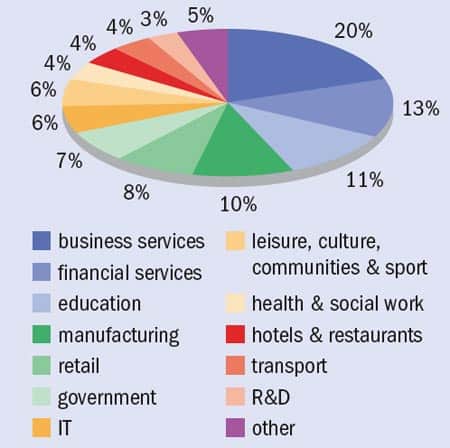
Beyond science, physics graduates tend to steer towards business services (law, accountancy, management consultancy, patent work and so on) as well as financial services, education and manufacturing. Many physicists choose a career in accounting because it offers a professional qualification transferable across any industry or organization. It also allows you to use your numeracy and analytical ability. Most big companies have graduate training programmes that let you study for an appropriate accountancy qualification, while the large accountancy firms like PriceWaterhouseCoopers and KPMG employ hundreds of new graduates each year.

Teaching also provides an opportunity for those with good communication skills to make a real impact. Although becoming a teacher is not for everyone, there are few other jobs where can you have so much influence on development of other people. Getting a complex scientific point across to a group of students can be an incredibly rewarding feeling. Indeed, teaching can be a very creative profession, in which you can continuously improve your lessons with new material and keep up to date with the latest educational techniques. The UK government now provides generous training grants and offers “golden hellos” to teachers in subjects such as physics where there is a shortage of applicants.

A helping hand

These are just a few of the careers available to physics graduates. With the right training you could become anything from an aeronautical engineer to a meteorologist. The hardest thing is deciding what you want to do. Help is available though — a few hours spent browsing the Internet can uncover a wealth of information about the various industries you might want to consider, and websites like Prospects and physicsworld.com are full of job adverts and advice for graduates. Your university careers service will also be able to offer plenty of useful information to help with your job search.

The Institute of Physics also has its own careers service for physicists, which provides one-to-one advice by telephone, e-mail and or in person. You can book a mock interview session with one of the careers advisers and go through your CV or application form. The Institute has also produced a series of guides to help students with issues such as completing application forms, writing the perfect CV, succeeding in interviews and making extracurricular activities work.

A physics degree stands you in good stead, so make sure that you sell it for what it is actually worth. But whatever you decide to do — make your millions, ensure the planet is safer place or to just take a year out — the most important thing is to make sure you enjoy it.

• This year’s Institute of Physics students careers fair is being held in London on 31 October

Box: Finding graduate opportunities

General careers information and job vacancies
physicsworld.com/cws/jobs
www.iop.org/careers
milkround.com
prospects.ac.uk
Masters courses and PhD positions
www.findamasters.com
www.findaphd.com
www.jobs.ac.uk
Other resources
Company websites
Graduate recruitment fairs
Evening presentations by firms on campuses
Newspapers and careers publications

Once a physicist: Ray Bowden


How did your interest in physics develop?

From an early age I had a natural curiosity about the physical world, and this was reinforced by some excellent teaching at my grammar school in south Wales. I remember passing a small iron foundry on the way to and from school in the 1950s and being drawn to its door to watch the pouring of molten iron.

How much did you enjoy your degree?

In 1957 I won a state scholarship and went to study physics at Imperial College London. I enjoyed all the new ideas I was exposed to, but as time went on I found myself increasingly interested in many other subjects. Nevertheless, I went on to Oxford University to do a DPhil on the structure of the carbon nucleus.

Why did you leave physics for the City?

After my DPhil I worked for a year as a reactor physicist with English Electric in Leicester, but I didn’t enjoy the desk-bound existence. I also realized I was not destined to have a glittering career as a physicist. The big change came when I saw an advertisement for an 18-month-long fellowship at Keble College, Oxford, for a scientist who wanted to read a non-scientific subject. My application was successful so I headed back to Oxford to study economics and management. After that finished I decided to spend a year on an aid project in a developing country and an opportunity arose to go to Tanzania. Unfortunately, the scheduled departure was delayed for nine months.

What did you do then?

A panic job search led to interviews with computer companies, an inventor and a stockbroker — the latter of whom gave me a peep into a world I knew absolutely nothing about. That interview went well, and I was offered a job as a trainee investment analyst. The job was fascinating. It involved visiting a whole range of companies and having access to chairmen, chief executives and finance directors, seeing their factories and getting to understand their businesses.

How did your career develop from there?

I made it to Tanzania in 1967, and after a year spent there I returned to the City as a stockbroker. In 1974 I was made a partner and later became head of research, before finally becoming one of the managing partners. After the City “Big Bang” in 1986 (which saw several major changes to the London Stock Exchange, including the introduction of electronic dealing), virtually all stockbroking partnerships were bought by banks and I found myself an employee of NatWest. I decided after a few years that a big bank was not for me and in 1988 I moved to the much smaller investment bank Robert Fleming, from which I retired in 1999.

How did you come to be chairman of The Wine Society?

While I was at university, I discovered a growing enjoyment of wine, and formed a fortunate friendship with a botanist at Oxford (now a distinguished wine-maker in Australia) who was a member of the society. I attended the society’s annual general meeting in 1970 and 1971, and during the latter I rather timidly stood up to make a point. This resulted in an invitation to meet the then chairman, who suggested that I stand for election to the committee. I was duly elected to the committee in 1973, became treasurer in 1976 and chairman in 1992.

How has your physics helped in your career?

The more exposure I have had to the business world, the more I have appreciated the benefits of the analytical disciplines that physics instilled in me. A key skill of an analyst is to ask the right questions, and a key skill of a physicist is to expect the answers, the opinions, and statements of others to be consistent with the available data. These skills also help one to jettison one’s own prejudices and ideas when they do not hold up in the face of the available information. I cherish two quotes. One was in an article about an American chief executive who had on his desk a card saying “In God we trust. All others bring data”. The other is from Professor Sayers of the London School of Economics in 1960: “The decisions of tomorrow are influenced by today’s slipshod history of yesterday.”

Sputnik’s legacy

On 8 December 1957 the International Herald Tribune newspaper ran one of the most memorable headlines in the history of space exploration. The single word “Kaputnik!” emblazoned across the front page captured the national mood of humiliation in the US that had followed the country’s disastrous attempt to launch an artificial satellite into orbit from Cape Canaveral two days earlier. The US Navy’s much-hyped Vanguard rocket had managed to raise itself just a few feet from the Merritt Island launch pad before falling back down and exploding. The satellite it had contained — a hastily put together contraption of wires and circuitry designed only to send a radio signal back to Earth — rolled a few feet across the launch pad beeping forlornly.

The timing could not have been much worse. Two months earlier, on 4 October 1957, the Soviet Union had successfully launched the world’s first artificial satellite — Sputnik 1— into Earth orbit, thus simultaneously proving the superiority of Soviet missile technology and kick-starting the space race. This was the reason for the mood of despondency that took hold of the American people two months later in the face of what would normally be considered a routine hazard of flight-testing.

Today it is impossible to overstate the importance of Sputnik’s legacy. Want to know the geography of your holiday destination? Switch on your computer and a magnificent array of satellite images are yours for the browsing, thanks to Google Earth. Stuck in traffic and want a quick way home? Fire up your in-car satellite-navigation system and a network of global positioning satellites will plot your route (see “Global navigation flies high”). Need to speak to a colleague on the other side of the world in real time? Internet conferencing lets you see and hear them simultaneously.

Every one of the hundreds of satellites that underpin our TV, telephone and Internet services is the direct descendant of Sputnik 1. In addition, we also have Sputnik to thank for humankind’s ventures into our cosmic backyard. The chain of events that Sputnik 1 set in motion fuelled the public and political support necessary to get space exploration off the ground. This support has since taken humans to the Moon, while unmanned vehicles are currently exploring the surface of Mars and even sending back data from Titan, Saturn’s most Earth-like moon.

The stage is set

The story of Sputnik 1 can be traced back to the aftermath of the Second World War. While many of the countries that participated in the war were enduring times of stringency, others — like the US — were entering times of unrivalled prosperity. In the US this was a simple consequence of massive wealth and an industrial base that had recovered from the doomed years of the 1930s depression. The war itself resulted in an enormous injection of capital into industries that made munitions.

Meanwhile, the Soviet Union was undergoing even more radical change. After the war it had claimed huge portions of Eastern Europe, so making its territory even larger than that of the US. The stage was set for a conflict that would be based not on national acquisitiveness, as the First and Second World Wars had been, but on something much more frightening. The Cold War was a battle about ideology, and satellite surveillance was a key weapon.

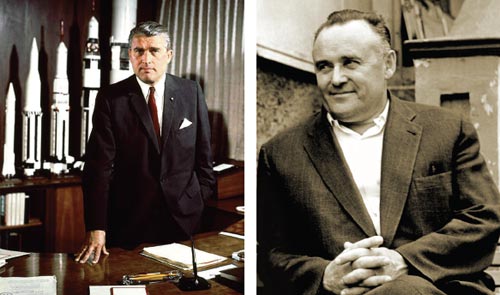
No satellite can make it into orbit without a vehicle to take it there — and in fact, developing a suitable rocket was the most difficult part of getting Sputnik 1 launched. By the end of the Second World War, Germany had developed rocketry to the point where it was routinely raining V-2 missiles on London. Developed under the leadership of the brilliant young engineer Werner Von Braun, these supersonic missiles could cover the distance from northern Germany to Britain in less than six minutes. Londoners wryly commented that you knew you had survived a V-2 attack if you heard the explosion.

The V-2s were fabricated at the Gestapo’s Mittelwerk facility, which was hollowed out of a mountain near Nordhausen in central Germany. The conditions there were horrendous. It was routine to motivate workers by forcing them to watch their compatriots being hanged from the cranes that were used to move rocket components around the giant subterranean factory.

Von Braun himself was a major in the SS (the paramilitary wing of the Nazi Party), but this did not stop the Americans spiriting him out of central Germany via Operation Paperclip in the final days before the Soviet forces overran the area. In late 1945 Von Braun and the bulk of his team were taken — along with many complete V-2 weapons and thousands of components and diagrams — to the White Sands Missile Range rocket development and testing site in New Mexico not far from the “Trinity site”, where the world’s first atomic bomb had been detonated a few months before.

When the Soviets got to Mittelwerk, they found that the area had been almost completely cleared of all evidence of the rocket scientists and their work. The only scientist who had elected to stay was Helmut Gröttrup, yet that single German engineer would turn out to be more than sufficient to revolutionize Soviet missile technology when teamed with one of the most influential rocket scientists of all time: Sergei Korolyov.

Korolyov, like Von Braun, had been fascinated by rockets and the lure of outer space for most of his life. Yet his efforts had not been lauded and supported by a state anxious to capitalize on his work in the way Germany had supported Von Braun. Instead, in the late 1930s Korolyov had been sentenced to penal servitude in the Kolyma uranium mines thanks to the testimony of one of his erstwhile colleagues, the rocket engine specialist Valentin Glushko. Glushko had become a victim of Stalin’s Great Purge of 1938 (in which millions of people who disagreed with Stalin’s style of communism were executed or sent to labour camps) and had denounced Korolyov as an enemy of the Communist Party in order to prove his own loyalty. It was to be 11 years before Korolyov got out of the gulag; when he was eventually released, it was to a world that had changed significantly.

The atomic age

In August 1949 an eye-searing flash of light high over the plains of Kazakhstan announced to the world that the Soviet Union had, like the US four years before, entered the atomic age. The nuclear test, which was the first indication that America’s postwar supremacy was not destined to last for ever, was to have profound and far-reaching consequences for Cold War relations and space exploration. Importantly for Korolyov it also meant that Stalin needed someone to develop the means by which to send nuclear terror over the ocean to his archnemesis — the US.

The US had spent the years following the end of the Second World War capitalizing on the weapons delivery system that had been decisive in their victory over the Axis Powers: the bomber. Stalin and his advisors were well aware of the supremacy of US bomber power and they knew too that the Americans were busy persuading the governments of many countries that bordered — and were hostile to — the Soviet Union to host Soviet-targeted bombers.

The fact that the US was not similarly surrounded by territories on which bombers could be based placed the Soviet Union at a severe tactical disadvantage. There was only one solution: Stalin had to find a way to deliver atomic warheads to the US without the use of bombers. The obvious answer was to use ballistic missiles, and this was the reason for Korolyov’s release from the gulag. The price of his freedom was to work with the man who had been responsible for his incarceration in the first place — Glushko — as well as the ex-Nazi Gröttrup, who was an expert in missile-guidance systems.

Korolyov had his own agenda, however. Despite knowing full well that the main aim of the Soviet rocket programme was to produce missiles that could bring nuclear destruction to the US, he was keen to realize a dream that he had held since childhood: to launch a spacecraft into orbit. It was not until 1956 — after Korolyov had spent seven years developing missiles to carry nuclear warheads — that he was allowed to work on his dream, though.

Meanwhile, on the opposite side of the Atlantic, the Technological Capabilities Panel (TCP) — one of the most secretive committees of President Eisenhower’s administration — had realized that the US needed missiles too, but for reasons other than delivering nuclear warheads. The panel’s purpose was to assess the risks to the US of nuclear annihilation via some form of surprise attack, and it included such luminaries as Edwin Land, the inventor of the Polaroid camera, and Harvard astronomer James Baker. The TCP concluded that the only way of countering the threat of a surprise attack was via the use of superior intelligence, and it recommended that space-based photoreconnaissance platforms be developed — in other words, spy satellites. The panel’s report, which landed on Eisenhower’s desk on St Valentine’s Day 1955, put in motion a sequence of events that had a profound influence on the course of the Cold War.

Eisenhower was nervous about being seen to be exploiting space for military purposes — particularly by the Soviets, whom he wished to avoid antagonizing. As it happened, a small satellite equipped with basic scientific instruments was already scheduled to be put into orbit as part of the International Geophysical Year (IGY) in 1958. Eisenhower wanted to use this probe to establish the important principle of freedom of the skies in an equivalent manner to the freedom of the seas that had been enshrined in maritime law for centuries. This scientific satellite could then, he reasoned, be followed by much larger satellites carrying military cameras.

Propaganda wars

Until 1956 the Soviet government — under Stalin’s successor Nikita Khrushchev — had resisted the idea of launching a satellite because they wanted Korolyov and his staff to focus on missiles. When news of the US’s plan to launch a satellite as part of the IGY reached Moscow, however, the Central Committee of the Communist Party had a change of heart. Once Khrushchev had met Korolyov and been told about the reconnaissance potential of Earth-orbiting satellites, he instructed that the satellite project proceed at full speed — provided that it did not interfere with the intercontinental ballistic-missile programme.

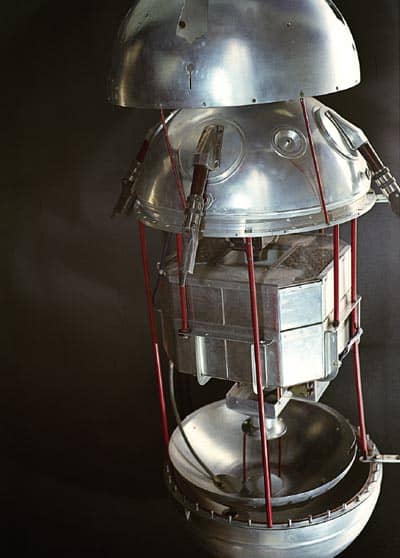
The original Soviet satellite — dubbed simply ObjectD — was planned to be a large device that would carry an array of scientific instruments, the construction of which involved several different institutions. When it finally arrived at the Soviet launch facility at Baikonur, however, Korolyov could see instantly that it would not work. It was too big and complex, and the integration between the various instruments was practically nonexistent. His assistant Mikhail Tikhonravov simplified the design down to an 84 kg sphere approximately 60 cm in diameter, which contained a radio transmitter that broadcast only a beep. Sputnik 1 — which in Russian means simply “fellow traveller of Earth” — was born. Its function was pure propaganda: proving to the world the superiority of Soviet science and technology and unnerving the West, particularly the US.

It succeeded spectacularly well, showing the Americans that the Soviet Union had the ability to launch nuclear weapons at will and that it too had realized the importance of reconnaissance satellites. Sputnik’s launch in late 1957 rattled the Americans so much that the orderly progress planned as part of the run up to their own satellite launch was abandoned. With the Kaputnik fiasco, which saw the US’s hastily prepared satellite crash back to Earth before it had barely got off the ground, taking place just two months later, the national gloom showed no sign of lifting.

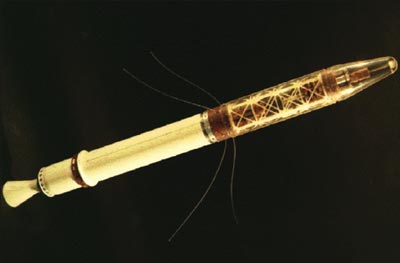
The disaster did have a positive result, however: it enabled Von Braun to persuade the US government to use his own rocket design to launch the IGY satellite. The Juno-1 was a more powerful version of a highly successful rocket that Von Braun had designed based on the original V-2. On 31 January 1958 it successfully fired the satellite Explorer 1 — which was equipped with a radiation detector designed by astrophysicist James Van Allen of the University of Iowa — into orbit. Within days Explorer 1 had confirmed the existence of the belt of intense radiation that bears Van Allen’s name to this day.

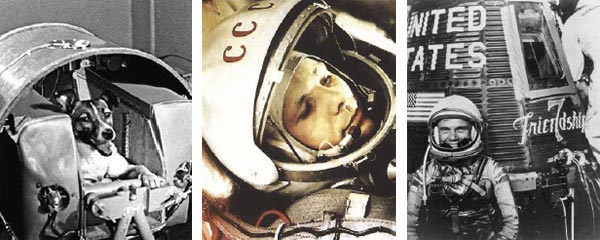
Despite the success of Von Braun and Van Allen’s creation, there was no longer time nor appetite for complacency in the US missile programme. On 3 November 1957 the Soviets had pulled off another coup with the launch of the first animal — a dog named Laika — into Earth orbit. This prompted an emergency meeting of US government, military and aircraft-industry leaders that was held in Los Angeles in March 1958 to conclude that it was essential to put a man into orbit ahead of the Soviets. Because of the perceived urgency, emphasis shifted away from the highly successful rocket-plane testing that had been going on for years at Edwards Air Force Base in the Mojave desert with the aim of developing a reusable spacecraft. Instead, the focus turned to using a missile-mounted capsule to place a man in orbit.

The idea was somewhat unfortunately named MISS (Man in Space Soonest) and it was afforded the highest national priority by the US government. Responsibility for the project was given to the National Advisory Committee on Astronautics, which on 29 July 1958 was converted — along with other military units — into NASA. MISS was subsequently re-named Project Mercury.

By then the US government was in uproar. Lyndon Johnson, the Senate majority leader, said that whoever controlled “the high ground” of space would control the world and that he for one “did not intend to go to bed by the light of a Communist Moon”. John F Kennedy invented the phrase “missile gap” to describe the perceived disparity between the number and power of the weapons in the Soviet Union and the US, and used it as a stick with which to beat the Republicans in the run-up to the 1960 presidential elections. A longerterm consequence of the furore was that the US educational system was overhauled to place more emphasis on basic science and engineering in order to provide better competition for Soviet scientists.

It was all to no avail, however, because on 12 April 1961 the Soviet Union put a cosmonaut named Yuri Gagarin into orbit aboard the Vostock 1 spacecraft. This resulted in more national humiliation for the Americans, who on 5 May launched Alan Shepherd on a suborbital lob lasting only 15 minutes. It would not be until February 1962 that the US finally launched John Glenn into full Earth orbit in a Mercury capsule using the more powerful Atlas rocket designed by the US Air Force.

One small step…

Gagarin’s flight had sealed the US’s — and indeed the world’s — commitment to space. On 25 May 1961, just one month later, President Kennedy made his famous announcement to Congress: “I believe that this nation should commit itself to achieving the goal, before this decade is out, of landing a man on the Moon and returning him safely to the Earth.” He was asking for the money to start the Apollo programme, which at its peak cost a staggering 50 cents a week for every man, woman and child in the US.

Today the legacy of the launch of Sputnik 1 is there for all to see. As Kennedy had promised, on 29 July 1969 US astronauts Neil Armstrong and Buzz Aldrin walked on the Moon’s ancient, cratered surface, claiming space for the purposes of peace. Despite the Challenger and Columbia disasters in 1986 and 2003, respectively, the Space Shuttle programme that succeeded Apollo did more than anything else to tame near-Earth space. Further afield, the exploration of the deeper solar system has also been a staggering success. Right now NASA’s two Mars Exploration Rovers — Spirit and Opportunity — are still trundling around the red planet after more than a year, despite a design lifetime of only 90 days (see “Rovers display spirit of discovery”). Together with the European Space Agency’s Mars Express and NASA’s Mars Reconnaissance Orbiter, they will help to turn Mars into a place that humans can understand and perhaps, one day, visit and ultimately colonize.

Further out into the solar system, NASA’s Galileo probe has vastly expanded our understanding of Jupiter and its moons. And in one of the greatest achievements in space science to date, in 2005 the Huygens probe landed on the surface of Saturn’s moon Titan in the most distant controlled landing ever conducted. Titan had been a target of interest almost since the time of Sputnik because it was known to have a chemical composition very similar to that of the Earth when it was young. Thanks to Huygens, which was delivered by NASA’s Cassini probe, we are now investigating Titan’s chemistry first hand (see “Tuning in to Titan”).

Finally, two of the most venerable heirs to the legacy of Sputnik are now at the edge of the solar system. Voyagers 1 and 2 are still going strong despite the fact that their aging nuclear generators are now running out of fuel. Attached to each spacecraft are the famous golden records that include representative sounds of our planet, a description of our basic science and our position relative to several pulsars, thus enabling us to be located easily. They are our species’ big “hello” to an indifferent cosmos — an optimistic legacy for a technology born out of a culture of suspicion and fear.

At a Glance: Sputnik and the space race

  • The first satellite, Sputnik 1, was launched by the Soviet Union on 4 October 1957 and consisted of a simple metal sphere equipped only with a radio transmitter
  • Much of the rocket science used to put Sputnik and the other early space capsules into orbit was developed in Germany during the Second World War
  • Sputnik 1 kicked off a period of rapid development of space technology as the US and the Soviet Union competed to demonstrate their technological and military prowess during the Cold War
  • Today satellites underpin numerous technologies, including navigation systems, TV, telephony and the Internet
  • The commitment to space that resulted from Sputnik’s launch has enabled us to explore far out into the solar system, with unmanned probes having so far visited Mars, Jupiter, Saturn and the edge of the solar system

More about: Sputnik and the space race

W E Burrows 1999 This New Ocean: The Story of the First Space Age (Modern Library, New York)
D Cadbury 2006 Space Race (Harper Collins, London)
P Dickinson 2001 Sputnik: The Shock of the Century (Walker and Company, New York)
H Gavaghan 1997 Something New Under the Sun: Satellites and the Beginning of the Space Race (Springer, New York)
T Wolfe 1991 The Right Stuff (Picador, London)
www.space50.org.uk


A faster way to better quantum computers

Quantum computers exploit the fact that a quantum system can be in a superposition of two states, say 1 and 0, at the same time. N such quantum bits (qubits) could be combined or “entangled” to represent 2N values simultaneously, which could lead to the parallel processing of information on a massive scale. However, qubits are very fragile and any residual noise – which is present in any practical quantum computer — can degrade the quantum nature of the qubits. This process is called decoherence, and if left unchecked, will prevent a quantum computer from working.

Fortunately, decoherence can be kept at an acceptable level using “error-correction” schemes that use several noise-prone qubits to perform the role of one noise-free qubit. These schemes require a good understanding of how noise affects the qubits, which depends on the specific design of the computer. A computer using trapped ions as qubits, for example, could be affected very differently by noise than a computer that uses nuclear spins.

The effects of noise can be measured using “quantum process tomography”, which involves measuring the output of a quantum computer for all possible input states. For an N-qubit system this involves 24N measurements. As a result a system with eight qubits would, in principle, require over four billion measurements.

Now, a team at the University of Waterloo led by Joseph Emerson along with David Cory at the Massachusetts Institute of Technology have come up with a new way of looking at decoherence that focuses on a select few noise parameters that most greatly affect the performance of a quantum computer — without having to make large numbers of mostly irrelevant measurements.

When applied to a three-qubit system, the technique involves measuring three probabilities — namely that no qubits; one qubit; and two qubits will fail during a quantum calculation. These values are determined by having the system perform specific sets of operations and watching how it responds. The measurements are repeated several times until the probabilities are obtained to a desired level of uncertainty.

The team applied their technique to an experimental “quantum memory” comprising three nuclear spins as qubits that were controlled using nuclear magnetic resonance. Using their new technique, the team were able to characterize the system in a matter of days – something that would have taken several months to do using quantum process tomography. The team then used the probabilities to develop optimized control techniques for maintaining the quantum nature of the memory.

According to Emerson, the technique can be used on any type of quantum computer and could provide a very efficient way of comparing the performance of different architectures. He also believes that it could help physicists gain a better understanding of the different types of noise that can occur in a quantum computer, leading to better designs. Emerson told physicsweb.org that he is very keen see the technique on an eight-qubit quantum computer based on ion traps that has been built at the University of Innsbruck in Austria.

Microchip ‘bus’ links up quantum bits

The basic unit of information in a quantum computer is the qubit, which can take the value 0, 1 or — unlike a classical bit — a superposition of 0 and 1 together. When many of these qubits are combined or “entangled” together a quantum computer can process them simultaneously, enabling it to work exponentially faster than its classical counterpart for certain operations.

To achieve this entangling feat, quantum computers need to link remote qubits via a bus that can transmit their states to and fro. Although buses have already been created for trapped ions and atoms — two of the many realizations of qubits — a bus for a superconducting qubit had yet to be realized. Superconducting qubits are particularly promising for practical quantum computers because the whole system can potentially be printed onto a circuit in a similar way to those in present-day computers.

Raymond Simmonds and colleagues from the National Institute of Standards and Technology (NIST) have fabricated two superconducting “phase” qubits — each a super-cooled insulating barrier sandwiched by a pair of tiny metal grains — separated by a bus in the form of a cavity that contains a standing wave. They first prepare one of the qubits in the desired 0, 1 or superposition state with a microwave pulse that changes the quantum oscillations of the phase difference between the barrier’s electrodes. The researchers then use an external field to briefly tune the energy difference across the barrier so that the qubit resonates with the cavity and transfers its state to the standing wave, where it can be stored for up to 10 ns. At the other end of the cavity, the same tuning process transfers the state to the other qubit (Nature 449 438).

Meanwhile, Robert Schoelkopf and colleagues from Yale University used microwaves to prepare superconducting “charge” qubits, which are physically similar to phase qubits but have states defined by the number of paired-up electrons that have tunnelled across the barrier. Their cavity has no initial standing wave, instead relying on the electron-pair tunnelling itself to emit a virtual photon into the cavity and create a combined superposition state between the qubits. This is a similar technique to work performed by the Yale group last week, in which they showed that a superconducting qubit could be used as a single photon source (Nature 449 443).

The three operations — information transfer, storage and combined superposition — by the NIST and Yale groups could eventually underlie the gate operations required to perform calculations in a microchip-based quantum computer. However, this will require many superconducting qubits to be linked together, and in a much more reliable way than the current devices.

NASA’s Dawn rises with the Sun

On its five billion kilometre journey, the $267m spacecraft will take data using three instruments: a visible-light camera and two spectrometers for mapping neutrons and visible and infrared light. These will be used to detect surface minerals and catalogue the elements present on Ceres and Vesta.

After being flung around Mars in a “gravitational slingshot”, Dawn should reach Vesta in August 2011. Roughly 500 km in diameter, Vesta is the largest asteroid in the asteroid belt and comprises a rocky core with a surface of solidified lava. Scientists will use data from Dawn to try to understand what caused the giant crater at Vesta’s south pole — an event that reduced the asteroid’s mass by 1%, and could have ejected enough material to form many of the other asteroids in the belt and meteorites found on Earth.

The second rendezvous for Dawn will be in 2015 when it reaches the dwarf planet Ceres. Astronomers believe Ceres has a different structure to Vesta, and could contain ice or even liquid water buried underneath its crust.

The main question for scientists is how these two very different types of bodies could have formed in the same region. When the planets began to emerge some 4.5 billion years ago, rocky planets formed close to the Sun where it was hotter, leaving icy planets to form farther away. Had it not been for Jupiter’s huge gravitational influence, Vesta and Ceres could have gathered enough material for them to become planets in their own right. The Dawn mission hopes to compare the evolutionary path they took, and in doing so throw light on the early Solar System.

It was not an easy journey to the launch pad for Dawn, however. The mission was first cancelled in 2003, but reinstated a year later. Then, in October 2005, NASA was forced to “stand down” Dawn because of cost overruns and a critical fault with its ion engines. In addition, the mission team admitted that there had been a power struggle between scientists working on small-scale missions and the NASA management. It was only after a new management system was introduced that Dawn was put back on track at the end of March this year.

Wolfgang Panofsky: 1919-2007

Wolfgang Panofsky was born into a Jewish family in Berlin on 24 April 1919. At the age of 15, he moved with his family from Germany to the US and graduated from Princeton University in 1938. After receiving a PhD in physics from the California Institute of Technology in 1942, he served as a consultant to the Manhattan atomic-bomb project.

In 1945, Panofsky joined the Radiation Laboratory at the University of California at Berkeley serving first as staff physicist and then as associate professor. In 1951 he moved to Stanford University, where he spent eight years as directory of its High Energy Physics Laboratory. During this time, he and fellow physicist Jack Steinberger were the first to isolate the neutral pi-meson — one of the sub-atomic particles predicted by theorists to account for the strong force binding atomic nuclei.

While at Stanford, Panofsky was also involved in upgrading the university’s “mark III” electron accelerator, which had come on-line in 1951. Although electron-scattering experiments at this machine later led to Robert Hofstadter earning the Nobel Prize for Physics, Panofsky and other physicists at Stanford argued strongly for a much larger and more powerful machine. Those efforts paid off in 1961, when the US Congress authorized construction of SLAC — a two-mile long electron accelerator.

Panofsky was appointed founding director of SLAC — a position he held until he retired in 1984. During this time, he upgraded the lab’s main accelerator and made the case for new high-energy facilities such as the Stanford Positron Electron Accelerating Ring (SPEAR). This machine was used to discover the J/psi particle, which led to physicists realising that quarks are real. SPEAR was also later used as one of the first sources of synchrotron radiation.

Panofsky’s experience in the Manhattan project influenced his thinking on the ethical and social responsibilities of scientists. He played an active role in advising the US government on arms control and international security. He also helped to secure the atmospheric test-ban treaty and in the 1980s spoke out strongly against the “Star Wars” anti-missile programme. In 1989 SLAC set up the Wolfgang Panofsky Fellowship, which supports young scientists who show the “creativity, insight and exceptional achievement” of Panofsky himself.

Quantum spin Hall effect glimpsed in HgTe

Physicists in Germany and the US have seen the first hints of an unusual solid-state phenomenon known as the quantum spin Hall effect (QSHE), in which spin-polarized electrons at the edges of an insulator are able to conduct. The researchers have seen this edge conduction in thin sheets of mercury telluride although they were not actually able to confirm that these edge electrons were spin-polarized. QSHE is interesting because it could be useful for making spintronic devices that exploit both the spin and charge of the electron (Science DOI: 10.1126/science.1148047).

All physicists are familiar with the classic Hall effect, in which electrons moving in a thin sample in the presence of a transverse magnetic field experience a force that pushes them towards one side of the sample. This creates a charge imbalance that leads to a voltage across the material. In 2004, however, physicists obtained the first evidence for the “spin Hall effect”, in which “spin-up” and “spin-down” electrons are deflected to opposite sides of a semiconductor. The resulting spin separation creates a spin current that is prependicular to the direction of the electric current.

The quantum spin Hall effect (QSHE) is a related phenomenon that has been predicted to occur not in conductors, but in certain very thin insulators. It involves spin-up electrons conducting along one edge of the insulator, with spin-down electrons conducting along the other side. Despite being insulators in the bulk, conduction is allowed at the edges because the interaction between the spin and orbital angular momentum of the electrons reduces the energy gap between the valence and conduction bands to zero for spin-polarized electrons.

Last year Shou-Cheng Zhang and colleagues at Stanford University in the US predicted that very thin sheets of mercury telluride (HgTe) should have the right band structure to support edge conduction. Now Zhang has joined forces with Laurens Molenkamp and colleagues at the University of Wuerzburg in Germany to find the first experimental evidence of QSHE in HgTe “quantum wells” — sheets of material a few nanometers thick in which the electrons are confined to two dimensions.

Electrodes were attached to the wells to measure their conductance when cooled to about 30 mK. The same non-zero conductance predicted by Zhang was seen in all wells ranging in thickness from 6.3 to 12 nm. Because the conductance did not increase with well thickness, the researchers concluded that the conduction was occurring along the edges of the well, rather than in the bulk of the material.

However, wells thinner than 6.3 nm behaved like insulators – in agreement with Zhang’s theory, which predicted that very thin wells would not have the appropriate band structure for the QSHE. When the team applied a magnetic field to the thicker wells, the edge conduction vanished – again in agreement with theory.

Despite their success at seeing edge conduction, the team was not able to confirm that the conducting electrons were spin polarized. “There is certainly more work to be done in this direction,” says Charles Kane of the University of Pennsylvania, who has predicted that the QSHE should also occur in very thin sheets of carbon called graphene. “But I don’t think that it detracts from the importance of this experiment”, he added.

Molenkamp told physicsworld.com that the team is now exploring how a SQUID magnetic probe could be integrated within the quantum wells to measure the spin polarization of the edge electrons. And because spin-polarized edge electrons are expected to encounter no electrical resistance, edge-conducting insulators could be used in very low-power spintronic devices that use both the spin and charge of the electron to store and process information.

The magic touch

Most of your research seems to concern the properties of light in unusual materials. Why do you find this interesting?

It’s the analogy between an optical medium and geometry that I find interesting — that a medium can define a space-time geometry in the same way as the gravitational field in general relativity. Some time ago I had to find a subject for a lecture course that would give me some teaching experience. But I had an attack of gout in my foot and couldn’t walk for a week. I spent my time in bed reading The Classical Theory of Fields by Landau and Liftshitz, and it was fascinating. So I thought: this is it, I’m going to lecture on that book. I learned general relativity while giving the lectures, and I simply fell in love with it.

I felt from the start that there must be a connection between light in media and general relativity. But it took me some time to pin it down, to use it to come up with ideas such as making artificial event horizons and unusual geometries for invisibility cloaks.

What can we learn from artificial event horizons?

In a black hole the event horizon — the region beyond which even light cannot escape gravity’s pull — is governed by general relativity and its quantum nature is a matter of speculation. In contrast, my event horizons could be made in analogous systems such as dielectric media, for which the quantum mechanics is well understood. So we can see how the quantum effects of event horizons emerge in an experimental, hands-on physics way.

I started this field of research about nine years ago, and at the moment we are working on experimental projects to make artificial event horizons.

Your research also touches on quantum mechanics in studies of the Casmir effect — for example, you recently showed that it can be used to make objects levitate. Why is this important?

A feature of quantum mechanics is that there is this constant brooding going on in nature — the quantum vacuum. It causes effects that cannot be ignored. Lately there have been fantastic measurements of the Casimir force, which enabled the first real tests of predictions about the quantum vacuum. The fascinating aspect is that these predictions seem to be right on the microscopic scales of the Casimir force but have disagreed with evidence from cosmological scales, where we try to use the quantum vacuum to explain dark energy.

The nimbus of physics as being incomprehensible to the public has partially been an advantage

Of course, you are best known for showing that it is possible to make an object invisible.

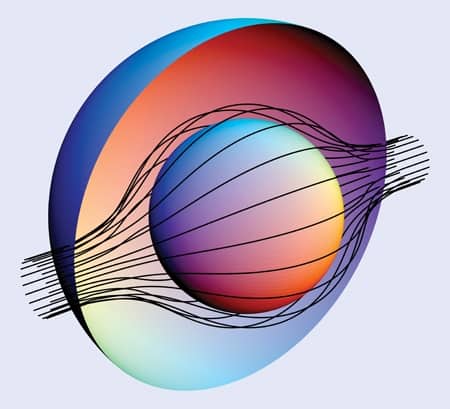
Yes, and this is also to do with the principles of the geometry behind optical media, and ideas of general relativity in optics. Essentially you use a material to change the geometry of space-time to create a hole where you can hide things.

Your paper on invisibility was published in Science at the same time as a paper by John Pendry that also gave a blueprint for an invisibility cloak. Who worked it out first?

It is very difficult to say, because in my case the starting point goes back to summer 2002 when I first had the idea of using media that perform co-ordinate transformations for making things invisible. John applied a similar idea to anisotropic media, such as crystals, whereas I focused on isotropic media, such as glass, where transformations are not enough. I found the missing ingredient in September 2005 during a long flight to Mexico. While chatting to my travel companion, explaining invisibility, I suddenly realized that I needed a “non-transformative component” and then worked out everything in my head. It still took some time until I got my theory published — my paper was rejected by all the major journals, because I was careful in not overselling its prospects and perhaps also because I was an outsider in the metamaterials community.

Invisibility cloak

Up to now we can only make cloaks that make an object invisible to light of one frequency. How far off are we from making an object disappear before our eyes?

Again, this is difficult to say, because it will depend on new ideas. It is clear that the present theoretical ideas we have restrict us to a narrow frequency range. This is because you have to guide electromagnetic radiation around a sample, and therefore the phase velocity of that radiation has to propagate faster than the speed of light so it can catch up with the radiation passing alongside it. For perfect invisibility with no disturbances you need an infinite phase velocity of light, which is achievable with certain exotic materials but restricts the cloak to a very narrow range of frequencies. If you accept that simple errors and finite disturbances will exist, however, then I think it’s conceivable that the frequency restriction is no longer true — it’s just a limit of our imagination.

You once said that non-scientists often perceive physicists as people who can perform miracles. Do you think that’s a healthy impression?

Well, that’s the way it is. The nimbus of physics as being incomprehensible to the public has partially been an advantage. We physicists receive a lot of advance credit. Frequently, the more outlandish and incomprehensible theoretical physics appears to be, the more dimensions it has, etc, the higher its standing is. If you were to explain the tricks, as a magician never would, the public might be disappointed.

In the long run, though, I don’t think it’s healthy — we have a duty to the general public to explain and to inform better about how science actually works. But as long as we get interesting devices or applications then there’s a clear case of money well spent. It’s the other aspect of physics, however — seeking to understand the physical world — which is also a good use of public money. Many people are naturally curious about what is going on in the world around them. Science has surprisingly few answers for the very deep and good questions, but it does have some.

Copyright © 2026 by IOP Publishing Ltd and individual contributors