

Gas-giant chaos will remain a mystery for now

Physicists have known for some time that the motions of Pluto and the inner planets are chaotic. This means that a small external force on a planet could, over time, cause a major change in the position of the planet within its orbit. Although no planets are likely to collide or be ejected from the Solar System anytime soon, the chaos means that the orbits of these planets cannot be forecasted with any long-term reliability.

Whether the orbits of the gas giants are chaotic, however, is less certain — some computer simulations have found chaos while others have not. One cause of this confusion could be “numerical artefacts” — spurious errors that accumulate, for example, when a computer rounds-off the results of successive calculations.

But according to Hayes the discrepancy is actually a result of the uncertainty in astronomers’ knowledge of the current conditions of the planets, which are used as input to the simulations. Although from observations we know the orbital positions of the gas giants to an accuracy of a few parts in 10 million, even that tiny amount of uncertainty can make the difference between regularity and chaos in a system, he says.

Hayes came to his conclusion by performing his own simulations of the Solar System, simplifying the Sun and inner planets as a single mass and calculating the trajectories of the gas giants up to a billion years into the future. To avoid the possibility of numerical artefacts either exacerbating or tempering chaos, he did the calculations using three different integration algorithms.

Hayes found that by starting the simulations at different points within the range of observational uncertainties he could end up with a chaotic progression after times from 2 to 230 million years — or even not at all. This means that we will be unable to determine whether the motions of the gas giants are chaotic until better observations are made, although Hayes told physicsworld.com that he doesn’t know when this will be.

Some physicists think that the existence of chaos in the motion of the gas giants could have an effect on our ability to accurately predict certain properties of the inner planets. One of these is the Earth’s tilt, which has a large impact on climate.
Physicists discover new layer in Earth’s mantle

Lying between 650 and 2800 km beneath the Earth’s surface, the lower mantle makes up over half of the Earth’s volume and is made mostly from compounds containing the elements oxygen, magnesium and silicon. Roughly 5%, however, is iron, contained in compounds such as ferropericlase (an iron-magnesium oxide) and silicate perovskite (an iron-magnesium silicate).

Scientists know that the spin states of iron’s electrons help govern physical properties of the mantle such as its density and the speed with which sound passes through it. Recently theorists have shown that the spins should change gradually from “high” to “low” states as the pressure and temperature increases with depth up to 135 GPa and 4000 K at the bottom of the lower mantle. But now Jung-Fu Lin from Lawrence Livermore National Laboratory and colleagues from other US institutions and the European Synchrotron Radiation Facility in France have shown that the transition is a little more sudden.

Lin’s group subjected ferropericlase to varying pressures in a diamond anvil cell while heating it up with a laser, and charted the spin states using X-ray emission spectroscopy. They found that there is a definite transition region where the spin states swap over, between 1000 and 2200 km in depth. “Our results indicate the occurrence of a new layer that is defined by the spin transition, called the spin transition zone,” said Lin. The researchers think that silicate perovskite — the more prevalent source of iron in the lower mantle — should also exhibit the spin transition zone, although they have not tested it yet.

Single-photon microwave source fits on a chip

Microwave communications systems employing so-called quantum cryptography could someday out-perform conventional secure communications, but not before physicists have a practical means of shuttling quantum bits or “qubits” around on chips similar to the ones in present-day computers. Photons are a good choice to carry qubits, but unless they can be emitted singly and reliably on demand there is risk that someone could intercept a surplus photon to furtively steal information.

One way to get a reliable single photon source is to place an atom — the qubit — inside a tiny cavity and excite it to a higher energy state so that it emits a photon containing the mapped qubit state out of the cavity’s opening. But cavities are generally 3D, which makes them difficult to couple to the nearly-2D wires used in integrated circuits. Now, however, Robert Schoelkopf and colleagues from Yale University have solved the problem by making the cavity itself part of a 2D wire and setting inside a superconducting tunnel junction as the qubit instead of an atom.

The junction comprises two grains of aluminium separated by a small insulating barrier. Quantum mechanics allows paired-up electrons to tunnel through the barrier, which means that — like a real atom — the junction has simple energy levels, in this case corresponding to how many electron pairs are on either side of the barrier. By absorbing a microwave photon, an extra electron pair will tunnel to the other side, equivalent to an atom’s excited state. Likewise, the electron pair can tunnel back to a non-excited state by emitting a photon. This means that the existence of a photon at the other end of the wire tells what state the qubit is in.

Unlike classical bits of information, which must take either the value 0 or 1, qubits can also be in a “superposition” of 0 and 1 at the same time. To make the junction work as a qubit, Schoelkopf and colleagues apply a magnetic field to force the junction into an excited state, a non-excited state, or the superposition of both.

Microwaves are regularly used in classical communication, and Schoelkopf and colleagues’ single photon source is a step towards using microwaves in quantum communication. Currently they can get an efficiency of 38% for generating a photon via an excited state and 12% for a superposition, but Schoelkopf told physicsworld.com that the challenge will be to transfer the information from the photon back to the qubit.

Sticky walls slow mixing

Emmanuelle Gouillart and a team at CEA Saclay, in collaboration with Jean-Luc Thiffeault at Imperial College, began by injecting a small amount of black dye into a cylindrical container of thick, transparent sugar syrup. The syrup was then mixed using a vertical rod moving in a figure-eight pattern while the concentration of the dye was measured using a digital camera. The degree of mixing was quantified in terms of the variation of the concentration of dye throughout the sample – with “grey” fluid being a completely mixed sample.

The experiment revealed that mixing occurred in the central region of the vessel, but the rate of mixing was limited by a very stubborn unmixed region near to the walls (see Mixing bowl ). This appeared to be caused by the syrup sticking to the walls and strips of this unmixed fluid were seen to move slowly from the edges into the centre, where they became mixed.

By studying time-sequences of the images and via numerical simulation, the team concluded that “laminar chaotic mixing” was occurring in the vessel. This is a well-known process by which fluids are mixed together gently without any turbulence.

However, the team was surprised at how slowly the mixing process was progressing. Instead of seeing a rapid exponential decay in the variation of dye concentration in the fluid that is normally expected in chaotic mixing, the team measured a much slower decay that obeyed a power-law. According to Thiffeault, this meant that the mixing was occurring hundreds of times slower than if the exponential decay was occurring.

The team was able to describe this power-law mixing in a theoretical model based on the “baker’s map” — the process by which a baker kneads dough by first stretching it and then folding it together. If this process is repeated, it leads to chaos. The effect of the sticky walls was modelled in terms of a periodic injection of strips, representing unmixed material, into the folds of the baker’s map.

While Thiffeault admits that engineers already have a good practical understanding of mixing, he says that industry could benefit from having a deeper knowledge of the physical processes involved. One field that could benefit from a better understanding of the effects of surfaces on chaotic mixing is microfluidics – which is concerned with the transport and mixing of fluids along very thin channels. The surface to volume ratio of microfluidics vessels is very large and therefore mixing is a great challenge to those designing such devices.

The sides of a vessel will always have some degree of stickiness, so Thiffeault believes that the best way to get rid of unmixed material at the edges is to rotate the vessel or use rod motions containing an extra “twist” to insulate the walls from the mixing region – something that is done in many kitchen mixers. The team are currently doing experiments on such stirring methods.

Electron microscope breaks half-Angstrom barrier

A TEM works by focusing a beam of electrons through a thin sample and capturing the image on a detector on the other side. Such instruments are much better at looking at very tiny objects than an optical microscope because the wavelengths of electrons are much shorter than that of light. A STEM is similar to a TEM except that the electron source can be scanned across the sample, which allows individual atoms to be imaged and identified.

However, even electrons struggle to resolve very small objects and physicists have had great difficulties getting the resolution of electron microscopes below one Angstrom, which is smaller than the distance between individual atoms in a solid. One barrier to sub-Angstrom resolution is spherical aberration, which is the unavoidable blurring of images by the cylindrical lenses used to focus the electrons.

The TEAM instrument is based on FEI’s Titan 80-300 S/TEM microscope, which has been available commercially since 2005. TEAM reached half-Angstrom resolution using new aberration-correction technologies designed by CEOS and built into the microscope’s probe, sample stage and the region between the sample and the electron detector. These technologies were integrated with an aberration correction system that was already used on the electron lenses of the microscope.

The Titan was already the best in the world for TEM, having been able to study samples with a resolution of 0.7 Angstrom. The previous record for a STEM was 0.63 Angstrom set by a competitor’s microscope. While the move to half an Angstrom may not seem like a significant improvement, it had taken the partners in the collaboration three years to get there from 0.7 Angstrom.

According to Dominique Hubert, who is general manager of FEI’s NanoResearch division, reaching 0.5 Angstom was particularly challenging because it was achieved in an instrument that can do both TEM and STEM. This, according to Hubert, required the researchers to overcome significant challenges in designing an instrument that is optimized to perform both types of microscopy.

TEAM was developed in FEI’s research and development lab in Oregon and will be installed later this year at the National Center for Electron Microscopy at Lawrence Berkeley National Laboratory. It could be in use by the third quarter of 2008 to study how atoms combine to form materials and how the growth of crystals and other materials is affected by external factors. Hubert physicsworld.com that technology developed for TEAM will eventually be used in commercial Titan microscopes.

The researchers behind TEAM now want to correct for chromatic aberration, which is caused by electrons of different energies being focused to slightly different points by the microscope.

Experiment finds graphene’s missing pi

Graphene is the darling of nanotechnologists because it is tough, easy to make and a very good conductor of both heat and electricity. The fact that it is one atom thick also makes it an ideal system for exploring the often bizarre properties of “two-dimensional” electrons.

Perhaps the most curious property of graphene is that it appears to behave like both a metal and a semiconductor. If electrodes are placed at either end of a sheet and a gate voltage is applied across the surface, the electrical conductance along the sheet will be different for different values of the gate voltage — just like a semiconductor. But unlike a semiconductor the conductance does not go to zero when the gate voltage drops below a certain value — something that you would expect of a metal. In the past when physicists have tried to measure this minimum conductance, however, they have found that it is a factor of pi (about 3.14) greater than predicted by theory.

While some worried that the theory could be wrong, others began to wonder if the minimum value was also related to the size and shape of the graphene sheet. Now, Chun Ning Lau and colleagues at the University of California at Riverside have showed this to be the case.

The team measured the minimum conductance of 14 different graphene rectangles with widths and lengths in the 300 to 8000 nm range. For samples with lengths smaller than 500 nm, the team discovered that the minimum conductance approached the theoretical value when the width of the rectangle was more than twice its length. However, when the width became any smaller than this, the conductance rose beyond the theoretical value. The team also found that in sheets longer than about 3000 nm, the conductance was always greater than the theoretical value, even when the width was greater than twice the length.

Lau told physicsworld.com that the experiment shows that the theory only applies to very small pieces of graphene, and that the minimum conductance is dependent upon the shape of the sheet.

According to Carlo Beenakker, a theoretical physicist at Leiden University in the Netherlands who studies graphene, Lau’s data agree with theoretical predictions regarding the relationship between conductance and the width and length of the sample. He told physicsworld.com that Lau’s work “closes a chapter on graphene.”

Selene blasts off for the Moon

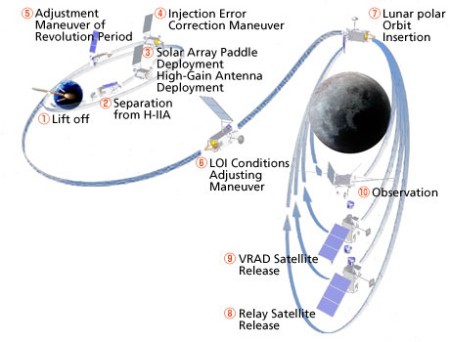
45 minutes after launch, JAXA confirmed that the $484m spacecraft separated from its rocket and then orbited Earth twice before starting its journey to the Moon. Once there, it will separate into a main orbiter, which will observe the Moon from a 100-km circular orbit for one year, and a small “VRAD” satellite that will measure the Moon’s gravitational field from an 800-km elliptical orbit. A third small satellite will assist VRAD’s measurements from a distant 2400-km elliptical orbit and relay data from the main orbiter to Earth.

In total, Selene has 15 different observation missions. These range from recording the different elements and minerals on the Moon’s surface using spectrometers and infrared imagers, to mapping the larger topographical structure using a stereo camera, radar and a laser altimeter. The mission will also investigate environmental properties of the Moon such as its magnetic field, and see how Earth’s ionosphere and magnetosphere look from the Moon’s perspective. Finally, Selene will use a high-definition camera to make a film of the Earth rising from the Moon’s horizon.

JAXA hopes that the spacecraft will put Japan at the front of lunar exploration and possibly even help plan for a manned moon base around 2030. However, the agency will have to shake memories of several failed space missions. Earlier this year JAXA’s Lunar-A spacecraft was scrapped because of worries that an aging mothership would jeopardize the mission. In 2005 the Hayabusa spacecraft, which was designed to fetch rock samples from an asteroid, failed because of thruster problems. Prior to that, JAXA had to destroy a rocket carrying spy satellites when it veered off course after lift-off.

Still, if all goes to plan, Selene will carry out the most wide-ranging study of the moon since NASA’s Apollo programme of the 1960s and 1970s and will keep Japan ahead of China and India, which plan to launch lunar missions over the next year.

Stringy ‘filaments’ could have produced first stars

As yet undiscovered, dark matter is thought to exist because galaxies seem to be held together by the gravitational attraction of much more mass than we can see through telescopes. Dark-matter particles could be “hot”, meaning that they are light and fast, although simulations suggest that hot dark matter would not explain how cosmic structure formed after the Big Bang. Most physicists therefore think “cold” or slower-moving particles are more likely because they do a better job of accounting for the universe’s evolution. But cold dark matter appears to be at odds with the observed densities of certain sub-galactic structures.

In the last few years, however, some researchers have latched onto the possibility of warm dark matter, which would still get the universe’s large-scale evolution right but would agree better with observations of smaller-scale structures. Now Liang Gao from Durham University and Tom Theuns from the University of Antwerp have performed numerical simulations on early star formation that give further credence to warm dark matter.

According to cold dark-matter theory, the first stars formed from “minihalos” inside huge isolated clouds of gas and dark matter — unlike stars in our present era, which form in molecular gases inside galaxies. In Gao and Theuns’s simulation, a generic warm dark-matter particle would change this picture so that the minihalos are replaced with trailing “filaments” of accumulated gas. These filaments would have been massive — about 9,000 light years long or a quarter the size of the Milky Way.

The researchers say that the filaments could well have produced a large number of low-mass stars that could exist to this day, and over time may have collapsed to seed the supermassive black holes that we appear to detect at the centres of most large galaxies.

Matter-antimatter molecule makes its debut

The Standard Model of particle physics says that every particle has an antimatter counterpart – the electron, for example, is paired with the positively charged positron. Although electrons and positrons annihilate each other, they can bind together temporarily to create a positronium atom, which resembles a hydrogen atom. In theory, two positronium atoms could join to form a dipositronium molecule. However, physicists had found it hard to make detectable quantities of dipositronium because it is very difficult to get enough atoms in the same place to react and form molecules.

Now, David Cassidy and Allen Mills of the University of California at Riverside have managed to collect and react enough positronium to confirm that dipositronium exists. The pair used a special positron trap developed by Clifford Surko and colleagues at the University of California at San Diego to collect positrons from the decay of sodium-22.

When about 20 million positrons were accumulated, the contents of the trap were focused onto a small spot on a piece of porous silica. The positrons made their way into the pores, where they reacted with electrons to form positronium. Some of these atoms stick to the surfaces of the silica, where they combine to form dipositronium. The surface plays a crucial role in encouraging the dipositronium to form because it stabilizes the molecules by absorbing energy that is given off when the molecule is formed.

The presence of dipositronium was confirmed by keeping an eye on electron-positron annihilation in the silica. Positronium atoms exist in two different quantum states depending on the relative orientation of the electron and positron spins. The “para” state only lasts about 125 ps before annihilating, while the “ortho” state hangs on for more than 1000-times longer (142 ns) before annihilating. Dipositronium is formed when two ortho atoms come together, but there is nothing to stop the two positrons in the molecule from exchanging their electron partners and creating para atoms. As a result, ortho atoms in molecules don’t last as long as free ortho atoms.

By monitoring the gamma rays that are given off during annihilation, researchers saw a reduction in the overall lifetime of positronium in the silica, which they interpreted as evidence for the formation of dipositronium. According to Cassidy, this was confirmed by heating the silica, which prevents positronium from sticking and reduces the number of dipositronium molecules that can be created. When this was done, the lifetime of the positronium increased.

Cassidy told physicsworld.com that he and Mills are now working on creating a Bose-Einstein condensate (BEC) of positronium, in which all the molecules settle into the same quantum state. Calculations suggest that BEC could be made by boosting the density of positronium by a factor of 1000 and cooling it to about 15 K. Cassidy says that this could be done by accumulating more positrons in the trap and then firing a more intense beam at the silica. Improvements to the silica itself could also help, he says.

If the density were increased by another factor of 1000, the BEC could be used to create an annihilation gamma-ray laser. In such a device the positron/electron pairs could be made to annihilate in a cascade, which would produce a stream of coherent gamma-ray photons resembling laser light. Annihilation gamma rays have a very short wavelength, which means that such a laser could someday be used to study objects as small as atomic nuclei.

Earth could survive a red-giant Sun

When the Sun becomes a red giant it will steadily lose mass and affect the orbits of the planets, making it hard to predict what will happen to them. Scientists think it is likely that Mercury and Venus will evaporate as the Sun’s surface expands outwards, but the fate of Earth is less certain.

A study by Roberto Silvotti from the Astronomical Observatory of Capodimonte in Naples, Italy and colleagues from Europe, the US, Israel and Taiwan suggests that planets orbiting close to a star — within twice the distance from the Sun to Earth, or 2 AU — can survive the red-giant phase. They have analysed observations of V 391 Pegasi, a star that ceased to be a red giant some 100 million years ago when, unusually, it blew away its outer “envelope” of remaining hydrogen. In its current form as a rare “B-type subdwarf” V 391 Pegasi pulsates as it fuses helium into carbon in its core.

Over seven years Silvotti and colleagues monitored the maxima of these pulsations, which occur on average every six minutes, by recording the flux of light coming from the star. But they found that every 3.2 years the maxima are shifted five seconds early or late, indicating that the star must be wobbling as a result of the gravitational pull of a low-mass companion with this orbit period. With 97% certainty, they calculated, this companion is a large planet roughly 10 billion years old — the first known to orbit a post-red-giant star.

The current of orbit of the planet lies at 1.7 AU, but the researchers estimate that before the red-giant phase when the star had more mass the orbit would have been closer, probably around 1 AU. Likewise, Earth’s orbit is expected to increase from 1 AU to roughly 1.5 AU when the Sun eventually sheds mass while turning into a red giant.

Despite the similarities, Silvotti says that the discovery does not necessarily mean that Earth will avoid assimilation like the planet orbiting V 391 Pegasi. But he hopes that the discovery will be the first of many that will enable physicists to more accurately forecast Earth’s fate.

Even if Earth does escape, however, humans will have to invest in some effective Sun protection — the researchers think that V 391 Pegasi’s planet has temperatures in the region of 200°C.

Copyright © 2026 by IOP Publishing Ltd and individual contributors