Thundercloud “accelerator” fires gamma-ray beam

Physicists have known for over a decade that 10 – 20 MeV gamma rays are produced in millisecond bursts during electrical storms. These bursts are believed to occur when high voltages in a thundercloud accelerate electrons to energies up to about 35 MeV. These electrons are slowed down by colliding with atoms in the air and as a result give off bremsstrahlung — gamma rays that are created when an electron is deflected off its course by an atom.

Much longer bursts lasting up to several minutes have also been seen, but these events seem to be much rarer than their shorter counterparts. Physicists have yet to work out where in the sky the longer pulses are coming from – if they are indeed coming from the sky. The energy distribution of the pulses and whether the pulses contain any other types of radiation such as charged particles was also unclear.

Now Harafumi Tsuchiya of the Cosmic Ray Laboratory of Japan’s RIKEN research institute and colleagues have used a new bank of direction-sensitive detectors they installed at a nuclear power plant to detect a 40-s gamma ray burst during a very intense thunderstorm on 6 January, 2007. Their system at the Kashiwazaki-Kariwa plant on the coast of the Sea of Japan was designed to measure the energy distribution, composition and source of thundercloud pulses.

By analysing the energy distribution of the pulse, the team was able to say that the pulse was made of bremsstrahlung gamma rays. The directionality of their detectors allowed the team to confirm that the pulse came from the storm and because such gamma rays can only travel short distances in the atmosphere, the team could also conclude that the pulse was created a kilometre or less from the detectors.

Since the gamma rays arrived about a minute before the first lightning strike, Tsuchiya believes that the pulse was probably created while electrical energy was building up in the thundercloud, rather than when energy is being discharged as lightning. He adds that the process is likely to begin with a cosmic ray passing through the cloud and ionizing the air to produce electrons, which are accelerated to towards the bottom of the cloud, which has a positive charge. These electrons ionize other atoms on the way, creating a stream of high-energy electrons.

Tsuchiya says that bremsstrahlung at MeV energies would be focused into a beam that only illuminates a small area on the ground, which could explain why so few long-duration pulses have been seen. The team plan to verify this by placing many radiation detectors over a wider area.

David Smith, a physicist at the University of California at Santa Clara and an expert on atmospheric gamma ray pulses, agrees that the pulse was made in a thundercloud accelerator. “The spectrum looks just right for bremsstrahlung”, he says. According to Smith, the millions of volts required to produce MeV electrons could be sustained in a cloud for seconds or even minutes as long as the stream of electrons does not become so intense that it causes an avalanche-like electric breakdown of the type that could lead to lightning. Smith is now designing an airborne experiment to test whether lightning flashes are preceded by gamma-ray pulses.

Lensless X-ray microscope fits in the lab

X-rays are desirable for microscopy because their short wavelength enables high-resolution images, but unlike electron microscopes they can be used on thick samples. Unfortunately lenses for X-rays are tricky to make, and as a result there has been a lot of research into creating lensless microscopes, which use a computer algorithm to generate images from a sample’s diffraction patterns. However, these microscopes rely on coherent X-rays, which normally are only obtainable from large accelerator facilities such as free-electron lasers.

Now Henry Kapteyn, Margaret Murnane and others from the University of Colorado, together with colleagues from the University of California in Los Angeles and Lawrence Berkeley National Laboratory, have shown that lensless X-ray imaging can be done in the lab using a process called high-harmonic generation. This makes use of a compact source that can produce coherent light, but with a longer wavelength than the desired X-rays. The light is shone into a gas-filled tube where atoms absorb bunches of photons, and then spit out single X-ray photons with a much shorter wavelength.

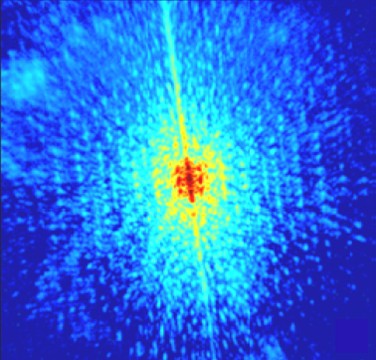
The group used an infrared laser with a wavelength of 780 nm as the light source, and after high-harmonic generation ended up with a coherent X-ray source with a wavelength of 29 nm. They found that these “soft” X-rays could image objects with a resolution of 214 nm. This is not quite as fine as the 62 nm resolution recently demonstrated at the large FLASH free-electron laser in Hamburg, Germany, but that fact that the imaging can be performed in any lab could make lensless X-ray microscopy feasible for many researchers. Richard Sandberg, one of the researchers, told physicsworld.com that his group are currently improving their device to have a higher spatial resolution.

Ideal materials make for perfect invisibility

First proposed theoretically in May last year and realized for microwaves five months later, the invisibility cloak has captured the imagination of the public and defence agencies alike. The idea is that metamaterials — artificial materials with exotic electromagnetic properties — can be designed to guide radiation around an object, like water flowing around a smooth stone.

A perfect cloak would need to make the light passing through its interior catch up with the light passing around it to prevent any scattering. Physicists think the only way to do this would be to make the phase velocity of light on the inner lining infinite by using a metamaterial with infinite values of permittivity and permeability, which is impossible. Still, because it is difficult to deal with infinite values numerically, there has been uncertainty over whether a metamaterial with even these ideal parameters would be able to render an object perfectly invisible, and hence how much of a deviation from the ideal parameters would be acceptable in a real device.

Min Qiu and co-workers from the Royal Institute of Technology have got around this problem using an analytical approach. They began by considering a cylindrical cloak, and examined the equations that relate the electric field of the light to the radius of the metamaterial layer. To prevent infinite values occurring at the innermost layer, they added a small perturbation to this radius, but then calculated what happened when they shrunk this perturbation closer to zero.

The team found that the light’s scattering did gradually disappear as the perturbation was reduced. However, they also found that just a tiny perturbation — for example 10-99 of the inner radius — would still produce significant scattering. To an observer, claims Qiu, this scattering would appear as a thin line at the centre of the cloak that would gradually become more blurred as the perturbation was increased.

Ulf Leonhardt — one of the physicists who came up with the proposal for invisibility cloaks last year — told physicsworld.com that he thinks the theoretical sensitivity to perturbations is very interesting. But he pointed out that the experimental device demonstrated last year by researchers at Duke University in the US worked very well, suggesting that the sensitivity might not be that important in real devices.

Sound causes colossal drop in resistance

Physicists know that the electrical resistance of certain manganese oxides called manganites can drop by as much as ten orders of magnitude when the materials are exposed to a magnetic field. While a full explanation of why this colossal magnetoresistance (CMR) occurs has evaded researchers, physicists have suspected for some time that it is related to interactions between electrons and phonons.

Now, an international team led by Andrea Cavalleri at Oxford University has performed an experiment that provides further insight into the role of phonons in CMR. The team fired a short terahertz (THz) laser pulse at a manganite sample while monitoring its electrical resistance by measuring the current flowing through it. When the energy of the laser is tuned to a specific phonon frequency, the resistance of sample drops dramatically for about 5 ns before returning to its original value.

According to Cavalleri, the pulse – which is about 300 fs in duration — is long enough to create phonons at a specific frequency (about 17 THz). However, it is short enough to avoid exciting electrons and other phonons at other frequencies. This allowed the team to conclude that the drop in resistance was caused exclusively by interactions between 17 THz phonons and electrons in their equilibrium state. The pulse was also short enough to ensure that the electrons did not heat up, which means that CMR does not necessarily require the electrons to be “hot”.

By exciting only 17 THz phonons and not heating the sample the team has managed to avoid the “chicken and egg” problem, which normally makes it very difficult to study materials such as manganite. In such materials the electrons interact with each other via phonons and if an experiment excites both the electrons and phonons it can be impossible to determine, for example, what is a cause of CMR and what is an effect of CMR.

The “chicken and egg” problem also affects those studying cuprate high-temperature superconductors and Cavalleri and colleagues now plan to use the technique to gain a better understanding of the role of electron-phonon interactions in these materials.

Cavalleri told physicsworld.com that there could be practical applications for colossal phonoresistance – particularly because it works at room temperature. It could be used, for example, to make THz radiation detectors and other THz optoelectronic devices. He also believes that the technique could be used to change the magnetic properties of certain materials using a THz laser pulse.

Single-atom entanglement goes further

Unlike classical bits of information, which must take either the value 0 or 1, quantum bits or “qubits” can assume a mixed-up superposition of the values 0 and 1. Furthermore, two qubits can be entangled so that the value of one qubit is revealed by measuring the value of the other. Although these odd properties have spawned an array of applications such as quantum encryption, future devices will hinge on the ability to remotely entangle qubits in a network that have already been separated by large distances.

Ideally atoms would be used to store qubits because they would remain stable over long timescales, while photons — which can travel undisturbed over long distances — would entangle them. Now Chris Monroe from the University of Maryland and others from the University of Michigan have demonstrated that photons emitted towards each other from separated atomic qubits can — after they have met midway — entangle the qubits from afar.

In their experiment, two atomic ions trapped a metre apart by electric fields are excited into a higher energy state using a pulse of laser light. Moments later, each ion falls back into one of two distinct energy states while emitting a photon of a corresponding frequency that can show what the new state is. Both of these photons are captured by a lens and guided towards each other along fibre optics.

At the ends of the fibres the photons meet at a beamsplitter, and if they are the same frequency they interfere. Monroe and co-workers can then detect the photons at the two outputs of the beamsplitter, from which they learn what the atomic states are. However, because they cannot know what ions these states belong to, the ions are left in a superposition of the two possibilities — in other words, they are left entangled.

The Michigan team can prove this entanglement exists by using another laser to probe the two ions, which fluoresce differently depending on their state, for signs of correlations. Over many experiment runs, they found that the correlations persisted, even when the ions were “rotated” to satisfy all the statistical conditions. “Useful entanglement of such states of matter has never been established before over such a distance,” Monroe told physicsworld.com.

The system may not have practical applications just yet, however. The losses in the apparatus conspire to produce an entanglement probability of about 10-9, meaning the researchers only get a successful entanglement every few minutes despite repeating the process a million times a second. Moreover, the near-UV photons required are of high loss in optical fibre, which limits the system’s long-distance potential. “We are looking at the possibility of efficiently converting these photons to more friendly — or even telecom — wavelength, where they could safely go many kilometres,” Monroe said.

Dinosaur extinction linked to colliding asteroids

Many scientists believe that the 180 km-diameter Chicxulub crater in Mexico was created by a massive rock that came from the asteroid belt. Lying between between Mars and Jupiter, the belt contains about a million objects that are greater than 1 km in size. Some of these asteroids are grouped in families, which appear to have been created when large asteroids collide with each other.

Now, Bill Bottke and colleagues at the Southwest Research Institute in Colorado and Prague’s Charles University have discovered a new family of asteroids and claim that there is a 90% probability that one of them created the Chicxulub crater. Dubbed the Baptistina asteroid family, the team believe it was formed when two large asteroids about 60 km and 170 km in diameter collided about 160 million years ago. Four different numerical simulations of the underlying of physics of collisions and planetary motion were used to track the origin and subsequent movement of the collision fragments.

The team began by trying to understand how asteroids break up after colliding at more than 10,000 km/h. This was done using numerical “hydrocodes”, which have previously been used to model explosions on Earth including below-ground nuclear blasts. These simulations revealed the size distribution of the collision fragments — information that was then used with measurements of the chemical composition of asteroids to decide which asteroids are members of the Baptistina family.

The team used a second numerical model to simulate how thermal energy from the Sun caused these fragments to slowly shift in their orbits – the so-called Yarkovsky effect. By running these simulations backwards in time, the team concluded that the collision happened 160 million years ago.

The Yarkovsky simulations were then used along with models of how the motions of asteroids are affected by collisions with other asteroids to decide how many large fragments – bigger than about 1 km – managed to make their way to “escape hatches” in the asteroid belt. These are special regions where the gravitational pull of nearby planets such as Jupiter can hurl asteroids into orbits that can put them on a collision course with Earth.

Finally, the team focussed on the motion of the fragments as they pass through an escape hatch and on to Earth. This was done using a fourth computer simulation that works out the trajectories of the fragments by taking into consideration the gravitational pull of the Sun and planets.

The team calculated that tens of asteroids 10 km or larger managed to escape the asteroid belt and that a handful of these managed to strike Earth, along with many smaller objects. This could explain the relatively large number of craters on Earth formed during the Cretaceous period 145 to 65 million years ago. The team also believe that there is a 70% probability that a large Baptistina fragment struck the moon 108 million years ago, creating the 85 km-wide Tycho crater.

The connection between the Baptistina family and Chicxulub is further strengthened by the work of geologists, which suggests that the crater was formed by huge chunk of carbonaceous chondrite, which is also common to the Baptistina family.

Bottke told physicsworld.com that the team is now applying their methods to several other known asteroid collisions that could be related to craters on Earth.

Single-photon transistor plans unveiled

It is normally very difficult to use single photons from one beam of light to control another beam because photons rarely interact with each other. Physicists believe that the way to get photons to interact with each other is to “squeeze” them into tiny spaces such as a quantum dot or even a single atom in an optical cavity. Squeezing the photons is essential because it intensifies their electromagnetic fields, thereby increasing the chances that they will interact.

Now, Mikhail Lukin and fellow physicists at Harvard University along with a colleagues at the Niels Bohr Institute in Copenhagen have proposed a new way of doing this by focusing photons onto tiny metallic nanowires. Here they are converted into surface plasmons – oscillations of conduction electrons – which travel along the nanowire. This process is analogous to sending a radio wave along a coaxial cable and squeezes the photons into a space that is smaller than their wavelength.

Lukin and colleagues have calculated that if a single atom is placed near the nanowire, it will absorb the first plasmon pulse that passes by, leaving the atom in an excited state. The excited atom will be unable to absorb subsequent photons and the transistor will be in the “on” position. The device could be switched “off” by firing either another single photon or a conventional laser pulse at it, causing the excited state to decay.

According to Lukin, the advantage of using a nanowire – rather than an optical cavity – to squeeze the photons is that a nanowire device would work over a wide range of wavelengths, whereas optical cavities are tuned and therefore will only work at certain frequencies.

The researchers believe that the device could someday be used as a very efficient single-photon detector in optical communication. They also point out that the device could function as a quantum logic gate that could be used in quantum computers. Key challenges in building a real device include identifying a suitable atom that can be strongly coupled to nanowire plasmons and connecting a fibre-optic cable to the nanowire to ensure that the photons are transmitted in and out of the device.

Lukin told physicsworld.com that the team is trying to build a device in the laboratory using artificial atoms such as quantum dots.

Stringscape

A PDF version (750 kB) of this article is also available.

Problems such as how to cool a 27 km-circumference, 37,000 tonne ring of superconducting magnets to a temperature of 1.9 K using truck-loads of liquid helium are not the kind of things that theoretical physicists normally get excited about. It might therefore come as a surprise to learn that string theorists – famous lately for their belief in a theory that allegedly has no connection with reality – kicked off their main conference this year – Strings07 – with an update on the latest progress being made at the Large Hadron Collider (LHC) at CERN, which is due to switch on next May.

The possibility, however tiny, that evidence for string theory might turn up in the LHC’s 14 TeV proton–proton collisions was prominent among discussions at the five-day conference, which was held in Madrid in late June. In fact, the talks were peppered with the language of real-world data, particles and fields – particularly in relation to cosmology. Admittedly, string theorists bury these more tangible concepts within the esoteric grammar of higher-dimensional mathematics, where things like “GUT-branes”, “tadpoles” and “warped throats” lurk. However, Strings07 was clearly a physics event, and not one devoted to mathematics, philosophy or perhaps even theology.

But not everybody believes that string theory is physics pure and simple. Having enjoyed two decades of being glowingly portrayed as an elegant “theory of everything” that provides a quantum theory of gravity and unifies the four forces of nature, string theory has taken a bit of a bashing in the last year or so. Most of this criticism can be traced to the publication of two books: The Trouble With Physics by Lee Smolin of the Perimeter Institute in Canada and Not Even Wrong by Peter Woit of Columbia University in the US, which took string theory to task for, among other things, not having made any testable predictions. This provided newspaper and magazine editors with a great hook for some high-brow controversy, and some reviewers even went as far as to suggest that string theory is no more scientific than creationism (see “Stringing physics along”).

Some of the criticism is understandable. To most people, including many physicists, string theory does not appear to have told us anything new about how the world really works despite almost 40 years of trying. “Sadly, I cannot imagine a single experimental result that would falsify string theory,” says Sheldon Glashow of Harvard University, who shared the 1979 Nobel Prize for Physics for his role in developing the unified electroweak theory that forms the core of the Standard Model of particle physics. “I have been brought up to believe that systems of belief that cannot be falsified are not in the realm of science.”

String theory is certainly unprecedented in the amount of time a theoretical-physics research programme has been pursued without facing a clear experimental test. But while one can debate whether it has taken too long to get this far, string theory is currently best thought of as a theoretical framework rather than a well-formulated physical theory with the ability to make specific predictions. When viewed in this light, string theory is more like quantum field theory – the structure that combines quantum mechanics and special relativity – than the Standard Model, which is a particular field theory that has been phenomenally successful in describing the real world for the last 35 years or so.

String theory is a theory of the “DNA” of a universe, but we only get to study a single “life form” – our own local patch of space. It’s as though Gregor Mendel had only a single pea and a simple magnifying glass to work with, from which he was expected to discover the double helix and the four bases A, C, G and T. Leonard Susskind, Stanford University

Ed Witten of the Institute for Advanced Study (IAS) at Princeton University, who is widely regarded as the leading figure in string theory, admits that it is difficult for someone who has not worked on the topic to understand this distinction properly. “String theory is unlike any theory that we have dealt with before,” he says. “It’s incredibly rich and mostly buried underground. People just know bits and pieces at the surface or that they’ve found by a little bit of digging, even though this so far amounts to an enormous body of knowledge.”

Some critics also slam string theory for its failure to answer fundamental questions about the universe that only it, as our best working model of quantum gravity, can seriously address. Some of these questions, says David Gross of the University of California at Santa Barbara (UCSB) – who shared the 2004 Nobel prize for his work on quantum chromodynamics (QCD) – have been around since the days of quantum mechanics. “String theory forces us to face up to the Big Bang singularity and the cosmological constant – problems that have either been ignored until now or have driven people to despair,” he says.

Gross also thinks that many people expect string theory to meet unfairly high standards. “String theory is full of qualitative predictions, such as the production of black holes at the LHC or cosmic strings in the sky, and this level of prediction is perfectly acceptable in almost every other field of science,” he says. “It’s only in particle physics that a theory can be thrown out if the 10th decimal place of a prediction doesn’t agree with experiment.”

So what is stopping string theory from making the sort of definitive, testable predictions that would settle once and for all its status as a viable theory of nature? And why does the prospect of working on something that could turn out to be more fantasy than physics continue to attract hundreds of the world’s brightest students? After all, a sizable proportion of the almost 500 participants at Strings07 were at the very beginning of their careers. “I feel that nature must intend for us to study string theory because I just can’t believe that humans stumbled across something so rich by accident,” says Witten. “One of the greatest worries we face is that the theory may turn out to be too difficult to understand.”

Irresistible appeal

In some ways, string theory looks like a victim of its own success. It did not seek to bridge the two pillars of modern physics – quantum mechanics and Einstein’s general theory of relativity – while simultaneously unifying gravity with the three other basic forces in nature: electromagnetism, the strong and the weak forces. Rather, string theory began life in 1970 when particle physicists realized that a model of the strong force that had been proposed two years earlier to explain a plethora of experimentally observed hadrons was actually a theory of quantum-mechanical strings (see timeline below).

In this early picture, the quarks inside hadrons appear as if they are connected by a tiny string with a certain tension, which meant that the various different types of hadrons could be neatly organized in terms of the different vibrational modes of such 1D quantum strings. Although this model was soon superseded by QCD – a quantum field theory that treats particles as being pointlike rather than string-like – it soon became clear that the stringy picture of the world was hiding something altogether more remarkable than mere hadrons.

String theory is different to religion because of its utility in mathematics and quantum field theory, and because it may someday evolve into a testable theory (aka science). Sheldon Glashow, Boston University

One of several problems with the initial hadronic string model was that it predicted the existence of massless “spin-2” particles, which should have been turning up all over the place in experiments. These correspond to vibrations of strings that are connected at both ends, as opposed to the “open” strings the harmonics of which described various hadrons. But in 1974 John Schwarz of the California Institute of Technology and others (see timeline below) showed that these closed loops have precisely the properties of gravitons: hypothetical spin- 2 particles that crop up when you try to turn general relativity, a classical theory in which gravity emerges from the curvature of space–time, into a quantum field theory like the Standard Model. Although the fundamental string scale had to be some 1020 orders of magnitude smaller than originally proposed to explain the weakness of the gravitational force, string theory immediately presented a potential quantum theory of gravity.

“Quantum field theories don’t allow the existence of gravitational forces,” says Leonard Susskind of Stanford University, who in 1970 was one of the first to link hadrons with strings. “String theory not only allows gravity, but gravity is an essential mathematical consequence of the theory. The sceptics say big deal; the string theorists say BIG DEAL!”

String theory succeeds where quantum field theory fails in this regard because it circumvents the shortdistance interactions that can cause calculations of observable quantities to diverge and give meaningless results. In the Standard Model – which is based on the gauge symmetry or gauge group SU(3) × SU(2) × U(1), where SU(3) is QCD and SU(2) × U(1) the unified electroweak theory – elementary particles interact by exchanging particles called gauge bosons. For instance, photons mediate the electromagnetic interaction, which is described by the original and most successful field theory of all time: quantum electrodynamics (QED), which was developed by Feynman and others in the 1940s.

Pictorially, these interactions take place where and when the space–time histories or “world lines” of pointlike particles intersect, and the simplest of such Feynman diagrams corresponds to the classical limit of the quantum theory. Provided the strength of the underlying interaction – which is described by the coupling constant of the theory, or the fine-structure constant in the case of QED – is weak, theorists can calculate the probabilities that certain physical processes occur by adding up all the quantum “loop” corrections to the basic underlying diagram (see “Why can’t string theory predict anything?” in part 2 of this article).

When trying to incorporate gravity into the Standard Model, however, such “perturbative expansions” of the theory (which amount to power series in the coupling constant) go haywire. This stems from the fact that Newton’s gravitational constant is not dimensionless like, say, the fine-structure constant. As a result, gravitons – which arise from quantizing the space–time metric in general relativity – lead to point-like interactions with infinite probabilities. String theory gets round this by replacing the 1D paths traced out by point-like particles in space–time with 2D surfaces swept out by strings. As a result, all the fundamental interactions can be described topologically in terms of 2D “world sheets” splitting and reconnecting in space–time. The probability that such interactions occur is given by a single parameter – the string tension – and the shortdistance divergences never arise. “String theory grew up as the sum of the analogue of Feynman diagrams in 2D,” says Michael Green of Cambridge University in the UK. “But working out the rules of 2D perturbation theory is only the start of the problem.”

This is because perturbation theory only works if space–time has some rather otherworldly properties, one of which is supersymmetry. While the strings in the initial hadronic theory were bosonic (i.e. their vibrations corresponded to particles such as photons that have integer values of spin in units of Planck’s constant), the world is mostly made up of fermions – particles such as electrons and protons, which have half-integer spins. In the mid-1970s Schwarz and others realized that the only way string theory could accommodate fermions was if every bosonic string vibration has a supersymmetric fermionic counterpart, which corresponds to a particle with exactly the same mass (and vice versa). String theory is thus shorthand for superstring theory, and one of the main goals of the LHC is to find out whether such supersymmetric particles actually exist.

The other demand that string theory places on space–time is a seemingly ridiculous number of dimensions. The original bosonic theory, for example, only respects Lorentz invariance – an observed symmetry of space–time that states there is no preferred direction in space – if it is formulated in 26 dimensions. Superstrings require a more modest 10 dimensions: nine of space and one of time. But in order to explain the fact that there are only three spatial dimensions, string theorists have to find ways to deal with the additional six, which is usually done by “compactifying” the extra dimensions at very small scales.

“To call them extra dimensions is a misnomer in some sense because everything is granular at the Planck [string] scale,” says Green. “Because they are defined quantum mechanically, they should be thought of as some kind of internal space–time structure.” Indeed, while the job of string theorists would be much easier if the universe was 10D and not 4D, the fact that strings have six extra dimensions into which they can vibrate can account for the otherwise mysterious intrinsic properties of elementary particles, such as their spins and charges.

Box: Strings in context

1968
Gabriele Veneziano discovers that the Euler “beta function” brings order to the measured scattering amplitudes of different types of hadrons.
1970
Leonard Susskind, Yoichiro Nambu and Holger Neilsen independently identify Veneziano’s amplitudes with solutions to a quantum-mechanical theory of 1D bosonic strings.
1971
Claud Lovelace realizes string theory requires 26 dimensions; Yuri Gol’fand and Eugeny Likhtman discover supersymmetry in 4D; John Schwarz, André Neveu and Pierre Ramond realize that string theory requires supersymmetry to accommodate fermions as well as bosons; Gerard ‘t Hooft shows that electroweak unification proposed by Steven Weinberg in 1967 is “renormalizable”, thus making gauge theories physically viable.
1973
Julius Wess and Bruno Zumino develop supersymmetric quantum field theories; David Gross, Frank Wilczek and David Politzer discover asymptotic freedom and so establish QCD; combined with electroweak theory, the Standard Model is established.
1974
Schwarz and Joel Scherk (and, independently, Tamiaki Yoneya) realize that string theory contains gravitons, and propose a unified framework of quantum mechanics and general relativity; Sheldon Glashow and Howard Georgi propose grand unification of the Standard Model forces via the symmetry group SU(5).
1976
Stephen Hawking claims that quantum mechanics is violated during the formation and decay of a black hole; mathematicians reveal Calabi–Yau spaces.
1978
Eugène Cremmer, Bernard Julia and Scherk construct 11D supergravity, which incorporates supersymmetry in general relativity.
1981
Schwarz and Michael Green formulate Type I superstring theory; Georgi and Savas Dimopoulos propose the supersymmetric extensions of the Standard Model.
1982
Green and Schwarz develop Type II superstring theory; Andrei Linde and others invent modern inflationary theory from which the multiverse follows.
1983
The discovery of W and Z bosons at CERN seals a decade of success for the Standard Model; Ed Witten and Luis Alvarez-Gaumé show that the gauge anomalies cancel in Type IIB superstring theory.
1984
Green and Schwarz show that the anomalies in Type I theory cancel if the theory is 10D and has either SO(32) or E8 × E8 gauge symmetry; T duality is discovered.
1985
Gross, Jeff Harvey, Ryan Rohm and Emil Martinec construct heterotic string theory; Philip Candelas, Andrew Strominger, Gary Horowitz and Witten find a way of compactifying the extra six dimensions using Calabi–Yau spaces.
1987
Weinberg uses anthropic reasoning to place a bound on the cosmological constant.
1994
Susskind proposes the holographic principle by extending work done by ‘t Hooft.
1995
Paul Townsend and Chris Hull, and Witten, propose that Type IIA theory is the weak-coupling limit of 11D “M-theory”; Polchinski discovers D-branes; Witten and others conjecture that all five string theories are linked by dualities, some of which are facilitated by D-branes.
1996
Witten and Polchinski discover that Type I theory and SO(32) heterotic theory are linked by S-duality; Witten and Petr Hořava show E8 × E8 is the low-energy limit of M-theory; Strominger and Cumrun Vafa derive the Bekenstein–Hawking black-hole entropy formula using string theory; Susskind and others propose a candidate for M-theory called Matrix theory.
1997
Juan Maldacena discovers the equivalence between string theory and quantum field theory (AdS/CFT duality), thus providing an exact manifestation of the holographic principle.
1998
The experimental discovery of the accelerating expansion of the universe suggests a small, positive vacuum expectation value in the form of a cosmological constant; Lisa Randall and Raman Sundrum propose braneworld scenarios as an alternative to compactification.
1999
Gia Dvali and Henry Tye propose brane-inflation models.
2003
The KKLT paper shows that supersymmetry can be broken to produce a small, positive vacuum expectation value using flux compactification to deal with extra dimensions; Susskind coins the term “landscape” to describe the vast solution space implied by flux compactification, and invokes the anthropic principle and the multiverse to explain the cosmological constant; the KKLMMT paper extends KKLT to cosmology.
2004
Hawking admits he was wrong about black holes and concedes bet to John Preskill.
2005
String theory is mentioned in the context of RHIC quark–gluon plasma thanks to application of AdS/CFT, thereby returning the theory to its roots as a description of hadrons.

String theory under scrutiny

Ever since antiquity, attempts have been made to reduce an apparently complex reality to a few elementary building blocks from which everything else is constructed. This project – now called reductionism – has a long history of failures. One example is the 200-year-long attempt to describe all physical processes in terms of mechanics, such as James Clerk Maxwell’s mechanical models of the electromagnetic field. Another is Hermann Weyl’s failed attempt to unify electromagnetism and gravity in a single theory shortly after Einstein had introduced special relativity.

However, reductionism has achieved some notable successes too, and these have spurred on the search for unity in theoretical physics. The Standard Model of particle physics, which emerged in the 1970s and describes the electromagnetic, strong and weak forces in a single framework, is a major triumph in this regard. But as the Standard Model says nothing about the fourth force of nature – gravity – many physicists believe that the end point of unification has not yet been reached. String theory is currently the dominant research programme pursuing this quest.

Although dominant, string theory is not free from controversy. Critics, one of the most prominent being Lee Smolin of the Perimeter Institute in Canada, take the theory to task for not having produced a single new prediction that would allow it to be compared with experiment. They claim that the features of string theory that are at least potentially testable, such as the existence of supersymmetry and cosmic strings, are not specific to string theory. In addition, those features that are specific to string theory, first and foremost the existence of strings, either do not lead to precise predictions or lead to predictions that are impossible to test with current technology.

This, argue Smolin and other critics, is unacceptable because a scientific theory must stand up to experimental scrutiny. Hence, string theory must either undergo a fundamental change or else it has to be given up. But how sound a judge of a scientific theory is testability, and is it strong enough to rule out string theory as a viable physical theory?

Positivist evolution

This emphasis on prediction and experimentation is reminiscent of the philosophy of science of Karl Popper and the positivists of the Vienna Circle (who included Moritz Schlick, Rudolf Carnap and Otto Neurath) and the Berlin School, which grew up round Hans Reichenbach. In the 1920s and 1930s these philosophers, following the tradition of Ernst Mach and other empiricists, suggested that we should only accept theories that can be compared with reality in experiments. Any domain of investigation that cannot comply with these standards should thus be rejected as unscientific.

This view of science was widely accepted until the 1960s, when various philosophers – most notably Imre Lakatos, Thomas Kuhn and Paul Feyerabend – pointed out that it was unduly restrictive, especially when it comes to new theories. Since new theories are not as fully developed as long-standing ones, they may well be sketchy in how they deal with phenomena that are well treated by older theories. Indeed, a new theory may even get some of its predictions wrong. Yet if we throw new theories out on such grounds, or because they are not sufficiently precise, we risk being stuck with the same old physics, perhaps forever.

For these reasons Lakatos proposed that the object of evaluation should not be an individual theory as viewed at one particular time but rather the larger “research programme” that spawns that theory. A research programme is characterized by a core set of ideas, techniques, rules and assumptions, and theories are expected to evolve in accord with these. Good research programmes are those that are progressive, i.e. those whose theories get better and better, even if individual theories face serious difficulties at certain times.

Newton’s theory of gravity is a good example of a progressive research programme. When it was first proposed, the theory had only limited empirical success and faced a host of anomalies. But Newton and his followers eliminated one anomaly after another, with the theory then triumphing for over 200 years before Einstein’s general theory of relativity superseded it. For instance, Newtonian gravity made incorrect predictions for the orbit of Uranus; but instead of regarding this as a refutation of the theory, physicists made the auxiliary assumption that Uranus’ motion was influenced by the gravitational force of a new, then unobserved, planet. A few years later, this planet – Neptune – was indeed discovered. Had the Newtonians adopted the strict testability view of science, one of the most powerful theories in physics would never have got off the ground.

How to progress

The crucial question for string theory is thus not whether the theory in its current form can be tested, but whether the research programme of string theory is progressive. A research programme can progress in many different ways corresponding to different virtues that a good scientific theory is supposed to have. These include the following (which are not specific to Lakatos’ philosophy): having a large range of varied empirical applications; generating successful novel predictions; spawning new technologies; answering perplexing problems; consistency; elegance; simplicity; explanatory power; unifying power; and, last but not least, truth.

Radical string critics would then conclude that string theory is progressive only in the dimensions of elegance and simplicity (in the sense that the theory contains only one class of basic objects – strings – from which all the basic particles and forces follow), while being largely stagnant in the other dimensions. However, because string theory requires the gravitational force to exist, it represents an important step towards a unified theory of gravity and quantum mechanics. String theory has also had some success as a tool to study quark-gluon plasmas in energy regimes that are difficult to address using existing theoretical techniques (see “Stringscape”). These two achievements suggest that string theory shows at least some signs of progress in the dimensions of unifying and explanatory power, respectively.

Nevertheless, a research programme that progresses only in some dimensions, while being by and large stagnant in the others, surely does not count as being progressive. Contrasting string theory with Maxwell’s unification of electricity and magnetism, for example, we can see that the latter was genuinely progressing and eventually successful in every dimension. It used the new and powerful concept of a field, which made the theory simple and elegant, while at the same time giving rise to a whole set of new phenomena that led to new predictions. The most astonishing of these was that electromagnetic waves were light – an unexpected result that led to the discovery of the radio, infrared, ultraviolet and other waves that we now view as ubiquitous.

Sceptics might say that by taking the analogy with Maxwell too seriously one imposes values onto string theory that it need not accept. After all, since string theory aims to unify the basic interactions, its success in spawning new empirical applications or technologies is quite irrelevant. However, renouncing the value of applicability comes at a price, since we do not want a theory that neither tells us how the world really is nor has any interesting applications.

The question of how progressive string theory is then becomes one of truth, and this brings us back to predictions. The more numerous, varied, precise and novel a theory’s successful predictions are, the more confidence we can have that the theory is true, or at least approximately true (see box below). That a theory describes the world correctly wherever we have checked provides good reason to expect that it will describe the world correctly where we have not checked. String theory’s failure to make testable predictions therefore leaves us with little reason to believe that it gives us a true picture.

The appeal of simplicity

Some philosophers, and physicists alike, argue that empirical tests are not the only route to truth: other dimensions of progress also have a connection with truth, albeit a less direct one. Simplicity is one example. If we assume that we somehow know that the world is simple in a certain way (for example in that it contains only one fundamental entity such as strings), then, all other things being equal, a theory that is not simple in this way cannot be correct. But if such claims are to affect what theories we judge to be true in science, then they need to be carefully argued and justified. The question is whether or not this is possible.

Because many physicists long for simple and unified theories, they sometimes conclude that the world “just has to be” simple. But modern science demands that claims about the world be justified by appeal to the phenomena in the world, not based on longings. A seemingly more promising strategy to defend simplicity is to perform a loose induction on the history of physics: we have accumulated a great number of hugely successful simple theories, hence the world must be simple.

But it is easy to cite counter cases, such as theoretical condensed-matter physics, where progress has not come about in this way. Indeed, even if such counter cases could be dismissed, it is still hard to properly articulate what kind of simplicity all the successful cases share and to argue that string theory is simple in precisely that way. In short, there is no straightforward argument for the conclusion that the world is simple, which means that claims about a theory’s truth based on simplicity as at best inconclusive.

Although string theory has progressed along the dimensions of unifying and explanatory power, this in itself is not sufficient to believe that it gives us a true picture of the world. Hence, as it stands, string theory is not yet progressive because it has made progress only along a few of the many dimensions that matter to a research programme’s success.

However, one of the punchlines of Lakatos’ methodology of scientific research programmes is that we should treat budding programmes leniently, and string theory therefore deserves to be pursued in the hope that one day it will become progressive. In practice, however, the questions of how much to invest in this effort and what should be sacrificed for that investment still remain.

Box: Truth in physics

Physicists generally hold contradictory beliefs about the role of truth in science. On the one hand there is the rhetoric about truth: that science is all about trying to uncover how the world really is. But on the other hand, physicists often violently resist foundational programmes that try to figure out what the world would have to be like if a theory were true. For example, rather than trying to understand deep truths about the world that could be lurking in issues in the foundations of quantum mechanics, such as the measurement problem, most physicists are eventually interested only in deriving observational predictions – even though their “sales talk” promises the contrary. However, when stripped of such “truth-talk”, the focus on prediction and application is not an illegitimate attitude. Indeed, there is vivid controversy in the philosophy of science over the question of whether truth really is a justifiable aim for science, or whether the more modest aim of empirical adequacy would not provide a better regulatory framework for scientific progress.

Truth also crops up in a completely different context within the philosophy of science: the issue of theory choice, or how best to choose between different theories. For example, in an ideal situation, physicists would be faced with more than one true theory and would then have to pick the one that has independent virtues, such as simplicity and explanatory power. This was the case, for instance, with different formulations of classical mechanics. But since string theory is currently the only contender for a unified theory of physics, researchers are not in such a luxurious position.


A testing time for strings

There is no getting away from it: string theory is an incredibly vast and challenging subject. With its talk of D-branes, 10- or 11-dimensional universes and a myriad of possible solutions – 10500 at the last count – string theory looks to outsiders, including many physicists, more like an arcane branch of mathematics than tangible physics. It appears to have told us nothing new about the real world, despite almost 40 years of trying.

But look into string theory in even a little detail and it is clear why so many young physicists are lured into the field (see “Stringscape”). First, although the details need to be worked out, string theory naturally unifies quantum mechanics and general relativity, thus providing a quantum theory of gravity and a framework that describes all the fundamental interactions in terms of just a single entity: strings, which vibrate in different ways. Second, contrary to what outsiders might expect, string theory is guided by problems in the real world, however remote these may seem.

For instance, string theory has given physicists a better understanding of blackhole entropy and has proved useful in modelling aspects of the quark–gluon plasma observed at the Brookhaven National Laboratory. String theory also offers the only explanation physicists have for the incredibly small value of the cosmological constant, which is thought to be causing the expansion of the universe to accelerate.

These are not, however, the kind of specific, testable predictions that all good physical theories must make before being accepted as a description of the real world. While this is, quite rightly, the main fuel for critics of string theory, such “falsifiability” is not the sole judge of a scientific theory (see “String theory under scrutiny”). Indeed, string theory raises several philosophical issues, such as the role of anthropic reasoning (pp16–17; print edition only), and forces us to face up to the meaning of space and time (pp18–19; print edition only).

With CERN’s Large Hadron Collider (LHC) due to switch on next year, now is the wrong time to slam string theory for its lack of predictive power. While not able to prove string theory is right, the discovery of supersymmetric particles at the LHC would give it a major boost, as would the discovery of “Kaluza–Klein” particles and possibly even mini black holes, which could be a signature of the universe’s putative extra dimensions. A flood of precision cosmological data due in the next few years will also offer new ways to put string theory to the test.

But string theory can be criticized for how it has promoted itself. Since the mid-1980s, many string theorists have oversold their subject by making grandiose claims about a “theory of everything”. Although that tendency has disappeared, it no doubt diverted some physicists from other, potentially more useful, lines of research in theoretical physics. Meanwhile, string theorists have not responded well to recent attacks based on the theory’s lack of testable predictions, most preferring to keep quiet rather than to engage in debate.

However, the richness of string theory that has became apparent in the last decade, and its increasing contact with the real world, gives theorists something to shout about. This is why our main feature on the subject, which started with fairly modest intentions, has ballooned into the longest ever to appear in Physics World. As the views of even many non-string theorists in the article make clear, the theory still holds all the potential it ever did to revolutionize our understanding of the universe.

Copyright © 2026 by IOP Publishing Ltd and individual contributors