Opaque lens focuses light

Optical microscopy and spectroscopy both rely on the controlled transmission of light through a sample. But if a sample is covered by an opaque layer – or indeed if a sample itself is opaque – the amount of light randomly scattered can render these techniques next to useless.

Allard Mosk and Ivo Vellekoop from the University of Twente, however, claim that they can not only circumvent the problems of an opaque medium but can actually exploit its properties to focus light to a point over a thousand times brighter than it would be when it is scattered normally.

The researchers start by expanding the diameter of the beam from a laser using a lens, and then split the cross-section into a number of segments by passing the beam through the pixels on a liquid crystal display (LCD). After focusing this expanded beam back to its normal diameter, they shine it through an opaque sample onto a digital camera.

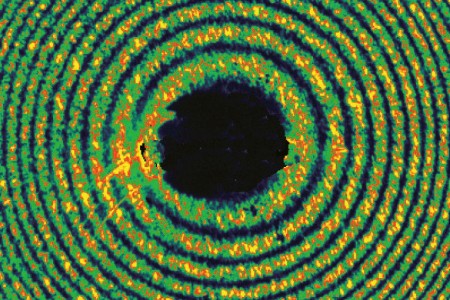
The crucial part of Mosk and Vellekoop’s technique is their computer program, which reads the intensity of the light hitting the camera and makes corrections to the LCD’s pattern to make this intensity as large as possible. For example, if one beam segment scatters through the sample in such a way that it interferes destructively with the rest of the beam when it arrives at the camera, the program adjusts that segment’s propagation before it reaches the sample using a phase modulator. When every segment’s phase has been optimized to interfere constructively, the brightest possible image is obtained (See Opaque lens).

Mosk and Vellekoop tested their technique for several opaque samples, some of which turned out to better at focusing than others. A fresh flower petal, they found, focused the beam to an intensity about 60 times greater than the normal scattered beam. On the other hand, titanium dioxide – a white pigment and one of the most strongly scattering materials known – could intensify the beam more than a thousand times over.

In practice, such an intense beam could be scanned over a biological sample to image it in a similar manner to a scanning electron microscope by using any opaque layers of tissue covering it as the “lens”. However, the technique would still require a camera or other detector behind the sample to read the intensity for optimization. “We are starting to work on optimization using local nanoscale probes that can be put inside tissue,” Mosk told physicsworld.com.

Nanotubes guide phonons with ease

Heat can be transported through a solid by phonons, which are quantized sound waves. Some physicists believe that phonons could be used to transmit information along a fibre if a suitable material could be found. However, any fibre capable of carrying phonons would have to be just tens of nanometres in diameter. While it is very difficult to make such fibres from most materials, carbon and boron nitride nanotubes can be made at such thicknesses.

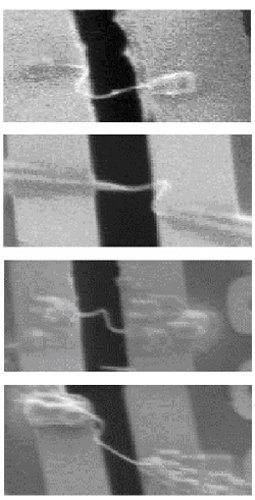
Now, Alex Zettl and colleagues at the University of California at Berkeley have shown that such nanotubes are exceptionally good at transporting phonons – even when the nanotubes are severely deformed. The researchers fixed individual carbon and boron nitride nanotubes between a suspended heat source and sink that created a temperature gradient across the nanotube (see Phonon waveguide). The individual nanotubes had diameters ranging from 10 to 40 nm and were several micrometres in length.

This method, pioneered by Berkeley’s Arunava Majumdar, allowed the researchers to measure how much heat was transferred through a tube. The apparatus was also attached to an electron microscope so that the inner and outer diameters of the nanotube could be measured while it was being bent using a piezo-electric manipulator.

Previous work showed that deforming a multiwalled nanotube produces ripple-like structures about 10 nm in size on the nanotube’s inner radius. The researchers had expected these ripples to scatter phonons and so degrade the nanotube’s thermal conductivity. To their surprise, they found that the thermal conductivity does not change at all even when the nanotubes are drastically bent (see Bent nanotubes).

Team member Chih-Wei Chang told physicsworld.com that the result could be important for overcoming the problems of heat dissipation in microelectronic devices. “Our findings would have immediate applications for heat management since nanotubes exhibit high thermal conductivity (around one order of magnitude higher than that of silicon) and are robust against mechanical deformations too,” he said.

More importantly, the work may lead to the use of phonons as information carriers. The team has already made solid-state thermal rectifiers, tuneable thermal links and phonon waveguides using nanotubes. It is now building more “phononic” devices that are analogous to optical devices used in electronics and photonics.

Interferometry images living cells in 3D

Tiny biological samples must normally be prepared before they can be viewed in 3D. Cells, for example, often have their inner components highlighted with fluorescent dyes. But such modifications can disrupt a cell’s normal functions, limiting the possibilities for analysis.

Feld and colleagues have done away with such preparations, and instead use the optical properties of the cell in its natural state to generate a 3D image. First, a laser beam is split into two: one beam goes through the sample while the other bypasses it. The beams are then recombined and shone onto a digital camera where they produce an interference pattern.

From this pattern the US team deduce the phase difference between the two beams, which changes according to the refractive index of the material that the sample beam passes through. By mapping this refractive index, a 2D image of the cell’s interior is generated.

To get a 3D image the researchers must place a mirror in front of the sample and rotate it incrementally with a galvanometer – a device that converts a small current into a mechanical motion. For each rotation, which alters the angle of the laser beam through the sample, they record an interference pattern.

Feld and colleagues demonstrated their technique, called tomographic phase microscopy, by imaging a cervical cancer cell (See Inside a cell). For the first time, an unaltered cell’s detailed 3D structure with elements such as the nucleus can be seen.

“Accomplishing this has been my dream, and a goal of our laboratory, for several years,” said Feld. “For the first time the functional activities of living cells can be studied in their native state.”

The resolution currently stands at about 0.5 µm, but the group says it should be able to improve it to 0.15 µm or less. They expect that it will complement electron microscopy, which can probe as small as 10 nm but requires samples to be either frozen or coated in a layer of conductive material.

Physicists minimize ‘sticky friction’ in tiny machines

Stiction is a problem in nano- and micro-electromechanical systems (NEMS and MEMS) whereby the tiny components stick together, often greatly reducing the reliability and long-term durability of these devices. It occurs when capillary, van der Waals and electrostatic forces between surfaces overpower the built-in restoring forces of the overall structure. In smaller systems the effect is more pronounced because of a larger surface-area-to-volume ratio.

Practical methods to eliminate stiction-related failures involve designing devices with high mechanical restoring forces, or by using “passivants” – special treatments for reducing surface energy. Some researchers have employed time consuming and costly molecular-dynamics simulations to see how roughness affects stiction, but so far these have not given any useful insights. Liu and co-workers, however, have performed experiments that demonstrate a correlation between surface roughness and stiction – a result that they hope could be used to minimize stiction in MEMS, and possibly NEMS, components.

The US team started with a series of silicon wafers, each with a different average roughness – that is, with different sized lumps or “asperities” on the surface. They then brought the cantilevers of an atomic force microscope with various tip radii into contact with a single asperity on the surface and measured the size of the adhesive force.

The researchers found that the adhesive force falls quickly as the average roughness is increased, but reaches a minimum beyond which it steadily rises again – in other words, there exists an optimal roughness. This value increases with the radius of the cantilever tip.

According to Liu and co-workers, this is because a tip resting on a completely smooth surface is strongly attracted by the majority of the surface’s adhesive forces. A small asperity on a slightly roughened surface acts to distance the tip from the surface, so these forces are less pronounced. But too large an asperity on a very rough surface will have its own strong adhesive forces which cancel the distancing effect.

“Our work suggests a promising way to minimize adhesion between two surfaces by tuning asperity height to feature-size in MEMS devices,” Liu told physicsworld.com. “We didn’t quantify by how much stiction could be reduced, but our model can provide a useful predictor of the behaviour of adhesive contacts down to the nano scale.”

X-ray holography breaks the femtosecond barrier

In their technique, Chapman and co-workers start by firing a coherent pulse of light from the X-ray free-electron laser at the DESY lab in Hamburg through a small hole in a “detector” mirror. This pulse then encounters a thin, translucent membrane that has been covered with a sample material – in this case 140-nm-diameter polystyrene balls – that lies just in front of a second, “backing” mirror (see Quick as a flash).

If the pulse hits one of the balls, it strips the polystyrene chains of their electrons, causing the material to explode under the repulsion of the remaining positive charge. The X-rays then scatter off the ball before travelling to the backing mirror, which reflects it.

Because the pulse has a finite width, however, not all of the X-rays interact with the ball – some of them bypass it and continue in their original direction before bouncing off the backing mirror. These X-rays can then scatter off the ball, albeit a fraction of a second after the initial scattering event, by which time the ball has got bigger as a result of the explosion.

Both parts of the now-scattered pulse – known as the “reference” and “object” beams – then travel back to the detector mirror, which reflects them onto a digital camera whereupon they interfere with each other to produce a “holographic” pattern. The researchers then analyze this pattern to reveal the structure of the sample’s material and how it evolved during the explosion.

Although other X-ray holography techniques have been used as far back as the 1970s, Chapman and co-workers’ technique is much faster, having a temporal resolution of just one femtosecond. This is the timescale of atomic motion, meaning that different samples could be imaged to see the stages in, for example, chemical reactions. “This is certainly the fastest hologram ever recorded,” Chapman told physicsworld.com.

Since a relatively long wavelength of 32.5 nm was used in this experiment, the spatial resolution of the technique currently stands at 50 nm, but Chapman explains that with future, shorter-wavelength free-electron lasers it should be possible to resolve features as small as 1 nm.

The researchers say they were inspired to make holographic patterns in this way by Isaac Newton, who noticed that sunlight produced “strange and surprising” light and dark bands on a screen after he had bounced it off a mirror speckled with dust particles.

Dirac medal honours charm-quark physicists

The charm quark was predicted in 1970 by Iliopoulos and Maiani when, with future Nobel laureate Sheldon Glashow, they formulated the now-famous “GIM mechanism” in an attempt to understand the weak interaction. This quark – the fourth predicted to exist – is now known to have a positive charge of two-thirds of that of an electron. “The GIM mechanism was a seminal contribution to the developing theory of the electroweak interaction,” David Gross, a member of the Dirac medal selection committee, told physicsworld.com.

Their theory was confirmed in November 1974 with the discovery of the J/Ψ particle – a bound state of a charm quark and a charm antiquark – at both the Brookhaven National Laboratory and the Stanford Linear Accelerator Centre in the US. The discovery persuaded many physicists for the first time to realize that quarks exist.

Maiani says he is extremely honoured to win the medal. “Dirac has been my hero since the beginning of [my] physics studies,” he said. “I will never forget the impression made upon me by the hole theory of the positron, and reading his book – together with [Richard] Feynman’s – is the way I learned quantum mechanics.”

The Dirac Medal is awarded to scientists previously unrecognized by the Nobel prize, Fields medal or Wolf Foundation prize who “have made significant contributions to physics.”

Phoenix blasts off to Mars

The $420 million Phoenix mission, the result of an international collaboration led by the University of Arizona, US, is the first project in NASA’s Mars Scout mission. It started life in 2003 as an attempt to revive the 2001 Mars Surveyor Lander, which was cancelled after the Mars Climate Orbiter and Mars Polar Lander failed in 1999. “We have worked for four years to get to this point, so we are all very excited,” said project manager Barry Goldstein at NASA’s Jet Propulsion Laboratory.

Phoenix will land using descent engines on a site in the northern hemisphere at 68.35° north latitude and 233.0° east longitude. Although these engines have not been used successfully since 1976 – NASA has recently favoured airbag systems – they enable the craft to carry the weight of seven different instruments, some of which were those mothballed from the Mars Surveyor Lander.

First, Phoenix will use a 3.35-metre-long robotic arm to dig into the surface and reach the icy layer residing a few centimetres beneath. Mounted on the end of the arm is a visible-light camera, which will provide high-resolution colour images of the soil and ice.

Samples delivered to the lander by the arm will be heated by a “thermal and evolved gas analyzer” to see how much water vapour, carbon dioxide and volatile organic compounds are contained in the soil. The samples will also be distributed to optical and atomic-force microscopes, which will examine mineral grains, while electrochemistry cells will be able to measure properties such as acidity or alkalinity, and a conductivity probe can check thermal and electrical properties.

Other instruments will look at the wider environment. During descent, a camera will record the geography around the landing site, and after Phoenix has landed a stereo camera will observe the local terrain in 3D. Finally, meteorological equipment will monitor changes in water abundance, dust, temperature and other variables.

“[Saturday’s] launch is the first step in the long journey to the surface of Mars,” said principal investigator Peter Smith of the University of Arizona. “We certainly are excited about launching, but we are still concerned about our actual landing, the most difficult step of this mission.”

NASA is still reviewing proposals for the second Mars Scout mission, due to fly in 2011.

Laser flips magnetic bit without any help

Most computers store data on magnetic hard disk drives, in which the direction – “up” or “down” – of the magnetic moments in a small region of the disk corresponds to a binary bit. Data are read by a magneto-resistance element and written by heating the bit with a laser and then flipping the moments with a magnetic field pulse from a tiny coil.

The cost and complexity of hard drives could be reduced significantly if data could instead be read and written using light alone. While some commercial hard drives now use light to read data from magnetic bits, a technique for writing data using only light had remained elusive.

Now, Theo Rasing and colleagues at Radboud University Nijmegen in the Netherlands along with researchers at Nihon University in Japan have shown that a single laser pulse can flip the magnetization of a 5 µm spot on a thin magnetic film from up to down and vice versa – without the need for an external magnetic field.

The pulse was only 40 fs (10-15 s) long – much shorter than the magnetic field pulses used in hard drives, which cannot be made much shorter than about 2 ns. Indeed, the 40 fs switching time had been thought to be impossible because in 2004, a 2 ps lower limit on controlled magnetic switching had been established by another team of physicists.

The laser pulse was circularly polarized, which means that it creates an intense but highly localized magnetic field within the material. The pulse was switched between two polarization states, which flips the direction of the field.

The researchers did their experiments on an alloy of gadolinium, iron and cobalt, which is used widely in magneto-optic data storage devices. The team is now checking to see if the switching occurs in materials with higher coercivity, which could allow an all-optical memory to achieve the same storage density as a conventional hard drive.

Rasing has patented the write process and he is confident that it will be commercialized. However, he admits that anyone wanting to build a hard drive using the technology would have to overcome the significant challenge of how to build a tiny laser that can also produce an intense pulse of circularly-polarized light that can be focussed down to a spot 50 nm in diameter, which is much smaller than the wavelength of the laser light. “But these are solvable problems,” he says.

A way forward for Islamic science

On a hill to the west of the city of Maragha in northern Iran lie the remains of an observatory. Built for astronomer Nasir al-Din al-Tusi in the 13th century, this observatory was home to a variety of instruments, a school of astronomy and a huge library. It attracted scholars from as far a field as China eager to learn how to set up astronomical facilities of their own. While the tables of planetary and stellar motion compiled from observations at Maragha remained popular for 200 years, even influencing Nicolaus Copernicus in his development of the heliocentric model of the solar system.

Similar achievements took place throughout the Muslim world between the 7th and 14th centuries. From Asia and the Middle East to north Africa and the Iberian peninsula Islamic scholars made impressive contributions across a range of fields including mathematics, optics, medicine, alchemy and philosophy. But by the 15th century, Islamic science had all but dried up, and today Muslim countries remain near the bottom of the scientific pile. Not one of the world’s top 200 universities, according to the Times Higher Education Supplement, is located in a Muslim country, despite the fact that together these countries contain more than a fifth of the world’s population.

Reza Mansouri, a cosmologist at the Sharif University of Technology in Tehran, believes this situation is a “catastrophe”. Mansouri is attempting to put his own country on the scientific map by stimulating exchanges between Iranian and Western scientists, and pressing the government for greater support. As a former deputy science minister of Iran who has also carried out research in Western universities, he is certainly well qualified to do this. But Mansouri thinks it will take at least 50 years for the country to fully embrace the scientific research process and accept such research as essential for the country’s economic development. The reason for such an apparently bleak forecast: what he sees as the failure of the Muslim mind to distinguish between science and theology.

Definitions of science

Mansouri, 59, grew up in Tehran, where the then clear views of the Milky Way stimulated an early interest in astronomy. His interest developed to the point where he was building his own small telescopes, but he realized that to make a career out of astronomy he would need to leave Iran.

In 1965 Mansouri secured a place to study the subject at the University of Vienna but changed to physics as this seemed to be stronger there (although he did then switch back to astronomy). He obtained his PhD in 1972 and stayed in Vienna until the cleric Ruhollah Khomeini overthrew the Shah in the Islamic revolution of 1979. Attempting to move back to the country before then could have been dangerous, his brother having been jailed and tortured by the Shah regime.

Since the revolution there has been a huge expansion of higher education in the country, with the number of university students having increased by more than a factor of 15 to nearly three million and the quantity of scholarly papers having risen some 20-fold, according to statistics by Thomson ISI. However, Mansouri says there is little actual research being done. There are only 500 or so PhD-educated physicists in Iran, some 25 of whom work in string theory. Mansouri himself leads a group of six cosmologists, which he hopes will grow to about 20 in the next 10–15 years. But these are exceptional examples – there is little research activity in most areas of physics, and indeed science as a whole, in Iran.

The problem, says Mansouri, is that Iran, like other Muslim countries, has a very distorted view of what science is – a problem that is rooted in culture and reflected in language. He points out that the Arabic term elm (which is used in almost all Muslim countries) is often taken to mean “science”, but this word in fact refers to a deep knowledge of Islam. Indeed ahl e elm means “religious scholar”. Consequently, he says, “there is no clear distinction between the meaning and purpose of science and the meaning and purpose of theology”.

According to Mansouri, the rot set in during the 13th and 14th centuries when science, which had previously been carried out by enlightened individuals, became institutionalized in what were called nezamyiehs (universities). Leading scholars such as Al-Ghazali, with the support of like-minded rulers such as the Mongols, developed the distinction between science that was “useful” for the life of a Muslim and that which was “harmful” (and therefore not pursued). The former was very narrow in scope, and included lunar astronomy, for example, only to the extent that it was needed to specify exactly when religious events such as Ramadan should occur. Dispassionate inquiry into the nature of the world for its own sake was out.

Iranian universities today do teach science beyond that required for practicing Islam, but Mansouri believes that the legacy of this narrow mindset means that students still learn a very prescribed curriculum by rote, rather than being encouraged to investigate subjects for themselves. Iran did in fact play host to the 38th International Physics Olympiad last month, a competition that involves some of the brightest physics students from across the world battling it out by sitting a number of extremely demanding papers in the subject. But for Mansouri this competition only serves to perpetuate the veneration of a received body of knowledge.

This view of science as a fixed body of knowledge then shapes the way politicians think of science and therefore how they fund it, he says. They view a scientist as an ahl e elm sitting in a small study who will at most need money for new books rather than the far greater resources needed for experiments, lab technicians and computers. The result is that Iran spends only about 0.5% of its gross domestic product on R&D.

Mansouri also believes that this static view of science leads to a distorted reverence of nuclear technology. He says that many politicians and ordinary people in Iran regard nuclear power and weapons as the pinnacle of technological achievement, resulting in the great national support for President Ahmadinejad’s uranium-enrichment programme, which is causing such consternation in the West. In fact, he says, academic physicists have almost nothing to do with this programme and that it is sustained by chemists and engineers.

A two-pronged solution

To make scientific progress and improve their material prosperity, Islamic countries must do at least two things, says Mansouri. The first of these is to make a clear distinction between science and theology. To this end, he has proposed the new term daneshgar as a precise translation of the term “scientist”, replacing ahl e elm as well as daneshmand, which is a 1000-year-old general term for a scholar. The other thing that must be done, he believes, is to build a handful of scientific institutes in Iran and the rest of the Muslim world that are genuinely world class, allowing them to exchange scientists with other top centres worldwide.

Mansouri has already tried hard to stimulate collaboration between Iranian and Western physicists. Over the past two decades he and his colleagues have taken part in developing the Large Hadron Collider at CERN and have also participated in the Jordanian SESAME synchrotron source. Now he hopes to develop a genuinely world-class facility within Iran – a 2 m optical telescope at the Institute for Studies in Theoretical Physics and Mathematics in Tehran that was given government backing three years ago. Although small by the standards of today’s leading observatories, Mansouri hopes that this telescope will allow high-quality research in very specific areas, such as studies of dark energy through weak lensing and supernovae surveys, one of Mansouri’s own research areas, and investigations of gamma-ray bursts. The telescope should open within seven years.

Mansouri also hopes that Iranian scientists can set up internationally competitive research groups in experimental areas that will be useful to industry, such as solid-state physics, optics and laser physics. But he thinks it will be at least 2050 before Iran can produce the new generation of scientists, administrators and teachers that it needs to become a modern scientific nation. He believes that in other Muslim countries, such as Saudi Arabia or Egypt, this will take even longer. Not making such changes will prove a disaster for Muslim countries, he believes, both from the point of view of material prosperity and for relations with the West. He hopes that he can continue to play his role in this process, drawing on both his Muslim and Western experiences. “I hope to become a part of the solution by offering my unique perspective,” he says.

In person

Born: Tehran, Iran, 1948
Education: Vienna University (degree and PhD in physics and astronomy)
Career: Vienna University (1972–1977); Cologne University, Germany (1978–1979); Sharif University of Technology, Iran (1979–present); plus secondments to Potsdam University, Germany and McGill University, Canada
Family: Married (to a poet and writer) with two children


Blog life: Cocktail party physics

Blogger: Jennifer Ouellette
URL: twistedphysics.typepad.com
First post: February 2006

Who is the blog written by?

Jennifer Ouellette studied English at university and says she “stumbled into writing about physics”, eventually becoming a full-time science writer for popular-science and trade magazines. She has written two books: Black Holes and Quantum Cats and The Physics of the Buffyverse, the latter of which attempts to use the TV series Buffy the Vampire Slayer to illustrate concepts in physics.

What topics does the blog cover?

Ouellette says the title of the blog comes from a description of her first book, which was a series of short essays mixing concepts in physics with art, literature, history and pop culture. In a more literal sense, the blog contains several recipes for physics-themed cocktails, from the “Laser Beam” to the “Black Hole” (which is so-called because “after one of these, you have already passed the event horizon of inebriation”).

Who is it aimed at?

As an outsider coming into physics herself, Ouellette writes accessibly for non-specialists. But her blog is obviously read by physicists too – she met her fiancé Sean Carroll, a cosmologist at the California Institute of Technology, after they read each other’s blogs. Naturally, the engagement was announced via both Cocktail Party Physics and Carroll’s blog Cosmic Variance.

Why should I read it?

As you would expect of a professional writer, Ouellette’s entries are polished and humorous. Her enthusiasm for science and scientists is obvious; and as she is not confined to one research area, she is free to hop around fields, frequently visiting conferences in search of good stories.

How often is it updated?

Entries are less frequent than on other physics blogs – only one or two per week – but they are also much longer, reading more like fully fledged magazine columns than the usual rattled-off blog posting.

Can you give me a sample quote?

“I must confess to finding it easier to write about applications of physics rather than the basic science. But when I started covering the quantumdots area, I learned some useful things about the ‘electrons and holes’ effect that is critical not just to quantum dots, but also lasers and other semiconductor physics. This is not an easy thing for a layperson to visualize, although physicists toss those terms around like high-school slang.”

Copyright © 2026 by IOP Publishing Ltd and individual contributors