Astronomers have so far discovered almost 250 planets beyond our solar system. Most of these “exoplanets” are gaseous giants similar to Jupiter, which itself contains large quantities of water. Researchers had therefore suspected that water also exists on planets of a similar size outside our solar system.
Now Giovanna Tinetti of the European Space Agency and University College London, along with colleagues in France, Taiwan, Spain and the US, has studied exoplanet HD 189733b, a gas giant that crosses between the Earth and its companion star every 2.2 days. As it does so, some of the light from the star is absorbed by the exoplanet, causing the star to dim.
To search for water, the astronomers paid close attention to three wavelengths of infrared light – 3.6, 5.8 and 8.0µm – as the edge of the exoplanet’s atmosphere crossed the star. They discovered that the atmosphere absorbed less light at 3.6 µm than it did at the longer wavelengths. According to Tinetti, this could only occur if the atmosphere contains a significant amount of water vapour.
While it is unlikely that life exists on HD 189733b or any similar exoplanet, the research supports the idea that significant quantities of water could exist in other planetary systems. According to Tinetti the technique could someday be used to search for Earth-like exoplanets with water – which she describes as “the ‘holy grail’ for today’s planet hunters”. However, such studies would be very difficult to do using existing telescopes, which are not capable of performing such measurements on Earth-sized exoplanets. As a result the quest will probably have to wait for NASA’s James Webb Space Telescope, which should launch in 2013.
Homestake, which contains over 600km of tunnels, operated as a gold mine from 1876 until 2001. Scientific experiments have been carried out there before — in 1965 it became home to the world’s first solar neutrino detector, which was set up by the late Raymond Davis of the Brookhaven National Laboratory. Davis went on to share the 2002 Nobel prize in physics for this work.
The proposal for the new lab involves experiments at two levels — one at about 1500m below the surface and another at around 2200m down. The intermediate level, which is where Davis set up his experiment, will involve the modification of an existing scientific site and the setting up of a number of new experimental chambers, while the deeper level will involve the conversion of caverns, boreholes and other structures previously used by the miners.
Many different types of experiment could be built at Homestake, including a number dedicated to studying the elusive neutrino. For example, physicists could build detectors to study an extremely rare nuclear process known as neutrinoless double beta decay, which, if real, would mean the neutrino is its own antiparticle and which would also permit researchers to work out the absolute mass of the neutrino. The mine might also host detectors to study the properties of neutrinos that have been sent some 1500km through the Earth from Fermilab near Chicago.
Other physics-based experiments at Homestake could include studies of proton decay or nuclear astrophysics, or lead to the development of next-generation gravitational wave detectors. Scientists working at the lab would also be able to study the Earth’s crust, examine life forms that live in conditions of extreme heat and pressure, as well as improve technologies for sequestering greenhouse gases underground.
The proposal for the new lab has been put forward by a multi-institutional collaboration of researchers headed by Kevin Lesko, a physicist at the University of California Berkeley. It was chosen ahead of three other proposals by a 22-member panel of experts appointed by the NSF, and marks the culmination of a drawn-out selection process. Homestake was originally put forward as a potential host several years ago, but disagreements between Barrick Gold Corporation, the Toronto-based company that owns the mine, and the South Dakota state government and the NSF have held up progress. In 2003, Barrick turned off the pumps that were preventing the mine from flooding, prompting fears that the site would be unfit for experiments.
The Homestake collaboration is now set to receive some $5m per year for up to three years from the NSF for design work. Funding to actually build and operate the lab will need further approval and ultimately require the go ahead from Congress. If approval is forthcoming for the current design, the Homestake facility would be the largest and deepest underground lab in the world, surpassing existing labs in Italy, Japan and Canada. It is to be called the Sanford Underground Science and Engineering Laboratory in recognition of a gift of $70m provided by the bank owner Denny Sanford.
Tiny machines on the micro- or nanometre scale could someday be used, for example, to deliver drugs to a precise location in the body via the bloodstream. However, before this is possible, scientists must work out how such tiny devices would be powered. Nature may provide a solution in the form of flagellated bacteria, which propel themselves using biomolecular motors. Since the motion of some flagellated bacteria can be controlled by simply shining a light on them in a process called phototaxis, some scientists have suggested that bacteria could be used as “beasts of burden” that power tiny machines of the future.
Now Min Jun Kim and colleagues at Drexel University in Philadelphia have worked out two ways of using the common bacterium Serratia marcescens to move tiny triangular sheets of epoxy. This bacterium is known to move very quickly, except when exposed to ultraviolet light, which stops it from moving.
The researchers first created “swarm plates” of bacteria in Petri dishes containing agar — a gel that is widely used to grow bacteria. The bacteria were introduced at an edge of a plate where they quickly multiplied before starting to move across the surface of the plate in waves.
In one experiment, the surface of a swarm plate was covered with a thin layer of “motility buffer” — a liquid nutrient that makes the bacteria move faster. A triangular sheet of epoxy measuring about 50 µm across and 10 µm thick was submerged in the buffer so that it rested on a leading edge of a wave of bacteria that were moving across the surface of the agar.
The triangle was carried forward by the bacteria at a speed of about 9 µm/s – but when the sample was exposed to ultraviolet light, the bacteria and the triangle stopped. Once the UV light was switched off, the bacteria and triangle began moving again at about 9 µm/s.
On other regions of the plate the bacteria formed swirling vortices and when a triangle was placed on such a vortex it rotated at a frequency of about 1 rad/s. This rotation could be stopped by applying UV light, and started again when the light was tuned off.
In a separate experiment, the triangle was carefully removed from the agar such that a layer of bacteria remained stuck to its surface. The triangle was then placed in a tray containing only motility buffer, where the action of the bacteria caused it to rotate. Once again, the rotation could be stopped by applying UV light, and then restarted when the light was switched off.
Kim’s team have used bacteria to move other simple shapes such as squares. But, he told Physics Web that he believes that microstructures of any shape and on the 1-500 µm size scale could be manipulated using the technique.
The possibility that the photon has a charge would have profound implications on a wide range of physics. For example, charged photons in the dense early universe would have had a tremendous amount of electrical potential energy, which does not fit in with our understanding of how the universe has evolved.
Furthermore, our current understanding of elementary particles suggests that a charged photon would imply the existence of an oppositely-charged anti-photon — but if such particles existed, much of the everyday physics that we take for granted would be different.
To place a bound on the photon’s charge, Altschul looked at data from the VSOP experiment – which operated from 1997 to 2005 using a combination of earthbound telescopes and the HALCA space telescope to study radio waves from distant galaxies. Signals coming from the same source were detected by separate telescopes and the interference between the signals was measured. By taking successive measurements VSOP was able to build up images of very distant galaxies that could not be resolved using a single telescope.
However, VSOP will only work if the photons detected at each telescope are coherent – and this coherence would be degraded if the photon has even the smallest electric charge. This is because photons detected at different telescopes would have travelled through slightly different magnetic fields, causing the relative phases of charged photons to change and destroying their coherence.
Altschul was unable to find any evidence of decoherence in VSOP data from galaxies about 1bn parsecs (about 3 bn light years) away, allowing him to conclude that the charge on the photon is less than about 10-32e.
He then put an even more stringent limit on the charge by assuming the existence of anti-photons. Quantum mechanics does not allow different particles –photons and anti-photons, for example – to interfere with each other. By bending the rules to allow such particles with tiny charges to interfere, Altschul was able to estimate how coherence would be lost by photons and anti-photons travelling long distances.
He concluded that the charge on the photon and anti-photon is less than about 10-46e. This is thirteen orders of magnitude better than the previous estimate for photons of two opposite charges, which had been done by looking for a “blurring” of the radio images of distant galaxies.
A swarm can be thought of as a system in which the density of particles fluctuates wildly from place to place. One such system is a school of fish, which exhibit density fluctuations as the fish rapidly change direction. Although physicists have tried to develop mathematical models of swarming, there are few simple experimental systems available for testing them.
Now, however, Vijay Narayan of the Indian Institute of Science in Bangalore and colleagues have demonstrated swarming in a table-top experiment involving very simple inanimate objects – thousands of short copper rods less than a millimetre thick vibrated between two horizontal plates. The system is similar to a so-called “active nematic” liquid crystal – a fluid made up of long, symmetrical molecules.
Narayan’s group measured the density fluctuations for different numbers of rods between the plates – from 35% to 66% coverage – using snapshots taken with a digital camera every 15 seconds for 40 minutes. They found that the tests with more rods had larger fluctuations, leading to more visible swarming behaviour.
Intriguingly, the researchers could not get the rods to swarm without first etching them at either end so they took on the shape of a tiny rolling pin. Although they do not know for sure why this modification was necessary, Narayan told Physics Web that it is similar to nematic liquid crystals, which are known only to comprise molecules with a rigid inner section and bendable extremities.
Commenting on the work in Science, Martin van Hecke, a condensed-matter physicist from Leiden University in the Netherlands, said: “What is clear already is that shape matters.”
Narayan said that their experiment shows how swarming – such as that seen in the animal kingdom – does not necessarily require communication, but can occur with simple particle-particle interactions. “It should provide encouragement to others to carry out quantitive tests of ‘flocking’ models by measurements of bird flocks, fish schools or giant herds of migratory beasts,” he added.
Atomic clusters are formed when a finite number of atoms clump together to form an ensemble larger than a typical molecule, but too small to be considered a bulk solid. Although any number of atoms can form a cluster, those with a certain ratio of elements, called “magic clusters”, are inherently more stable than others.
Magic clusters are interesting because they can be used as building blocks for new materials, the properties of which can be fine-tuned by adjusting the clusters’ composition. But no-one has ever been able to predict the magic ratios, which have previously had to be determined by trial and error.
Now a group led by Kiran Boggavarapu of Virginia Commonwealth University in the US has come up with such a rule by considering how clusters of two particular atoms – aluminium and hydrogen – bond together.
Just like molecules, clusters have a series of discrete energy levels, and only become stable once one of these is completely filled with electrons. Faced with a cluster of aluminium atoms, therefore, a hydrogen atom will bond in such a way to either take or donate an electron to fill a level. “It is so unusual that the smallest atom – hydrogen – can bring such a big difference,” Boggavarapu said.
For instance, if a cluster of aluminium atoms needs one more electron to become stable, a hydrogen atom could either form a “bridge” between two aluminium atoms or form a “cap” by linking three aluminium atoms. This would enable its electron to become delocalized so that it can be shared with the aluminium cluster. On the other hand, if a cluster has too many, a hydrogen could “radially” bond and withdraw the extra electron from the cluster. (See figure: “Like magic”.)
Using these electron-sharing conditions, the US group wrote an equation that predicted the different numbers of hydrogen atoms that could make a certain-sized cluster of aluminium atoms stable. A cluster of seven aluminium atoms, for example, could have either one radially-bonded hydrogen atom (Al7H), or it could have two radially-bonded hydrogen atoms and one bridge-bonded hydrogen atom (Al7H3).
Boggavarapu showed his group’s rule to Kit Bowen and co-workers at Johns Hopkins University to see if it worked for real magic clusters using a technique called photoelectron spectroscopy, in which ultraviolet light is used to knock electrons from a cluster so that their binding energy can be determined. They found that the binding energies for different magic clusters matched the bonding types that their rule predicted.
The researchers now want to see if the magic clusters will retain their properties when they interact together. If they do, they could be promising materials for storing hydrogen, which is widely touted as a clean alternative to fossil fuels as a source of energy. Boggavarapu told Physics Web that hydrogen is bonded weakly enough in aluminium-hydrogen magic clusters to allow it to be released at ambient temperatures and pressures.
Physicists have several explanations for the classic “Brazil-nut effect” — in which big particles gather at the top of a container — the simplest being that the smaller particles fall through gaps between the larger particles. Another possibility is that “convection currents” cause all particles to rise up through the centre of the can, but that only the smaller particles can join the narrow downward currents that move along the walls of the container. Others have proposed a thermodynamic model whereby the smaller particles “condense” at the bottom of the can.
The “reverse Brazil-nut effect” occurs in containers with particles of different sizes and densities. It is thought to occur either when the larger particles are heavy enough to push the smaller particles out from beneath them, or when the shaking is violent enough that that gaps between smaller particles become large enough for the large particles to fall through.
Now, Matthias Schroeter and colleagues at the University of Texas at Austin claim to be the first to have observed an abrupt transition between the two effects.
The researchers filled a glass tube with a mixture of small glass spheres that were 1.4 mm in diameter and denser, bigger brass spheres that were 2.4 mm in diameter. They then shook the tube up and down at a frequency of 20 Hz, with a maximum acceleration of five times that of gravity, for a period of one hour. The team briefly interrupted the shaking to take photos of the top and bottom of the tube, before resuming shaking once again. Further photos were taken once every hour for about 200 hours.
After the first hour, the system had initially settled into a reverse Brazil-nut state, with nearly all the large spheres sinking to the bottom of the tube. Then, after about 25 hours of shaking, the larger brass spheres suddenly started drifting upwards and within an hour were all at the top of the tube. The system remained in the Brazil-nut state for the remaining 180 hours of the experiment.
Schroeter and colleagues believe that the change was caused by increased friction between the spheres, which became scratched and scuffed after hours of vibration. He told Physics Web that there is always a competition between convection moving the particles upwards, and gravity pulling the larger, heavier particles to the bottom. While gravity wins out at first, increasing friction between particles boosts the rate of convection until it begins to dominate at about 25 hours, explained Schroeter.
They confirmed this idea by repeating the experiment having repolished the scuffed spheres in an ultrasonic cleaner. As before, the brass spheres started off at the bottom of the tube for 25 hours, before rising again to the top. They also measured the coefficients of friction between the spheres before and after the transition and found that friction had increased significantly.
The team are now doing computer simulations to gain further insight into the effects of friction on the two processes.
Axions are ultralight particles that were first postulated in the 1970s to resolve a discrepancy between experimental findings and the theory of the strong force. In March 2006, the PVLAS team shone a laser beam through a strong magnetic field of 5.5 T in a vacuum and saw that the beam’s polarization rotated slightly. At the time many physicists thought that this was due to an ultralight particle coupling with photons in the beam, and so heralded it as the first glimpse of the axion.
Now, the PVLAS team has repeated the original experiment at two different magnetic field strengths. While the rotation was again observed at the original field of 5.5 T, no effect was seen at 2.3 T – leading the team to conclude that the rotation is an instrumental effect related to the magnetic field strength.
The latest news from Italy should come as a relief to physicists who believe that axions could make up dark matter. This is because the PVLAS axion appeared to couple too strongly to light to be a suitable candidate for dark matter.
The null result also puts PVLAS line with an experiment at CERN called CAST, which has been trying to convert solar photons into axions in a 10-m long test magnet. CAST has found no evidence for axions at the coupling strength implied by the 2006 PVLAS result.
Physicists are now gearing up to search for axions by studying gamma rays from a distant quasar that will soon be passing through the intense magnetic field of the sun. Such observations can be made every October when the Sun comes between the Earth and the quasar 3C 279. During this alignment, a small number of the quasar’s gamma rays could be converted into axions at the far surface of the sun. The axions should then travel through the Sun unhindered, only to be converted back into gamma rays when they emerge on the near side. Unconverted gamma rays, however, would be blocked by the sun and therefore any gamma rays from the quasar that are detected on Earth would be seen as evidence of axions.
Wettlaufer was first inspired to investigate star patterns when he and his wife were looking out of an aeroplane window landing in Chicago and noticed a frozen lake peppered with the distinct shapes. “We were absolutely struck,” he said. “My wife is from Sweden and she knew these as the harbingers of dangerous ice skating, but had never seen so many.”
The star patterns are formed when a hole in a recently-frozen lake allows water to swell up from beneath and spread over the snow-covered surface, leaving dark “fingers” of melted ice stemming from a central point. Previously, physicists had suspected that the fingers form because of a domino effect: the water starts flowing in one direction, causing the snow to melt faster in that region and thus helping the water to flow faster. But no-one has ever constructed a model to see if this idea is correct.
Tsai and Wettlaufer began by assuming that the rate of flow of the water is dependent on how compacted – and thus how porous – the snow is. They then created a model that also took into account parameters including the driving pressure and heat content of the water and how fast heat could transfer by diffusion.
The US pair found that all these parameters govern the number of unstable regions in which fingers would form. In particular, more porous snow coupled with a higher driving pressure would result in more fingers.
Tsai and Wettlaufer performed tests in the lab to see if their model matched real-world data by pumping water at a temperature of 1 °C through a dish of slush held below freezing. Although they were not able to change how porous the slush was, they changed other parameters included in their model such as the size of the initial hole. After 14 test runs, they could conclude that their model did not perfectly predict the number of holes, but was right 95% of the time.
Wettlaufer told Physics Web that their study could be relevant in many other processes involving instabilities, such as the fate of floating ice in polar oceans. “We hope that…more people notice wintertime lakes with a different eye to these stars,” he said. “I know I will always have a camera on hand.”
Blue-sky thinking New developments in solar-cell technology could help us to harness even more of the Sun’s power. (Source: Maximilian Stock Ltd/Science Photo Library)
The burning of skin on a hot summer’s day, the awesome power of a tornado or the existence of a simple blade of grass all testify to one thing: the huge amount of energy transmitted to us from the Sun. In a single hour the Sun delivers the same amount of energy as consumed by all of humanity in a year – about 5 × 10²⁰ J – and in 36 hours releases as much energy as exists in the Earth’s estimated oil reserves. When you combine this with the fact that solar energy is essentially inexhaustible, available to everyone the world over and generates no greenhouse gases or other harmful pollutants, it seems hard to imagine why we do not make greater use of it.
The main reason is cost. Electricity produced by solar (or photovoltaic) cells costs about $0.30 per kilowatt hour (kWh), whereas that derived from wind costs in the region of $0.05 per kWh and from natural gas about $0.03 per kWh. Technologically, the difficulty in deriving energy from the Sun’s rays – as opposed to, say, fossil fuels – is that they have a relatively low energy density. The upshot is that in the US, for example, photovoltaic cells generate only about 0.02% of electricity, with the vast majority of the rest coming from coal, gas and nuclear power.
This situation is set to change, however. Gradual improvements to the basic single-crystal silicon solar cells have already reduced the cost of photovoltaic electricity by about a factor of 20 in the past 30 years, and the continuing development of cheaper crystalline materials should see this trend continue. According to a report produced by American scientists George Crabtree and Nathan Lewis for the US Department of Energy in 2005, solar cells will become competitive enough – generating electricity at $0.02 per kWh – to be implemented on a massive scale in about 20–25 years’ time.
But some believe that the rise of solar energy could be far more dramatic. Crabtree and Lewis themselves estimate that the widespread use of photovoltaic cells could happen as soon as 2015 if physicists can perfect a new generation of more advanced devices built using nanotechnology. These include cells based on quantum dots or nanocrystals devices, which are potentially both cheaper and more efficient than existing cells. Indeed, such is the promise of these technologies that a report produced for the German government in 2003 predicted that by 2050 photovoltaics could be meeting a quarter of the world’s energy needs.
Such a transformation would require huge political will. However, the increasing urgency with which governments are addressing, or at least discussing, the issue of climate change suggests that this will may emerge. Although the world’s emissions of greenhouse gases could be reduced using other non fossil-fuel energy sources, some researchers, such as solid-state physicist Keith Barnham of Imperial College London, believe that photovoltaics could take much of the strain on their own. He points out that if the UK expanded its photovoltaic capacity by 40% each year – which is less than occurred globally in 2004 – then it could more than make up for the loss of generating capacity caused by the closure of its ageing nuclear reactors over the next 20 years.
Solar-cell basics
The silicon solar cell has remained essentially unchanged since it was invented at Bell Labs in the US over 50 years ago. Part of a wafer of silicon is doped to create an excess of holes (i.e. a p-type semiconductor) while another part of the wafer is doped to contain an excess of electrons (an n-type semiconductor). At the junction between these two regions, electrons and holes combine to create a potential barrier, which keeps the remaining electrons and holes apart. However, when a photon with sufficient energy strikes the cell, it promotes electrons from the valence band to the conduction band, creating electron–hole pairs. Pairs formed on or near the p–n junction are forced by the electric field to separate so that the holes pass to the p-type region and the electrons to the n-type region, thereby producing a current.
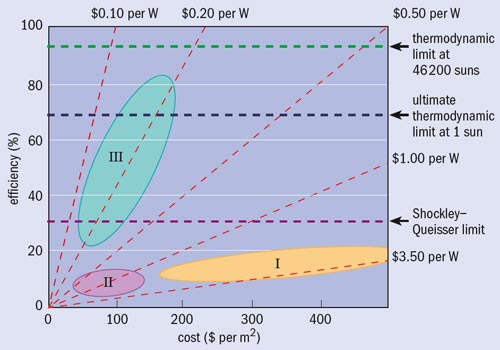
The performance of a solar cell is measured by its efficiency: the ratio of the electrical power generated to the power of the light incident on the cell. In 1961 physicists William Shockley – who shared the 1956 Nobel Prize for Physics for the invention of the transistor – and Hans Queisser calculated that the simplest kind of solar cell can achieve a maximum efficiency of 31%. This is a cell that consists of a single p–n junction, generates just one electron–hole pair for each incoming photon, is exposed to unconcentrated sunlight, and wastes as heat any incoming photon energies in excess of the semiconductor band gap.
The vast majority of solar cells on the market today are so-called first-generation cells, which are made from single crystals of silicon. The best-performing (which is considerably less than the record achieved in the lab, by Martin Green and colleagues at the University of New South Wales in Australia, of 24.7%). However, first-generation cells are expensive to produce because of the high costs of purifying, crystallizing and sawing the single silicon wafer. “Second-generation” solar cells aim to reduce these costs by using thin films of silicon and other, compound, semiconductors, such as copper indium diselenide and cadmium telluride, mounted on glass substrates. But while much cheaper than monocrystalline silicon cells, these second-generation devices suffer from structural defects that make them less efficient than their single-crystal counterparts.
Generation gap Efficiency versus cost for the three generations of solar cells. First-generation cells, which are based on expensive single-crystal silicon wafers, account for about 85% of devices sold today. Second-generation cells, which comprise thin films of silicon and other semiconductors, are cheaper but less efficient. Meanwhile, third-generation devices made from more advanced technologies and materials are at an earlier stage of development but promise high efficiencies at low costs. The horizontal lines show the theoretical upper limits of the efficiencies (from bottom to top) of a standard solar cell, an advanced cell exposed to unconcentrated sunlight, and an advanced cell subject to sunlight concentrated by a factor of 46,200 – the maximum possible. The dashed diagonal lines are loci of constant cost per unit power, measured in dollars per peak watts. Because of natural variations in the solar power that reaches a given area across the day/night cycle and changes in cloud cover, the average electrical power produced by a solar cell in a year is about 20% of its peak rating. A price of $1 per peak watt translates to a unit electrical cost of about $0.05 per kWh over the 30-year lifetime of a typical solar cell. (IOP Publishing)
To try and overcome these limitations, researchers are working on third-generation cells that, if practicable, would yield extremely high efficiencies but be as cheap to produce as thin-film devices (see “Generation gap” figure). The way to make these third-generation devices is to violate one or more of the Shockley–Queisser criteria. One option is to concentrate the sunlight using mirrors or lenses. The number of electron–hole pairs, and therefore the current from a cell, is proportional to the rate of photons arriving at the cell. This effect in itself would not yield a higher efficiency since the current per unit flux of sunlight does not increase. But because the output voltage of a p–n junction increases logarithmically with the current, the power output and therefore the efficiency do in fact increase logarithmically. If all other aspects of the cell remain equal, focusing the incoming sunlight can increase efficiencies up to 41%.
Another option is to stack multiple cells with different semiconductor band gaps on top of one another. This arrangement allows the device to generate a current from a much wider range of photon wavelengths than a single-crystal silicon cell. Already used to power spacecraft, where cost is not such a big issue, multi-junction cells have an efficiency limit of 43% if they contain two separate junctions, 49% for three junctions and 66% with an infinite number of junctions.
A further option for exceeding the conventional 31% limit is to convert some of the excess photon energy (i.e. the difference between the photon energy and the semiconductor band gap) into useful energy. One way to do this is to create multiple electron–hole pairs for each incoming photon. For decades it has been known that this phenomenon takes place inside bulk semiconductors, where energetic conduction electrons knock other electrons from the valence band into the conduction band. But this effect is very limited – in silicon, for example, it leads to only just more than one electron per incoming photon.
However, according to physicist Victor Klimov at the Los Alamos National Laboratory in New Mexico, this so-called carrier multiplication can be enhanced by making solar cells from networks of billions of tiny pieces of semiconductor known as quantum dots, rather than one large piece of semiconductor. In experiments performed last year, Klimov was able to generate up to seven electron–hole pairs per incoming photon by illuminating single 5 nm-sized crystals of lead selenide with extremely brief laser pulses. He says that this process could lead to solar cells with efficiencies of over 40%.
Klimov admits that he does not know exactly how the quantum dots manage to achieve this photon multiplication, but he believes it may be due in part to the process that occurs in bulk semiconductors and also, possibly, because of the creation of “virtual electrons”. This latter process would involve an electron gaining more energy than was deposited from an incoming photon, albeit for a very brief period of time, and then transferring some of its excess energy to an electron in the valence band.
Quantum dots could also be used to make “hot-carrier” cells, in which the extra energy supplied by a photon is not lost as heat – as it is in conventional solar cells – but instead results in higher-energy electrons and therefore a higher voltage than in a standard cell. Green at the University of New South Wales is one physicist working on this technology. “When building a material from the bottom up in the form of quantum dots, it is possible to manipulate the properties of the material on the micro-scale,” he explains. “So by changing the stiffness of the interaction between the quantum dots and the material that they are embedded in, we can reduce the amount of heat that is lost due to atomic vibration.”
Although it could be 10–15 years before this technology reaches the market, Green’s group has now built its first cell based on quantum dots, and he thinks that commercial devices based on this technology could reach efficiencies of 20–30%. “I would be very surprised if in 30 years’ time solar cells were not using nanotechnology in some way,” he adds.
The quantum-well cell
Before quantum dots can be used to make solar cells based on either carrier multiplication or hot carriers, however, two crucial hurdles must be overcome. One is how to separate out the electrons and holes generated in such devices – i.e. the function performed by the p–n junction in a silicon solar cell – while the other is to find a way to connect the individual quantum dots. This could perhaps be done by using nanowires or by simply placing the dots close to one another and relying on quantum tunnelling.
An alternative third-generation device that also takes advantage of nano-scale structures is the so-called quantum-well solar cell. Barnham and colleagues at Imperial College London have built such a cell by sandwiching 50 slices of the semiconductor indium gallium arsenide, which has a relatively low band gap, with each slice just a few nanometres thick, between slightly thicker pieces of gallium-arsenide phosphide, which has a higher band gap. Each slice of lower-band-gap material bounded on either side by the higher-bandgap substrate forms a potential well, into which photons are absorbed and from which electrons and holes then escape thanks to their thermal energy.
The quantum wells shift the energy range over which the cell operates downwards, and in doing so reduce the band gap of the gallium arsenide so that it can capture a greater fraction of the spectrum of photons striking the cell. This slightly decreases the voltage from the cell (since the average energy of the electron– hole pairs produced is lower), but this drop in voltage is more than compensated for by the increased current, resulting in a higher power output overall. A more obvious way to reduce the band gap of a gallium-arsenide cell is simply to grow a layer of indium gallium arsenide on top of it. But according to Barnham, mismatches in the atomic spacing between the two materials introduce dislocations that reduce the efficiency of the compound material.
Like other third-generation solar cells, the quantum-well cell would be exposed to concentrated sunlight. Relatively cheap optics focus the incoming light onto a much smaller area of solar cell, thereby lowering the area of cell needed and the overall cost of the system. Since the cell itself makes up a lower fraction of the overall system costs it makes sense to use a more expensive, but higher efficiency, cell. Barnham and coworkers have so far recorded efficiencies of up to 27% in their cell when it was exposed to sunlight that has been concentrated 300 times. The researchers claim that the efficiency of their cell could in fact go beyond 30% by recycling the photons when the electrons and holes recombine, as they inevitably do. Barnham and colleagues recently set up a company, QuantaSol, to commercialize their technology, and plan to sell their quantum-well cells to concentrator manufacturers within the next six to nine months.
Dyes and plastics
An entirely different type of third-generation device is the “dye-sensitized” solar cell. Pioneered by Michael Grätzel of the Swiss Federal Institute of Technology and co-workers, it uses a combination of a chemical dye and the wide-band-gap semiconductor titanium dioxide, which is cheaper than silicon. Photons arriving at the cell liberate electrons from the dye molecule, which are then transferred to the conduction band of the semiconductor and out to an electrode. The hole left in the dye, meanwhile, recombines with an electron in a layer of electrolyte that sits between the semiconductor and a second electrode.
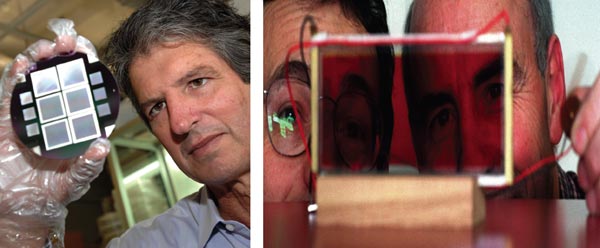
Solar innovators Martin Green of the University of New South Wales in Australia (left); and David Cahen of the Weizmann Institute of Science in Israel (right) working with Jim McQuillan of Otago University in New Zealand, colleagues of Michael Grätzel of the Swiss Federal Institute of Technology in Lausanne.
One of the virtues of the dye-based solar cell is that the band gap of the semiconductor does not have to be matched to the spectrum of light impinging on the cell; the absorption spectrum of the dye can be easily tuned to this – which is why the cheap semiconductor titanium dioxide, with its wide band gap, can be used. As the semiconductor layer need not be thick, the dye cell can also be mounted on flexible substrates. In addition, because the cells are transparent they can be embedded into windows.
According to Grätzel, scientists had abandoned this concept because of the limited intensity of light gathered by the dye. But he and his co-workers have shown that this problem can be overcome by using a nano-crystalline form of titanium dioxide. A network of nanometre-sized semiconductor crystals provides a multitude of nooks and crannies in which the dye molecules can bond, multiplying the surface area available to the dye by over 1000 times. Grätzel says that his group’s best-performing cell to date has an efficiency of just over 11%, which should, he estimates, make commercially manufactured dye-sensitized cells between three and four times cheaper than conventional silicon cells. This year the company G24 Innovations started the first commercial production of dye-sensitized solar cells at a plant in Cardiff in the UK.
Finally, a much younger technology than dye-sensitized cells, but one with considerable potential, is the organic solar cell. Such devices, which use plastics as the active component, are potentially far cheaper to make than semiconductor devices. They are also flexible, which means they could be wrapped around surfaces, rolled up or perhaps painted onto structures. Earlier this year David Carroll, a physicist at Wake Forest University in North Carolina, and colleagues claimed to have created a polymer-based solar cell with an efficiency of 6%. Although low by the standards of silicon, this efficiency is nevertheless impressive for polymers, which have a high band gap and are not as good at separating out electron–hole pairs.
Attention to detail Jiwen Liu of Wake Forest University in the US inspecting one of his group’s polymer solar cells.
Carroll and colleagues achieved their high efficiency by creating nanometre-sized “veins” within the polymer poly(3-hexylthiophene) that guided the electrons and holes rapidly out of the device before they could recombine. However, the researchers believe that they can attain efficiencies as high as 10% by wrapping a polymer around a piece of fibre optic cable. The fibre has two roles: holding the photons within the polymer until they are absorbed; and capturing photons from a greater range of incident angles. This latter point increases the fraction of the day that a cell can perform at peak levels – from about an hour with a thin-film cell to about five hours.
“Plastic solar cells are definitely here to stay,” says Carroll, whose team is currently building prototypes of both the thin-film and fibre varieties. “They make very good flexible cells that are capable of providing more power over the course of a day than silicon. Even six months ago I would not have said this.”
Overcoming the storage problem
Building efficient, and therefore cheap, photovoltaic cells is not, however, a guarantee that solar power will become a major part of the world’s energy mix. Even if these devices can be converted into high-performance commercial products, there still remains the problem of actually building and installing the enormous number of panels that would be needed. Humans currently consume energy at a rate of 13 terawatts (TW), and many experts predict that population growth and economic expansion will increase this figure to about 45 TW by 2050. Generating 20 TW of that energy with panels that are 10% efficient would, according to Crabtree and Lewis, mean installing such panels over 0.16% of the Earth’s land surface. Given that only a fraction of this will be met by installing panels on people’s homes, vast “farms” will have to be built in areas with significant amounts of sunshine. Attempting to build such farms in the West could, ironically, be opposed on environmental grounds.
Another hurdle is the infrastructure needed to deliver the solar electricity to where it is needed (when the cells are built in farms). Perhaps the biggest challenge, however, is how to store solar electricity, given that the Sun does not shine all the time. One option, which is already used by producers of nuclear power, involves pumping water up hill when the demand for energy is low and then releasing the water when demand is high thereby generating electricity in the process. Solar energy could also conceivably be stored using batteries or flywheels (see “Energy storage takes off” by Bob Swarup on page 42, print version only) or even through the creation of hydrogen. However, the infrastructure needed to pump the hydrogen to where it is needed would be extremely expensive.
It therefore remains to be seen whether the current rapid growth in photovoltaic capacity can be maintained. In particular, it is uncertain to what extent governments will back solar power. Germany has set up a programme that guarantees in law that generators of solar energy will be paid a certain minimum amount for their electricity by companies operating electrical grids, which share the extra cost that they incur between their customers. This has resulted in a number of large photovoltaic companies, including Q-cells based near Leipzig in Germany, which is now valued at several billion dollars and is growing extremely quickly. Meanwhile, Japan – which is home to the world’s largest photovoltaic manufacturer, Sharp – has plans to increase its solar-cell capacity to about 100 gigawatts (about 30 times the current global capacity) by 2030.
But other countries do not appear as enthusiastic. In the US, for example, money for photovoltaic research is still hard to come by. The US Department of Energy currently spends about $100m a year on developing solar energy, but only a small fraction of this goes on research into novel technologies. “There are no technical challenges that cannot be overcome,” says Carroll. “That is, there are no physical laws that prevent really high-efficiency devices from being built. The technology will be commercialized if the public sector invests.”
Like others, Carroll believes that solar power will account for a significant fraction of world energy production in 10 to 20 years’ time. But he thinks that this could happen much sooner – in as little five years – if politicians were willing to fund more research. “You can solve anything with science,” he adds. “But you have to pay scientists to do it.”