

A new dawn for nuclear power

Global warming is rooted in one of the most fundamental ideas of Newtonian physics: there is no action without a reaction. Put simply, we cannot continue to pump carbon dioxide and other pollutants produced from the burning of fossil fuels into our environment without suffering the consequences. Environmental scientists have been highlighting this problem for some time, but only now are governments giving the issue the attention that it deserves. Man-made climate change is one of the greatest threats our planet faces, and is already estimated to be responsible for over 160,000 deaths worldwide each year resulting from heatwaves, flooding and crop damage.

Yet in tackling global warming we face a dilemma. Fossil fuels provide at least 85% of our total energy needs, from the electricity that powers our homes to the production of manufactured goods and our food supply. Renewable energy sources, such as those utilizing the Sun, the wind and the waves, can help reduce our dependence on fossil fuels, but their unreliable nature and often low output means that they can only provide a small part of the energy solution. Indeed, most forms of renewable energy have a significant environmental impact of their own – for example by disfiguring the landscape or by endangering wildlife. They also require fossil-fuel power stations to be on standby for when output is low, for example when wind turbines are not generating in still conditions.

Fortunately, there is another option to tackle our looming energy crisis: nuclear power. At the atomic level, the thermal energy released in a fission event is 200 MeV, compared with only a few electron-volts produced each time a hydrocarbon molecule is broken by burning carbon-based fuels. As a result, a single nuclear reactor fuel pellet just 1 cm long can produce the same amount of electricity as 1.5 tonnes of coal. Furthermore, nuclear power produces tiny amounts of waste, as opposed to the vast volumes of pollutants pumped unchecked into the environment by the burning of fossil fuels. Although nuclear waste is much more toxic than these pollutants, it can at least be completely contained.

Nuclear power came to the fore in the late 1950s and 1960s, with the building of many nuclear power stations around the world. However, the environmental hazards associated with nuclear waste have always been an argument against nuclear power. Combined with the Chernobyl accident in 1986 and market forces in the energy sector, the nuclear industry went into decline in the 1980s and 1990s. But the tide now appears to be turning. In May, for example, the UK government signalled its intention to build a new fleet of nuclear power stations across the country, and several other countries, including China, Finland, France, India and Russia, have announced or even begun work on building new reactors.

It is not just the urgent need to combat climate change that is fuelling this nuclear revival. Economic arguments based on spiralling gas and oil prices, plus strategic interests in ensuring individual countries have a stable energy supply, are also major factors. In fact, so strong are these economic and strategic arguments that it now seems impossible to see a realistic solution to our energy needs without nuclear power playing a significant role once again. And where there is nuclear power, there are physicists.

A history of design

Nuclear reactors are powered by the energy released in nuclear fission. This process involves firing neutrons into uranium-235 nuclei, which convert into uranium- 236 nuclei with enough excess energy to become distorted and split into two heavy fission fragments plus two or three additional neutrons per fission event. The small mass difference between these final products and the initial neutron and uranium-235 nucleus is released as energy through Einstein’s famous equation.

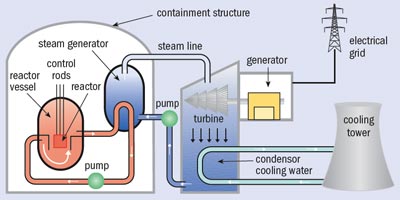
Most of this energy ends up as the kinetic energy of the fission products, which generate a lot of heat by colliding with surrounding atoms. This heat is carried away by a coolant such as carbon dioxide or water (which forms the primary coolant circuit) and is used to heat boilers in a secondary circuit that produces steam to drive a turbine and generator – just as in a power station based on fossil fuels. Of the neutrons released, some will escape from the reactor while others are absorbed, but about half will split further uranium nuclei, triggering a chain reaction. To keep this process under control most reactors require a moderator – usually made of graphite or water because their light atoms are good at absorbing the kinetic energy of the neutrons.
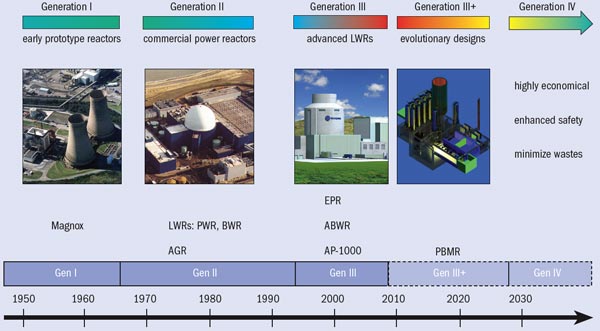
The world’s first commercial nuclear power station opened in the UK in 1956 at the Sellafield site on the Cumbrian coast, and it ran for almost half a century before closing in 2003. The four Calder Hall reactors were of the Magnox type, which means they used a magnesium “no-oxidation” alloy to encase the uranium fuel rods. As well as retaining volatile fission products, such as caesium and strontium, this Magnox cladding has a low neutron-absorption cross-section and therefore reduces “parasitic absorption” of neutrons. Made of graphite and containing holes both for the fuel rods and to allow the cooling gas to flow, the moderator slows the neutrons by elastic scattering such that their kineticenergy distribution becomes comparable to that of a gas in thermal equilibrium with the graphite. Since at these energies neutrons have a much higher probability of interacting with atoms, Magnox reactors can use fuel containing naturally occurring levels of uranium-235 (about 0.7%), avoiding the need – and expense – for the uranium to be further “enriched”.

By the early 1970s the UK had 11 Magnox nuclear power stations (containing a total of 26 individual reactors) either fully operational or in various stages of construction or planning. It had also exported the Magnox design – since termed “Generation I” – to Japan and Italy, which each have one plant. In a bid to increase the ratio of electrical to thermal power output, however, the then Central Electricity Generating Board introduced the advanced gas-cooled reactor (AGR) concept – now referred to as a “Generation II” design. First opened in the mid-1970s, all seven AGR stations (14 reactors) in the UK are still operational.

The moderator (graphite) and coolant (carbon dioxide) are the same in both the Magnox and AGR designs. However, AGRs have much higher thermal efficiencies by operating at a temperature of 600 °C as opposed to about 370 °C in a Magnox unit. Since at high temperatures uranium undergoes a crystalline phase change that makes it expand, potentially weakening the cladding, AGRs use uranium oxide as their fuel. And as Magnox becomes soft and may even ignite in air at AGR temperatures, stainless steel is used as the cladding instead. Since stainless steel absorbs more neutrons than Magnox, AGRs require uranium with a uranium-235 content of a few per cent, the extra cost of which is recovered through increased energy output of the fuel.

The UK also carried out research into “fast reactor” designs until the early 1990s, for example at the Dounreay site in northern Scotland. These reactors have no moderator and the neutrons released in a fission event therefore retain their large kinetic energies. As a result, fast reactors can convert depleted uranium (i.e. uranium with almost all of its uranium-235 removed) into plutonium, which can also be used as a nuclear fuel. Since for every plutonium atom destroyed through fission at least one more is created in spent fuel, the fast reactor – or breeder reactor – creates more fissile material than it consumes, thereby potentially increasing nuclear fuel reserves enormously.

Since the energetic neutrons in a fast reactor have a lower probability of interacting with another nucleus, however, the reactors require more dense fissionable material and materials that can survive very large neutron fluxes. As a result, fast reactors are more complex and expensive than Magnox reactors or AGRs, partly because they require an additional cooling circuit, and the design was never used commercially.

Light-water reactors

Elsewhere in the world, France initially followed the UK’s lead by building reactors similar to the Magnox design during the 1960s. Meanwhile, the US realized that the most economical reactors are those that are collectively referred to as light-water reactors (LWRs). These are simpler to build and to operate than Magnox reactors or AGRs, and they also benefit from economies of scale. The fuel, for instance, has been improved through the joint efforts of many countries so that now it can sustain higher useful energy outputs than AGR fuel, which was developed by the UK alone.

LWRs use ordinary water as a moderator and as a coolant, running on uranium-oxide fuel enriched with up to 5% uranium-235 and contained in a zirconium alloy cladding. LWRs come in two basic types: the pressurized water reactor (PWR) and the boiling water reactor (BWR). PWRs maintain the water in the primary coolant as a liquid and raise steam in a secondary circuit that operates at a lower pressure (see “Power from the nucleus” figure). In contrast, BWRs use a single, two-phase water–steam pressure circuit in which the steam from the core directly drives the turbine. The advantage of this design is that it does not require a secondary coolant circuit and the associated heat exchangers, pipes, valves and pumps. However, this advantage tends to be offset by increased complexity in other aspects, notably maintenance and decommissioning because the steam travelling to the turbines is radioactive and hence contaminates them.
Many of the advantages of LWRs stem from their very compact reactor cores, which are possible because water is the most effective of all commonly used moderators at slowing down fission neutrons. This makes LWRs more economical and much easier to build and operate than Magnox and AGR plants (although the latter do not require such high levels of uranium enrichment). For example, the pressure vessel in which the reactor is contained plus all the surrounding structures are small enough to be built in a factory and transported to site, whereas Magnox and AGR pressure vessels are so big that on-site construction is required.

Although the UK had designed AGRs to be competitive with LWRs, which they almost were, the design ended up being slightly more expensive to build and operate than LWRs. Combined with their slightly worse operational performance, the competition from LWRs was too much in the end – a bit like Boeing versus the small UK aircraft manufacturers. The UK recognized this by deciding to follow its AGRs with PWRs, and the construction of the UK’s first and only PWR – Sizewell B on the Suffolk coast – began in 1988. Indeed, of the 436 reactors currently in operation worldwide 357 are LWRs of which 264 are PWRs, and it is the latter that are predominantly being built today.

New builds

Today many countries are grappling with the problem of how to meet their energy demands while producing less carbon dioxide, and the UK is no exception. When former UK Prime Minister Tony Blair came to power in 1997 – two years after Sizewell B came online – he decided to “park” the issue of nuclear power. But it now seems clear that the UK government has accepted that the only way to meet its ambitious targets for reducing carbon-dioxide emissions is to at least maintain the currently 18% contribution that nuclear energy makes to its “energy mix”.

Building of a nuclear power station does not take place over night. When and if the UK government decides to go ahead with a new fleet of nuclear plants (a decision that is currently under consultation and which will be finally taken in October), it then needs to decide what technology to opt for and who will build and operate the plants. These latter choices are left to market forces, based on whichever consortiums of reactor vendors and owners come forward, and are then subject to stringent safety and environmental criteria. In total, it takes about 10 years before a new nuclear plant can be hooked up to the national grid.

The two mostly likely candidates for new-build reactors in the UK are, like Sizewell B, PWRs: the Areva EPR (European pressurized water reactor) and the Westinghouse AP-1000 (AP stands for “advanced passive” and the 1000 denotes the 1000 MW of electrical power that such units can produce). Other design possibilities are the Advanced Boiling Water Reactor (ABWR), which is basically an optimized version of the BWR, and the Advanced Candu Reactor (ACR), which is based on the very successful Canadian Candu reactors. These units are similar to PWRs but use heavy water (D2O) as a moderator. Heavy water captures almost none of the neutrons, but as it contains deuterium it is very good at slowing them down. This means that more fission neutrons are available, allowing ACRs to operate with very low-enriched fuel.

The common feature of all these “Generation III” designs is that they are simple to operate: they require less intervention, less fuel and are easier to maintain than previous designs. They also have advanced, passive safety features that rely on physical forces such as gravity and convection, with little or no need for mechanical devices such as pumps. However, campaign groups such as CND and Greenpeace have effectively ignored such features and instead have concentrated on raising concerns about the nuclear waste that a new fleet of nuclear power stations would produce.

While it is certainly true that more nuclear power stations will mean more nuclear waste, the volume of waste generated per kilowatt-hour output will be much less in the new designs than in the older ones. For instance, a fleet of 10 new gigawatt-capacity LWRs would deliver about twice the amount of electricity over their 60 year lifetime as the current fleet yet would produce only about an extra 10% of high-level radioactive waste over the same period under reasonable assumptions. Furthermore, these new reactors could allow us to utilize reserves of civil plutonium by using “mixed oxide” fuel made of uranium and plutonium oxides.

The AP-1000, EPR, ACR and BWR designs all use the same fuel, pressure vessels, steam generators and other key components as today’s operational Generation I and Generation II reactors. New stations based on these designs could therefore be built immediately. Indeed, an EPR is already being built in Finland (see “Generation III” figure), with one in France to follow, while China has ordered several AP-1000s. Perhaps 20 years from now, however, we may be ready to build what are known as Generation IV reactor designs.

Generation IV

In the late 1990s the US Department of Energy selected six Generation IV designs from a shortlist of more than 100 concepts to “broaden the opportunities for the use of nuclear energy”. Three of these designs are fast reactors, which have a sustainable fuel cycle in which plutonium-239 is produced from uranium-238 neutron-capture reactions and could therefore operate for many hundreds of years with existing uranium reserves. The three fast-reactor designs differ mainly in the choice of coolant: namely liquid sodium, liquid lead and helium gas, some of which are better heat conductors, while some are more problematic if they leak.

Another Generation IV design is the supercritical water reactor, in which water in its supercritical phase is used as a coolant. Water in this state (i.e. where there is no distinction between a liquid and a gas) has a very high specific heat capacity, enabling a higher thermal efficiency than with existing LWRs.

There is also the very high-temperature reactor (VHTR), which is related to current HTR reactor designs such as the pebble-bed technology being pursued by South Africa (see Physics World July 2002 pp42– 43, print version only). These reactors typically use graphite moderators and gas coolants, and hold the prospect of high thermal efficiencies. Furthermore, VHTRs are incredibly safe because the radioactive content of the fuel is contained even if the reactor reaches temperatures in excess of 1500 °C (i.e. 500 °C more than the normal operating temperature).

Perhaps the most exciting aspect of the VHTR design, however, is that it can produce hydrogen via electrolysis in water or thermochemical reactions and thus play a role in a future hydrogen economy. Generating hydrogen is an extremely energy-intensive process, requiring either large amounts of electricity or heat – both of which are plentiful in the VHTR design with virtually no carbon-dioxide emissions. The production of hydrogen does not compromise the performance of the reactor, although it does reduce the electricity output. Using fossil fuels to create hydrogen, on the other hand, is not environmentally justifiable.

The final Generation IV design – called the molten salt reactor – is the most radical. Here the fuel is in the form of a uranium salt that circulates in the coolant so that any loss of coolant would shut down the chain reaction. How this works in practice has not yet been formally decided, as research into the molten-salt design – and all the other Generation IV designs, in fact – is at a very early stage. It is unlikely that all six designs will succeed in a real commercial setting. Some will eventually be discarded as some reactors prove more viable than others. Optimistically, nuclear fusion will start to come along at a similar time and add a brand new dimension to nuclear power.

A nuclear renaissance

The nuclear power industry in Europe (with the exception of France) and the US has stagnated since the mid-1980s, with few new plants having been commissioned. This is partly due to the efforts of antinuclear groups and also the Chernobyl accident in 1986, but market forces have played a role too. In the UK, for instance, competition from natural gas, the deregulation of the energy market and uncertain government support made it difficult for new nuclear plants to secure the necessary private investment. In other countries, competition from cheap coal undermined the case for new nuclear plants, while in both the UK and US the successful extension of the operating lifetimes of existing nuclear plants has, ironically, hampered the building of new ones.

Today, however, we are entering a renaissance in nuclear power. Although not the complete solution to climate change in itself, nuclear power can help slow down global warming and provide a reliable supply of electricity as part of a diverse energy mix. And in a reversal of fortunes, the recent rises in gas and oil prices have meant that nuclear power plants are now the most economic energy option in many countries. Given that oil and gas reserves are beginning to run out, the UK and other governments need to follow the lead set by China, France, South Korea and Japan in pursuing a new nuclear programme.

We can therefore expect to see a new fleet of UK reactors, possibly a mix of EPR and AP-1000 designs, coming on-line in the next 10 to 15 years that will run perhaps until 2080. Before that date we may also see Generation IV reactors, some of which may also produce hydrogen. By then, nuclear power in conjunction with renewables would have helped the UK reduce its carbon-dioxide emissions to a more sustainable level. In contrast, by simply replacing the current nuclear fleet with renewables that supply the same proportion of energy (currently about 19% of the total in the UK) we will make no in-roads into reducing our emissions at all.

With prospects in the nuclear power industry appearing much brighter than they were even five years ago, physicists are likely to find themselves in increasing demand. The nuclear field is of worldwide importance and is one of the few areas where physicists can actually use their skills outside academia. Knowledge of the materials science and heat transfer inside a reactor can be just as important as knowing about nuclear reactions and neutron physics, topics that are taught on postgraduate masters courses (see Physics World April 2006 pp42–43, print version only).

Ironically, the recent successful ruling brought by Greenpeace earlier this year against the UK government’s energy-review process also appears to have signalled a revival of the UK’s nuclear-energy programme, since the government responded with a steely determination to repeat the review and insisted that nuclear power is required. Unfortunately, the protests by environmental groups against nuclear power stations have merely led to more fossil-fuel plants being built. The setting up of the National Nuclear Lab in the UK is further evidence of a nuclear revival, and it seems that the tide is turning and we should now welcome a new dawn for nuclear power.

Box: Keeping a nuclear reactor under control

Contrary to what some antinuclear groups would have you believe, nuclear reactors are not unstable contraptions ready to run out of control at any moment. Sound physical principles are used to ensure the safety of any properly constructed reactor. For example, in a water-moderated reactor the neutrons released in fission are slowed down by collisions with hydrogen and oxygen nuclei (the vast bulk is done by just the hydrogen), making them easier to capture. If for some reason the number of reactions increases, however, the additional heat output will cause the moderator to expand – thereby reducing the reaction rate and preventing the system from running out of control. A similar feedback mechanism called Doppler broadening is provided by the increased absorption of neutrons in the reactor materials as they heat up, and the goal is to design a reactor in which several such mechanisms combine to produce a stable system.


An example of a poorly designed system was the Russian RBMK reactor. In 1986 one such reactor at Chernobyl was responsible for the worst nuclear disaster in history. These reactors used graphite to moderate the neutrons and water to cool the system, which are normally good choices. However, an unfortunate combination of the two made the RBMK extremely dangerous: most of the moderation was provided by the graphite while the water mostly acted as an absorber. As the water heated up it boiled off and so the density of the absorber was reduced. This led to more reactions, which boiled off even more of the absorber, triggering an unstable feedback loop.

Another contributing factor in the accident related to the neutrons emitted by the fission products. The two or three neutrons released in a fission event are known as prompt neutrons, since they are emitted either immediately at the point of splitting or rapidly “boiled off” from the excited fission products. However, these fission products themselves sometimes eject neutrons following beta decays. Although accounting for less than 1% compared with the number of prompt neutrons, these “delayed neutrons” – which can go on to initiate further fissions – ensure that in a normal reactor the power levels in the reactor change very slowly and safely. But at Chernobyl the number of neutrons increased very rapidly and unsafely due to the prompt neutrons alone, causing the reactor to go from 10% of full power to 100 times full power in three seconds. This fault was only present in RBMK reactors, which means that “another Chernobyl” could not happen.

Box: Dealing with waste

The common perception is that nuclear reactors generate large amounts of radioactive waste, that this waste is difficult to manage safely, and that it is somehow different from other toxic waste generated by industry. The reality is different: the volume of waste is relatively low, especially so for the high-level waste comprising mostly radioactive fission products and transuranics (which amount to only a few cubic metres from a 1 GW PWR per year). While this high-level waste represents a significant hazard, half a century of experience shows that it can be managed very safely. As for the much larger volumes of lower-level radioactivity waste, its hazard potential ranges from very low to practically negligible (the average extra daily dose to a worker at the repository for low-level waste near Sellafield, for instance, is of the order of that from eating one Brazil nut a day!). Unfortunately the UK, for instance, has failed to make much progress towards building final geological repositories for its higher-level radioactive waste, having only decided late last year that this is the best way to deal with such material. This is a political rather than technical challenge, and one that is largely independent of whether new nuclear power stations are built or not. Irrespective of whether you are in favour of nuclear power or against it, the existing waste has to be disposed of eventually and will still exist at almost the same magnitude even if we build no new nuclear power stations.

At a Glance: Nuclear power

  • The first commercial nuclear power station opened in the UK in 1956 and today there are over 400 reactors in operation worldwide
  • Most of these plants are light-water reactors, in which water is used both to cool the reactor (thereby extracting energy to drive turbines) and to moderate the neutrons released during fission
  • Producing huge amounts of energy without any greenhouse gases, nuclear power can play an important role in combating global warming
  • Although hampered by the image problem of radioactive waste, nuclear power is once again back on the agenda of several countries, including the UK
  • The next generation of nuclear reactors will be safer and more economical than existing designs and will also produce less waste

More about: Nuclear power

J J Duderstadt and L J Hamilton 1976 Nuclear Reactor Analysis (Wiley, New York)
T Goddard 2006 A future for nuclear power Physics World April pp15–17
K S Krane 1987 Introductory Nuclear Physics (Wiley, New York)
W J Nuttall 2005 Nuclear Renaissance: Technologies and Policies for the Future of Nuclear Power (IOP Publishing, Bristol)
W M Stacey 2001 Nuclear Reactor Physics (Wiley, New York)

Blog life: Asymptotia

Blogger: Clifford Johnson
URL: asymptotia.com
First post: July 2006

Who is the blog written by?

Clifford Johnson is a UK theoretical physicist working at the University of Southern California in Los Angeles, US. His research interests include string theory, M-theory and gravity. He started blogging as one of the group of physicists that produces Cosmic Variance (see “Blog life: Cosmic Variance”), but left to found his own blog a year ago. The title of the blog refers in part to making incremental progress towards a better society.

What topics does the blog cover?

Asymptotia is more personal than many physics blogs, reading a bit like extracts from Johnson’s diary and illustrated with his photographs. Indeed, Johnson says that one of the purposes of his blog is to demonstrate to the public that scientists are normal people with wide-ranging interests. Of course, a lot of what he does is science, and that is well covered, but there are also posts on architecture, the environment, food and drink, and what’s going on in LA. As Johnson says in his introduction to the blog: “There’ll be lots of things. Three chief topics among those will be science, arts, academia…and gardening. Oh, that’s four.”

Who is it aimed at?

Johnson is passionate about science-outreach work, and blogging is one element of that. Thus he tries to make his posts about science accessible to non-scientists. He also talks about his offline outreach efforts, including judging science fairs and appearing on TV. Recently he was asked by glossy magazine King to participate in a feature about successful young black men in America, feeling slightly out of place alongside fashion designers, music producers and basketball players.

Why should I read it?

Being a string theorist, Johnson naturally weighs in on the recent debate triggered by Peter Woit’s criticisms of the theory on his blog, Not Even Wrong (see “Blog life: Not Even Wrong”). In a series of posts entitled “More scenes from the storm in a teacup”, Johnson argues that “the whole business of singling out string theory as some sort of great evil is rather silly”. His posts attracted hundreds of comments from people on both sides of the debate, including big names such as Michael Duff and Lee Smolin.

How often is it updated?

Often more than once a day. Indeed, one of the reasons for Johnson leaving Cosmic Variance was that his co-bloggers felt that his frequent posts were drowning their voices out.

Can you give me a sample quote?

“One of the marvellous things about gardening is the variety of pleasant things that develop as a result of your work, again and again, while you are off doing other things (like your day job). It’s a bit like teaching, in a way: you do your best and hope that one day the results blossom in both the near and distant future.”

Energy solutions

Whether their declaration on climate change turns out to be anything other than warm words remains to be seen. But the leaders of the G8 industrialized nations, meeting in Germany last month, did at least promise “substantial” reductions to the amount of greenhouse gases that their countries emit. And although the leaders could not agree on what “substantial” means in real numbers, it was pleasing that US President George W Bush agreed to “consider seriously” a pledge made by the European Union, Japan and Canada to cut emissions by at least 50% by 2050 – having previously shied away from discussing specific limits – and that he promised to work within the United Nations to create a successor to the Kyoto Protocol, which ends in 2012.

The G8 agreement sounds great in theory. But in practice how can we reduce emissions of carbon dioxide by such massive amounts, while at the same time meeting the ever-growing demand for energy, particularly from the developing world? One important response will be to limit our consumption of energy as much as possible. But it is also essential that we develop environmentally friendly sources of energy and make improvements to those sources that are already in widespread use. This special issue of Physics World examines a few of the areas in which physicists are making – or can expect to make – significant contributions to these challenges, namely by carrying out research into solar and fuel cells, nuclear power, clean-coal technology and energy storage (see pp20–45, print version only).

In the long term, the world will have to invest in renewable energy sources such as solar cells or wind and wave power. But as Physics World has argued before, the best solution to the energy crisis in the shorter term is to build more nuclear power stations. It is sobering to think that China is building power plants at a rate of at least two new 500 MW coal-fired facilities each week. In addition to the vast amounts of carbon dioxide that are pumped out when coal is burned, mining is a dangerous business: estimates suggest that almost 6000 people were killed in the Chinese coal industry in 2005 alone.

Far better, surely, for China and other countries in the developing world to increase their nuclear capacity. Indeed, there are plans for new types of “Generation IV” nuclear power stations that could even produce hydrogen for use in fuel cells. There are, of course, downsides in allowing countries to develop new nuclear programmes, be it the danger of nuclear-weapons proliferation or the problem of dealing with nuclear waste. But these are issues that can be addressed. In the context of non-proliferation, the International Atomic Energy Agency (see p8, print version only) does much good work, albeit with limited powers.

Despite the appeal of nuclear power, coal will probably continue to play a major role in our short-term energy needs as it is so cheap to burn and is so widely available: there is several hundred years’ worth of recoverable coal left on the planet, making it by far the largest reserve of fossil fuel. Given this reality, we need to improve techniques to capture and store carbon dioxide from coal-fired power stations and find ways of burning it as cleanly as possible. Focusing on nuclear and coal in the short term will give us breathing space to develop the real potential of renewables and perhaps even fusion energy too.

Going loopy over consciousness

Douglas Hofstadter’s writing talent makes his love of paradox contagious. Reading I Am a Strange Loop inclines one to see whimsical connections, language games and self-reference everywhere. Part of Hofstadter invades one’s brain and starts thinking there in its own right – a phenomenon that is itself a theme of the book. Hofstadter, therefore, is in effect co-writing this review, inclining it towards paradox. Which may be why my method of urging you to read the book will itself be paradoxical: I shall summarize why I find it ultimately unconvincing.

Hofstadter, a professor of cognitive science at Indiana University, expresses disappointment that his 1979 masterpiece Gödel, Escher, Bach (one of my favourite books) was not recognized as explaining the true nature of consciousness, or “I”-ness. I have to confess that it never occurred to me that it was intended to do so. I thought it merely explained the problem, highlighting stark flaws in common-sense ideas about minds. It also surveyed the infinite depth and meaning that can exist in “mere” computer programs. One could only emerge from the book (or so I thought) concluding that brains must in essence be computers, and consciousness an attribute of certain programs – and that discovering exactly what attribute is an urgent problem for philosophy and computer science. Hofstadter agrees with the first two conclusions but not the third; he considers that problem solved.

I Am a Strange Loop is supposed to restate and explain his solution: in short, that a mind is a near-infinitely extendable, self-referential loop of symbols that suffers – or rather, benefits – from the hallucination of being an “I”. Furthermore (Hofstadter says paradoxically), that hallucination is itself an “I”. Hofstadter’s “strange loop” is a bit like an ordinary feedback loop, such as the images in a pair of parallel mirrors facing each other, but instead of merely depicting itself physically, it symbolically refers to itself. And unlike ordinary self-referential statements, like this one, the symbol inside a brain that refers to itself as “I” is not used by anyone else: it is someone.

Strangely, Hofstadter’s half of this theory of consciousness (the loopy half), is quite convincing. The unconvincing half is essentially philosopher Daniel Dennett’s theory from his book Consciousness Explained (which critics have justly renamed Consciousness Denied) – namely that our opinion that we are conscious is simply mistaken. Hofstadter calls it the “I myth”. We can, of course, be mistaken about anything, so here Dennett laid down a valuable marker: the true explanation of consciousness will have to refute his position.

Hofstadter is a master of analogy and metaphor, which abound in this book. One of his metaphors is that of a soul (but devoid of religious connotations – these souls are unequivocally aspects of the brain) and, daringly, the idea of differently sized souls corresponding to degrees of consciousness. Children have smaller souls than adults, he says; animals have tiny (but non-zero) souls; the Franco-German philosopher and humanitarian Albert Schweitzer’s soul was bigger than yours or mine. But Hofstadter’s arguments for his analogies are, frustratingly, sometimes compelling but often absent.

The central analogy is between minds and other “strange loops”: certain self-referential statements discovered by Kurt Gödel within formal mathematical systems. These statements assert their own unprovability within the system but are nevertheless provably true, akin to the paradoxical “this statement is false”. And the way Gödel’s proof works is by showing that certain very large numbers also have another meaning, as statements about numbers; and so a proof about numbers – which is itself just a number – turns into a proof about proofs, and in particular about itself.

The author flits between two somewhat conflicting strands of this analogy. He stresses that human consciousness depends on the universality of our thinking – the fact that we can extend our internal repertoire of symbols indefinitely, and eventually refer to anything at all. But he also draws the lesson that self-awareness is the heart of the matter. I do not see why. Most of my conscious thought is not about me. Gödelian statements refer meaningfully to themselves, but are not conscious. Universality implies the ability to contemplate oneself, but the converse is not true.

Correspondingly, Hofstadter does not seem to be able to decide whether animal minds are merely quantitatively inferior (“small-souled”) or qualitatively. On the one hand he says that the “huge and fundamental breach between humans and…all other species…makes us unique, and…gives us what we call ‘souls'”. Yet, on the other : “to argue…that the word ‘soul’ does not even apply to animals…seems to me more like received dogma than like mature reflection”. I think Hofstadter was right the first time: animals are not miniature people but are fundamentally different, and unmysterious, things. They cannot create new meanings at all because they lack the as-yet-unknown attribute of human brains that gives them universality.

The more Hofstadter invokes souls, feelings and animals – and the less he discusses computers, mathematics and meaning – the more, it seems to me, emotion replaces reason. For instance, what is his evidence for Schweitzer’s oversized soul? Firstly, that Schweitzer empathized with insects. So if a soul is measured by its empathy with the small-souled, would an even greater soul empathize with cucumbers? Secondly, Schweitzer loved Bach’s organ music, and musical taste is apparently a soul-size indicator. Hofstadter’s argument for that? Absent. The animal theme culminates in a veritable celebration of sentimental anthropomorphism, describing Hofstadter’s own “ability to mirror the interiorities” of grasshoppers and ants while listening to the music of Bach.

Hofstadter argues that emergent entities (such as people) and abstract concepts (such as numbers, and meanings) really do have causal effects on the microscopic constituents of events. He imagines a computer made of toppling dominoes that is designed to factorize integers. It is presented with the input “641” and set in motion to perform its computation. Why is one particular domino left standing? The most fundamental explanation does not refer to the sequence in which the other dominoes fell; rather it is “because 641 is prime”.

I see no escape from this argument: regarding microphysical explanations as more fundamental than emergent ones is arbitrary and fallacious. Yet, from Hofstadter’s point of view, I seem to have catastrophically missed the point, for he eventually disowns the argument. Consciousness (in its guise as free will), he says, cannot “push material stuff around” because “physical law alone would suffice to determine [its] behaviour”. But physical laws can’t push anything! They are just predictions and explanations – and by no means our only ones. Here I wondered what the point of the “641” argument was in the first place, and indeed of the whole book. Finally, Hofstadter embraces irrationality itself: “Our very nature is such as to prevent us from understanding our nature”.

I judge claims to understand consciousness largely by this question: can you use that understanding to create an artificial-intelligence program? Judged by that criterion, Hofstadter does not have the answer. However, his claim that our nature prevents us from understanding our nature cannot be taken at face value. Like a Gödelian claim to be unprovable, it applies only inside the system from which it is derived, namely Hofstadter’s own philosophical framework. But, again like Gödel’s construction, this simultaneously reveals that there is a truth to be discovered outside of that framework.

Something new is needed to discover that truth, and Hofstadter’s loops are probably involved. “Strange loopiness” is a distinctive form of emergence, rooted not in complexity but in universality, the real substrate of “I”-ness. That is why, if you want to understand what an “I” is – what you yourself are – you should want to read this book. Unless your soul is too small.

No-way physics

Many principles of physics are of the form “If you do this, what will happen is that.” Newton’s second law, for example, says that the acceleration of a particular mass will be proportional to the force applied to it. Such principles imply that certain effects are practically impossible. A small number of principles, however, belong to a different category. These say, in effect, “That cannot happen.” Such principles imply that certain effects are physically impossible.

Notorious examples of the latter include the first two laws of thermodynamics. The first law says that energy cannot be created or destroyed (“You can’t win”), while the second can be stated in several forms, such as that heat cannot be transferred from a colder to a warmer body or that the entropy of a closed system always increases (“You can’t break even, either”). Other examples include Heisenberg’s uncertainty principle and the relativity principles regarding the impossibility of recognizing absolute velocity and the prohibition of faster-than-light travel.

Such principles often represent not “new physics” but deductions from other principles. What is different about them is their form. And to say that something is physically impossible tends to make scientists want to rebel.

No way

The physics of impossibility goes by several names. “Forget-about-it” physics is one; “noway” physics is another. Half a century ago, the mathematician and historian of science Sir Edmund Whittaker referred to “postulates of impotence”, which assert “the impossibility of achieving something, even though there may be an infinite number of ways of trying to achieve it”.

“A postulate of impotence”, Whittaker wrote, “is not the direct result of an experiment, or of any finite number of experiments; it does not mention any measurement, or any numerical relation or analytical equation; it is the assertion of a conviction, that all attempts to do a certain thing, however made, are bound to fail.”

Postulates of impotence thus resemble neither experimental facts nor mathematical statements true by definition. Nevertheless, such postulates are fundamental to science. Thermodynamics, Whittaker said, may be regarded as a set of deductions from its postulates of impotence: the conservation of energy and of entropy. It may well be possible, he argued, that in the distant future each branch of science will be able to be presented, à la Euclid’s Elements, as grounded in its appropriate postulate of impotence.

But no-way physics is important to science for another reason: it attracts contrarians. I am not talking about the endless attempts by frauds and naifs to get round the laws of thermodynamics by creating perpetual-motion machines. Rather, I mean serious physicists who find no-way physics a challenge to devise loopholes. In seeking these loopholes, they end up clarifying the foundations of the field.

Contrarian physicists played a key role in both the discovery and the interpretation of the uncertainty principle. In 1926 Werner Heisenberg was promoting his new matrix mechanics – a purely formal approach to atomic physics – by claiming that physicists had to abandon all hope of observing classical properties such as space and time. Pascual Jordan played the contrarian by devising a thought experiment to get round such claims.

Jordan argued that if one could freeze a microscope to absolute zero, then it should be possible to measure the exact position of an electron, say, or the time of a quantum leap. This seems to have inspired Heisenberg to think about the interaction between the observing instrument and the observed situation, which led him to the uncertainty principle. Jordan, the contrarian, forced Heisenberg to think operationally rather than philosophically, and to clarify the physics of the situation.

Another example of contrarian physics was James Clerk Maxwell’s thought experiment involving a tiny creature who operates a small door in a partition inside a sealed box. By opening and shutting the door, the “demon” – as it was later called – lets all the faster-moving molecules into one side of the partition, violating the second law of thermodynamics by getting heat to flow to that side. The discussion of this thought experiment helped to clarify the then-mysterious concepts of thermodynamics.

The critical point

Heisenberg once wrote, “Almost every progress in science has been paid for by a sacrifice, for almost every new intellectual achievement previous positions and conceptions had to be given up. Thus, in a way, the increase of knowledge and insight diminishes continually the scientist’s claim on ‘understanding’ nature.”

Heisenberg is overstating the point: surely the advance of science involves developing more subtle and complex concepts that encompass the simpler existing ones. But these more subtle and complex concepts are often produced by those who are dissatisfied by the prospect of having to make the kind of sacrifice Heisenberg mentions.

Dissatisfaction is a powerful driving force in science, and it can arise in many ways. Sometimes it springs from a scientist’s sense that a confusing heap of experimental data can be better organized. At other times it arises from the feeling that a theory is too complicated and can be simplified, or that its parts are not fitting together properly. Still other dissatisfactions arise from mismatches between a theory’s predictions and experimental results.

No-way physics produces a special kind of dissatisfaction, involving the collision of science with our hopes and dreams – of limitless energy, of superluminal travel, of pinning things to specific places at specific times. Humans seem hard-wired to have such hopes, and hard-wired to balk at the science that dashes them. Small wonder then that no-way physics leaves them dissatisfied. But science wins in the end.

Once a physicist: Lenny Lipton


How did you first become interested in physics?

I was not like other children in my neighbourhood or school, and I wasn’t like my parents. From an early age I built things, like telephones and projectors, and painted, sculpted and spent time alone when other children were out playing. I read about scientists in the school library and dreamt of being a space explorer; and I loved the science fiction of H G Wells and Robert Heinlein. But the truth is that I don’t know how I got interested in physics. In retrospect, I’d have to say it was nature because it certainly wasn’t nurture.

Where did you study physics and how much did you enjoy it?

I got my undergraduate degree in physics at Cornell University. I started in electrical engineering but I felt the physics students were closer to my more eccentric and independently minded personality. I loved the idea of physics more than doing it; I hated problem sets with a passion. The opinions of my professors were decidedly split on the subject of my abilities – some thought I was a lost cause but a couple saw the spark of something.

How did you become interested in stereoscopic images?

When I was about 10, there was a stereoscopic boom. I became aware of 3D photography, comic books and movies. I began to do my own experiments on the polarization of light, and started designing stereoscopic projectors. For me, stereoscopic images were a thing of wonder and beauty, and I never saw the difference between the art and science of stereopsis.

How did your career develop after you graduated?

I had an independent income from song royalties (I wrote the lyrics to “Puff the Magic Dragon” while at university) and then a book that I wrote (Independent Filmmaking), which stayed in print for 20 years. So I could do whatever I wanted. I made films and wrote books for about a decade, but then one day in 1972, it suddenly occurred to me that my calling was stereoscopic imaging, and that has stayed with me for the last 35 years.

What are some of your career highlights?

Not many people have the chance to make the kind of contribution I have, and it has been through dumb luck as much as anything else. I created the electronic stereoscopic display industry – not on my own, but if I had never been born it would have taken a different shape or may have been delayed. I turned out to be a good systems designer, and I concentrated on creating an infrastructure for stereoscopic imaging after my founding of StereoGraphics Corporation in 1980. It took a decade of effort. I also turned out to be a pretty good inventor of components and I designed a very early optically compensated liquid-crystal device. That made possible CrystalEyes, the first practical electronic stereoscopic product for computer graphics and video, which is used a lot for molecular modelling. I also invented the ZScreen polarization modulator, inspired by Jim Fergasen, which is the basis for my firm’s 3D movie projector that is now in 700 cinemas worldwide.

What are you working on now at REAL D?

We need to be able to send left and right images – stereopairs – over a single satellite feed from live events to cinemas and I am working on a high quality multiplexing approach to do this. I am also working on the next generation of the projection system, but I cannot tell you any more about that. Very few people know how to do good cinema stereo photography, so I am spending some time working with the major film studios to get their creative people up to speed. I love that part of the job. Finally, we are making progress with electronic displays to produce fine stereoscopic images that can be viewed without eyewear – what people call the “holy grail” in this field.

How has your physics background helped you in your career?

I had a great education at Cornell but I was a decidedly mediocre student. I am a creative and determined person, and I got a lot smarter once I found a field I loved. I see the world becoming one in which children are pointed in the direction of money as an end in itself. I hate living in that kind of a world. Schools need to be more accepting of eccentric people with a different point of view because we are the people who make the difference. We are the people who invent.

Scientists in the melting pot

It is rare to go away for a weekend with almost no idea of what to expect when you get there, but that was very much the case when I arrived in Edinburgh in April last year. I had just flown in from running an experiment at the Argonne National Laboratory in the US, and had five minutes to introduce myself to 30 strangers. With my brain still somewhere halfway across the Atlantic, I fell back on a humorous account of my efforts to promote an Einstein Year event at the University of York where I work. The photographers from the local press had decided to take pictures of me lying face down looking up at some water rockets as they were launched. By the time they got the perfect shot, I was completely soaked and all dignity was lost. The picture looked so dramatic, or ridiculous, that it appeared in several Yorkshire papers. As the assembled group fell about laughing, I knew I was in good company.

I was attending the first of three weekends that made up the 2006 NESTA Crucible programme for early-career researchers. NESTA (the National Endowment for Science Technology and the Arts) has a £300m endowment from the National Lottery to support talent, innovation and creativity in the UK. Being financially and politically independent, NESTA can take some risks in choosing its activities, and Crucible, which aims to enhance the creativity of early-career scientists, is a key part of its mission. The 30 Crucible “fellows” were mostly young scientists drawn from all branches of academia, with a few from industry and government labs. We had applied and been selected largely on the basis of our being receptive to new ways of thinking, and most of us shared a passion for transmitting our enthusiasm for our subjects to the wider public.

Free thinking

It is hard to explain exactly what the objectives of the Crucible programme were. Indeed, the organizers asked us several times what we as participants wanted to get out of it and some of us in the group wondered whether the NESTA representatives actually knew what they wanted to achieve themselves! From my own perspective, the free-form nature of the programme was one of its more enjoyable aspects, but not knowing what was coming next did not always seem to suit some of the more rational scientists in our group.

Our first weekend in Edinburgh passed at breakneck speed, led by the colourful science writer and broadcaster Vivienne Parry. First, we found ourselves up on the crags of Arthur’s Seat, as an expert explained how James Hutton, the father of modern geology, had examined these very rocks and shown that the Earth must be very old. We were later taken to the Botanic Gardens, where we were encouraged to assemble models of well-known molecules from plastic sticks and balls. A NESTA fellow had designed this event and was delivering it as part of the Edinburgh Science Festival. He gamely presented the same introductory talk he would have given to 10 year olds, perhaps not the most advisable approach given the large number of research chemists in the group.

After dinner, we returned to the Botanic Gardens for the privilege of a nocturnal tour, where we were forced to fall back on our night vision and sense of smell to experience the same plants and flowers that we had enjoyed earlier in the day. As well as learning about science communication through participation and discussion, we were given time to reflect on our own career paths with advice from “careers doctor” Sara Shinton.

The second weekend saw us begin in a Cambridge college and finish in Westminster. On the way, we learned how science policy is developed in the UK, through talks by MPs who are interested in science and presentations by organizations such as the Parliamentary Office of Science and Technology. Easily the most restful weekend of the three was the final one held in the beautiful surroundings of Dartington College in Devon. We had asked for – and were given – more space in the programme, being encouraged to dream and look at different ways of working. One of the more popular ideas we came up with was establishing a retreat for young scientists where they could meet likeminded people and spend time on problems away from the daily grind.

Sharing ideas

In our everyday lives, we are constantly pushed for results, yet it would be hard for me to point to concrete outcomes from my participation in the Crucible programme. In a broader sense, however, the benefits are too many, subtle and varied to list. The Crucible programme was put together with care and imagination, and pushed us to think in new ways. It was an amazing opportunity to meet very active young scientists from a wide range of different backgrounds and disciplines.

In academic life, it is a rare treat to be able to spend so much time sharing ideas with people from different areas of the sciences. Indeed, we enjoyed the experience so much that we decided to organize a fourth weekend ourselves, after applying to NESTA for additional funding. I acted as the host for the event, held in March this year at the University of York, which nearly all of the other fellows were able to attend. The weekend focused on issues that we were passionate about, such as public engagement, science education and career paths for young researchers. To keep our identity going, we styled ourselves “The Invisible College” and we are now working on projects including collaborations between scientists and artists, and a leaflet that gives advice about organizing outreach events.

It has been a great privilege to participate in the Crucible programme and I would greatly encourage any young scientists who want to broaden their horizons to apply.

Box: Crucible programme

The NESTA Crucible programme aims to encourage innovation by bringing together bright thinkers from a broad range of scientific disciplines. Each year 30 early-career researchers are selected as “fellows”, spending three weekends together participating in seminars, skill sessions, guest lectures and discussions designed to help them see their work in the broader context of society, politics and the media. Applications for the 2007 NESTA Crucible programme have now closed, but more details of the scheme are available at www.nesta.org.uk/programmes/crucible.

“Cosmic forgetfulness” shrouds time before the Big Bang

Many think of the Big Bang as the “fireball” that triggered the immensely hot, dense state roughly 14 billion years ago to expand into the vast cosmos we see today. But in classical physics there’s a problem: as we extrapolate our models further into the past, they predict the Big Bang as a moment of infinite energy and temperature, called a singularity. Classical models can get to within a hundred-billionths of a second of this singularity, but their equations lose all meaning much before.

To understand the universe at earlier times, physicists need to settle on a theory that can unite the three stronger forces of nature – electromagnetism and the strong and weak forces – with gravity. This means they must reconcile Einstein’s theory of gravity – general relativity – with quantum mechanics, and thus create a quantum theory of gravity.

One such proposed theory is “loop quantum gravity” (LQG), which assumes that time proceeds in finite quantum “jumps”. In LQG, the energies that classically take arbitrarily high values are instead limited by an upper bound. “I realized about six years ago that loop quantum gravity can avoid the singularity, but the equations I used were still too complicated to show the precise form of the quantum state,” Bojowald told Physics Web.

The loss of the singularity, however, opens up the possibility that the Universe could have had a state that extended back in time before the Big Bang. This would mean that the Big Bang did not mark the beginning of the universe, but was rather a transition – or a “bounce” – of the universe from a prior collapsing state to our familiar expanding one.

Now Bojowald has explored whether we might be able to glimpse such a pre-Big Bang universe. He began with a model based on LQG that he devised earlier this year in which the universe’s state is defined by a few parameters, including how it is currently expanding, the amount of matter present and the strength of gravity. By progressively simplifying the model, he was able to find equations of the state of the universe that were exactly solvable at the time of the Big Bang.

Living in the post-Big Bang era, we enjoy a fairly smooth space-time. But before the Big Bang, if such a time existed, there is the possibility that the universe was in a highly-fluctuating quantum state in which even the usual concept of time might have little meaning. Bojowald has found that the sheer size of our present universe gives rise to a fundamental uncertainty in his equations that prevents us from ever learning how big quantum fluctuations before the Big Bang were.

This means that we may not, for example, perform backwards calculations to trace back all aspects of the universe prior to the Big Bang – what he calls “cosmic forgetfulness”. “The fact that some properties cannot be predicted completely was very unexpected,” he said. Nevertheless, Bojowald added that aspects associated with classical behaviour, such as the universe’s size and contraction rate, could in principle be determined.

But John Barrett, a quantum-gravity theorist from the University of Nottingham in the UK, warns that LQG is not widely-adopted among theorists, which could put Bojowald’s conclusions on shaky ground. “LQG is a partially-baked cake,” he said. “There are some aspects one would need to make a complete quantum theory of gravity that just aren’t there yet.”

Astrophysicists draw up wish list

The roadmap identifies six “basic questions” that need to be addressed by the astroparticle community over the next decade:

•What is the nature of dark matter?
•Do protons have a finite lifetime?
•What are the properties of neutrinos?
•What do neutrinos tell us about the interiors of the sun and Earth and about supernovae?
•What is the origin of cosmic rays?
•Can we detect gravitational waves?

To answer these questions, the roadmap recommends that design studies be undertaken on four major experimental facilities that have been proposed by astroparticle physicists. These are the Cherenkov Telescope Array for the study of high-energy gamma rays; the European Underground Rare Event Calorimeter (EURECA) for searching for dark matter; the Large Apparatus for Grand Unification and Neutrino Astrophysics (LAGUNA) for detecting neutrinos; and the Einstein Telescope for the detection of gravitational waves.

The total cost of these projects could exceed €1bn.

Phase two of the roadmap will further prioritize projects and will be produced in September at a meeting in Amsterdam of over 300 European astroparticle physicists organized by ASPERA. The third and final version of the roadmap is expected in July 2008, when budgets will be presented to funding agencies.

Founded in 2001 to foster cooperation among national funding agencies, ApPEC currently includes representatives from 11 European countries. ASPERA was set up by ApPEC in 2006 to coordinate the funding of large astroparticle physics experiments.

Graphene p-n junction is unveiled

Graphene could have great potential as a material for making tiny electronic devices because it is both a semiconductor and a very good electrical conductor – and at just one atom thick, it is about as small as you can get.

Physicists had speculated that graphene could form a p-n junction — which is a basic building block of a transistor — by placing positive and negative electrodes next to the surface of graphene. The positive electrode would attract electrons to the region of graphene below it, creating an area of excess negative charge (an n-type semiconductor). Similarly, the negative electrode repels electrons and creates an area of excess positive charge (a p-type semiconductor). In other words, the graphene now has p-type and n-type regions with a well defined “p-n junction” in the area between the two electrodes.

However, it is not easy to place a tiny metal electrode (or local gate) very near to the surface of graphene without damaging the graphene or changing its electrical properties. The obvious solution is to first deposit a very thin insulating layer on the graphene followed by the metal electrode – but it has proved hard to find an insulating material that will form an extremely thin and well-ordered layer on graphene.

Now, Charles Marcus and colleagues at Harvard University have cracked this problem using atomic layer deposition (ALD) to create a suitable insulating layer by depositing successive layers of nitrogen oxide, trimethylaluminium, and aluminium oxide onto graphene. A metal electrode of titanium and gold was then deposited on top of the insulator.

Marcus told Physics Web that the technique was borrowed from chemists, who had developed it to coat carbon nanotubes, which are essentially graphene sheets rolled up into tubes.

According to Pablo Jarillo-Herrero, a physicist at New York’s Columbia University, who is part of a separate group investigating the use of ALD on graphene, the major advantage of this technique is that it can be used to create a insulating layer with a relatively high dielectric constant compared to other techniques using silicon oxide or polymethyl methacrylate (PMMA). A high dielectric constant is important in very small electronic devices because it allows large enough electric fields to be applied without electrical breakdown occurring across the insulator.

The graphene sheet itself rests on a silicon substrate coated with an insulating layer of silicon oxide. The silicon acted as the second electrode controlling the p-n junction. The researchers measured the resistance of the graphene as a function of the voltages applied to the electrodes – measurements that confirmed that the graphene contained p-type and n-type regions.

To convince themselves that the device was indeed only one atomic layer thick, the team applied a large magnetic field to the device to see if they could observe the quantum Hall effect – the quantization of the conductance of charge carriers, which only occurs in 2D systems. Marcus and colleagues observed the quantum Hall effect in both negative and positive carriers as predicted by a theoretical paper also published in Scienceexpress by Lenoid Levitov and Dima Abanin of the Massachusetts Institute of Technology (Sciencexpress DOI: 10.1126/science.1144672).

Although the team was able to create a graphene p-n junction, Marcus was quick to point out the unlike other semiconductor materials, their device had no energy gap. This means that the junction could not be used in a practical transistor to switch electrical currents. However, physicists already know that graphene can be made to have a band gap if it were fabricated in a very narrow ribbon. Marcus is currently investigating how to apply their ALD technique to creating devices based on narrow strips of graphene that could function as useful transistors.

Meanwhile at Columbia University, Jarillo-Herrero and colleagues are also working on a scheme to create a graphene transistor using graphene ribbons and ALD.

Copyright © 2026 by IOP Publishing Ltd and individual contributors