I wanted to share something I find very exciting, but also [show] how we do science and the fun in doing it. I think we are all scientists in that we can all explore and understand. Most of all, I wanted to connect with people who don’t realize how much they have it in themselves, in their curiosity, to address some of the questions we all ask. That they are part of this human endeavour, this human journey of pushing the frontiers of knowledge.
Why did you call it The Beauty of Falling?
The book explains how our understanding of gravity evolved – how Einstein’s general theory of relativity provides a very good description but fails at a point. The “beauty of falling” is that the theory does fail. It shows us that there’s not an ultimate truth, there’s not an ultimate knowledge and that’s “it”. Science is always a continuous endeavour.
So failure is a good thing, right?
Failure is the best feature that a theory can have because it tells us where to look for new discoveries. We don’t need to do lots of observations and wait until there is a mismatch between observations and the theoretical projections. We know from the outset that eventually we’ll need to uncover new layers of physics – and that to me is very exciting. When you know something will fail, how do you embrace that and move forward?
How do you convert mathematical ideas into language?
For me, the symbols on a blackboard: this is the language. Theorists use mathematics to express thoughts in a rigorous technical way. But after a while, this almost becomes second nature so you don’t even think about the symbols themselves. The concepts, and how they fit together, become much more natural. Setting those equations back in words, and [explaining] what it means practically for the real world, is very important as a physicist. Having a real intuition for how things work is important.
Click here to read Kate Gardner’s review of The Beauty of Falling.
Claudia de Rham decided early in life she wanted to be an astronaut. Her peripatetic childhood meant she spoke several languages, but imperfectly, and was drawn to science as a universal language – a more reliable base from which to understand the world. As her ambition to go into space developed, she learned to scuba dive and to fly planes, having heard these are desirable skills for astronauts.
Years of intense training appeared to pay off when, in 2009, de Rham made it to the final round of astronaut selection for the European Space Agency. In the end, she passed every test except the medical screening, which picked up latent tuberculosis – ruling her out not only in 2009 but forever. Thankfully, de Rham had also been pursuing a career in theoretical physics. So when her astronaut dream evaporated, she threw herself into the hardest challenge she’d ever experienced: understanding gravity.
Her new book The Beauty of Falling: a Life in Pursuit of Gravity is by no means an autobiography wrapped up in popular science, but it does use snippets from de Rham’s life story to explore the science of gravity. Sometimes the connection is straightforward: learning to dive and to fly provides some great visuals for explaining the basics of gravity and its interaction with other major forces. Other parallels are less obvious. Having moved around a lot as a child and as a researcher, de Rham likens the shape of her itinerant life to the curved nature of space–time. The metaphor works; perhaps better than the more standard one of a ball on a trampoline.
Unlike many popular-physics books, de Rham doesn’t linger too long on the history of human understanding of her topic. Three chapters suffice to bring us up to gravitational waves (or “glight” as she prefers to call it) and how we detect them. She then describes how observations of gravity break the rules of general relativity and the various theories of gravity that might be the next step in understanding.
This is where we reach de Rham’s own research on massive gravity, for which she and collaborators have won several prizes and grants. They argue that gravity, like electromagnetism, is both a particle and a wave. And, crucially, that a particle with non-zero mass – the graviton – exists. Its mass would have to be minuscule, of course – they postulate less than 10–30 eV. Gravitons would therefore be difficult – if not impossible – to find. But if they exist, gravitons would resolve some pesky problems in physics.
The book deals with some hugely complex theoretical ideas. Towards the end, even de Rham’s genius for metaphor just can’t keep up and she has to present the actual mathematics. As she says at that point, if a reader has stuck with her this far, they won’t be afraid of a few equations. It’s a reasonable assessment, because The Beauty of Falling is not a light read. While every step is clearly explained, the information is packed deep, tight and dense.
This density may well put off some lay readers, which is a shame, as de Rham is clearly capable of making complex ideas accessible individually. But I got the feeling that the density is intentional, as if de Rham has a point to prove about herself and her capabilities.
Though it isn’t a major theme even in the short biographical sections of the book, de Rham is of course a woman working in a male-dominated field, with theoretical physics being particularly short of women. It’s shocking to hear there were times in her education when de Rham, despite only being in her 40s, was the only woman in the room and that she was explicitly told women couldn’t understand advanced physics. She also struggled for years longer than male colleagues (including her own husband) to find a permanent position.
Thankfully she found a stable home at Imperial College, London, in 2016, where she’s been based ever since. Though she has wound up working on an idea that has been dismissed and even ridiculed by some, it’s clear that de Rham is not deliberately courting controversy; she loves her research. She finds massive gravity compelling and hopes that one day there will be a way to test it experimentally.
The Beauty of Falling is a reminder that the human side of science also includes the formulation of high-level abstract concepts – it’s in our nature to understand beyond what we can observe. Not every reader will follow the minutiae of massive gravity, but we can all empathize with the desire to comprehend it.
2024 Princeton University Press 232pp £20hb
Physics World‘s Matin Durrani interviewed Claudia de Rham about this book and her career. Read the interview here
This article has been updated because the original version incorrectly claimed that the observed electrons follow “chiral paths” and “chiral trajectories”.
Structured electrons with chiral mass and charge have been created by researchers in Germany. The researchers say their work, which is analogous to work done with photons in 2010, achieves chirality in single-electron matter waves without angular momentum. Some other researchers, however, are puzzled by this claim.
In 2010, David Grier of New York University and colleagues created helical optical beams with much greater intensity at the beam edge than at the centre. Then, they showed that objects could be trapped by such beams and, depending on the chirality of the helix, pulled back towards the light source.
“At the time, we speculated that you ought, in principle, to be able to drop matter waves into one of these states,” says Grier. “People have controlled matter waves with light; they’ve created vortices in matter waves, but as far as I know no one has taken the next step and created not just a topological phase but a topological intensity distribution.”
Femtosecond electron pulses
In the new work, Peter Baum and colleagues at University of Konstanz fired femtosecond electron pulses (almost none of which contained more than one electron) from an ultrafast transmission electron microscope at a 50-nm-thick silicon nitride membrane. They directed optical laser pulses with orbital angular momentum at the same membrane.
The silicon nitride was transparent to electrons, but the laser pulses shifted the electron density in the membrane such that parts of the electron’s wavefunction were accelerated and other parts decelerated. This created single electrons with chiral mass and charge distributions. The researchers characterized these with a second femtosecond laser and silicon nitride membrane.
The team showed that, if they used laser pulses with zero angular momentum, the output could be modelled by electrons with no chirality. If the angular momentum quantum number was 1, the electronic charge and mass wavefunction has the chirality of a single, left-handed coil. If it was −2, the wavefunction was a right-handed double helix. They also scattered these chiral wave packets off chiral nanoparticles, with a left-handed electron showing less chirality when scattered off a left-handed nanoparticle and extra chirality when scattered off a right-handed nanoparticle and vice versa.
Imprinting chirality
The researchers explain that the optical pulses imprint chirality onto the electron’s wavefunction, converting it into a coil of charge and mass, without actually giving the electron either polarization or orbital angular momentum. “The coil propagates as a whole,” explains Baum; “the centre of mass is on a line.”
The researchers believe that these properties could be useful in a range of applications including electron microscopy, the study of magnetic materials, and construction of subnanometre optical tweezers. It could even, they say, have cosmological implications if such electron coils occur in nature. “Are they all around?,” ponders Baum, “We are currently starting to explore these possibilities.”
Grier is both impressed and puzzled by the results. “Light you can control essentially with consumer electronics,” he says, It’s much harder with matter waves. I consider this [work by Baum’s team] a really interesting implementation in matter waves of what my group demonstrated in 2010 in light waves.” He does note, however, that other groups have previously implemented chiral optical beams and shaped the intensity of electron beams, and that this research was not cited by Baum and colleagues in their paper in Sciencethat describes their research. (Baum’s team accepts this and say they were unaware of the previous work.)
He is perplexed, however, by the researchers’ insistence that the chiral electron beams have no orbital angular momentum. He says that the chiral wavefunctions the researchers have achieved can generally be expressed as superpositions of so-called Bessel modes. “All but a special few of those superpositions carry orbital angular momentum through a net helical structure in the overall phase,” he says. “You have to do something a bit special to create a solenoidal mode with no orbital angular momentum. I don’t see how [Baum’s team] achieved that balancing act, or how they verified it. It seems to me that they just assume it to be so.”
Miles Padgett of the University of Glasgow in Scotland says that the research is “lovely” and says he “would happily accept that there is something interesting in generating an electron beam which goes above and beyond generating a solenoid optical beam.” He says, however, that “that’s not what [their] paper tells me, because this paper doesn’t recognize the generation of a previous optical solenoid beam [Grier’s work is not cited].” He is also puzzled by the claim of chirality without angular momentum, and is curious about whether or not the chiral electrons generate DC magnetic fields – which would indicate rotation. The researchers have not experimentally measured this.
Painted with light Burrow Farm Engine House on Exmoor in Somerset, UK, photographed with the galactic core in the background. (Courtesy: Shaun Davey)
Shaun suggested our initial face-to-face meet should be at around 11 p.m., on a remote track on the flanks of the wild hinterland of Exmoor National Park in Somerset, UK. We were to rendezvous at the rather delightful what3words coordinates of: ///otters.grins.greet near a monument colloquially named “Naked Boy Stone”.
As is usual when I venture onto the moor, I informed my son before setting off. Mobile signals can get a bit iffy above about 300 m, although what I expect him to do from Oxford, more than 150 km away, I’m not altogether sure. In hindsight, I might also have chosen my words more carefully when I told him not to worry about meeting this man because “We’d followed each other on Twitter/X for years”. Perhaps I should have begun by telling him that Shaun Davey is an acclaimed photographer of the night skies.
Under the illumination of our head torches, we set off, traipsing along a branch-strewn trail that followed a section of the disused West Somerset Mineral Line. Built between 1857 and 1864, the rail track was constructed to carry iron ore from the mines of Exmoor down to Watchet Harbour, for onward shipment to Wales and the steel blast furnaces of the Ebbw Valley.
The last trains ran in 1913, and the isolated location was ideal for our purposes, though it did make our journey somewhat perilous – the edge of the unlit path ran along a deep rail cutting. It was amazing to think that it would have been carved out by manual labour alone. However, my first thought was “that’s one hell of a drop if we slip”.
Our destination was a small stone building that had once housed a steam engine, used to raise and lower the miners and to pump water from the tunnels. Illuminated by a handheld LED lamp, it cast a dramatic picture against the stars.
It’s no mean feat for a photographer to capture objects that are both a few metres and a few light-years away in a single image, but this is where Shaun’s vast experience of landscape astrophotography came into play. He set up two tripod-mounted cameras; one to photograph the landscape and the other to capture the sky, each using different exposure times. Correct exposures are governed by three variables: the shutter speed, the lens aperture and the ISO (detector sensitivity). All are adjustable, so picking the right settings is an art.
When it came to photographing the sky, Shaun mounted the camera on a device fitted with the most powerful laser I’ve ever seen outside a laboratory. He calibrated the camera platform by aligning the laser beam with the polar star. I’d never been so aware of the extent of laser collimation until I witnessed the needle-sharp beam projecting deep into the blackness of the heavens. Once the tracking mount has been aligned, the attached camera can precisely follow the motion of celestial bodies as the Earth rotates. Without the tracking tripod, you’d just get blurred slashes caused by unwanted star – or rather Earth – motion.
It’s no mean feat for a photographer to capture objects that are both a few metres and a few light-years away in a single image
After the photos had been taken, Shaun post-processed them with Photoshop and Lightroom to correct for colour and optical distortions (he uses a wide-angle lens that can make straight lines appear curved). Finally, the images were merged to create one stunning photograph.
Light pollution is, of course, the biggest irritant for astrophotographers, which is why Shaun picked a cloudless night and a location within one of the six designated Dark Sky Reserves of the UK. Nevertheless, light pollution was evident even at 2.30 a.m. Some sources were obvious from the direction of the glow: the industry of Wales (50 km away), Tiverton/Cullompton and/or Exeter (all approximately directly south, and at about 19, 23 and 40 km, respectively), and the Sun. In midsummer, when our expedition took place, it’s never far below the northern horizon.
This adventure kicked off after I posted on X that I’d never seen the Milky Way with my naked eye in my life (I’m 70 years old). Shaun replied with a promise that he could knock that one off my bucket list by showing me the galactic core (the brightest region of the Milky Way at the centre of our galaxy). He kept his promise.
Readers are invited to submit their own Lateral Thoughts. Articles should be between 750 and 800 words long, and can be e-mailed to pwld@ioppublishing.org
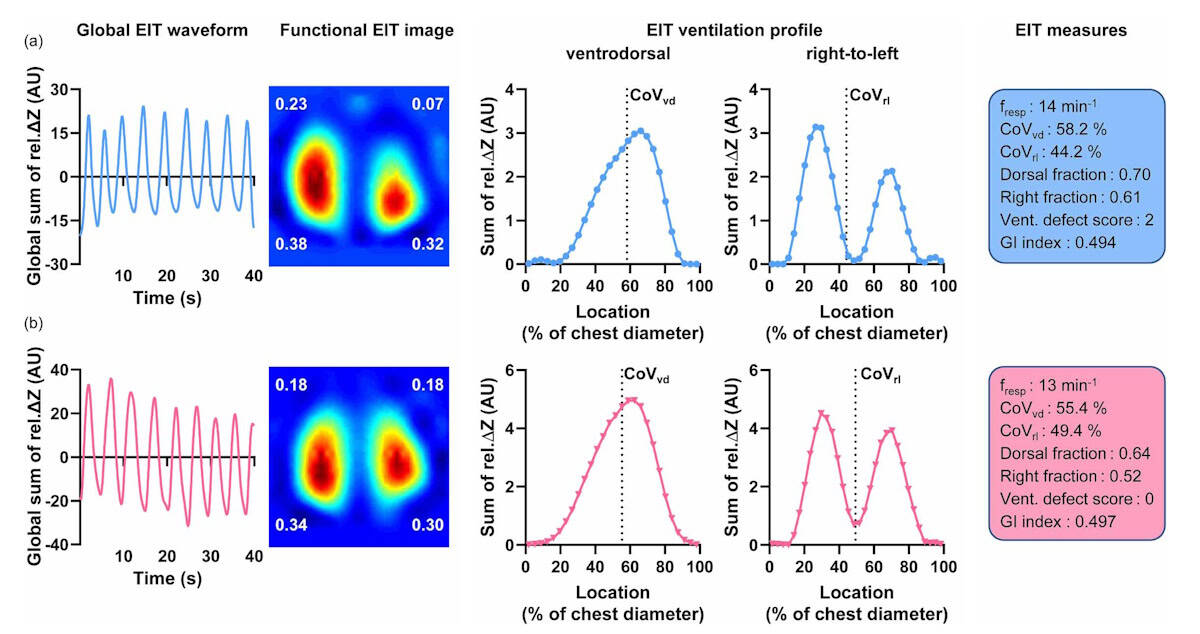
Key differences Example EIT exams in a man (a) and a woman (b). The waveforms show the tidal variation of the EIT signal, while the images show the distribution of tidal impedance variation (the numbers represent the ventilation fraction in each quadrant). The profiles show the distribution of ventilation in the front-to-back and right-to-left directions. The boxes on the right present parameters derived from the EIT data. (Courtesy: I Frerichs et al Physiol. Meas. 10.1088/1361-6579/ad5ef7)
Electrical impedance tomography (EIT) is a radiation-free, non-invasive imaging technique that uses measurements from surface electrodes to create a tomographic image of the body. EIT is particularly suited to assessing lung function: while conventional radiological imaging reveals lung morphology, EIT can be used to directly monitor regional lung ventilation and perfusion, and track changes due to disease or therapy.
To date, however, few EIT studies have examined the respiratory differences between men and women. To address this shortfall, a team from the University Medical Centre Schleswig-Holstein in Kiel, Germany has performed a detailed study of large group of volunteers to investigate how biological sex affects EIT measurements. Their findings suggest that key differences exist, and that these must be considered when interpreting clinical chest EIT studies.
“The anatomical and physiological differences between women and men make it important to determine sex differences in medical research,” explains first author Inéz Frerichs. “The relative lack of studies on sex-dependent differences in EIT findings is related to the fact that the method is not so old and large population studies in this field still need to be conducted. Small pilot studies do not have the power to establish possible differences reliably.”
Detailed data analysis
EIT works by applying small alternating currents through pairs of electrodes attached to the skin near the organ being examined. Measuring the resulting voltage differences through all adjacent electrode pairs enables construction of a 2D tomographic map of the electrical conductivity of that body part.
In their latest study, described in Physiological Measurement, Frerichs and colleagues analysed data from 218 adults with no known lung disorders who had participated in a previous EIT study. The cohort included 120 men and 98 women, with no significant differences between the subgroups asides height and weight. The team examined EIT recordings obtained during about one minute of quiet relaxed breathing (known as tidal breathing), with the subject seated.
The EIT exams were performed using an array of 16 electrodes placed around the lower chest, with the reference electrode attached onto the belly. Data were acquired at a rate of 33 images/s – a high scan rate that allows continuous assessment of dynamic physiological processes.
For all subjects, the researchers calculated the tidal impedance variation (TIV) for each image pixel in each recorded tidal breath and created 2D plots showing the distribution of tidal volume in the chest cross-section. They then quantified this spatial distribution using a series of established EIT measures: the centre of ventilation in the ventrodorsal (front-to-back) direction (CoVvd) and the right-to-left direction (CoVrl); and the dorsal and right fractions of ventilation.
The overall results from the male and female subgroups revealed significant differences in ventilation distribution between men and women. In the right-to-left direction, women exhibited a more symmetric distribution between the right and left lung regions than men, with CoVrl located more at the right side of the chest in male subjects than in female subjects. The right fraction of ventilation was also higher in men than in women.
Differences were less pronounced in the front-to-back direction, but still significant, with CoVvd predominantly located in the dorsal image half in both sexes, but more dorsally in men.
The researchers also calculated ventilation defect scores, a parameter that further defines the heterogeneity in ventilation distribution throughout the lungs. To calculate this score, they determined the fraction of ventilation in each image quadrant, and assigned a value of 0 (for a fraction of 0.15 or higher), 1 (between 0.10 and 0.15) or 2 (lower than 0.10) to each. Summing the four quadrant values gave the overall ventilation defect score.
They observed that ventilation distribution among quadrants was less heterogeneous in women than in men, with 83.4% of women exhibiting low ventilation defect scores (0 or 1), compared with 57.5% of men. A score higher than 1 was found in 42.5% of men but only in 16.6% of women.
Differences matter
The researchers conclude that ventilation distribution detected by EIT is affected by biological sex in this large group of quietly breathing male and female subjects, with the most striking variation the significantly higher right-to-left asymmetry seen in men than in women. They attribute this finding in part to differences in chest anatomy – the left ventricle is much larger in men than in women, even after normalization to body height.
Another possible cause may be breathing mechanics: differences in skeletal chest anatomy mean that women mainly perform thoracic breathing whereas men mainly exhibit abdominal breathing, which creates larger diaphragm motion. As EIT is sensitive to out-of-plane impedance changes, measurements may be affected by the movement of abdominal organs lying above and below the examination plane, particularly as this study used electrodes located at the lower part of the chest. But as the researchers did not monitor the type of breathing during the study, they cannot determine the exact role of this factor.
The findings reiterate the importance of accounting for biological gender when interpreting clinical chest EIT studies. The researchers point out the need for further clinical studies in lung-healthy subjects. “We need to perform large population studies to determine the reference values of several EIT measures for both sexes and also to clarify if sex differences exist when EIT examinations are performed in different body positions and chest sections,” Frerichs tells Physics World.
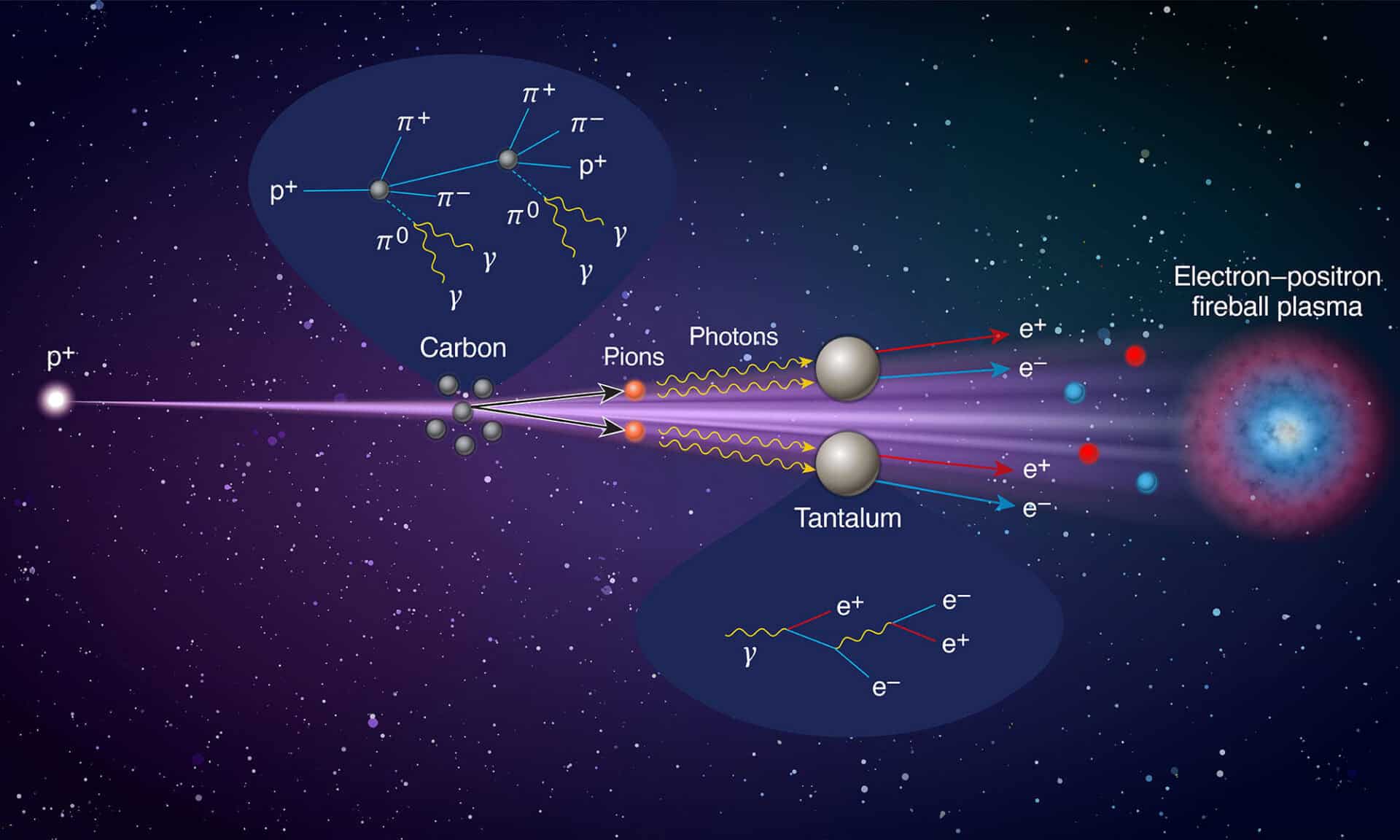
Producing plasma: A proton (far left) from the Super Proton Synchrotron (SPS) accelerator at CERN impinges on carbon nuclei (small grey spheres). This produces a shower of various elementary particles, including a large number of neutral pions (orange spheres). As the unstable neutral pions decay, they emit two high-energy gamma rays (yellow squiggly arrows). These gamma rays then interact with the electric field of tantalum nuclei (large grey spheres), generating electron and positron pairs and resulting in the novel electron-positron fireball plasma. Because of these cascade effects, a single proton can generate many electrons and positrons, making this process of pair plasma production extremely efficient. (Courtesy: University of Rochester Laboratory for Laser Energetics illustration / Heather Palmer)
Plasma “fireballs” are omnipresent in deep space around black holes and neutron stars, but creating artificial versions here on Earth has proved difficult because of the high energies required. Physicists at CERN have now succeeded in generating such plasmas in the laboratory for the first time, using the nuclear research facility’s Super Proton Synchrotron (SPS) accelerator to create high-density beams of relativistic electron-positron pairs. The work could shed light on the extreme astrophysical emission processes that occur in gamma-ray bursts (GRBs) and active galactic nuclei (AGNs).
In general, a plasma is a gas so hot that some or all its component atoms are split into electrons and ions, which can then move independently of each other. However, in the extreme conditions around astrophysical bodies such as black holes and neutron stars, where accretion-powered jets and pulsar winds prevail, plasmas are instead made up of matter-antimatter pairs – electrons and positrons – moving at near-light speeds. These relativistic electron-position plasma beams also appear in blazars, which are AGNs that produce astrophysical jets directed towards the Earth.
The collective behaviour of these electron-positron pair plasmas is different from that of conventional electron-ion plasmas because of the symmetry between the matter and antimatter components, explains Charles Arrowsmith, a PhD student at the University of Oxford, UK, and the lead author of a Nature Communications paper on the work. “The role of these space plasmas is believed to be fundamental to explaining the emission from GRBs and the jets of AGNs, but until now numerical simulations were the only means to validate our theoretical models on the microscale,” Arrowsmith says. “Being able to perform controlled laboratory experiments realizes a decades-long pursuit with the promise of exciting science to come.”
Behaving like true astrophysical plasmas
A member of Gianluca Gregori’s group at Oxford, Arrowsmith worked with Dustin Froula and Daniel Haberberger of the Laboratory for Laser Energetics at the University of Rochester, US to make plasmas using the SPS’s 440 GeV/c beam. Their experiment involved 300 billion protons, each carrying a kinetic energy 400 times larger than its rest mass. “When a proton smashes an atom with such a large momentum, it has enough energy to release its internal constituents – quarks and gluons,” Arrowsmith explains. “This process produces a shower of particles (pions, kaons and other hadrons) that ultimately decay into electrons and positrons.”
The particle density of the electron-positron beams generated at the SPS is high enough for them to start behaving like true astrophysical plasmas, he adds. Indeed, the measured size of the pair beams exceeds that of the characteristic scales required for collective plasma behaviour to occur. According to Arrowsmith, such a beam “opens up an entirely new frontier in laboratory astrophysics by making it possible to experimentally probe the microphysics of GRBs or blazar jets.”
Such studies were previously impossible, he adds, because satellite- and ground-based telescopes cannot resolve the smallest details of distant environments such as GRBs or AGNs. “Our laboratory experiments will now be able to test microphysical models of the behaviour of these space plasmas and the emission processes therein,” he says.
Future experiments might even use these test systems to directly probe the physics of plasmas involving electron-positron pairs. “This will help shed new light on extreme astrophysical emission processes to address as-yet-unresolved questions,” Arrowsmith tells Physics World.
“My understanding of identity has been shattered,” mulls the protagonist in Blake Crouch’s book Dark Matter (2016). “I am one facet of an infinitely faceted being called Jason Dessen who has made every possible choice and lived every life imaginable.”
Authors, poets, writers and film-makers have long exploited the notion of paths-not-taken as a narrative ploy. Early examples include Robert Frost’s poem “The Road Not Taken” (1920), H G Wells’s novel Men Like Gods (1922) and Jorge Borges’s short story “The Garden of Forking Paths” (1941).
But the “many-worlds” interpretation of quantum mechanics has turbocharged the genre, unleashing new possibilities for fiction about different choices, alternative lives and multiple worlds. Recent movies inspired by it include Another Earth (2011), Multiverse (2019), Loki (2021) and the award-winning Everything Everywhere All at Once (2022).
A fundamental principle of the many-worlds interpretation is that any contact between the different worlds is impossible. But a fundamental principle of popular culture is that it’s not, physics be damned. The beauty of using parallel worlds in fiction is that it can neatly exploit our human anxiety over the consequences of taking and having taken actions. In a sense, it reveals the God-like, world-shaping power of the human ability to choose and the depth of our innate desire to live our lives again.
As Brit Marling, co-author and star of Another Earth, told an interviewer: “Sometimes in science fiction you can get closer to the truth than if you had followed all the rules.”
Physics be damned
Quantum-inspired fictional worlds are back in the spotlight after featuring in two Apple TV+ dramas this year – Constellation and Dark Matter. Both use superposition as a device for allowing characters to take forking paths. The former was cancelled after one season, while the latter finished its season in June. The two shows illustrate what’s problematic about the genre.
In Constellation, characters feel and communicate with each other in different possible universes. The show highlights the uniqueness of the emotional ties we form and the joy or devastation we face when these links are severed or reconnected. It’s literally a haunting story where ghosts from other worlds alternately comfort and terrorize.
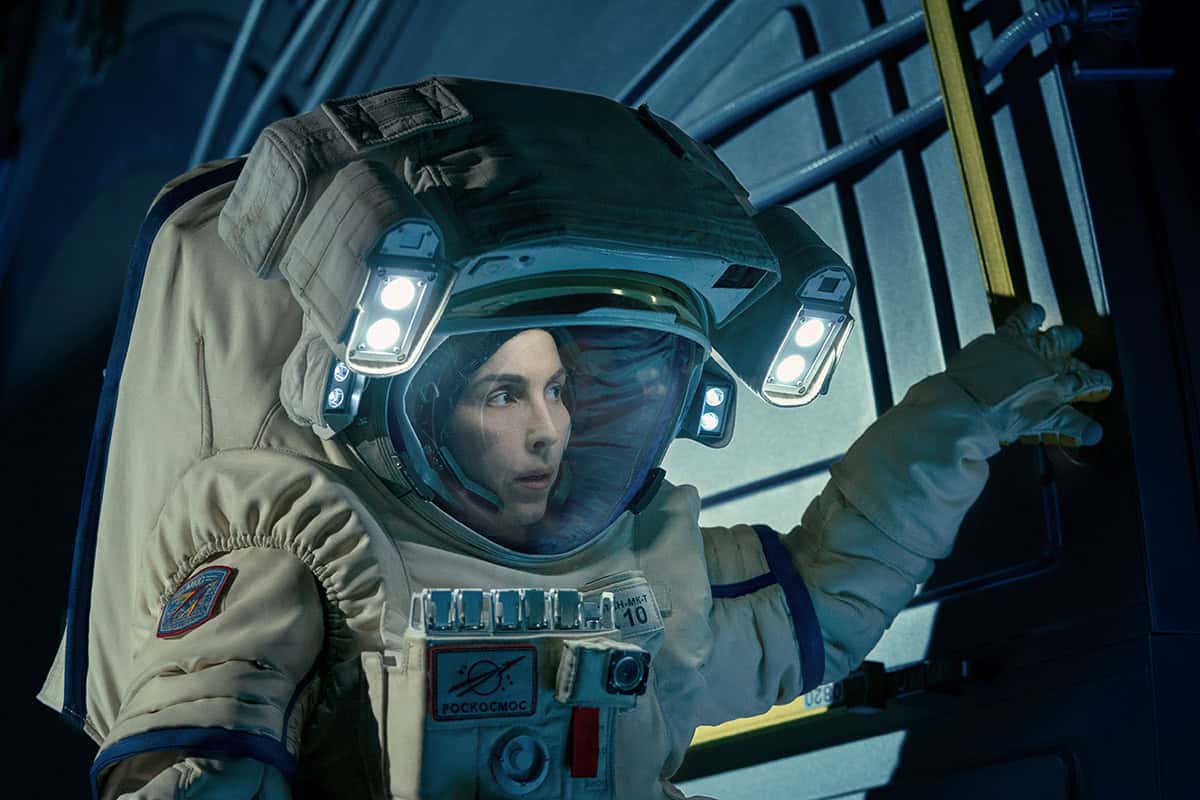
Quantum ghostsConstellation stars Noomi Rapace as an astronaut who returns to Earth after a disaster in space — only to discover that key pieces of her life seem to be missing. (Courtesy: Apple TV+)
Dark Matter extracts somewhat more from superposition. Jason Dessen, a former physicist, has abandoned his brilliant career to spend more time with his wife, Daniela – who has also given up her career as an artist – and their child. In the alternate universe, where he did not give up his career, another Jason – let’s call him Alt-Jason – has used quantum superposition to create a “gateway to the multiverse” that “connects all possible worlds”.
Tired of fame and success, and his “intellectually stimulating but ultimately one-dimensional life”, Alt-Jason wants to take the “road not taken”. Using the gateway, he goes to Jason’s world, brutally beats Jason, sends him to Alt-Jason’s world, and assumes Jason’s role as husband and father. The book and series open with that switch; Jason has to figure out what’s happened and get back to “his” world and his family.
The characters in Dark Matter – the novel and the series – make predictable observations. Dessen, for instance remarks that “we’re a part of a much larger and stranger reality than we can possibly imagine”, and that “my identity isn’t binary…it’s multifaceted”. But the structure also makes possible imaginatively gripping scenes, such as Jason’s horrifying loneliness when he experiences seemingly insignificant things both familiar and unfamiliar, and a home that’s only “almost home”.
In one creepily intense scene, Daniela puzzles over the new quality of her love-making to the person she thinks is Jason but is actually Alt-Jason. We’re no longer like an “old married couple” but like “their first time every time”, she thinks. They smoulder with an intensity “that reminds her of the way new lovers stare into each other’s eyes when there’s still so much mystery and uncharted territory to discover”. It worries her, sort of.
Dark Matter – again, both the book and the TV series – give semi-explanations for the gateway. Thanks to quantum mechanics, scientists can put things in superposition to create worlds with an infinite number of possibilities. As the cliché goes: “Everything that can happen will happen.” People can enter superposition if they take a drug that prevents consciousness from destroying the superposition.
To enter superposition, they enter a box that uses the equivalent of what the show calls “noise-cancelling headphones” to block the intrusion of what would collapse the superposition. Once in superposition, they walk down a long corridor with an infinite number of doors leading to all possible outcomes. One’s frame of mind determines which world you enter.
The critical point
Previous Critical Point columns have provided a taxonomy of science-distorting art – “science bloopers” if you like (see columns from April 2007 and June 2007). Some distortions are well-meaning and create works that would be impossible otherwise, such as Mary Shelley’s Frankenstein. Others, however, are due to inattention or stupidity. Even the title of the 1968 movie Krakatoa, East of Java is wrong (Krakatoa is west).
So are fictional works based on quantum-travel-between-worlds just examples of “harmlessly enabling distortion” (HED, done for a good purpose)? Or should we think of them as examples of “fake artistic distortion” (FAD, done for special effects without caring how science works)? It’s an interesting question especially for philosophers, who have long worried about art having to appeal to its audience’s “sense” of reality, and its tendency to reinforce that sense despite its distortions.
In a similar way, the appeal of TV series based on many-worlds interpretations depends on how agreeably and acceptably they manipulate popular preconceptions about quantum mechanics, such as about time travel, alternate worlds, the reality of superposition, and – most of all – the illusion that the fundamental structure of the world is up to us.
But wouldn’t it be more artistic to portray a universe where quantum systems are what they are – in some cases coherent systems that can decohere, but not via thought control (as in Dark Matter)? If we did that, then artists could speculate about what it’d be like to meet and even trade places with other selves without introducing fake scientific justifications. We could then try to understand if and why we would want or benefit from such identity-swapping, on both a physical and emotional level.
That might really shatter and reconfigure what it means to be human.
Robert P Crease (click link below for full bio) is a professor in the Department of Philosophy, Stony Brook University, US, where Jennifer Carter is a lecturer in philosophy
Back in April of this year we reported that researchers in Germany and Austria were the first to use a laser to excite a low-lying metastable nuclear state of thorium-229. Now an independent team in the US has repeated the feat. Their work is seen as important progress in the development of a solid-state nuclear clock.
Such a device could rival today’s best atomic clocks in terms of accuracy. But unlike atomic clocks, a thorium-based nuclear clock could be a completely solid state device (the best atomic clocks use trapped atoms or ions cooled to cryogenic temperatures).
As a result, nuclear clocks could be much easier to operate outside of metrology labs, where they could find a wide range of applications including precision measurements of Earth’s gravitational field. What is more, because the frequency of such a clock is defined by nuclear forces it could be used to identify physics beyond the Standard Model of particle physics.
The idea of a thorium-229 nuclear clock was first proposed in 2003, but it proved very difficult to make accurate measurements of the frequency of the light involved in the clock transition – something that is key to the development of a clock.
This year, the research has accelerated and now Ricky Elwell of the University of California, Los Angeles and colleagues are the second group to use a laser to excite the clock transition in thorium-229 nuclei embedded in a crystal lattice. What is more, the precision of their measurement of the transition frequency is about an order of magnitude better than that of the German and Austrian team.
Ewell and colleagues report their measurements in Physical Review Letters and the science writer Rachel Berkowitz has written an accompanying piece in Physics. She points out that the team has found that the crystal appears to affect the transition – which could be important for the development of nuclear clocks.
When a space-walking astronaut needs to relieve themselves they often have to do so in adult-style nappies inside their spacesuits. This is not only uncomfortable and unhygienic, but also wasteful too.
The system can collect and purify about 500 ml of urine in five minutes. The urine is first collected via a collection cup made from moulded silicone that is lined with a nylon-spandex blend before being vacuum pumped to the urine filtration system where 87% of the liquid is recycled.
The purified water is then mixed with electrolytes and pumped into a drinks bag where it can be consumed.
“Astronauts currently have only one litre of water available in their in-suit drink bags,” notes Cornell’s Sofia Etlin. “This is insufficient for the planned, longer-lasting lunar spacewalks, which can last ten hours, and even up to 24 hours in an emergency.”
Yet at eight kilograms and the size of a backpack, it might need some miniaturization before it can be used by prospective Mars colonizers.
At the start of her career, Laura Tobin was adamant that she would never be a weather presenter. A trained meteorologist, she was sick of being asked “Are you going to be on TV?” as a joke, aware that it was a comment on her gender as much as her job. “They’re suggesting that you’re going to stand there, point at a screen, and not be credible,” she says.
Today, however, Tobin is a regular fixture on television screens across the UK. Since 2012, she has been a meteorologist and weather presenter for the broadcaster ITV. She says she is grateful she took a chance in her career: “You should never say never. It’s good to give something a go.”
Prepared for anything
Tobin’s career began with a degree in physics and meteorology at the University of Reading, which she completed in 2003. She actually failed the first year of her physics A level (the physics qualification she needed to go to university), but something “clicked” in her second year; she fell in love with the subject and did well in her final exams. “It’s integral to know physics to be able to forecast the weather,” says Tobin. “You need to be able to model the atmosphere and understand how it moves. The atmosphere is essentially a fluid so large parts of my degree were fluid dynamics.“
After graduating she joined the MET Office – the UK’s national meteorological service – as a forecaster. Based in Cardiff, Wales, her work was used to produce local weather services including radio bulletins and forecasts for renewable energy generation, road gritting and hill walking conditions.
This meant that long before she worked in front of a camera, Tobin had to present her work in a way that anyone could understand, which she says was a challenge at first. “When you’re taught scientifically about the weather you have to change the way you speak,” she says.
In her next role, Tobin had to adapt her forecasts to a very different audience. She worked at the Brize Norton Royal Air Force base in Oxfordshire, UK, where she briefed pilots on the weather conditions and delivered reports for the British Forces Broadcasting Service. However, it took her a while to be accepted into the team: “They used to ask me really ridiculous questions. They used to try and catch me out because they wanted to see if I knew what I was talking about because I was a girl and I was young”.
Luckily, Tobin did know what she was talking about. In fact, she has taken a positive lesson from the experience and says she still always over-prepares for any questions that might come her way.
Never say never
When she had been at Brize Norton for five years, Tobin heard that the BBC, a UK public service broadcaster, was recruiting television weather presenters. Despite her earlier misgivings, she decided to give it a go.
When she saw firsthand what the job entailed, she was shocked, “I realized that I had a misconception of what a TV weather presenter was,” she says. The television meteorologists were skilled broadcasters who could deliver regular weather reports in multiple genres, but they also had to understand the science behind everything they said, and they had to be ready to comment on everything from hurricanes to NASA launches.
Tobin took the role and stayed at the BBC for four years before moving to ITV, where she now works on the breakfast programme Good Morning Britain. She has neverlooked back, but the transition to broadcasting wasn’t seamless. When she started at the BBC, her forecasts were prerecorded and she would often have to do many takes to get them right. She had scientific knowledge but effectively presenting what she knew on live television was a skill she had to learn on the job.
Every weekday morning, Tobin has just a few minutes to give viewers all the information they need about the day’s forecast. This can be a challenge, but she says it’s the most effective way to communicate, “I think if I spoke for longer than a minute on a climate report, I would lose people. You need to be succinct.”
A new mission
In Tobin’s early days as a television meteorologist she would occasionally report on an extreme weather event like record rainfall or temperature. These events have grown more and more frequent and now, as she points out, “they’re happening so often that you can’t report them all”. Today, viewers don’t just watch Tobin to decide whether to pack sunscreen or an umbrella, they look to her for credible information about the climate crisis.
In September 2021, Tobin travelled to Svalbard in the North Pole to report on the effects of climate change for ITV. In one video she stands on what was once the edge of a glacier and explains that in the last 40 years the ice has retreated by half a kilometre. Confronted firsthand with the effects of global warming, Tobin is visibly emotional as she delivers one report to viewers.
But Tobin isn’t all “doom and gloom” – she is passionate about raising awareness of the climate crisis because she believes the people who watch her on television can make a difference. Despite facing a backlash from climate change deniers, she is not deterred, and raising awareness of climate change is now Tobin’s mission: “I’d like to hope that I’m inspiring people to make a change.”