Blog life: Backreaction

Bloggers: Sabine Hossenfelder and Stefan Scherer
URL: backreaction.blogspot
First post: February 2006

Who is the blog written by?

A husband and wife team, currently separated by the Atlantic Ocean. Theoretical physicist Sabine Hossenfelder is based at the Perimeter Institute in Waterloo, Canada, and Stefan Scherer works in the editorial office of the Landolt-Börnstein scientific database in Frankfurt, Germany.

What topics does the blog cover?

The blog’s tagline is “a scientifically minded blog with varying amounts of entertainment, distractions, and every day trivialities”. Hossenfelder’s research interests are in extensions of the Standard Model of particle physics, such as extra dimensions and “brane” scenarios. She also talks about day-to-day life at the Perimeter Institute – a centre for theoretical physicists established in 1999 by Mike Lazaridis, founder of the company that makes the successful BlackBerry mobile-communication devices (which all staff at the institute are issued with). Meanwhile, Scherer’s interest in the history of science manifests itself in regular posts commemorating the birth dates of famous physicists such as Henri Poincaré and Heinrich Hertz.

Who is it aimed at?

Backreaction features longer posts and more illustrations than the average blog in an attempt to explain complicated topics in cosmology and particle physics to the layreader. For example, in one post, Hossenfelder explains how an Aero chocolate bar can be seen as a model of the universe, with the chocolate representing the tiny amount of baryonic matter, the other ingredients corresponding to mysterious dark matter, and the empty bubbles that make up most of the volume to dark energy.

Why should I read it?

Hossenfelder provides a humorous take on the recent debate over the status of string theory: one post was supplemented with a sound file she created that set heated remarks by physicists such as Leonard Susskind and Lee Smolin to a musical backing by the band the Fun Lovin’ Criminals. But the blog is not all fun and games – there are also lengthy and thoughtful posts on science and society, and a regular series of entries written by guests explaining why they became physicists.

How often is it updated?

There is usually at least one substantial post every couple of days, with the load being shared between the two bloggers.

Can you give me a sample quote?

Hossenfelder writes: “I have a friend (who shall remain unnamed, but you can occasionally find him in the comment section) with the habit of always being late by at least 15 minutes. He is the truest academic that I know, and the 15 minutes are a part of his personality. Here at PI [the Perimeter Institute], coming late to a seminar or a meeting is significantly tougher, because your BlackBerry beeps relentlessly and reminds you of your slackness (that’s the true reason why we get one). But still, it is possible to be late. The easiest way to achieve it is to make a detour via the kitchen to grab a coffee – our executive director Howard Burton made ‘the importance of coffee and good food’ really clear to the architects, and so it became a priority for the building.”

Clouding the issue of climate

For scientists, the archetypal romantic hero is the unappreciated pioneer working long hours while being scorned for his unorthodox, but ultimately correct, ideas. Galileo is the defining case, though picking just from the field of earth science, Svante Arrhenius, Milutin Milankovitch, Louis Agassiz, Guy Callendar and Alfred Wegener all endured their time in the wilderness before their ideas were finally vindicated. It is unsurprising then that many lone researchers who find their ideas criticized by the scientific establishment like to portray themselves in this light.

Unfortunately, while this “Galileo syndrome” is commonplace, most such ideas turn out to be wrong. The authors of The Chilling Stars would like you to believe that Danish physicist Henrik Svensmark’s controversial view of climate change is the genuine article. But since Svensmark himself is the lead author of this hagiography – irritatingly written in the third person with journalist Nigel Calder – one might be wise to take this declaration with a pinch of salt.

Svensmark’s idea, first mooted decades ago, is that the formation of clouds, and hence the climate, can be influenced by changes in the flux of galactic cosmic rays (GCRs). Claiming that GCRs have an impact on the climate by increasing the density of cloud-seeding aerosols is controversial in itself, as this mechanism has not been well established. But the authors go much further, stating that GCRs are actually the dominant driver of climate change on all timescales from days to billions of years, thus usurping humankind’s supposed contribution to 20th-century global warming through the release of greenhouse gases.

These are extraordinary claims, which will require extraordinary evidence to be accepted. It is therefore unfortunate that the book is more reminiscent of Immanuel Velikovsky’s 1950 bestseller Worlds in Collision – in which the author used ancient mythology to claim that the planet Venus was formed by a comet 3500 years ago – than it is of Galileo’s Dialogue. The link between GCRs and clouds is presented as fact, vague correlations are offered as proof, and everything in history – from the ice ages to the evolution of birds – is reinterpreted in the light of the “new” theory.

A clear example of the authors’ poor logic concerns trends in the Antarctic climate. They take two valid observations – that clouds have a net warming effect on Antarctica, but a cooling effect elsewhere; and that warming in the Antarctic has been less pronounced than across the rest of the globe – and declare that the two facts must be linked via a cosmic-ray effect on Antarctic clouds. Nowhere is there any evidence that Antarctic clouds are in fact correlated to GCRs; no other valid hypotheses (such as the known impact of the ozone hole on polar winds) are discussed, let alone disproved; and the “continental” temperature trend the authors use consists mainly of data from just one Antarctic island. But from this flimsy premise, they unquestioningly attribute all the anomalies of Antarctic climate (of which there are many in the climate record) to cosmic rays. This is scientific chutzpah of the highest order.

The dramatic centre of the book is the description of a recent experiment conducted by Svensmark and colleagues in which GCRs were shown to create small aerosol particles in “surprising” numbers in the lab. This is indeed interesting, and was rightly written up as a paper and published (Proc. R. Soc. A 463 385–396). However, it is far from the ultimate proof of their ideas that the authors claim. The researchers did not show that GCRs could actually produce much larger cloud condensation nuclei, even in the lab, nor how they would affect clouds in the real world even if they did.

In fact, in claiming that GCRs would only affect low-lying clouds and thus produce a cooling effect the authors display a breathtaking ignorance of the complexity of aerosol–cloud interactions. Yet these missing steps did not stop Svensmark from claiming that he had proved that GCRs have “an effect on everyday weather” in the press release accompanying the paper’s publication. For comparison, his theory is not even at the same historical point as the theory of greenhouse gases after John Tyndall’s experiments on the thermal properties of gases in the 1860s. Svensmark and colleagues do not seem to be aware of the huge amount of work that was necessary to get from there to the latest report from the Intergovernmental Panel on Climate Change.

The last few chapters of the book are simply exercises in unconstrained speculation. Any event even vaguely correlated to a hypothetical change in GCRs must have been caused by it, regardless of the absence of evidence. A good example is the onset of the quaternary ice ages 2.6 million years ago. Preliminary work suggested that a large supernova occurred at this time, and the authors discuss at length how this would have led to cooling. Unfortunately for this hypothesis, the dating of the supernova was later revised; but rather than abandon the idea, the authors simply postulate that another as-yet-undetected event must have caused the change instead.

The common thread that is running throughout the book is that since GCRs must affect climate, it is just a question of finding the evidence. If one tack does not pan out, it is discarded and the next one picked up. This is a recipe for being led astray by spurious correlations and turns normal scientific practice on its head.

In reading the book, I was struck by some odd omissions. Nowhere is it mentioned that the first set of correlations between total cloud cover and GCRs published by Svensmark in 1997 disappeared in the light of new data. His second set of correlations, this time only with low cloud cover, are shown, but the fact that those correlations also broke down as the dataset was extended does not get a mention either. Nowhere is there a graph showing cosmic-ray fluctuations in recent decades. In fact, measurements show no significant trends and, since that undermines the authors’ claim that a reduction in GCRs is responsible for the current global warming, it is rather disingenuous to omit this information.

However, this just underlines the clear agenda evident throughout The Chilling Stars. It is not enough for the authors’ theory to succeed, they want the “opposing” greenhouse-gas theory to fail too. Computer modellers are apparently “silly” to be working on “fashionable” theories of anthropogenic global warming. But the reasons why are completely unclear. Are the calculations for the warming effects of carbon dioxide and methane incorrect? Do greenhouse gases have less effect on climate than GCRs? There is no mention of either here.

The authors would do well to consider that the criticism they have received is not due to the implications of their ideas, but to their track record of dubious and premature claims. The sad thing is that their underlying idea may have some merit, but a credible theory is unlikely to emerge from under the weight of this embarrassing bunk.

In support of neutrons

If there is one field of research in which Europe can justifiably claim to lead the world, then it is neutron scattering. Europe boasts the world’s two most powerful sources of neutrons: the Institut Laue-Langevin reactor in France and the ISIS spallation facility at the Rutherford Appleton Laboratory in the UK. But that pre-eminence is being threatened by new facilities such as the Spallation Neutron Source in the US and the J-PARC facility in Japan, which is set to open next year. To maintain its lead, Europe must press ahead with building the European Spallation Source (ESS).

The facility was first proposed over 15 years ago, but progress has been dogged by a lack of political will. Thankfully, momentum now seems to be building (see “Neutron lab comes back from the dead”). The European Strategy Forum on Research Infrastructures, which includes representatives of the member states of the European Union (EU), has deemed the ESS to be a “mature” project, while the EU’s Seventh Framework programme is considering providing the necessary preparatory funding.

Concrete plans to host the ESS have already been put forward by Spain, Sweden and Hungary with support from their national governments. A UK consortium is also seeking to host the facility, backed by three universities in Yorkshire and the local development agency. The UK has a strong case for hosting the ESS because it has the largest neutron-scattering community in Europe – 1200 out of 4500 at the last count. Indeed, a recent report commissioned by the UK government has rightly endorsed the scientific case for more neutrons. The problem for the Yorkshire bid is that it does not have the backing of the UK government, which only wants to build major new facilities at its recently created “campus dipoles” at the Rutherford lab and the Daresbury lab in Cheshire. This is unfortunate, since the Yorkshire bid has much to commend it, having already secured outline planning permission on a site near Selby and promising to rejuvenate the local economy.

What the government should do is initiate a formal process for discussing and evaluating rival UK bids. If it refuses to do this, the government should waste no time in throwing its weight behind the Rutherford lab. Putting forward such a national bid would be the perfect opportunity for Gordon Brown, who will succeed Tony Blair as prime minister, to show that he is fully committed to UK science.

Life, the universe and everything

The title of John Gribbin’s latest book – The Universe: A Biography – suggests we might be in for claims that the universe has a life of its own, but in fact this is a book packed with physics. The particle physics of the early universe, string theory, cosmological nucleosynthesis, the nature of dark matter and dark energy, the formation of galaxies and the solar system, the production of elements in stars and the nature of interstellar dust are all explained in considerable detail and with some style. Gribbin excels at getting difficult ideas such as quantum mechanics across and is a master of the homely analogy. I liked his emphasis that it was astronomical observations that first revealed to us the number of types of neutrinos and showed that neutrinos must have mass.

What makes this book unlike a biography is that very few people are mentioned. Perhaps so many are involved in cosmology these days that it can be overwhelming to name-check them all. As Gribbin says, “It is extremely rare for cutting-edge research nowadays to be carried out by a single country (let alone a single research group at a single university). The days of the lone genius – a Newton or an Einstein – are long gone.” But it still seems odd to talk about electroweak unification without mentioning Abdus Salam and Steven Weinberg, or the cosmic microwave background (CMB) without Arnold Penzias and Robert Wilson.

Indeed, given the significance of the CMB for current cosmological research, it is introduced rather cursorily in just a few sentences. Later we read that “increasingly sophisticated studies…by NASA’s WMAP satellite early in the twenty-first century and the European Space Agency’s Planck Explorer a little later showed that the universe is indistinguishably close to flatness, so its density must be indistinguishably close to the critical density. This left the puzzle of where the ‘missing’ mass (sometimes called dark matter, since it has never been seen) was”. This short extract manages to announce the results from the Planck mission before it has been launched, incorrectly claim that the CMB data prove the universe is spatially flat, and lump together dark matter and the cosmological constant as “missing mass”.

Gribbin castigates those who have been slow to accept the consensus model of cosmology including a cosmological constant, implying that it is a result of their ignorance of the history of their subject. My own impression is that the community has in fact been too quick to accept a picture that lacks a physical motivation. He also has a selective memory of his own research contribution: “I have a fondness for pulsars, since the first important piece of research I ever did, as a PhD student, was to show that pulsars could not be white dwarfs.” In fact, the abstract of his paper with John Faulkner (Nature 218 734) reads: “The rapidly pulsating radio sources may, after all, be vibrating white dwarfs.”

I found the later chapters of the book, on the formation of the solar system and the origin of life, the most interesting. There have certainly been striking new developments in these fields in the past decade. For example, the discovery of “hot Jupiters” – planets the size of Jupiter but much closer to their parent star than Jupiter is to the Sun – implies that Jupiter-mass planets may form in a completely different way to the terrestrial planets.

Gribbin’s marshalling of what is known about organic molecules in the giant molecular clouds where stars form and the composition of meteorites is highly suggestive of his claim that we are finding “the building blocks of the building blocks of life”. Star-forming clouds have significant abundances of hydrogen cyanide and acetylene, which can be used to synthesize amino acids; and traces of glycoaldehyde, which is involved in the synthesis of ribose. Meteorites contain amino acids, carboxylic acid and sugars, including glycerine and glucose. All this suggests that the cloud from which the solar system formed could have made quite complex organic molecules, and even if they did not survive the process of formation of the Earth, these molecules could have been transported to Earth by meteorites.

Work done by Lou Allemandola of NASA Ames on the synthesis of the large molecule hexamethylenetetramine (HMT or (CH2)6 N4) in the interstellar medium is particularly interesting. When warmed in water, HMT forms small hollow spheres, which were also found in the Murchison meteorite that fell in Australia in 1969. These structures suggest a mechanism for the development of the first life either in the Earth’s ocean or, more fancifully, in comet nuclei or even giant molecular clouds. But while Gribbin makes much of the fact that “in the late 1990s, astrobiologists discovered that amino acids found in meteorites are also left-handed”, like those of terrestrial life, there is a problem. Over 50 amino acids are found in the Murchison meteorite, but these do not include all 20 found on Earth; and while there is a moderate preponderance of left-handed molecules, it is not the overwhelming majority found in life.

In the final chapter of the book Gribbin moves on to the possible future of the universe, with a strong emphasis on the “ekpyrotic” model developed from M-theory by Neil Turok and Paul Steinhardt, a fairly wacky model in which the universe cycles between positive and negative cosmological constants as multidimensional “branes” collide and separate. Over all, despite some vagueness and inaccuracies, and the omission of names and references that would allow the reader to follow things up in more detail, I found The Universe: A Biography an enjoyable read.</p

Neutron lab comes back from the dead

When the German government announced in February 2003 that it was withdrawing its support for the European Spallation Source (ESS), the news came as a serious blow to neutron scatterers across the continent. First proposed in 1991, the ESS was to be the world’s most powerful source of neutrons and was designed to ensure that Europe retains its lead over the US and Japan in this valuable approach to materials analysis. Germany’s decision to fund four other large research facilities instead of the ESS precipitated the withdrawal of support from other nations, and the €1.5bn project looked set to be delayed indefinitely or even abandoned altogether.

But times have changed. Continuous lobbying of policy-makers by neutron scatterers across the continent, combined with two very favourable reviews on the scientific importance of a next-generation neutron source – one in the UK and one at a European level – have resuscitated the ESS. In October last year the Spanish and Basque governments declared that they wanted to build the facility in Bilbao, and are currently pledging €300m towards the estimated €1.2bn construction costs. Then in March this year, the Swedish government said that it would provide €325m of the capital costs and 10% of running costs if the facility were built in the university town of Lund in the south-west of the country. And a month later Hungary also officially threw its hat into the ring, although its government has not yet said how much it is prepared to contribute. The UK may also bid to host the facility, although it appears that the British government does not want to back the one group – based in Yorkshire – that has so far put together a proposal.

Peter Tindemans, chairman of the European Spallation Source Initiative (ESSI), which represents neutron labs and their users as well as the various consortia bidding to host the facility, says that with the three firm bids on the table he is very confident that the ESS will now be built. Indeed, he expects that a decision on where it will be built could be taken before the end of the year and that approval of funds could then be forthcoming before the end of 2008. “What is particularly encouraging”, he adds, “is that the governments that have put forward bids are saying they would still participate even if the ESS were not built in their countries.”

The virtue of neutrons

Neutron scattering is widely used by materials scientists, condensed-matter physicists, chemists and biologists to probe the structure and physical properties of a wide range of solids, liquids and gases. The technique is similar to X-ray diffraction except that neutrons interact with atomic nuclei whereas X-rays scatter off electrons in an atom. Neutron scattering is therefore very good at pinpointing the positions of light atoms such as hydrogen, which are abundant within biological molecules, for example. Such atoms are hard to locate with X-rays because the intensity of the scattered beam is proportional to the number of electrons in the atom.

Europe’s 4500 neutron scatterers are fortunate in having access to the world’s two most powerful sources of neutrons, the reactor at the Institut Laue-Langevin (ILL) in Grenoble, France, and the ISIS spallation source at the Rutherford Appleton Laboratory in Oxfordshire, UK. However, these facilities will be overtaken in the near future by the Spallation Neutron Source (SNS) in Tennessee in the US, which will reach a maximum power of 1.4 MW, and a 1 MW source at the J-PARC laboratory in Tokai, Japan.

Like the SNS and the J-PARC facility, the ESS was one of a number of new regional sources that a 1998 report commissioned by the Organization for Economic Co-operation and Development said was needed to make up for an impending worldwide shortfall in neutrons. In common with its US and Japanese counterparts, the ESS would generate neutrons through the process of “spallation”, in which protons are accelerated and then smashed into a mercury target, driving neutrons from the mercury nuclei. At 5 MW it would be considerably more powerful than the US and Japanese machines, providing intense beams of low-energy neutrons. These would be ideal for developing, for example, read heads for computer disk drives, technologies for storing hydrogen, or medical implants.

Despite the ESS promising so much, it was put in limbo by the German government’s decision in 2003 to instead support the construction of a free-electron laser – now known as XFEL – at the DESY lab in Hamburg and an upgrade to the heavy-ion GSI lab near Frankfurt. The UK and French governments also withdrew their support at about the same time. But neutron scientists regrouped, dusted off their plans and launched ESSI in 2004. Their prospects improved in April 2006 when the Council for the Central Laboratory of the Research Councils, which runs the ISIS facility, completed a review of neutron provision with the conclusion that UK scientists would need access to a next-generation neutron source within the next 15 years. Then in October last year, the European Strategy Forum on Research Infrastructures, a body set up by European Union member states and the European Commission in 2002, ranked the ESS among the most mature projects within a list of 35 large-scale facilities that could be built in the continent over the coming years (Physics World November 2006 p8; print version only).

Bob Cywinski, a neutron scatterer at Leeds University in the UK, believes that this endorsement of the ESS, coupled with likely funding for preparatory R&D from the EU’s Seventh Framework programme, means that there is a “very good chance” that the ESS will be built. As Cywinski points out, the design of the facility has been slimmed down by the ESSI – from its original two target stations to one, and there has been a corresponding shaving of the construction costs from €1.5bn to €1bn (in 2000 prices). The single target station – which will serve up to 40 instruments – will be used to produce long (millisecond) pulses of neutrons. These pulses have long wavelengths and can be used to study large structures such as polymers and biomolecules. A short-pulse target station could then be added at a later date. “This approach makes considerable sense,” says Cywinski. “A long-pulse target is entirely complementary to existing facilities and to those being built in Japan and the US.”

Rival bids

Each of the countries putting forward bids believes it can claim the prize. Colin Carlile, a UK physicist who was recruited by Lund University from the ILL, has been impressed by the “open commitment from the university, the region, the national government and industry to build the ESS here”.

Juan Urrutia, president of the executive committee of the Spanish consortium, says that he has no doubt that “Bilbao will be the European city for neutrons.” Meanwhile Laszlo Rosta, scientific director of the company organizing the Hungarian bid, believes that his country may have the edge if European politicians are keen to build an important scientific facility in eastern Europe. He says that the Hungarian government intends to choose between several possible sites (two of which are in or near Budapest) before the end of the summer.

The UK government, however, is proving more reticent. Cywinski, who is heading a consortium of Yorkshire universities that wants to build the facility near the town of Selby, says that the government seems unwilling to discuss the bid even though the consortium has obtained preliminary planning permission. Indeed, a spokesperson for the Department of Trade and Industry told Physics World that “the Rutherford Appleton Laboratory’s expertise in the field of neutrons would make it a highly credible candidate for the next-generation neutron source”, reiterating the government’s previously stated intention to build the ESS at either the Rutherford lab or the Daresbury lab in Cheshire. Member of Parliament for Selby John Grogan points out that with Gordon Brown replacing Tony Blair as Prime Minister, it might be worth “having another go” at putting the Yorkshire consortium’s case to the government.

Negotiating which country should get to build the ESS will almost certainly involve horse trading and political manoeuvring. Tindemans, for example, believes that it would make sense to combine the decision on the site of the ESS with funding arrangements for the XFEL, which is a similar-sized facility that will provide complementary measurements.

According to Tindemans, the host will probably pay between 30% and 50% of the construction costs, with the remainder of the bill likely to be divided out among the other participating nations in proportion to their gross domestic product. In addition to Spain, Sweden, Hungary, the UK and Germany (which had put forward a bid but withdrew it at the end of last year), there are also institutions from France, Switzerland, Italy and Latvia taking part in the project. The total cost of the project over its 40-year lifetime will be about €5bn.

If all goes to plan, construction could begin in 2009, with the first neutrons generated in 2017 and the earliest experiments carried out a year or two later. This would mark the successful conclusion of a long and winding road. For Carlile, however, the fact that two previous designs for the ESS have not been funded makes it imperative that negotiations over the next 18 months go smoothly. “We’ve been to the well twice and returned with an empty bucket,” he says. “If it were to happen for a third time that would be it.”

Science bloopers II

Poster for the film Krakatoa East of Java

In the 1980s ABC News – the news division of the American Broadcasting Company – unveiled a new logo consisting of a stylized image of the Earth, which was animated with the continents moving from east to west: from right to left on the TV screen. Soon after the logo’s debut, someone pointed out the error. The network’s producers made the correction ceremoniously on air during the late-night news programme Nightline. First the existing logo was shown with the globe revolving as usual east to west. Then the globe slowed and stopped, and then began to turn west to east, the direction in which it continued to revolve until the logo was retired some years ago.

Two months ago I discussed varieties of scientific bloopers (see “Science bloopers”). These include “flubs”, which spring from scientific illiteracy, and “gaffes”, which are committed by those who should know better but are easy to fix. The ABC News logo, of which my colleague Roy Lacey from Stony Brook’s chemistry department reminded me, was a gaffe. Other common examples of gaffes include textbook diagrams of DNA molecules spiralling in the wrong direction, rainbows with the colour sequence reversed, and so on.

Gaffes in fiction

Dozens of respondents sent me bloopers of all kinds: in commercials, literature and political speeches, variously involving facts, instruments and procedures. This time I will write about gaffes, which are interesting because the reasons why they are harmful are sometimes murky. Of course, a prominent news agency needs to get the Earth’s spin right, and textbook publishers need to get spirals and colours correct, because such mistakes would undermine their authority. But are gaffes harmful in fiction? Those who commit them are usually trying to make a scene prettier or at least look the way that an ordinary person expects. So does it really matter if few notice or care?

Specialists do notice and care, however, and each field has its gaffe collectors. Greg Budney, curator of the Macaulay Library of Natural Sounds at Cornell University, has a list of movies (Black Hawk Down, Raiders of the Lost Ark) that include noises from birds that do not belong to the region in which the film is supposedly set. The New York Times garden columnist Anne Raver, meanwhile, occasionally writes about botanical blunders in films, such as the appearance of tall, flowering tomato plants in otherwise realistic-looking scenes that take place in Connecticut not in mid-summer but early spring.

Others collect hydrodynamic gaffes, such as clips from films that have incorrectly scaled waves, and meteorological gaffes, including hyping or misuse of the “wind-chill factor” that applies only to bare human skin exposed to wind for milliseconds.

Fred Cohn from New York City reminded me of a notorious geographical gaffe in the title of the early disaster movie Krakatoa, East of Java (1969). Just before the advertising campaign for the film opened, the producers learned that Krakatoa is actually west of Java. A correction was deemed to be too expensive.

Meanwhile, James Lamb, from the Owens Valley Radio Observatory at the California Institute of Technology, noticed an optical gaffe in William Golding’s novel Lord of the Flies, in passages where Piggy’s glasses are said to be used to start fires. Since Piggy is myopic, the lenses would have been diverging and thus ineffective. Lamb finds this disturbing since Piggy is generally taken to represent science and human intelligence.

Thermal physics is a “constant source of science bloopers”, according to Sami Franssila of the Micro and Nanosciences Laboratory at the Helsinki University of Technology. He cites films such as Icestation Zebra, where the Arctic conditions magically transform to a pleasant indoor environment inside an abandoned research hut, and Cliffhanger, in which Sylvester Stallone camps overnight in snow-covered mountains in little more than a wet T-shirt.

My favourite blooper is entomological. In the movie Anaconda (1997), a camera crew ventures “deep into the Amazon” – a location, it seems, that is entirely free of flies and mosquitoes. This allows Jennifer Lopez and the other female lead actor to dress in skimpy clothes – and for male lead Ice Cube to be sweat-drenched and stripped to the waist – as they prance around the rainforest and splash in the river. Mosquitoes would have killed this movie.

In my April column, I cited a gaffe from a biography of the jazz musician Charles Mingus, which claimed he once blared his horn in a tunnel to hear the Doppler effect. Several readers said this was not a gaffe. So, on a recent pass through the Lincoln Tunnel I blared my horn. I heard reverberations, but no Doppler shift. Either I do not drive as fast as Mingus, or my ears are not as sensitive as those of a jazz musician. Both, surely.

The critical point

Such gaffes are amusing – but are they harmful? To explain why this is the case requires me to shift to a more serious tone. We need to get the seemingly trivial features of nature right, even in fiction, because of a much-underrated virtue that the philosopher Paul Woodruff wrote about a few years ago in his remarkable book Reverence: Renewing a Forgotten Virtue.

Reverence, Woodruff says, has fallen out of favour, being absent from recent discussions in ethics, political theory and other areas. Reverence, he thinks, sounds too spiritual and too religious for many people, who value irreverence instead. But in the context of science bloopers, exercising reverence means showing that we value nature. Making public our desire to get the details right is healthy because it underlines that the fundamental features of the world are not up to us. Reverence is a virtue because it cultivates in ourselves and in others the sense that we constantly need to reconfirm – and keep testing – what we think we know.

Sounding out the Big Bang

Our view of the universe is about to change forever. Since science began, all our knowledge of what lies above, below and around us has come from long-familiar forms of energy: light, produced by distant astrophysical objects; and matter, in the form of particles such as cosmic rays. But we are now in a position to study the universe using an entirely different form of energy that until now has never been directly detected – gravitational waves.

A key prediction of Einstein’s general theory of relativity, gravitational waves are vibrations of space–time generated by the acceleration of all forms of mass and energy. Extreme gravitational environments such as black holes or neutron-star binaries generate waves with the largest amplitudes, while the frequency of the waves depends on how such sources move. Small-scale motions, such as those of stellar-mass black holes, generate high-frequency gravitational waves, while larger objects, such as massive black holes, move more slowly and produce lower-frequency signals. Passing through material of any kind at the speed of light, gravitational waves fill the entire universe and may therefore carry information from the beginning of space–time itself.

Around the world several gravitational-wave detectors are currently taking data, in the hope that they will detect these tiny disturbances of space–time directly for the first time. These large interferometers – LIGO in the US, GEO-600 in Germany, VIRGO in Italy and TAMA in Japan – are all looking for minute changes in the relative lengths of two kilometre-scale arms induced by a passing gravitational wave. In the next few years they should be able to detect the high-frequency signals (roughly 100 Hz or more) produced by the most extreme gravitational objects (see figure 1).

Gravitational-wave detectors are not restricted to the Earth: an international project called the Laser Interferometer Space Antenna (LISA) is currently awaiting critical funding decisions that could see it launched in about 2017. Away from the noisy environment of our planet, LISA’s three spacecraft will use lasers to form a trio of interferometer arms each five million kilometres long. The mission will therefore be able to detect disturbances in space–time down to 1 mHz and below, probing a region of the gravitational-wave spectrum that is known to contain a large number and variety of sources.

Since gravitational waves allow us to study the universe with a new form of energy that couples to everything, gravitational-wave detectors may also lead to totally unexpected discoveries – as did the telescope and the microscope in their times. Moreover, gravitational waves provide a detailed record of events that took place in the first second or so of the universe, which should allow us to constrain models such as cosmic inflation and other extreme and uncharted physics of the early universe. Indeed, these ghostly disturbances of space–time effectively turn the early universe into a sophisticated laboratory for ultrahigh-energy physics that could help tackle the problem of quantum gravity.

Probing inflation

Gravity has already revealed to us an invisible universe. About 70 years ago, Fritz Zwicky discovered the gravitational effects of what we now call dark matter, when he realized that the speed with which certain galaxies move could not be explained by the amount of visible matter. Determining the nature of dark matter alone – which is now thought to make up about 21% of the universe – is one of the great challenges of modern physics. Furthermore, about 10 years ago astronomers found that an even larger fraction of the universe (about 75%) is made up of “dark energy” – a gravitationally repulsive substance that is causing the expansion of the universe to accelerate. Can we even begin to guess what we might find when we use gravity itself to probe the universe?

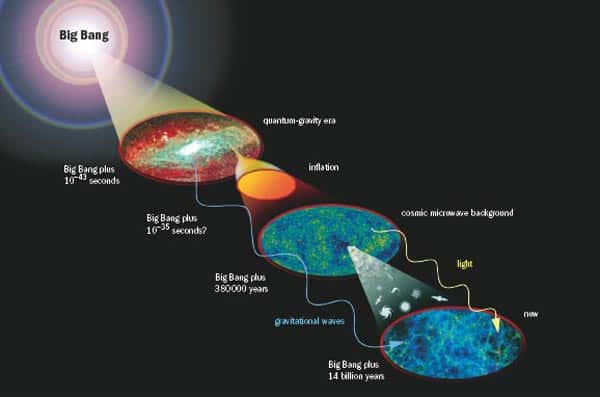
While we are likely to discover unforeseen sources of gravitational waves in the recent (i.e. nearby) universe, one great hope is that gravitational-wave detectors will tell us about the extreme gravitational conditions that existed much earlier in the universe’s history (see figure 2). Electromagnetic radiation has already provided direct evidence of many processes that took place in this era. For example, the spectra from distant matter has indirectly shed light on how light nuclei were produced in the first few minutes of the universe, while the cosmic microwave background provides a snapshot of the universe as it was 380 000 years after the Big Bang.

This background – a cold sea of low-frequency electromagnetic radiation – was produced after the universe had expanded and cooled sufficiently to allow hydrogen atoms to form (a process called recombination). Photons that had previously been scattered by charged particles in the primordial plasma could now propagate freely – their observed wavelength today having been stretched to the microwave region. The cosmic microwave background has told us much about the propagation of acoustic waves in the primordial plasma, among other important results such as the geometry of space (see “The cosmic microwave background”). But gravitational waves can tell us much more about the early universe by probing motion that occurred at such early times and on such small scales that its electromagnetic traces have long since been washed out in thermal equilibrium (see figure 2).

The idea that currently generates the most excitement is the possibility of detecting gravitational waves from cosmic inflation, a period of accelerated expansion that began immediately after the Big Bang during which the volume of the universe increased by a factor of up to 1080 in a tiny fraction of a second. Inflation is the best model we have for explaining the large-scale structure of the universe – in other words, for making the universe big, for kick-starting cosmic expansion and for producing the fluctuations in space–time that seeded galaxy formation. Yet we know very little about the physics of this extremely brief chapter of cosmic history.

As gravitational waves were produced by motion on the quantum scale during inflation, detecting them would indicate the existence of gravitons – the hypothetical particles of gravity and hence space–time itself. These single quanta are thought to have imprinted small fluctuations onto the fabric of space–time that were blown up to enormous scales by inflation. Detecting such primordial gravitational waves would therefore test whether quantum mechanics is correct under very high densities. It would also allow cosmologists to estimate parameters such as the rate of inflationary expansion, which are currently poorly constrained.

Primordial waves

The best way to search for these early gravitational waves is to study the cosmic microwave background (CMB) radiation. Thanks to many beautiful results from experiments such as the Cosmic Background Explorer (COBE) and the Wilkinson Microwave Anisotropy Probe (WMAP), we have already detected the imprint of other quanta in the CMB – work for which COBE researchers John Mather and George Smoot were awarded the 2006 Nobel Prize for Physics. Small differences in the temperature of the microwave background in different patches of the sky are direct evidence for fluctuations in the “inflaton field” that drove inflation. These fluctuations are the reason why matter clumped together to create the galaxies and other cosmic structure that we see today. With even more heroic experimental efforts it may be possible to tease out the much weaker signature of gravitons in the microwave background.

In order to separate the contributions of the graviton- and inflaton-induced fluctuations, we need to study the polarization of the CMB. These photons became polarized – i.e. the electric-field component of the electromagnetic wave tends to point in a particular direction – when they scattered off free electrons either during recombination or a few hundred million years later when the first stars formed and reionized the surrounding gas. Because the pattern of temperature fluctuations in the CMB has a “quadrupolar” component – that is, it is brighter along some axes than along others – the electrons are made to jiggle more along certain directions. This gives rise to different polarizations, but the quadrupolar signal generated by gravitational waves is special because gravitational waves themselves have a purely quadrupolar character. (It is this property that allows us to detect gravitational waves using interferometers, see figure 3.) As a result, gravitational waves can generate polarization fluctuations even in places where there is no local temperature perturbation.

In 2001 researchers working on the DASI experiment in Antarctica detected polarization fluctuations in the CMB at the level expected – i.e. a few per cent of the temperature fluctuations – and since then other experiments including WMAP, BOOMERANG and the Cosmic Background Imager have verified and extended the DASI results (see figure 4). But disentangling the particular polarization signal expected only from gravitons – which involves a vortex-like pattern of polarization – is much harder because its contribution is so small. Detecting the polarization pattern at fainter levels is the target of new experiments such as the Robinson Gravitational Wave Background Telescope (“BICEP”) in Antarctica and of a variety of planned and proposed experiments both on the ground and in space, including the European Space Agency’s Planck Explorer and, eventually, NASA’s Beyond Einstein Inflation Probe.

Indeed, one day it might even be possible to detect these graviton-induced inflationary gravitational waves directly using an interferometer. Given the weakness and high frequency of the signal, the capability to do this is decades away. But one should always bear in mind the possibility of the unexpected. For example, there are exotic “pre Big Bang” versions of cosmology in which the high-frequency waves are strong enough to even be detected with current technology.

If the graviton pattern is found, it will reveal much about how fast the universe expanded during inflation and indeed about gravity itself, since direct imprints of gravitons provide a convincing test of quantum mechanics under unimaginably remote and extreme conditions. On the other hand, like many of the other gravitational effects described here, it might not be detected at all. If inflation happened too slowly, for instance, the graviton contribution may simply be too weak to be detected.

Cosmic phase transitions

It could be that the universe remained gravitationally smooth and quiet after inflation, with few gravitational waves being generated. On the other hand, inflation could have become unstable as it drew to an end, triggering bulk motions of mass and energy that generated lots of gravitational noise. Gravitational waves therefore provide a unique signature of the physics of this and other crucial phase transitions in the early universe that changed the course of cosmic history.

At the end of inflation the huge internal vacuum energy that drove the expansion is thought to have been converted into normal, non-inflating energy – i.e. thermal radiation in the form of many fast moving particles, some of which went on to become the cosmic microwave background. How this phase transition took place depends on the way the internal vacuum energy of inflation couples to other physical fields, such as those described by the Standard Model of particle physics. Although this coupling is not currently understood, models of inflation suggest that a measurable fraction of the inflation energy can indeed be converted into gravitational noise.

There is no reason to suspect that such phase transitions in the universe were wildly different to those seen every day on Earth. Indeed, inflation may well have ended in a phase transition much like that of water turning from a liquid to a gas. When you boil a kettle, heat is converted from energy in the water to energy in the steam, during which the flow of material is unstable: the steam forms in superheated bubbles of water that grow explosively once they convert to the steam phase, turning a tranquil pool of hot water into rolling turbulence. In the early universe a similar instability can be powered by supercooling from the cosmic expansion.

Phase transitions are not new in cosmology. As long ago as 1949 Maria Mayer and Edward Teller wrote a paper about stellar-mass lumps of neutron-rich material formed in a cosmological nuclear phase transition. Today physicists use the Standard Model and particle accelerators to probe nature at still earlier times – and hence higher energies – in cosmic history. Phase transitions are a key part of the Standard Model and its various extensions. For example, quantum chromodynamics – the part of the Standard Model that describes how quarks interact by exchanging gluons – is often associated with a phase transition that takes place at an energy of several hundred mega-electron-volts, whereby the “hadronic” phase of familiar nucleonic matter (e.g. protons and neutrons) emerges from a “quark soup” phase of free quarks and gluons.

At the much more energetic tera-electron-volt (1012 eV) scale of the early universe, the vacuum is thought to have undergone a transition from a “false” vacuum (corresponding to a symmetric universe in which all particles are massless) to the “true” vacuum of broken symmetry and massive particles that we observe at today’s low energies. Pinning down the details of this fundamental “electroweak symmetry breaking” process, with which is associated the famous Higgs boson, is the primary goal of the Large Hadron Collider (LHC) at CERN due to switch on early next year.

The idea of searching for gravitational waves from these QCD and electroweak cosmological phase transitions dates back to papers by Edward Witten of Princeton University and me in the 1980s. Since then, other researchers have linked phase transitions with less well established but cosmologically important physics in the very early universe. For example, in 1993 Andy Cohen of Boston University and David Kaplan and Ann Nelson of the University of California in San Diego, both in the US, suggested that disequilibrium as a result of a phase transition could be partially responsible for the small excess of matter particles over antimatter particles in the universe that we observe today – a critical process about which we have no data aside from the excess itself.

Another fascinating possibility is that a phase transition was responsible for the creation of our 3D space some time in the first few trillionths of a second of the universe. In the 1990s string theorists discovered that our 3D world can be described merely as a 3D “brane” of Standard Model fields that lives within a higher-dimensional space. Shortly afterwards, I suggested that the stabilization of our brane as a result of a phase transition from a different configuration in such brane cosmologies could produce an observable gravitational-wave background – effectively providing a test for a particular version of string theory.

Last year, Lisa Randall at Harvard University and Geraldine Servant at CERN worked out a concrete model of such brane-stabilization dynamics that predicts a very strong transition from a primordial higher-dimensional phase to a “Randall–Sundrum brane phase”, and with it gravitational radiation that would be easily detectable with LISA. As is typical of many such phase transitions, the gravitational-wave spectrum displays a peak at a frequency close to the redshifted horizon size, which is the scale at which the most violent cosmological activity takes place, with a broad power law at higher frequencies from smaller scale motions and at lower frequencies from slower, decaying motion.

Quiet universe

The existence of cosmic phase transitions and their possible gravitational signatures therefore suggests that the early universe may not have been the quiet place it is usually assumed to have been. In all these examples of phase transitions, the energy liberated in the process of settling into a new, lower-energy state is released first in the form of bulk motion and only later does it thermalize into microscopic particle motions. By using gravitational waves to infer the critical temperature or “boiling point” of such transitions and their latent heat we can therefore study cosmic processes that are hard to measure in any other way.

Whether or not we can actually detect the gravitational waves produced by such phase transitions depends on their frequencies and amplitudes. The frequency of the waves is set by the time it takes typical bubbles of “cosmic fluid” to collide, while their amplitude is determined by the size of the bubbles and the speed with which they collide. Both frequency and amplitude are thus determined by the typical separation of bubbles, which can be estimated via general thermodynamic principles from the critical temperature and latent heat without knowing the detailed physics of the transition.

For example, we expect bubble nucleation to grow quickly as the universe cools below the critical temperature of the transition and to stop when the separation between bubbles it is at most a few per cent of the size of the universe at the time of the transition. The efficiency with which energy is converted into gravitational waves, which determines their amplitude, has also been estimated to be about 1% or less. This might sound very small, but since gravitational radiation is redshifted by the expansion of space just like ordinary light, it suggests there could be an additional, noisy gravitational-wave background with an energy density just 100 times less than that of the cosmic background radiation. This is comparable to the amount of starlight in the entire universe.

The frequency of the gravitational-wave radiation depends on when the phase transition happened. The wavelength now is its original wavelength (i.e. about 1% of the size of the universe as it was then) stretched by the amount the universe has expanded since then. For example, the electroweak phase transition has a “bubble scale” of about a millimetre – which is actually not too different from that of the bubbles inside your kitchen kettle – so that is the typical wavelength of the noisy gravitational waves when they were created. Once it has been redshifted to the present day, the wavelength of these gravitational waves is stretched to an enormous 100 million kilometres. This corresponds to a frequency in the millihertz range, which we ought to be able to detect with an interferometer such as LISA (figure 5).

Cosmic symphony

Viewed in terms of gravitational radiation, the early universe provides a powerful physics laboratory that complements particle accelerators such as the LHC. The conditions in the early universe at TeV energies will be comparable in energy to the proton–proton collisions at the LHC, but the cosmic system “lasts” for much longer than the LHC collisions and involves many more particles. Indeed, in terms of phase transitions, which involve the collective effect of many particles, the early universe provides an even better laboratory than the LHC!

Phase transitions and inflation are not, however, the only ways to create strong gravitational-wave backgrounds. Physical theories that go beyond the Standard Model – namely string theory – include exotic structures such as branes and strings in addition to the usual particles and fields. At the microscopic scale of atomic nuclei, string-like behaviour has already been inferred in the way that the strong force binds protons together. But it is possible that much longer stable strings exist, rather like long, thin cyclones in the vacuum.

Such “cosmic strings” – if they exist – could have formed abundantly in the early universe as defects at the end of the inflationary phase transition and then stretched to astronomical size by cosmic expansion, losing energy mostly by emitting gravitational waves. Sometimes they may even crack like whips and make a distinctive snapping gravitational-wave “sound” – a phenomenon that Thibaud Damour at the Institut des Hautes Etudes Scientifique in Paris and Alex Vilenkin at Tufts University in the US have recently suggested would provide telltale signs that strings exist.

The properties of cosmic strings are already constrained by the gravitational waves they produce. For example, the mass per length of cosmic strings must be less than about 10–9 in dimensionless units, otherwise their gravitational-wave background would have been detected by now. In fact, this constraint on gravitational-wave backgrounds does not come from interferometers but from the timing of pulses from distant millisecond pulsars. Like giant flywheels, these distant rotating neutron stars slow down at such a stable rate that you can predict the steady arrival time of pulses with an accuracy of about a microsecond per decade. (These pulses are also used to track orbital changes in the system due to gravitational radiation – the discovery of which provides the best evidence of gravitational waves so far and led to the 1993 Nobel Prize for Physics for Russell Hulse and Joseph Taylor.) The apparent stability of such pulsar signals would be disrupted if there were such a cosmic gravitational-wave background. When LISA launches a decade or so from now, however, the limits on cosmic strings will get very much better and perhaps we will actually detect gravitational noises from them.

Detecting cosmic strings from their gravitational radiation would tell us a great deal about how fundamental physics fits together. Cosmic strings have descriptions both in terms of string theory and quantum field theory, displaying aspects of both that remain hidden in the particles and fields so far discovered. That is potentially important as physicists are on the lookout for concrete links between string theory and the known particles and fields, and how these connect to a quantum theory of gravity. As string theory enters its third decade it is more important than ever to connect these beautiful mathematical ideas with real experimental data. The new science of gravitational waves might therefore reveal, in addition to precise and detailed maps of black-hole behaviour, signatures of new fundamental physics.

At a Glance: Gravitational-wave background

  • A key prediction of general relativity, gravitational waves are generated when a massive system such as a binary star accelerates and changes shape
  • Although there is indirect evidence for gravitational waves, several large interferometers worldwide are currently poised to make the first direct detection
  • Gravitational waves squeeze and stretch space–time as they propagate, carrying information about the early universe from long before electromagnetic waves could propagate
  • Subtle gravitational-wave signatures in the polarization of the cosmic microwave background could tell us how quickly the universe expanded during inflation, while cosmic phase transitions may have left a gravitational-wave background of their own
  • Gravitational waves produced by cosmic strings would connect string theory with the known particles and fields, and help in the quest for a quantum theory of gravity

More about: Gravitational-wave background

T Damour and A Vilenkin 2005 Gravitational radiation from cosmic (super)strings: bursts, stochastic background and observational windows Phys. Rev. D 71 063510

M R DePies and C J Hogan 2007 Stochastic gravitational wave background from light cosmic strings

C J Hogan 2000 Gravitational waves from mesoscopic dynamics of the extra dimensions Phys. Rev. Lett. 85 2044

C J Hogan 2006 Gravitational wave sources from new physics

C J Hogan 2006 The sounds of spacetime American Scientist 94 534

L Randall and G Servant 2006 Gravitational waves from warped spacetime

E Witten 1984 Cosmic separation of phases Phys. Rev. D 30 272

Physicists SCORE for third world

Scientists have long known that sound waves can be generated by irregularly heating a pressurized gas. Now, a new £2m project called SCORE (Stove for COoking, Refrigeration and Electricity supply) is aiming to exploit this “thermoacoustic” principle to develop an affordable and versatile wood-powered generator that will be capable of both cooking and cooling food across the developing world where access to power is severely limited.

The project is being run by leading UK and US researchers along with the charity Practical Action, industry and universities across Africa and Asia. “Though the physical principles are well-understood and the technology has been used before to provide power sources or cooling units on satellites, there has been no research into producing a combined device that can be mass-produced at a reasonable price,” said SCORE researcher Mark Johnson of the University of Nottingham.

In the planned appliance, wood is burnt beneath a gas-filled pipe containing a porous “stack” of small parallel channels. As the gas heats up, it creates a temperature gradient across the stack. This causes the gas molecules to oscillate back and forth against the channel walls, exchanging heat and producing areas of high and low gas pressure, which generate intense sound waves like a singing kettle. Then, as the gas is constantly shifting to and fro between the hot and cold sections of the pipe, it begins to “rhythmically” compress and rarefy, thus enhancing the sound waves.

These sound waves can be harnessed in a linear alternator – akin to a loudspeaker operating in reverse – which converts them into electricity. However, they can also be passed to another thermoacoustic engine working backwards to generate a cooling effect. Here, the gas effectively picks up heat from one end of the pipe, transports it, and drops it off at the other. The ensuing cool part can then be used as a refrigerator. Not surprisingly, the heat from the burning wood can also be used as a conventional cooker.

According to SCORE project director Paul Riley, the use of thermoacoustics avoids moving parts, which will make the device far more reliable than petrol or diesel generators. Moreover, it will produce fewer pollutants and use wood far more efficiently than open fires, which are the primary cooking method for two billion people worldwide. The target is to produce the device for a mere £15 to £20 – less than a tenth of what it currently costs to supply electricity to a rural area.

Riley and his colleagues are now recruiting researchers so the technology can be refined. They hope to produce their first prototype in 18 months, with field trials and mass distribution of the devices in target communities by the end of the five-year project.

Supersolids: the plot thickens

Supersolidity was first predicted in 1969 by Russian theorists Alexander Andreev and Ilya Liftshitz. They said that lattice vacancies, which usually only occur at finite temperature, could still exist at temperatures close to absolute zero in weakly-bound elements such as helium due to quantum “zero point” energy. By cooling solid helium to low temperatures, these vacancies could all collapse into the same ground state, becoming what is known as a Bose-Einstein condensate (BEC). In this supersolid state, vacancies would behave as a coherent entity, moving throughout the rest of the solid effortlessly like a superfluid.

Physicists Moses Chan and Eun-Seong Kim of Pennsylvania State University in the US found the first evidence for supersolidity when they noted a small change in the rotational inertia of a sample of pure helium-4 supported inside a torsion oscillator below a temperature of 230 mK. This, they concluded, meant 1% of the sample had condensed into a supersolid and so had remained at rest in the lab frame. Since then, however, several groups have shown that the supersolid state can be removed by “annealing” a helium sample beforehand to remove any impurities. This has led physicists to assume that supersolidity must rely on a finite amount of disorder (see related story: “Supersolids reliant on disorder, say physicists”).

However, new results obtained using the ISIS neutron source at the Rutherford Appleton Laboratory in the UK appear to contradict the findings of Chan and Kim. Oleg Kirichek of Rutherford and colleagues from the UK and US investigated how neutrons scatter off the atoms and vacant lattice sites inside unannealed helium-4 that had been cooled to 80 mK. By using a computer model to convert their data into a momentum distribution, they have found that there is no mass occupation of the ground (zero-momentum) state by either atoms or vacant lattice sites.

According to Kirichek, these results show that the theory by Andreev and Liftshitz does not apply to “high quality” solid helium-4. However, they do not reveal why Kim and Chan observed the superfluid-like effects of supersolidity in their torsion experiment, which used samples of the same quality helium. “I don’t think there is an unambiguous answer,” John Goodkind, who was the first to start looking for the supersolid state in the 1980s, told Physics Web. “We are all hoping that more experiments will clarify the situation.”

Quantum well fires single electrons on demand

Classical computers process information by performing operations on successive “bits”, which can be either 0 or 1. Quantum computers, on the other hand, use the phenomenon of entanglement to operate on quantum bits, or “qubits”, which can be both 0 and 1 at the same time. The ability to process many values simultaneously should in principle mean that quantum computers can vastly outperform their classical counterparts when performing certain tasks.

New research by Christian Glattli and colleagues at the Ecole Normale Supérieure and other French institutions provides a step forward for one of the most promising ways of building a qubit – confining electrons to two dimensions in a semiconductor (a system known as a 2D electron-gas (2DEG)). Glattli and coworkers took a slab of the semiconductor gallium arsenide and doped it so as to make a quantum dot at one end of the slab and a large 2DEG at the other, with a tunnel barrier in between. By applying a rapidly alternating voltage across the quantum dot and then a static voltage across the tunnel barrier they were able to shift the energy levels of the electrons in the quantum dot such that the electrons could enter or exit the 2DEG.

Quantum dots have been used as single-electron sources before, but the device made by the French group is the first to be able to emit and absorb electrons over intervals of just a few nanoseconds, which makes the device’s speed comparable with present-day electronics. They did this by assuming that the quantum-dot and gate components are analogous to a resistor and capacitor in series, then used RC circuit principles to calculate the combined impedance of the quantum dot and gate, and therefore how frequently electrons would be emitted from the quantum dot given the voltage across the system.

To actually make qubits, Glattli’s team will need to demonstrate that two single-electron emitters can generate electrons coherently, and that the resulting entangled state can be maintained for longer than about a microsecond, according to solid-state physicist Stephen Giblin.

Copyright © 2026 by IOP Publishing Ltd and individual contributors