

Quasar eclipses could clarify axion mystery

Axions are ultralight particles that were first postulated in the 1970s to resolve a discrepancy between experimental findings and the theory of the strong force. But more recently, theorists have begun to wonder if axions could also be the particles that make up dark matter – the substance thought to form most of the mass in our universe.

Because axions interact so weakly with matter, most experiments hoping to detect them exploit the fact that photons should sometimes be able to turn into an axion in the presence of a magnetic field, and vice-versa. In March last year, researchers at the PVLAS experiment in Italy thought they had glimpsed this conversion process – and hence axions – for the first time when they registered a slight change in the polarization of a laser beam as it passed through a magnetic field in a vacuum.

If this axion interpretation were true, however, it would imply axions have too strong a coupling to light to be suitable dark matter candidates. Moreover, an experiment at CERN called CAST, which has been hoping to convert solar photons into axions in a 10-m long test magnet, has found no evidence for axions with the coupling strength implied by PVLAS. In light of these contradictory results, other experiments – most notably the axion-like particle search (ALPS) at the DESY lab in Hamburg – are trying to discount the PVLAS result. These involve shining light into an opaque wall, and checking whether any can get through by being temporarily converted into axions by a magnetic field.

According to Malcolm Fairbairn of CERN and colleagues from Germany and Russia, however, a simpler version of this “shining light through the wall” technique presents itself every October when the Sun comes between the Earth and the distant quasar 3C 279. In this alignment, the Sun would act as the wall, and the source of light would be the quasar. If axions with the coupling strength implied by PVLAS exist, then a small number (2%) of the quasar’s gamma-ray photons glancing the surface of the Sun would interact with its magnetic field and be converted into axions, which would then travel through the Sun unhindered. Upon reaching the other side, the axions would be re-converted back into photons by the magnetic field. Fairbairn’s plan is to look for these photons using space-based gamma-ray telescopes during the October alignments. If no gamma rays are detected, this would be compelling evidence that the axion interpretation of PVLAS’s data is wrong.

Fairbairn has already checked existing observations of 3C 279 by the EGRET experiment taken in 1991 to look for signs of the quasar’s gamma rays, but found that the data were not detailed enough to be able to tell either way. However, he thinks that the GLAST experiment, due to be launched in December this year, will be sensitive enough to make a firm conclusion. Nonetheless, he may be too late if the ALPS experiment, which is scheduled to start up this summer, returns a null-result first.
Soft-matter pioneer dies

Born in Paris in 1932, de Gennes was home-schooled by his mother in Barcelonnette – a town in the Alpes-de-Haute-Provence region of France – because of frail health. He went on to graduate from the prestigious Ecole Normale Supérieure in Paris in 1955. After obtaining his doctorate in 1957, he began work as an engineer at the atomic energy commission (CEA) before becoming a professor in 1961 at the newly opened faculty of sciences at Orsay, near Paris, where he worked on superconductors and then liquid crystals – materials that have intermediate phases of matter between the solid and liquid phases.

De Gennes made several fundamental discoveries concerning the electromagnetic properties of liquid crystals, including how the orientation of their molecules can change when an electric field is applied. This research directly led to the development of a whole new industry, in which liquid crystals are used in displays for calculators, watches and flat-screen monitors. De Gennes’ book The Physics of Liquid Crystals, published in 1974, remains the definitive reference in the field.

In the 1980s, de Gennes turned his attention to long-chain polymer molecules, and in particular “superglues”, which are highly efficient adhesives that allow a variety of materials to be held together. One day, he said, such glues could be used to assemble aeroplanes without rivets.

In 1991, de Gennes was awarded the Nobel Prize in physics for having discovered that “methods developed for studying order phenomena in simple systems can be generalized to more complex forms of matter, in particular to liquid crystals and polymers.” He also worked hard in trying to interest young people in physics and visited over 200 schools after receiving the prize. In a tribute to de Gennes, France’s minister for higher education and research Valérie Pécresse said that he was the “perfect example of the teacher-scientist.”

De Gennes received many other awards during his lifetime, including the medaille d’Or from the national research council (CNRS) in 1980. He was a member of France’s Academy of Science and an honorary professor at the College de France.

• A full obituary of Pierre-Gilles de Gennes will appear in the July issue of Physics World.

Negative refraction gets natural

The refractive index of a substance describes how light bends as it enters the material. Most substances have a positive refractive index, which means that light entering a block of glass at an angle to the surface bends towards the normal. But in 1968 Russian physicist Victor Veselago showed that if both the permeability and permittivity of the material were simultaneously negative, refraction would be negative too. In other words, light entering the material at an angle would be bent on the other side of the normal.

Devices that have exploited this odd effect to date, such as high-resolution “superlenses”, have all used negative-refraction materials created artificially in the lab, such as arrangements of copper rings or rods. This is because materials with both negative permeability and permittivity have not been found in nature. But now Andrei Pimenov of the Universität Würzburg along with colleagues at other German institutions has shown that negative refraction can crop up in metal ferromagnets – in other words, in natural materials.

Pimenov’s team first suspected that ferromagnets might have a negative refractive index after testing materials consisting of layers of ferromagnets and superconductors last year. They found to their surprise that the materials exhibited weak negative refraction if the superconducting layers were in the normally-conducting phase and if an applied magnetic field was used to keep the ferromagnetic layers in a “resonant” state, which is when the magnetic moments rotate at the same frequency as the incident light. This prompted them to see if pure ferromagnets could behave as negative-refraction materials in their own right.

The team shone light on thin films of the metallic ferromagnet La2/3Ca1/3MnO3 and then measured how the amplitude and phase of the transmitted light changed using an interferometer. Using these values they could calculate the permittivity and the permeability, and hence the refractive index. For frequencies of light up to 150 GHz they found that the refractive index was negative. At higher frequencies, however, the effect began to peter out.

Pimenov told Physics Web that metallic ferromagnets should, in principle, be able to have a negative refractive index up to frequencies of 1 THz. However, he added that such materials are unlikely to have negative refractive index at optical frequencies (above 450 THz), which would rule them out as optical superlenses. Nevertheless, Pimenov said that his team is now going to start testing other materials including iron. These could demonstrate negative refraction while in a resonant state at frequencies slightly above 150 GHz, which could be useful for telecommunications.

Physicists confirm existence of polariton condensate

First created in 1995 from a gas of rubidium atoms, Bode-Einstein condensates (BECs) are systems in which a large number of bosons have collapsed into the same ground state. This enables the bosons to shed their random, classical behaviour and move as a coherent whole, providing a means to study quantum effects such as superfluidity in a macroscopic setting. The drawback is that the phase change normally takes place at temperatures close to absolute zero.

However, polaritons – which are bosons consisting of an electron-hole pair and a photon – are a billion orders of magnitude lighter than rubidium atoms, so should be able to form a BEC at much higher temperatures. The first claim of a polariton condensate came last year, when Jacek Kasprzak of the Université Joseph Fourier in Grenoble, France, together with colleagues in Switzerland and the UK, used a laser to steadily increase the density of polaritons in a semiconductor microcavity kept at the relatively warm temperature of 19 K. They found that above a critical density, the polaritons began to display the coherent behaviour of a BEC (see related story: “BECs confound at higher temperatures”).

Other researchers in the field doubted that the polaritons were a true BEC, though, because the behaviour was only seen in the region excited by the laser beam, which is itself coherent. To settle the matter, David Snoke and colleagues from the University of Pittsburgh and Bell Labs in the US have made a similar system in which the polaritons produced by the laser subsequently migrate away from the laser’s excitation. They did this by using a sharp pin, just 50 µm across, to create an inhomogeneous stress on the microcavity, which formed a trap that the polaritons could accumulate in. In this system, they found that a BEC still formed at a temperature of 4.2 K.

Although this is not as warm as the BEC at 19 K Kasprzak’s team reported, Snoke told Physics Web that since publication they have increased the condensation temperature to 32 K: “There is plenty of reason to expect we can go even higher…I would not predict room temperature, but over 100 K is not out of reach for us.” In addition, the US team’s microcavity is made from the widely-available semiconductor GaAs in a trapping system similar to that used in atomic gases, which will make the field easily accessible to more research groups.

Nonetheless, there may still be doubts whether Snoke’s system is a BEC in the conventional sense, because polaritons have such a short lifetime that the system can only reach a quasi-equilibrium. “Some people want to restrict the use of the BEC term to a system that is in true equilibrium,” said Snoke. “On the other hand, some people want to generalize it to include all sorts of systems including lasers. It’s more a question of terminology.”

Electrons hold their spin in silicon

Spintronic devices are electronic circuits that could use both the charge and spin of electrons to transmit, store and process information. In principle, such devices could boost the processing power of conventional computers or even be used in quantum computers.

Silicon should be an ideal material for spintronic devices because the electrons are expected to travel far further than they can in metals without losing their spin polarization. In addition, silicon is the material of choice in the electronics industry, so silicon-based spintronics should be compatible with today’s commercial chip-making processes.

The problem is that it has always been impossible to get the spin-polarized electrons into the silicon in the first place. Spin-polarized electrons are usually found in ferromagnetic materials such as iron, where the spins of most conduction electrons point in the direction of magnetization. If a layer of ferromagnetic metal is bonded to a piece of silicon, the electrons can be made to flow from the magnet into silicon by applying a voltage. Unfortunately, the electrons lose their polarization as they cross the interface between the two materials thanks to an “impedance mismatch” between metal and semiconductor.

This problem has been circumvented in other semiconductor materials such as gallium arsenide by allowing the spin-polarized electrons to “tunnel” across the interface, thus avoiding the impedance mismatch. This however, requires a very thin and abrupt interface between the metal and the semiconductor, which cannot be achieved when growing layers of ferromagnetic metal on silicon.

Now, Ian Appelbaum and Biqin Huang of the University of Delaware and Douwe Monsma at Cambridge NanoTech in Massachusetts have found a new way around the impedance-mismatch problem by sending higher energy “hot” electrons across the metal semiconductor interface. Instead of behaving like an electrical current driven by an applied voltage – which is affected by impedance – these electrons act more like bullets being fired across the interface and are immune to impedance effects. As a result, these “ballistic” electrons travel into the silicon without losing their polarization.

The researchers first created the hot electrons in a tunnel junction that is attached to a 5 nm layer of a ferromagnetic cobalt-iron alloy. The electrons were then injected into the ferromagnet, where they became spin polarized before entering the silicon. After crossing the silicon, the electrons then entered a second ferromagnetic layer, which can measure the spin polarization of the electrons after they have crossed the silicon.

By applying a magnetic field to the device, Appelbaum and colleagues were able to rotate the direction of spin-polarization as the electrons travelled through the silicon. The degree of precession could be altered by varying the magnetic field or by changing the velocity of the electrons by applying an electric field. By observing this precession, the researchers were able to confirm that the electrons did indeed retain their spin polarization while in the silicon.

The measurements had to be done at the very low temperature of 85 K to minimize leakage currents in the device. While such temperatures are hardly practical, Appelbaum told Physics Web that the device has provided important insights into the materials science of spin transport in silicon.

Ghostly ring provides strong evidence for dark matter

Dark matter is thought to constitute up to 95% of all matter in the universe. Although it has never been observed directly, most physicists believe it to exist because galaxies appear to rotate faster than they would if they only contained ordinary “baryonic matter”. The extra pull of the dark matter would explain away the unusual motion.

Unfortunately, it is difficult to prove dark matter exists because it is usually so mixed up with the baryonic matter that the two become indistinguishable. The two types of matter do sometimes become separated, however, during a collision between two galaxy clusters. Last year, for example, an analysis of the two colliding galaxy clusters known collectively as the “Bullet Cluster” seemed to identify to a dark matter distribution that was offset from the surrounding hot plasma – but the dark matter was still overlapping the galaxy clusters themselves (see related story: “Gravity lens reveals dark matter”).

Now a team led by James Jee of John Hopkins University in the US has found a dark matter distribution that they say is completely isolated from the baryonic matter. “In our case, the structure is different not only from the gas, but also from the galaxies,” Jee told Physics Web. “In other words, this is the first time that dark matter has been detected in its own structure.”

Jee’s team made the discovery while analysing Hubble telescope data of how light has travelled through of the galaxy cluster CL0024+17. Over long distances, large masses such as stars inside galaxy clusters can gravitationally bend passing light in a similar way to an optical lens. By using this “gravitational lensing” technique to map the distribution of mass in the cluster, the team were surprised to find that it implied there was a detached ring-shaped structure. “I have looked at a number of clusters, and I haven’t seen anything like this,” said Jee.

Dark matter may not be the only explanation for the findings, however. After dark matter was purportedly found in the Bullet Cluster last year, some physicists insisted the data could also be explained with alternative theories of gravity, such as modified Newtonian dynamics (MOND), which suggest that the familiar inverse-square law for gravity does not hold on cosmological scales. “It is always possible to tweak or introduce new parameters to physics in order to explain observations,” Jee continued. “However, it will certainly be harder for MOND people to explain our observation than the Bullet Cluster result because the dark matter structure is traced neither by the galaxies nor by the gas.”

Martian sands shift slowly but surely

Astronomers have long been puzzled by the sand dunes on Mars, which were first discovered in 1971. The dunes look very much like those on Earth, which suggests they were created by the action of wind. The problem is that the Martian atmosphere is so thin and still — so how could the wind have played a part?

Even more curious is the fact that successive missions to Mars have not detected any change in the positions of the dunes, whereas the dunes on Earth are shifting constantly. Some scientists have therefore suggested that the dunes were created long ago, when the Martian atmosphere could have been much denser than it is today.

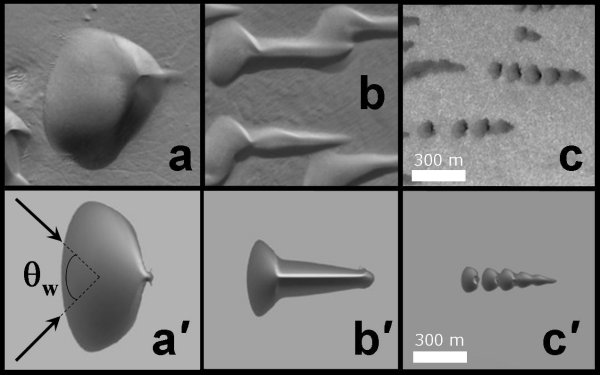
Now, however, Eric Parteli at the University of Stuttgart and Hans Herrmann at the Swiss Federal Institute of Technology in Zürich reckon the Martian dunes could indeed form and shift under the planet’s current atmospheric conditions. They have carried out a series of computer simulations of the formation of two distinct types of dunes seen on Mars — arrowhead-shaped “barchan” dunes, which are formed when the wind blows mainly in one direction, and elongated “exotic” dunes that are formed when the wind alternates between two directions (see figures).

Assuming that the sand was subject to just one 40-second gust of wind every five years – conditions experienced by Mars probes — the simulations suggested that the exotic dunes could have formed from barchan dunes over a period of about 10,000 to 50,000 years. Parteli told Physics Web that under the same conditions, it would take about 4000 years for a dune to shift by 1 m, which could explain why the dunes have not appeared to move since they were first discovered.

According to Parteli, the key to modelling the dunes is a process called “saltation”, whereby a grain of sand is lifted by the wind, and driven along above the sand until it falls back, creating a splash of ejected grains. The ejected grains could then also be picked up by the wind leading to a rapid multiplication of the amount of sand that is being blown along.

Saltation has been successfully modelled for dunes on Earth using parameters determined experimentally. But when Parteli and Herrmann used the same parameters under Martian conditions, they found that dunes would not form. Undeterred, they turned to research done nearly 30 years ago that established that the airborne grains should travel 10 times faster on Mars than on Earth thanks to the planet’s thinner atmosphere and lower gravity. As a result, each Martian grain should eject about ten times more sand upon impact than does a grain on Earth. Using these saltation parameters, Parteli and Herrmann were able to reproduce both the barchan and exotic dunes.

According to Parteli, the simulations suggest that atmospheric conditions on Mars have been relatively stable over the past 50,000 years and that the dunes are not necessarily evidence that the Martian atmosphere had been more Earth-like in the past.

Negative resistance found in 2D electron gas

In a normal conductor, electrical current is a result of charged particles – usually electrons – being forced to move by an electrical field applied across two terminals. Along their way the electrons will often be hindered by ions and impurities, which collide with the electrons causing resistance and hence energy loss.

Negative resistance, therefore, ought to imply that energy is somehow being supplied to the electrons, making them move faster. Trouble is, energy cannot appear from nowhere without breaking the first law of thermodynamics, which states that energy must be conserved in an isolated system.

Ismet Kaya of Sabancı University in Turkey and Karl Eberl of the Max-Planck Institute in Germany, however, say that negative resistance can occur in a conductor containing three terminals in a line. In theory, some of the energy lost to resistance by electrons travelling from the first terminal to the second could find its way to electrons passing from the second to the third terminals. These energized electrons would then move with a forward current in a reversed electric field – in other words, having a negative resistance – while obeying the first law of thermodynamics.

The problem with the theory is that it requires a number of “hot” electrons from the first section to cascade in a beam into the second section where they can pass on their energy. But this would normally be prevented by the Pauli exclusion principle, which ensures that electrons have a uniform distribution of energy in all directions. Kaya and Eberl got around this by creating a small, 10 µm long structure made from GaAs and AlGaAs, in which electrons behave as a 2D gas. By cooling the structure down to 4.2 K, electrons injected into the first terminal could momentarily sideline the exclusion principle and make the necessary energy transfer.

Kaya told Physics Web that the negative resistance effect could be harnessed to make a source of terahertz radiation, simply by adding an inductor into the structure. Terahertz radiation, which lies sandwiched between the microwave and infrared regions of the electromagnetic spectrum, could one day enable data to be transmitted at high rates, but can currently only be produced in large facilities such as synchrotron particle accelerators.

Black hole shrinks braneworld dimensions

The ultimate aim for theorists is to write down a “theory of everything”, which would describe all the known forces of nature using the same set of equations. But one of the major hurdles facing them is gravity, which is the only force not included in the Standard Model of particle physics. This is partly because gravity, as described in theories by Newton and Einstein, is many orders of magnitude smaller than the other forces – a curious discrepancy known as the hierarchy problem.

Some cosmologists have suggested that the hierarchy problem would disappear if we were to assume that our universe’s four familiar dimensions – three for movement in space, and one for time – form a single “brane” in a higher-dimensional bulk. In this braneworld, the three forces described by the Standard Model would act along our brane in the normal way. Gravity, however, would be able to spread throughout the bulk, leaving us to observe just a fraction of its attractive force.

In the most popular braneworld models, the extra dimensions are distorted so that they occupy volumes up to a millimetre in size. Therefore to catch a glimpse of them one must look for deviations in Newton’s gravitational inverse-square law at equally small scales. In January this year Dan Kapner and colleagues of the University of Washington in the US used a torsion-balance experiment to prove the law holds down to 55 µm – small enough to make the idea of extra dimensions less plausible (see related story: “Pendulum swings away from dark energy”). However, Dimitrios Psaltis from the University of Arizona now claims to have used the age of a black hole to put a new limit on the theoretical size of the extra dimensions, which might explain why they haven’t been found yet.

Black holes are often expected to have an extremely long life because their rate of evaporation is fairly slow. But if extra dimensions do exist then some of this evaporation could take place in the bulk of the braneworld, and so would proportionally reduce the black hole’s lifespan. Psaltis took recent measurements of the 3D velocity and position of the black hole XTEJ118+480 to reconstruct its trajectory. This in turn allowed him to calculate when it last passed the galactic plane, and thus the earliest time the black hole could have been formed.

Psaltis found that XTEJ118+480 must be older than 11 Myr, which in braneworld terms means the extra dimensions could extend over volumes no larger 80 µm. Although this is not quite as small as the experimental limits set by the Washington team, it does shrink the target area for future tests of the inverse-square law.

However, Ruth Gregory of Durham University, who has also researched the cosmological effects of a braneworld, told Physics Web that the equation Psaltis used to calculate the lifetime of a black hole is not based on hard theoretical ground. “I certainly won’t be taking it to the bank,” she said. “The main problem is that we don’t know what a black hole looks like on a brane. But it is good that experimentalists are taking observations to put the theory to the test.”

Fermions pair up without superfluidity

Particles fall into two categories: bosons, which have integer spin values, and fermions, which have half-integer spin values. When cooled close to absolute zero, bosons all fall into a single ground state, collectively undergoing a transition to a peculiar phase of matter called a Bose-Einstein condensate (BEC). While in a BEC, the bosons move as a coherent whole, exhibiting weird macroscopic quantum effects such as superfluidity.

Although quantum mechanics forbids any two fermions to occupy the same state, in certain conditions they can still condense into a BEC by pairing up under attractive forces and thus imitating integer-spin bosons. The pairing is strongest when spin states of the two fermions in a pair are different – electrons, for example, form “Cooper” pairs when they are in “up” and “down” spin states. Because electrons are charged, their superfluid flow also gives rise to superconductivity, an important property described by Bardeen Cooper Schrieffer theory.

However, the superfluid state becomes less prevalent in a system if the ratio of fermion spin-states is imbalanced. This discovery was made last year by a group at the Massachusetts Institute of Technology (MIT) in the US led by Wolfgang Ketterle, who used radio-frequency fields to transfer populations of spin states in an ultracold gas of neutral fermionic atoms – a much simpler system to study than superconductivity in electron gases. They found that at low enough temperatures the gas separated into two regions: the minority spin state paired-up in the core of the gas with an equal number of fermions from the majority spin state, thus behaving as a superfluid; and the remainder of the majority spin state was left to congregate around the outside.

Now the same MIT group has seen what happens if the ratio of fermion spin-states is heavily imbalanced. To do this, they prepared a mixture of lithium-6 atoms (fermions) with 95% in the same spin state, and then used radio-frequency spectroscopy to measure the excitation spectrum. This spectrum allowed them to search for atoms bound in pairs, which are highlighted by a characteristic high-frequency peak.

In such heavily-imbalanced mixtures, the so-called Chandrasekhar-Clogston limit is known to prevent a superfluid state from ever forming at low temperatures – and this was indeed observed by Ketterle and his colleagues. However, they found that the minority of spin states (5%) still bound together in pairs. “It always appeared that when pairs of fermions are formed they will ultimately condense at low temperature,” Ketterle told Physics Web. “Now we have a situation where they just form and never condense.”

Ketterle added that by studying the pairing of fermions that have not condensed to a superfluid at low temperatures, physicists may eventually be able to test theories of poorly-understood systems such as high-temperature superconductors, which exhibit pairing above the condensation temperature. However, he said that the discovery also raises the big question of how the fermions are pairing without becoming a superfluid: “One has to figure out what is meant by pairing. I cannot say whether it is a result of a ‘monogamous’ relationship, or if each atom is attracted by several other atoms in the other spin state.”

Copyright © 2026 by IOP Publishing Ltd and individual contributors