Carl Friedrich von Weizsäcker: 1912–2007

Carl Friedrich von Weizsäcker was born on 28 June 1912 in the northern German port city of Kiel. Between 1929 and 1933 he studied physics, astronomy and maths in Berlin, Göttingen and Leipzig, where he worked with some of the leading physicists of his day, including Heisenberg, Bohr and Erwin Schrödinger. As a young physicist, von Weizsäcker became interested in the binding energy of atomic nuclei and in 1937 determined what later became known as the “Bethe–Weizsäcker formula”, which predicts the energy of the nucleus in terms of the number of constituent protons and neutrons.

In 1939 von Weizsäcker became part of Germany’s “uranium project” — a loose network of scientists across the country who began carrying out research into nuclear reactors, isotope separation and nuclear explosives. Although these scientists never succeeded in building a practical nuclear weapon, historians have long wondered why this was the case. Some have argued that physicists like Heisenberg and von Weizsäcker simply lacked the technical knowledge to build a bomb. Others claim that these physicists did not bother determining key quantities like the critical mass of the bomb because they knew the German government did not have the resources to ever build such a device, which made it pointless to carry out such a calculation.

After the war, von Weizsäcker claimed that the real reason why he and other German scientists had not built a bomb was that they had deliberately chosen not to, fearing its appalling consequences in the hands of the Nazi regime. Von Weizsäcker first put forward this version of events in interviews he gave with the historian Robert Jungk, whose 1957 book Brighter than a Thousand Suns suggested that von Weizsäcker and Heisenberg had acted honourably all along.

The full story only emerged years later when transcripts of conversations between von Weizsäcker, Heisenberg and eight other German physicists, who had been secretly recorded while they were interned by the British military at Farm Hall, near Cambridge, were finally published in 1993. It turned out that von Weizsäcker had deliberately encouraged his fellow physicists to argue that they had never wanted to build a bomb, even though they knew this was not strictly true.

After the war, von Weizsäcker returned to research, being appointed director of the department of theoretical physics at the Max Planck Institute in Göttingen before taking up a professorship at the University of Hamburg in 1957. That he year he was one of 18 prominent scientists to sign the “Göttingen declaration”, which called for West Germany to not develop nuclear weapons.

A committed Christian, von Weizsäcker also turned his attention to philosophy, developing a keen interest in ethics and responsibility. His books include The World View of Physics, The Unity of Nature and The Politics of Peril. Von Weizsäcker’s younger brother, Richard von Weizsäcker, was German president between 1984 and 1994.

Von Weizsäcker briefly returned to the spotlight in 2002 when he commented on the release of letters that Bohr had written — but never sent — concerning the visit of Heisenberg and Von Weizsäcker to Copenhagen in September 1941. These letters suggest that Heisenberg and colleagues had indeed been working flat-out on a bomb between 1939 and 1941.

Entanglement dies a sudden death

In the weird world of quantum mechanics, entanglement means that particles can have a much closer relationship than allowed by classical physics. For instance, two photons can be created experimentally such that if one is polarized in the vertical direction, then the other is always polarized horizontally. By measuring the polarization of one of the pair, we immediately know the state of the other, no matter how far apart they are.

Whereas ordinary computers use bits of information that are either 1 or 0, quantum computers use quantum bits of information, or qubits, that can be in a superposition of both 1 and 0 at the same time. A 1 could represent, say, a horizontally polarized photon, while 0 represent a vertically polarized photon. By combining N such qubits, these could entangled to represent 2N values at the same time, which would, in principle, allow a quantum computer to outperform a classical computer for certain tasks.

However, the qubits in any practical quantum computer have to interact with their local environments, which will cause the quantum state of the qubit to change, or decay. A photon reflecting from a mirror, for example, could suffer a change to its polarization, and successive interactions could even lead to the entanglement disappearing altogether. Crucially, the gradual nature of the decay means that it should be possible to restore entanglement during the computation process using error-correction schemes.

However, it had been predicted that interactions that appear to have a small effect on a single qubit can have a devastating effect on an entangled system of two qubits. This effect — entanglement sudden death, or ESD — is so rapid and complete that error-correction schemes will not be able to restore entanglement. Now, Luiz Davidovich and colleagues at the Federal University of Rio de Janeiro have observed ESD for the first time.

In their experiment, the researchers prepared entangled pairs of photons, which were then sent along two identical paths that were separated such that there could be no mutual interaction between the photons. Each path contained optical equipment that could be used to cause a deliberate and gradual decay of the vertical polarization component of both photons. The researchers then detected both photons with the aid of interference filters to determine their degree of entanglement – or concurrence.

The researchers studied pairs of photons that were entangled in two different ways: one type had a certain combination of horizontal and vertical polarizations, while the other type had a different combination of these polarizations. Both initial states were created with the same degree of entanglement and both were subjected to the same gradual decay of vertical polarization. It turned out that the entangled pairs that were more vertically than horizontally polarized underwent ESD, whereas the pairs that where the opposite was true decayed relatively slowly as expected. Davidovich reckons that the vertically-rich entanglement suffered ESD because in this experiment, vertical polarization is a higher energy state and is therefore more sensitive to decay via interactions with the environment than is the lower-energy state of horizontal polarization.

Davidovich told Physics Web that ESD should also occur in other systems that have been proposed for use in quantum computers including trapped ions and atoms in cavities. However, he does not believe that ESD precludes the development of quantum computers. “It leads to an upper limit for the duration of the quantum computation”, he said. “Calculations must be made faster than the time for which ESD occurs”.

Davidovich explained that ESD precludes the use of error correction: “Error-correction techniques rely on entanglement. ESD implies that the quantum computer becomes classical at a finite instant of time, after which quantum error correction is no longer possible”.

Back to the Moon

Many physicists of a certain generation will vividly remember the excitement of NASA’s Apollo missions of the late 1960s and early 1970s when astronauts took their first tentative steps on the Moon. These heroic missions, witnessed around the world via grainy black-and-white TV pictures, captured the imagination of millions. Sadly, the public’s interest in the Moon quickly faded: the astronaut Alan Shepard even resorted to hitting a golf ball on the lunar surface in a stunt to keep that flagging interest alive. It was not until the 1990s – when NASA launched its Clementine and Lunar Prospector robotic missions – that the Moon became sexy once more.

Now everyone, it seems, wants to get in on the act. Last year the European Space Agency (ESA) celebrated the successful completion of its SMART-1 Moon mission, while Japan, China and India all have lunar projects in the pipeline (pp12–13, print version only). In addition to the political prestige that they confer, these missions serve two main purposes: they allow the countries involved to acquire scientific and technological expertise; and they help to inspire a new generation of young people to study and work in science and engineering. The missions should also yield some useful scientific information, such as data on the composition and geology of the Moon and hints as to how the solar system came into being.

It would be even better, however, if these missions paved the way to the building of a permanent base on the Moon. Apart from being a grand challenge that appeals to the human sense of adventure, such a base would let us carry out more sophisticated scientific experiments – for example examining in detail the properties of the lunar crust – and see if it is feasible for humans to live and work for several months at a time on a planetary body other than the Earth. NASA has said that it wants to build such a base by 2020, but this ambitious goal is more likely to succeed if the US joins forces with other nations to create a serious, long-term international collaboration. The current spate of lunar missions, most of which are organized at a national level, must therefore be a forerunner to a global lunar effort, in which private enterprises could even play a part.

For both ESA and NASA, such a base would not be the final frontier but merely a stepping stone to something more ambitious and expensive still – sending astronauts to Mars. Since it takes so much fuel to escape the Earth’s atmosphere, most space missions can carry only relatively small payloads. On the Moon, where gravity is weaker, less fuel is needed to launch a rocket. By building up significant stockpiles of equipment on the Moon through a series of small lunar missions, the idea is that we could then send a relatively large mission to Mars, where there is exciting research to be done. But even if humans survived the trip to Mars, can we be sure that they could do anything useful once they arrived? It seems sensible also to carry out more research into new types of robots such as “self-learning” devices that can obtain information without relying on instructions sent by scientists back on Earth. We should first set up and exploit a lunar base, which would be a big enough challenge in its own right, before deciding whether to send humans to Mars.

Blog life: Not Even Wrong

Blogger: Peter Woit
URL: www.math.columbia.edu/~woit/wordpress
First post: March 2004

Who is the blog written by?

Peter Woit, a mathematician at Columbia University, New York. He describes his career as unusual – after completing a PhD in theoretical particle physics in the 1980s, he realized that “someone who didn’t believe in string theory but wanted to apply mathematics to quantum field theory didn’t have much of a future in physics departments in the US”. For the last 10 years, he has held a permanent but untenured position in the maths department at Columbia.

What topics does the blog cover?

Woit has made his name as a critic of string theory. The blog is named after Wolfgang Pauli’s put-down of a young physicist’s paper, which is now used more generally to refer to a theory that does not make testable predictions. Most of Woit’s posts are about string theory and its problems, though he does write about other aspects of high-energy physics, both experimental and theoretical. Last year, Woit’s views became more prominent with the publication of a book with the same title as the blog (see “String theory gets knotted”). His book, together with Lee Smolin’s similarly themed The Trouble With Physics, propelled the debate over string theory into national newspapers and magazines.

Who is the blog aimed at?

Woit tries to make his posts accessible to a general audience, but when your main topic is string theory, that is always going to be difficult. However, it seems that many non-physicists do tune in, perhaps attracted by the heated debate that often breaks out in the comments on his posts.

Why should I read it?

Woit’s criticisms of string theory make interesting reading, and so do the arguments that he generates with string-theorist bloggers such as Luboš Motl at Harvard University (Reference Frame) and Clifford Johnson at the University of Southern California (Asymptotia). If you try to follow a link from Woit’s blog to Motl’s, you will now be presented with a note from Motl reading: “Sorry, but I really can’t afford to share readers with that particular person who produces so many untrue statements and who parasites on the work of scientists.” Insults flying between physicists are not something the public normally get to witness, which is one reason Woit’s blog is so compelling (see Physics World January pp24–28, print version only).

How often is the blog updated?

Once every day or two, usually with quite lengthy posts.

Can you give me a sample quote?

“This latest claim about a ‘test for string theory’ is quite remarkable and even more bogus than usual. It is based on a paper which has nothing to with string theory and doesn’t do a string theory calculation at all. The year is just beginning, but I’m already willing to award this press release the title of ‘most outrageously misleading string theory hype of 2007’. It is going to be extremely hard for anyone else to match it.”

Case not proven

It was with great anticipation that I opened this book, searching for details of the scientific experiment that proved that God does not exist. What was the experimental procedure? What did the distribution of data points look like? What were the error bars? Was it a 2-sigma or 3-sigma proof? Disappointment soon followed: there was no description of any such experiment.

So what justifies the book’s bold subtitle? What the book in fact contains is a melange of homespun philosophy, amateur biblical interpretation and a smattering of scientific data served up under the pretence of being a proof. All this despite the fact that Immanuel Kant and David Hume emphasized two centuries ago that attempts to conclusively prove either the existence or non-existence of God by such reasoning could not work.

While scientific understanding has increased vastly since then, the scientific method has not changed; it has the same strengths and weaknesses, and the same limited domain of application. The author is thus committing a category error in trying to use scientific proof in areas where it simply does not apply.

Victor Stenger, emeritus professor of physics at the University of Hawaii, seems to have been drawn into this fundamentally misleading position by responding to authors who claim that they have proved scientifically that God does exist. But the fact that those writers have made the error of claiming that science can prove what it cannot does not justify Stenger in making what is essentially the same mistake. Both groups attempt to claim the mantle of science in order to buttress their faith positions. Both demonstrate the lack of a good philosophical training that should be essential for today’s scientists.

Stenger summarizes his eight arguments for the non-existence of God on pages 229–231 (“Gods who disagree with the data”). I will respond briefly to each of the points he makes.

• There are no signs of direct design in the natural universe
Despite the prominence of the intelligent design lobby, direct design by a creator is not a serious scientific or philosophical proposal. Indeed, most competent scientist-theologians agree that evolution took place through natural selection. Thus the lack of evidence of design does not contradict the religious view as it refers to issues of mechanism that have no theological implications either way.

• The mind is determined by physical processes; there is no scientific evidence for a soul
This is the strongest argument the author puts forward for the non-existence of God as it relates directly to a number of religious claims and is plausible in terms of present-day neuroscience. However, it is certainly not a scientific proof, as we have not solved the hard problem of consciousness, and do not even know how to begin tackling it.

• No independent evidence exists for the miracles claimed in the scriptures
Here, Stenger undertakes an exercise in exegesis, based on a literalist reading of the Bible. This is not science in any ordinary sense of the word.

• The universe came into being by natural processes (or, as Stenger puts it, “no violations of physical laws were required to produce the universe”)
Here, Stenger puts forward his own debatable and unproven model of the creation of the universe, based on ideas from James Hartle and Stephen Hawking. This speculative theory, which apparently presumes that the laws of physics existed in some Platonic domain before space and time came into being, does not deal with the ultimate issues of creation or existence, and is certainly not proven science.

• The universe is not congenial to human life (“the universe is wasteful of time, space, and matter from a human perspective”)
This argument is not based on science; rather it is an emotional argument centred on the author’s personal opinions. “Wasteful” is not a scientific concept, nor can it lead to scientific conclusions. Stenger does not take seriously the arguments of John Barrow, Martin Rees, Steven Weinberg and others that only a very small region of the physical parameter space allows life to exist, which many scientists feel requires an explanation.

• Religious revelations have not been empirically confirmed or given us any new insight
This is an exercise in psychology and religious interpretation that has nothing to do with science. Stenger presents nothing here that a social scientist would recognize as valid data.

• Humans define morals and values for themselves
Despite Stenger’s disclaimer that he is not propounding moral relativism, this is indeed a moral-relativist position. While his claim is in part correct in describing how humans behave, it does not illuminate the sources of ethical right and wrong. Furthermore, it undermines any claim to the existence of an objective morality that all humans share, which the author implicitly claims to be the case in his subsequent argument.

• The existence of evil
Stenger claims that it is a scientific fact that evil exists, and that this is incompatible with the usual monotheistic idea of God. So what is the experiment that establishes evil as a scientific fact? There is none, as science does not comprehend the concepts of “right” and “wrong” – there are no units (“milli-Hitlers”) for degrees of evil. Hence this is an ethical claim falsely dressed up as science. But this argument does show a belief in absolute standards of right and wrong, in agreement with my own belief that there is a moral reality underlying the universe.

All these points constitute acceptable philosophical argument for the non-existence of God, but none of them amount to a genuine scientific proof. Overstating what science can do is bad for science, as it undermines both its integrity and its believability. It is also a mistake to present the public with a false dichotomy between science and religion, because this will unnecessarily tend to fuel an antiscientific backlash in wider society.

The aim of the book is to apply scientific-like reasoning to issues of ultimate reality. But this is not new: it has been developed in depth by philosopher-theologians such as Arthur Peacocke, John Polkinghorne and Nancey Murphy, whose writings on this topic are ignored by the author. Indeed these individuals have developed such an approach to a much more sophisticated level than is apparent in Stenger’s book. The author quotes Hume’s advice to be sceptical in all things, but does not take this advice to heart in relation to his own overblown claims for the power of science.

Tale of two anniversaries

Measured in terms of Nobel prizes, the Brookhaven National Laboratory can claim to be one of the most successful scientific labs ever built. A total of 10 researchers who used the lab’s facilities went on to become Nobel laureates, sharing six Nobel prizes among them. Five of the prizes were for physics: the theory of parity violation and the discoveries of the muon neutrino, the J/ψ particle, charge–parity (CP) violation and the fact that the number of neutrinos emitted by the Sun is less than that predicted by theory. The other Nobel was for cell chemistry.

Located on Long Island about 100 km from New York City, Brookhaven opened in 1947 as one of the first three US national labs, the others being Argonne and Oak Ridge. All were designed to operate facilities too big for single institutions, even large universities, to support. At Brookhaven, these facilities included the Graphite Research Reactor and the High Flux Beam Reactor (HFBR), as well as several accelerators, including the Cosmotron, the Alternating Gradient Synchrotron and the Relativistic Heavy Ion Collider.

This year Brookhaven celebrates two anniversaries, each illustrating a different challenge facing modern scientific institutions. One is the lab’s 60th anniversary. Being at the forefront of science for so long has not been easy. Brookhaven has periodically had to reinvent itself and revise its fundamental priorities in response to changing scientific developments. Its initial focus on reactor research was subsequently redirected to high-energy accelerators, and later to heavy-ion physics, synchrotron radiation and supercomputing.

The other, less happy Brookhaven anniversary is one that thrust a second challenge on the lab, and one with a complex social dimension. A decade ago Brookhaven announced that it had found a leak of slightly radioactive water in wells near the spent-fuel pool of the HFBR, the centrepiece of its solid-state physics programme. The leak did not affect drinking water and was not a health hazard. Scientists assured the public that the groundwater was safe and that the lab posed no health hazard to the community.

Some members of the media, however, yearned for another Watergate, in which they could heroically expose the illegal cover-up of a dishonest government agency. Others wanted a repeat of the story of the book and movie A Civil Action, in which the actions of a corrupt, neighbourhood-polluting company trigger a successful lawsuit. The Brookhaven story was neither – but false rumours circulated of high cancer rates in towns near the lab that were hard to dispel and even to address. The outcome was the firing of Brookhaven’s contractor 10 years ago this month, the shutting down of the HFBR in 1999, and even calls to close the entire lab itself (Physics World May 2003 p19, print version only).

The climate of distrust seemed to legitimitize the most flagrant accusations against the lab, some of which continue today. One example is an opinion piece that Kelly McMasters – an adjunct professor of creative writing at Columbia University – published last November in the New York Times. She accused the lab of contaminating her home town (even though the local department of health has found no wells to be contaminated), mentioned a “cancer cluster” around the lab (though this is not substantiated by studies carried out by New York State), and demanded that the lab’s reactors be shut down (even though they had already been shut down years ago). McMasters, it seems, is writing a book about growing up in her supposedly threatened home town.

Social Iagos

Brookhaven’s second, social challenge – which, like the first, remains unabated – was to cope with this atmosphere of distrust and foster honest discussion about environmental safety. A major obstacle is that some people profit by promoting distrust.

Shakespeare gives the classic example of self-advancement through trust disruption in the play Othello. Denied a position of authority he craves, Iago cultivates distrust between his leader Othello and Othello’s wife Desdemona. Eventually Othello no longer believes in Desdemona’s fidelity, despite her honest denial of the charges, and kills her.

Society, too, has its own Iagos – people or groups that advance their agendas using dire predictions and false claims to foster unwarranted distrust between communities and institutions. Social Iagos can be politicians seeking votes, celebrities coveting moral status, pseudo-environmentalists wanting publicity, and citizens posing as innocent victims to obtain government money, sell books or achieve notoriety. All have reasons to keep alive hopes of another Watergate, another A Civil Action.

To meet this ongoing challenge, Brookhaven made more explicit its commitment to environmental responsibility, and established a community forum that included some of the lab critics. The HFBR’s closure also helped; although the facility was deemed safe by scientists and a government review panel, it was a focal point for community fear. Local politicians and the media (some of them, anyway) began to scrutinize accusations against the lab as carefully as they did statements from the lab itself.

The critical point

Brookhaven’s challenge of remaining flexible in a changing scientific landscape will continue. So will the social challenge of fostering honest discussion of responsible environmental conduct in a climate that not only includes voices seeking to disrupt trust, but that to some extent nurtures and encourages them. Social Iagos threaten to obstruct our ability to distinguish between real and fake threats to the community, and therefore pose a direct and significant social threat. They give rise to an amplified version of the danger of crying “Wolf!”.

Brookhaven’s experience in meeting this social challenge offers valuable lessons in how trust is lost, how it is regained, and how it is maintained – and is another of the lab’s contributions to science. For every major scientific facility will face this challenge in the coming century. What is at stake in meeting this social challenge is much more than science – it is the health and robustness of society itself.

The quantum solid that defies expectation

If a branch of physics were to be judged by the number of Nobel laureates it has produced, then superfluidity would surely rank among the most successful. The field has borne nearly 20 laureates, from the award of the 1913 Nobel Prize for Physics to Heike Kamerlingh Onnes, who discovered superconductivity, to that of the 2003 prize to Alexei Abrikosov, Vitaly Ginzburg and Tony Leggett for their contributions to the theory of superconductors and superfluids. The reason why is simple: these counterintuitive phenomena, whereby below a certain temperature matter flows without resistance, are rare examples of quantum-mechanical behaviour seen at the macroscopic scale.

“There is a saying among condensed-matter physicists that what the Big Bang is to cosmology the ‘supers’ are to atomic physics,” says Philip Anderson of Princeton University in the US, who shared the 1977 Nobel Prize for Physics for his work on the electronic structure of magnetic and disordered materials. “Most people are unaware how much of our conceptual understanding of the world around us comes from this field, such as broken symmetry and the Higgs mechanism.”

Superfluidity was discovered in the liquid phase in 1938, when Pjotr Kapitsa – who shared the 1978 Nobel prize for the work – found that liquid helium-4 suddenly behaves as if it has zero viscosity when cooled below a temperature of about 2 K. With no resistance to flow, a superfluid can do bizarre things such as creep up the sides of a vessel containing the material or pass through holes just a few atoms wide. Superconductivity, a similarly dramatic low-temperature phenomenon in which electrical current flows without resistance, is due to the superfluidity of electron pairs. However, in 2004 Moses Chan of Penn State University in the US and his then graduate student Eun-Seong Kim reported evidence for superfluidity in a much more unlikely setting: the atomic lattice of bulk-solid helium-4.

Such a “supersolid” phase of matter would flow through a classical solid as if it were not there. Like superfluidity in a liquid, this weird behaviour is predicted to be a consequence of Bose–Einstein condensation – a phase transition in which all the particles in a system collapse to the same ground state and can therefore no longer be treated as individual entities moving at random. Such quantum degeneracy is possible because helium-4 atoms are bosons, i.e. particles that have integer multiples of spin angular momentum.

Since 1995, when physicists in the US created the first Bose–Einstein condensate (BEC) in the gaseous phase by cooling bosonic rubidium and sodium atoms to a few hundred nanokelvin – an achievement for which they were awarded the Nobel prize in 2001 – these systems have provided an unprecedented “laboratory” in which to study the mechanisms responsible for superfluidity. If supersolids do indeed exist, it would mean that Bose–Einstein condensation has been observed in the solid as well as in the liquid and gas phases.

Although several groups have since verified Chan’s 2004 claim, recent experiments that reveal the role played by crystal disorder have raised doubts about whether such a supersolid phase has been observed at all. Moreover, theorists disagree over precisely what the mechanism behind supersolidity might be. “The situation is very murky,” admits Chan.

Super signature

The possibility of a supersolid, in which a Bose–Einstein condensate would coexist with the regular atomic lattice of a solid, is not new: it was first predicted by Russian theorists Alexander Andreev and Ilya Liftshitz in 1969. Rather than individual atoms undergoing condensation, they suggested that the supersolid state emerged from the condensation of atomic vacancies. In most solids vacancies are created when an atom at a particular lattice site is liberated, usually by thermal energy. But in the case of helium-4, which only solidifies at extremely low temperatures and high pressures (see figure 2), the atoms are so weakly bound that vacancies may exist even at absolute zero due to quantum “zero-point” energy.

It was the possible existence of such zero-point vacancies that convinced John Goodkind of the University of California in San Diego back in the 1980s that the supersolid state was worth investigating. “The existence of BEC in the solid phase would be as significant as the discovery of superfluidity in liquid helium,” he says. “It would be a new state of matter that is counterintuitive.” Using ultrasound to probe the microscopic properties of helium-4 as it was cooled, Goodkind noticed a sudden increase in the velocity and dissipation of the sound waves near 200 mK, which he interpreted as being due to a thermodynamic phase change – possibly a BEC (1997 J. Low Temp. Physics 109 409). Unfortunately, at that point Goodkind’s funding ran out, but his anomalous result had caught the attention of Kim and Chan.

Excited by the prospect of observing a new phenomenon that would push their experimental ingenuity to the limit, Kim and Chan set about searching for the supersolid state in 1999. They used a torsional oscillator, which consisted of a cylindrical cell filled with high-pressure helium-4 embedded within a porous Vycor glass disk. The cell, which was suspended from a rod, could then be rotated back and fore. By monitoring the oscillation period while the cell was cooled close to absolute zero, the researchers were able to look for signs of nonclassical rotational inertia – a sudden drop in the oscillation period of the cell that would mark the onset of superfluidity in the solid helium-4 inside it. When the sample reached a temperature of 175 mK, this is exactly what they observed (see figure 3).

“At sufficiently low temperature, solid helium-4 does not behave as a solid,” says Chan. “I lost count of how many control experiments we performed with different cells to convince ourselves of the phenomenon.” Kim and Chan published their results in January 2004, concluding that the drop in rotational inertia they had observed was “probably” due to 2% of the helium-4 undergoing Bose–Einstein condensation to the supersolid state (Nature 427 225). Flying in the face of classical physics, this ghostly component of the system remained at rest in the laboratory frame, passing effortlessly in and out of the normal atomic lattice as the cell rotated about it.

Crucially, Kim and Chan saw no such behaviour when shortly afterwards they repeated the experiment using helium-3. Unlike their heavier bosonic cousins, helium-3 atoms are fermions – that is, they have half-integer spins and are thus prevented by the exclusion principle from forming a BEC. It is, however, possible for helium-3 atoms to produce a BEC if they first pair up to form bosons, a process akin to the pairing of electrons in superconductivity, which can take place at much lower temperatures. Indeed, the first observation of superfluidity in helium-3 in 1972 at just 2 mK – a feat for which David Lee, Douglas Oscheroff and Robert Richardson were awarded the 1996 Nobel Prize for Physics – was a clear sign of the link between superfluidity and Bose–Einstein condensation.

Given the potential significance of discovering the supersolid phase, however, it was clear that there was still some work to do before Kim and Chan could drop the word “probable” from their claim. In particular, there was the possibility that the “non-classical inertia” that they recorded was simply due to a layer of liquid helium-4 in the sample that had become trapped in the nanometre-sized pores of the Vycor glass disk in which their helium-4 had to be contained to keep it under sufficient pressure. The pair therefore repeated the experiment using a bulk sample of solid helium-4, observing a drop in rotational inertia that suggested 1% of the sample had become supersolid. “What this showed was that we were observing a macroscopic, not a local, quantum phenomenon,” remarks Chan. The pair’s definitive claim of the discovery of a supersolid was duly published in September 2004 (Science 305 1941).

Perfect confusion

Spurred on by the results from Penn State, other research groups soon began attempts to replicate Kim and Chan’s torsional-oscillator experiment. By the start of 2006 three such groups had confirmed the supersolid result: Keiya Shirahama and co-workers at Keio University in Japan (arXiv.org/abs/cond-mat/0607032); Minoru Kubota and his students at Tokyo University (arXiv.org/abs/cond-mat/0702632); and John Reppy – who searched unsuccessfully for the supersolid state in the late 1970s – and his student Sophie Rittner at Cornell University in the US (Phys. Rev. Lett. 97 165301).

All of these groups had confirmed that below a temperature of about 200 mK some 1% of solid helium-4 flows in a non-classical way. However, in the Cornell experiment Reppy and Rittner also found that by maintaining the temperature of the solid helium-4 close to its melting point for several hours and then slowly cooling it down again, they could reduce the supersolid signal to less than 0.05% and even make it disappear completely. Since such “annealing” is expected to reduce the level of imperfection in the solid, this suggested that the observed supersolid behaviour is not a universal property of bulk-solid helium-4 but the result of defects or imperfections in the crystal structure.

Several further experiments have supported this disorder interpretation. Earlier this year, for instance, Reppy repeated Kim and Chan’s bulk helium-4 experiment but with samples that were heated and re-frozen extremely rapidly so as to introduce disorder, finding that up to 20% of the solid had become superfluid (Phys. Rev. Lett. 98 175302). Meanwhile, one of Chan’s new students, Tony Clark, has found that when an ultra-pure single crystal of helium-4 is placed in a torsional oscillator, the supersolid fraction is just 0.3%. “I found all these new results very confusing,” says Chan. “What is puzzling is that the solid helium that was confined in Vycor glass in our initial experiment, and in porous gold in another [2005 J. Low Temp. Phys. 138 159], should have been of even worse quality than that in Reppy’s latest results – yet we found a supersolid fraction of just 2%.”

The case for supersolids appeared to be further weakened by independent “DC flow” experiments performed by John Beamish and co-workers at the University of Alberta in Canada shortly after Kim and Chan’s 2004 result. The team placed solid helium-4 in an array of capillaries and searched for direct evidence of supersolidity by creating a pressure difference in the sample and seeing whether any mass flowed as a result (2006 Phys. Rev. Lett. 96 105304 and 95 035301). “The behaviour of solid helium-4 is quite different to that of superfluids,” says Beamish. “Our results show that right down to temperatures of 30 mK, solid helium-4 does not flow.”

Theorists to the rescue

Many theorists are not surprised that the outcome of torsional-oscillator experiments should depend strongly on the conditions under which the solid helium-4 sample is prepared. In part this is due to calculations performed by Nikolay Prokofev and Boris Svistunov at the University of Massachusetts and several others, including David Ceperley at the University of Illinois, showing that vacancies cannot exist at absolute zero. As a result, superfluidity in a helium-4 crystal may not be due to the Bose-Einstein condensation of vacancies. Indeed, last year Chan himself cast doubt on this explanation when he found that the supersolid fraction did not decrease as a function of pressure, as it should have done if the observed drop in rotational inertia was due to the formation of a BEC (Phys. Rev. Lett. 97 115302).

But an even more compelling reason to doubt Andreev and Liftshitz’s 1969 prediction is the recent progress made in understanding how certain types of crystal defect might produce a supersolid-like signature. “Based on first-principle numerical calculations, we guarantee the existence of at least two supersolid phases of helium-4,” says Svistunov. One of these, he claims, occurs in superfluid grain boundaries, the layers about three atoms wide that separate regions of different crystal orientation (Phys. Rev. Lett. 98 135301). The other is a superfluid glass phase, in which the helium-4 atoms form a spatially disordered but metastable “superglass” state (Phys. Rev. Lett. 96 105301).

Sebastien Balibar at the Laboratory for Statistical Physics at the Ecole Normale Supérieure in Paris has recently found evidence for superfluidity in helium-4 crystals with grain boundaries. Although a network of such entities would produce non-classical rotational inertia that would show up in a torsional oscillator, he and his colleagues instead used a barometer-like device to look for direct signs of supersolidity (see figure 6). Similar to the flow experiments of Beamish and coworkers, their idea was to contain solid helium-4 inside a glass tube and use a camera to visualize the flow of mass in response to a height difference between the inside and outside of the tube (Science 313 1098).

“Good-quality crystals do not exhibit flow, while those with grain boundaries and hence a definite amount of disorder do,” says Balibar. However, he concedes that it is difficult for a network of superfluid grain boundaries to account for the large supersolid fractions observed in the torsional-oscillator experiments. “It could be that grain boundaries connect liquid or glassy regions in disordered crystals to produce a large supersolid signature,” he says. Since such grain boundaries are unlikely to be aligned in narrow channels in a material, this may explain why Beamish and co-workers did not see such flow in their capillary experiments.

In February this year, Victor Grigor’ev and colleagues at the Academy of Sciences of Ukraine reported evidence for Prokofev and Svistunov’s glass phase in solid helium-4 (arXiv.org/abs/cond-mat/0702133). By precisely measuring the pressure of their sample as a function of temperature, T, they found a departure from the expected classical T4 dependence to a T2 dependence at temperatures below 300 mK. The team claims this is what one would expect if a glassy phase had formed, and suggests that such a phase might explain the anomalous results seen so far in solid helium-4.

Chan hopes that studies like these, which look for direct thermodynamic signatures of supersolidity, will help settle the issue of what is responsible for the supersolid signature seen in his experiment. “Other than Goodkind’s original ultrasound experiment, the most clear-cut evidence for a supersolid so far still comes from torsional-oscillator measurements,” he says. “In my opinion, Balibar’s results are probably due to liquid helium-4 films flowing along “cracks” or grain boundaries and are not relevant to the supersolid phenomenon seen in our experiments.”

Chan’s group is now performing thermodynamic studies of its own. At the March meeting of the American Physical Society in Denver this year one of his new students, Xi Lin, presented measurements of the heat capacity of solid helium-4 as a function of temperature, showing that it has the expected classical form plus an additional peak at the same temperature (about 80 mK) where the torsional-oscillator signals show up. “We need to do one more control experiment to nail this before we can say whether the peak is related to the supersolid,” says Chan.

Super questions

So is Chan in line for the next Nobel prize in superfluidity? “Based on current experimental evidence, we do not know whether he is observing the supersolid state and therefore we do not know if it exists,” says Goodkind. “Only torsional-oscillator experiments explicitly show a signal – other studies of direct flow plus neutron and X-ray scattering experiments show no evidence for supersolidity and attempts to look for a thermodynamic signature have so far not been successful.” Goodkind is hopeful, however, that the variety of current experimental searches for supersolids – which include recent studies performed by Beamish that are similar to his own 1997 experiment – will be able to identify the cause of the anomalous behaviour seen by Chan and by him.

Tony Leggett at the University of Illinois, who in 1970 showed that non-classical rotational inertia was a marker of the supersolid state, thinks that the recent Rittner–Reppy results with disordered crystals are very telling. “To me these data suggest that what people have seen to date is anomalous kinetics, rather than non-classical rotational inertia,” he says. But he adds that to find out for sure we need a “Hess–Fairbank” experiment, in which solid helium-4 is subjected to DC rather than AC rotation as in a torsional oscillator.

Philip Anderson basically agrees. “None of the experiments are seeing superfluidity proper, but they do see evidence for a quantum fluid,” he says. Anderson calls this quantum fluid a vortex fluid because, he says, the evidence to date supports the idea that vorticity – a key parameter in describing superfluidity – is quantized but not that the vortices are frozen in.

Meanwhile, Chan – who prefers not to dwell on the possibility of a trip to Stockholm – is concentrating on the role of crystal defects, by systematically introducing disorder to solid helium-4 samples and measuring the supersolid response. “It is fun to be involved in an experiment that has got many theorists scratching their heads and encouraged experimental colleagues to join in the search,” he says. “Sometimes progress seems slow, and it can be frustrating to find yourself up a blind alley. But it is more fun to be the detective than to read the detective novel.”


The tale of the blogs’ boson

Popularly known as the God particle, the Higgs boson is the most sought-after particle in physics. It is believed to endow all other particles with mass and is the last undiscovered component of particle physicists’ great theoretical framework – the Standard Model. It is not hard then to see why New Scientist magazine should have devoted a long news story and a leader article in its issue of 2 March to a possible sighting of the particle. And why other publications, including The Economist, should then have carried enthusiastic articles of their own on the subject.

The story was given extra spice because the supposed discovery took place at the aging Tevatron accelerator at Fermilab near Chicago, which is pulling out all the stops to find the Higgs before the much more powerful Large Hadron Collider (LHC) switches on at CERN in Geneva either this year or next (see p7, print version only). But many at Fermilab are unhappy. Although the putative sighting was officially reported at a scientific meeting by CDF, the 600-strong collaboration carrying out the Higgs search at the US facility, it only became known to the media when it was discussed in Web logs, or blogs, by individual members of the group. Judged against the generally accepted standards within particle physics, the events seen at the Tevatron constituted very poor evidence for the Higgs, but that doubt was not made clear in the newspaper and magazine articles. So should physicists be more cautious about discussing science in blogs?

Bump hunting

The CDF detector records the collisions between huge numbers of protons and antiprotons accelerated in the Tevatron. A new particle can be revealed by looking for a particular bump in the energy spectrum of the events recorded by CDF. The specific signature that John Conway of the University of California Davis and colleagues had been looking for was the decay of one of five “supersymmetric” Higgs bosons into two tau leptons, which are very heavy cousins of the electron. These five Higgs particles are postulated by the most popular version of the theory of supersymmetry, which is designed to overcome theoretical inconsistencies within the Standard Model.

Like any search for new particles, however, the process involved the screening out of huge numbers of “background” processes recorded by the detector. For example, the Z boson, discovered in the early 1980s at CERN, can also decay to give a pair of tau leptons, and this process occurs far more frequently than the Higgs to tau decay. But because the mass of the Z boson is well known, it is possible to predict the spectrum of tau-pair masses that would be expected from Z decays. An excess of tau pairs above this prediction could indicate the presence of a new particle, and it was exactly such a bump in the spectrum that Conway saw and reported to a conference in Aspen, Colorado, on 9 January. The position of the bump corresponded to a possible Higgs boson with a mass of about 160 GeV, a value favoured by previous constraints.

Tommaso Dorigo, a member of the CDF collaboration from the University of Padova, Italy, then reported the sighting on his blog A Quantum Diaries Survivor on 19 January. This was added to in a post by Conway himself at the popular group blog Cosmic Variance, in which he described how “the hair literally rose up on the back of my neck” when he saw the bump for the first time. Stoking the fire further, Dorigo alluded to an analysis he was working on of a different decay signature – a bottom quark and antiquark – in which he claimed there could also be hints of the Higgs.

Notwithstanding their excitement, however, Dorigo and Conway tried to emphasize the uncertainty inherent in their results. Particle physicists usually say that they have evidence for a new particle when the bump in question lies at least three standard deviations or “3- sigma” away from a statistical fluctuation (equivalent to a 1 in 800 chance that what they are seeing is merely a statistical fluke), while 5- sigma constitutes a cast-iron discovery (with the probability of a fluke being merely 1 in 3.5 million).

Achieving such high levels of certainty generally requires enormous amounts of data, but is particularly difficult when searching for the Higgs boson because the mass of this particle (or particles) is unknown. Gauging the significance of the results from such a “bump hunt” must therefore allow for the fact that a fluctuation could occur at any mass. Taking all this into account, Conway explained in a detailed follow-up post that the significance of the bump in the tau-lepton search was 2.1- sigma, below the threshold for evidence but corresponding to a probability of only about 1 in 50 that the bump was caused by a fluctuation.

While this at first sounds convincing, both bloggers pointed out that such “2-sigma effects” come and go in particle physics all the time. There are so many different analyses of the data being carried out that 1 in 50 chances will crop up quite frequently (i.e. a 2- sigma effect would be expected to occur due to random effects once in every 50 searches). Furthermore, Dorigo estimated that his bottom-quark data only had a significance of less than 1- sigma, far below what particle physicists would normally consider to be interesting.

Mixed messages

Such statistical nuances are not the easiest thing to convey to the wider world, however, as Dorigo admits. “Particle physicists know that a 2- sigma effect is bound to wash away,” he says. “But that was not represented in the New Scientist article.” However, he does accept some of the blame himself for not adequately portraying all of the uncertainty.

Some of the other members of the collaboration agree that the press articles overstated the case for a Higgs sighting and fear that the affair could damage the collaboration’s image. Conway also points to the danger of a “boy who cried Higgs” effect, with the media having lost interest by the time the Higgs really is discovered.

Another bone of contention was the identification of individuals’ names with the Higgs searches, in a field of physics that emphasises the collective. Conway calls the media “somewhat myopic in this regard, when they exaggerate the contributions of just a few, however compellingly they have recorded their work in blogs”. Meanwhile, Robert Roser, one of the two CDF spokesmen, believes that Dorigo and Conway “did not cross the line” in their blogs. “Perhaps they didn’t make it clear how much of the exuberance was personal as opposed to that of the collaboration as a whole, but that is a small point,” he adds.

Blogs also threaten the traditional ways of releasing scientific results at seminars and conferences. Before CDF results can be made public they go through a lengthy period of internal scrutiny known as “blessing” – something that Dorigo has criticized on his blog before as “baroque, bordering on grotesque”. But even after that stage, the collaboration prefers to control the way in which results are released – for example, earlier this year Dorigo was asked to remove CDF’s new measurement of the mass of the W boson from his blog until after a seminar at Fermilab.

Conway says he is “baffled” as to why the media found the story interesting, but says he is concerned that blogs might lead to distortions. “Any science reporter whose primary source of scientific information is blogs is about as responsible as the student who, writing a paper, draws primarily from [the online encyclopedia] Wikipedia,” he says.

Dorigo, however, is more optimistic about the role blogs have to play. He decided to apologise to the CDF collaboration, in an open letter that he also posted on his blog, but he maintains that he did nothing wrong. He has always hoped that journalists would pick up on blogs as he thinks that “there is a major lack of communication from the experiments to the media”. He even thinks CDF and other large collaborations could set up their own official blogs to supplement their existing “arid, static and unfriendly” webpages. “Why not have a blog where collaborators can write what they think about the results?” he adds.

As the researchers at Fermilab make their last attempts to pluck the Higgs from their data, and results from the LHC begin to emerge over the next couple of years, there are sure to be plenty more bumps and blog rumours, whatever the leaders of the experiments think about it. “The spreading of scientific information through blogs cannot be ignored by those involved in large experiments,” says Dorigo. Indeed, the CDF collaboration is currently discussing whether to set up guidelines for blogging researchers. “The very fact that I am talking to Physics World is a sign that scientific magazines and newspapers have understood that information is easily accessible through well-maintained blogs,” says Dorigo.

Optical lattices could give insight into QCD

Fermi condensates are formed when particles with a half-integer spin number, known as fermions, pair up at very low temperatures and collectively fall into the same quantum state. They can be created by loading ultracold atoms into an “optical lattice”, which is an array of energy wells formed by crisscrossing laser beams. The strength of the interactions between the particles in the pair can then be “tuned” by applying a magnetic field to the lattice – an ability that allows physicists to simulate the pairing of electrons in high-temperature superconductors and other poorly-understood states of matter.

A team led by Walter Hofstetter from J. W. Goethe University, however, has thought of an altogether different application – using an optical lattice as a physical simulation of how quarks interact via the theory of QCD. Quarks are always bound together within hadrons as pairs or triplets according to their “colour”, which can be either red green or blue. Hofstetter’s team thinks that if an optical lattice were prepared containing ultracold fermionic atoms with three closely-spaced, “hyperfine” states, the states would be analogous to the three colours of quarks, and so the cold atom system could be used as a “toy model” of QCD.

To do this, the team suggests using lithium-6 atoms . Once cooled into a Fermi condensate , their interactions could be tuned to make the atoms strongly attract each other – comparable to the way quarks are bound, for example, in a proton.

“An experimental implementation of our model with cold atoms would be much more powerful than any numerical simulation on a classical computer, because quantum many-body systems quickly become very complicated,” Hofstetter told Physics Web. “It would be similar to the speedup of a quantum computer compared to a classical one for more specialized purposes.”

One particularly intriguing application of the model would be to study the change in the system from the Fermi condensate, “superfluid” phase at weak interactions to having three fermions tightly bound together in a “trionic” phase at strong interactions. This would be closely analogous to a phase transition thought to occur in QCD, in which quarks change from a “colour superconducting” state to a normally-bound, hadronic state depending on their density.

This will not be the first time that concepts from condensed-matter and particle physics have been exchanged – for example, the gaps between energy levels in superconductivity have been shown to be similar to those in nuclei excitations. “From this point of view the study of atoms in the optical trap has great potential,” Bogdan Wojtsekhowski, a particle physicist from the Thomas Jefferson National Accelerator Facility, told Physics Web. “However, I am sceptical about the connection between the trionic state [for atoms] and the QCD state [for quarks].”

Experimental groups at the University of Mainz in Germany and the Massachusetts Institute of Technology in the US are already considering implementing Hofstetter’s idea.

MRI resolution reaches 90 nm

MRI is widely used in medicine, biology and materials science because it can make non-intrusive 3D images of materials. The technique involves placing a sample in a magnetic field and then transmitting a radio-frequency pulse through the sample via a metal coil. The radio waves drives the spin of some of the nuclei out of alignment with the magnetic field. Together, these nuclei create a bulk magnetic moment that induces a current in the coil and in turn provides information about the local chemical nature of the sample.

Conventional MRI is limited to a resolution of several micrometres, being restricted by how small the coils that generate and detect the radio waves can be made. Now, however, John Mamin and colleagues at IBM’s Almaden Research Center in California have found a way around this restriction by doing away with the detection coils and using a mechanical cantilever instead. Although their technique of magnetic resonance force microscopy (MRFM) is not new, the IBM team have been able to improve its resolution to just 90 nm.

The technique involves coating a sample onto the free end of a 120-µm long cantilever, which vibrates at its natural frequency. The sample — in this case a test object made from tiny rectangular blocks of calcium fluoride — lies just above a tiny magnetic tip made of a cobalt-iron alloy that generates an intense and highly-localized magnetic field.

A nearby coil generates regular radio pulses, which are tuned to reverse the alignment of the nuclear spins of fluorine-19 atoms in the sample. Thanks to the motion of the vibrating cantilever, the portion of the sample that is nearest to the magnetic tip moves back and forth though the highly-localized magnetic field. This results in a force being exerted on any fluorine atoms that happen to be near the tip. This force changes the resonant frequency and amplitude of oscillation of the cantilever, which can then be detected using fibre-optic interferometry.

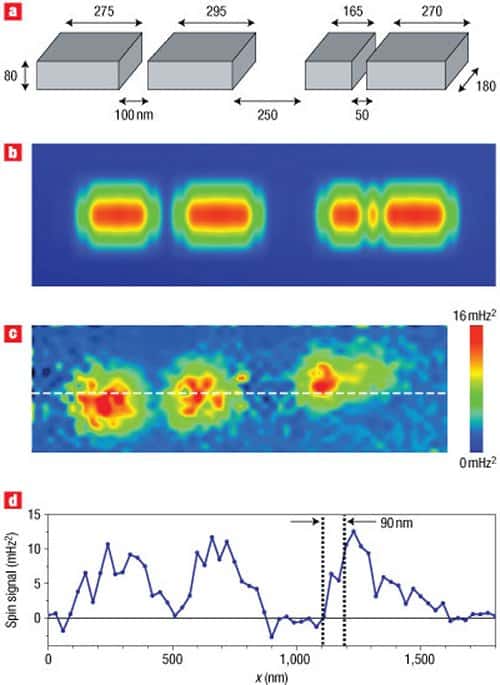
The magnitude of these changes is proportional to number of fluorine atoms in the region of the magnetic field, allowing a 2D image of the calcium fluoride concentration to be made by scanning the tip across the sample. The researchers claim that they were able to makes images of as few as 1200 atoms in a sample comprising rectangular blocks of calcium fluoride that were 80 nm tall and 180 nm wide. The blocks varied in length from 165 nm and 295 nm and were arranged in a row, separated by distances as small as 50 nm. The microscope imaged all the features on the sample with the exception of the 50-nm gap – leading the researchers conclude that the resolution of the microscope is 90 nm (see figure “90 nm resolution”). This is equivalent to a detection volume of volume of just 650 zeptolitres, which is some 60,000 smaller than is possible with the best conventional MRI and at least 70,000 times smaller than with the best MRFM to date.

Although the new microscope represents a major improvement in MRI microscopy, the measurements had to be done in a vacuum chamber at temperatures as low as 600 mK in order to minimize noise in the cantilever. As a result, measurements cannot be made under ambient conditions, which precludes its use in the study of many of materials – particularly some biological samples.

Copyright © 2026 by IOP Publishing Ltd and individual contributors