

New lower limit set for Newton’s law

While Newton’s second law has been proven over and over again here on Earth, astronomical evidence has led some physicists to suggest that it may not hold for all values of acceleration. Stars at the outer edges of galaxies, for example, rotate faster than predicted by the second law. This rotation can be explained by either accepting that Newton’s law breaks down at very small accelerations or by the introduction of dark matter, which has yet to be observed directly. In our own solar system, the Pioneer 10 and 11 spacecraft appear to be affected by an acceleration as yet unexplained by Newton’s law as they travel away from the sun.

It turns out that both of these gravitational anomalies could be explained by introducing a characteristic acceleration below which Newton’s law breaks down. For rotating galaxies this acceleration is about 1 x 10⁻¹⁰ m/s2 and for Pioneer 10 and 11 it is about 9 x 10⁻¹⁰ m/s2.

In 1986, physicists verified the second law to about 10-11 m/s2, which suggested that researchers should look elsewhere for explanations. Now, Jens Gundlach and colleagues at the University of Washington along with co-workers in Indiana have used a torsion pendulum to confirm Newton’s law for accelerations down to 5 x 10-14 m/s2 — providing even stronger evidence that a breakdown of Newton’s law is not responsible for these anomalies.

The pendulum weighed 70 g and was suspended from a metre-long tungsten wire that was 20 µm in diameter. When twisted, the wire exerted a restorative force on the weight, causing it to oscillate with a period of about 13 minutes. The weight was made to oscillate over a range of extremely small amplitudes (13 nrad to 19 µrad), which meant that weight experienced extremely small accelerations for relatively long periods of time. Any breakdown in Newton’s law during these periods of small acceleration should have caused the oscillation frequency of the pendulum to deviate from that predicted by Newton’s law.

The researchers measured pairs of amplitudes and frequencies over a wide range of amplitudes. The amplitude was then used to calculate the maximum force on the weight and the oscillation and amplitude were used to calculate the maximum acceleration. The physicists found that force did indeed equal mass times acceleration down to an acceleration of 5 x 10 -14 m/s2.

While this shows that Newton’s law holds at very low accelerations, the measurements were made using a mechanical restoring force and not gravity. Gundlach and colleagues are now devising an experiment that will test Newton’s law at very small accelerations in which the force is gravitational.
Twin spacecraft take first 3D images of the Sun

The twin satellites of NASA’s $540m Solar Terrestrial Relations Observatory (STEREO) orbit the Sun with one slightly ahead of Earth and the other slightly behind. The 3D images are created by virtue of the satellites being slightly separated in space — just as a pair of eyes can perceive depth. The new images released by NASA cover all wavelengths detected by STEREO (visible, ultraviolet and radio) and some clearly show plumes of material emanating from the surface of the Sun (see figure “3D plumes”).

CMEs can send electrical currents and high-energy particles coursing through the Earth’s protective magnetic field. The resulting geomagnetic storms can cause severe disruption by knocking out power grids and telecommunications systems. It is hoped that the STEREO satellites will transform our understanding of why CMEs occur and also allow scientists to better forecast when geomagnetic storms will happen.

NASA’s existing Advanced Composition Explorer satellite (ACE) can warn of a geomagnetic storm about an hour before it strikes. STEREO is expected to increase this notice period to about two days. STEREO’s satellites contains nearly identical suites of visible, ultraviolet and radio detectors to track the direction and speed of CMEs from their origin at the solar surface, through the Sun’s atmosphere and then across the interplanetary medium.

Fibonacci spirals in nature could be stress-related

Stress engineering can be used to create microstructures without using any high-precision patterning equipment. In the technique, a curved “core” material is coated with a different “shell” material at a high temperature. The composite is then cooled while carefully restricting the geometry, and because of difference in the thermal expansion of each material selective parts of the shell buckle under stress, causing patterns to form.

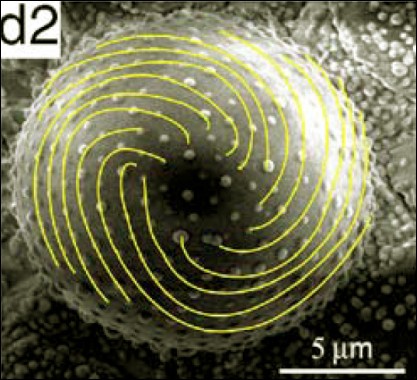
Zexian Cao and colleagues from the Chinese Academy of Sciences used stress engineering to create different-shaped microstructures just 12 µm across with a silver core and a SiO2 shell. They discovered that if the shells were encouraged into spherical shapes during cooling, triangular stress patterns formed on the shells. On the other hand, if they were encouraged into conical shapes, spiral stress patterns were formed. These spiral patterns were “Fibonacci spirals” – that is, spirals that have dimensions governed by the Fibonacci series (see fig: “Fibonacci spiral”).

Cao’s team do not think the Fibonacci spirals formed by accident, however – they think that their cause may be related to a tricky problem posed by the physicist J J Thomson in 1904. Thomson asked how a collection of like-charges would arrange themselves on a conducting sphere so as to minimize energy. Physicists have since calculated that the charges would take on triangular patterns – similar to Cao’s spherical microstructures. Because of this, Cao’s team thinks that the Fibonacci spirals on the conical microstructures must be the equivalent minimum-energy (and hence minimum-stress) configuration for a cone, although they have not performed any calculations themselves.

Biologists have long suspected that the branching of trees and other occurrences of the Fibonacci sequence in nature is simply a reaction to minimize stress, but no concrete proof of it has every been found. “Our experiment using pure inorganic materials may provide proof to this principle,” Cao told Physics Web.

Cao added that using stress engineering to create Fibonacci patterns could also have applications in photonics: “Fibonacci spirals are a special lattice; I would say they are both ordered and disordered. If the lattice points were some materials of a proper ‘dielectric’, it may provide a new photonic crystal that displays some interesting properties.”

Perturbative QCD fails for Compton scattering

Protons and other hadrons are made of three quarks held together by gluons, which mediate the “strong” interactions between the quarks. While all of this is elegantly described by quantum chromodynamics (QCD), the strong interaction confines the quarks inside hadrons, which makes it impossible to study the properties of individual quarks. Moreover, the equations of QCD are eye-wateringly difficult to solve and physicists instead have to use approximations to QCD to predict the properties of protons and other hadrons.

If a proton is involved in a high-energy collision, the behaviour of its constituent quarks can, however, be approximated using perturbative QCD (pQCD), which assumes that the three quarks behave essentially like weakly interacting particles. This technique was used in the early 1980s to analyze cross-section data from a Compton scattering experiment carried out at Cornell University. A cross-section is a measure of the likelihood that a specific scattering event will occur. The apparent success of this analysis had led physicists to conclude that the pQCD approximation was valid for Compton scattering at energies of a few GeV.

However, in the intervening years some researchers suspected that the scattering was better defined by another approximation to QCD called the handbag model. In the absence of any new experimental data, however, this question had remained unresolved.

But now physicists from the Hall A collaboration at the Jefferson Lab accelerator have performed a new set of more accurate Compton scattering experiments that provide strong evidence that, at low energies of a few GeV at least, the handbag approach is the better of the two. In particular, the relationship between the cross-sections and the momentum of the collisions was much better described by the handbag model than by pQCD.

Jefferson Lab’s Kees de Jager told Physics Web that while pQCD remains valid at higher energies, “the handbag dominates in the few-GeV range”.

Quantum physics says goodbye to reality

Some 40 years ago the physicist John Bell predicted that many hidden-variables theories would be ruled out if a certain experimental inequality were violated – known as “Bell’s inequality”. In his thought experiment, a source fires entangled pairs of linearly-polarized photons in opposite directions towards two polarizers, which can be changed in orientation. Quantum mechanics says that there should be a high correlation between results at the polarizers because the photons instantaneously “decide” together which polarization to assume at the moment of measurement, even though they are separated in space. Hidden variables, however, says that such instantaneous decisions are not necessary, because the same strong correlation could be achieved if the photons were somehow informed of the orientation of the polarizers beforehand.

Bell’s trick, therefore, was to decide how to orient the polarizers only after the photons have left the source. If hidden variables did exist, they would be unable to know the orientation, and so the results would only be correlated half of the time. On the other hand, if quantum mechanics was right, the results would be much more correlated – in other words, Bell’s inequality would be violated.

Many realizations of the thought experiment have indeed verified the violation of Bell’s inequality. These have ruled out all hidden-variables theories based on joint assumptions of realism, meaning that reality exists when we are not observing it; and locality, meaning that separated events cannot influence one another instantaneously. But a violation of Bell’s inequality does not tell specifically which assumption – realism, locality or both – is discordant with quantum mechanics.

Markus Aspelmeyer, Anton Zeilinger and colleagues from the University of Vienna, however, have now shown that realism is more of a problem than locality in the quantum world. They devised an experiment that violates a different inequality proposed by physicist Anthony Leggett in 2003 that relies only on realism, and relaxes the reliance on locality. To do this, rather than taking measurements along just one plane of polarization, the Austrian team took measurements in additional, perpendicular planes to check for elliptical polarization.

They found that, just as in the realizations of Bell’s thought experiment, Leggett’s inequality is violated – thus stressing the quantum-mechanical assertion that reality does not exist when we’re not observing it. “Our study shows that ‘just’ giving up the concept of locality would not be enough to obtain a more complete description of quantum mechanics,” Aspelmeyer told Physics Web. “You would also have to give up certain intuitive features of realism.”

However, Alain Aspect, a physicist who performed the first Bell-type experiment in the 1980s, thinks the team’s philosophical conclusions are subjective. “There are other types of non-local models that are not addressed by either Leggett’s inequalities or the experiment,” he said. “But I rather share the view that such debates, and accompanying experiments such as those by [the Austrian team], allow us to look deeper into the mysteries of quantum mechanics.”

Microscope could scan optical lattices

Optical lattices are regular arrays of identical energy wells created by criss-crossing laser beams. By injecting ultracold atoms into the energy wells, the lattices can be used to create and study a range of materials such as Bose Einstein condensates, in which all the atoms are in the same quantum state. The lattices can also be used to mimic the conditions normally found in solids. The advantage of an optical lattice is that the interactions between atoms can be tuned by tweaking the laser beams, whereas the interactions in solids are fixed by the structure and composition of the material.

While researchers have been very successful at measuring the collective properties of atoms in optical lattices, they cannot currently make measurements on individual lattice sites or on individual atoms. Such measurements would be particularly useful when studying lattices in which several different phases – such as magnetic and superconducting – coexist.

Now Corinna Kollath and Thierry Giamarchi of the University of Geneva, along with Michael Köhl of Cambridge University have come up with a way of using a single trapped ion to probe optical lattices with a spatial resolution of about 20 nm.

Under the proposal, the ion would be held above the optical lattice in a trap created by focussing radio waves using a configuration of four electrodes. To make a measurement, the ion would be dropped down into the lattice, where a laser pulse would cause the ion to bind momentarily with a resident atom to create a molecule.

The properties of this molecule could be detected either through a change in the oscillation frequency of the ion within the trap or by observing changes in light scattered from the ion when it binds with the atom. This information could then be used to determine the atomic density of the lattice site – and in some cases its spin density, which is related to the magnetization of the site.

According to Kollath, such magnetic measurements could be used to confirm the antiferromagnetic state of fermions in an optical lattice by observing that the lattice sites alternate between spin-up/spin-down configurations. The technique could also be used to cause a small local perturbation to the optical lattice, which Kollath says could help physicists gain a better understanding of energy gap that defines the superconducting phase of matter.

Meanwhile, Köhl told Physics Web that he and several other groups are currently working on ways to combine single-ion trapping with lattices of ultracold atoms. While both techniques are well-established on their own, Köhl said that they put very different demands on the nature of the experimental set up.

Black-hole eclipse sizes up X-ray source

Supermassive black holes are billions of times heavier than the Sun and astronomers believe that they lie at the heart of every galaxy. The gravitational pull of these and other black holes is so strong that nothing – not even light – can escape. Black holes appear to be fed by a steady stream of gas and other material that spirals around the body in an “accretion disk”, before plunging in. This material gets very hot as it accelerates towards the black hole and emits copious X-rays, which reveal the position of the otherwise invisible black hole.

Although extremely bright, the X-ray emitting region of these disks is very small and astronomers had not been able to measure the size of the emitters directly. It had been predicted that the NGC 1365 X-ray source was about ten times the size of the black hole’s event horizon – the point at which not even light can escape from the black hole. This was confirmed by the sheer luck of a cloud eclipsing the black hole while it was being observed by Chandra. The transit took about two days, which makes the X-ray emitter about one billion kilometres in diameter.

Martin Elvis of the Harvard-Smithsonian Center for Astrophysics in Cambridge, Massachusetts and a member of the Chandra team told Physics Web that he expects more eclipses of NGC 1365 to occur. Indeed, the team already have plans to use the ESA’s XMM-Newton X-ray telescope satellite to observe these eclipses with the aim of reconstructing the shape of the X-ray source.

Gravity Probe B backs general relativity

The Gravity Probe B (GP-B) satellite is a collaboration between NASA and Stanford University and was launched in 2004 with an aim to study two effects predicted by general relativity, a theory first put forth by Einstein in 1915. In addition to the geodetic effect, the theory also predicts that massive bodies will pull space and time along with them as they rotate — an effect called frame dragging.

Now analysis of the data from GP-B has confirmed the geodetic effect with an accuracy of better than one percent. Although the same effect has already been measured by NASA’s Cassini mission, the results indicate that the much subtler frame-dragging effect should be confirmed by further data analysis by the end of this year. Frame-dragging has also been measured before by NASA’s LAGEOS satellites with an accuracy of ten percent, and it is currently unclear whether GP-B data will yield a more accurate result.

Gravity Probe B used superconducting quantum interference devices (SQUIDs) to measure tiny changes in the orientations of four perfectly-spherical, quartz gyroscopes as the experiment orbited the Earth for one year. The gyroscopes were housed inside a vacuum chamber and were maintained at 1.8 Kelvin during the measurements using liquid helium. The probe also includes a telescope that was trained on a distant “guide star” to provide a reference direction for measurements on the gyroscopes. General relativity predicts that the frame-dragging effect will cause the direction of the gyroscopes to change by a tiny 0.041 of an arc second.

Prior to launch, however, the satellite suffered numerous delays, and now there is the possibility that the accuracy of its data will not surpass that of other experiments performed before now. “On one level one can say that [Gravity Probe B] is a fantastic triumph of engineering — nobody has ever done an experiment like this before,” Clive Speake, a physicist from the University of Birmingham, told Physics Web. “On the other hand, one can’t do these experiments for fun. We have to wait until the frame-dragging result comes out.”

Photosynthesis takes a leaf out of the quantum book

Arguably the most important chemical reaction on Earth, photosynthesis allows plants to harness the Sun’s energy by converting carbon dioxide and water into energy-rich carbohydrates. For the most part this takes place in chlorophyll molecules, which are arranged such that neighbouring molecules have different energy levels. When light shines on one of these molecules, an electron is momentarily excited before passing its energy over to a nearby molecule with a slightly lower energy level. In this way energy can flow “downhill” from energy level to energy level until it reaches the crucial “reaction centre” where the actual photosynthesis occurs.

Scientists had assumed that the energy moves downhill in a “random walk”, which is essentially an incoherent “hopping” between energy levels. But this mechanism doesn’t explain how solar energy is transferred so quickly to a reaction centre, which allows photosynthesis to proceed with efficiencies of 95% or more. Gregory Engel and colleagues at the University of California in Berkeley, however, may now have the answer – and it’s all to do with quantum mechanics.

The US team performed 2D electronic spectroscopy to map the electron-energy levels of a certain strain of chlorophyll. They discovered regular variations of signal that sustained for hundreds of femtoseconds, which the physicists interpreted as “quantum beats” coherently linking all the energy levels together. Engel told Physics Web that this means the excitation can find the optimal route to the reaction centre without wasting energy through random hopping. “In effect, the excitation can ‘feel’ these many states at once without having to visit them individually,” he said.

It turns out that the computer scientist Lov Grover stumbled across an analogous method in 1997 by developing “Grover’s algorithm”, which he proved to be the fastest possible search of an unsorted database in quantum computation. “In the [photosynthesis] case, the energy searches for the path it needs to follow to get to where it’s useful,” explained Roseanne Sension at the University of Michigan.

Some may have qualms over Engel’s conclusions, however, because the experiment was performed at a temperature of just 77 K. The physicists chose this to exaggerate the behaviour of the electrons so that the experiment would be easier to demonstrate. But they insist that the energy transfer process would remain the same at more hospitable temperatures. “I’m not convinced it will,” said Sension. “Things are more rigid at low temperatures, so there is less [chance] that it will lead to decoherence. But it remains to be seen.”

Evidence mounts for Bose glass

Optical lattices are regular arrays of identical energy wells created by crisscrossing laser beams. When very cold atoms are injected into an optical lattice, they settle into the wells, ordered like eggs in an egg-box. Atoms can, however, move around the lattice by tunnelling from one well to another — movement that can be controlled by adjusting the shape, depth and spacing of the wells.

If the atoms can move easily from well to well, all the atoms in the optical lattice can collapse into the same quantum state — the BEC state — which extends as a coherent wave throughout the entire lattice. In this state, the atoms move collectively as a superfluid, experiencing no impediment to their flow. However, if the wells are made deeper, individual atoms occupy just one well each and the coherence and superfluidity are destroyed. The ensemble then becomes a Mott insulator.

Physicists have long wondered if the coherence and superfluidity of a BEC could also be destroyed if disorder were deliberately introduced to the optical lattice. This state of matter, which was first predicted in 1989, is known as a Bose glass. It was given this name because BECs can only be formed easily with bosons and because the disorder is reminiscent of the structure of traditional glass, which does not have a crystalline lattice.

Now Leonardo Fallani and colleagues at the European Laboratory for Non-linear Spectroscopy at the University of Florence have done just that. The researchers began with a 1D optical lattice in which all the wells were identical in terms of depth, width and spacing. By overlapping a second set of laser beams that were slightly mismatched to the lattice, they were able to create a disordered lattice in which wells all had different depths and were no longer the same distance apart. The level of disorder could also be increased by tweaking the laser beams.

In one experiment, the researchers began with an ordered Mott insulator and measured the excitation energy spectrum – essentially the energy required to remove an atom from its well and place it into a neighbouring well. This energy spectrum had discrete peaks characteristic of atoms in a lattice of identical energy wells. However, as disorder was introduced, these peaks began to vanish, suggesting that the system was transforming from an ordered insulator to a disordered insulator resembling a glass.

In a second experiment, the researchers began with a disordered lattice in which atoms could still tunnel between wells. As a result, a fraction of the atoms were in the superfluid state and therefore behaved as a coherent wave – the remaining atoms were thought to be in the Bose glass state. As the depth of the wells was increased, the researchers observed that the coherence – and therefore the fraction of atoms participating in the superfluid state — rapidly approached zero. This, according to the researchers, established that the Bose glass is an insulator rather than a superfluid.

Fallani and colleagues claim that these two observations are consistent with formation of a Bose glass. However, they also admit that further work must be done to confirm the existence of this new state. In particular, they must show that the excitation spectrum is completely devoid of any structure, which is an important signature of a genuine Bose glass.

Copyright © 2026 by IOP Publishing Ltd and individual contributors