French frustration

It would be unusual, in most western nations, for all the leading candidates in a national election to turn up at a trade show for farmers. But such is the influence of the French farming community that this is exactly what happened at the Paris Agricultural Show last month when the conservative Nicolas Sarkozy, the Socialist Ségoléne Royal and the centre’s rising star François Bayrou all put in an appearance.

Frustratingly for the science community, however, these three presidential candidates have not shown the same interest in the concerns of scientists, despite some impressive sounding rhetoric to the contrary. Sarkozy, for example, has said that research should be France’s “number one budget priority”, while Royal has pledged to increase the country’s research budget by 10% over the next five years.

Although research has kept a relatively low profile in the election, France does attach importance to science. It spends more on research as a fraction of Gross Domestic Product than similar-sized nations such as the UK and Italy, despite a decline in recent years. It also understands the huge benefits that accrue from hosting major international scientific facilities.

The Institut Laue-Langevin neutron source and the European Synchrotron Radiation Facility (ESRF) – both world-leading labs in their respective fields – are located in Grenoble (see pp12–13, print version only). One of the main CERN sites is in France. France has also fought hard to host the €10bn International Thermonuclear Experimental Reactor at Cadarache in Provence. Indeed, in purely monetary terms, estimates suggest that France gets back three euros for every one it pays towards the ESRF – and there is probably a similar story at France’s other international labs too. Add on the benefits that these labs bring to local universities and hi-tech companies, and it is clear that France has done exceptionally well from hosting such facilities.

However, in other respects France underperforms scientifically. Pay and working conditions are poor, while universities and the laboratories of the national research council (CNRS) are overly bureaucratic and tightly controlled by the state. It is unfortunate that researchers have been so sceptical about genuine reforms, such as the new national research agency (ANR), which hands out grants on the basis of peer review (see p14, print version only). Some scientists think that politicians will pressurize the ANR to award grants only in more applied areas, while others, bizarrely, even fear that having to compete for grants will stifle creativity.

Whoever wins the presidential election will need to introduce more such fundamental reforms – such as giving universities more freedom, increasing salaries of researchers and offering postdocs more job security – and not just be lured by the prize of hosting grands projets.

Making the switch to teaching

There is something incredible about working with young people and giving them the skills and confidence to do something that they have never done before. For physics teachers, the ultimate challenge is to help those students who believe that physics deals with some mysterious, incomprehensible world to realize that it actually governs the world in which they live. If you can get just a few of these students to understand the relevance of physics to their lives, then you have achieved something important. It was this challenge that led me to switch careers midstream and retrain as a physics teacher.

When I finished my degree at Oxford University in 1991, I knew that I wanted to be based in London and earn enough to afford an extravagant lifestyle. These criteria led me away from science and technology into the world of finance, analysing the alcoholic drinks market at the investment bank BZW. As a young person, this was a wonderful place to be, with opportunities to travel and meet interesting people. But ultimately I realized that it was not the life I wanted. This dawned on me while I was eating a fantastic steak with a good wine at the Savoy but trying to justify a market forecast for the drinks firm Guinness that I knew would ultimately turn out to be incorrect due to factors I would never be told.

It was at this point that I moved to South Africa, where there was a demand for investment analysts with experience of European markets to help raise funds in the post-apartheid era. Although I loved working in Africa, it became clear to me after a few years that I wanted to move out of finance. On my return to the UK, I therefore got a job for a company that specialized in video-on- demand technology, albeit in a commercial position. As I sat through meetings, I discovered that I was much more interested in the technical part of the discussions and that what I enjoyed most was describing how technology works.

Taking the plunge

By the time I realized that the video-on-demand company was not going to offer me a long-term career, I had two small children and the priorities that I had used to launch my career were irrelevant to my lifestyle. It was then that I considered a more radical career change: retraining as a teacher. It took some time for me and my family to agree that this was the right decision, but the more family-friendly hours and the opportunity to work outside large cities were major plus points.

Next I had to decide how to train and what type of school to teach in. Having left London for a village in Cambridgeshire, I decided to apply for the Postgraduate Certificate of Education (PGCE) at Cambridge University. I was keen to obtain a recognized qualification and receive a good training that would give me confidence in my new career. The main alternative to the PGCE would have been an on-the-job training route called the Graduate Teacher Programme, where it is possible to earn a salary while training (see “Those who can, teach physics”).

The year of training was a humbling lesson in starting at the bottom, as I realized that teaching was a totally different skill to anything I had done before. The bulk of the course was spent working in two different schools. In the first I spent a lot of time observing classes and teaching parts of lessons. At the second school it became more serious and I was given a relatively full timetable to teach, although there was always support near at hand. A real treat was the weeks spent at Cambridge University with a combination of lectures and classes. Sitting back and letting someone else do the teaching was always enjoyable, and the quality of the discussions was excellent.

The teaching life

Since I completed my PGCE in 2004, I have been teaching physics at Comberton Village College, a rural comprehensive school that draws students from the villages around Cambridge. We attract pupils with a wide range of backgrounds, including the children of leading Cambridge professors. The school takes great pride in ensuring that all students are given the best chance possible.

Each class I teach is different, with its own problems and rewards. It is often the students who are hardest to teach that I get to know best and develop the closest relationships with. Ironically, this is a result of all the time I spend outside of normal lesson times discussing my expectations for their behaviour. There are also students who never fail to inspire me with their new and interesting ideas about science, which, although not always fully thought through, can reveal an approach that I had never considered.

Switching to teaching has been one of the most rewarding and worthwhile decisions I have ever made, but it has certainly not been an easy option. On days when I am teaching large and demanding classes with no free periods I feel that I am working harder than in any of my previous jobs. Compared with even the most difficult audiences I faced in the City, a large group of 15-year-old students is far less forgiving. However, I can also say that I never find myself sitting around wishing for the end of the day. As a teacher, you must plan your lessons carefully to ensure you get things right most of the time, but when you do the rewards are enormous.

Once a physicist: Mike Long


How did you become interested in physics?

As the son of a pastor, I grew up in several tiny towns, one of which had only 500 people. When maths suddenly “clicked” for me at the age of about 16, and a godsend of a teacher portrayed physics as a fun exercise in discovery for smart people, my path was set.

Where did you study physics and how much did you enjoy it?

I received a scholarship to go to Murray State University in Kentucky, where my field of study made me arrogant. I posted Rutherford’s quote in my room: “All science is either physics or stamp collecting.” (I still believe it.) I consider the effect of a physics education on the mind to be like a team of gifted mechanics rebuilding an old car: they tear it down to nothing then reassemble it with only the best parts into something sleek and powerful. So, I enjoyed my study of physics a lot. I finished at the top of my class, and then went on to graduate study at Vanderbilt University in Tennessee. After a year I quit, having got what I wanted from physics: how to think.

How did your career progress from there?

I didn’t see much of a career as a physicist without a PhD and I didn’t want to be an engineer, so I put my education to work doing mathematical modelling of business systems. I spent 10 years with a tiny company of fun people who were some of the smartest folks I have ever known. I did some travelling, I started a family, I pursued an interest in stand-up comedy and I wrote some columns for a local newspaper. After about seven years I realized that I loved words more than I loved maths and science, and that my physics background made me a better writer than I might have been otherwise because I knew how to understand a problem and explain it.

How did you make the move into political speechwriting?

The writers I admired had, like me, backgrounds wholly unrelated to English or journalism. Many had spent time as political speechwriters, and I contacted them directly. It turns out that political speechwriters don’t get much fan mail; they were happy to hear from someone interested in their work and they introduced me to people in Washington. Eventually I found work as a low-lowlow- level writer and moved to DC with my family and enough savings to last a year before I would have to resurrect my maths skills. Fortunately, within two months I was asked to be speechwriter for Republican Senator Fred Thompson (now an actor on the TV show Law and Order).

What does your job as director of the White House Writers’ Group involve?

I write speeches, editorials and positioning papers. For some clients, I get to contribute to the making of policy – speechwriters have more say than anyone knows in how public and business policy turns out. I am often called in at the last minute to fix things, so I have long stretches of free time when I hustle for work, write fiction and contribute to magazines and newspapers.

What are some of the highlights of your writing career?

Ben Stein, the former White House speechwriter who is also an economist and an actor, allowed me to write a pilot TV script based on one of his ideas; we worked on that together for some time, which was a treat. I wrote the liner notes for the DVD of the documentary Comedian about Jerry Seinfeld’s return to stand-up comedy after leaving his famous TV show. I have written for four presidential candidates, members of the President’s cabinet and CEOs of some of the largest multinational corporations. Best of all, I occasionally get to offer candid advice to people who make decisions that affect the world.

How has your physics education helped you in your career?

If I’m working on a technology “gig”, my education gives me the inside track. As Physics World readers know, a physics degree tends to impress people – there aren’t a lot of speechwriters who can talk about the atom. When people ask me what they should study in college, I say: first, not writing – learn to do something useful and then you’ll have something to write about; and second, study physics – you will learn to see through any problem.

Quantum computing – a commercial reality?

The 300 or so scientists, journalists and entrepreneurs who gathered at the Computer History Museum in California’s Silicon Valley on 13 February had, on the face of it, come to see a man solve a Sudoku puzzle on a laptop. Why did they bother turning up, you might ask. The reason was that the puzzle was apparently not being solved by the laptop, but by another computer, connected over the Internet, that was sitting in a lab in Vancouver. This second computer was no ordinary digital device but, according to the company D-Wave carrying out the demonstration, the “world’s first commercially viable quantum computer”.

If D-Wave, which was spun out from the University of British Columbia in 1999, has indeed built such a device, it would have made a huge breakthrough. For about the last 20 years some of the brightest minds in academia and industry have been attempting to build a quantum computer – a machine that can, in principle, exploit the weird laws of quantum mechanics to vastly outperform classical computers when carrying out certain types of calculation. But although these scientists have constructed primitive prototypes, they are still probably at least a decade away from building a useful quantum computer, such is the difficulty of manipulating delicate quantum systems without destroying them in the process.

It was perhaps no surprise then that the media reacted enthusiastically to D-Wave’s demonstration, proclaiming that “Canadians win race to build ‘super computer'”, to quote one headline. But is the breakthrough really all it is cracked up to be? Given the slightly mysterious nature of the demonstration and a lack of accompanying technical information, many other scientists in the field remain highly sceptical. Phil Keukes, a quantum-computing researcher at Hewlett Packard in Palo Alto, California, is one of these. “D-Wave seems to be using certain quantum effects in its machine,” he says. “But it is not clear that it has a quantum computer.”

Inside Orion

Quantum computers exploit the ability of quantum systems to exist in two states at the same time. Rather than use bits, which are either 1 or 0, they use qubits, which can be in a superposition of both 1 and 0 simultaneously. The idea is that if a quantum computer has N such qubits, these can then be combined or “entangled” to represent 2N values at the same time. By processing each of these values simultaneously, a quantum computer could, in principle, operate exponentially faster than its classical counterpart.

Researchers have built very basic quantum computers – consisting of at most a handful of qubits – using the quantum states of a variety of microscopic systems, including ions confined by electromagnetic fields, neutral atoms, photons and the minuscule pieces of semiconductor known as quantum dots. D-Wave, however, has built the 16 qubits in its machine – known as Orion – from loops of superconducting niobium. The advantage of using superconducting materials is that – unlike atoms and photons – they are macroscopic objects that can be fabricated and manipulated using conventional microchip technology. The pairs of electrons inside a superconductor, which lead to it having a zero resistance below a certain temperature, all exist in the same quantum state and therefore confer quantum properties to the superconductor as a whole.

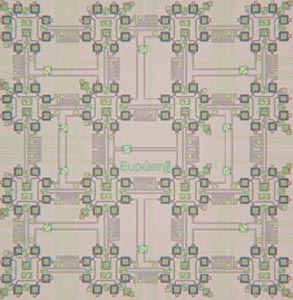
Each of Orion’s qubits is about 50 µm across and the chip on which they are mounted measures 5 mm by 5 mm (in contrast, the whole system, including refrigeration equipment, has a volume of about 45 m3). Current within Orion’s qubits can circulate either clockwise or anticlockwise around the loop, or in a mixture of both directions, corresponding to a 0, 1 or a superposition of the two values. The value of each qubit at any one time is determined by three controllable parameters – an individual qubit’s own “bias” towards 1 or 0; the coupling between neighbouring qubits (i.e. whether their currents want to align or circulate in opposite directions); and the energy barrier between different qubit states (which can be overcome by quantum tunnelling).

To perform a calculation, Orion is first cooled down to just 0.01 K to minimize the thermal noise than can wreck quantum states. With qubits initially set to the same value, the three parameters are adjusted via instructions contained within an algorithm that is fed to the computer. Once all the adjustments have been made and the system settles into a stable state, the answer to the calculation is then a 16-bit digital number given by the final values of the qubits.

Orion is designed to solve a class of problems known as “NP-hard”, which essentially involves finding the minimum or maximum of a certain function (matching biological molecules with one another, for example, means maximizing the similarity of structure). Such problems are “intractable” because the time that a classical computer would need to solve them increases exponentially with the size of the dataset involved. The beauty of Orion is that, in principle, it does not find the answer through brute number crunching but by allowing the rules of quantum mechanics to determine the most stable values of individual qubits given the competing forces of bias and coupling. “We are essentially tapping into the equation-solving potential of nature,” says physicist Geordie Rose, a founder and chief technology officer of D-Wave.

Only so fast

According to D-Wave, Orion takes about 100 times longer to solve a given problem than the best known classical algorithm attacking the same problem on one of the firm’s PCs. But Rose says that as the company increases the number of qubits on the chip – it claims it will have a staggering 1024 qubits by the end of next year – Orion will become competitive with the best classical algorithms available. These upgrades will follow a 32-qubit version of Orion, access to which will be made available later this year via the Web.

So what is the catch – how has this small company managed to do something that has seemingly eluded all other research groups so far? The answer is that Orion is in fact not a fully-fledged quantum computer. It is instead what is known as an “adiabatic quantum computer”, which remains in the lowest possible energy level at all points in a calculation and is consequently less susceptible to decoherence – the destruction of the relative phase of different energy levels within a general-purpose quantum computer that occurs if the computer is exposed to the outside world. “For this reason, it is technically less challenging to scale to 16 qubits than with general-purpose superconducting qubits,” says Frank Wilhelm, a physicist who works on superconducting qubits at the University of Waterloo in Canada.

Rose acknowledges Orion’s limitations, pointing out, for example, that it cannot simulate other quantum-mechanical systems – which is likely to be one of the main applications of the first generation of general-purpose quantum computers and which would be of use to chemists and biologists, for example. He also points out that any quantum computer given an NPhard problem to solve is unlikely to be exponentially quicker than a classical machine and is instead likely to only be quadratically faster (although this could still potentially speed up calculations by factors of thousands). “We think a quadratic approach is more robust against noise,” he says. “This was a design choice, but one we believe provides huge market potential.”

Not everyone believes that Orion can achieve even a quadratic speed increase, however. Umesh Vazirani, a computer scientist at the University of California, Berkeley, says that for this to be achieved, Orion must vary the rate at which it executes its algorithm during the course of the calculation. But he thinks that no-one knows how to do this for the kind of calculations that D-Wave is attempting.

Rose admits that “there are unresolved issues related to finding good algorithms for the machines we’re building” but claims that the only way of ironing out these issues is through an “empirical approach”, essentially by continuously redesigning and rebuilding the processor rather than carefully building a device from first principles. While reluctant to provide details, Rose claims “it is beyond doubt” that Orion does exploit quantum-mechanical phenomena in its calculations. But he admits that he does not know whether a larger version of Orion will be able to harness the power of the quantum world. “The blunt truth is that no-one really knows how a large-scale machine will actually perform,” he adds.

Notwithstanding the uncertainty that surrounds its technology, D-Wave has so far managed to raise $38m – with about half the money coming from private venture capitalists and the other half from the Canadian government – and hopes to raise additional funds from established technology companies. And although Wilhelm remains sceptical about the potential of the adiabatic approach and would like D-Wave to publish a detailed, peer-reviewed account of Orion’s operation, he agrees with Rose on one thing – that the only true way to find out the potential of this technology is to build and test a larger version of the device. “Until this is done,” says Wilhelm, “the assessment of the power of this chip remains in limbo.”


Rebellious thoughts

“In spite of its title,” the author remarks, “this book is mostly not about rebel scientists.” In fact, it is a collection of Freeman Dyson’s essays and book reviews divided, rather arbitrarily, into four themed sections, of which only two focus mainly on science and scientists. I once proposed compiling a volume of my own book reviews to a publisher who turned the idea down flat. But then, I am not the inimitable stylist that Dyson is, nor can I call upon his deep erudition. One might add that many of his reviews are lengthy and discursive pieces from the New York Review of Books, often not of just a single book.

Such a compendium is a problem to review, since the subject matter is difficult to pin down. With that in mind, I will take the liberty of picking and choosing a few essays I admired, as well as some that I shook my head over. From my point of view, the most exciting of the four sections concerns issues of war, peace and morality. This section could have been titled “weapons and hope” and indeed contains three rewritten chapters from Dyson’s out-of-print book of that name. It also includes an analysis of pacifism as a moral force, in which Dyson draws parallels between the abolition of slavery and the continuing frustrated attempts to ban nuclear weapons, thus deriving some hope that the latter will one day be achieved.

One of the essays I was less pleased with was a review of Edward Teller’s memoirs, in which Teller comes across as basically a great guy with something of a flaw in his character. Other reviewers have pointed out discrepancies between Teller’s book and accounts of the same events, such as Janet Patterson’s The Ruin of Oppenheimer and Frances Fitzgerald’s Way Out There in the Blue. For instance, Teller’s complicity with advocates of bombing in the US Air Force to build a second, unnecessary weapons lab is well documented. Perhaps to those who Teller respected or found use for he was the cultivated and sweet piano-player that they describe, but in my experience his was an outsize ego feeding on the naive patriotism of the young and adapting his scientific judgments to his political prejudices.

By way of contrast, I very much enjoyed Dyson’s several essays about his friend Richard Feynman, who was indeed a “rebel scientist” if ever there was one. Unlike Teller, Feynman really did have an instinct for dealing wisely with the young, as charmingly confirmed in Leonard Mlodinow’s little book Some Time With Feynman.

In view of Dyson’s Templeton prize, a “conflict of interest” note might have been appropriate to some of his essays on science and religion. Nonetheless, I liked his contrast of the thinking of Feynman and John Polkinghorne, in which he concludes that there is no real equivalence between scientific thinking and theological analysis no matter how refined the latter may be. However, in this chapter he also claims that religions other than Christianity have no analytical theology, and hence do not identify so centrally a conflict with the teachings of science. I do not believe this is the case: creationism is alive and well in Islamic Turkey, for example, and is already a problem for educators of young Muslims in the UK.

I concur with Dyson’s take on the philosopher Daniel Dennett – that in confronting religion directly, he is attempting to eradicate one of the deepest instincts of the human character and so is bound to fail. However, I differ from Dyson in that I consider, as does Dennett, religion to be a deeply embedded evolved behaviour pattern, rather than an intellectually justifiable, or necessarily useful, concept.

Perhaps because I take a somewhat narrower-minded view of science than Dyson, I would not have cut Michael Crichton’s Prey, a scary science-fiction treatment of nanotechnology, quite so much slack. Personally, I would like to be convinced of a plausible danger before writing off a whole science – it is amusing that Crichton has become, since Dyson’s review, a high-profile global-warming denier.

The long essay from which the book takes its title is a tour de force of which I must approve because of its strong bias against bare-bones reductionism. The instance he emphasizes is not one I would have thought of, but it is a beauty: the black hole. Dyson points out that neither Einstein, whose equations foreshadowed the black hole, nor Oppenheimer, who showed how one could form, had much interest in the discovery. It was to them mere “phenomenology”, an uninteresting application of more fundamental principles. In fact, if relativity and quantum theory are ever to be reconciled, the black hole will surely turn out to be the first hint of a possible resolution.

It must be apparent by now that, whatever my cavils, I read the book with continuing amazement at Dyson’s ability to tie together a wide variety of intellectual threads, and great enjoyment of his command of language. Dyson justifiably enjoys a reputation as a highly literate author with an encyclopedia of subjects at his fingertips. Whatever he writes deserves to be read.

Science bloopers

Phidias, the greatest sculptor of classical Greece, got into trouble while working on his statue of the goddess Athena for the Parthenon. Citizens seeing his work in progress realized its head was disproportionately big, and denounced it. The sculptor asked them to suspend judgment until the statue was complete and they could look up and see it – literally in perspective – mounted high on the temple. When this was eventually accomplished, the citizens appreciated the sculptor’s wisdom: Phidias’s distortions had indeed been necessary to make the statue look lifelike.

I often think of this tale when I see science mistakes in the media. It is tempting to ridicule science bloopers – or what I would call “science solecisms” – partly because we feel superior for noticing them. But as the Phidias story cautions, not all distortions from reality are bad, and some can even be useful.

Flubs and gaffes

What we might call the “flub” is a mistake due to science illiteracy. In one biography of the jazz musician Charles Mingus, for instance, the author claims that Mingus blew his car horn while driving through a tunnel because he “loved the swelling echo and the Doppler effect”. Clearly the author, the manuscript reviewer and the editor had forgotten what elementary physics they had been taught, if any. Flubs, though, do not really bother me, and I don’t think they are truly harmful. I suspect that the author would have needed to have the mistake explained to him – and would have been happy to fix it once he had understood what was wrong.

The “gaffe” is similar to the flub, but occurs in contexts where you might expect better. The Oscar-winning movie Titanic (1997), which is the highest grossing ($1.8bn) and costliest ($200m) film ever made, is celebrated for the supposed care that director James Cameron took to get the ship’s details correct, down to the rivets and even the patterns on the crockery off which the passengers ate. But this care did not extend to the night sky, where the stars are in the wrong positions. Gaffes of this sort do trouble me, for they treat nature as less important than cups and saucers. This particular gaffe bothered me even more when I learned that Cameron had studied physics at college, and so really should have had more respect for nature. Say it ain’t so, James!

Enabling distortions

Another problem is that while the real Titanic‘s lifeboats lacked lanterns, in the film version a lifeboat crew produces one to hunt for survivors – Cameron needed something to light the scene. I’d call this a “harmlessly enabling distortion”, or HED, as it was done knowingly for a good purpose.

Most HEDs are used to make a scene prettier or at least look the way an ordinary person might want it to look, who would not notice or care if it deviates from reality. To those who do care, however, HEDs can be offensive and have the opposite effect, making the scene look unrealistic. Physicists have plenty of material to choose from, such as noisy explosions in space, visible laser beams and people wearing bullet-proof vests being blown violently backwards through shop windows after being shot. Many of these physics flaws are listed in the wonderful website Insultingly Stupid Movie Physics (see Physics World June 2004 p52, print version only).

“Good faith enabling distortions” occur when the person who commits them does care, and has recourse to them only as a last resort. The producers of the film Finding Nemo (2003) for instance, enlisted Adam Summers, a specialist in fish biomechanics who is now at the University of California, Irvine, to ensure maximum possible realism in the animation. Summers did the best he could, given the parameters; after all, it was a movie about talking fish.

But what I call “Phidias distortions” are those that are deliberate, knowledgeable and done for a genuinely artistic end. I can think of several classic short stories involving the supernatural in this category. These include Washington Irving’s Rip Van Winkle and Fitz-James O’Brien’s The Diamond Lens, which involve suspensions of natural behaviour but create a concentrated and even chilling effect, thanks to the authors’ careful control of details.

“Fake artistic distortions”, however, are mistakes that the perpetrators try to pass off as artistic distortions. When last year the novelist and recovering alcoholic and drug addict James Frey was discovered to have fabricated details of his bestselling memoir A Million Little Pieces, a spokesman for its publisher Doubleday said that the deceptions were unimportant. What mattered was instead “the power of the overall reading experience”.

The critical point

Bloopers evidently come in many different varieties. Some – especially those in movies and books – can be harmless even when annoying, and can serve bona fide artistic purposes. It would be difficult, however, to justify as harmless a blooper in a textbook or physics syllabus. But what varieties have you spotted – and have I missed any categories? I shall devote a future column to the responses.

  • Which are your favourite science solecisms? Do they matter and, if so, why? E-mail your contributions to Robert P Crease

Large Hadron Collider faces delay

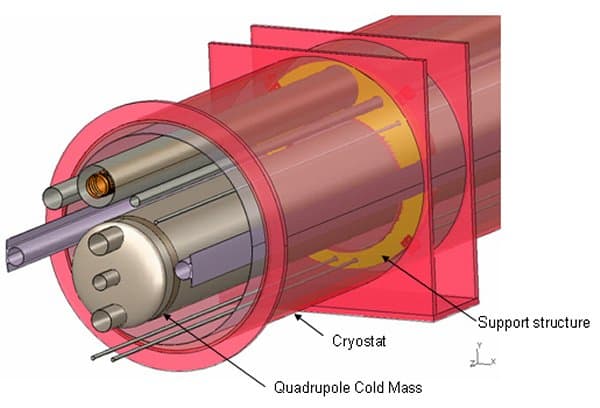
The €6.3bn LHC — the biggest experiment ever in particle physics — will accelerate protons in opposite directions around a 27-km-long ring and smash them together at energies close to 14 TeV. The protons will be guided around the ring by some 6000 superconducting magnets of various types. These include 392 “quadrupole” superconducting magnets that are designed to focus the proton beams before they collide at four interaction points around the accelerator.

Earlier this week, however, scientists at CERN performing preliminary tests on three of these quadrupoles witnessed a serious failure when structures supporting one of the magnets broke at a pressure of 20 atmospheres in response to “asymmetric forces” that were applied during the test. It is essential that the magnets can survive such unwanted pressures, which will occasionally be generated when the LHC is up and running.

These high pressures will occur if the superconducting magnets, which store huge amounts of energy, warm up inadvertently — for example, if faults in the magnet arise or if part of the proton beam careers off course and hits the magnet. This warming process, which is known as “quenching”, causes the magnets to lose their ability to superconduct and release their stored energy. Although the LHC contains a special protection system that will kick in to distribute the unwanted heat evenly through the rest of the magnet and so prevent the coil from melting, the magnets will still be subjected to enormous pressures.

Fermilab nor CERN do not yet know why the magnets failed. According to Fermilab, however, four engineering reviews of the magnets were carried out between 1998 and 2002, none of which appear to have addressed the asymmetric loads. The only tests on the magnets while they were still at Fermilab were performed on single magnets, which would never develop such loads. Fermilab is now planning an “external review of the factors that led to the magnet failures” and says it is working with staff at CERN to address the problem.

Originally slated for 2005 start-up, the LHC has already suffered several delays. CERN was caught out in 2001 when it emerged that the LHC was to cost 30% more than originally envisaged and was also running behind schedule. The committee that reviewed CERN’s operations in the light of these overruns recommended that the collider’s start date be put back from 2005 to 2007, and the lab will have been anxious to ensure that this date does not slip any further.

Nanotubes chill chips

A carbon nanotube can be thought of as a sheet of carbon one atom thick that has been rolled up to make a nanometre-diameter cylinder. Despite being very lightweight, nanotubes are extremely strong and flexible. They are also conduct heat and electricity very well, which is why there have been many attempts to develop electronic devices from nanotubes since they were first discovered in the early 1990s. However, the use of nanotubes to conduct and dissipate heat has been largely ignored.

This opportunity has been seized by Robert Vajtai and colleagues at Rensselaer Polytechnic Institute in New York along with Krisztian Kordás and co-workers at Finland’s Oulu University, who have created the first nanotube cooling fins for silicon chips.

The fins were made by first growing a film of multi-walled nanotubes (several carbon tubes nested inside one another) on a silicon substrate. The individual nanotubes pointed out of the substrate surface and were about 1.2 mm long and varied in diameter from 10-90 nm. The nanotube film was then detached from the substrate and a laser was used to systematically remove nanotubes from the film to create 10×10 arrays of nanotube “fins”. The fins were pyramid-shaped structures each containing a large number of individual nanotubes (see figure).

The arrays were then soldered to silicon “flip chips”, which are used in portable and automotive electronics. Despite being knocked about during the assembly process, the nanotubes came through unscathed and their cooling capabilities were on par with copper structures. Indeed, Vajtai told Physics Web that the nanotubes proved to be much more robust than the delicate copper structures that are currently used to make light-weight cooling fins.

Vajtai said that the group is currently trying to boost the performance of the fins, which he believes could reach ten times the heat dissipation of copper fins. This could be done by using higher-quality nanotubes and through the careful optimization of the overall structure of the arrays in terms of the size and spacing of the fins. He also believes that nanotube cooling fins could someday be manufactured at a cost of about one cent per device cooled, which is comparable to existing technologies.

Quasicrystals are selective with terahertz light

Shine light through the large holes of, say, a kitchen colander and you get just a portion of it coming out the other side. Shine it through arrays of holes smaller than the light’s wavelength, however, and almost all of it can be transmitted. This is thanks to the way photons interact with surface electrons, producing collective excitations known as “surface plasmon polaritons”. Previously, enhanced transmission was thought only to occur in periodic holes in metal. But now Valy Vardeny and colleagues from the University of Utah have shown that the effect can be even more pronounced in aperiodic, “quasicrystal” arrays.

At a glance, quasicrystals look as though their pattern ought to repeat, but at closer inspection one finds that there are always subtle irregularities that preclude any of the translational symmetry that is found in normal crystals. Quasicrystals do, however, have rotational symmetry, meaning that at a certain number of intermediate points in a complete revolution their pattern will be the same.

Vardeny’s team made different arrays of holes in 75-µm-thick stainless steel foil varying from quasicrystal to totally random patterns. They then shone light through the foils and measured the spectra of light emitted from the other side.

They found that the foils with random holes attenuated the light output fairly evenly over the spectra. The quasicrystal arrays of holes, on the other hand, let sharp peaks of the light’s frequency pass through, which were directly related to the spacing between the holes in the structure. In addition, the precise transmission could be tuned by simply rotating the foil. For patterns that were neither well-defined enough to be termed quasicrystals, nor totally random – what Vardeny calls “quasicrystal approximates” – the transmission peaks were less prominent.

Vardeny told Physics Web that the foils could be developed as tuneable filters for use in communications. Terahertz radiation, which lies sandwiched between the microwave and infrared regions of the electromagnetic spectrum, is currently fairly underexploited, but could enable large amounts of data to be transmitted at high speeds. Vardeny’s team is now looking at other aperiodic structures for use in the terahertz region.

Quantum lottery is your best bet

Like it or loathe it (and Einstein famously loathed it), quantum processes such as radioactive decay are innately random. But in spite of its weirdness, over the past 80 years physicists have got to grips with the randomness to produce an ever-growing list of proven technology.

None can be so fun, however, as the “quantum lottery”, a project devised by final-year physics student Jaspal Jutla at the University of Southampton. The idea is to invite non-scientists from all backgrounds, young and old, to take bets on the decay of a radioactive sample. Jutla hopes this will encourage participants to think about some of the philosophical aspects of quantum mechanics that have emerged over the years. “It’s an area of physics that is extremely fascinating and has many unanswered questions,” she told Physics Web. “It can also be fun because it urges the participant to use their imagination.”

Jutla has performed many trial runs of the quantum lottery, which comprises a small amount of caesium-137 placed a few centimetres away from a scintillation crystal. Caesium-137 has a half-life of 30 years, and as it decays it emits gamma-ray photons, some of which are absorbed by the scintillation crystal and amplified into a measurable signal through a photomultiplier tube. Jutla then records the number of photons or “counts” per second and takes the average over eight seconds.

To enter, participants must go to the project website and guess whether on each of the eight seconds the number of counts will be above or below the average. On 2 May, Jutla will then perform the experiment to determine the lucky winner. Until then, however, she is aiming to promote the quantum lottery as widely as possible. So far this has mostly been via leaflets that explain some of the mysteries of quantum mechanics with a minimum of theory, but she also hopes to do presentations for local primary school children and appear on her university radio station “Surge” in the near future.

With just 256 combinations and the prize of an iPod shuffle mp3 player, there should be incentive for everyone to have a go – although Jutla admits she may have to run the experiment for longer to make more combinations if there is substantial interest. But if that’s not enough, Jutla is keen to draw attention to Hugh Everett’s “many worlds” alternative interpretation of quantum mechanics, which supposes that every possible outcome of a quantum event does indeed occur, just in its own separate universe. “I like that interpretation,” she said. “It means that everyone’s a winner.”

Copyright © 2026 by IOP Publishing Ltd and individual contributors