This episode of the Physics World Weekly podcast explores how medical physicists are using exciting new technologies to make precision medicine possible. Our guests are Anna Barnes, Director of the King’s Technology Evaluation Centre at Kings College London and President of IPEM, and Nicky Whilde, who is head of radiotherapy physics at the Mid and South Essex NHS Foundation Trust.
In a wide-ranging conversation with Physics World’s Tami Freeman, Whilde and Barnes define the key concepts of precision medicine and explain how they are being implemented by medical physicists using magnetic resonance imaging, radiotherapy and other technologies.
This episode was created in collaboration with IPEM, the Institute of Physics and Engineering in Medicine. IPEM owns the journal Physics in Medicine & Biology.
This episode is supported by PTW, the dosimetry specialist.
When the Hôpital de la Tour in Switzerland recently restructured its radiation therapy services, it brought in a completely new medical physics team. These physicists were tasked with revising all of the hospital’s radiotherapy processes, including the machine quality assurance (QA), without interrupting clinical activities.
To deliver a seamless changeover, the team needed to find a comprehensive QA system that could effectively manage the department’s suite of radiotherapy treatment and simulation devices. Ideally, the software would be simple to use, fast to deploy, and able to perform all of the required QA and quality control (QC) tasks from a single platform.
The answer lay in RadMachine – a complete cloud-based QA platform from oncology software company Radformation. RadMachine provides machine QA for all therapeutic and imaging systems, as well as ancillary equipment, integrating all of the data into a simple, centralized hub. The software enables users to review multiple QA data streams at once and provides detailed reports to help track device performance over time.
Jarno Bouveret: “RadMachine was really fast and easy for us to implement”. (Courtesy: Karla Torzsok)
“When we arrived in this centre, it was challenging because the previous physicists left before our arrival. We found lots of home-made QA solutions, but these were unusable without knowledge transfer, so we had to quickly implement a new QA system,” explains Jarno Bouveret, medical physicist at the Geneva-based Hôpital de la Tour. “We were looking for next-generation software and we found RadMachine, which we are now using. It has merged all of the QA into one platform, it’s really nice software.”
One of the first tasks was to perform the standard tests required to comply with Swiss legislation. “RadMachine includes all of these tests, and Radformation helped us to adapt it, so it was really fast and easy for us to implement,” says Bouveret. He notes that the software came preconfigured – he and his colleagues just needed to perform some verification checks before customizing the QA processes to meet their needs. “It’s simple in RadMachine to just select different tests and merge them into a common test list,” he explains.
The team has been using RadMachine for over a year now – for machine QA of the department’s two radiotherapy treatment devices, as well as its CT, PET/CT and MRI simulation systems. Bouveret points out that the software’s inherent automation has helped to simplify the daily QA workload. For example, users can create a checklist of QA validation tests that the therapists complete each day. If all the tests are passed, RadMachine validates the QA automatically; but if one fails or a query is flagged, the software alerts the physicist to check it further. Likewise, if the daily QA has not been performed at the usual time, RadMachine will send an email alert.
Bouveret also works within an imaging centre at a different hospital, where much of the QA is delegated to an external company that just sends over reports. He thinks that switching to RadMachine could enhance the QA process here too, by providing greater insight into erroneous measurements, for instance, and tracking QA results over time. “I will try to import it into this other hospital, to show how good it is and what benefits it could offer,” he adds.
Designed for imaging
Meanwhile, at the University Hospitals Health System in Cleveland, Ohio, medical physicists are already utilizing RadMachine within the centre’s diagnostic imaging department. “Currently, we’re using RadMachine to record and analyse our CT quality control data and our MRI quality control data,” says Nichole Harris, a diagnostic medical physicist. “It serves as an electronic QC record and it also helps us to maintain compliance with different regulatory organizations by having records readily available.”
Nichole Harris: “RadMachine strikes the right balance in terms of scalability and efficiency”. (Courtesy: Ian Tuttle)
Harris explains that the hospital selected RadMachine due to its flexibility, its cloud-based architecture, and the availability of single sign-on features for IT integration. Another selling point was the availability of Python and associated libraries for custom test scripting. While Harris and her team have not exploited this scripting facility yet, she emphasizes that it is “something we’re looking forward to working on in the future”.
With RadMachine in operation for approximately six months now, Harris says that one valuable feature that’s emerged is the software’s ability to analyse the test data in detail and look for trends. “We are also able to produce compliance reports for different regulatory organizations, and to really see the enterprise as a whole,” she says.
RadMachine also provides automated exception reporting. “We no longer have to check every machine, every day,” Harris explains. “Our end-users perform the daily QA tests, record the data, and then RadMachine will notify the physics group immediately if something needs attention.” This approach frees up the medical physicists to concentrate on the areas where they can make the most impact, such as correcting any anomalies and focusing on the areas required to maintain compliance.
In addition to the daily QA, the team uses RadMachine to approve quality control following major system repairs, where it helps to minimize clinical downtime. Harris adds that the software’s flexibility enables them to customize it for subtle differences between machines or manufacturer’s QA requirements. “It’s built for imaging, so it’s set up in a fashion that’s applicable to our task and strikes the right balance in terms of scalability and efficiency,” she says.
System support
When the UH Seidman Cancer Center first deployed RadMachine, the team at Radformation helped set up the software to work with their imaging systems, as well as helping Harris and her team to define the overall structure for implementation. “When there were questions about the logic or nuances of the system, they responded in a quick fashion to help us resolve these issues and get the system set up,” Harris explains. “They were quite the asset in terms of the single sign-on integration with our IT organization.”
Bouveret agrees that Radformation’s support team was a great help in implementing the new software. “I have had a lot of contact with them,” he says. “They have helped us to customize some image analysis to respond to the Swiss legislation. Every test we have asked for, they have created for us.”
Looking ahead, Bouveret says that the Hôpital de la Tour plans to begin new treatments such as radiosurgery, which will require the development of specific QA procedures. “We will be able to create our own tests by coding in Python and then we can just import it into the RadMachine software,” he tells Physics World. “So this will be really interesting for the future.”
Visit Radformation at the AAPM Annual Meeting, booth #807, to see a demonstration of RadMachine.
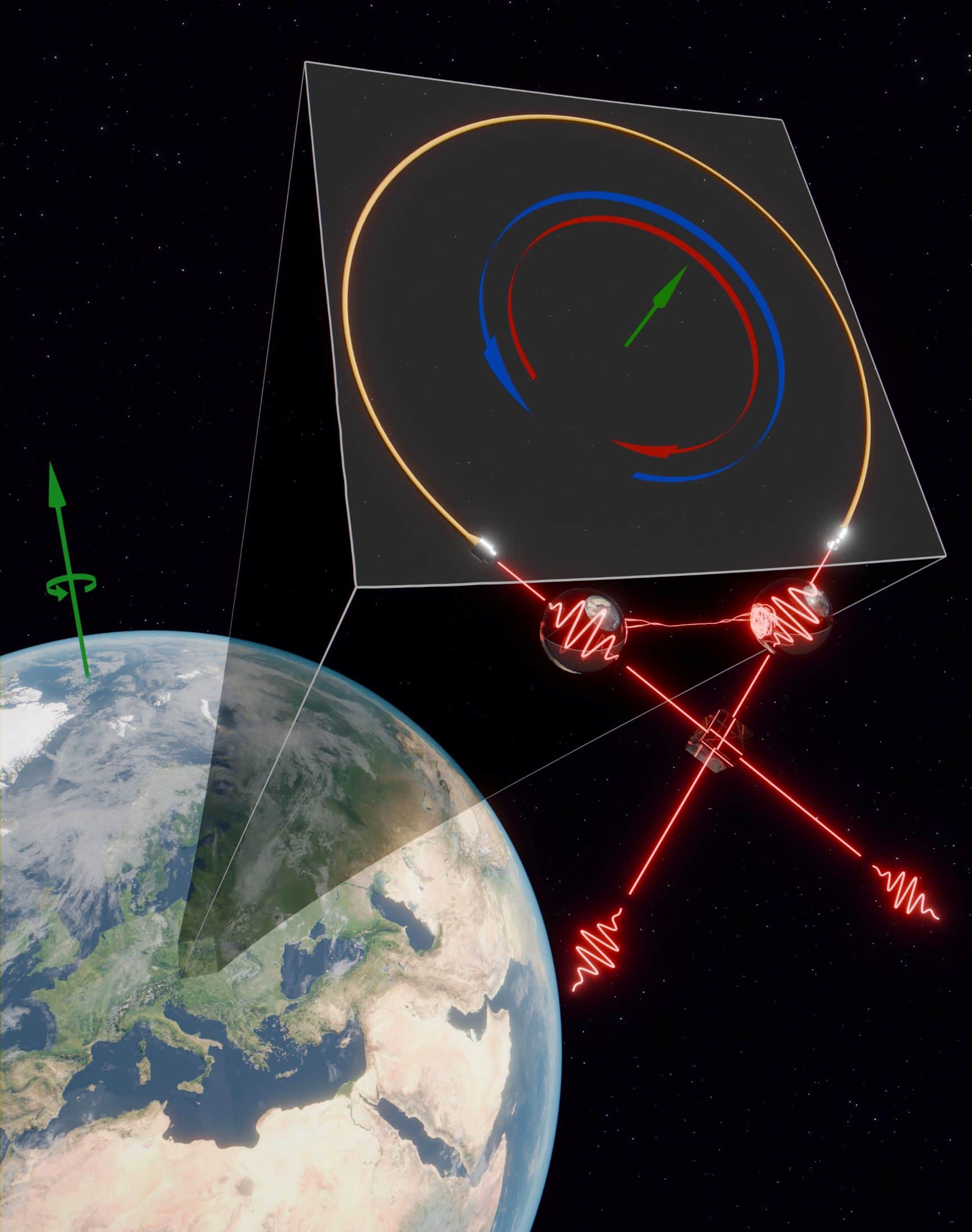
All in a spin: Two indistinguishable photons (red lines) are incident on a beamsplitter cube and become entangled. The two photons are then coupled into an optical fibre-based interferometer, which is sensitive enough to detect the rotation of the Earth as experienced at the interferometer’s location in Vienna, Austria. (Courtesy: Marco Di Vita)
A new experiment has measured the effect of Earth’s rotation on entangled states of light. The experiment, which features an optical fibre-based device called a Sagnac interferometer that its developers describe as the most sensitive ever built, paves the way for even more sensitive tests of gravitational effects on quantum objects.
In a Sagnac interferometer, beams of light travel around the same path, but in opposite directions. If the interferometer is at rest with respect to a non-rotating frame of reference, the travel time for each beam is the same, and recombining the two beams at a detector will produce an ordinary interference pattern. However, if the interferometer is rotating, the interference fringes will be shifted by an amount proportional to the angular velocity. The sensitivity of a Sagnac interferometer depends on the area defined by the paths, so with a large-enough interferometer, it becomes possible to measure even very small rotations with high precision.
Quantum entanglement is a phenomenon in which two or more particles become inextricably linked in ways that do not appear in classical physics. For example, if one photon in a polarization-entangled pair is measured and found to have horizontal polarization, we know immediately that the other photon must be vertically polarized, no matter how far apart they were when the measurement took place. This “spooky action at a distance”, as Albert Einstein called it, was once thought to be a quirky – or even nonsensical – aspect of the quantum world, but it is now a key part of quantum cryptography and quantum communications systems as well as quantum sensors.
The rationale for using entangled photons in a Sagnac interferometer is that they accumulate twice the time difference during their journey around the two paths compared to classical photons that are not entangled, explains Haocun Yu, a Marie Curie Postdoctoral Fellow at the University of Vienna, Austria and a member of the experimental team. “This is a unique property of multi-photon entanglement and is known as super-resolution,” Yu says. “By measuring this time difference, we are able to measure the effect of the rotation of Earth of these entangled particles.”
Keeping noise levels low and stable
The challenge with any quantum device is that entangled states are extremely fragile. Even the tiniest disturbance, or noise, in their environment can cause entangled particles to “decohere” (lose their quantum nature) through random interactions.
With interferometers, this challenge becomes more acute as the area of the device increases. Although larger Sagnac interferometers are better able to detect small rotations, any increase exposes the entangled photon pairs to additional noise.
Rotation detector: Sagnac interferometer built with 2 kilometres of optical fibre wrapped around a 1.4 metre square aluminium frame. (Courtesy: Raffaele Silvestri)
In the latest work, Yu, team leader Philip Walther and colleagues at Vienna and the Austrian Academy of Science constructed their interferometer by winding a 2-kilometre-long optical fibre around a 1.4 m x 1.4 m rotatable metal frame, giving the device an effective area of more than 700 m2. To keep noise levels low and stable, the researchers wrapped insulation around the fibre (mitigating fluctuations due to changes in temperature and air flow) and performed reference measurements to eliminate some sources of background noise. These measures enabled the device to detect enough high-quality photon pairs to boost its sensitivity by three orders of magnitude compared to previous quantum Sagnac interferometers.
Isolating and extracting the signal
Apart from noise, one of the main challenges the researchers faced was extracting the Earth’s rotation signal from their data. “This meant establishing a reference point for our measurement where light remains unaffected by Earth’s rotation effect,” explains Raffaele Silvestri, a PhD student at Vienna and the lead author of a Science Advances paper on the experiment.
Since they could not stop the Earth from spinning, the researchers devised a workaround, splitting the optical fibre into two equal-length coils and connecting them via an optical switch. “By toggling the switch on and off, we could effectively cancel the rotation signal at will,” Silvestri says. “We basically tricked the light into thinking that it’s in a non-rotating universe.”
Thanks to this approach, the researchers succeeded in measuring a rotation rate with a sensitivity of 5 μrad/s – the highest resolution ever achieved with an optical quantum interferometer.
The researchers say that detecting the Earth’s rotation is a milestone. “Its minute rotation rate, fixed direction and the inability to manipulate its behaviour make it particularly challenging to observe,” Yu says. “What is more, the ubiquitous presence of acoustic and seismic vibrations and thermal fluctuations directly transduce into noise for such a large apparatus.”
The new interferometer will now serve as a prototype for a larger device that the researchers will use to explore how quantum entanglement is influenced by gravitational potential. “Further improvements to our technique will also enable measurements of general-relativistic effects on entangled photons,” Walther says. “This will allow us to explore the interplay between quantum mechanics and general relativity, along with tests for fundamental physics.”
The inverse Mpemba effect has been observed in a quantum bit (qubit). The research was done at the Weizmann Institute in Israel and suggests that under certain conditions a cooler trapped-ion qubit may heat up faster than a similar warmer qubit. The observation could have important implications for quantum computing because many leading qubit types must be maintained at cryogenic temperatures.
The Mpemba effect is the puzzling observation that hot water sometimes freezes faster than cold water. It was first recorded in antiquity and is named after Erasto Mpemba, who as a teenager in Tanzania in the 1960s sought an explanation for the effect – which he first encountered while making ice cream and then confirmed in a series of experiments. Despite the best efforts of physicists over the past six decades, the effect remains poorly understood.
Researchers have also observed the inverse Mpemba effect whereby a cold system heats up faster than a warm system. Theoretical and experimental studies have revealed a range of systems – magnetic, granular, quantum and more – that exhibit Mpemba effects.
Avoiding decoherence
Quantum Mpemba effects are of particular interest to people developing cryogenic qubits. These must be operated at very low temperatures to reduce noise, which destroys quantum calculations in a process called decoherence.
In a new experiment described in Physics Review Letters,Shahaf Aharony Shapira and colleagues observed an inverse Mpemba effect in a single trapped strontium-88 ion coupled to an external thermal bath. This low-temperature ion acted as a qubit that interacted with the thermal bath, causing a slow decoherence of its quantum state over time.
“Most studies are about the direct Mpemba effect, which is easier to understand if you think classically,” says Aharony Shapira.
She offers an intuitive description of the classical Mpemba effect. Imagine, she says, a double-well potential where one well is a global minimum – the system’s most stable state – and the other is a local minimum – a comparatively less stable state.
Uniform energy distribution
When a system is at a high temperature, its energy distribution is relatively uniform, allowing it to transition between the two wells more freely. At lower temperatures, the system’s energy distribution becomes much narrower, concentrating near the bottom of each of the wells.
If the system starts in the local minimum, higher-temperature systems have lower energy barriers between the two wells, allowing them to transition quicker to the global minimum as it cools down.
“However, the inverse effect that we saw has a different intuition,” says Aharony Shapira.
End-state shortcut
To simulate the thermal bath, the team used laser pulses to induce transitions between the qubit states and the higher energy states of the trapped ion. Eventually, the interaction between the thermal photons from the laser caused the qubit to decohere.
The path the system takes as it moves towards its end-state is known as its “relaxation path”. This path is governed by the system’s interactions with the bath and its intrinsic quantum properties, such as coherence and interference effects that can suppress or enhance certain relaxation modes.
Unlike in classical systems, the relaxation rates in quantum systems do not change linearly with temperature. For certain initial conditions, a colder qubit might have a relaxation path that allows it to bypass certain energy barriers more efficiently than a warmer qubit. This shortcut allows it to reach the higher temperature equilibrium state faster than the warmer qubit – which is what the researchers observed.
School bus analogy
Team member Yotam Shapira explains the observation using the analogy of a bus driver waiting for schoolchildren to disembark. The bus driver, he said, finishes work when the last child gets off and is therefore limited by the speed of the slowest child.
“What we saw is that we can find conditions where it’s like the slowest child didn’t show up that morning,” he says, “Now the transition is much faster.”
Hisao Hayakawa is a researcher from Kyoto University whose team observed the Mpemba effect in a quantum dot. He says that the mechanisms observed at Weizmann Institute were similar to those seen in previous experiments. However, he suggests that the research may provide more insights into finer control mechanisms for quantum computing systems.
“These experiments suggest that the speed control to reach a desired state in quantum computers might be possible if we know the physics of the quantum Mpemba effect after a quench,” he said. A quench refers to a sudden change in a quantum system’s conditions, such as its temperature or magnetic field.
The research could influence the design of large-scale, temperature-sensitive qubit systems. “Maybe not cooling the system as much as you can would be best in the future,” said Aharony Shapira, “You need to be sensitive to special modes that, like in our case, can heat up very fast.”
Almost half of students who quit physics at 16 in England say they did not enjoy the subject, with a quarter noting that teaching was poor. That’s according to a recent survey carried out by the Ogden Trust – a charity that seeks to encourage people to study physics above the age of 16. Most pupils who do carry on with physics post-16 are, however, satisfied with their teaching.
The trust surveyed more than 1000 undergraduate students at UK universities, roughly half of whom are doing science, technology, engineering or mathematics (STEM) degrees. Students who had taken physics A-level – about 20% of respondents – report largely positive experiences, with 86% saying it had been well taught. Some 83% of those students say their physics teachers had strong specialist knowledge.
A less positive picture emerges from the other 80% of undergraduates who never took A-level physics. Almost half of them say they did not enjoy the subject, with a quarter describing the teaching as poor. The difference could partly be due to self-selection: physics A-level students will have actively chosen the subject and therefore been more engaged.
Another reason is that A-level physics classes are usually small and more likely to be taught by specialist physics teachers. Students who carry on with physics therefore have a better experience of the subject than those who gave up at 16, hampered by the estimated shortage of 3500 physics teachers in England alone. “GCSE-level teachers will often be teaching out of their field without the confidence and subject knowledge to inspire the class and support a depth of understanding,” says Clare Harvey, chief executive of the Ogden Trust.
Career advantage
The survey does, however, find that physics is the top-rated subject at A-level for inclusivity and for teachers being effective subject advocates. Of the students who did not take physics post-16, only 12% cite a lack of inclusivity as the reason – the lowest percentage out of 10 barriers mentioned. Most participants, including those who did not study A-level physics, also understand the career advantages it offers, with two-thirds believing it improves students’ prospects.
“The survey helps to validate and reinforce our strategy to support teachers, providing coaching and mentoring to keep specialist physics teachers in the profession and providing subject knowledge continuing professional development and support to upskill teachers who have to teach physics when it is not their specialism,” adds Harvey. “Retaining and retraining teachers to enhance the teaching and learning of physics remains central to our strategy.”
The results of the survey tally with work carried out by the Institute of Physics (IOP), which publishes Physics World. It points out that the lack of specialist physics teachers particularly affects students from lower socio-economic groups, who are three times less likely to take physics A-level than those from higher-income groups. As a result, 70% of A-level physics students come from about 30% of schools – often in the wealthiest areas of the UK.
“This is an important piece of work from the Ogden Trust and chimes with our experience that the quality of physics teaching up to 16 is affecting students’ deep engagement with the subject and reducing their likelihood of choosing it for A-level,” says Louis Barson, director of science, innovation and skills at the IOP. “The gradual loss of specialist physics teachers and the deployment of out-of-field teachers to teach physics up to 16 has correlated with the decline in uptake at A-level.”
The IOP has called on UK governments to improve both the recruitment and retention of physics teachers, which sees nearly half of teachers leaving within the first five years, and to fully fund retraining programmes for out-of-field teachers. Barson adds that the IOP has developed programmes that support recruitment and the retraining of out-of-field teachers – often in partnership with the Ogden Trust. This year, the number of accepted places on a physics “Initial Teacher Education” courses is 70% up on last year.
The thermoelectric effect is much stronger at the interface of two liquid metals than it is in solid–solid or solid–liquid systems. This discovery, from researchers at the Ecole Normale Supérieure (ENS) in Paris, France, could lead to improvements in batteries that contain liquid–metal interfaces, and might even enhance our understanding of Jupiter’s magnetic field.
In thermoelectric materials, the flow of heat from a cooler area to a warmer one can be harnessed to generate electricity via the thermoelectric effect, which converts temperature differences into an electric voltage. The effect is usually seen at solid interfaces between electrical conductors or semiconductors or between solids and liquids.
“Some very unusual behaviours”
In the latest work, however, a team led by ENS physicist Christophe Gissinger observed a thermoelectric effect between two metals, gallium and mercury, that are both liquids at 30 °C.
“The liquid–liquid nature of the interface between the two metals leads to some very unusual behaviours,” Gissinger explains. “First, the electric currents generated in our liquid experiment are 50 to 100 times more intense than expected in conventional solid systems. Second, the geometry of these currents is complex, featuring multiple loops and stagnation points, which have no equivalent in solid thermoelectricity.”
The researchers also found that when they applied a magnetic field to the interface, the field interacted with the thermoelectric current in a way that made the two liquids rotate in a circular pattern, but in opposite directions, at a speed of a few centimetres per second. This effect, which can be observed with the naked eye, could lead to a new way of pumping these liquids.
Experimental challenges
To perform the measurements, the team had to overcome two challenges. The first, says Gissinger, was controlling the temperature of the system. “For a convincing quantitative study, we needed a very large temperature gradient, of around 80°, but to a precision of less 0.3°, which required a powerful cooling/heating system,” Gissinger says.
The second challenge was measuring the thermoelectric effect. At just a few microvolts, the voltages the researchers measured were too low for conventional probes. This meant the team needed to create a new type of probe and perform a great deal of signal acquisition and processing on the experimental data. “Using metals that are liquid at room temperature was key because it greatly facilitated the installation of these elements,” Gissinger says.
From planets to batteries
As for practical implications of the discovery, Gissinger notes that the interior of the planet Jupiter also contains a liquid-liquid interface, between molecular hydrogen and metallic hydrogen. “Since the poles and the equator are generally not at the same temperature, you have here a configuration that is quite similar to the set-up in our experiment: a temperature gradient along an interface between two different conducting liquids,” Gissinger tells Physics World. “A thermoelectric current is generated at the interface between these two liquids that could interact with the planet’s radial magnetic field to generate complex zonal flows.”
The work could also lead to improvements in liquid metal batteries, which Gissinger describes as a highly promising technology for energy storage. These devices are similar to conventional batteries except that the anode and cathode are made from liquid metals separated by a liquid electrolyte. They are therefore based on a superposition of conducting fluids, similar to those described in the ENS study. “We expect that by maintaining a temperature difference in different parts of the battery, a strong thermoelectric current will appear around its liquid interfaces,” Gissinger says. “With an appropriate applied magnetic field, we can thus agitate the electrodes (by thermoelectric pumping) and enhance the battery’s efficiency.”
The researchers, who report their work in PNAS, say they would now like to see whether they can amplify the new thermoelectric effect by trying out other types of conducting fluids.
The world’s best runners are gathering in Paris for the 2024 Summer Olympics. Sprinters vying for the title “world’s fastest” hope to chase records set by all-time greats such as Usain Bolt and Florence Griffith-Joyner, competing on a highly engineered athletic track. Across the Atlantic, however, a different type of sprinter is practising its craft daily, not on polymer-laced rubber, but on water.
Basilisk lizards – nicknamed “Jesus Christ lizards” for their ability to run on water – don’t run for accolades or titles; they’re just looking to escape predators. When threatened, these pint-sized powerhouses take a running start on land, then skitter across the water. At 100 grams, basilisk lizards are hardly heavyweights, but they’re much too heavy to be supported by surface tension.
The ability to run on water is one of the most impressive feats in the animal kingdom – a triumph of physics as much as biology. It’s a question that has intrigued researchers for many years, but there’s something else all good physicists will want to know: could humans moving at speed ever run on water?
Slap, stroke, recover
Biologist Tonia Hsieh was first struck by the basilisks’ water-running in her undergraduate class on herpetology – the study of amphibians and reptiles. She couldn’t stop thinking about their ability to seemingly defy the laws of physics, so she pursued a PhD at Harvard University in 1999 chasing these little reptiles’ superpower.
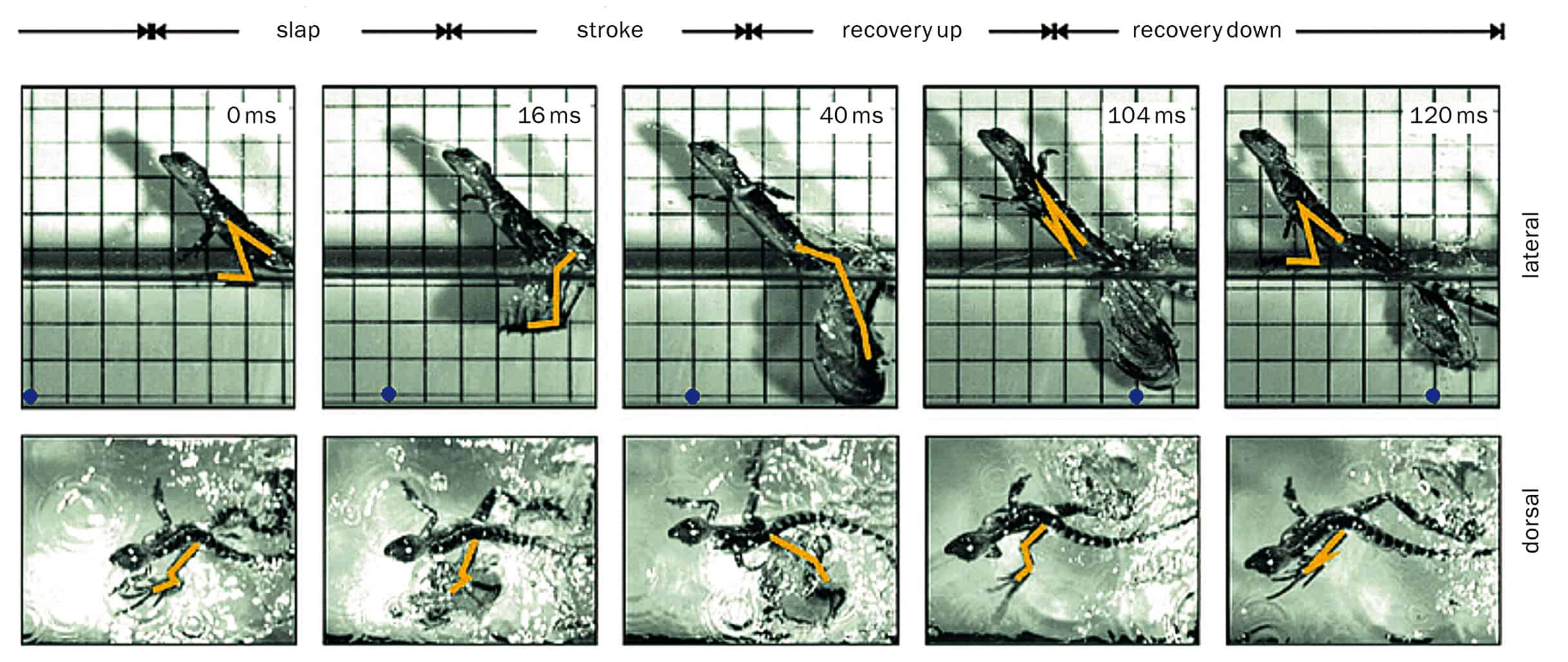
A few years before, two other Harvard researchers had studied the same problem, developing a mathematical model that was Hsieh’s starting point (Nature380 340). Tom McMahon and Jim Glasheen had analysed videos of the lizards and showed that each step they take across the water can be broken down into three stages – slap, stroke and recovery (see “On your marks” image).
On your marks The basilisk lizard is capable of short sprints on water thanks to its slap–stroke–recovery step cycle. (Courtesy: J. Exp. Biol.206 23)
When the basilisk runs, its foot slaps the water’s surface, just like a human sprinter on a track. With every footfall, the runner drives their shoe into the track, and the track pushes back. That’s Newton’s third law: every action has an equal and opposite reaction. The same holds for the basilisk. Each time the lizard’s foot hits the water, the liquid exerts an upward force. The larger the lizard’s foot and the faster it hits the water, the more upward force the slap generates.
Unlike a human sprinter, the basilisk is running on a yielding surface. When its foot dips into the water, the basilisk extends its leg like a swimmer’s arm, but it moves so fast that in the milliseconds before the water rushes in, an air-filled cavity forms above the foot. This is the stroke. During this phase the lizard’s foot experiences a lifting force proportional to the amount of water it moves.
In the final phase – recovery – the basilisk quickly pulls its foot up and lifts it for the next slap. Anyone who’s waded through knee-high water knows this isn’t easy. The basilisk’s foot must make it out before the water closes around it, otherwise it will be dragged down.
Glasheen and McMahon showed that thanks to the basilisk’s speed and large feet, the slap–stroke–recover sequence should generate enough upward thrust to support the lizard’s weight. For Hsieh, however, many questions remained. Staying above the water is only the first challenge: the basilisk also needs to move forward, and it needs to do this while balancing on the ever-changing surface of a liquid.
Like running on a mattress
To tackle these questions, Hsieh built a watery track for her runners using large aquarium tanks. A platform on either end gave her subjects solid starting and finishing lines. Hsieh stood by with a high-speed camera, poised to capture each run. She soon discovered, however, the challenges of running a scientific experiment on live, free-willed lizards.
“I had so many videos of them running across the water and then turning and running smack into the window,” she recalls. For useful data, she therefore had to wait until the lizards decided to run. Eventually, though, Hsieh was able to capture the basilisk foot’s speed and orientation in each phase. To calculate the forces, however, she needed to capture the motion of the water as well as the lizards.
Fluid dynamicists use a technique called particle image velocimetry (PIV) to measure the speed and direction (i.e. the velocity) of flow. For an analogy, think about late-afternoon sunlight slanting through a window. If it falls at a particular angle, the light will illuminate the dust particles in the room, revealing air currents that are otherwise invisible. PIV works the same way.
Hsieh filled her tank with 12-micron glass spheres that matched the water’s density. These tiny particles acted as tracers – just like dust – that followed the same path as the water. To illuminate them, she replaced sunlight with a 1 mm-thick laser sheet focused near the basilisk’s foot. By tracking the particles, Hsieh saw exactly how the lizards accomplished their gravity-defying sprint (PNAS101 16784).
The lizards were using the water like a squishy starting block – propelling themselves forwards as well as upwards. During the slap, they did this by angling their feet slightly down, so they met the surface at an angle, and during the stroke they were pushing against the wall of the cavity.
But Hsieh’s biggest surprise was the strong side-to-side forces, ranging from 37–79% of the lizard’s body weight. The basilisks were throwing themselves from side-to-side like a wobbling toddler. “It never occurred to me,” says Hsieh, “that if you can produce enough force to stay on top of water, how are you going to maintain your balance? That’s a really major problem.”
Everything we take for granted about moving around in the world is actually really, really hard
Imagine sprinting on a thick foam mattress. With every step, you’ll wobble as you try to stay balanced. That, Hsieh realized, explained the basilisk’s ungainly sideways motion. “They’re basically tripping every single step, and they’re catching themselves. Everything we take for granted about moving around in the world is actually really, really hard.”
Water running is a young basilisk’s game. As Hsieh’s lizards grew, they became bigger and slower, struggling to support their weight – potentially bad news for aspiring human water runners. However, these lightweight critters don’t have the last word in running on water. In fact, nature’s most successful water runners outweigh the basilisk lizard by a factor of 10.
Water dancers
Western grebes and their near-doppelgängers, Clark’s grebes, are unassuming birds. They have slender, swan-like necks and black and white plumage. Their most striking feature is their red eyes. But behind this unremarkable exterior lurks a water-running powerhouse.
Biologist Glenna Clifton first saw the grebes in the early 2010s in a BBC documentary. At the time she was a PhD student at Harvard, and her animal-behaviour class was discussing mating displays. Like many birds, the western and Clark’s grebes begin their displays with mated pairs mirroring one another. A head shake, a riffle of a beak through plumage. Then the birds extend their long necks, lock eyes and rush (see “It takes two” image).
It takes two By rapidly slapping their large feet, western grebes can run across water. Pairs of grebes perform this feat as part of a mating display. (Courtesy: iStock/Wirestock)
As a synchronized pair, the grebes rise out of the water, feet beating furiously, wings held stationary behind them. With heads proudly raised, the birds run up to 20 metres in just a few seconds. Having studied ballet since the age of three, Clifton was “really sparked and captivated” by this dance. But apart from previous work on basilisk lizards, she found no information on the water-running physics of grebes, so she set out to answer the question herself.
Grebes won’t run on water in a laboratory, so Clifton planned a field study to capture wild grebes rushing. In May 2012 she set out for Oregon’s Upper Klamath Lake with two high-speed cameras and two field assistants. They called themselves the Grebe Squad.
Each morning the group pitched up tents and arranged their equipment on a narrow spit of land between the highway barrier and the lake. Their experiment used two synchronized cameras, placed about 40 metres apart, to view the same birds from different angles. By placing a known object – in their case, a T-shaped calibration wand – in the field of view of both cameras, they could work out the sizes, angles and positions of the grebes (J. Exp. Biol. 218 1235).
This sounds straightforward, but it was anything but. The Grebe Squad spent days on the lake, scanning hundreds of birds for signs of an imminent rushing display. “We usually got about three to seven seconds of warning,” Clifton says, “because they would have a certain look in their eye. They would call to each other…with a certain kind of intensity.” With that scant warning, they coordinated over walkie-talkies, pointed both cameras, manually focused and collected 1.7 seconds of high-speed footage. Then they raced to get the calibration wand to the same spot the birds had been in before either camera moved. An errant elbow, a gust of wind or a sinking tripod would ruin the data.
“Grebes are, arguably, way stronger water-runners than basilisk lizards because they start from within the water,” Clifton explains. “Imagine treading water fast enough to get up out of it. It’s just crazy.” Synchronized swimmers and water-polo players would agree. Typically, a swimmer (or bird) is supported by buoyancy. A floating object displaces a water volume equal to the object’s weight, as described by Archimedes’ principle. In turn, the object feels an upward, buoyant force equal to the displaced water’s weight. As the grebe rises, it displaces less and less water, giving it less and less buoyant force.
Is there a balance between foot size and energy expended that would let humans run on water?
Without buoyancy holding it up, the grebe counters its weight the same way a basilisk does – by slapping its feet. And the Grebe Squad’s data revealed that grebes slap a lot. During rushing, Clifton says, “[grebes] take up to 20 steps per second, which is a really high stride rate for animals.” An Olympic sprinter, in contrast, takes about five steps per second.
To estimate the forces a grebe produces, Clifton dropped aluminium models of grebe feet into a laboratory water tank and measured the impact force. The grebes’ feet are proportionally bigger and they move faster than the basilisk’s. They produce stronger slaps capable of supporting 30–55% of the grebe’s mass, compared to only 18% for the lizard’s. If a basilisk lizard were scaled up to the mass of a grebe, its feet would still be 25% smaller in area than the grebe.
Larger feet push more water with each slap, but they also require more energy to accelerate and they generate more drag. Is there a balance between foot size and energy expended that would let humans run on water?
Could humans run on water?
Although it was built for basilisk lizards, the model developed by Glasheen and McMahon at Harvard also tells us what it takes for a human to run on water. The idea is simple: to run on water, the total impulse from a slap and stroke must be greater than the impulse needed to support the runner’s mass. Impulse is simply a force multiplied by the time over which a force is applied – in this case, the time between steps. With a little algebra and some simple assumptions, you can determine the slap velocity needed, given the runner’s mass and foot area, as well as the time between steps and the depth the foot reaches.
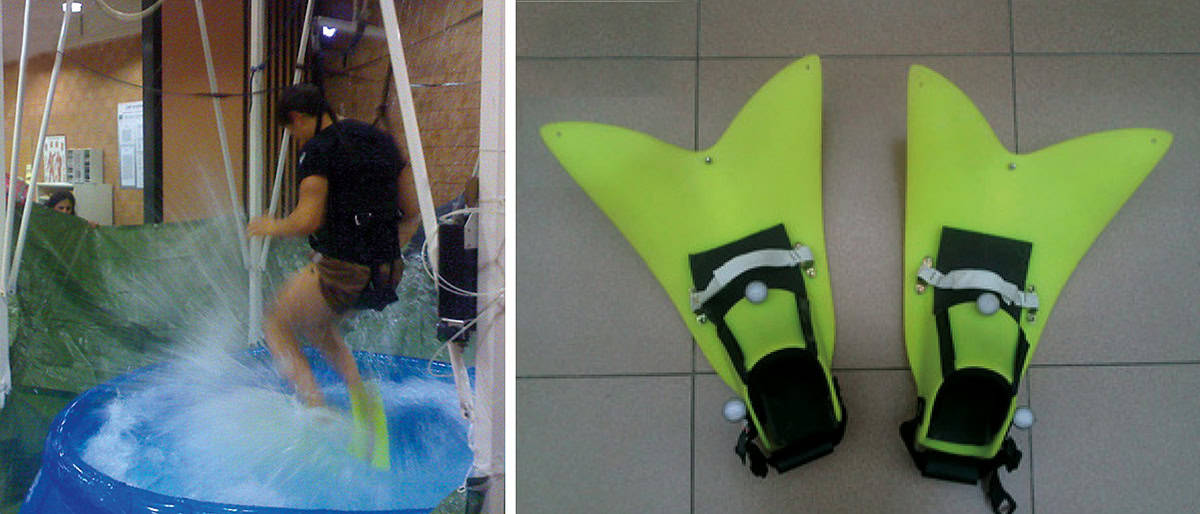
All in a day’s work In 2012 a group of Italian researchers used bungee harnesses and flippers to test whether humans could run on water in low-gravity conditions. (Courtesy: CC BY 4.0/Minetti et al. 2012 PLOS ONE7 e37300)
In their original paper, Glasheen and McMahon calculate that an 80 kg human with an average foot size and a world-class sprinter’s stride rate would have to slap the water at a speed of nearly 30 metres per second to support themselves. Unfortunately, the power needed for a stroke at that speed is almost 15 times greater than a human’s maximum sustained output. In other words, no human can run on water – at least, not on Earth.
That’s the theory, but does it stack up in reality? To find out, in 2012 a group led by Alberto Minetti, a physiologist at the University of Milan, studied whether reduced gravity conditions would enable humans to run on water (PLOS One 7 e37300). Their volunteers wore a special harness that reduced their effective weight to a fraction of its Earth-normal amount, along with fins that made their feet as proportionately large as a basilisk’s (see “All in a day’s work” images). Then they attempted to run on the spot in a small, inflatable pool. The video footage is spectacular.
The test subjects look more like cyclists than runners. Their thighs pump up and down, churning the water into splashes higher than their heads. Their legs stroke to a depth a little over halfway to their knees, but it’s clear that they manage to support their reduced weight for the seven to eight seconds the researchers deemed a success.
The team found that everyone could water-run at 10% of Earth’s gravity, but as they adjusted the harness so that the effective gravitational force increased, fewer runners could keep up. At 16% of Earth’s gravity – roughly equivalent to the Moon’s gravity – most of the runners could support themselves. At 22% of Earth’s gravity – still less than that on Mars – only one subject could. The Martian edition of the Space Olympics is unlikely to include water-running.
Running on Titan An image of Saturn’s moon Titan taken by NASA’s Cassini mission. The blue areas show Titan’s ethane and methane lakes. Under Titan’s low-gravity conditions, would it be possible for a human to run across these lakes like the basilisk lizard? (Courtesy: NASA/JPL-Caltech/ASI/USGS)
But water isn’t the only liquid found in our solar system. Titan, Saturn’s largest moon, has lakes and seas comparable to ours, and its gravitational acceleration is only 13.8% of Earth’s. (That’s a little less than our Moon’s.) Unlike Earth’s lakes, Titan’s are made of frigid liquid ethane and methane (see “Running on Titan” image).
So, could a human being – like current women’s 100 m world champion Sha’Carri Richardson – run on Titan’s lakes? Ethane – even at Titan’s 94 kelvin – is less dense than water, so it offers less impulse to runners. But Titan’s lighter gravity counters that.
At 45 kg, Richardson, who is representing the US in Paris, is petite but blisteringly fast. In the 2023 World Athletics Championships she won gold with a championship record of 10.65 seconds in the 100 m. Her UK size five shoes provide a good foot area. When sprinting (on land, admittedly), she takes ~4.6 steps a second. I’ll assume on ethane that she sinks about 8 centimetres – a bit less than the Italian water-runners – during each step.
To stay atop Titan’s ethane, Richardson would have to slap the surface at about 9.0 m/s. That slap would provide more than 60% of her necessary vertical impulse and require running at about 8.7 metres per second (31.2 kilometres per hour). Her world-championship time was significantly faster at 9.3 metres per second.
So quick dashes across Titan’s lakes are theoretically possible – at least for humanity’s fastest. Just make sure to dress warmly and maybe hold your breath.
For more from Nicole Sharp about the fluid dynamics of animals, listen to the July edition of the Physics World Stories podcast.
A matter-wave interferometer has measured the effect of gravity on individual atoms at the highest precision to date. That is according to its creators in the US and Italy, who built their instrument by combining matter-wave interferometry with the spatial control of optical lattices. The research was led by Cris Panda at the University of California, Berkeley and puts new constraints on some theories of dark energy involving “chameleon particles”.
Matter-wave interferometry is a powerful technique for probing fundamental physics. It takes advantage of wave–particle duality in quantum physics, which says that atoms behave as waves as well as particles.
“Lasers are used to split each atom in a quantum spatial superposition, such that each atom is effectively in two places at once,” Panda explains. “The two parts are then recombined and interfere either constructively, if the two parts are in-phase, or destructively, if they are out of phase.”
Search for new physics
When existing in two places, the phase of each component of the matter wave can be affected differently by external forces such as gravity. As a result, matter-wave interferometry can be used to make extremely precise measurement of the nature of these forces. This means that it can be used to search for deviations from the Standard Model of particle physics and Einstein’s general theory of relativity.
One fruitful area of investigation involves probing the gravitational force by placing a matter-wave interferometer next to a large mass. Atoms are split between locations at two different distances from the mass, allowing a comparison of the gravitational attraction between the atom and mass at two different places.
A shortcoming of such experiments, however, is that the atoms quickly fall out of place under Earth’s gravity, so making measurements longer than a few tens of milliseconds is difficult – limiting accuracy.
Atoms on hold
In 2019, the Berkeley team showed that optical lattices offer a solution by using lasers to hold atoms in position in Earth’s gravitational field. Earlier this year Panda and colleagues managed to hold atoms for 70 s in this way. Now, they have integrated a tungsten mass into their instrument.
Their latest experiment began with a gas of neutral caesium atoms that was cooled to near absolute zero in a magneto-optical trap. Some of the atoms were then transferred to a vertical optical lattice located just below a cylindrical tungsten mass that is about 25 mm in diameter and height (see figure).
A laser pulse was used to put the atoms into a superposition of two different micron-scale distances below the mass. There, they were held until a second pulse combined the superposition so that interference could be observed.
Information accumulation
“During the hold, the part of the atom in each location accumulates information about the local fields, particularly gravity, which can be read out at the end of the interferometer,” Panda explains. “The hold time can be many seconds and up to one minute, much longer than possible when atoms are falling under Earth’s gravity, which makes this device exceedingly sensitive.”
While the experiment did not reveal any deviations from Newton’s law of universal gravitation, it did allow the team to put new constraints on some theories of dark energy – which is a hypothetical form of energy that is invoked to explain the universe’s accelerating rate of expansion. Specifically, the team put limits on the possible existence of “chameleon particles”, which are dark energy candidates that couple to normal matter via gravity.
The team is also confident that their technique could have exciting implications for a wide range of research. “Our interferometer opens the way for further applications, such as searches for new theories of physics through precise measurements of fundamental constants,” Panda says. “It could also enable compact and practical quantum sensors: such as gravimeters, gyroscopes, gradiometers, or inertial sensors.”
Majorana particles could be an important component in quantum computers – if they exist. Using a new approach, physicists at QuTech in the Netherlands say they have now found fresh hints that Majorana-type behaviour is possible. They have also devised an experimental testbed for studying the properties of these particles and determining whether they live up to expectations.
Quantum computers use phenomena such as superposition to solve problems that would be impossible for classical machines. However, the quantum mechanical states they use for their computations are fragile. These states are known as quantum bits, or qubits, and they easily decohere, meaning that they lose their quantum nature and thus their ability to perform calculations. This is true for all existing qubit platforms, including trapped ions, spin qubits, superconducting qubits, Rydberg atoms and others. The only way of avoiding decoherence is to keep these quantum systems extremely stable, which requires equipment that is bulky, expensive and complex.
One possible alternative is to make qubits from so-called Majorana bound states (MBSs). These states are quasiparticles that arise from collective effects in a superconducting system, and they are protected from decoherence by the system’s topology – for example, by being bound to opposite ends of a nanoscale wire. This stability could make it possible to perform quantum computations with fewer qubits, but MBSs are notoriously difficult to produce. Only a handful of labs have seen positive hints of their existence, and past claims about Majoranas have produced intense debate within the scientific community. Several once-promising results have become the subject of expressions of concern or retractions, including two Naturepapers co-authored by researchers at QuTech (which is a collaboration between the Delft University of Technology and TNO, the Netherlands’ organization for applied science research).
A new route
In the latest work, which is also published in Nature, a different team at QuTech produced MBSs by coupling two spin-polarized quantum dots in a semiconductor-superconductor hybrid material. The coupling occurs via so-called Andreev bound states, which can be seen as a superposition of electrons and holes. By controlling these states using magnetic fields and gate voltages, the researchers tuned the system to “sweet spots” that demonstrate correlated zero-bias conductance peaks (ZBPs), which are an important property of MBSs and are resilient in the face of local perturbations.
However, because these experiments use only two quantum dots, the MBSs that arise are not topologically protected. These states have therefore been nicknamed “poor man’s Majoranas”, and the QuTech researchers aim to use them as a platform to study how the protection of Majoranas evolves as the number of sites in a so-called Kitaev chain increases.
Key experiments
The researchers performed two key experiments to verify the Majorana-ness of their system. In the first, they isolated Majorana pairs from each other and showed that disturbing one leaves the other unaffected, demonstrating that the ZBPs are indeed protected from local disturbances. In the second, the team estimated the Majorana polarization, which is an important metric for the quality of MBSs and is key to using them in qubits, which require multiple MBSs.
Srijit Goswami, the QuTech physicist who led the latest study, says that realizing these Kitaev chains in a two-dimensional platform is an important step towards the systematic study of MBSs. Disorder and impurities in these devices, he explains, sometimes create strong electrical fluctuations that would not be desirable in scalable qubits. Though these fluctuations do not undermine the physics of the experiment, Goswami acknowledges they need to be tackled before working towards more complex devices. “In order to realize a qubit, we must first understand the primary decoherence mechanisms for Majorana-based qubits,” he tells Physics World.
Debating Majoranas
Sankar Das Sarma, a theorist at the University of Maryland, US, who has collaborated with QuTech scientists in the past but was not involved in this work, describes the result as good for basic research, but emphasizes that an expansion to many-dot experiments will be necessary to create a workable technology. He also expresses some uncertainty as to whether the team’s approach – using quantum dots rather than nanowires, as previous experiments did – could lead to Majorana modes with exponential topological protection. The team’s biggest achievement, he says, is fabricating the sample and doing the experiment.
Henry Legg, a theorist at the University of Basel, Switzerland, who was likewise not involved in this research, says it is nice to see new device fabrication on new platforms. However, he suggests that the team may, in fact, have observed other, less interesting states that resemble Majorana bound states (MBSs), but lack the necessary topological protection. Such states would not have any advantage over other platforms such as superconducting or spin qubits, he explains, adding that the result has no proven relevance to the ultimate goal of a true MBS. The main challenge in this field, he says, is to overcome the impact of disorder, and it is not clear that producing a true Kitaev chain from these building blocks will do that.
Two critics of previous QuTech research on Majoranas are also not convinced. Vincent Mourik of Germany’s Forschungszentrum Jülich points out that the retracted QuTech Majorana work contained undisclosed data manipulations, including “inappropriately deleted or cropped” data in published figures. Given these earlier practices, and the similar topic, Mourik says he hoped that QuTech would adopt a policy of sharing the full data of a project upon publication. In the latest work, however, he notes that Goswami and colleagues only shared data corresponding to the published figures, not the full dataset.
Sergey Frolov, a physicist at the University of Pittsburgh, US, offers a similarly harsh judgement. “This paper, like the other two papers from Delft in Nature on this, do not report Majorana, present data in a very narrow way and do not advance quantum computing,” says Frolov, who co-organized an international conference on reproducibility in condensed-matter physics earlier this year. “Once we get the old data out of them, we will request this ‘poor man Majorana’ data as well,” he adds. “I think there will be things to find in the full data…Until they undergo a full external investigation, none of their results should be taken seriously.”
In response, the authors of the latest QuTech paper say that there is “no methodological connection” between this work and the work described in the previous retracted papers. “These experiments were conducted in a different research group with a different set of researchers,” they continue. “We find it deeply concerning that [Mourik and Frolov] place us, as authors of this new publication, under collective suspicion.”
The authors also state that QuTech’s data management policy “goes further than the policy of other research institutions” as QuTech publishes “at least all raw data underlying published figures, as well as the processing scripts. This was also the case for the current publication.”
This article was amended on 11 July to include a response from the authors
Back in 2022 when I wrote about new developments in wind-powered shipping, my article attracted quite a lot of comments. Ships are big polluters and I described some of the amazing innovations using wind to power such vessels. But some people seemed to think wind-powered shipping was a retrograde step if we want to make shipping greener.
Many of the objectors repeated the memes that prompted me to write that original article in the first place – essentially mocking the notion that wind-powered ships could possibly be the solution. But shipping is cleaning up its act, with plenty of recent developments. Most exciting of all is that several novel “clean” ships have been launched in the last few months.
Shipping is the lifeblood of the global economy, with about 90% of trade being seaborne. More than 90,000 ships crossed the oceans in 2018, burning two billion barrels of the dirtiest fuel oil. Making up 2–3% of global greenhouse-gas emissions, they also belch out sulphur dioxide, nitrogen oxides and particulate matter, endangering human health, especially along key shipping routes.
But shipping – like aviation – isn’t covered by the Paris Agreement on climate change, which seeks to limit the global temperature rise to 2 °C this century via emissions reductions. Instead, it is up to International Maritime Organization (IMO) – an industry body – to negotiate cuts. It wants to halve emissions from the sector by 2050, which would otherwise rise six-fold by then if nothing were done.
Most ships today still burn bunker fuel – a “heavy” oil that’s mostly what’s left over after crude oil is refined. Literally, it’s the dregs: when burned, it spews out about 3500 times as much sulphur as road diesel fuels. Since 2019, however, the IMO has said that all ships over 5000 tonnes – which emit 85% of all maritime greenhouse-gases – must collect fuel-oil consumption data.
In 2020 the IMO also banned the sale of high-sulphur fuels. In the past, such fuels were allowed to contain as much as 3.5% sulphur. But that limit has now been capped to 0.5%. Ships must also use “scrubbers” to clean up exhaust gases. These mandatory measures from the IMO are a good first step, but they’re not going to solve the problem long term or let us hit targets.
It’s a gas
So how can we cut emissions from ships? It’s a complex question that depends on the energy density of a fuel, how much space you have on a ship, and how far it needs to travel on a regular basis. One of the main contenders is liquid natural gas (LNG), which has an energy density of 55 MJ/kg compared to 45 MJ/kg for heavy oil.
Many see liquid natural gas as the only realistic short-term solution if we are to cut shipping emissions by 40% by 2030
Indeed, many see LNG as the only realistic short-term solution if we are to meet the IMO’s interim target, which it introduced last year, of cutting emissions by 40% by 2030. LNG is 25% less carbon intensive than heavy oils and doesn’t emit as much nitrogen and sulphur oxide. It’s also a mature technology, with many ships already running on LNG.
Green hydrogen, which has energy density of 120 MJ/kg, is a longer-term goal but economics are currently not on its side. Ammonia (18.5 MJ/kg) is another contender even if it’s toxic and, like hydrogen, has to be stored under high pressure. Still, the shipping industry is used to moving it around the globe as it’s a feed stock for many industrial processes and a good method of storing hydrogen.
Batteries, though, aren’t realistic for many applications. Apart from their tiny energy density (0.4 MJ/kg) you’d need loads of room on a ship taking up valuable space if range is required. Nuclear is not considered an option either. Despite its massive fuel energy densities (79,390,000 MJ/kg), it has many restrictions, huge operational costs and lots of geopolitical issues at play.
There are now over 469 LNG-powered ships in operation, according to the latest data in the Alternative Fuels Insight (AFI) platform from risk-management experts DNV. Whilst this is still in the “burning things to make things move” category, LNG is still much better environmentally than bunker fuel and a step in the right direction. Taking the current order book into account, DNV reckons there will be more than 1000 LNG ships by 2027.
Batteries, ammonia and hydrogen
Among other recent developments, we’ve seen two battery-powered container ships completed last year by Shanghai-based COSCO Shipping. Battery prices continue to fall due to volume production and the new ships use swappable shipping-container-sized batteries, which is a neat idea. The two ships were built by CHI in Yangzhou and are the world’s first 700TEU electric container ships.
In what will make SI unit purists squirm, a TEU (or twenty-foot equivalent unit) is a measure of volume, where 1 TEU is a container 20 feet (6.1 m) long. Large container ships can typically transport more than 18,000 TEU, while some can even carry more than 21,000 TEU. The COSCO ships use battery-powered electric motors that can move a ship at a top speed of 19.4 km/h, with each battery having a total capacity of over 50,000 kWh.
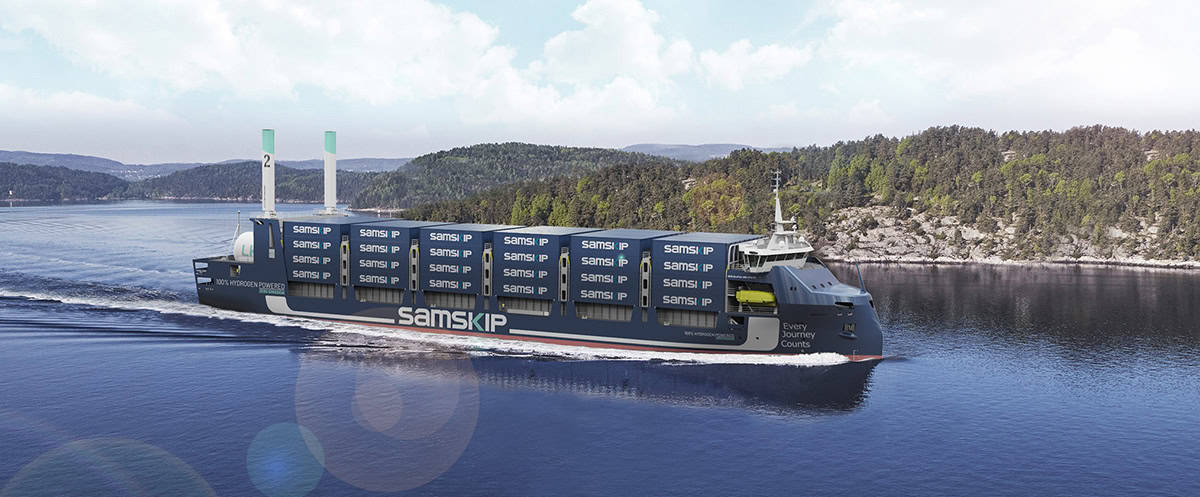
Green corridor The Samskip-led SeaShuttle project will build two hydrogen-powered container ships to create one of Europe’s first zero-emission “green corridors” between the Oslo Fjord and Rotterdam. (Courtesy: Samskip)
COSCO expects each such ship could reduce carbon dioxide emissions by almost 3000 tonnes per year. Named COSCO Shipping Green Water 01 and COSCO Shipping Green Water 02, respectively, it has been reported that the former will be used in the Yangtze River shipping goods from Jiangsu to Shanghai.
Work is still progressing on ammonia-powered fuel-cells for ships. Although conventional fuel oil has a higher energy density, ammonia is easily stored in bulk as a liquid at modest pressures (10–15 bar) or refrigerated to –33 °C. Ammonia also benefits from an existing near-global distribution network, in which it’s stored in large, refrigerated tanks and transported around the world by pipes, road tankers and ships.
The world’s first clean, ammonia-powered contained ship was announced in November 2023
The world’s first clean, ammonia-powered container ship was announced in November 2023 in a joint venture between Yara Clean Ammonia, North Sea Container Line, and Yara International. A 1400 TEU ship named Yara Eyde, the vessel will – when it starts operation in 2026 – be the first to sail emission-free on a route between Norway and Germany.
As for hydrogen, 2021 saw the launch of the MF Hydra – the first commercial passenger and car ferry running on liquid hydrogen. Powered by two 200 kW fuel cell modules, the ship – built by Norled AS – can carry up to 295 passengers, eight crew members and 80 vehicles. It currently sails on a triangular route between Hjelmeland, Skipavik and Nesvik. In fact, Norway has ruled that all ferries, tourist boats and cruise ships travelling on its World Heritage fjords must be zero-emission by 2026.
Another company at the forefront of developments is Samskip, which was awarded a contract worth NKr149m ($14m) from Norway’s government to develop two SeaShuttle hydrogen fuel-cell vessels in 2022. The company claims that the pair will be the first green hydrogen-powered container vessels of their size for short-sea journeys. The 135 m-long 500 TEU vessels run on 3.2 MW fuel cells and will also have diesel backup generator sets. Delivery is due next year.
Green future
The shipping industry is building up valuable experience in these new technologies and does not seem to be shying away from the challenge. But will these technologies scale up, how long will it take – and at what cost? Those are the big questions given the huge number of vessels currently sailing on the world’s oceans and the fact that they still have very long operational lives.
It will take a long time to build new ships or refurbish existing vessels to make them greener. But the direction of travel for shipping is becoming clearer.