Icicles and hot air

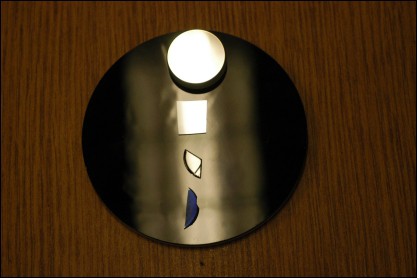
Here’s two things that you probably don’t know about icicles — they are usually filled with liquid water and their shapes are defined by hot air. So says a theory put forth by Martin Short of the University of California at Los Angeles in his talk “How the icicle got its shape” (B7.00003).

Icicles elongate as water flows down the their sides and eventually freezes – but this is not the whole story. Instead of freezing rapidly, the water stays liquid for longer because the icicle is sheathed in warm rising air. The air is warmed by the latent heat given off when the water eventually freezes. This heating makes the icicle longer and thinner that it would otherwise be. The relatively warm liquid core also seems to help this elongation process.

Short’s theory allowed him to predict the shape of an icicle as a function of its length. He then trawled the Internet for photos of icicles, and sure enough the data agreed with his theory.

The strange thing is that stalactites (those things that grow from the roofs of caves) are exactly the same shape as icicles — but their formation doesn’t involve rising air or liquid cores.

A new spin on windmills

Windmills could someday reduce net global carbon dioxide emissions to zero, says Klaus Lackner of Columbia University. But these aren’t the sort of windmills that generate electricity. Instead, they scrub carbon dioxide from the air passing through them — much like a conventional smokestack scrubber.

In his talk “The future of fossil fuels” (A2.00003), Lackner claimed that 250,000 such windmills could eliminate all of mankind’s carbon dioxide emissions — at a cost equivilent of boosting the price of gasoline by 25 cents per gallon.

The ability to remove carbon from the air is essential, says Lackner, because 50% of all carbon emissions come from cars, airplanes and other small sources. It would be very difficult to collect carbon dioxide from such sources and tough to convert them to run on carbon free fuels.

Lackner is currently working with a company in Arizona to develop the technology, and was hesitant to provide further details. He did show a sketch of the windmill and it wasn’t a pretty sight — picture a giant ventilation grating with fins sitting on top of a pole. “Not in my backyard”, do I hear?

Rocky Mountain physics

I arrived in Denver on Saturday and had a fantastic Sunday touring the mountains with an old physicist friend of mine who lives just outside of the city. While most of our tour involved taking in the beautiful scenery of the Rocky Mountain foothills, it had a definite physics theme.

Steve’s a bit of an expert on magnetic data storage and Colorado is definitely the place for him, with both Seagate and StorageTek having “campuses” outside of Denver. That magnetic attraction might have something to do with NIST in nearby Boulder, which is home to some world’s leading experts on magnetic devices.

Steve used to work at NIST and was keen to get us up into the mountains — which begin just behind Boulder — for a better view. From a lookout on Flagstaff Mountain we could see NIST, JILA (home to three Nobel laureates) and the NOAA’s Earth System Research Laboratory. Not part of the vista, but also in Boulder is the National Center for Atmospheric Research (NCAR). And of course, there is the University of Colorado — not bad for a place with less than 100,000 people!

A few miles outside of Boulder we travelled across a flat, stoney and desolate plateau aptly named “Rocky Flats”. Until very recently this was home to a US government nuclear weapons production facility, where a friend of Steve’s used to make triggers for hydrogen bombs. Now mostly demolished, the plant was the raided by the FBI in 1989 over allegations of poor safety and the illegal dumping of waste.

But you’ll be relieved to hear that the highlight of the tour had absolutely nothing to do with physics. We went up to the town of Evergreen, which is nestled in a steep valley in the first range of the Rockies. The town has a pretty little lake that was dotted with people ice fishing. Being Canadian, Steve and I couldn’t resist walking out onto the ice (which was at least a foot thick) to see if the fish were biting. The fish were not obliging, but it was a lovely warm sunny day and folks were sitting on the ice in lawn chairs sunning themselves — a fantastic sight. Back at the hoteI I looked at myself in the mirror, and sure enough I had managed to get a sunburn out on the ice!

Model puts new spin on hurricane prediction

The dynamics that govern a hurricane’s path and intensity are incredibly complex, and one of the least understood is eyewall replacement. In this process the wind speed drops initially when the first cloud walls collapse. But the new walls that move in to replace them re-intensify the wind as they shrink inward – a similar result of angular momentum conservation that makes ice skaters spin faster as they fold their arms.

Precisely when eyewall replacement will occur, and to what extent it will re-intensify a storm, is of utmost importance to meteorologists. For example, in 1999 Hurricane Floyd’s eyewall replacement reduced a potential catastrophe to a rainstorm as it reached land. But in 1992 Hurricane Andrew – the US’s second most destructive tropical storm – an eyewall replacement led to fierce wind intensification at the worst conceivable moment.

Now, Shuyi Chen from the University of Miami and colleagues from other US research institutions say they have a method of forecasting eyewall replacement. The physicists took data from their own Hurricane Rainband and Intensity Change Experiment (RAINEX), a collaboration that took radar data from Hurricanes Rita, Katrina and Ophelia, which caused massive devastation to the Gulf Coast of the US in 2005. They then used a computer model to interpret the data, which had a resolution of 1.6 km – more than three times as detailed as previous models.

Chen’s team discovered that, prior to replacement, a “moat” of dry air forms that separates the existing eyewall from a new wall farther out. This moat gradually merges with the inner wall until it finally collapses, allowing the outer wall to take its place.

Chen told Physics Web that although their research is available now, it may take some time for it to be implemented in hurricane forecasting. “As with all new techniques, it needs to be improved and more research is needed for a transition to operations.”

When graphene meets negative refraction

The lens has been dreamt up by Vadim Cheianov and Vladimir Fal’ko of Lancaster University in the UK and Boris Altshuler of Columbia University in the US. It would consist of two flat metal electrodes placed side-by-side and just above (but not touching) a strip of graphene, which is a sheet of carbon atoms just one atom thick.

One electrode would have a positive voltage and attract electrons to the region of graphene below it, while the other electrode would have a negative voltage and repel electrons from the region of graphene below it. In other words, the graphene now has a p-type and an n-type region with a well defined “pn junction” in the area between the two electrodes.

The researchers then calculated what would happen to a point source of electrons in the n-type region. According to the team, electrons travelling towards the junction at an angle theta to the normal would be bent back beyond the normal by that angle — exactly what happens to light when it enters a material with negative refractive index. Indeed, electrons emanating from a point source in the n side should be focused back to a point on the p side (see figure). Simulations carried out by the researchers suggest that such a lens could have a focal length of about one micrometre.

This strange behaviour arises from graphene’s peculiar band structure, which is due to the carbon atoms being arranged in a honeycomb structure. According to the team, the negative refraction is caused by the electrons moving from the conduction to the valence band of graphene, which leads to the component of momentum that is parallel to the junction being reversed.

Unfortunately, the lenses would have some drawbacks. Only those electrons that cross perpendicular to the junction enjoy 100% transmission. This loss of electrons at the junction means that these devices could not be used to create “perfect” lenses that focus electrons to a spot smaller than the electron’s intrinsic wavelength – something that is in principle possible with negative refraction materials.

The lenses are also expected to produce “fuzzy” images because the pn junction is not sharp, but rather a gradual shift from n to p. In addition, the lens would operate best at very low temperatures, because thermal fluctuations will distort the image.

Boris Altshuler told Physics Web that building the lens would also be a challenge. Most electrons would need to travel the entire length of the lens without scattering, something that cannot be achieved in current graphene samples. In addition, little is known about how to create pn junctions that are transparent to electrons. While Altshuler is not aware of any researchers who are currently building such lenses, he says that the expertise currently exists in at least five different laboratories worldwide.

Nanorods make “ideal” anti-reflection coatings

The refractive index is perhaps the most fundamental quality in optics because it describes how the speed of light changes as it enters a substance. As a result light passing through one substance is more likely to reflect off another if the difference between their refractive indices is greater – a relationship quantified by Augustin Jean Fresnel almost 200 years ago.

For this reason, if a material encompassed by air is to minimize the amount of light it reflects, its surface must have a refractive index close to that of air, which is almost one. But solids in general do not have indices between 1 and 1.4, and those that do exist are synthetic porous materials that cannot be made thin enough for viable optical coatings.

Fred Schubert and his team from the Rensselaer Polytechnic Institute in New York, however, have now invented a new class of thin-film materials with refractive indices as low as 1.05. To make the materials, they deposit silica nanorods at an oblique angle onto an aluminium nitride surface. These nanorods are separate enough to allow air to reside between them, so the effective refractive index is that of the nanorods and air combined. Therefore, by increasing the proportion of air, the refractive index can be lowered towards one.

More importantly, however, the actual value of the refractive index can be precisely tuned by altering the angle of deposition. This enabled the physicists to produce almost perfect anti-reflection coatings by having several layers of graded-index material stacked one on top of another. The grade with a refractive index close to that of the underlying material is deposited first, with successive grades decreasing in refractive index until the final layer – the one in contact with air – has the low index.

Schubert told Physics Web that his team are now planning other types of optical material using the same fabrication process such as distributed Bragg reflectors, which would have alternating high/low graded-index layers.

Weaving a tangled web

Can there be too many science metaphors in a play for even a physicist reviewer? That was the question I found myself asking while watching Strings, a new physics-based play that opened for a three-week run over Christmas in a small theatre in New York City. The witty and enjoyable play was written by US novelist Carole Buggé and starred a competent cast of experienced actors. The storyline involves three physicists on a train journey from Cambridge to London, who, in a self-referential touch, are going to see a performance of Michael Frayn’s own intellectual science play Copenhagen.

The three travellers in Strings are the upper-class cosmologist George (Keir Dullea, best-known as Dr Dave Bowman in the film 2001: A Space Odyssey), his mountain-climbing physicist wife, June (Mia Dillon) and a brilliant working-class string theorist, Rory (Warren Kelley), who is also June’s lover and George’s friend. The programme notes that the play is loosely based on a real train journey made by three physicists: the Americans Burt Ovrut and Paul Steinhardt; and the South African Neil Turok. During that journey the three hammered out their “ekpyrotic” theory of the origin of the universe, in which the Big Bang is caused by a collision between the extradimensional “branes” that appear in string theory.

The complex relationships between George, June and Rory are time and again compared metaphorically to principles in science, from June being shared like an electron between atoms in a covalent bond, to George as a neutral neutron and Rory a positive proton. Many other concepts from modern physics are employed by Buggé, but they are awkwardly presented almost as lectures in a classroom – at times even including a flip chart. These include the famous Schrödinger’s cat thought experiment, wave–particle duality, the unification of the four fundamental forces, and the “spooky action at a distance” implied by quantum mechanics. Each time the actors were called on to explain rather than embody the physics, they and the audience seemed uncomfortable.

The three characters of Strings each share a scene with a physicist from the past: George discusses gravity and curved space–time with the comically foppish Isaac Newton (Drew Dix); June speaks to Marie Curie (Andrea Gallo) about radioactive decay and Curie’s loss of her beloved husband Pierre; and Rory idolizes Max Planck (Kurt Elftmann) for resolving the ultraviolet catastrophe in the classical description of black-body radiation in 1900 and thus ushering in the new era of quantum mechanics.

While quantum mechanics has been experimentally verified, allows new phenomena to be predicted, and has played a major role in technological development, string theory has been criticized for doing none of these things. Whether the brane-collision theory of the Big Bang proposed at the beginning of the 21st century will turn out to be a significant step towards an ultimate theory of everything thus remains to be seen.

The play Copenhagen that the three companions are going to see – as were Ovrut, Steinhardt and Turok – is based on an actual meeting in 1941 between Werner Heisenberg and his mentor Niels Bohr in Nazi-occupied Denmark. Copenhagen also involves three characters: Heisenberg, Bohr and his wife Margrethe. Frayn presents various possible versions of the meeting, focusing on the question asked in the play by Heisenberg “Does one as a physicist have the moral right (during wartime) to work on the practical exploitation of atomic energy?”. Frayn’s play is more successful because rather than lecture the audience on the science, he employs subtle dialogue, allowing the non-scientist Margrethe to stand in for the lay audience.

The human issues in Strings, besides infidelity, centre on George’s belief in God and the loss of George and June’s son in the terrorist attack on the World Trade Center. In another reference to Copenhagen, this incident parallels the loss of the Bohrs’ son Christian in a boating accident. June’s grief is tinged by guilt that she was not caught in the building’s collapse herself because of accidental delays in meeting her son that fateful morning. If she could only have died with him, she laments. Even better, could she – and physics would seem to allow it – replay the event in a parallel universe with a better outcome? Buggé’s creativity in Act 2 allows for a parallel universe, with playful symmetry to scenes in Act 1.

Buggé is to be congratulated for taking the time to learn the science, and in most cases getting it correct, but she could have improved the development of the characters and their relationships. Rory is the best-written character, while we know little about June’s background other than that she (like the US physicist Lisa Randall) has worked on extradimensional theories of gravity. It seems to this reviewer that a tighter one-act play omitting the didactic lecturing would be an improvement.

Blog life: A Quantum Diaries Survivor

Blogger: Tommaso Dorigo
URL: dorigo.wordpress.com
First post: January 2005

Who is the blog written by?

Tommaso Dorigo is an experimental particle physicist at the University of Padova, Italy. He is a member of both the CDF collaboration at Fermilab in the US and the CMS experiment, which is due to begin studying particle collisions at the Large Hadron Collider at CERN next year.

What topics does it cover?

The blog began as part of the “Quantum Diaries” project, in which 33 physicists wrote about their life and work for a year to celebrate the International Year of Physics in 2005. As indicated in the blog’s name, Dorigo was one of the few participants who continued blogging after the project finished. As well as describing the research and the politics that go on in a large particle-physics collaboration, Dorigo often writes about his hobbies of chess and amateur astronomy.

Who is it aimed at?

In a series of posts entitled “Physics made easy”, Dorigo attempts to get non-physicist readers up to speed with the latest particle physics, building up to challenging posts about his current research. He has even asked readers for assistance in proof-reading his papers, offering an acknowledgement in the article in return.

Why should I read it?

The blog provides a rare insight into the sociology of a large physics collaboration. Dorigo has criticized the official procedure for having new results approved and published by the CDF collaboration, calling it “baroque, bordering on the grotesque”. His post describing a possible hint of the Higgs boson seen in the CDF data was recently picked up and discussed in many other physics blogs, and subsequently the media.

How often is it updated?

Once or twice a day.

Can you give me a sample quote?

“I am willing to bet a thousand dollars that no new elementary particles (exotic ones, beyond those included in the Standard Model and beyond the Standard Model Higgs) will be discovered before December 31st, 2010. That is enough time to allow CMS and Atlas to really dig deep with their data into the unknown. The first physicist who is publicly known, who earned less than $100,000 in 2006 (if you are too wealthy I cannot take you, sorry – the bet amount should be slightly uncomfortable to part with, otherwise there is no sense in betting!), and who takes my bet here, will win my $1000 if any experiment publishes a unquestionable discovery of a new massive elementary particle before the above date.”

Cleaning up the power industry

When I finished my physics degree at the University of York in 2004, I had no idea what I wanted to do with my career. I had enjoyed my degree and was interested in a career with a scientific bent, but at the same time I wanted to feel like I would be contributing something useful to a company. As I searched through various careers websites I came across E.ON UK, which at the time I had never heard of. I soon discovered that E.ON is the parent company to the electricity and gas supplier Powergen, and that it has its own centre for science and engineering in Nottingham called Power Technology.

After applying via E.ON UK’s graduate recruitment scheme and going through the selection process, I was sure that this was where I wanted to work. I began my 18-month stint as a graduate trainee in September 2004, which was a whirlwind introduction to the company and the power-generation industry in general. I soon realized that power companies do far more than simply maintain the network of electricity cables and ring people to annoy them about their bills.

The carbon challenge

E.ON has its headquarters in Germany and is the world’s largest investor-owned power and gas company. It is the second-largest generator of electricity in the UK and owns the country’s second-largest distribution network. E.ON employs about 15,000 people at over 50 sites in the UK and it took over Powergen in July 2003. In the UK, E.ON runs three large coal-fired power stations, five gas-fired power stations, an oil-fired power station and 14 small-scale combined heat and power plants. E.ON also owns or has a stake in 20 wind farms across the UK and is currently building the country’s largest biomass power station near Lockerbie in Scotland. Moreover, the company is part of a consortium hoping to build the world’s largest wind farm, the London Array, which would sit 20 km from the Kent and Essex coasts in the outer Thames estuary.

I have been fortunate enough to work for the company at an exciting time when the industry is undergoing a lot of change. E.ON’s challenge is to deliver the energy the UK requires at an affordable price while reducing the impact the business has on the environment, and the firm is committed to developing clean-energy technologies. Power Technology is the focus of E.ON’s multimillion research and development programme into low-carbon alternatives for generating power. The centre also supports existing power stations by ensuring that they operate as efficiently as possible.

One of the projects I have taken part in involved gaining new environmental permits for all the power stations following changes in legislation. This required modelling the dispersion of waste gases in the atmosphere and of other effluents in rivers in order to help reduce the impact the stations have on their local environment. The highlight of my career so far was helping to gain consent for a new, highly efficient gas-fired power station that is due to be built on E.ON’s site in Grain, Kent, in the next few years. The atmospheric modelling that I carried out contributed to some important decisions about the design of the facility, such as the height of the stack through which gas will exit the plant.

Clean living

Last year I was involved in two R&D projects on low-carbon energy generation. E.ON recently set up a new marine-energy division, and my first project involved modelling tidal flow for an assessment of tidal- and wave-energy devices at marine sites around the UK. My second project saw me studying how carbon dioxide can be captured from flue gases before they are released to the atmosphere using solvents like amine and then stored in empty gas reservoirs (see “Burying climate change for good”). I produced a model of atmospheric dispersion to assess whether the effects of the amine-scrubbing plant could increase the impact of other pollutants in the flue gas, such as sulphur dioxide or various oxides of nitrogen.

E.ON has a wide range of opportunities for both graduates and more experienced workers. Jobs are available within R&D and at all stages of power generation, including boiler engineering, gas turbines and electrical engineering. The company also has strong links with a number of universities through the Engineering and Physical Sciences Research Council and is currently helping to fund a £10m university research programme into low-carbon energy technologies. This demonstrates E.ON’s commitment to finding cleaner energy sources and building relationships with engineers and physicists.

I have really enjoyed working at E.ON over the past two and a half years. The atmosphere is friendly and everyone who works here is very enthusiastic about their area of expertise. I learn something new every day and have continued to develop not only technical skills, but also more general skills such as giving presentations and managing projects. I have always been interested in the environment and in trying to maintain a clean and healthy planet for generations to come. Now I feel I am using my scientific background to contribute to the challenges ahead.

Equations as icons

When the 14-year-old Richard Feynman first encountered eiπ + 1 = 0, the future physics Nobel laureate wrote in big, bold letters in his diary that it was “the most remarkable formula in math”. Stanford University mathematics professor Keith Devlin claims that “like a Shakespearean sonnet that captures the very essence of love, or a painting that brings out the beauty of the human form that is far more than just skin deep, Euler’s equation reaches down into the very depths of existence”. Meanwhile Paul Nahin – a retired US electrical engineer – says in his recent book, Dr Euler’s Fabulous Formula, that the expression sets “the gold standard for mathematical beauty”.

For some people this expression, named after the 18th-century Swiss mathematician Leonhard Euler, even seems to have become an icon, having special significance apart from its mathematical context. It once even served as a piece of evidence in a criminal trial. In August 2003 an eco-terrorist assault on several car dealerships in the Los Angeles area resulted in millions of dollars worth of damage when a building was set alight and over 100 vehicles were destroyed or defaced. The vandalism included graffiti on the cars that read “gas guzzler” and “killer” – and, on one Mitsubishi Montero, eiπ + 1 = 0. Using this as a clue and later as evidence, the FBI arrested William Cottrell, a graduate student in theoretical physics at the California Institute of Technology, who was later tried and convicted. Cottrell testified at his trial that “Everyone should know Euler’s theorem”.

Icons, legitimate and illegitimate

The only equation that most people actually do know is another icon, E = mc2. Einstein’s famous equation has appeared in countless movies, pop songs and cartoons. Those of a certain age, for instance, may remember the hit single Einstein A Go-Go by 1980s electronic pop band Landscape, the lyrics of which went “You’d better watch out, you’d better beware, coz Albert says that E equals mc squared”. More recently, during last year’s World Cup, the six large outdoor sculptures that were erected in Berlin to illustrate Germany’s status as the “land of ideas” included a car, a pair of football boots and a gigantic representation of E = mc2.

Icons can have a dark side, when they call more attention to their image than to what they stand for. The spell cast by equations can tempt us to think that all knowledge can and ought to be couched in the form of equations, with neat packages, balanced amounts and simple units. Equations have, for example, been composed for making perfect sandwiches, workable relationships and successful sitcoms. These are, however, illegitimate attempts to create algorithms for things that cannot be quantified.

The spell of equations that I want to discuss is something different, that of genuine equations that enthral authentic scientists. In addition to the two I mentioned already, other equations that I think are legitimate icons include Maxwell’s equations – “Was it a God who wrote these signs?” Boltzmann wrote about them, quoting Goethe’s Faust – and Einstein’s equations of general relativity.

But how can an equation become an icon? After all, an equation is merely one step in the ongoing process of scientific inquiry. Euler’s expression, for example, was but one implication of his exploration of functions, while E = mc2 was an afterthought of Einstein’s development of special relativity. If equations are only a means to an end, of less intrinsic value and interest than the tasks they were developed to help us with, why do some of them seem to possess an inherent value or significance beyond the process of inquiry to which they belong? Why can an abstract object like an equation literally stand alongside a pair of boots or a car?

The answer is that some steps in an inquiry acquire, and deserve, special status. Certain expressions serve as landmarks in the vital and bustling metropolis of science, a city that is continually undergoing construction and renovation. They preserve the work of the past, orient the present, and point to the future. Theories, equipment and people may change, but formulas and equations remain pretty much the same. They are guides for getting things done, tools for letting us design new instruments, and repositories for specialists to report and describe new discoveries. They summarize and store, anticipate and open up.

But there is still more to equations. As Devlin once wrote of Euler’s equation, it reaches into the depths of existence because “it brings together mental abstractions having their origins in very different aspects of our lives, reminding us once again that things that connect and bind together are ultimately more important, more valuable, and more beautiful than things that separate”.

The critical point

Devlin’s remark suggests, I think, the chief reason why equations such as those of Euler and Einstein attract value and interest beyond the particular scientific inquiries that gave birth to them. They serve as clear and concise examples of what equations and formulas do: they show how seemingly disparate elements are implicated in a unity, and do so concisely, with few moving parts, so to speak. They bring what equations do out into the open. They are like a really good joke the economy of which reveals the structure of a joke, or a proof so concise that it demonstrates what a proof is.

If equations have a dark side, it is that they can also lead us to think that knowledge resides in the equation itself, rather than in the ongoing processes of construction and renovation. They can promote the erroneous view that science consists of a set of facts or beliefs to be memorized, rather than a quest for greater understanding that is achieved by moving beyond existing facts or beliefs to new ones that we suspect are on the horizon.


Copyright © 2026 by IOP Publishing Ltd and individual contributors