Bubbles compute in logical devices

Microfluidics is a new field of research that involves moving picolitre quantities of liquids through micrometre-sized channels. Because such tiny quantities are involved, microfluidics is ideal for studying expensive or difficult to synthesize materials such as new drugs. Large numbers of microfluidics systems can also be connected to create “laboratory-on-a-chip” systems that allow lots of chemical processes to be performed at once, speeding up the discovery of new drugs.

Although scientists know how to move and react chemicals within tiny channels, switching the direction that they flow remains a major challenge. This is usually done using “microvalves”, which rely on external magnetic fields. However, microfluidics systems could be made smaller and cheaper if this switching could be activated by the presence (or absence) of the chemicals themselves.

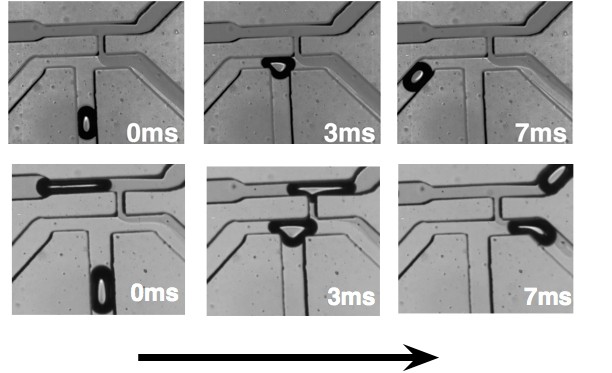
Now, Prakash and Gershenfeld have discovered that the direction of flow of air bubbles in a microfluidic system can be switched according to the presence (or absence) of other bubbles. When a bubble reaches a junction in a microfluidic channel, it is always pushed along the route with lower resistance to flow. If the first bubble to reach a junction moves through one channel, this channel will then have higher resistance. As a result, a second bubble arriving a short time later will always flow along the other channel.

The researchers used this property to create a very simple logical “AND-OR” gate, which switches the flow of two input bubbles depending upon their relative arrival times at the gate. Prakash and Gershenfeld also created the more complicated “INVERTER-AND” gate, in which a smaller bubble can switch the direction of larger bubble. This “gain” is an important property of electronic devices such as semiconductor transistors and could ultimately be exploited to create large-scale bubble logic devices.

Indeed, Prakash and Gershenfeld have already connected gates together to do more complicated computations such as “NOT(A) AND B”. They are now busy fabricating several chips that combine the logical gates to create large-scale processors.

The devices are also capable of storing, transporting and combining chemical compounds, and their chemical and computational capabilities could be exploited to create chips that aid in the discovery of new drugs or that search for explosives Individual bubbles can carry different chemical compounds, which means that the logical devices could be applied to two important processes of industrial chemistry – combinatorial chemistry and high-throughput screening.

Irving Epstein, a chemist at Brandeis University, told Physics Web that the technology could also be used to create cheap portable analytical devices that could be used, for example, to test for AIDS testing in remote areas or for detecting pollutants. “Given the rate of recent progress, I could imagine at least some applications becoming available within the next 2-5 years”, he said. As for bubble computers, Epstein believes that microfluidic systems may ultimately be superior to conventional computers for certain highly parallel computations that involve evaluating very large numbers of possible solutions to a problem.

Multibillion-dollar collider plans unveiled

According to the so-called Reference Design Report, the ILC will consist of two linear accelerators facing each other head on, each 12 km long, with one accelerating electrons and the other positrons (anti-electrons). The collisions, which will be recorded in two huge detectors, will take place at energies of up to 500 gigaelectronvolts. Physicists hope that the collisions will allow them to examine the Higgs boson and perhaps a range of exotic “supersymmetric” particles, as well as help them pin down the nature of dark energy and dark matter and look for possible extra dimensions.

The report was drawn up by a group of 60 scientists, known as the Global Design Effort (GDE), under the leadership of Barry Barish, a physicist at the California Institute of Technology. The group was formed after a previous panel chaired by Barish decided that the collider’s accelerating cavities should be built using superconducting technology pioneered at the DESY laboratory in Germany rather than a rival copper technology developed by other scientists in the US and Japan. The GDE drew up a “baseline” design for the ILC in late 2005 and has now refined this to in order to reach the desired energies and luminosities in the most efficient way.

The GDE estimates that the collider itself will cost $4.9bn in today’s prices, and that the costs associated with the site, such as digging the tunnels to house the machine (some sections of which will be several hundred metres underground) will add another $1.8bn. Then there is the money needed to pay for the labour – an estimated 22m man hours – as well as the cost of the detectors. According to the International Committee for Future Accelerators, which oversees the global collaborations needed to build high-energy colliders, these costs are comparable to those of the Large Hadron Collider.

Now that the ILC’s reference design has been completed, work will begin shortly on a more detailed “engineering design”, which should be finished by some point in 2009. At the same time negotiations will take place on the thorny issue of where to build the ILC. Assuming that a site can be chosen, construction could begin by around 2010. The machine’s length could subsequently be increased to 50km, resulting in collision energies as high as 1000 gigaelectronvolts.

Storing light here — and retrieving it there

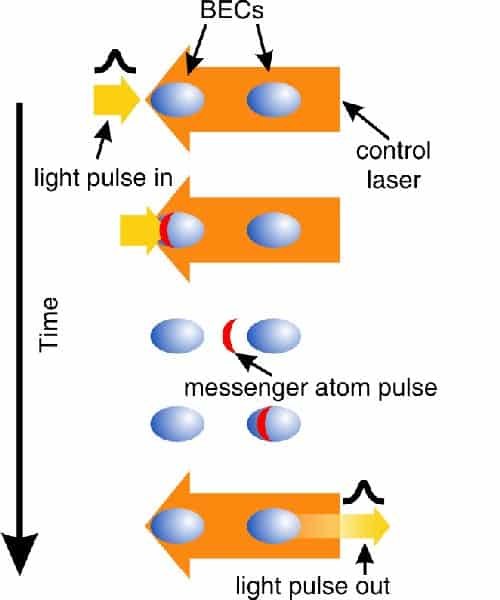
To make light “jump” from one place to another, Lene Hau and colleagues from Harvard University exploited a technique that they developed in 2001 to store a light pulse in a BEC, which effectively slows laser light to a standstill. This technique involves shining a pulse from a probe laser onto a BEC of sodium atoms, which induces tiny oscillating distributions of electric charge in the atoms.

Normally these dipoles radiate and quickly decay, but shining a control laser onto the atoms transfers the oscillations in charge to oscillations in spin, which are more stable. So when the control laser is turned off, the information content of the probe pulse is “imprinted” on the oscillating spin dipoles of the atoms. Switching the control laser back on releases the light by allowing the atoms to reradiate coherently i.e. with the same phase of the original probe pulse.

What is different in the new experiment is that the delayed pulse is made to reappear from a second BEC situated some 160 µm away. The trick lies in the fact that the quantum-mechanical wave function of the spin dipoles is actually a superposition of atoms in the ground state and atoms in a spin-excited state. Because of conservation of momentum, the spin-excited atoms move away from the BEC when the atoms absorb photons from the pulse laser, while the ground-state atoms stay in the condensate.

The clever part of the experiment is that the Harvard team decided to wait until the spin-excited atoms had reached the second condensate before turning the control laser back on. To their delight, they found that that this physically separate collection of atoms was then able to re-emit the initial light pulse. This revived light pulse slowly propagated out of the second BEC before reaching its normal speed of 300 million metres per second.

Because the two BECs had been independently prepared, one might expect the “messenger wavepacket” transferred from the first condensate to be alien to the second BEC. The fact that it was not implies that the ground-state wavefunction has a component in both BECs at the same time, which can then combine with the spin-excited component once it had reached the second BEC. The experiment is a striking demonstration of quantum indistinguishability.

“By manipulating the matter copy [of the original light pulse], we can process optical information”, says Hau. She told Physics Web that the experiment could lead to techniques to process optical information in optical communications and quantum-information networks. Other applications could be in ultra-sensitive rotation sensors or gravity detectors.

Diamond light source ready for business

Light from Diamond is emitted by electrons as they are steered around a ring with a circumference of 560 metres by powerful electromagnets. The lab’s beams are 100,000 times brighter than those from the Synchrotron Radiation Source in Daresbury in the north-west of England – the “second-generation” facility that it replaces. This is possible thanks to devices called “undulators” that are inserted into straight sections of the ring, which make the electrons wiggle about their otherwise straight trajectory.

Three teams of researchers have been selected to carry out the first experiments as part of a six-month project to fine-tune Diamond’s experimental facilities. They include Chris Binns, head of condensed-matter physics at the University of Leicester, who will use Diamond’s nanoscience beamline to image magnetic materials that could be used to make better computer hard drives. He will be using the beamline’s “photoemission electron microscope”, which he says will be “an invaluable tool in trying to understand how these new magnetic materials work”.

Diamond currently has a total of seven beamlines, although a further £120m of funding has already been secured to build another 15 beamlines, which will come on stream by 2011. Eventually there could be up to 40 beamlines on the machine. About 10% of beam time will be sold to industrial users. However, beam time is likely to be oversubscribed despite the machine running 24 hours a day.

Although Diamond has been built on time and to budget, the facility got off to a difficult start with a bitter controversy about whether it should be build at its eventual site or at the Daresbury lab. The were also problems with the French government, which initially wanted to help pay for the project before deciding in 2000 to build its own source Soleil near Paris. The Soleil lab was officially opened at the end of December.

Molecules self-assemble into stripes

Confining and controlling electrons onto metal surfaces is an awkward task, and currently researchers do this by carefully positioning single atoms using techniques such as scanning electron microscopy (STM). But these “top down” methods are either time consuming or difficult to control, so make it hard to engineer ensembles of confining nanostructures.

Now, a team led by Johannes Barth at the University of British Columbia in Vancouver have developed a new “bottom up” approach, whereby molecules of the amino acid “methionine” assemble themselves onto silver surfaces. To create the nanostructures, the physicists prepared a highly regular surface of silver by heating and rapidly cooling it. They then deposited a beam of methionine onto the substrate, and observed as the molecules formed periodic stripes on the substrate.

This unusual ordering, which required no direct intervention, resulted because methionine is one of few amino acids that contain sulphur atoms. These sulphur atoms interact with the surface of the substrate when they are adsorbed, forming electron-reflecting walls that (as verified by scanning tunnelling spectroscopy) can confine electron wavefunctions to one dimension.

Barth told Physics Web that the periodicity of the 1D stripes can be tuned in “exquisite detail” by simply altering the concentration of methionine molecules on the surface. Furthermore, by arranging single atoms of iron along the silver stripes using STM, his team could reduce the system to zero dimensions. “We believe that the ease, versatility and elegance of the bottom-up strategy will attract widespread attention,” he said.

Strongly interacting Fermi condensates are put on trial

Particles fall into two categories: bosons, which have an integer spin number, and fermions, which have a half-integer spin number. When sufficiently cooled, bosons all fall into a single ground state, collectively undergoing a transition to a so-called “Bose-Einstein condensate” (BEC). Although quantum mechanics forbids any two fermions to occupy the same state, an equivalent “Fermi condensate” can still occur when the half-spin fermions pair up and thus imitate the behaviour of single-spin bosons.

The length scale at which fermions pair up, however, has a huge impact on the behaviour of the condensate. If two fermionic atoms come close enough together to form a small molecule, they will form a BEC at low temperatures, just like bosons. But if they pair up on a much larger scale involving interactions across the whole system, forming what are known as “Cooper pairs”, the condensate is instead governed by “BCS” theory (named after its originators, John Bardeen, Leon Cooper and J Robert Schrieffer).

Physicists are currently most interested in length scales between these two extremes: the “BEC-BCS crossover” region. Because in this region fermions strongly interact with one another, there is no simple theoretical means to describe their behaviour, and therefore physicists have had to rely on methods such as “Monte Carlo” simulations (advanced computer algorithms that can tackle many-body systems), or simply extending BCS theory into the BEC regime.

Now, Rudi Grimm and his team from the University of Innsbruck have performed measurements to show that the latter of these methods cannot provide a faithful description of a strongly interacting Fermi condensate. Instead, they recommend Monte Carlo simulations as the only current means for obtaining an accurate description over the entire crossover region.

The physicists started by trapping a gas of fermionic lithium-6 atoms into a cigar-shaped geometry using lasers. They then cooled it to below 100 nanokelvin and applied a magnetic field to force the atoms to pair up as bosonic molecules. Finally, after condensing the molecules into a BEC, they carefully tuned the magnetic field to promote the molecules into the BEC-BCS crossover regime.

Grimm’s team came up with a novel technique to probe the regime’s behaviour, by momentarily “squeezing” the condensate with the trapping lasers. They could then measure the ensuing oscillation’s frequency to ascertain a better description of the system’s “equation of state” – an important characterization of underlying interactions within the condensate.

“Our work shows that the experiments on ultracold Fermi gases have now reached a stage where one can really perform meaningful tests of many-body quantum theories,” Grimm told Physics Web. “This is important as these theories are very difficult and usually rely on certain assumptions, the justification of which is not fully clear.”

Tiny mass detectors come out of the cold

Existing microelectromechanical devices can determine the mass of tiny objects weighing 10-18 grams (attograms). However, all such devices require extremely controlled conditions in which to work, such as high vacuum, extremely low temperatures and superconducting magnets. This is because it is difficult to detect the miniscule mechanical motion of the tiny machines, which typically consist of an oscillating cantilever made from a small wafer of semiconducting material a few microns long and several hundred nanometres wide.

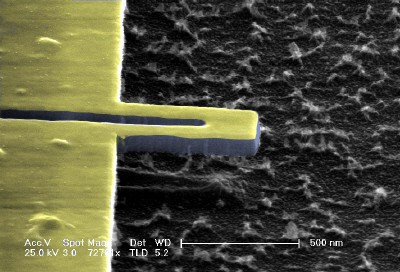
The Caltech team’s approach is fundamentally different in that it has used metallic films as the sensing layer material in its cantilevers instead of the commonly used semiconductors. The researchers say that their technique overcomes a mindset in sensing that has thwarted the realization of such nanoscale sensors so far. “This change not only greatly simplifies the fabrication process, but also enables us to make extremely small working devices at the nanoscale,” explains team member Mo Li. Equally important is the fact that the researchers can detect accurately the mechanical motion of their devices, even when the machines are moving at very high frequencies of between 30 MHz and 300 MHz – something that was impossible with cantilevers made from semiconducting materials.

Another unexpected property of these nanocantilevers, compared with microcantilevers, is their substantially reduced viscous damping when operated at atmospheric pressure. This is because their small cross-sectional dimensions (400 nm wide by 80 nm thick) are on par with the mean free path of air molecules in the atmosphere (around 65 nm). The nanodevices can therefore operate under ambient conditions.

Roukes and colleagues demonstrated that their cantilevers can measure masses on the attogram scale with a resolution of just 100 zeptograms (10-19 grams) – a new record under these conditions.

“These nanocantilevers are very versatile platforms for diverse sensing applications,” said Li. “One ongoing project in our group has already shown that these devices are very sensitive, fast chemical gas sensors that could be used in chemical weapons detection, for example.” Other potential applications include electromechanical “noses” for breath analysis and early disease diagnosis, batch fabricated pressure sensors and even components for pace makers, he added.

The Caltech physicists would now like to create an array of hundreds of individual cantilevers, each of which is tailored to detect specific chemical species. They describe such a device as the electromechanical equivalent of a dog’s nose.

The team will report its work in the journal Nature Nanotechnology.

Mankind to blame for global warming says IPCC

There is little doubt that both global temperatures and sea levels have been rising steadily over the past 150 years as human activity increased the amounts of carbon dioxide and other greenhouse gases in the atmosphere. However, the complex nature of Earth’s climate had made it difficult for scientists to be sure that man is causing global warming. In 2001, the IPCC said that there was a 66-90% certainty that humans were mostly to blame for rising temperatures since about 1950, but improvements in both the science and underlying climate data have boosted this confidence to 90% in this latest report entitled Climate Change 2007: The Physical Science Basis.

The IPCC report predicts that global temperatures will rise by 1.8 -4.0°C between 1990 and 2100, depending on how much carbon dioxide and other greenhouse gases are released into the atmosphere. These predictions are a bit more conservative than the IPCC’s 2001 report, which predicted a 1.4-5.8°C increase. Sea levels are expected to rise by 28-43 cm during the same period – much more definite limits than the 9-88 cm forecast of the 2001 report. And even if greenhouse gas concentrations were to be stabilized during this century, temperatures and sea levels would continue to rise for many centuries to come thanks to the long timescales associated with many climate processes, the report says.

On a regional basis, today’s report says that warming is expected to be greatest over land and at most northern latitudes, with parts of Russia and Canada most greatly affected. This is expected to reduce snow cover and cause the melting of permafrost in the northern hemisphere. Arctic and Antarctic sea ice is projected to shrink, and by 2100, the Arctic Ocean is expected to be nearly ice-free in late summer.

There is a 90% certainty that extreme weather such as heat waves and heavy precipitation will become more frequent in some regions. Thanks to improvements in the scientific understanding of precipitation patterns, the report says that there is 90% certainty that warming will lead to greater precipitation in high latitudes and decreases in most sub-tropical regions. Indeed, 20% reductions in rainfall are predicted for the Mediterranean basin and southern Africa.

While there will never be a complete consensus on climate change, the report has been produced by about 600 scientists from 40 countries and was reviewed by 620 climate experts. The report was also reviewed, revised and accepted by representatives of 113 countries.

For further analysis and comment on climate change see this month’s issue of Physics World.

Two-photon emission seen in semiconductor

Entangled photon pairs are useful because the quantum state of one photon is revealed automatically by measuring the state of the other. This property could someday be exploited in quantum computers which, in principle, could outperform classical computers for certain tasks.

The most common way to produce entangled photons involves passing light through a non-linear crystal, which very occasionally converts a single photon into an entangled pair of lower-energy photons. However, this parametric down conversion process is inefficient and it is difficult to control precisely the number of pairs produced in this way. Therefore, some researchers are looking towards electrically-controlled semiconductor devices as a way of gaining better control over photon-pair production.

Alex Hayat and Meir Orenstein of the Israel Institute of Technology (Technion) in Haifa have observed two-photon emission from layered semiconductor devices based on gallium indium phosphide quantum wells – structures that allow electron energy levels to be modified by confining electrons to nearly two dimensions.

The emission process is stimulated by applying an electrical signal, which pumps electrons to higher energy levels. Although the majority of excited electrons return to a lower energy level by emitting a single photon, some follow a different route via intermediate energy levels and produce a photon pair. While this process has been observed in atomic systems, the researchers say that this is the first time it has been observed in a semiconductor.

According to Hayat, two-photon emission in semiconductors could be used to create compact sources that produce lots of entangled photons at room-temperature. However, the researchers have yet to confirm that the photons are entangled, which is the team’s next planned experiment.

Hayat and Orenstein are not the first to propose a semiconductor-based source of entangled photons. Last year Robert Young and colleagues at Cambridge University in the UK unveiled a semiconductor quantum dot that produced entangled photon pairs. Unlike the Technion source, in which light is emitted in a process involving one electron, the Cambridge source involved a two-electron “biexciton” process. While the Cambridge source is perhaps less practical — it operates at very low temperatures (10 K) and is optically, rather than electrically pumped — it realized very precise control over photon-pair production.

A climate of alarm

These days it seems hard to get away from talk about global warming. Dramatic stories about potential climate catastrophes fill the front pages of newspapers and receive hours of airtime on TV and radio, while politicians take every opportunity to boost their green credentials. The chief scientific advisor to the UK government Sir David King has described climate change as “the most severe problem we are facing today”, while former US Vice-President Al Gore claims that “at stake is nothing less the survival of human civilization”.

But for Richard Lindzen, a climate physicist at the Massachusetts Institute of Technology, this explosion of interest amounts to “baseless alarmism”. Lindzen, who has studied meteorology and the climate for more than 40 years, believes the evidence that man is dangerously overheating the planet simply does not stack up. And he thinks that the predicted widespread sea-level rises, droughts and floods will not materialize. Even if these effects were on the cards, he says, attempts to reduce emissions of carbon dioxide and other greenhouse gases would do almost nothing to hold such disasters back.

Lindzen, 66, is unusual in being an established climate researcher who publicly argues the case against anthropogenic climate change. Any large meeting related to environmental science is likely to have very few talks or posters that would dispute the basic thesis of man-made global warming. However, Lindzen believes there are plenty of other scientists who broadly share his views but do not air them for fear of losing credibility or funding. Indeed, he says he has experienced a lot of what he sees as the bias operating within climate research. “Many programme managers have told me that funding depends on concern for global warming,” he says. “But if that is true, how can you objectively study the way climate works?”

From whence the warming?

Lindzen has no issue with the notion that the Earth has warmed. The body that was set up by the United Nations to investigate the phenomenon of global warming, the Intergovernmental Panel on Climate Change (IPCC), which draws on the expertise of hundreds of climate scientists, engineers, economists, social scientists and others around the world, stated in 2001 that the global mean temperature has increased by about 0.6 °C during the 20th century, a figure that Lindzen thinks is probably about right. He also agrees that the concentration of greenhouse gases in the atmosphere has gone up (with carbon dioxide increasing from about 280 parts per million in about 1700 to over 370 parts per million today), much of which has been caused by human activities. But where he parts company with the IPCC is the extent to which this increasing concentration can cause warming, or in other words, how much man is influencing the climate.

The now famous “hockey-stick” graph published in 1999 by Michael Mann, then at the University of Virginia, and colleagues shows that temperatures in the northern hemisphere were higher in the last few decades of the 20th century than during any comparable period in the previous four centuries and possibly even over the last millennium. Meanwhile, researchers at the Hadley Centre in the UK have produced a climate model that closely reproduces the temperature data from the last 150 years if it includes both natural and human-induced temperature fluctuations. These and other studies led the IPCC to conclude in 2001 (in its “summary for policy makers”) that “taking into account the remaining uncertainties, most of the observed warming over the last 50 years is likely to have been due to the increase in greenhouse gas concentrations”, a conclusion that is likely to be strengthened in the panel’s latest report on the science of climate change, which is released this month.

For Lindzen, however, the comparison between modelled and observed temperature data is basically an exercise in “curve fitting”, since, he says, the properties of a number of the natural and human-induced mechanisms that could heat or cool the Earth are poorly understood. Indeed, he believes that the claimed anthropogenic heating “signal” is obscured by the “noise” of the uncertainty in the temperature measurements and, more importantly, the internal variation of the climate. By internal variation he simply means the internal dynamics of the atmosphere and the ocean, rather than external natural factors, such as variations in the Sun’s output or sudden changes in levels of atmospheric aerosols due to volcanic eruptions. “The most plausible null hypothesis for the variation in temperatures we have seen is that it is natural,” Lindzen says. “So we are faced with the question: is there anything here that calls for an extraordinary explanation? I think the answer is no.”

But he goes further. Lindzen believes that even if man were indeed responsible for the vast majority of the warming observed in the last 100 years, he thinks there is still no cause for alarm. In its 2001 report, the IPCC concluded that between 1990 and 2100 the Earth would heat up by between 1.4 °C and 5.8 °C, with the exact amount depending on future trends in greenhouse-gas emissions, as well as on the specific model used to carry out the projection. For Lindzen, these figures are way off the mark. He claims the climate models used by the IPCC are far too sensitive to changes in the concentration of atmospheric carbon dioxide, and estimates that the Earth will in fact warm up by perhaps just a few tenths of a degree over the next century. Needless to say, this is a conclusion that other climate researchers strongly disagree with (see “How sensitive is the climate?”).

No action required

Lindzen himself wrote part of one of the chapters of the IPCC’s 2001 scientific assessment. Although he was not involved in drawing together the different chapters into an executive summary, he does believe that this was well carried out and resulted in statements that were couched in suitably uncertain terms. However, he objects to the way that this document was then used to prepare the summary for policy makers, a process that involved people from government, industry and environmental organizations as well as scientists. If that was not bad enough, he says, the summary for policy makers was then further stripped down by the press, eager for a good story, and politicians, keen to play up the significance of the report as much as possible in order, as he says, to “co-opt the authority of scientists”.

Lindzen, however, reserves his greatest wrath for scientists who are not climate-research specialists but who, as he sees it, try to exploit their authority in the climate-change debate. For these people, he says, there is a “special place in hell”. Among these he counts Lord (Robert) May, former UK chief scientific advisor and past president of the Royal Society, and Sir David King. “For whatever reason, be it an agenda or a bias or an emotion, I have no idea what, but the statements they make bear no relation to the science,” he says.

But is it not possible that increasingly powerful models could ultimately confirm once and for all that significant man-made global warming is taking place? Would it not be sensible to start limiting carbon-dioxide emissions just in case? No, says Lindzen. He believes that the Kyoto treaty will have a tiny impact, delaying any particular level of warming by just a year or two, and that it is completely unrealistic to see it as just a first step in a whole series of ever more ambitious emissions treaties.

For Lindzen, there is not a lot we can do, beyond ensuring that nations become rich enough to build flood defences or whatever might be necessary if the climate does start to go awry. To some, this might seem complacent, but he rejects this allegation. “That would be like saying you have a child that has a rare illness and nobody knows how to deal with it, and then a faith healer comes along and says that because you have no alternative you might as well follow me.”

Certainly in public, Richard Lindzen is in the minority when it comes to his belief that man is not seriously heating up the Earth. NASA’s Gavin Schmidt believes that Lindzen is “fighting yesterday’s battles” and that the issues he is arguing about “were once key uncertainties but are now ready for the textbooks”. There are also likely to be many who believe he is getting in the way of saving the planet. But there will doubtless be others who see him as a necessary dissenting voice in a scientific issue that is often portrayed as being done and dusted.

In person

Born: Webster, Massachusetts, 1940
Education: degree in physics and PhD in applied mathematics, both from Harvard
Career: Chicago (1967–1972), Harvard (1972–1983), MIT (1983 onwards)
Outside interests: photography, amateur radio, oriental rugs
Family: married, two sons

How sensitive is the climate?

The benchmark figure usually used to illustrate the climate’s sensitivity is the temperature change caused by a doubling of carbon dioxide (CO2) in the atmosphere. In 2001 the IPCC’s best estimate for this was 2.5 °C. But Lindzen believes this is a huge overestimate. He maintains that although levels of CO2 have only risen by around a third since the industrial revolution, some three-quarters of the heating associated with a doubling of the concentration of the gas has already taken place. He says that this is because the warming effect of each additional carbon-dioxide molecule decreases as more and more carbon is added to the atmosphere, and because the concentration of other greenhouse gases such as methane and freons is not likely to increase significantly in the future. He believes that even if man were responsible for the entire 0.6 °C rise seen in the last century, we can expect only another 0.3–0.4 °C when carbon-dioxide levels reach 560 ppm (on current trends this is expected to occur sometime between 2040 and 2070).

Lindzen maintains that the models go wrong because they completely fail to replicate the “feedback” mechanisms in the climate system. Everyone agrees that, according to simple physical calculations, if greenhouse gases were acting alone, their doubling would lead to a rise of about 1 °C in global temperatures. But the models used by the IPCC have strong positive feedbacks from water vapour, which is a powerful greenhouse gas. In other words, greater evaporation in a warmer world leads to larger concentrations of water vapour in the atmosphere, which in turn leads to higher surface temperatures.

But Lindzen believes that the difficulty of modelling individual clouds – one of the thorniest problems faced by climate scientists (see “A model approach to climate change”) – means that researchers have no way of knowing how much of the water vapour in the atmosphere will condense into clouds and then fall to Earth as rain and how much of the rain will evaporate. He also points out that clouds themselves provide strong feedback mechanisms – with lower clouds tending to reflect incoming solar radiation back out into space, thereby reducing warming, and higher clouds tending to reduce the amount of the Earth’s thermal radiation that is lost to space, so increasing warming.

In fact, Lindzen believes that, if anything, clouds and water vapour actually provide a strong negative feedback within the climate system, roughly halving the heating effect of greenhouse gases. He claims that ground- and space-based observations show that upper-level cirrus clouds in the tropics contract strongly when surface temperatures are higher and expand when these temperatures are lower, so opposing the trend on the surface. He calls this the “infrared iris effect”, by analogy with the eye’s iris that opens and closes in response to visible light.

However, Gavin Schmidt of NASA’s Goddard Institute for Space Studies in New York believes that Lindzen’s estimate of the climate’s sensitivity is wrong. According to Schmidt, Lindzen has not properly taken into account the thermal inertia of the oceans, which means that much of the temperature rise associated with the carbon in the atmosphere today will not appear for about 20 years. He adds that Lindzen has also not accounted for the possible cooling effects of aerosols, which, if ignored, also lead to an underestimate of climate sensitivity. As regards the role of clouds and water vapour, Schmidt claims that Lindzen is unique in his belief that they act as a negative feedback, adding that there are now strong observational data to the contrary.


Copyright © 2026 by IOP Publishing Ltd and individual contributors