Lensless x-ray microscope focuses on biological samples

Lenses for x-rays are notoriously tricky to manufacture because they rely on nanometre-scale features. For this reason, physicists developing x-ray microscopes have been keen to adopt “lensless” designs that measure diffraction when x-rays are passed through samples. But while this principle has worked well for periodic structures such as crystals, methods for non-periodic structures such as biological materials have been ineffective.

In existing lensless x-ray microscopes, data from just a single diffraction measurement are taken, which must then be subjected to an algorithm that gradually hones in on a “solution” or image after many thousands of steps. At the University of Sheffield, however, John Rodenburg and colleagues have used a sophisticated technique dating from 1969 called “ptychography” that melds many overlapping diffraction measurements together, meaning only a few steps are required before a detailed image is resolved.

A crude analogy for this, according to Rodenburg, would be to imagine clapping you hands while blindfolded in a mountain range. If you were to remain stationary, it would be very difficult to work out the positions of the mountains by hearing the echoes alone. But if you were to steadily move around, it would be much easier to build up a rough picture of where they all are.

The key advantage of the technique when applied to x-ray microscopy is that the resultant image has a very wide field of view, so the portion of a sample under inspection can be immediately recognized. Not only does this enable biological samples to be examined in their natural environment, but the wavelength-scale detail is such that segments of the image can be enlarged to be viewed more clearly.

Rodenburg said that a large-scale version of the device could be used to take 3D images like modern CT scans in hospitals. However, he added that the lensless design principle could be extended to other parts of the spectrum that are unable to be focused optically, such as ultraviolet or terahertz wavelengths. “We can get as good an image as the best optical microscope in the world,” he said.
Graphene resonator is one atom thick

First made in 2004, graphene sheets are tiny flakes of graphite that can be as little as one atomic layer thick. They are the darling of nanotechnologists because they are easy to make and are very good electrical conductors — thereby providing an ideal system for exploring the often bizarre properties of two-dimensional electrons. However, researchers have been slower to exploit the novel structural properties of graphene, including its remarkable strength and resilience at atomic-scale thicknesses.

Working with physicists at Pomona College in California, the Cornell team made about 30 different resonators using flakes of graphene ranging from one atomic layer to 50 nm thick. The graphene flakes were dropped across trenches 1 to 5 micrometres wide, adhering to the tops thanks to the van der Waals attraction. In most instances the graphene spanned the trench to form a “doubly-clamped beam”. However, in some cases the graphene failed to span the trench and instead attached to one side forming a diving-board like structure called a “cantilever beam”.

The devices had resonant frequencies in the 1-170 MHz range depending upon the thickness of the beam, its tension and whether it is doubly-clamped or cantilever. The resonators were excited by using a pulsed laser, or by applying an electrical signal between the graphene and an electrode at the bottom of the trench. Vibrations were detected by observing the deflection of a laser that was reflected from the graphene surface.

McEuen told Physics Web that the very low mass of the resonators could be exploited to measure the mass of molecules to a high degree of accuracy. When a molecule adheres to a resonator, the increase in mass would change the resonant frequency. This change could be detected and used to calculate the mass of the molecule. The spring-like nature of the resonator could also be used to detect minute forces, says McEuen.

Although the resonators are about ten times thinner than other materials used to detect mass, McEuen cautions that the “quality” of the resonators – or their ability to continue vibrating after being struck – is not as good. As a result, they currently offer little benefit over existing mass detectors. McEuen said that the poor quality of the resonators is a mystery that his team is currently investigating.

“Crowd turbulence” has deadly consequences

During the annual Hajj pilgrimage over two million Sunni Muslims travel along a proscribed route in and around the Saudi city of Mecca. Tragically, this mass-movement of people sometimes triggers crowd disasters, particularly at places where the route narrows such the Jamarat Bridge, where pilgrims perform the ritual stoning of the Devil.

Dirk Helbing and Anders Johansson of the Dresden University of Technology analysed video images of the January 2006 disaster at the Jamarat Bridge, in which over 300 pilgrims died. They used a computer algorithm that determined the velocity and position of individuals in a large crowd moving towards the bridge. The data covered the 45 minute period up to and including the disaster and revealed three distinct phases of motion.

During the initial phase the pilgrims made steady progress towards the bridge, but the rate of flow decreased as the crowd became denser. Then the crowd suddenly underwent an abrupt transition to a second phase of “stop-and-go” motion that propagated like waves along the direction of travel.

These waves persisted for about 20 minutes as movement towards the bridge slowed and crowd density continued to increase until the crowd made a sudden transition to the third and very dangerous phase. At this point clusters of people began moving randomly in all possible directions in a phenomenon described by Helbing and Johansson as “crowd turbulence”

The researchers believe that turbulence may have been brought on by individuals panicking and pushing in all directions to increase their personal space. This caused violent pressure waves to surge through the crowd, tossing individuals several metres, tearing off clothing and ultimately leading to the trampling of hundreds of pilgrims.

The study revealed that death and serious injury began about ten minutes after the onset of turbulence and 30 minutes after the onset of stop-and-go flow. Helbing and Johansson are hopeful these characteristics could be detected automatically using video systems, giving authorities enough time to implement crowd control measures.

In collaboration with Habib Zein Al-Abideen of Saudi Arabia’s Ministry of Municipal and Rural Affairs, Helbing and Johansson have made a series of recommendations, which have already been implemented in a redevelopment of the Jamarat Bridge and its surroundings. In addition to automated crowd monitoring, the bridge and its approaches have been redesigned to improve crowd flow and minimize delays that could lead to over-crowding. There were no major incidents at the bridge during this year’s Hajj.

This is not the first time that Helbing has studied crowd dynamics and he has identified “shock waves” that travel through dense crowds. However, the much more dangerous crowd turbulence seen at Jamarat Bridge is a phenomenon that has not been studied before.

Another new twist on the Hanbury Brown-Twiss effect

Fifty years ago, physicists Robert Hanbury Brown and Richard Twiss noticed that photons from the star Sirius tended to arrive at a pair of detectors at the same time. They realised that this “bunching” effect was permissible for photons because they are bosons, and are therefore inclined to fall into the same quantum state. Since then, the corresponding “antibunching” effect has been noted for fermions, which are governed by the Pauli exclusion principle and so can never occupy the same state.

Now, Chris Westbrook and other physicists from the Université Paris-Sud in France and the Laser Centre Vrije Universiteit in the Netherlands have reported both Hanbury Brown-Twiss (HBT) bunching and antibunching using the same apparatus, which they claim is the first time that Bose-Einstein and Fermi-Dirac statistics (underlying bosons and fermions, respectively) have been directly compared.

In their experiment, the physicists used two ultracold isotopes of helium gas: helium-4 (an innate boson as it has an integer spin number) and helium-3 (an innate fermion as it has a non-integer spin number). In turn, they released the isotopes from a magnetic trap and let them fall under gravity onto a position-sensitive detector. They could then see how well the impacts of the individual atoms were correlated.

Quantum mechanics aside, one might expect the atoms to arrive at the detector randomly. However, Westbrook and colleagues discovered that the helium-4 atoms often arrived together, whereas the helium-3 atoms tended to avoid simultaneous impacts – the tell-tale signs of bosonic bunching and fermionic antibunching.

Westbrook says similar HBT methods could be used to accurately detect quantum correlations in systems where the behaviour is strongly governed by it, such as those displaying the fractional quantum Hall effect. “Being able to observe quantum correlations in such systems would be a very important step forward,” he said. “Analogues to strongly correlated condensed matter systems are being proposed using ultracold atoms.”

Refrigerator cools one electron at a time

While physicists have exploited the thermal properties of magnetic nuclei to reach temperatures as low as 100 pK, these techniques are not suitable for cooling relatively large structures such as an electronic sensor. Instead, researchers are looking at the tunnel-junction refrigerator as a practical way to cool devices such as space-based photon detectors used by astronomers.

These refrigerators work by having hot electrons (those with energies above the Fermi level) tunnel out of a piece of metal and into a superconductor, thereby removing heat from the metal. The tunnelling of electrons through an insulating material is a quantum process that is encouraged by applying a fixed voltage between the metal and superconductor. However, it is not always the hottest electrons that leave the metal and this limits the cooling efficiency of conventional tunnel-junction refrigerators.

The new single-electron refrigerator improves on this process by using a tunnel junction through which only one electron can squeeze through at a time. This is called a “coulomb blockade” junction in which mutual repulsion between electrons prevents multiple tunnelling. This orderly tunnelling process ensures that only the hottest electrons can leave the metal, thereby boosting the cooling efficiency. The researchers also replaced the conventional fixed voltage with an oscillating radio-frequency signal that could be synchronized with the tunnelling events. The oscillatory nature of the RF signal meant that “cold” electrons also tunnelled into the metal from the superconductor, further enhancing the cooling process.

Pekola told Physics Web that the design is the first cyclic refrigerator that is based on electron transport. His team has already built prototype devices, which they have characterized using fixed voltages (see figure “Single-electron refrigerator”). The prototype has a metal island that is about 1 µm high and 100 nm wide. “We are now planning to try the devices using RF signals”, said Pekola.

While the single-electron refrigerator has the potential to out-cool existing tunnel-junction devices, Pekola does not believe that it will find practical application outside of basic research. This is because conventional tunnel-junction refrigerators offer greater heat lift (the ability to remove heat from an object) and should be sufficient to cool cryogenic sensors. However, he believes that the refrigerator could be used to study the behaviour of electrons at lower temperatures than before. This could allow physicists to study mesoscopic phenomena and superconductivity in nanometre-scale structures.

Caesium slows down optical image

Delaying images – or image “buffering” – has potential in many applications from holography to quantum information. Currently, images can be either converted to electrical signals for processing or sent down a long, empty delay line. But analogue-to-digital conversion is prone to information loss, and delay lines often demand too much space.

At the University of Rochester in the US, however, physicists John Howell and colleagues have now shown it is possible to optically delay images, without loss of amplitude or phase information. First, they send pulses of light through a stencil so that the image is “imprinted” onto the photons. They then delay the pulses’ propagation by up to 10 nanoseconds by passing them through a gas that is highly dispersive – in this case, a chamber of hot caesium. Finally, they recover the image using an optical fibre that scans for the arrival of the pulses.

Amazingly, images remain intact using this method even when the light pulses are reduced, on average, to less than a photon each. This means that the wavefunction of a single photon, which has a state governed by the stencilled image, can be preserved.

While Howell and colleagues admit that light pulses have been delayed before, they say this is the first time that optical images, which contain an enormous amount of information, have been delayed.

Synchrotron accelerates neutral molecules

Synchrotrons are large circular devices in which particles – usually electrons – are made to travel near the speed of light round a ring using a combination of electric and magnetic fields. Since the first charged-particle synchrotrons were constructed in the 1940s, physicists have toyed with the idea of a neutral-particle synchrotron. In principle, “polar” molecules, which have a small electric dipole, could be accelerated in a synchrotron using a large electric field that switches at high speed. Unfortunately, the technology to do so was not available, and idea lay dormant.

Cynthia Heiner and physicists from the Fritz-Haber-Institut der Max-Plack-Gesellschaft in Germany have now overcome these difficulties and built a working neutral-particle synchrotron. Their device, which has a circumference of just 81 cm, is able to confine 3-mm packets of polar molecules such as ammonia over flight distances of more than 30 metres, at speeds of the order of 100 metres per second.

Although their device is dwarfed by most charged-particle synchrotrons like the new Diamond facility near Oxford in the UK, the research possibilities could be just as great. The team operates the device at a temperature of just 0.5 mK, at which point the molecules have such a low energy that their wave-like character begins to dominate.

Heiner says that colliding cold molecules into each other could permit some strange reactions. For example, electrons could tunnel through potential barriers, creating molecules that have never been witnessed before. “This is an area of physics that has yet to be explored,” she said.

Nanopolymers make their debut

Nanoparticles are nanometre-sized collections of atoms that can be used as building blocks to make a wide variety of materials, such as supercrystals or ionic liquids. However, they lack the ability to bond along specific directions — like atoms and molecules do — which means they are not easily joined together to make large structures like filaments or films. This is because nanoparticles are typically coated with a capping layer to prevent further growth or clustering.

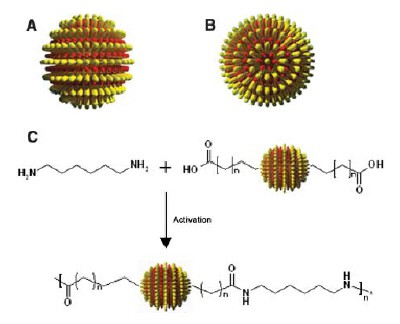
Now, Stellacci and colleagues have found a way to overcome this problem. The researchers effectively break the symmetry of the round nanoparticles by bonding two different types of ligand, such as thiol molecules, onto the poles of the spheres. The ligands on one nanoparticle are then free to bond with the ligands on the other particles so they can then be chained together to form the nanoscale equivalent of polymers (figures 1 & 2). The chaining reaction, which takes just a few hours, is very similar to way nylon polymerizes to form chains, says Stellacci.

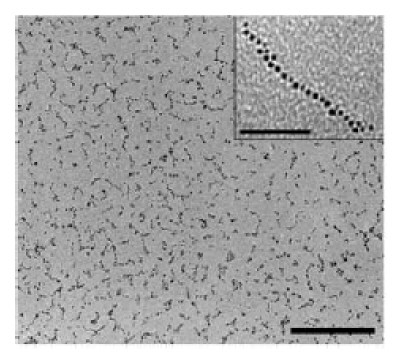
The scientists confirmed their result by taking tunnelling electron microscope images of the nanoparticle chains. The number of nanoparticles in each chain varies widely but the maximum number counted was 50,000 nanoparticles molecularly linked together (figure 3). Some chains even produced a continuous film as large as a square centimetre across and 60 µm thick.

“The main application of this work is in the generation of a new class of materials called nanopolymers with substantially novel properties, such as controlled porosity on the nanoscale,” said Stellacci. “These polymers will allow fundamental investigations of material properties – for example, can such materials retain glass transition temperatures and if so, how viscous is the glass?”

The team now plans to make longer chains of nanoparticles.

Molecule carrier is on the straight and narrow

The movement of atoms and molecules on solid surfaces plays a crucial role in many important technological processes – including surface catalysis, which removes pollutants from car exhausts, and the processing of semiconductor chips. In most cases this movement (or diffusion) occurs in random directions, with the right molecules eventually finding their way to the right – or wrong – places on the surface.

Now, Ludwig Bartels and colleagues at the University of California, Riverside along with researchers at the University of Central Florida have discovered a phenomenon that could make surface diffusion a much more regimented process. They began with a very clean copper surface that is cut to expose a flat crystalline surface. Very small quantities of AQ and carbon dioxide molecules are then deposited on the surface, such that most of the surface remains bare. AQ was used because the researchers had already discovered that it travels with great precision along straight lines defined by the crystal structure – unlike carbon dioxide and most other molecules, which move in random directions on the surface.

Bartels and colleagues observed that when a carbon dioxide molecule encounters an AQ molecule, it attaches itself and is pulled along in a straight line (see figure “Hitching a ride”). A second carbon dioxide molecule could also be picked up along the way. This journey continues until the carbon dioxide molecules were dislodged either by raising the temperature of the copper or by disturbing the carrier using the tip of scanning-tunnelling microscope (STM).

While this process was observed using a STM in an ultra-high vacuum chamber and at temperatures below 60 K, Bartels told Physics Web that it may be possible to harness the effect under less stringent conditions. The researchers are also trying to expand the carrier’s cargo capabilities by looking for molecules that are similar to AQ, but capable of carrying atoms or molecules other than carbon dioxide.

The team are currently investigating how the molecular carrier could be used to shuttle molecules to “active” sites on surface catalysts to improve their performance. Bartels also believes that the effect could someday be used by the semiconductor industry to create structures at specific locations on computer chips – something that is done today by photolithography, which involves depositing material on the entire chip and using masks and other techniques to form the required structures.

Tropical beetle has the brightest whites

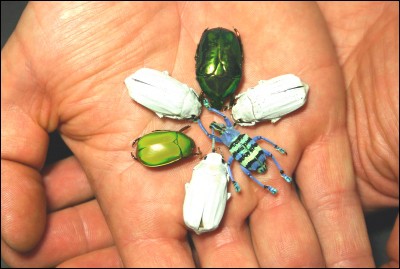
The bright colours of certain insects are normally down to either a strong pigmentation or a highly periodic structure. But these properties cannot be responsible for insects with brilliant white shells, because white light needs a scattering process that covers all the visible wavelengths.

This mystery encouraged Pete Vukusic and his colleagues from Exeter University in the UK to investigate Cyphochilus, a species of beetle renowned in entomological circles for its unusually bright white shell. After examining electron microscope images of the shell’s interior, they discovered a network of nanoscale protein filaments that were completely devoid of any periodicity. These unordered filaments have a very different refractive index to the air that surrounds them, meaning they can scatter light over the entire visible spectrum.

Although randomness is the key to scattering white light, the aperiodic structure of Cyphochilus does it much more efficiently than many other insects, such as the common Cabbage White butterfly. Vukusic said the reason for this efficiency is that the filaments are less crowded, so the light can “see” individual filaments. However, he added that if crowding were reduced further it would diminish the scattering itself. “It’s a fine line, but this beetle seems to have achieved a good compromise.”

The physicists now think that their discovery could lead to a new generation of bright white materials, which cannot currently be made as thin as the beetle’s five-micrometre shell.

“Synthetic materials can already produce spectacularly white light,” Vukusic told Physics Web. “It’s not that nature is doing something much better than we can, it is just doing something much thinner.”

Copyright © 2026 by IOP Publishing Ltd and individual contributors