

Physicists who fancy a flutter

Earlier this year Jorge Hirsch believed he had found a flaw in the reigning “BCS” theory of low-temperature superconductivity, claiming that in certain circumstances it violates Lenz’s law of electromagnetism. The University of California San Diego theorist was keen to put his claim to the test but no experimentalist was willing to take him up on it. To drum up interest and collect “seed money” for an experiment Hirsch turned to a novel solution. He put out a challenge on his website, asking for 500 physicists who did not believe him to bet $100 each that the experiment would prove him wrong and so verify BCS theory.

Hirsch is far from the first physicist to fancy a flutter. As far back as 1600, Johannes Kepler bet that he could deduce the equation for the orbit of Mars around the Sun within a week. Unfortunately, it took him five years. In the 20th century, researchers at Bell Labs kept a betting book in the tearoom for decades, recording wagers on physics, politics and economics. In the 1980s physicists at the Stanford Linear Accelerator Centre in California established a similar book, recording, for example, that theorist Michael Peskin won a dinner for four after betting with Sidney Drell on the existence and mass of the top quark.

Among today’s physicists, Stephen Hawking is known as something of an enthusiastic gambler. Two years ago he famously lost a bet to John Preskill of the California Institute of Technology when he admitted that information can escape from a black hole, something he had previously held to be impossible. Hawking was successful, however, in his bet with Gordon Kane of the University of Michigan that the Higgs boson would not be discovered at the Large Electron Positron Collider experiment at CERN, and he looks well on his way to winning a similar bet regarding the discovery of the particle at the Tevatron collider at Fermilab.

Indeed, particle physics seems to provide rich pickings for physics gamblers, and the Large Hadron Collider (LHC), which is due to switch on next year, is inspiring plenty of speculation. Tommaso Dorigo, a particle physicist at Padova University in Italy, has bet $1000 on his weblog (dorigo.wordpress.com) that no physics “beyond the Standard Model” will be discovered at the LHC by the end of 2010. The bet was taken up by fellow particle physicist Gordon Watts and by string theorist Jacques Distler.

Long bets

But why do physicists like to gamble? In Dorigo’s case, it acts as a sort of insurance policy: although he thinks he will win the bet, he says he would be much happier if he had to pay out. Indeed, for many the bets are just a bit of fun. But bets can also stem from real academic animosity and the desire to humiliate your opponents by having them “put their money where their mouth is” and fail.

One of the most famous examples is the bet in 1980 between economist Julian Simon and biologist Paul Ehrlich on the price of commodities – Ehrlich predicting that over the following decade the prices of five particular metals would rise, whereas Simon believed the prices would fall. With all five dropping in price by 1990, Ehrlich was forced to pay up.

Inspired by such bets, Kevin Kelly, founder of Wired magazine, set up the Long Bets Foundation in 2001, which encourages bets lasting longer than two years on issues of importance to science or society. Of the physics-related predictions, science author John Horgan has bet physics popularizer and string theorist Michio Kaku $2000 that no-one will have won a Nobel prize for work on a unified theory of physics by 2020.

But while Long Bets has allowed some big names the chance to be able to showcase their ideas, another website hopes to make useful predictions by aggregating the opinions of many anonymous users. Robin Hanson, an economist at George Mason University, who originally studied physics, invented the concept of “idea futures” in 1990, setting a “market value” for a particular idea by allowing people to buy the ideas they believe in and sell the ones they do not. This concept was put into practice on the Foresight Exchange (www.ideosphere.com), where as claims are bought and sold using play money, their trading price rises and falls between 0 (impossible) and 1 (certain). For example, the claim that the cosmological constant is non-zero is currently trading at 0.93, but cold fusion by 2015 is at just 0.15.

Tom Bell, an American lawyer, wants to set up an ideas market with real money. He envisages the market prices of ideas on the exchange being used by the media as a reality check on scientific claims. The idea does have precedent – in 2003 the US government set up an ideas market on foreign policy inspired by Hanson’s work. However, the market was cancelled within a day, amidst a media furore over the ethical implications of betting on assassinations and terrorist atrocities.

Odds on

The recent crackdown on online gambling in the US may put a spanner in the works of ideas markets. Indeed, the UK is one of the few countries where non-sports betting is legal: a fact that was taken advantage of in 2004 by betting firm Ladbrokes. They offered odds on a series of scientific propositions, including the discovery of the Higgs boson and of life on Saturn’s moon Titan. The bets proved popular, and punters particularly fancied the 500-1 odds offered against the discovery of gravitational waves by 2010. Indeed, a rush of interest forced the odds down to just 10-1 by the end of the two-week trial. So far, Ladbrokes have not had to pay out on any of the wagers. Meanwhile, all Hirsch wants to do is get his experiment done. Unfortunately, he has so far raised only $340. “In the field of superconductivity, people seem very good at ‘post-dicting’ but not so good at predicting the result of experiments,” he says. “After the experiment is done there will be lots of ‘predictions’, whatever its result is.” But what happens if he raises the money, carries out the experiment, but then loses the wager? “As our President says, ‘I won’t answer hypotheticals’. I won’t lose.”
Simply the best

Most physicists can point to a popular-science book that has inspired them more than any other or perhaps even encouraged them into science as children. For some it is The Double Helix – James Watson’s frank and amusing account of the discovery of the structure of DNA. For others it may be Cosmos by Carl Sagan. Millions of people bought Stephen Hawking’s A Brief History of Time, although few now judge it as a good way into physics.

But what is the best ever science book? One attempt to answer that question took place at a recent debate at Imperial College London, chaired by science writer Jon Turney and featuring as panellists former Guardian science editor Tim Radford, Imperial College biologist Armand Leroi and Sara Abdulla, publisher of Macmillan’s science-books division. Although Radford described science books as “the ultimate in non-fiction”, the message emerging from the discussion was that popular science should be judged by the same standards as literary works. The quality of writing, in other words, is paramount.

This theme was reflected in the rather broad definition of “science book” used by the three panellists, each of whom selected three books to champion. Abdulla chose Jonathan Lethem’s novel As She Climbed Across the Table, which tells the story of a fictional particle physicist at a US university, and two plays: Bertolt Brecht’s The Life of Galileo and Tom Stoppard’s Arcadia. Leroi’s number one choice was Konrad Lorenz’s account of his life with animals, King Solomon’s Ring. The winner, determined by a show of hands by the hundred-or-so audience members, was Radford’s first choice: The Periodic Table, a collection of memoirs and short stories themed around chemical elements by industrial chemist and Auschwitz-survivor Primo Levi.

Notable by their absence were some of the big names of popular-science writing, such as Stephen Hawking, Richard Dawkins and John Gribbin. The panellists admitted this was in part due to a desire to be different, but Abdulla also complained about the lack of literary quality in much mainstream science writing.

“If all someone wants to do is explain scientific concepts in plain English, they should write instructions for aspirin packets,” she ventured. “If authors want people to spend £10–20 of their hard earned cash and several evenings reading 70,000 words, they have a duty to entertain, to enthral, to arouse, and to stimulate.”

Learning from literature

One person who hopes to do something about Abdulla’s concerns is Turney. He is the leader of a Masters course at Imperial College on writing “creative non-fiction”, which is now in its second year. The course aims to teach students how to bring popular-science writing alive using literary techniques such as dialogue and plot. Leroi, who has also turned his hand to popular-science writing with the book Mutants and who lectures students taking the degree, has high hopes. He even thinks that it will “change the course of English literature”, doing for non-fiction what Malcolm Bradbury did for fiction when he set up a creative-writing degree at the University of East Anglia.

If science writing can benefit from literary devices, there is also a trend to incorporate real science into fiction. Janna Levin’s new book A Madman Dreams of Turing Machines (reviewed on p40 print version only) is just the latest example, exploring as it does the lives of the mathematicians Alan Turing and Kurt Gödel in the form of a novel. Biologist Jennifer Rohn has even founded a website that celebrates this relatively new genre, which she calls “lab lit”. This is something quite different from science fiction – rather than dealing with speculative possibilities and stereotypical “mad scientists”, lab lit depicts real science and realistic characters in books, plays and films.

Judging greatness

In one sense, history will be the best judge of greatness. How many of today’s science books will still be read in 100 years’ time? Given that science changes so quickly, books about the process and personalities of science – histories and biographies, for example – will probably age better than books about the science itself.

This is one reason for the enduring popularity of The Periodic Table, first published in 1975. Levi became famous not as a scientist, but as a chronicler of his experiences in Auschwitz in the books If This is a Man and The Truce. But The Periodic Table focuses on his career as an industrial chemist and conveys the struggles and small triumphs that make up everyday life for most scientists – for example his failed attempt to create non-marking lipstick by distilling chicken droppings.

Still, there will always be a place for explanations of the big ideas of the day, as the massive sales of A Brief History of Time and a seemingly endless stream of popular accounts of cosmology attest. An early attempt at the tricky task of popularizing cosmology is still remembered as one of the best: indeed, Steven Weinberg’s 1977 book The First Three Minutes – in which the Nobel-prize-winning theorist describes the origins of the universe – was the most frequently mentioned book by contributors to the “Shelf Life” column in Physics World (see box).

It may sound like a cop-out, but there is no magic formula for a great science book. Some, like The First Three Minutes, tap into the public’s thirst for knowledge about the great mysteries of existence, while others tackle quirky topics like The Physics of Star Trek. Some are first-hand, albeit often one-sided, accounts by researchers at the cutting-edge of science, while others are by journalists and historians who can put the great scientific questions in context. You almost certainly have your own favourites that have not been mentioned here, and, if so, we would like to hear from you about them.

Top shelf material

Over the last two years Physics World has asked 24 physicists and science writers for their opinions on popular-science books in our monthly “Shelf Life” column. Each was asked for their selection of the three best science books. There was surprisingly little consensus, with only 10 books receiving more than one nomination, but the clear winner was Steven Weinberg’s The First Three Minutes. His 1977 account of the origin of the universe was a precursor of countless popular-science accounts of the Big Bang and cosmology. The top 10 were as follows.

With five nominations

Steven Weinberg The First Three Minutes

With two nominations

Bill Bryson A Brief History of Nearly Everything
Rachel Carson Silent Spring
Richard Dawkins The Selfish Gene
Albert Einstein Relativity
Galileo Galilei Dialogue
James Gleick Chaos
Brian Greene The Elegant Universe
George Johnson Strange Beauty
Carl Sagan Cosmic Connection

• What is your favourite science book, and why? E-mail martin.griffiths@iop.org and the best contributions will be considered for publication in Physics World

The book of nature

In 1623 Galileo crafted a famous metaphor that is still often cited by scientists. Nature, he wrote, is a book written in “the language of mathematics”. If we cannot understand that language, we will be doomed to wander about as if “in a dark labyrinth”.

Like other metaphors, this one has two facets; it is insightful, but it may be misleading if taken literally. It captures our sense that nature’s truths are somehow imposed on us – that they are already imprinted in the world – and underlines the key role played by mathematics in expressing those truths.

But Galileo devised the metaphor for a specific purpose. Taken out of its historical context and placed in ours, the image can be dangerously deceptive.

The two books

The idea of a book of nature did not, however, originate with Galileo. For centuries it had been an accepted part of religious doctrine that the world contained two fundamental books. Nature, the first book, is full of signs that reveal a deeper meaning when interpreted according to scripture, the second book, which supplies the ultimate meaning or syntax of nature’s signs. Understanding involved reading the books together, going back and forth between what one finds in the world and what one reads in scripture. Indeed, reading the Bible was once considered part and parcel of studying nature, and not in any way anti-scientific.

During the Renaissance, however, scholars came to appreciate more keenly that the truths of nature were not always easy to discern. Rather, such truths were often cleverly encoded in nature and so required a special training to unlock. Meanwhile, the Protestant Reformation brought about changes in the understanding of texts, emphasizing the truths in them that were exact and self-contained rather than symbolic or allegorical.

Building on these scientific and religious changes, in 1623 Galileo decided to appropriate the “two books” metaphor for his own purposes to get him out of a jam. In fact, his troubles had begun a decade earlier, when one of his students was discussing Galileo’s work at the Pisan court, and a participant noted the apparent conflict between scripture and Galileo’s scientific claims, especially regarding the motion of the Earth. The authorities were also threatening to put De Revolutionibus, written by Galileo’s intellectual ally Copernicus, on the official index of forbidden books for similar reasons.

Worried for himself and for other scientists, Galileo wrote a letter to the Grand Duchess Christina about the connection between science and scripture. In that letter he appealed to the traditional image that God reveals himself to humanity in two books – nature and scripture. He suggested that both books express eternal truths and are compatible because they have the same author – God is saying the same thing in two different ways.

Galileo’s arguments seem to have convinced Christina, but not the authorities. In 1616 De Revolutionibus was put on the index, followed by Kepler’s textbook on Copernican astronomy in 1619, and Galileo himself came under attack. Partly in response he wrote The Assayer, which contains the famous passage that “the grand book of the universe…cannot be understood unless one first learns to comprehend the language and to read the alphabet in which it is composed…the language of mathematics”. Those versed in mathematics and physics, in other words, can know aspects of God’s handiwork that others cannot.

Galileo chose his metaphor carefully, and its roots were deep in Western metaphysics and theology. First, it used the traditional idea that God revealed his power, glory and truth in the world. Second, it relied on the equally traditional notion that the Bible cannot go against clear demonstrations of logic or the senses. Finally, it appealed to the time-honoured analogy of nature as a book. Galileo was on solid theological ground.

In fact, Galileo had stood the old image on its head, even if he was not fully aware of what he had done. The image of the book of nature now implied something almost opposite to what it had before – that the signs of nature had their own self-contained meaning. To understand nature one did not need to rely on the Bible as an allegorical aid; studying nature was an independent activity best carried out by a separate, professional class of scholars. If anything, the book of nature now became the primary text – the blueprint, written in technical language – and scripture the user’s manual, written in popular language.

Galileo was suggesting that scientists were as authoritative as the clergy. As Peter Harrison remarks in his book The Bible, Protestantism, and the Rise of Natural Science, “the book of nature and those natural philosophers who interpreted it…assumed part of the role previously played by the sacraments and the ordained priesthood”.

The critical point

But the image of the book of nature can haunt us today. One reason is that it implies the existence of an ultimate coherent truth – a complete text or “final theory”. While many scientists may believe this, it is ultimately only a belief, and it is far likelier that we will endlessly find more in nature as our concepts and technology continue to evolve. Furthermore, the image suggests that the “text” of the book of nature has a divine origin. The idea that the world was the oeuvre of a superhuman author was the precursor of the idea that it was the engineering project of an intelligent designer. This implication has led some contemporary sociologists of science to succumb to the temptation of characterizing scientists as behaving, and seeking to behave, in a priest-like manner.

The most important lesson to be found in Galileo’s image is the need to keep developing and revising the metaphors with which we speak about science.

Fish cells swim circles around physics lab

Just as some birds fly in unison in large flocks, some bacteria and other live single cells can organize themselves into moving structures. But exactly how this happens has been a mystery because unlike birds, single cells have no conceivable way of observing and responding to the average velocity of their neighbours.

Now Bálint Szabó and colleagues at Eötvös University in Budapest have developed a new theory of flocking that is unique because it is not based on individuals being aware of their neighbour’s average velocity. The researchers say that this very simple model of flocking could also be applied to a wide variety of animals – even complex organisms such as birds or even elephants.

The researchers studied the collective motion of keratocytes, which are live single cells produced by goldfish scales. Fish keratocytes are often used in studies of cell migration because they move rapidly and their movement is not affected by the presence of chemicals in their environment.

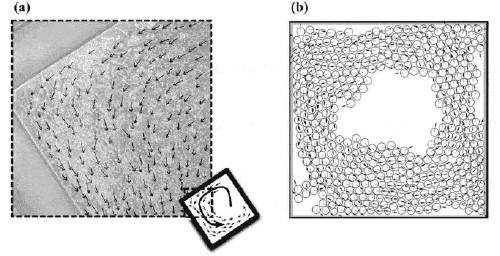
The cells were confined within a small incubator and their behaviour was recorded visually using a videomicroscope (see figure “Fish cells on the move”). When only a few cells were present, the keratocytes moved independently in random directions. However, as the population multiplied, the keratocytes started to move collectively when the cell density reached about 0.0005 cells per square micrometre. Above this critical density the keratocytes moved in coherent groups. When the cell density was increased even further, the effect of collisions with the walls of the square-shaped incubator caused the cells to move in a whirl-like structure (see figure “Whirling keratocytes”).

The researchers were able to explain this phase transition by creating a simple model of the interaction between two keratocytes that is based on three forces acting at three different distances. At very short separations a repulsive force causes the keratocytes to move apart. At intermediate cell separations (up to about one cell diameter) an attractive force causes the keratocytes to move together. At distances greater than about one cell diameter the force was set to zero. When used to simulate the behaviour of moving cells, this combination of simple forces caused the onset of collective motion at a critical density. This is unlike previous models, which assumed that the cells could respond to the motion of their neighbours.

The team hopes their experiment and model will create a better understanding of a range of biological phenomena, including how groups of cells of arrange themselves to become embryos and how wounds heal by the coherent movement of endothelial cells.

Metamaterial bridges the terahertz gap

Sandwiched between the microwave and infrared regions of the electromagnetic spectrum (at about 300 GHz to 10 THz), THz radiation is notoriously difficult to work with. It is too high frequency to be manipulated electrically like microwaves and too low frequency to be controlled by optical means.

This is unfortunate because THz radiation is particularly useful for studying the rotations and vibrations of molecules, allowing for the creation of new “fingerprints” for the identification of chemical species. This could be combined with its ability to travel through paper, plastics and cloth to develop scanning equipment for the detection of weapons and explosives. Astronomers are also interested in THz radiation because the cosmic microwave background originated by the Big Bang includes a THz component.

While there has been some recent success in developing THz detectors and sources, devices that can switch and filter THz radiation have remained elusive. Simple, low-cost and effective switches and filters are essential for the creation of commercial devices that can manipulate beams of THz radiation in an effective way. The best that researchers have done so far are modulators that can change the intensity of a THz beam by only a few percent – and this often requires the device to be operated at very low temperatures. As a result, the development of practical THz technologies remains in its early stages, with only a handful of companies currently offer commercial spectroscopy and imaging equipment.

Now Hou-Tong Chen and Willie Padilla of Los Alamos National Laboratory (LANL) and colleagues have created a device that can switch or modulate a THz beam with 50% efficiency. The device is based on an array of micrometre-sized structures, that each combine two inductive rings with a parallel-rod capacitor (see figure “Rings and rods”). Similar metamaterials using larger structures have been used to control microwave radiation and the LANL team simply reduced the size of the rings and rods to make the structure respond to radiation at about 1 THz.

When a voltage is applied across the array it absorbs THz radiation in a narrow frequency band. When the voltage is switched off the structure becomes more or less transparent to THz radiation – thereby forming the basis of switch. This narrow-band operation also means that the array could be used to create filters that selectively block or transmit specific THz frequencies.

Don Arnone, who is chief executive of the UK-based THz equipment maker TeraView, told Physics Web that the LANL work offers a potential solution to the problem of how to manipulate THz radiation. “Reducing the cost and size of THz technologies is a challenge and metamaterials could do this”, he said. However, he cautioned that while important, this result should be seen as one of many incremental improvements in THz technology.

Thinning thermosphere gives satellites a boost

Carbon dioxide warms the lower atmosphere by trapping heat in a well-known process called the greenhouse effect. However, scientists believe that carbon dioxide cools the upper atmosphere — the region about 50-800 km above Earth’s surface. Here the density of carbon dioxide is too low to maintain greenhouse warming and instead the gas absorbs heat from its surroundings and radiates much of it away from Earth with a net cooling effect.

Most atmospheric physicists believe that increasing carbon dioxide levels in the upper atmosphere will boost this radiative effect and cause the temperature and density of that region to decrease. However, obtaining global historical data on the temperature, density and size of the upper atmosphere can be a tricky business, which has made these effects difficult to confirm.

Now, Jan Laštovička of the Institute of Atmospheric Physicists in the Czech Republic and colleagues in the US, India and Germany believe that these effects have been observed in a sufficient number of independent studies to paint a consistent picture of the manmade changes occurring in the upper atmosphere.

According to the researchers, comprehensive studies of the mesosphere – the portion of the upper atmosphere at 50-90 km altitude – reveal that most of this region is cooling at a rate of about 3 Celsius degrees per decade. This cooling is in agreement with models based on increasing carbon dioxide levels. Further up in the thermosphere (90-800 km) there have been no direct measurements of temperature. However, a dramatic drop in the “ion temperature” of 17 degrees per decade has been observed at heights of about 350 km. The ion temperature is a measure of the thermal motion of ions and is related directly to temperature. This drop is also consistent with rising carbon dioxide levels.

Careful studies of the orbital trajectories of satellites in the thermosphere reveal that the satellites are experiencing less atmospheric drag than before. This implies that the density of this part of the upper atmosphere has been dropping at 2-3% per decade, which is also in line with theoretical predictions based on rising carbon dioxide levels. Laštovička and colleagues also point out that the contraction of the upper atmosphere has been indirectly observed in terms of the downward movement of the ionized layers of the upper atmosphere – referred to as the ionosphere.

Laštovička told Physics Web that the thinning of the thermosphere could be good news for operators of some low-Earth-orbit (LEO) satellites such as the International Space Station, which orbits about 350 km above Earth. LEO satellites are slowly falling back to Earth because of atmospheric drag, which is proportional to atmospheric density. The Space Station, for example, must fire a booster rocket every so often to maintain its orbit – something that it may have to do less often as the thermosphere continues to thin.

To knot or not to knot

The most remarkable thing about knots is that they appear to form spontaneously as soon as a cord is shaken, moved or handled. Studying knot formation, however, remains difficult without a consistent way of producing them. Rather than using string or electrical cable – perhaps the type of cords one would most associate with tangling – Jens Eggers and colleagues at the University of Bristol prefer lengths of ball chain that you would normally find attached to your bathroom plug. These have little of the stiffness that would otherwise resist the formation of loops, but are also bumpy enough to prevent knots from falling out too easily.

The team carried out a series of experiments in which they put an individual chain of a particular length onto a slightly concave plate that shook at 12 times the acceleration of gravity, bouncing the chains about for half a minute to both create and dispel knots at an observable rate. If the chain exceeded a certain minimum length, they found that the probability of knot formation rose quickly as a function of length to a steady value of 0.26 – in other words, the chance of creating a knot was 26%. In ball chains, this minimum length was about 38 beads (16 cm), or just over half the length required to manually create a knot.

Eggers says that this result is intuitive because knots arise at the ends of the chain and propagate inwards, so tend to form independent of length. However, he added, length does make a difference to the time required to shake out a knot, which escalates rapidly as the length is increased.

So does Eggers have any advice for reducing the knots in one’s cables? “It’s fairly obvious, qualitatively,” he says. “The cables shouldn’t bend too easily, and they should be fairly slippery. But in terms of the detailed parameters, that’s a non-trivial question to ask.”

Magnetic vortex flipping made easy

Magnetic vortices occur in very small disks of magnetic material that are typically less than a few micrometres in diameter. Boundary effects at the edges and surfaces of the disk conspire to cause the magnetic field to “curl” around in a whirlpool-like structure, before popping out of the disk at the centre of the vortex. Vortices exist in one of two curl states – clockwise and anti-clockwise.

For each curl state, the magnetic field at the centre of the vortex can also point either up or down. These “core polarization” states can be flipped by applying a magnetic field. Such states are therefore a promising candidate for the high-density storage of digital information with a “0” corresponding to “up” and a “1” to “down”, for example.

Until recently, polarization states were flipped by applying a very strong magnetic field of about 0.5 T in the direction perpendicular to the surface of the disk. While this illustrates how stable a vortex-based computer memory would be to stray magnetic fields, 0.5 T is about 500 times too strong to be deployed in a practical data-storage device.

But now a completely new technique for vortex flipping has been devised by Bartel Van Waeyenberge of Ghent University in Belgium along with colleagues in Germany, the US and Austria. Instead of delivering a strong perpendicular field, they applied an oscillating (250 MHz) and very weak (0.1 mT) magnetic field along the surface of a disk of a soft magnetic material called Permalloy. This does not flip the vortex, but rather causes it to gyrate back and forth on the disk (see figure “When vortices collide”). By deliberately boosting the field to 1.5 mT for one period of oscillation (about 4 ns) an “anti-vortex” structure was made to appear along with a new vortex with opposite core polarization than the original vortex. Then, the original vortex and the anti-vortex annihilate each other leaving only the new vortex – thereby completing the flipping process. The vortex could then be flipped back by applying an identical pulse.

According to Van Waeyenberge, this flipping process could be adapted to write data in a high-density data storage device. He told Physics Web that the group are now trying to work out a practical way of reading the state of a vortex bit – but he would not elaborate on specific avenues of investigation. In this current work the researchers determined the state by measuring the direction of the magnetic field that pops out of the centre of the vortex. This core region of the vortex only measures about 10 nm across and in this experiment it was probed using a scanning transmission x-ray microscope connected to the Advanced Light Source accelerator at the Lawrence Berkeley National Laboratory in California – something that would not easily fit within a memory chip.

Silicon becomes a superconductor

Boron is widely added to silicon to make it a useful semiconductor, but rarely does it account for more than 0.002% of the total number of atoms. Because it has one fewer electron than silicon available for bonding with neighbouring atoms, boron incorporated into silicon leaves a positively-charged “hole” at each site where boron’s “missing” electron would be paired with one of silicon’s. At room temperature these holes can move around, making boron-doped silicon a “p-type” semiconductor, but at low temperatures, the holes remain bound in orbitals to the boron nuclei. It has long been known that at boron concentrations of around 0.01% these low-temperature orbitals overlap, making metal-like conductivity possible. However, until now all attempts to make silicon superconducting have failed.

Busterret Etienne at the Centre National de la Recherché Scientifique in Grenoble and colleagues have now tried doping to even higher concentrations in a bid to witness the effect. Because silicon is normally reluctant to allow impurities into its structure, they had to employ a vigorous method called “gas immersion laser doping” that repeatedly melts and cools a thin silicon film using a pulsed laser. During each molten stage, atoms from boron gas diffuse into the film and remain there while it solidifies, ultimately replacing up to 9% of the silicon atoms. The researchers found that below a temperature of 0.35 K, this highly-doped silicon becomes superconducting.

Etienne says that they will probably be able to increase the transition temperature a bit further, although the material will be unlikely to have any applications in consumer devices.

Hydrogen storage goes metal-free

Hydrogen is often touted as an environmentally-friendly fuel for road vehicles of the future. When consumed in a fuel-cell powered electric car, it produces nothing more than pure water as a by-product. However, many technological challenges remain before it can be used commercially. In particular, hydrogen has a low energy density compared to conventional fuels and therefore it must be stored as a liquid or an extremely high-pressure gas to ensure that reasonable distances can be travelled before refuelling.

These storage methods are both expensive and cumbersome and some researchers believe that it would be better to store hydrogen within solid materials that can absorb large quantities of the gas. In such materials a chemical reaction splits the hydrogen molecule into two hydrogen atoms at the surface of the material. The atoms then migrate into the bulk of the material and form a metal-hydride compound. The hydrogen can be released by heating the material.

Current materials that can easily absorb and discharge hydrogen near room temperature contain transition metals and the storage process must be catalysed by expensive precious metals such as platinum. This makes them too heavy and too expensive for commercial use.

But now Douglas Stephan and colleagues at the University of Windsor have developed the first non-metallic material that can absorb and store hydrogen at room temperature, releasing the gas when heated above 100 ºC. The material contains pairs of boron and phosphorous atoms, which are separated by a ring of carbon atoms. This structure has a net neutral charge but the boron and phosphorous atoms carry a positive and negative charge respectively. The researchers believe that this property allows the two atoms to work together to split the gaseous hydrogen molecules into two hydrogen atoms, which are then covalently bound within the material. According to Stephan, this mechanism is known as “heterolytic cleavage” and has only been observed in transition-metal complexes.

Although the metal-free material offers hope of lighter and cheaper storage materials, Stephan admits that there is still a long way to go. Crucially, the material stores less than 0.25% of its weight in hydrogen, which is far off the US Department of Energy’s target of 6% set for 2010 and the 2.5% achieved by some transition metal materials. Stephan describes the DOE target as a “challenging problem” and the researchers are currently exploring alternative molecular structures.

Copyright © 2026 by IOP Publishing Ltd and individual contributors