ITER fusion reactor gets final approval

ITER, which stands for the International Thermonuclear Experimental Reactor, will attempt to prove that nuclear fusion can be harnessed as a source of energy. Supporters of nuclear fusion argue that it is safe and sustainable and does not produce any greenhouse-gas emissions or long-lived nuclear waste. However, significant technological challenges remain – most notably the development of materials and methods that are capable of confining and sustaining nuclear fusion at enormous temperatures.

The reactor will use magnetic fields generated by superconducting coils to confine a plasma of deuterium and tritium in a doughnut-shaped chamber called a tokamak. The plasma will be heated to a temperature of 100 million degrees so that the deuterium and tritium nuclei can overcome their mutual repulsion and undergo nuclear fusion – the process that powers the Sun. It is hoped that the first plasmas in will be achieved by 2016, with full-power deuterium-tritium operation by about 2021. The facility is expected to run for 20 years with €5 billion set aside for operating costs.
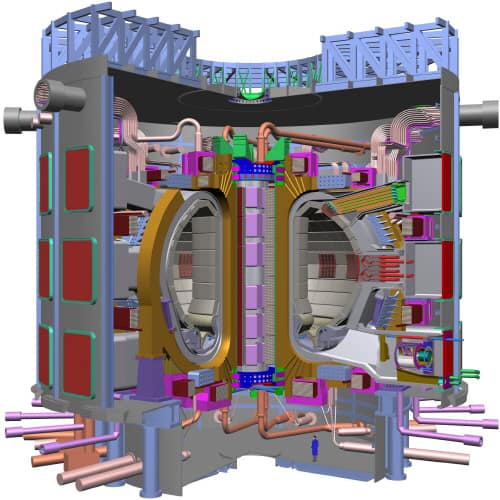
It is hoped that ITER will produce 500 MW of power to demonstrate that it is feasible to generate power from fusion. However, it will not produce any electricity. The plasma volume will be about 840 cubic metres, which is more than five times the volume of the Joint European Torus experiment in the UK, which is currently the world’s biggest tokamak.

ITER is intended to bridge the technology gap between existing highly-experimental reactors and a demonstration power plant, loosely referred to as “DEMO”. Construction of DEMO will probably start some time in 2025, with operation perhaps 10 years later. Commercial power plants could then be up and running by around the middle of the century.

The Cadarache site was chosen in 2005 after a lengthy battle to host the facility split the consortium into two factions – with the EU, Russia and China backing the French site and the US and South Korea supporting a site in northern Japan. Cadarache is already home to Tore Supra, currently the world’s largest superconducting tokamak, and some 500 fusion scientists.
Dark energy dates back nine billion years

In 1998 the astronomical community was astounded when data from Hubble and other telescopes established that the rate of expansion of the universe was increasing – something that physicists are still struggling to explain. Astronomers had long known that the universe is expanding, but the rate of expansion was expected to slow as the finite energy of expansion is depleted by the gravitational attraction that holds the universe together.

Physicists have tried to explain the acceleration in terms of “dark energy”, which boosts the expansion of the universe by counteracting the effects of gravity. To be effective, dark energy must account for about 70% of all energy in the universe — but it has yet to be detected and physicists don’t really know if its behaviour remains constant or if it changes over time.

The most popular explanation for dark energy draws on the “cosmological constant” first proposed by Einstein. A consequence of the constant is that energy density of empty space is the same regardless of whether the universe was expanding. Therefore when one cubic centimetre of the universe expanded to ten cubic centimetres it would somehow end up with ten times more energy.

Now Hubble has shed more light on this mysterious energy. Riess and colleagues used the space telescope study light from 24 type-1a supernovae that exploded 8-10 billion years ago. Such supernovae are considered “standard candles” because they all have a similar brightness and this can be exploited by astronomers to reveal when a supernova occurred and how the universe has expanded in the intervening years.

The observations reveal that dark energy was around nine billion years ago and has been acting in a consistent way ever since. The data suggest that the effect of dark energy was rather weak until about five to six billion years ago when it defeated gravity in a “cosmic tug of war” and the rate of expansion began to increase.

The observations also confirm that the cosmological constant is currently the best explanation for dark energy, casting doubt over alternative theories such as quintessence.

Einstein proposed the cosmological constant in 1917 in order to reconcile his general theory of relatively with the contemporary notion that the universe was not expanding. This changed in 1929 when the US astronomer Edwin Hubble established that expansion was indeed occurring and Einstein retracted the cosmological constant. Now, data from the telescope named after Hubble has resurrected a concept that Einstein called his “biggest blunder”.

X-ray laser focuses on tiny objects

Many biological cells are too small to be studied with an optical microscope and higher-resolution techniques such as x-ray diffraction and electron microscopy cannot be readily adapted to study living cells. In 2000 the biophysicist and FLASH collaboration co-leader Janos Hajdu proposed a new way of imaging living cells and other small biological particles by using the diffraction pattern from an ultrashort and extremely intense x-ray laser pulse.

Hajdu told Physics Web that a key benefit of the technique is that (unlike traditional diffractive imaging) it does not require multiple versions of the particle to be arranged in a periodic lattice – something that cannot be done with living cells and some viruses. Hajdu who has a joint appointment between Sweden’s Uppsala University and the Stanford Linear Accelerator believes that the technique could revolutionize the study of extremely small single-cell organisms such as picoplankton, which can be less than 500 nm in size and therefore much too small to be observed by an optical microscope.

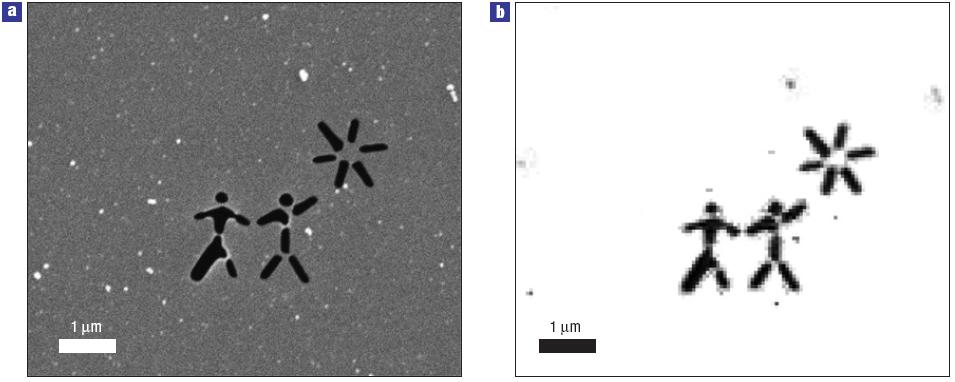
FLASH researchers aimed an extremely short (25 fs) and intense x-ray pulse at a semiconductor structure that was several micrometres in size. The resultant diffraction pattern of scattered x-rays was captured just femtoseconds before the pulse destroyed the structure. An image of the structure was then computer-generated from the diffraction pattern.

The experiment used “soft” x-rays at 32 nm wavelength to yield an image with a spatial resolution of 62 nm. This is much too large for studying viruses and other small particles. To do true atomic-scale measurements, researchers will have to wait until “hard” x-rays with wavelengths less that one nanometre become available in August 2008. This is when the Linac Coherent Light Source (LCLS) opens at the Stanford Linear Accelerator Centre in the US. FLASH researchers are now doing further work in Hamburg that will help them design experiments for the LCLS. Plans are also underway to open a next-generation hard x-ray laser in Hamburg in 2013.

Originally called the Vacuum Ultraviolet Free-Electron Laser when it opened in 2005 in Hamburg, the DESY facility was renamed FLASH earlier this year. It is currently the only x-ray laser capable of delivering such short and intense soft x-ray pulses. Unlike traditional lasers, which exploit interactions between atoms and light, FLASH is an linear electron accelerator fitted with an undulator that causes very fast moving electrons to wiggle back and forth across their trajectory. The acceleration associated with this wiggling motion causes the electrons to emit highly coherent UV or x-ray light.

Graphene makes its mark on spin

Graphene consists of single layers of carbon atoms that one would normally find stacked in graphite. Steven Louie from the University of California in Berkeley has now looked at long “nanoribbons” of graphene, which like a semiconductor contain both occupied and unoccupied electron states separated by an energy gap. But because of the peculiar zigzag geometry left by broken hexagonal bonds, the electrons at opposite edges of a graphene ribbon are in different states. On one edge, the occupied states are spin-up and the unoccupied states are spin-down, whereas on the other edge the reverse is true. (See image: “Moving state”.)

Louie discovered that applying an electric field across the zigzag edges shifts the energies of the states, thus eliminating the gap for one spin orientation between the occupied states on one edge and the unoccupied states on the other. In other words, electrons within those spin states can conduct freely, but electrons within the opposite spin state cannot. Louie said that this “half-metallic” behaviour could find applications in the emerging area spintronics, where electronic spin as well as charge could be used to govern the movement of electron current.

According to Louie, the effect could be tailored by altering the width of the graphene ribbon. In a wider ribbon, for example, the interaction between the states at opposite edges would be weak because they would not overlap much, meaning that the gap would be closed less than in a narrower ribbon. Louie found that if the ribbon is more than 32 chains of atoms wide, the interaction would become negligible and the states would be unable to maintain their opposing spins. On the other hand, he said, a thin ribbon would need a much larger electric field to make the half-metal transformation.

Gadget recharging goes wireless

While electromagnetic radiation can be used to power a remote device, current technologies are often inefficient and sometimes dangerous. This is because the electromagnetic waves radiate in all directions from the power source and most of the energy is lost to the environment. These problems can be partially overcome by using highly-directional radiation such as laser light — or electromagnetic induction, which operates at very short range. However, these techniques require the gadget to be in a specific location and therefore are not really convenient for charging a mobile phone left casually on a tabletop.

Soljacic and colleagues used theoretical calculations and computer simulations to propose a method that uses an electromagnetic field to couple the power source to the gadget to be charged. Energy is transferred to the gadget because its antenna resonates at the same frequency as the transmitter, while other objects in the room do not absorb energy because they do not resonate at this frequency. The researchers call this process non-radiative energy transfer. In addition, much of the energy that is not absorbed by the gadget would be reabsorbed by the transmitter.

Gadget and power source each employ the same resonant structure, which is an antenna for exchanging energy. The researchers investigated two types of resonant structures – a disk of dielectric material and a loop of wire bisected by capacitive plates. The simulations suggested that the loop would be a better choice under real-world conditions because less energy would be absorbed by nearby objects including humans. Calculations suggested that energy transfer efficiencies of 15% or greater could be achieved, which the researchers claim is large enough for practical applications.

Indeed, Soljacic envisions a home of the future with a transmitter in every room, ensuring that all portable electronics devices are charged. Other household gadgets such as robotic vacuum cleaners could run off the power source. “In addition to consumer electronics, wireless energy could find industrial applications, for example powering freely-roaming robots within a factory pavilion”, he added. The MIT team now plans to demonstrate the new technology in the laboratory.

Climbing plants get wrapped up

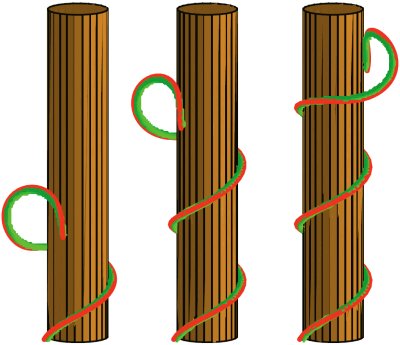
Climbing plants have developed many different techniques for growing vertically upwards without being able to support themselves. Garden peas, for example, grow by wrapping themselves in a spiral around an appropriate upright support. Alain Goriely from the University of Arizona and Sébastien Neukirch from the Université Pierre et Marie Curie have now modelled this process by assuming that a plant’s tendril is akin to an elastic rod wrapped around a cylindrical pole. The two researchers were then able to calculate the positions of the tendril where the tension in the stem is balanced by the resultant force from the support.

They discovered that the tendril’s natural curvature plays a crucial role in determining the radius of the pole that it can climb. For relatively thin poles, the tip curls closely around the surface – in other words, the angle between the tip of the tendril and the tangent of the pole is almost zero. For a slightly thicker pole, the tip must curl into the pole’s surface to maintain its grip, so the angle increases. When the radius of the pole is more than 3.3 times the tendril’s natural curvature, the angle increases so much that the tip curls back on itself, leaving the tendril unable to climb at all.

Goriely and Neukirch went on to study how important friction was for climbing. Unsurprisingly, friction helps tendrils to climb by preventing the tendril from sliding back. In fact, they reckoned that if the friction is high enough, plants could climb poles up to eight times the tendril’s radius.

Plants halt shifting sands

Although plants are not common in areas with sand dunes, they play an important role in stabilizing the movement of sand and fixing the position of dunes. Indeed, there is often a relentless competition between plants and sand, which has been harnessed for thousands of years by people living in such regions to control the movement of dunes.

Orencio Durán and Hans Herrmann of the University of Stuttgart in Germany developed their equations using scientific observations of sand-dune behaviour in desert regions. For example, scientists have observed that crescent-shaped “barchan” dunes change into parabolic-shaped dunes when colonized by plants. This transformation is thought to be the first step in halting the movement of a sand dune.

The Stuttgart physicists have used the equations to define a “fixation index”, θ, which is the ratio between the rate at which a sand dune erodes and how quickly a plant can grow and inhibit erosion. The equations reveal that plants can transform a barchan dune into a parabolic dune when θ has a value less than 0.5 and plant-growth trumps erosion. Conversely, if θ is greater than 0.5, wind-induced sand erosion stops plants from growing and a barchan dune can continue to move.

“Our results will help allow scientists to make long-term predictions (over thousands of years) about how coastal dunes evolve,” Herrmann told PhysicsWeb. “They might even have an impact on environmental issues, like how to increase biodiversity.” The research may also aid in protecting semi-arid regions that are threatened by desertification processes.

Durán and Herrmann now plan to repeat their calculations with different types of plants and for varying amounts of rainfall. They also hope to actually test their predictions in the desert.

Spin measured without destruction

Quantum computers could exploit the fact that a quantum particle can be in two states at the same time – spin up or spin down in the case of an electron. With the two states representing a one or a zero, N such particles – or quantum bits (qubits) – could be combined or “entangled” to represent 2N values simultaneously. This could lead to the parallel processing of information on a massive scale. However, the realization of a quantum computer involves fundamental challenges such as how to read the logical state of a qubit without destroying the state, and how to entangle the qubits.

Semiconductor quantum dots are nanoscale structures that contain as few as one electron and show great promise for use as qubits. Information can be stored in the spin state of a single electron and while several optical and electronic schemes exist for reading the spin state, they all destroy the state as part of the process.

The Santa Barbara group shone plane-polarized laser light on a gallium-arsenide quantum dot. The spin state of the electron was determined from the direction of rotation of the polarization of the reflected light – the so-called Kerr rotation. According to Awschalom, a Kerr rotation measurement is inherently non-destructive because it involves photons that have reflected from the sample without absorption. “If a photon was absorbed by the dot (thereby disturbing the system), then Kerr rotation would not be observed”, he explained. The researchers minimized the chances of absorption occurring by using photons with energy sufficiently far from any optical transitions in the quantum dot.

Awschalom explained that the Santa Barbara work represents an important step towards the optical entanglement of single-electron quantum dots. Upon reflection, photon and dot are entangled in the same quantum state. If the photon is then reflected from a second dot, all three are entangled. If the polarization of the photon is then measured, the two quantum dots remain entangled.

Moon’s surface is alive and gassing

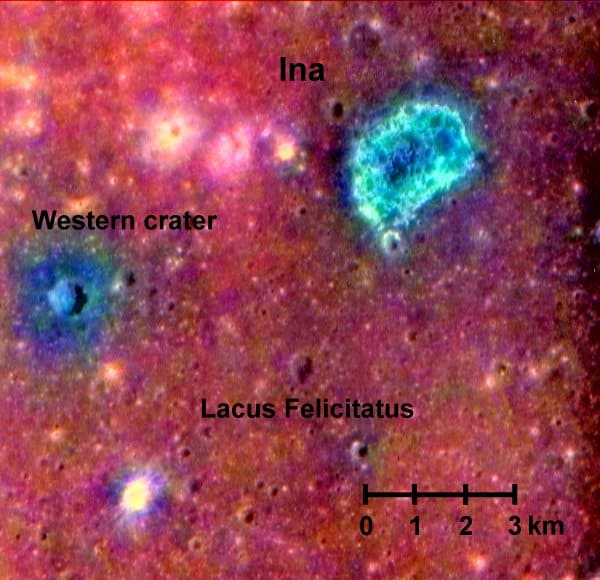
Geologists Peter Schultz and Carlé Pieters of Rhode Island’s Brown University and Matthew Staid of the Planetary Science Institute in Arizona focused on a D-shaped area on the moon called the Ina structure, which was first discovered in images from the Apollo lunar missions of 1972. The Apollo images show that Ina contains unusually rough terrain that should have been smoothed out over the last billion years by the constant bombardment of space debris. The Apollo data also reveals that the region has very few meteor craters compared to other parts of the moon. These observations have led Schultz and colleagues to conclude that Ina is “exceedingly young” at several million years old. This is backed up by optical spectroscopy measurements made by the Clementine space probe in 1994, which show that Ina has a highly-reflective surface indicative of very recent formation.

Ina’s surface could be very young because it has been modified by periodic releases of gas from ancient faults within the moon’s surface, say the scientists. These explosive events blow off the lunar soil, obliterating meteor craters and exposing fresh and highly-reflective material.

The researchers believe that a relic of this gas may have already been detected by the Apollo missions, which found high levels of radioactive polonium near Ina. This means that radon gas was present in that region in the past 60 years, suggesting that outgassing is an ongoing process.

Schultz said that there are at least four other locations where outgassing could have disturbed the lunar surface. The upcoming Lunar Reconnaissance Orbiter, Chandrayan, and SELENE lunar missions (from the US, India and Japan respectively), should provide more information regarding the distribution of outgassing regions and the frequency of such events.

Sound science behind glowing sugar

In materials with structures that lack symmetry such as piezoelectric crystals, charge of opposite sign separates when the material is stressed. If the stress is great enough, the material fractures, and the charge then recombines in the gas between the gap producing a small spark of light. Kenneth Suslick and Nathan Eddingaas from Illinois found that they can intensify the effect by immersing slurries of crystals into paraffin infused with various gases, which is then irradiated with ultrasonic waves.

During this process, millions of microscopic bubbles continually form and implode through the process of “acoustic cavitation”, generating shock waves that drive individual crystals together at half the speed of sound. “It’s like the difference between hitting the crystals with a hammer and firing at them with a bullet,” said Suslick.

The team monitored the light emitted from two known piezoelectric crystals: sugar and resorcinol (a white aromatic solid). When they were manually crushed in nitrogen, the crystals not only displayed luminescence, but also a faint nitrogen emission spectrum. Both types of crystals produced the same emission when they were irradiated with ultrasound in nitrogen-infused paraffin – however, the intensity was so much greater that the crystal slurries could be seen glowing in daylight. Moreover, only irradiation with ultrasound could produce spectra from paraffin infused with inert gases such as helium or argon.

Suslick and Eddingaas said that the bolstered intensity was because of the increased rate of fracture from the 20 kHz ultrasonic waves, which meant more surfaces were exhibiting mechanoluminescence at any one time. But only the strength of the collisions could explain the presence of line emissions for helium or argon, which are much more difficult to ionise. “We learn more about the fracture of materials from this kind of study,” said Suslick, who has been investigating acoustic cavitation for the past 30 years. “It’s a tool for understanding chemistry at the interface between the mechanical world and the molecular world.”

Copyright © 2026 by IOP Publishing Ltd and individual contributors