Stuff of life descended from hazy skies

Margaret Tolbert and colleagues at the University of Colorado, Boulder subjected several mixtures of methane and carbon dioxide to ultraviolet radiation. These mixtures correspond to what scientists believe was the composition of Earth’s atmosphere at the time when life first appeared. Photochemical reactions in the mixtures produced a range of organic aerosols with an average diameter of about 50 nm. According to Tolbert, some of these particles could be consumed by organisms alive today.

“As these particles settle out of the skies, they would have provided a global source of food for living organisms”, speculated Colorado researcher Melissa Trainer. Previous theories on the origins of life focussed on specific environments such as thermal vents, where energy and nutrients are concentrated. A global and plentiful source of food, however, could have allowed life to spread much faster than previously thought. The smog-like haze created by the aerosols could also have shielded emerging life forms from harmful UV radiation.

Chiral liquid splits light by polarization

The unusual properties of chiral liquids result from a lack of “mirror symmetry” in the structure of their constituent molecules, which exist in either right- or left-handed configurations. Fresnel predicted that this lack of symmetry would cause light with right-handed circular polarization to travel at slightly different speeds through a chiral liquid than light with left-handed circular polarization. This would result in a small difference in the angle of refraction when a light beam enters or exits a chiral liquid, splitting unpolarized light into two circularly polarized beams.

One would be forgiven, however, for wondering why such a seemingly simple theory has never been investigated before. “In all honesty, I don’t know,” said Peer Fischer, who works together with Ambarish Gosh at Harvard. Most likely, it is that the divergence of the beams as they travel through a chiral liquid is extremely small. To get around this problem, the group “amplified” the effect by constructing a succession of prisms, each containing a chiral liquid of alternating handedness. After passing through 20 interfaces, a laser beam had separated enough so that it could just be resolved onto a CCD camera.

It has also been predicted that light reflected from the inner surface of a chiral liquid should be split according to polarization. Fischer’s group measured the angular separation for this phenomenon by bouncing light through a single prism of chiral liquid onto a position-sensitive diode. The difference was remarkably small – of the order of just one ten-thousandth of a degree – and was measured using a lock-in technique that modulated the incident beam between right and left-handed polarization.

Despite the tiny angles involved, Fischer thinks that a miniaturized version of the method could be of practical use to analytical chemists, who often have to determine the handedness of minute quantities of chiral liquids. “The key application is that the splitting effect happens at the interface. It doesn’t matter if you use a drop or a gallon, the physics is the same.”

Antiprotons excel at cancer treatment

Proton-beam therapy is a very effective way of destroying tumour cells in the body because protons deposit most of their energy at a precise depth in human tissue. This depth is a function of proton energy, which can be set to minimize the energy absorbed by healthy tissue surrounding a tumour.

Antiprotons should deliver the same precision with an added benefit — when an antiproton nears the end of its range, it will annihilate with a neutron or a proton, depositing additional energy and boosting the radiation dose delivered to the target area. Some of the fragments produced from this energy release could go on to destroy adjacent tumour cells.

Researchers working on CERN’s Antiproton Cell Experiment (ACE) have confirmed this hypothesis by irradiating hamster cells suspended in gelatine with beams of protons or antiprotons. The researchers then measured the fraction of surviving cells after irradiation as a function of depth.

The team compared cell survival within the target region (the tumour) to cell survival in the area in front of the target region (healthy tissue). They concluded that antiproton annihilation kills nearly four times as many target cells than proton therapy, while inflicting the same damage on healthy tissue.

“We have taken the first step towards a novel treatment for cancer,” said Michael Doser, who is a physicist at CERN. “The results show that antiprotons are four times as effective as protons at terminating live cells. Although it still has to be compared with other existing methods, it is a breakthrough in this area of investigation. “

ACE spokesperson Michael Holzscheiter of the US company Pbar Labs LLC explained: “To achieve the same level of damage to cells at the target area one needs four times fewer antiprotons than protons. This significantly reduces the damage to the cells along the entrance channel of the beam for antiprotons compared with protons.”

While initial results are certainly favourable, the researchers admit that clinical applications are still a decade or more away. For starters, antiprotons can only be produced using high-energy particle accelerators. And currently, CERN’s Antiproton Decelerator is the only facility in the world that can generate an antiproton beam of sufficiently low energy and high quality for this type of application.

Supersolid’s existence remains in dispute

The supersolid state of matter is predicted to occur at very low temperatures when the vacant lattice sites in a regular solid condense into the lowest quantum state and exhibit fluid-like properties. The result is a material that appears mostly like a solid, but with a small proportion (about 1%) flowing like a liquid. This bizarre behaviour was first glimpsed by Pennsylvania State physicists Eunseong Kim and Moses Chan in 2004, who noted a change in the rotational inertia of solid helium at temperatures below 230 mK.

The Cornell physicists, led by John Reppy, confirmed these findings using a similar technique. By sealing a sample of solid helium in a torsion chamber – a device that supports the sample as it twists to and fro on a springy length of rod – they could monitor the rate of oscillations as it was cooled. At around 200 mK, the chamber began to twist faster. This, they concluded, was due to the vacancies decoupling from the oscillation and moving throughout the helium like a fluid.

The physicists then reheated the helium and found that it did not turn back into a supersolid when they cooled it down again half a day later. According to Chan, the Cornell group is the first to have witnessed these controversial annealing effects. “Three other groups including us have failed to show the destruction of a supersolid state by annealing. One possibility is that [annealing] is reducing the defects in the crystal, but there is no widespread agreement.”

Over in Europe, however, the Helsinki team failed to find any evidence for helium becoming a supersolid at temperatures as low as 10 mK. Opting for a thermodynamic approach, they measured the melting temperature of helium at different pressures, discovering an “excess” of entropy (disorder) below 80 mK. But rather than increasing with temperature, as would have been the signature of a supersolid transition, the entropy actually decreased. Igor Todoshchenko, leader of the Helsinki group, was unsure what this odd behaviour was due to. “It might be that only crystals of bad quality show [the transition]. This is a hot topic at the moment and many physicists are trying to understand it.”

A Casimir force for good in MEMS design

The mysterious attraction between two neutral, conducting surfaces in a vacuum was first described in 1948 by Henrik Casimir and cannot be explained by classical physics. Instead it is a purely quantum effect involving the zero-point oscillations of the electromagnetic field surrounding the surfaces. These fluctuations exert a “radiation pressure” on the surfaces and the overall force is weaker in the gap between the surfaces than elsewhere, drawing the surfaces together.

The Casimir force can be both a help and a hindrance in the design of the micrometre-scale mechanical components used in MEMS. It can cause trouble by causing components to stick to one another, but it has also been exploited to control the movement of conducting plates in MEMS devices. As a result, the precise control of the Casimir force would be an important tool for MEMS designers.

Now Umar Mohideen of the University of California, Riverside and colleagues have made an important step towards Casimir control by demonstrating that materials with higher charge-carrier densities are subject to greater Casimir forces than those with lower densities. The researchers came to this conclusion by using a contact-mode atomic force microscope (AFM) with a gold-coated polystyrene sphere of diameter 0.6 µm attached to the microscope’s cantilever. The sphere was placed near to a silicon plate and the Casimir force between the two was measured. Two plates were studied – a control plate and a plate that was doped with impurities to boost its charge-carrier density by a factor of about 20 000. The Casimir forces differed by as much as 17 pN at 70 nm separation between ball and plate, which is about 7% of the total Casimir force on the ball and plates.

Hubble to get new lease of life

Since its launch in 1990 Hubble has made a series of groundbreaking observations of the cosmos, but NASA decided in 2004 that it would not extend its life beyond about 2008, when its gyroscopes and batteries were expected to fail. This enraged astronomers, particularly since they were keen to compare the Hubble’s visible light images with those from the James Webb Space Telescope, which is due to take off in 2013.

Yesterday, however, NASA announced that it is to send a Shuttle servicing mission to Hubble, probably around the middle of 2008. Astronauts will install a new instrument known as the Cosmic Origins Spectrograph to make observations at ultraviolet wavelengths of the elements from which stars and galaxies are formed. A second instrument, called the Wide Field Camera 3, will operate from the infrared to the ultraviolet, allowing astronomers to study more distant, and therefore earlier, galaxies than they can today. The astronauts will also replace one of three Fine Guidance Sensors, which aim the telescope, and attempt to repair a visible and ultraviolet instrument that failed in 2004.

“We have conducted a detailed analysis of the performance and procedures necessary to carry out a successful Hubble repair mission over the course of the last three shuttle missions. What we have learned has convinced us that we are able to conduct a safe and effective servicing mission to Hubble,” said NASA Administrator Michael Griffin. “While there is an inherent risk in all spaceflight activities, the desire to preserve a truly international asset like the Hubble Space Telescope makes doing this mission the right course of action.”

In reaching its decision, NASA had to bear in mind that Hubble is in a very different orbit to the International Space Station, and that the Shuttle crew could not seek refuge in the Station if something went wrong with the Shuttle. But after three successful Shuttle launches since the 2003 disaster NASA has concluded that the risk of an accident is low enough to warrant the Hubble mission. However, the agency will have a second Shuttle ready to launch in case of an emergency.

Cosmology comes of age

Back in the 1960s, according to Paul Davies’ new book The Goldilocks Enigma (see “Seeking anthropic answers”), cynics used to quip that there is “speculation, speculation squared – and cosmology”. Anyone trying to understand the origin and fate of the universe was, in other words, dealing with questions that were simply impractical – or even impossible – to answer. But that has all changed with the development of new telescopes, satellites and data-processing techniques – to the extent that cosmology is now generally viewed as a perfectly acceptable branch of science.


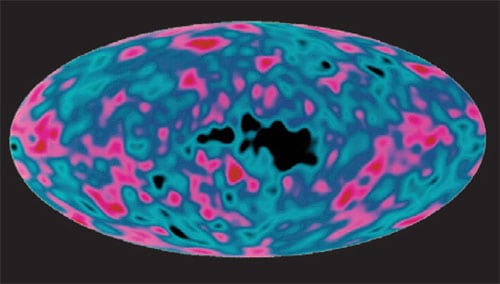
If anyone was in any doubt of cosmology’s new status, the Royal Swedish Academy of Sciences last month gave the subject welcome recognition with the award of this year’s Nobel prize to John Mather and George Smoot (see pp6–7; print version only). The pair were the driving force behind the COBE satellite that in 1992 produced the now famous image of the cosmic microwave background. The mission’s data almost certainly proved that the universe started with a Big Bang, while tiny fluctuations in the temperature signal between different parts of the sky were shown to be the seeds of the stars and galaxies we see today. These results are regarded by many as the start of a new era of “precision cosmology”.

But for cosmologists, the job is far from over. There are still massive holes in our understanding of the cosmos, notably the nature of dark matter and dark energy, which together account for over 95% of the total universe. Indeed, some regard dark energy and matter as just ad hoc assumptions needed to fit the data. (Hypothetical particles called “axions” are one possible contender for dark matter (see pp20–23; print version only), but don’t bet your house on it.) Some physicists even think it makes more sense to adjust Newtonian gravity rather than invoke dark matter. But the notion that cosmology is in crisis, as argued by some on the fringes of the subject, is almost certainly wide of the mark. For the moment at least, we should celebrate Mather and Smoot’s success.

Physics legends

Richard Feynman starts his book QED: The Strange Theory of Light and Matter with a remarkable confession. He tells a brief story about the origins of his subject – quantum electrodynamics – and then says that the “physicist’s history of physics” that he has just related is probably wrong. “What I am telling you”, Feynman says, “is a sort of conventionalized myth-story that the physicists tell to their students and those students tell to their students, and is not necessarily related to the actual historical development, which I do not really know!”

Like Feynman, many teachers and textbooks are unashamed to retell “damn good stories”: colourful versions of people and events that are oversimplified and often inaccurate. All of the scholarly fields are afflicted. Ivan Morris, a British-born scholar who taught Japanese studies at Harvard University, once expressed an intention to write a book about myths embraced by his academic colleagues, tentatively entitled The Bull Must Die. Unfortunately, Morris died before he could finish the work and the bull continues to flow unchecked.

True legends

There are some scientific legends that contain grains of truth. One is the famous story that Galileo dropped balls from the Leaning Tower of Pisa to refute Aristotelian mechanics. The legend is so theatrical that many people assume it to be apocryphal. Galileo scholar Stillman Drake, carefully examining Galileo’s correspondence, concludes that Galileo probably did perform an experiment on falling bodies at the Leaning Tower. But what is untrue is that this could have been decisive in overturning Aristotelian mechanics. Galileo was merely demonstrating, albeit dramatically, a conclusion that he had already reached based on many forms of thought and evidence.

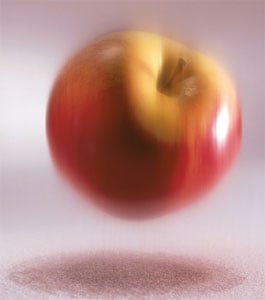
It is a similar case with the story, long hated by historians of science, of an apple that fell in his mother’s orchard teaching Newton the law of universal gravitation. Historians now know that the story (whether true or false) of the falling apple prompting him to ponder gravitation comes from Newton himself. However, what is surely false is the implied causal force of the event – that seeing an apple fall created the law of universal gravitation in Newton’s mind, without much further analysis and reflection. As his biographer Richard Westfall observes, “The story vulgarizes universal gravitation by treating it as [nothing more than] a bright idea.”

These two stories, I think, owe their currency partly to historical condensation – the tendency of popular and even historical literature to pluck out a single episode to summarize and stand for a complex series of important events. Thus the Leaning Tower episode becomes shorthand for the move from Aristotelian to modern mechanics, while the apple incident, recollecting as it does the tree of knowledge in the Garden of Eden, condenses the process by which new fundamental ideas are born. They are also popular because they are theatrical.

False legends

In contrast, many other common legends are entirely unfounded. Sometimes they persist because they conveniently reinforce established dogma, such as the story that the Catholic Church condemned the use of zero and Arabic numerals. Naturalists are also said to have convincingly proved evolution in action by showing in the 1950s that the increased abundance of industrial soot in the environment led to more melanic (darker, mutant) peppered moths. This experiment is now known to be badly flawed.

Other false stories are popular simply because they are fun. An example is the one about physicist Donald Glaser coming up with the idea of the bubble chamber one night at a bar after popping open a beer. A few years ago, after hearing this story one too many times, I called Glaser to ask if it were true. He assured me that it was false – he came up with the idea behind the bubble chamber via the application of cold, hard reason. However, Glaser admitted that, for sheer amusement, he once tried to see charged particle tracks in soda bottles.

Other stories are harder to explain. Does the Coriolis effect really make bath water swirl down the drain in opposite directions in different hemispheres? The effect is so weak in sinks and bathtubs that it is swamped by other factors, such as where the tap is located, the angle at which water hits the basin, water currents and so forth. Yet this story is confidently repeated by many scientists and science writers including Isaac Asimov – though Frank Close, in Lucifer’s Legacy, tells an amusing story about unsuccessfully trying to confirm it on a plane from England to South Africa. This damn good story, I suspect, exists because we would like the world to behave as our models say it does.

The critical point

Although damn good stories are found in every field, why are they so abundant in science? After all, scientists like to pride themselves on their strict adherence to fact and evidence. What prompted Feynman, who was otherwise so insistent on getting things right, to be so breezily unconcerned with telling students an untrue “physicist’s history of physics” about a subject that he professed to love? Could it be that he and other physicists think these stories innocent? Do they fear that the truth will adversely affect what students do; or do they think that damn good stories are beneficial because they boost students’ enthusiasm?

I have recounted a few of my favourite legends – what are yours? I shall devote a future column to the responses.

• Good stories – does it matter whether they are true or false? If not, why do we keep retelling them? E-mail your contributions to Robert P Crease to the address below or fax them to +1 631 632 7522

Seeking anthropic answers

In their 1990 book The Early Universe, cosmologists Rocky Kolb and Mike Turner write: “It is unclear to one of the authors how a concept as lame as the ‘anthropic idea’ was ever elevated to the status of a principle.” But much to that author’s chagrin, we are now seeing a renaissance in discussions of that idea, lame or otherwise; a case in point being Paul Davies’ new book The Goldilocks Enigma: Why is the Universe Just Right for Life?.

The anthropic principle, as originally expressed by Brandon Carter in 1974, states that: “What we can expect to observe must be restricted by the conditions necessary for our presence as observers.” That is, given that we are here, we already know that the universe must have had properties – values of coupling constants, number of space–time dimensions, magnitude of the cosmological constant, and so on – such that life could evolve. Is this a vacuous statement, a tautology? Is it at least descriptive? Or could it even be predictive – can we get a better handle on fundamental theories armed with this knowledge?

Davies, a cosmologist who has just moved to Arizona State University in the US, starts by inverting the question to ask what it is about the properties of the universe that make it so perfectly suited to life. In the canonical example, Fred Hoyle pointed out that the formation of heavy elements in stars depends exquisitely on thermonuclear reaction rates. Tiny deviations in either direction would make stars unable to turn helium into the carbon of which all life (with the usual “as we know it” caveat that lurks behind these arguments) is made. But these rates are not written in any obvious way into the fabric of the Standard Model of particle physics. They just emerge in an as-yet incalculable way from the more fundamental parameters of the model.

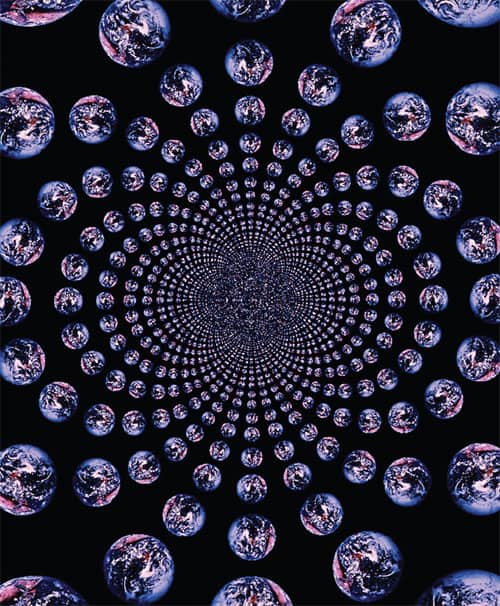
Such questions have come to the fore over the last decade as string theory has morphed into “M-theory” with its “landscape” of 10500 possible vacua, each with its own fundamental parameters. Is the world as we know it somehow uniquely determined, or are we simply a random sample from that vast set of possibilities? Or could every one of those vacua be realized somewhere in a gargantuan “multiverse”?

The first half of The Goldilocks Enigma is a workmanlike introduction to the standard models of particle physics and cosmology. This material has been treated at least as well elsewhere, but is necessary background for the discussion of the anthropic argument itself. But it is when Davies moves into these murkier waters that he starts to get into trouble. The problem with anthropic arguments is that they are entirely devoted to distinctions without differences: choosing between theories that, by definition, have identical observational consequences; that is, the universe as we are currently able to see it. Hence, the upshot of the ongoing discussions of the anthropic principle is that we are still too ignorant to make any definitive statements.

Still, Davies himself is convinced that these arguments have force. He describes two extreme possibilities: a unique, “just-so” universe that will only be understandable in the light of a truly final theory; and an “absurd” universe that just happens to have its properties randomly dialled-in for no underlying reason at all. But he prefers what he proudly refers to as a teleological explanation: a so-called life principle arising out of physical laws that only become definitely determined as the universe evolves.

“Nobody would deny that atoms, stars and galaxies are fundamental features of the universe,” says Davies. But he should be more careful with his use of the word “fundamental”. Clearly these things are emergent properties of the universe, and it is exactly this emergence out of quarks, strings or whatever lies at the bottom that gives force to anthropic arguments at all. He goes on: “It seems clear that life (and mind and culture too) is an equally significant step on the path of cosmic evolution.” Perhaps that can seem obvious to one of those living beings, with a mind, inside the only culture we know of.

But the universe does not need an “atom principle” to ensure that atoms are formed, or even a “carbon principle” to enforce the details of stellar nucleosynthesis that Hoyle was worried about. So it is not at all clear that we should elevate the existence of life to something in need of a “life principle” separate from the laws of physics themselves – the same laws responsible for those atoms and nuclei. Indeed, this is just the criticism correctly levelled by Davies himself against the proponents of intelligent design: just because we are not yet able to understand the evolution of the mechanism of the flagellum, that does not mean it did not evolve.

Still, these ideas are entertaining, if only barely coherent; and along the way, Davies highlights some of their weirder repercussions. Chief among these is something that philosopher Nick Bostrom at Oxford University has called the “presumptuous philosopher problem”. If you take anthropic arguments at face value, then when considering models of the universe, you should give more weight to theories that predict a greater number of intelligent beings. A priori, you as an individual are more likely to exist if there are many intelligent beings rather than few. If you buy into this, then you should prefer models that predict vast universes to tiny ones, perhaps by odds that no observational evidence could possibly overcome. In particular, Bostrom (and Davies) point out that we should take seriously the possibility that we are living, Matrix-like, in a computer simulation, since simulated minds could be much more common than real ones.

In getting to this point, however, we realize that we have circled round to something philosophers have been worrying about for longer than physicists: how can I be sure I am not just a “brain in a vat”? This strain of scepticism started with Descartes and was only quashed by Ludwig Wittgenstein and his followers in the last century. Wittgenstein famously said, “Whereof one cannot speak, thereof one must be silent”, and perhaps, in the absence of better theories and data to support them, that is how physicists should treat anthropic questions.


Shelf life: Jennifer Ouellette


What are the three best popular-science books, and why?

There are so many good popular-science books out there, but the best are those that combine a compelling narrative with clearly expressed scientific concepts. Robert Gilmore’s Alice in Quantumland, Lawrence Krauss’s Atom and The Code Book by Simon Singh top my list because they each found unusual ways to build a narrative around the scientific concepts. A close runner-up would be E =  mc2 by David Bodanis, who is a marvellous scientific storyteller.

What science books are you currently reading?

I just finished The Physics of Superheroes by James Kakalios, and have started Janna Levin’s new book A Madman Dreams of Turing Machines.

What else are you reading?

While I’m waiting for the next instalment of Jasper Fforde’s delightful Thursday Next series, I’m tackling Marisha Pessl’s novel Special Topics in Calamity Physics.

Which popular-science book have you never read, but feel you ought to have tackled, and why?

On the Shoulders of Giants by Stephen Hawking. I like the concept of laying out the five most important scientific figures and their work within their historical context, but the sheer length of the book is daunting.

What advice could you offer to physicists who would like to write a popular-science book?

Know your target audience and tailor the level of your prose accordingly. Many popular-science books miss the mark when it comes to speaking to a lay audience. Avoid specialized jargon, define all your terms when you can’t avoid using scientific terminology, and never underestimate the power of analogy and metaphor when attempting to communicate with non-scientists.

Copyright © 2026 by IOP Publishing Ltd and individual contributors